This piece responds to Brigitte Empire's video, "How The Boys Failed at Satire" (2026), where she effectively calls satire "dead"; i.e., referring to liberal-penned stories like The Boys (2019) but not really trying to separate different kinds of satire. The world is simply "past it," now—with Brigitte throwing the baby (Jesus or otherwise) out with the bathwater. "If we're going to get out of this world-beyond-parody alive," she implores, "we're going to have to build an alternative [through action]. This is something satire cannot achieve. [...] Satire is rarely-if-ever praxis [emphasis, me]" (timestamp: 45:28). It's one for the books, and where my books (on Gothic Communism) draw a completely different conclusion—the opposite, in fact!
Note: This critique is made good-faith, for Pride (to try something new)—meaning of someone whose work I respect, but disagree on this one point. Go support Brigitte's work!

Our focus here is Gothic satire, operating in duality to liberate workers through performance; i.e., power is performed (re: "Notes on Power," 2023) but commonly in illusory forms that many historically discount or replace, in bad faith; e.g., Mary Shelley's Frankenstein; or, the Modern Prometheus (1818), which Kripke and Amazon parody as blindly as one can—taking Shelley's satirical benchmark (superhumans and Cartesian abuse/mad science) and breaking it for profit (exploitation, which Shelley's novel fought against; re: "Making Demons," 2025). The fault lies with them, not Shelley, the Gothic or satire more broadly. To say otherwise feels like surrender, Brigitte's oversimplifying of satire a massive mistake. To disabuse her of this notion, I'll draw upon my own expertise (the Promethean Quest, but also Amazons, ludology and Creed's monstrous-feminine).
First, we'll give the gist, followed by a setup half and demo half; "Setup" states my intent and goals as clearly possible, while "Demo" hopefully demonstrates everything in a fun and educational manner, "when in Rome" (re: Amazons and the Promethean Quest, but also butts, below). "Are ya ready, kids?" We're playing with power!
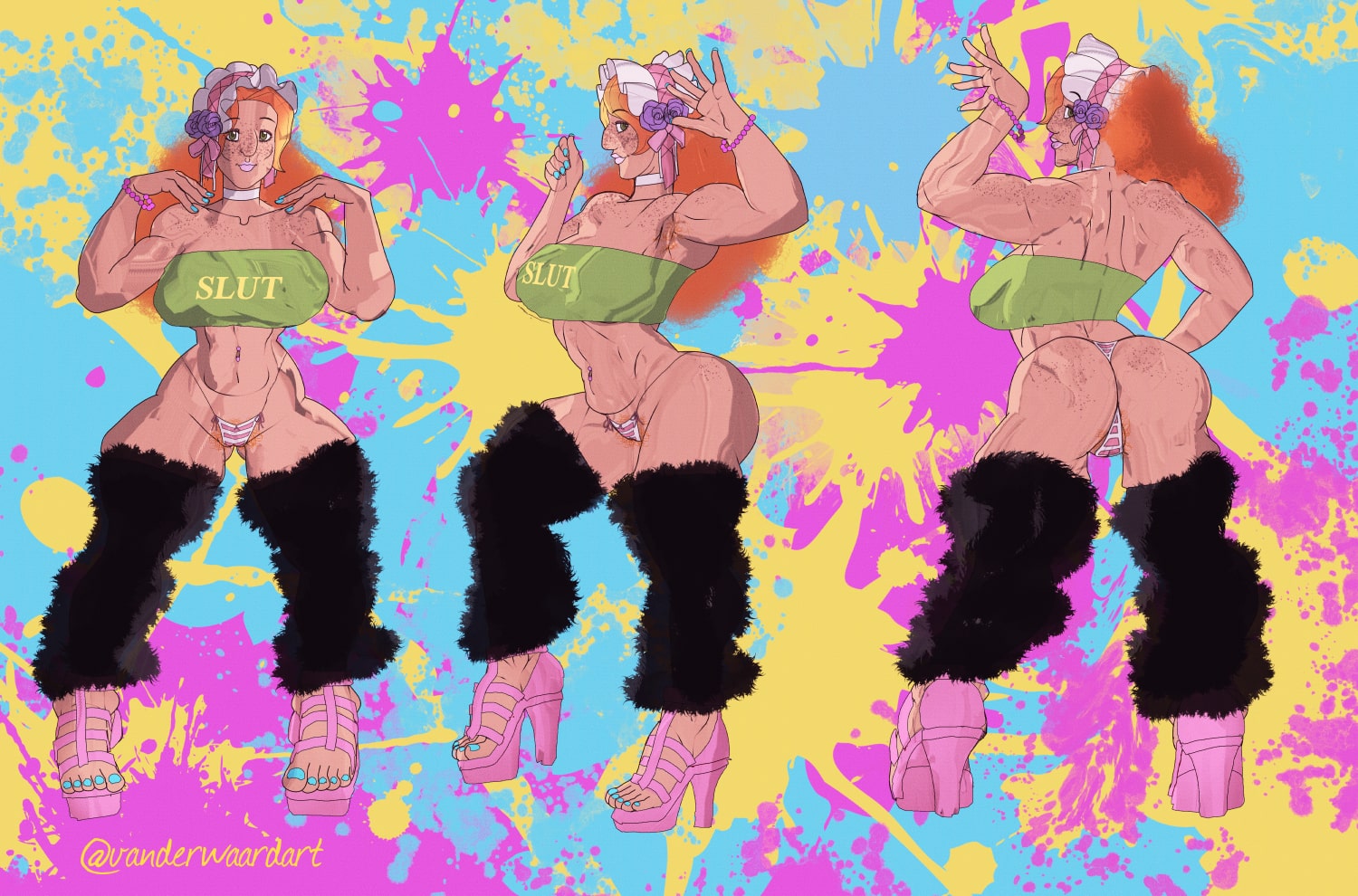
(artist: Persephone van der Waard)
Table of Contents
- Concerning State Vampirism
- Disclaimers
- The Gist: Exclusion, Performing Power, Reclamation (of Satire), Wiggle Room and Duality
- Setup: Hurt, not Harm
- Commonality and Respecting Brigitte's Work while Dealing with Gothic Doubles
- Celebrating Satire in Gothic Forms; or, Stating My Goals Before We Start
- Criticism and Giving It; or, the Claws Come Out: a Satirical Whore's Love Tap when Devalued
- A Demonstrational Response to Brigitte Empire; or, a Question of Duality Regarding Satire as "Dead"
- The Value in Gothic; or, Monsters and Their Satirical Value (for Workers)
- Some Theory
- "Among the Tombstones"; or, the Liminality of Gothic Satire (and the Value Therein)
- More Amazons; or, a Panoply of Warrior Ass: A Quick Peak at Some Zombie Babes, during the Promethean Quest
- A Cruel Angel's Thesis: Dissecting Brigitte's Argument before Salvaging it (a Ghoulish Quickie)
- Dissection
- Salvage
- In Conclusion: Turning the Tables (with Masks)
Concerning State Vampirism

(artist: Karen B.; cited: "The World Is a Vampire," 2024)
This piece (essay or otherwise) is part of a larger series on state vampirism. As I conceive it, state vampirism = feeding through the state mid-abjection*, be it openly capitalist or Marxist-Leninist. These are largely questions of aesthetic, whose Promethean (self-destructive) function extends to other configurations "of Omelas"; e.g., Zionism. Furthermore, there's overlap between my anti-Zionist work and my work critiquing Marxist-Leninism/state vampirism alongside capital, so consider reading both.
*Which state predation and revolutionary action both rely upon to function; i.e., "on the Aegis" as something to further or reverse, mid-vampirism, through paid/unpaid labor (re: me, vis-à-vis Julia Kristeva). To that, abjection (us versus them/alienation and fetishization) is one of four main Gothic theories my book series utilizes—the other three being hauntology (retro-future), cryptonymy (show/hide) and chronotopes (time-space) alongside smaller theories; e.g., Jerrold Hogle's ghost of the counterfeit† and Barbara Creed's monstrous-feminine (Gorgons and Amazonomachia, as I study it). As a queer sex worker and academic, I dialectically-materially prioritize abjection and vampirism through unpaid labor—chiefly sex work as exploited by Cartesian dualism and its harmful, maximalist binaries under Capitalist Realism, treating nature as monstrous-feminine (re: "Nature Is Food," 2024)—but mention the other theories, too (access "Four Main Gothic Theories (the Four Gs)" in "Paratextual Documents" for their longer definitions). In essence, capital/the state rape by design, which unpaid labor prevents by breaking Capitalist Realism mid-abjection; i.e., reversing abjection during ludo-Gothic BDSM (rape play) when having the whore's revenge (which "State Vampirism" explores at length): "to break the profit [and productivity] motive by making a world for which it (and rape) are no longer possible using these methods; i.e., by using the same demonic and slutty language capital does, but at cross purposes" (source: "Rape Reprise," 2024).
†Re: "Raising Awareness" (2025), footnote 1.
Disclaimers
"A Response to Brigitte Empire" is part of my Sex Positivity book series, which continues after its June 2025 finale in small-form content; e.g., essays on and interviews with other sex workers, all of whom I credit on my Acknowledgments pages and Sex Work page. This piece doesn't focus entirely on sex work, but widespread exploitation that includes sex work as problem/solution; i.e., in a shared predatory system, "whoring nature (and workers) out" in highly abject ways.

(artist, left: Bay Ryan; right: Persephone van der Waard)
For the Visually Impaired: I read this essay out loud on my YouTube channel.
Disclaimer Regarding Essay Contents: All opinions are my own; i.e., as part of my research, conducted alongside my book series, Gothic Communism (2023). The material within is written/speaks about public figures and popular media for purposes of (sex) education, satire, transformation and critique, hence falls under Fair Use regarding copyright and free speech regarding defamation/obscenity laws (the Miller Test; source: Justice.gov). Click here for my entire series disclaimer. Lastly many of the links on this page lead to my age-gated 18+ website where my entire work on Gothic Communism is stored and exhibited.
CW: bikini-style pin-ups and cleavage (e.g., boobs and butt cracks); fascism, genocide and rape*; police brutality and carceral violence; environmental destruction; and Gothic poetry and violence
*Meaning (from my definition) "to disempower someone or somewhere—a person, culture, or place—in order to harm them," generally through fetishizing and alienizing acts or circumstances/socio-material conditions that target the mind, body and/or spirit) […] Rape can be of the mind, spirit, body and/or culture—the land or things tied to it during genocide, etc; it can be individual and/or on a mass scale" (source: "Psychosexual Martyrdom," 2024).
Concerning Keywords: My arguments rely on various keywords I've previously coined, which here present in bold while color-coded (usually only once, while stressing their keyword status; e.g., ludo-Gothic BDSM, Metroidvania, or the palliative Numinous, etc). While some are given here, in abridged form, "Paratextual (Gothic) Documents" provides all neologisms, in full.
The Gist: Exclusion, Performing Power, Reclamation (of Satire), Wiggle Room and Duality
Here's the gist, each talking point in bold. From the top!
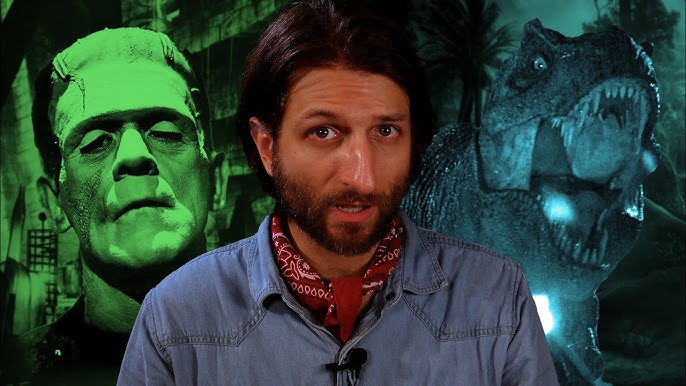
(source thumbnail: Atun-Shei's "Jurassic Park Is Basically Just Frankenstein," 2026)
Brigitte excludes much in her thesis, and I get why. Exclusion for safety is valid, trying different routes when under attack (as trans people very much are). But exclusionary attitudes become harmful once they omit things that otherwise can do good—including satire/the Gothic, but also oneself. Brigitte's doing so frankly feels like a bit of a self-report (and self-own) that, all the same, speaks to my profession (Gothic ludology and activism through literary criticism). I might as well respond, "Paleontology isn't praxis" (which obviously isn't true, above). Jokes aside, satire isn't zero-sum, and combines with different things, including media, to free workers from oppression (as Frankenstein famously showed, and which many since further hybridize to sublimate her critique, also above). Brigitte's wholesale dismissal feels especially dubious because it seemingly targets media, at large; e.g., "books aren't praxis" (or something equally scorched-earth). In isolation, nothing is (Cassandra the oracle 100% correct, but completely alone*); whether the pen or the sword, either gains their power through awareness and connection. Teamwork above all else: predictive power married to play that opens the mind, and whose trashy powers of persuasion Gothic Communism uses for dialectical-material gain (namely universal liberation by defanging the state's ability to exploit nature).
*With me discovering that exposing what people already know but choose to deny is praxially inert; i.e., when "preaching to the choir"; e.g., me somehow expecting my research into Bad Empanada to make waves among his supporters and defenders, when many had already been defending and downplaying his toxicity and harmful rhetoric for years—to the point where they, like shadows on Plato's cave wall, would rather shoot the messenger than break the illusion that benefits them (usually white straight men with beards and/or diplomas, 2026). I've since decided to focus on different "choirs" to preach to, finding allies that aren't bad faith (usually minorities, though not always†); e.g., Elliot Sang (a YouTuber whose work I respect similar to Brigitte Empire's): "Thank you for commenting on trans genocide and calling it what it is. As a trans woman, it's so hard to get cis folk to take us seriously about this (e.g., me vs Bad Empanada and those who defend him until he goes after Graham Platner or something equally bourgeois, status-quo). So thank you! Solidarity, comrade, and happy Pride!" (source YouTube community post: Persephone van der Waard, 6/12/2026 in response to Eliot Sang Again's "Trans Genocide, and the TikToker Who Went to Conversion Therapy," 2026).
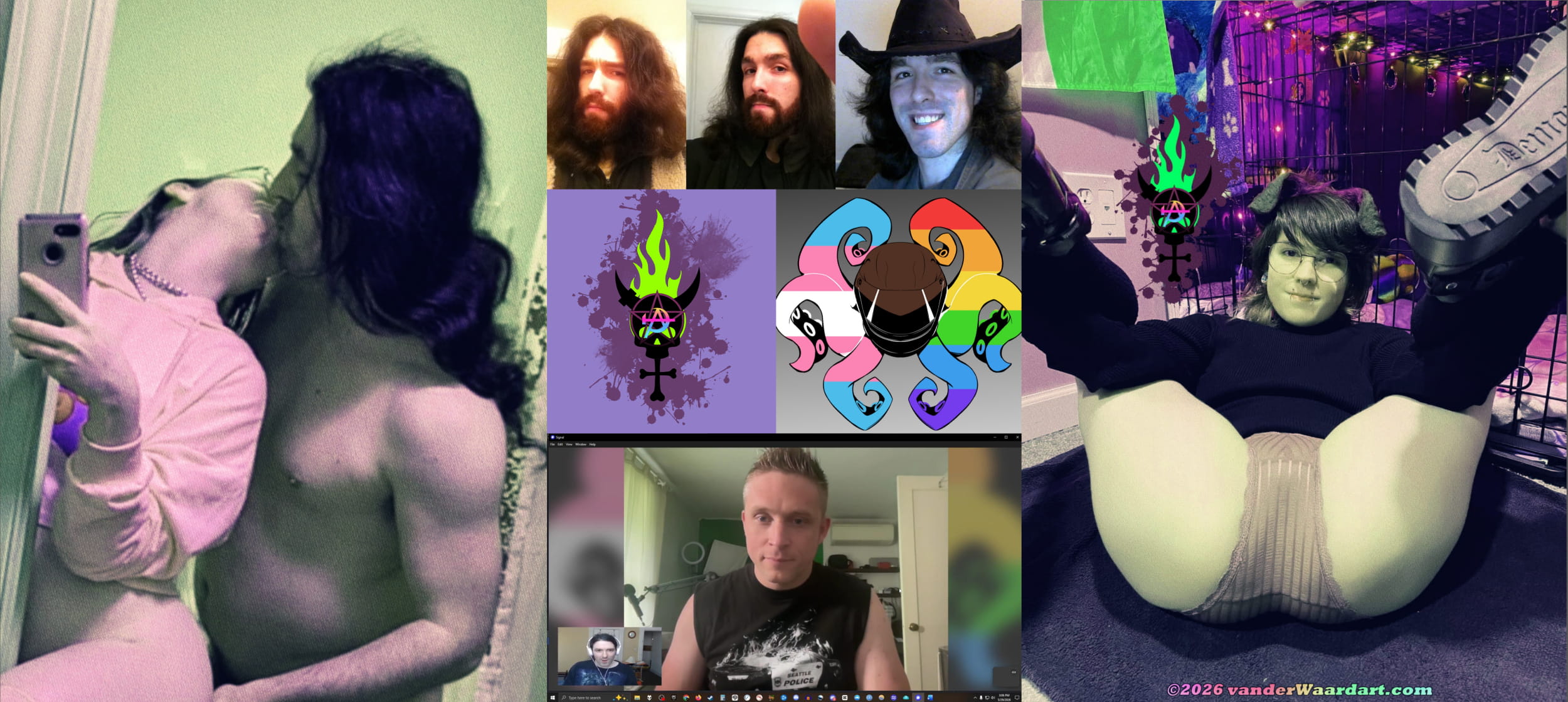
(artists, left: Cuwu and Persephone van der Waard; top-middle: Persephone van der Waard; middle-middle and bottom-middle: Persephone van der Waard and Squid Tips; right: Cuspid—source: "I'm Still Here: On Pride, Birthdays and Beyond," 2026)
†With cishet "grunglers" like Squid Tips (above) pulling their weight and then some (re: "Just the Tip: An Interview with Squid Tips," 2026).
Regardless of the register(s) involved, power is performed; people learn through fear and nostalgia as something to harness and satirically play with, onstage, that can transform the world, offstage. Such things are always dualistic, the state using shadows since Plato to mollify viewers into passivity then feed on them (re: state vampirism, state's rights vs worker rights). You don't break Capitalist Realism without theatre, though, the Gothic sort home to monsters, inequality, confusion and torture; i.e., of an optional and selective irony that frequently veers into self-parody (re: The Boys)—those whose ignominious forfeiture to bad actors by good, whether steady or immediate, only cedes much-needed ground when performing power to reduce harm (dismantling capital/the state as a system thereof, exploiting workers through notably escapist vectors). Already abject under capital, workers become alien and fetish in ways that induce state predation when unchecked. And yet, because alienation and fetishization cut both ways, I wish to highlight how regarding satire-as-Gothic. Gothic is absurd, corrupt—a place rooted in tremendous obscurity and decay amid power as up-for-grabs. It's a battle, a "gorgeous row":

The name of the game is reclamation, which happens through theatre (often kayfabe, camp and similar bread and circus, above and below); re: from Plato to us, literal shadows or things comparable to them (simulacra—videogames the neoliberal, electronically enchanting variant of technological abuse that, endlessly copied, workers reclaim inside themselves: a freeing of the mind through play to enact change outside the game-in-question; re: "The World Is a Vampire"). Satire is theatre, which incorporates Comedy and Drama on any stage; duality simply means both sides use it, workers (and nature) vs owners and those who serve them/the state guiding thought (thus action) through the usual circuits outside our bodies (avatars and conduits, themselves). There's no set function. Instead, they double each other regardless of venue or form (the Gothic prone to routine monsters, paradox and boundary violations, which my apologia embraces and defends: terror and theatre being the instruments of the colonized resisting occupation). Better to acknowledge that and respond in ways that utilize satire's proletarian value, not toss the whole thing out and give the state their precious monopoly. Those who do might as well call satire "degenerate," and save us all some time. I'm not saying Brigitte does so, here, but that's frankly the road she's on while throwing satire to the dogs (thus Gothic; re: Frankenstein and similar stories; e.g., Matthew Lewis' The Monk, 1794)—a rather baffling strategy given Brigitte calls her channel "The Daily Telegrift," and owing to her own obvious preference for satire, self-depreciation and sarcasm (the former a clear imitation of Charlie Chaplin, whose own perceived "abandonment" of convention we'll explore deeper in).

(source: Michael Carbert's "May 21, 1966: Ali vs Cooper II," 2026)
Nobody's perfect, but also there's room to work after getting hit to win the rematch (above)—to remind Brigitte (the proverbial "champ" in this scenario), as gently and roughly as needed, how such things have more power than she gives them credit. So are Gothic and dead conventions par for the course, teamwork making the dream work by bursting bubbles if required. Brigitte blew one; I shall pop it—not to "dunk on" anyone, here, but remind her what works and what doesn't, and how Gothic satire reveals and conceals at the same time when sharing the same stages the ruling class do. The colonized and colonizer share the same space—not just our language, but land and labor as part-in-parcel when asking for then taking them back; e.g., me existing alongside the KKK in Michigan, and Brigitte living on TERF Island. "Use what works," she seems to say while discounting satire (re: the Chaplin refrain). "I am," I reply, armed with the same basic tools billionaires abuse to feed on workers and nature, en masse. When in Rome, fight fire with fire! Land back, labor back, sex back, class-war-is-ass-war (as me and mine tend to focus* on)! Point out the flaws, then go to work! You know the drill.
*Versus SWERFs, which TERFs usually are—my work combating either alongside trans allies in the UK; e.g., Ethel Thurston (who incidentally got me into Brigitte's work):

(source: Udita Chakrabarti's "My Non-Binary Partner and I Were Told Our Relationship Would Never Work," 2018; cited: "'How about side by side with a friend?': Thanking Ethel Thurston" from "Dead on Arrival" [2026]—a polemic critiquing J.K. Rowling and token parties who unironically defend her)
Frankly, I don't care about The Boys (which Brigitte rightly clocks as liberal apologia), but do care about satire—meaning something my book series routinely and pointedly valorizes for workers; i.e., while stressing parody (a kind of satire focusing on people) with educational qualities that punch up as states punch down; re: "Informed (Ironic) Consumption and De Facto Educators Using Parody and Parallel Space" (written 2022, published 2025).
That was then, this is now. Our focus remains Gothic poetics, including violence, terror and monsters*, but also sex, drugs and rock 'n roll (and similar trashy things)—in a word, duality but specifically dialectical-material critique, one for which different usage of the same poetic devices dualistically share the same space, ergo bodies, costumes (and hyphenations of those things), onstage and off (what I call "half-real" vis-à-vis Jesper Juul, but emphasizing fiction and non-fiction with elements of play bouncing between; see: ludo-Gothic BDSM, below). It's already crowded, the usual liberal boundaries and refrains falling apart in hyperreal ways, mid-crisis—meaning those for which Gothic readily excels, deconstructing power for new structures made from dead parts (scratching whoever to draw blood and expose the fash beneath the mask and/or behind† the curtain). Capital's buffers have become noticeably "thin," under crisis; effectively decayed, they less wait and more beg for the usual rabble-rousers: to emerge and punch iconoclastically through Capitalist Realism, our Gothic continuum turning one's viewing of the world upside-down (and all to protect those the state normally preys upon; i.e., unpaid labor's including not just care work but sex work as the oldest profession, therefore struggle; e.g., disabled people often forced into sex work in ways they joyously reclaim from SWERFs, below).
*From Weber, Asprey and me (see: "The State: Its Key Tools" from "Paratextual Documents," 2024). We'll cite various other things, too, Gothic Communism a holistic discipline (these citations regular for me; i.e., I like to cite them because I think they're productive).
†The scapegoat only in front of it, which we'll process deeper in.

(artist: Aria Rain; cited: "Concerning Rape Play: a 2025 Note on My Development of Ludo-Gothic BDSM," 2025)
Setup: Hurt, not Harm
Before we dive in, I want to preface things with some setup; i.e., that softens the blow while nonetheless giving it hard enough to deal educational damage—hurt not harm, and coming from a neurodivergent trans woman who tends to fawn and overexplain things. So I apologize in advance for being overly careful, here, while still setting a good example for Pride; i.e., to establish healthy bonds, versus tearing down old ones. To it, I want to establish common between us, including how I'm celebrating and defending what I think Brigitte also cares about when giving my critique (the Gothic something of an acquired taste, and whose "safe-to-eat" label should be taken with a pinch of salt, below): from a place of love that scratches lightly when needed, then offers questionable "cures" (a bit like Don Quixote's healing potion for Sancho Panza). Poison was the cure, babes:

(exhibit 0: Source screencap: L.A. Beast's "Rare Expired 80's & 90's Snack Taste Test (CheeZe Edition)" [2026]. That brown stuff on the cracker he's holding is expired cheese, by the way.)
"Response" isn't meant as a scathing rebuke, then, but comical* reply that reminds Brigitte of satire's value beyond the predominantly liberal forms she centers on (which includes Chaplin, to be frank). To it, I'll trot out and show the audience various things, doing so in my admittedly oddball style (an acquired taste not above cracking jokes, above). As I do, context still matters; a given critique needs to mention any element of class, culture and race that might prove relevant, while still being honest and open. I'll do my best, then—stating how and why I appreciate Brigitte's work before critiquing it in good faith (no meat axe)!
*Which the "demo" side shall suitably depict: satire has value through laughter giving us the energy to continue, doing so however dumb the content being consumed actually is; i.e., bread and circus is still bread, our daily bread something to take and energize for the long road before us (think elvish whey bread, minus the pedigree). Same idea with Gothic at large (whose signature oxymorons fight harm with "harm," the purposeful quotes and irony a means of control through play as such). There's no ethical consumption under capital, but taking and repurposing something emergently—meaning outside an intended role (to zombify your brain)—is ethical; re: raising awareness, and by any means necessary (a cooking approach my sister-in-law lovingly calls "grog"). Enjoyment =/= endorsement (re: Sarkeesian), provided you consume in moderation (ass or otherwise) and educate responsibly!
Commonality and Respecting Brigitte's Work while Dealing with Gothic Doubles
First, common ground. Why critique Brigitte—someone I clearly respect—when we obviously have so much in common (e.g., Amazons, ludology and Gothic, below)? In fact, we're practically doubles:
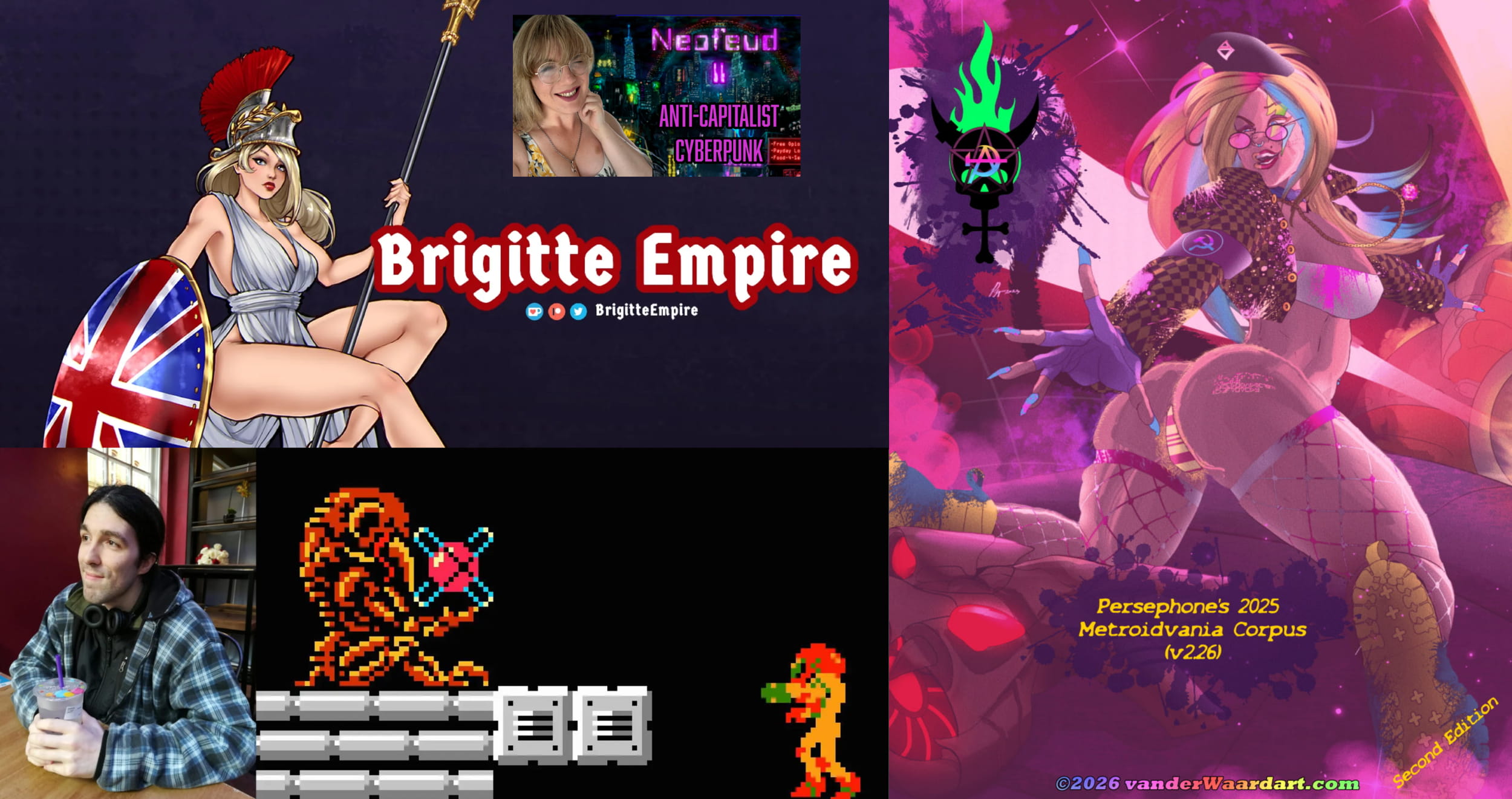
(exhibit 1: Artist, top-left and mid-top-left: Brigitte Empire; far-bottom-left and right: Persephone van der Waard. Brigitte's YouTube page reads, "Tongue-in-cheek video essays by Britain's least fake columnist" sounds both truthful and highly sarcastic [as Matthew Lewis once did, followed by Wilde, Price, myself and others]. In my case, and borrowing from older Gothic auteurs, I'm literally a Gothic ludologist specializing in Metroidvania, BDSM and Amazonomachia [re: "From Masters to PhD," 2025]. Fakery is something to play with to perform power [all ideas we'll touch on, deeper in]—something both Brigitte and I are guilty of when playing with the same stuff to achieve similar goals [the same goal, I would argue: liberation from inside empire]. The Gothic is holistic and allows for this, in duality. For one, sex is the most controlled thing in the world—the very thing the ruling class demand to survive, and which they tokenize through Amazons [quite successfully] to police state territories; i.e., whores policing whores in deeply TERF-y ways, their Neo-Gothic revival in the 1800s [under bourgeois nuclear models] seeing Ancient-Athenian propaganda brought back to life [which The Boys very much is: "Girls get it done!"].
In turn, duality comes into play when discussing and/or performing these attributes; i.e., you scratch a TERF and a SWERF bleeds, no matter how nunly and/or whorish she appears [the nun in whore's clothes or whore in nun's basically wearing the same outfit, below]. However Radcliffean [and outlandish] that seems, it historically-materially comes about. And so the telling of friends from foes remains a routinely useful skill:
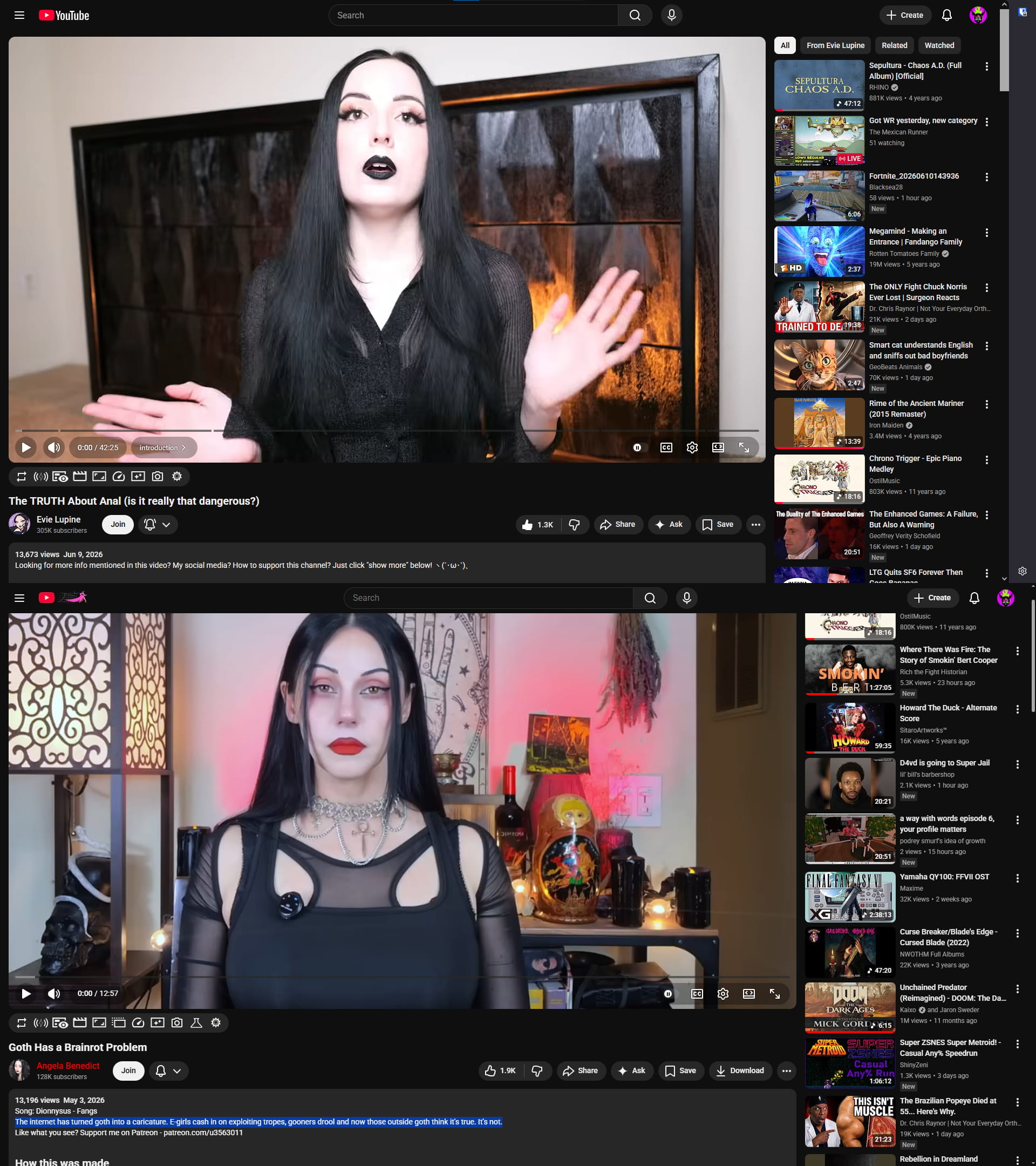
[source screencap, top and bottom: Evie Lupine's "The TRUTH About Anal" and Angela Benedict's "Goth Has a Brainrot Problem," 2026]
Function = flow, not aesthetic, and good and bad actors look alike regardless of costume [with Evie being the good actor and Angela being the bad, in this case]. Here, cop/criminal or terror/counterterror are anisotropic, their function determined accordingly by direction as something to "suss out" [as I did with Benedict, a bad actor embodying "gaslight, gatekeep, girl boss"; re: "Interview with the Vampire," 2026]. One's body, like society around it, is something to fiercely protect but also let different parties in for business and/or pleasure; i.e., as things to indulge in while "testing the waters." Here, a little sarcasm, fakery and playfulness go a long way to challenge bad actors—meaning their DARVO-and-obscurantism, hero/victim contradictions enabling state vampirism, cryptonymy-and-abjection. Good nerds challenge bad, sexual acts and asexual analysis performatively overlapping, mid-dialectic, in psychosexual ways. So the body [and things that represent it and vice versa] is both space of danger and play grappling with various tensions and techniques; e.g., Amazons and anal sex both weapons of state power and something for workers to reclaim theatrically where it happens; i.e., making the usual violence impossible. Birds of a feather flock together—wherein I don't solely broach these topics [re: "Our Sweet Revenge," 2025] but do so convergently and synchronistically: alongside other sexologists, BDSM nerds and Goth types [re: Evie, above].
Such is Gothic, the Neo-Gothic lifting from the actual Medieval period to reinvent the past; i.e., in "Gothic" ways useful, through satire, to workers "passing the torch"; e.g., mocking the Church:
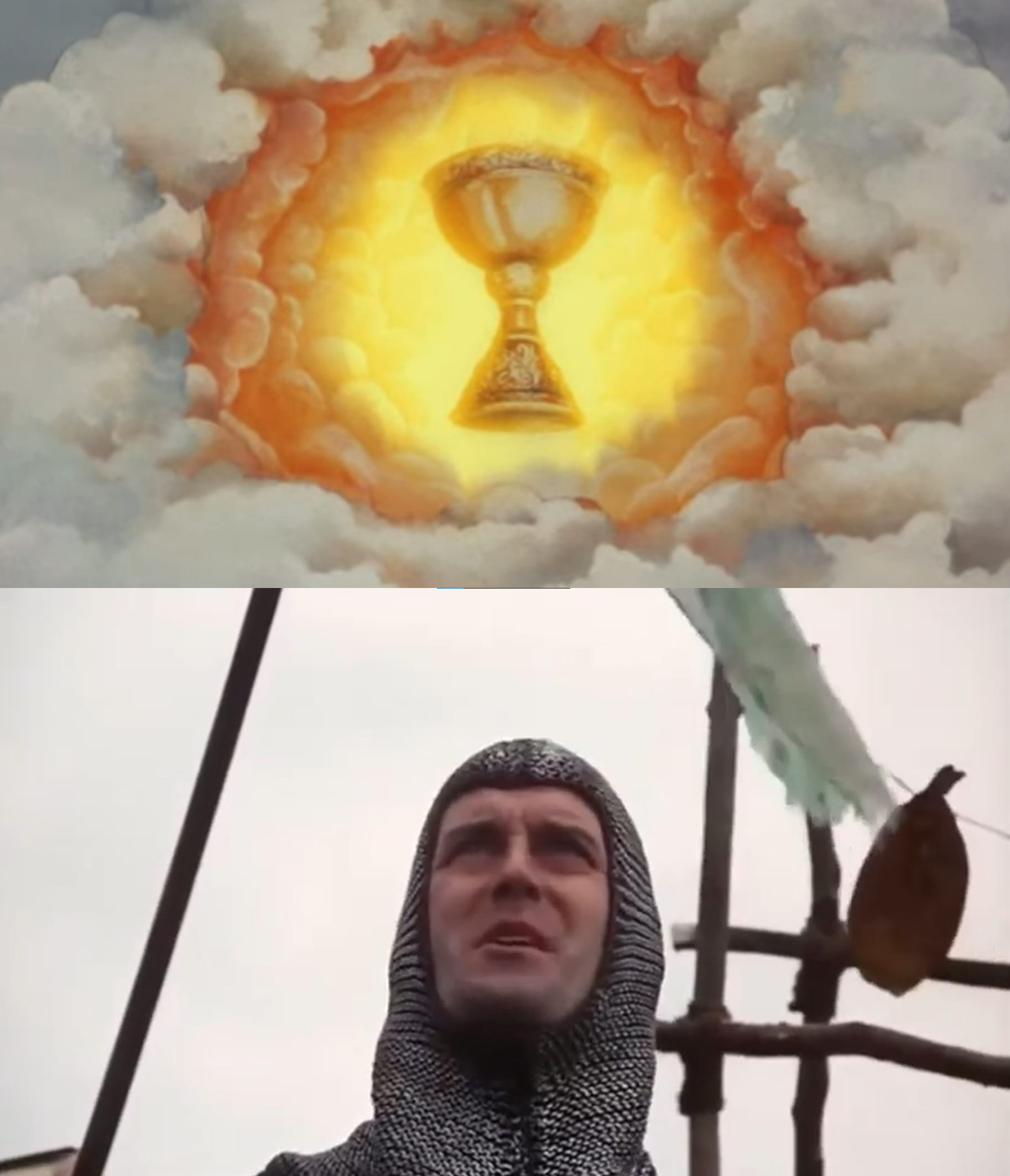
Whatever the target, poetry is code and play that—however tangential on its face—allows for different ways to present and manifest argument, mid-survival. To that, the state doesn't monopolize castles, Amazons, or any other Gothic, monstrous-feminine thing [or portal-like allusions to said things, above]: where power is stored and fought over. Use them to smuggle and fire whatever weapons wait at your disposal; pass the message along as one might a fart or a scream—to shock and awe, distract, disrupt and ultimately undercut in duality our easily-terrified foes. Leave your "Grail Beacon" on; watch them shit themselves, dropping the mask of an admittedly bad costume [also above]. Such things linger as much through comedy as something also fought over—conservatives recuperating Monty Python as much as the Wachowskis' blue pill, red pill analogy [each standing on Plato's broad shoulders]. Monopolies are a myth; attempts at monopoly are commonplace, steeped in myth. Become whatever serves workers best, breaking stereotypes the state reinforces "on the Aegis" we both share [Athena's mirror shield, able not just to host shadows like Plato's cave, but bounce them back]. As you do, always keep duality and disguise in mind. Goth baddies don't always wear the habit; i.e., anymore than real nuns do, the virgin and the whore a longstanding thing Gothic nerds cryptonymically "walk the tightrope," concerning [as all women do, trans or otherwise].)
The above exhibit should paint a picture as to what confusions commonly result when dealing with activism/counteractivism; i.e., among performers who—as people—so often look, sound and otherwise act alike until push comes to shove. I don't view my criticism as much of a shove (at least not a hard one), and want to stress how I very much enjoy Brigitte's work (with her expertly marrying comedy and current events while also touching on serious topics, below). This isn't to hack her apart or "school" anyone—and she's the one with the actual PhD, mine merely independent studies I call "PhD" (to highlight its academic value/function)—but instead offer up things that poetically contribute collectively towards a larger goal: universal liberation (no scapegoats, no Omelas children/whores).

(source screencap, top and bottom: Brigitte Empire's "Trans Women Banned From Snooker" and "The Forgotten Transgender Epstein Victim," 2026 and 2025)
I don't want to confuse my readers (which doubles often do). As I lay things out (and do so in my usual "Gothic," semi-confusing style), remember to consider this whole piece an exercise for Pride; re: critiquing a good actor in good faith, using my usual tools and training as lifted from a time before the Internet (as a medievalist raised on books, debate, and anti-plagiarism); i.e., to raise awareness of an intersectional sort. Class war is ass war* achieving a Gothic maturity† the state discourages (to better rape us with, mid-torpor). In keeping with state vampirism, function = flow of power up or down to cryptonymically further/reverse abjection (thus state predation). Doing so happens in duality per Gothic satire; i.e., as notably diehard, undead, and Numinous during what I call ludo-Gothic BDSM (calculated risk, with an emphasis on rape prevention through Gothic parody and pastiche; e.g., Amazons).
*Stressing "the liberation of sex work through revolutionary struggle; i.e., hugging the whore as alien/seeking revenge through unity illustrating mutual consent with other abjected workers" (abridged, source: "Paratextual Documents").
†"[T]the ability to say healthy things through taboo language during ludo-Gothic BDSM; i.e., while pushing for intersectional solidarity and consciousness, developing Gothic Communism (thus universal liberation) through various creative successes that collectively overcome praxial inertia, division, dormancy and betrayal" (ibid.)—with "to combat various forms of reductionism (class, culture and race); i.e., by building on Marx' notion of class consciousness: combining class with culture and race consciousness (awareness) to raise emotional/Gothic intelligence while synthesizing praxis" (ibid.).
Restating My Goals Before We Start; or, Celebrating Satire in Gothic Forms

(model and artist: Scyllacibin and Persephone van der Waard)
Again, I wrote "Response" regarding someone I respect on a topic we both celebrate. Before we start, then, I want to stress how my focus here, however "spicy" it comes across, isn't Brigitte and exposing her like a Scooby Doo villain—as there's less to expose, I think, than simply a poor thesis to dissect and learn from (versus a so-called "progressive" like Rebecca Watson*; re: "Nancy Drew Syndrome," 2025). Rather, I wish to present Gothic as something to praise in hopefully persuasive ways: utility amid confusion, which trans people are currently dealing with on either side of the pond (the same proverbial "boat"). Capitalist Realism sows confusion, and generally on the homefront as fallen, up-for-grabs, and open to interpretations that hauntologically reify and send power up. But for a moment, especially when capital is weak (the "bust" side of the boom-or-bust equation), power is out-of-joint/displaced and free to wander in ways workers might seize and use for ourselves: within contradiction and cryptonymy (concealment and revelation) as merely part of the human condition and its language. Worker is other (woman or otherwise), nature monstrous-feminine free to roam.
*Who, when scratched, was a huge dick about it.
In Gothic, house = prison, alien, and vampire, etc, in bad faith; i.e., an unheimlich something not merely to expose (the black castle under the white), but process through play in ways that grant any side the abject, cryptonymic means to send power up or down (with "black," theft and piracy as much tools for liberation as not, below). Function = flow and no set function to language exists, in Gothic. Instead, satire = camp as a consciously dialectic-material arrangement; i.e., during ludo-Gothic BDSM developing Communism in Gothic ways, and whose various revelations during Gothic Communism uncover this-or-that: to work "within the labyrinth" (a given explorer as much the Minotaur as the maiden, the two indiscrete). Matter shapes consciousness; we toil under capital as such, not wholly subject to state illusion when parallel to/facing it, "on the Aegis" (the Gorgon's mirror shield as much as Athena's): that we're already trapped, and how to consciously improve our lot under pressure by performing adoptively the self-same illusions for ourselves (rendering others the dupe, Gloggins). Whatever confusions that result merely describe the reality we find ourselves in, then perform like the shark in its waters (or pirate on her island, also below) our own infernal plots!
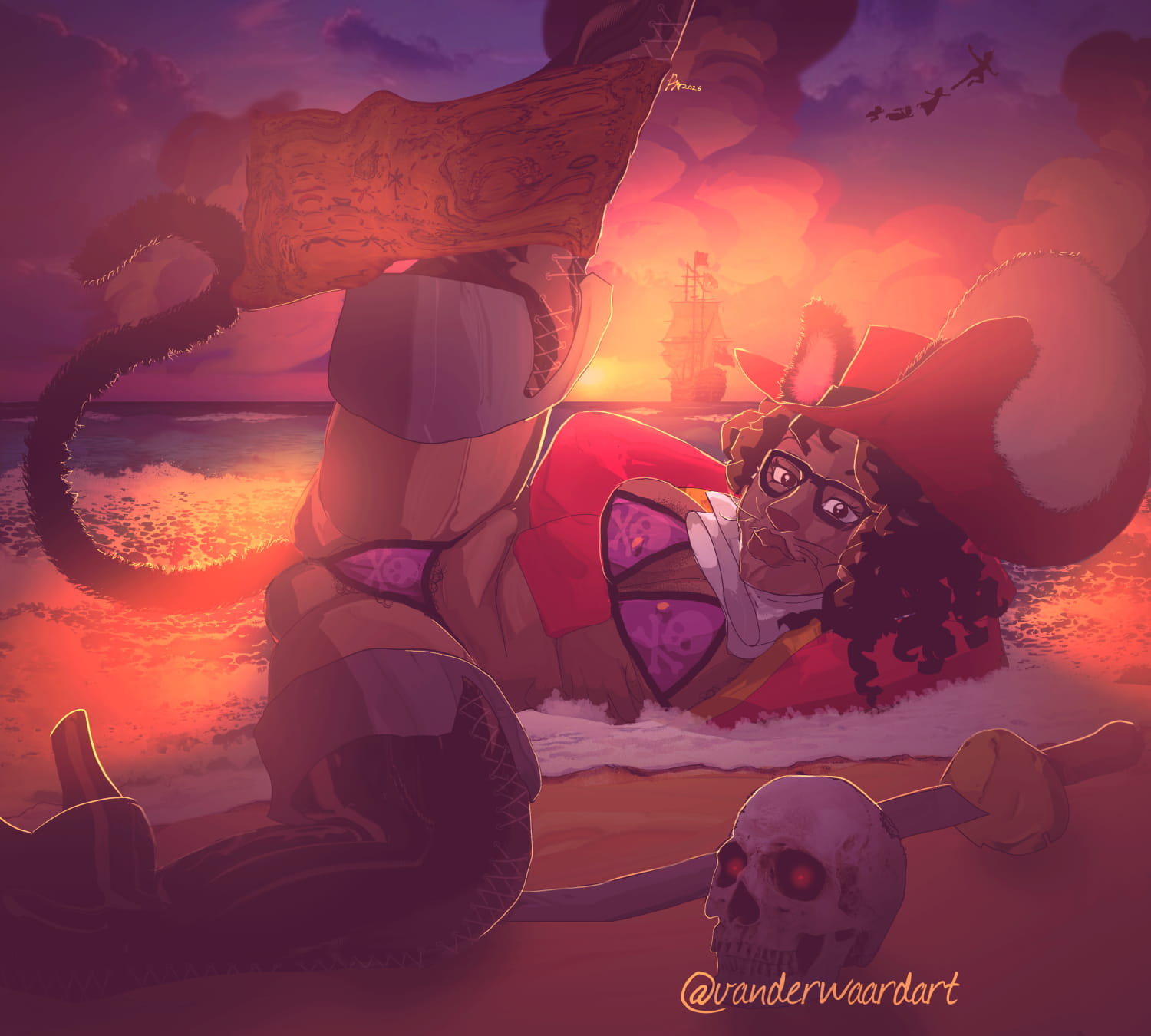
(model and artist: Mauve and Persephone van der Waard)
Satire isn't mere consumerism, then, relegated there for nothing else. Instead, whatever the gods do (mortal or otherwise), we take and respond to build a better world; i.e., with our own god-like power as camping, dualistically, the whole of existence in Promethean ways. It's kayfabe, giving us a puncher's chance that however slim should be taken and built pandemonically upon (Creed's "terrifying powers" argument especially productive when used for the whore's benefit). Like Burn's mice and men, exploitation and liberation share the same spaces of play where power performs, and in duality among good actors versus bad! They suck; we suck back, the Gorgon (and her avatars) extra thirsty!
Smile at the gods, remember? But also, we're gods of a communal sort, the very ones united in satirical, rule-in-Hell ways the owner class fear and control through repeat bad actors (and their Wizard-of-Oz doubles pimping Elphaba's clone, piratic dress-up serving whomever by directing power satirically to-and-fro in silly-serious ways). They're humbugs, truth stranger than fiction; i.e., which Gothic fiction doubles while commenting on/within real life, the playground somewhere in between: pirates steal shit and satirize themselves as much as others, permeating discourse with the power that play categorically offers. There's power in that to subversively expose/transform in equal measure, theatre and action not mutually exclusive like Brigitte argues. She closes the strait, any course I chart requiring it to reopen while critiquing the same enemy—the ruling class, but also their servants and whitewashers (who paradoxically "paint it black" in ways we might double and reclaim, below). Despite Brigitte's crisis of faith, we prey at the same church, thus remain able to mask, dress up and transform ourselves, accordingly (through different "denominations" that amount to more skepticism/optimism or less). Again, power isn't simply guns, factories and tanks, but a thing to perform and perceive in Gothic spaces and architectural embodiments, mise-en-abyme (re: "Castles in the Flesh," 2024); e.g., Amazons (to explore alongside the Promethean Quest*, deeper in):
*A dualistic metaphor when developing Communism, if ever there were.
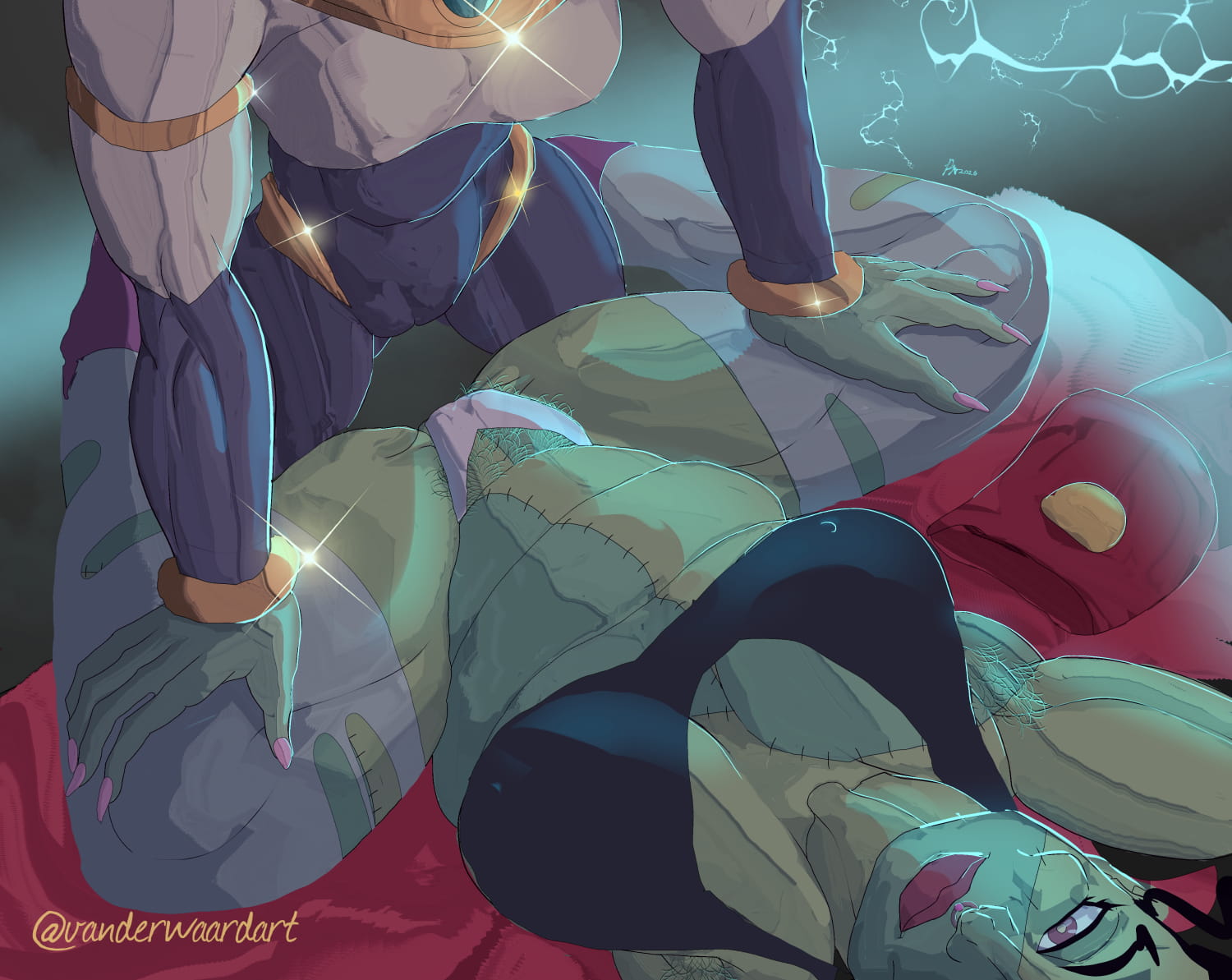
(model and artist: Cosmo Wanderlust and Persephone van der Waard)
Criticism and Giving It; or, the Claws Come Out: a Satirical Whore's Love Tap when Devalued
Pleasantries dispensed with, let's switch gears and let the claws come critically out (mid-commonalities celebrating something we both care about, mind you). Yes, there's reason to be hopeful, but also frustrated when someone loses hope in ways that frankly feel premature; i.e., we're not dead, yet, and saying satire doesn't have value (as I and many others define it) is frankly absurd and makes me want to ask, "Am I a joke to you?" And sorry to barge in like the Kool-Aid Man, in that respect, but consider this a love tap; i.e., from a satirical whore, having her feathers ruffled by an unlikely source. It happens, and I apologize in advance; I'll be as as gentle as I can, but as rough as required.
Can you blame me? From Medusa to us, the state already pimps nature as monstrous-feminine and does so by design (there's no "failure," in that respect). For us, then, there must be struggle to a high degree because the struggle is great (and dualistic). This means correcting different wrongs even when coming from workers we respect—especially those we respect, and double-quick if they stick their foot in their mouth. Concerning Brigitte's ignominious gaff, I wanted to give that specific statement my full attention; i.e., given it was so completely wrong and steeped in my own expertise as all but needing me to weigh in. To that, I'm only responding to a short portion at the end where I think Brigitte delivers her video thesis; re: "If we're going to get out of this world-beyond-parody alive, we're going to have to build an alternative [through action]. This is something satire cannot achieve. [...] Satire is rarely-if-ever praxis [emphasis, me]" (timestamp: 45:28).

Girl, like what? First, I merely wondered why Brigitte had buried the lead. Then I marveled at how wrong she was—not from saying anything noticeably "fash" or in defense of fascism (I'm looking at you, Flaccid Kav), but more because she seemed oddly out of her depth; re: "satire cannot build a better world... because satire is rarely if ever praxis." The ensuing double-take practically broke my neck:
- One, this argues that parody is no longer possible in Trump's America, which is to say monopoly Capitalism in its neoliberal form decaying into fascism around the world (as global US hegemony extends to Britain, where Brigitte lives).
- Two, it makes The Boys' failure theoretically impossible, insofar as satire cannot succeed to begin with (or so Brigitte says, not really specifying what failure and success mean for workers vs owners beyond "satire isn't praxis").
- Three, it presents satire simply as humor or the absurd that focuses myopically on single persons or scapegoats (versus systems of critique in ways that veil or lay the sarcasm on thick; re: Shelley's Frankenstein, but also her contemporaries and forebears; e.g., Jane Austen's "truth universally acknowledged" quip from Pride and Prejudice [1813] or Diogenes' "behold, a man!" response to Plato*).
- Four, satire is something—described collectively as "we," "our" or "us," by Brigitte—that would appear to belong entirely to the ruling class: Erik Kripke of The Boys and Matt Parker and Trey Stone of South Park (1997); i.e., as that most banal of evils, pooping out bread-and-circus (don't blame Dada for fascism).

*The latter who wasn't past having his own bubble burst, and on topics of fierce debate comparable to "satire isn't praxis"; e.g., what it means to be human (sit down, Dracula). "The ancient Greeks debated this topic feverishly," writes Everything Horn. "Plato famously attempted to define a man, using references from his mentor Socrates. He settled on a scientific definition, naming man a 'featherless biped,' two characteristics that distinguished humanity from other animals. In a humorous scene, Diogenes the Cynic, hearing Plato's definition, plucked a chicken in his home and brought it to one of Plato's lectures. When Plato asserted that man was a featherless biped, Diogenes stood, brandished the bald chicken and shouted, 'Behold—a man!'" (source: "Behold—A Man," 2019). The same kinds of debates very much occur today—with trans people saying "Behold a woman!" to mock J.K. Rowling for her own erroneous statements on defining a woman (to control that in all the usual Cartesian ways Shelley once mocked, with Frankenstein). Is their doing so not praxis, Brigitte? I would argue it is, the words of such people tied to action-as-words, or words and action walking arm-in-arm; i.e., on various theatres comparable to Plato's famous ampitheatre: a place of play and instruction overlapping different techniques borrowed by others, millennia later.

Did it ever occur to Brigitte (or Chaplin, above) that billionaires use satire "badly" to serve their own class? Instead, Brigitte argues how satire historically-materially doesn't translate to action—with her citing Marx' "Eighteenth Brumaire" (1852) regarding the repetition of history in tragedy before farce, and me wanting to shout at both, "Don't forget camp!" Indeed, I've borrowed and camped the phrase myself, essentially taking Marx' lamentations and running with them: "The tradition of all dead [whores] weigh like a nightmare on the brains of the living." Brigitte just reads the original in a funny voice, presaging her own abysmal thesis with something written by another thinker prone to various mistakes (re: Marx' homophobia corrupting Socialism at large, I argue; see: "Making Marx Gay," 2024).

(source screencap: L.A. Beast's "The Cheeseburger-in-a-Can Challenge," 2014)
This didn't "soften" the blow, which bothered me once it came as much through Brigitte's unbridled confidence while saying it. I felt like she'd just fed me cheeseburgers in a can (above), then called it "gourmet" seemingly without irony (or laughter/disgust). I could taste her despair (which, while valid, ironically isn't praxis if it renders what could be praxis functionally inert). "Satire isn't praxis"? Girl, no; you're looking under the wrong rocks, and need only turn over those where trans people are to see fresh life growing (echoing postpunk after punk's demise, in Thatcher's Britain)! We're not dead yet, living under cycles of generational trauma whose reclamation thereof (through violence, terror and monsters) workers should defend. In doing so, we should neither let straight white guys tell us what satire is (read: Chaplin* as much as Kripke or Stone), nor convince us to issue statements they'd say minus irony. Yet that's precisely what Brigitte appears to have done, requiring me to write this while wearing the following facial expression:

*Remember how Chaplin's breaking the Fourth Wall and giving a statement that didn't target Hitler exclusively (the scapegoat) also didn't target the American side of things (and remains girded in the language of American liberalism focused on "mankind"). But regardless, it's still satire because breaking the Fourth Wall (and basic conventions of theatre) doesn't preclude commentary and action, within/outside media (re: Austen, Lewis, Diogenes, etc). Doing so is still theatre (thus satire) because theatre is concentric† (and recursively so), wedding Comedy to Drama (and their masks); i.e., as tied afterwards to material conditions nonetheless announced and addressed through argument! Chaplin's appeal didn't work, because fascism was already in America, under his very nose—indeed, had started there, first. He didn't stop it, and excluded many groups of people through his own accidental ironies: the white straight savior camping the fash, while largely exempt from oppression himself (thought still facing it through poverty and child labor under British rule, escaping it in a rags-to-riches gift for the stage). But I'd never tell him not to try nor say his doing so "wasn't satire." We theatre nerds stick together even when some understandably lack the language (most people did in the 1940s, regarding queerness), and speaking plain while in costume is par for the course (and still satire, my dudes).
†Such mise-en-abyme speaking to different stories and devices pulled from the Medieval and Neo-Medieval alike: the play-with-in-a-play of Shakespeare's "rude mechanicals," in A Midsummer Night's Dream (1600), Mary Shelley's frame story in Frankenstein (1818), or the infernal concentric pattern as Aguirre calls it (a Promethean device for undermining monomythic action during ludo-Gothic BDSM; re: "Geometries in Terror; or, Traces of Aguirre and Bakhtin in Hollow Knight's Promethean Castle World," 2024).
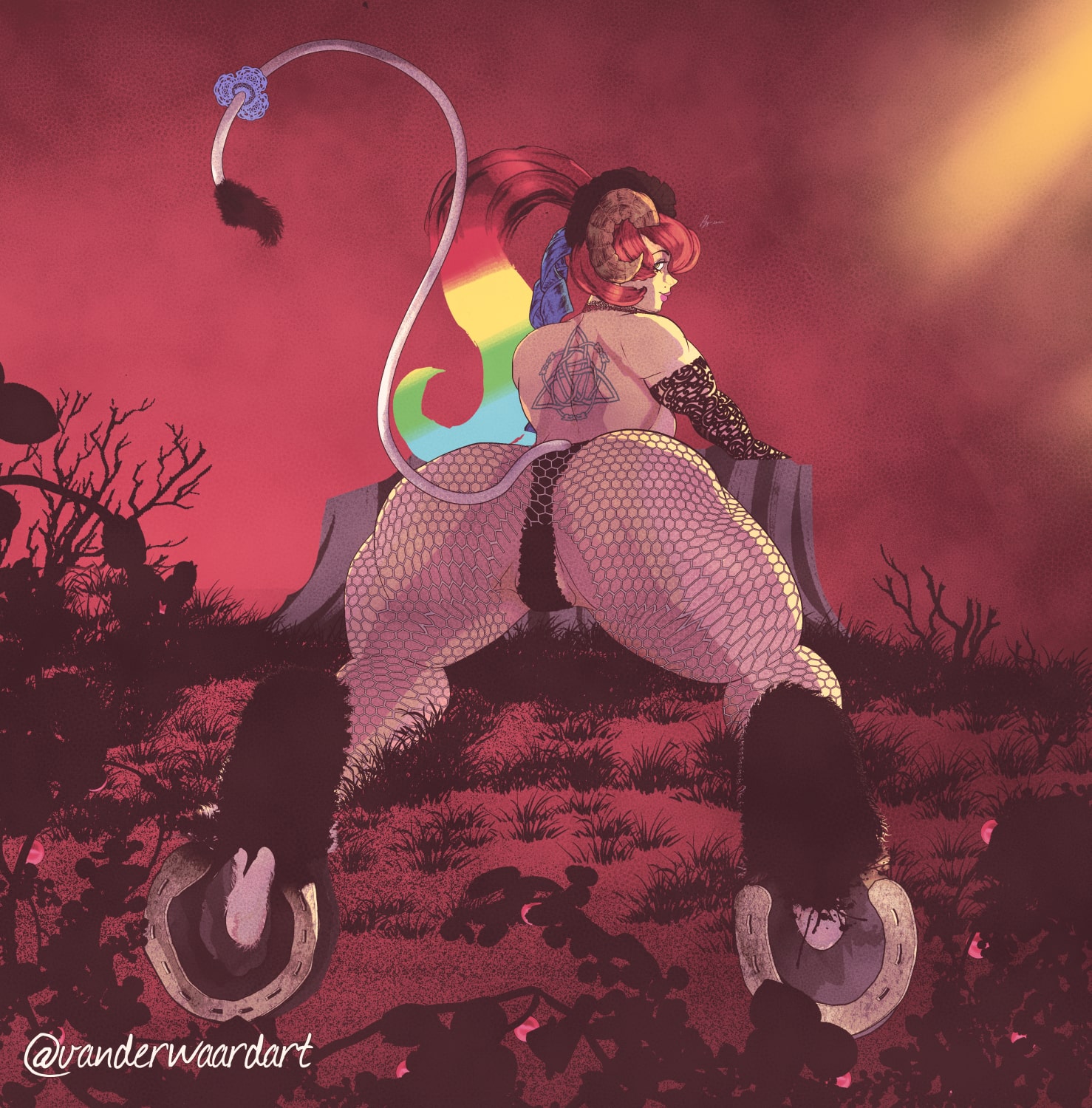
(artist: Persephone van der Waard)
I digress. No one's above critique, and Brigitte kinda stepped in my yard with this one. However, this shall be a friendly demonstration, playfully showing my ass (and expertise) going forwards; i.e., considering how duality is a tricky thing to illustrate at the best of times, satire only "dead" if the elite actually monopolize satire and Gothic language (read: rapey supermen). They don't, insofar as exploitation and liberation (again) share the stage, and where this post shall demonstrate a lack of monopoly through duality as such. Duality = praxis, because praxial inertia comes from those who stymie momentum (re: "Overcoming Praxial Inertia," 2023). Trust among trans people (and other minorities) builds intersectionality during mistrust, showing others our proverbial ass that anisotropically flows power down to workers—all while scratching our foes and shielding us apotropaically from harm; i.e., when the Man comes around, show him your Aegis (the paradox of exposure yielding the Gorgon or the Amazon's weapons-and-armor nudism [and comparable scenarios and devices] to suitably prevent harm in anti-predatory forms): where power is stored, and relayed in hauntological ways delving into puns, taboos, and various other "darkness visible" (from Milton). So the Gothic secretly teaches the reader while playing with "barbarism" (a tangent "More Amazons" shall take and run with, in Promethean ways). Girls shit, and Gothic ain't for the prudish (the ass a secret weapon, "scratching" our foes and conveying different information in different directions upon its surface; e.g., moon letters on a "full moon," below)!
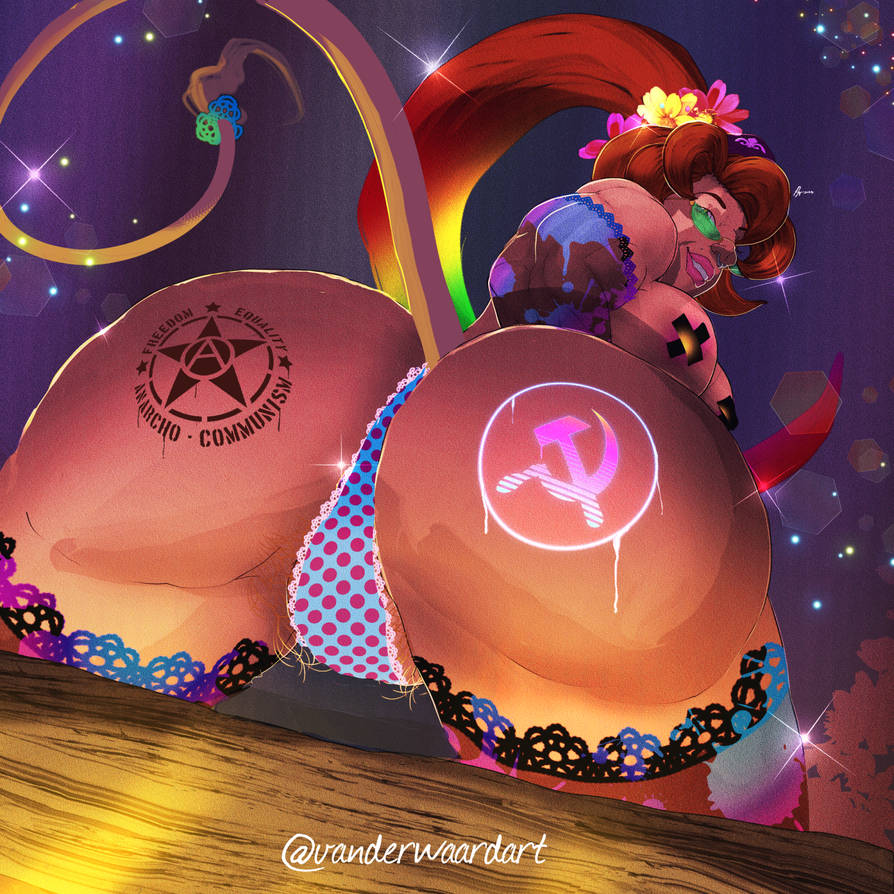
(artist: Persephone van der Waard)
A lack of shame serves us well. Except, I've already written multiple books questing for Numinous things (e.g., "The Quest for Power," 2023); here, and for the rest of my response to Brigitte (which starts now), let's have some fun—doing so where power stores and is played with in different satirical ways (queer existence an ontological, indeed praxial satirizing of straight norms, from Judith Butler [1990] to us)! Per Gothic, it's often silly and serious—not just Camus' Absurd, smiling at the gods in Sisyphean ways (or whatever Prometheus does when the eagle eats his liver), but making us laugh, scream, cry and/or anything else (often at the same time); i.e., while raising awareness to bring workers together (sex or otherwise). This happens while avoiding class, culture and race reductionism (ergo tokenism, a topic I've repeatedly explored elsewhere; e.g., TERFs and black moderates monopolizing Gothic). This requires including Gothic satire (silly or serious) in monstrous(-feminine) forms; e.g., the canonical satire of the Amazon (as nuclear dogma) something workers eventually camped, meaning in deeply subversive ways conducive to good praxis and scholarship (any subsequent action happening within daily habits synthesizing this or that as preferential code; re: "The Basics of Oppositional Praxis," 2024).
A Demonstrational Response to Brigitte Empire; or, a Question of Duality Regarding Satire as "Dead"
Ironies aside, and having mostly prefaced and vented my own nerdy outrage concerning Brigitte's dubious thesis statement (which I don't want to rush back to, just yet), you now know my stance on Brigitte's words, and could stop reading here, if you wanted (that's your chance to bow out, should you choose). The rest is merely demonstrating what I already said, having fun in the bargain: while holding the paddle and using it in Amazonian ways that, whatever the lesson they teach, don't direct at Brigitte 100% of the time!

(artist: In Case)
As I do, I still respectfully yet full-throatedly disagree with her argument; i.e., without beating a dead horse (though we shall inspect its corpse). As we respond, let me continue saying why to stress Gothic's satirical importance, offering up something less rigid and myopic in the bargain (re: ludo-Gothic BDSM, above). To surrender that value (as Brigitte did, and maybe Chaplin before her) is to ironically become unable to affect change, thus relegate ourselves to whatever prisons await. Fascism doesn't die if you make fun of it; it dies through the violence of denormalizing it in different ways (the Gothic imprimatur of violence, terror and monsters, aka sex and force through morphological expression serving worker rights). Let that be your mask and mirror, your sword and shield! A poetic lever to move the Earth (from Archimedes to us)!
The Value in Gothic; or, Monsters and Their Satirical Value (for Workers)
The value in Gothic lies in its paradoxical ability to prevent harm in anti-predatory forms; re: the whore's revenge, insofar as flow = function, not aesthetic, and Gothic satire able to change the flow power travels in paradoxical ways (while tied up or otherwise cornered, below). Therefore, to dismiss satire outright as "dead" or "incapable of praxis" is to unwittingly hobble ourselves/prohibit the very action Brigitte calls for. Indeed, my book series—nay, the entire Gothic mode—historically engages with satire; i.e., that, if not fully alive then certainly isn't fully dead, either! Such monsters (my preference again being the monstrous-feminine, below) are undead, demonic, and/or of the wild. Somehow it both lies "in state," yet roams monstrously the wilds of our imaginations into daily life; i.e., of something fearsome that normal folk (of the Imperial Core) quake to see in broad daylight (or lust after but I digress). Such is Gothic Communism, its satirical factory conducive to action-in-duality that Chaplin (and others) usually omit (effectively tone-policing by taking the "high road," and leading the clown, drag queen or whore to paradoxically sigh, "Am I a joke to you?"):

(artist, left: Michael Whelan; right: Persephone van der Waard; cited: "X Marks the Spot," 2025)
Gothic (gay-anarcho) Communism is a holistic, intersectional discipline that—among other things—champions universal liberation through a healthy stewardship of nature (fighting global warming as a symptom of Capitalism). One concerned with Gothic poetics' aesthetic (argument) had in duality during dialectical-material analysis, it stresses sex work under capital as something to iconoclastically liberate from state power—namely how capital/the state cheapen life while moving money (and resources) through nature to nature and workers' detriment. Patel and Moore lay out the basic idea; I apply it specifically to sex workers camping our own rape, reversing abjection (thus state vampirism) during ludo-Gothic BDSM—i.e., per Marx and myself, Capitalism alienates and sexualizes everything (source: "Preface Postscripts; or, Capital Cheapens Life (and Sex Work): A History of the World in Seven Cheap Things, TERFs and the Epstein Files" from "State Vampirism," 2026).
Rather, such things happen in duality to revitalize satire whenever it seems dead, "used up," and otherwise of no further use to anyone (the Gorgon [the monstrous-feminine] not just beheaded but turned to stone, unable to blink). So we whores under capital walk in Medusa's footsteps, setting nature free from man-made curses/manufactured scarcity (and pushing towards post-scarcity in pre-capitalist language—what I call the Wisdom of the Ancients and Indigenous Peoples the Wisdom of the Ancestors; re: "The Value in Showing Intersectional Solidarity When Combating Fascism," 2026); i.e., when such things call to us. So we embody and symbolize them, the witch hammering the witch hunter using what's on hand (satire a common weapon that Gothic performers tactically abuse to our advantage; i.e., during tactical frivolity as something we'll mention during the theory portion). If Marx can lament about the summoning of this or that to men's service (re: "Brumaire"), then simply conjure up different ghosts! Use them to turn the tables and have our revenge, not abandon all hope under Capitalist Realism as whittling down our physical, mental and spiritual reserves! An act of creation many use to survive, satire in Gothic has the power to change minds by inducing action, and doing so effectively since state predation first appeared (from Athens to us; re: Amazons and Gorgons; e.g., Helen of Troy's "face that launched a thousand ships" translating well enough to butts, below).
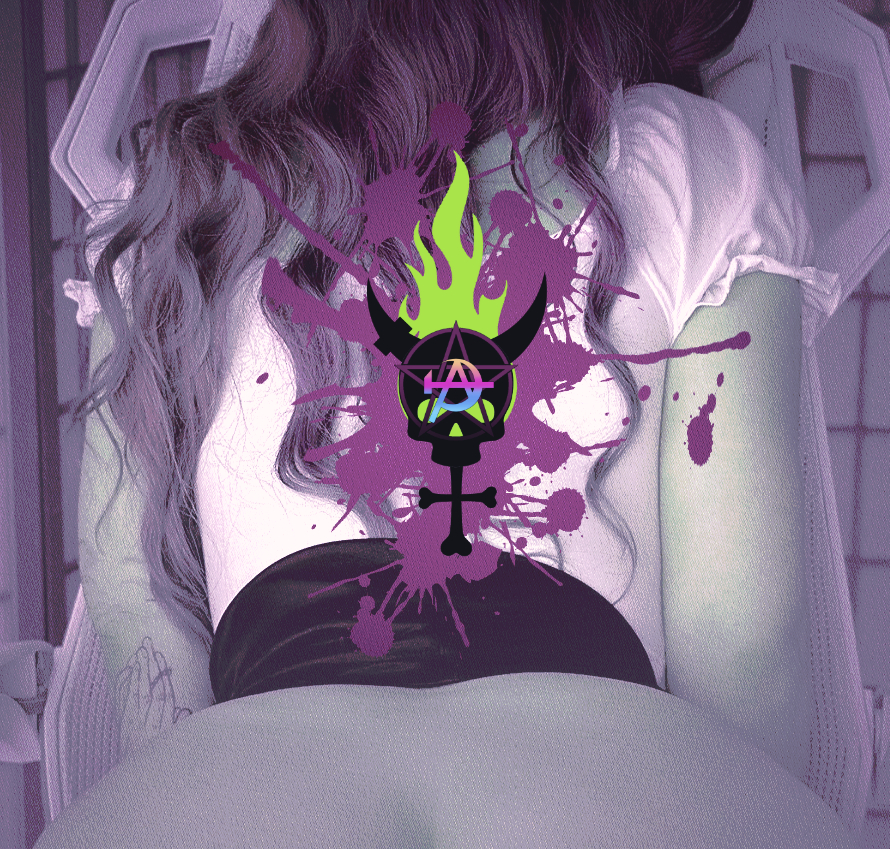
(model and artist: Blxxd Bunny and Persephone van der Waard)
In turn, all of this comes from me walking in the footsteps of older trailblazers—with me studying British Gothic as an American trans woman, and Brigitte a British one looking at American satire (re: Chaplin, Kripke and Stone); i.e., all while camp as a whole verges unmercifully in what Sontag both calls fascinating fascism (1974) and true camp aka "seriousness that fails" (1964). "The grass is always greener" and all that, curiosity a driving force that "leaves marks" when mistakes invariably happen. I made my own, to be sure. Gothic allows for it through paradox; paradox grants workers wiggle room, the power explored therein a thing to transform the world in Promethean ways. Here, my trans-on-trans critique comes both with love and in fragments, one had on black mirrors whose house bad actors occupy alongside queer folk (a moment of rising entropy allowing for troubling comparison, below). Excuse me, then, while I wiggle on the glass, sharing its surface with older disquieting shades I play with to open Brigitte's eyes (essentially "preaching to the choir" when the minister draws a blank): a demo.

That's the secret, you see, "joy under fascism" (2025) something to embody and pass along to others around us; re: Gothic is violence, terror and monsters in readily satirical forms—is sex, drugs and rock 'n roll to break Capitalist Realism in humorous-yet-solemn varieties; i.e., "the Aegis" making Marx gayer (thus sexier and funnier) than his physical self actually was (essentially my book series abstract: become the Gorgon, the arbiter of power-as-abject). "The old world is dying, the new world struggles to be born; now is the time of monsters." From Cassandra to Gramsci to me (and friends, below), an interregnum or state of transition speaks to liminality as something to presage different preventable things: those already underway likewise in duality! Hell is already here (a structure of invasion and replacement), but stays something to rule within by ousting the elite while inside (as Satan did to Paradise). We need only embody a better arrangement, ourselves: of relating to the Earth while becoming its protector for all, assimilation-poor-stewardship.

(artist: Nyx; cited: "Concerning Rape Play")
This means in Miltonically emancipatory forms that replace the elite with workers to develop Communism (and using any "fire of the gods" the state accuses and exploits, virgin/whore). As the world goes to Hell in a hand basket—led by someone a bit weirder than Virgil or Charon (above)—we see in and upon things a reflection of our own self-hatred, but also viewing of us by the world as something to anticipate and escape, as people stare (the assigning of evil onto a perceived sinner under state contradictions; i.e., the Protestant ethic). This happens through Hell, the Gothic Communist playing with Promethean things that might seem to put us at odds with our safety. Monsters paradoxically = satire as such, the worker a monster under cop/victim binaries that camp-in-duality anything that might otherwise solidify our doom: the arsenal to paradoxically prevent it, a given case passing before our eyes (and our pimps' eyes, below). Such exposure is the whore's revenge, and the value in Gothic's satirical freight when dualistically turning the tables (see: "Rape Reprise" [2024] to further examine these paradoxes, its doing so with Nyx' help: swimming in Styx, above).

(artist: Ary Scheffer; cited: "Pieces of the Camp Map," 2023)
Put a pin in that; we'll get back to it, by the end. I want to give some theory tied to a larger dialectical-material struggle Gothic satire speaks to. First, though, the larger trail being trod. More recent authors aside, you need only examine Plato's Republic (c. 375 BC) towards Dante's Inferno (c. 1308), Milton's Paradise Lost (1667), Swift's Gulliver's Travels (1726), Lewis' The Monk (1794), Radcliffe's Italian (1797) and Shelley's Modern Prometheus—meaning to see how satire and political action are not mutually exclusive, nor do they stay onstage. Instead, they oscillate back and forth, traveling and trading in duality and in highly liminal, anisotropic ways: as the state feeds, its ensuing cryptonymy-and-abjection a simultaneous act of concealment and revelation that alienates and fetishizes for different aims when workers don't always obey prescribed masters (the plot to Frankenstein). Silence is death; buffers remain useful while calling oppression out, doing to act accordingly (a call to war for both sides, however foggy that gets).
A common example is Radcliffe's Black Veil (re: "Radcliffe's Refrain," 2024), but also the zombie apocalypse, a demonic/alien invasion, or Dracula's castle (and its many incarnations; e.g., Castlevania [1986] Nintendo's stab at Gothic pastiche, below)—what I call the liminal hauntology of war visited upon workers under Capitalist Realism: among the ruins, mastery in decay and threatening to return and rape the middle-class alongside state prey. From there, you have to see the forest for the trees—meaning while of the Dante sort (of dark trees preceding the inferno), then reflect it upon yourself, mise-en-abyme, as coming from older hauntologies' cryptomimesis (echoes of trauma, trapped between language that plays with ghosts). The Gothic, not just me, "demos" this often—doing from princess to castle as frequent hyphenations but also echoes of ourselves-as-alien, steeped in destruction as something to assign and mete out on loop. Mirrors of a black sort, they commonly root in castles and the secrets they hold/convey upon themselves (as homely/unhomely instruments of stealth and war but also feeding and sex). Satire is satire, a given "done to death" (as Gothic repeatedly has been, under capital's profit motive) reflecting different machinery winding down before things revive. We're all monsters, dancing in the ruins of a shared stage and its endless debate: workers vs the state, our rights vs theirs something to play and interpret as two sides of the same coin (that a larger bank vault houses).
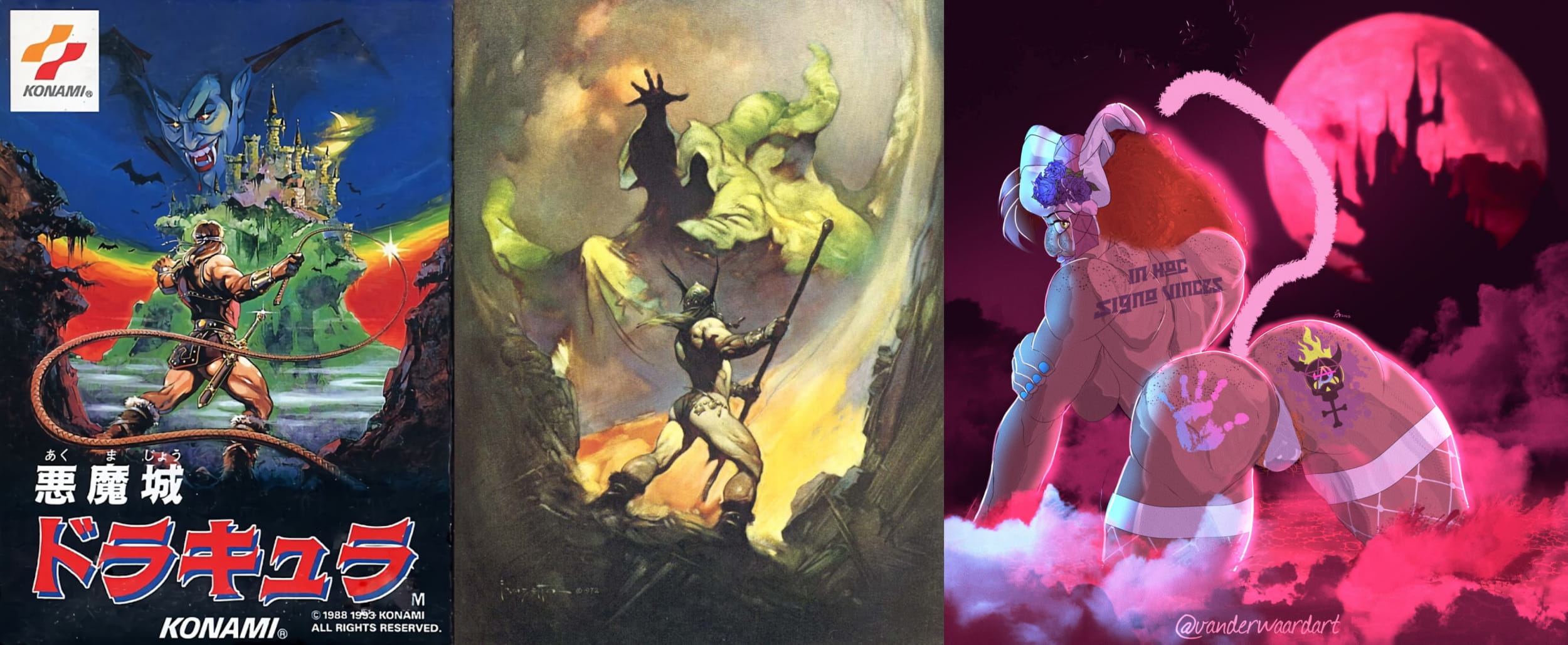
(source: left; artist, middle and right: Frank Frazetta and Persephone van der Waard—cited: "From Master's to PhD," 2025)
I digress. We'll get back to Brigitte in a moment. For now, some theory to "load the gun" as already fired. We'll quote and define some shit—namely Gothic terms from other academics alongside myself—then walk among the tombstones before returning to Brigitte's argument as one-of-many (and where my own Promethean, Ozymandian refrain revives Medusa on repeat: her-buns-were-there). So capital gives us strange appetites; i.e., while kettling us, we wretched of the Earth trawling for clues the dead who came before (so to speak):
Capitalism achieves profit by moving money through nature; profit is built on trauma and division, wherein anything that serves profit gentrifies and decays, over and over while preying on nature. Trauma, then, cultivates strange appetites, which vary from group to group per the usual privileges and oppression as intersecting differently per case; i.e., psychosexual trauma (the regulation of state sex, terror and force) and feeding in decay as a matter of complicated (anisotropic) exchange unto itself, but also shapeshifting and knowledge exchange vis-à-vis nature as monstrous-feminine: something to destroy by the state or defend from it (and its trifectas, monopolies, etc) using the same threatening aesthetics of power and death, decay and rape (source: "A Cruel Angel's (Modular) Thesis," 2024).
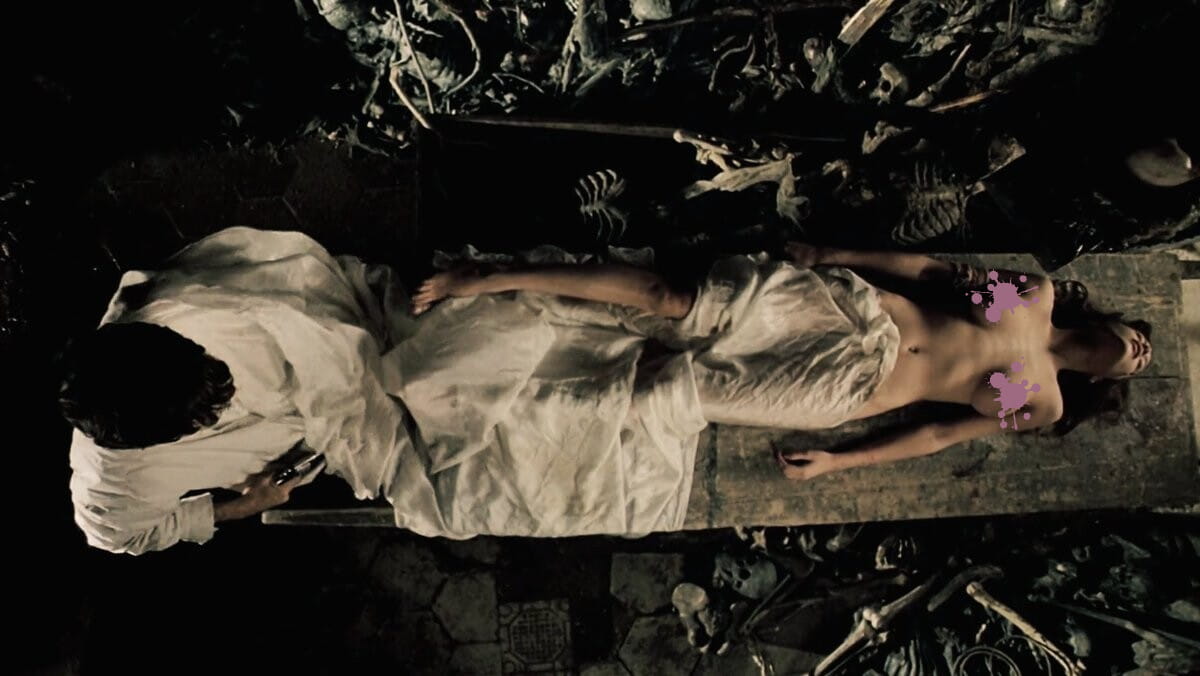
In turn, power is something to quest for in deeply satirical ways (read: the Medieval and poetic hyphenations, ergo bad puns; e.g., graveyard sex, incest and necrophilia rooted in highly campy forms, above), and of which a little theory goes a long way (to prevent confusion and avoid harm)!
Some Theory
I already camped Marx; re: "The tradition of all dead [whores] weigh like a nightmare on the brains of the living." To it, workers are not exempt from such things, but also any abuse of these devices needn't preclude a better dialectical-material usage. But said usage remains classically fake to some degree, thus alien, imposturous, what-have-you; i.e., from Hogle's ghost of the counterfeit, vis-à-vis Punter and various Gothic yarns:
In the Gothic from the later eighteenth century on, as David Punter has shown, "the middle class" often does what we have just seen Leroux do in Le Fantôme: it "displaces the hidden violence of present social structures, conjures them up again as past, and falls promptly under their spell" with feelings of both fear and attraction towards the phantasms of what is displaced (Punter, 418). The Gothic, well before Leroux adopts it, enables a growing bourgeois hegemony to be both haunted by and distanced from the "hidden barbarities" that have helped make it possible (Punter, 419)—and hence the repressed uncertainties it feels about its own legitimacy (as in Abraham's "phantom")—by projecting such anomalies into the horrors of apparently old and alien specters, buildings, and crypts (source: "The Ghost of the Counterfeit: Leroux's Fantôme and the Cultural Work of the Gothic," 2002).

(artist: Darek Zabrocki)
As I write,
The Western world is generally a place that testifies to its own traumas by fabricating them; i.e., as markers of sovereignty that remain historically unkind to specific groups that nevertheless survive within them as ghosts of unspeakable events linked to systemic abuse. Trauma, in turn, survives through stories corrupted by the presence of said abuse. There is a home resembling a castle, where a ghost—often of a woman—lurks inside having been met with a sorry fate. But undeath is something that can be felt through echoes of ourselves that aren't diegetically spectral; they feel spectral through an uncanny resemblance, like standing over our own graves. This becomes something to play with during ludo-Gothic BDSM [rape play/calculated risk], akin to an (at-times) humorous, even trashy gallows theatre [camping our own holocaust as] rife with dark, forbidden language: sin, vice, violent sex, all-around death, and other taboo subjects discouraged by privileged (and unimaginative) moderates who historically frame the Gothic as a puerile, good-for-nothing backwater while simultaneously suffering from conservative delusions of privilege and/or tokenism (re: Jameson). In other words, the pedagogy of the oppressed faces its classic foil: tone-policing (source: "Healing from Rape").

(ibid.)
The point being that performance and power mid-satire revolve around things that others might be too quick to dismiss; i.e., not just Brigitte, and not just bogus but useless—especially when facing a foil of such things monopolizing the very ideas at work; re: home is false, a place of theft that sucks on workers under different spells. These functional rebels less abandon and more reverse, mid-dialectic—cryptonymy-and-abjection a kind of satire, exposing the black castle under the white as Gothic has since Otranto (1764) while borrowing dualistically from, and building on, the same predator/prey dynamics and power structures and struggles (re: "Prey as Liberators," 2024). Again, home isn't just false in Gothic, but predatory in ways I call "state vampirism." We challenge this however small or silly we seem, but action and satire remain at play while exposed, hand-in-hand. It's not strictly silly or serious, but borrow from older forms that paradoxically marry the two in duality (e.g., the jester's privilege, below): "Reader, I clowned on him." Such costumes are ghoulish on both sides, but anisotropically for nature or against it as monstrous-feminine (the whore's revenge versus the pimp's).

(source: Christie Thompson's "The ICE Protest Frogs Have a Long History of 'Tactical Frivolity' Behind Them," 2025; cited: "Tactical Frivolity," 2026)
Consider, for example, the frog-suited resistors punching up against ICE. Doing so around America and the world, these performers imitate those who did, do, will do elsewhere as concerning a more active and aware form of performance within illusion; i.e., that fascists historically steal, DARVO-and-obscurantism, to fleece the locals and bleed them dry/convert them to the same vein, skull-equals-theft (re: Radcliffe's Black Veil and refrain, which historically hid pirates inside the house pretending to be ghosts). From Baudrillard's hyperreal expressing an illusion or simulation as, however perfect its "likeness" outwardly seems (or equal to reality a certain joke might seem), nevertheless hides a "desert" behind which empire has either long since expired or is dying among the bones of its own victims (alluded to not just by Mary Shelley's Frankenstein, but partner-in-crime Percy Shelley's "Ozymandias," 1818). Inside such spheres (re: Aguirre's infernal concentric pattern), such actors very much take praxis to the streets (a form of disorderly action steeped in entropy to allow for change). We learn to see while blindfolded: "Look on our Works, ye Mighty!" So confusion and power share the same zone, Cervantes' "tilting at windmills" from Don Quixote (1605) both a commentary on delusion and speaking to dragons behind the veil (which Tolkien [and more recent authors] have long since used to critique modernity in dated forms of treasure and torture; e.g., goblins, below, something we cryptonymically reclaim from Tolkien; re: "Goblins, Antisemitism, and Monster-Fucking," 2025).

(artist: Lucid-01; cited: "Ladies First; or, the Grift of False Rebellion," 2025)
Frogs, goblins, and other sinful beings (a kind of Gothic heroine trapped "in Hell" while on Earth, if you wish)—their ideas did simply emerge ex nihilo, nor are they merely Jameson's "blank parody*" falling into endless replication; i.e., the lip-service-y sort that doesn't extend to meaningful action, but performative blindness-as-paid-for (and one Jameson extends to Gothic as "failing" in this respect, but he's full of it; re: "The Future Is a Dead Mall," 2025). The way out of the labyrinth occurs within, reversing abjection upon a black mirror the state cannot monopolize, and one that shows and hides different things; i.e., through the abjection process and its fakery rooted in illusion (what Swift would call "splendid lies," Milton "darkness visible," Plato "shadows," Hogle "cryptonymy/a vanishing point," etc). Time is a circle, such things and their paradoxical utility pulled back and forth; i.e., in ceaseless duality while seeking wisdom among oblivion; re: the state sucks ("dead labour feeding on living labor"), and so do we. It pimps nature to whore nature out, raping it; born into a world that rapes our bodies and empties our brains, we have the whore's revenge upon ourselves and our bodies/art of said bodies: to place, side-by-side, and dig up afterwards that oldest of struggles (the liberation of sex work) as far from done. Instead, the Gorgon and her "tendrils" express positivity and liberation as cursed—by state predation hounding the corpse! We bounce such things back, losing our enemies along the way while showing our friends our ass (and the "marquee" secrets it holds).
*As he writes in Postmodernism, or the Cultural Logic of Late Capitalism (1991): "Pastiche is, like parody, the imitation of a peculiar or unique, idiosyncratic style, the wearing of a linguistic mask, speech in a dead language. But it is a neutral practice of such mimicry, without any of parody's ulterior motives, amputated of the satiric impulse, devoid of laughter and of any conviction that alongside the abnormal tongue you have momentarily borrowed, some healthy linguistic normality still exists. Pastiche is thus blank parody, a statue with blind eyeballs" (source).

(source: bottom; artist, top-left and top-right: Blxxd Bunny and Persephone van der Waard)
Gothic employs satire, mise-en-abyme—specifically a kind of active, seemingly blind and vulnerable satire whose paradox of exposure saw me coin ludo-Gothic BDSM (rape play and calculated risk); re (to give a longer definition):
ludo-Gothic BDSM
A new term I coined, one regarding unpaid labor—primarily sex work's—reversal of abjection through revolutionary dialogs (and Gothic counterculture) to challenge state vampirism using ludo-Gothic BDSM:
Per Marx and myself, Capitalism alienates and sexualizes everything. Nature is monstrous-feminine as such, "empowerment" applying to any aspect of our life, bodies, violence and terror the state wishes to monopolize/control, and any trope, convention, cliché or fetish that might be used to degrade, humiliate, rape or otherwise demonize/dominate beings "of nature" per capital's qualities (re: settler-colonial, heteronormative and Cartesian); i.e., that we can reclaim during ludo-Gothic BDSM [...]
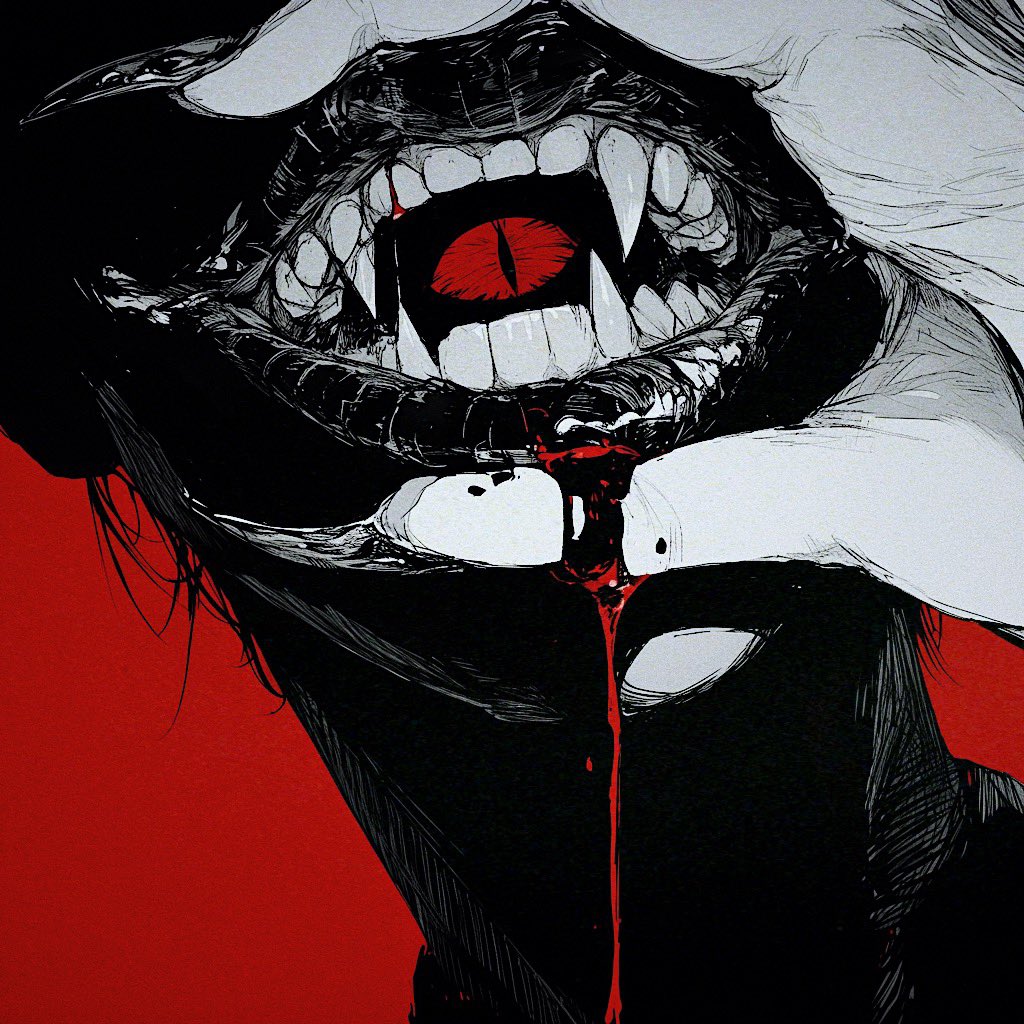
(artist: ALT3R4TI0N)
To do so is to break capital's hold on all things demons, darkness and nature they stole and monopolized, in turn smashing their own abjection against them and breaking Capitalist Realism with our Aegis—to deny capital's dead labor and language feeding on living labor and language according to what power and knowledge we exchange to and fro. The whore's revenge is to break the profit [and productivity] motive by making a world for which it (and rape) are no longer possible using these methods; i.e., by using the same demonic and slutty language capital does, but at cross purposes: to hug the alien—not demonize it to receive state violence—thereby (ex)changing how the world is seen to begin with (source: "Rape Reprise," 2024).
Satire isn't dead, in this case, but undead, which brings us back to Brigitte's claim that satire has somehow "died" (too unironically for my taste). The details of its death have been greatly exaggerated (not helped by Kripke and others, of course). We'll do so "among the tombstones," raising the dead for satire's fearsome resurrection!
"Among the Tombstones"; or, the Liminality of Gothic Satire (and the Value Therein)
When I say "among the tombstones," I mean as the Gothic and its satire do: amid the endless, half-real fakery and echoing references of semi-dead things, brought happily back to life under liminal conditions; e.g., cyberpunks and Amazons embodying the same-old satire through the usual levers of power (actual guns, but also weapons-and-armor nudity known to them and Gorgons)! "Oh, we're 'dead,' huh?" I tease Brigitte, shaking my weapons at her on the Aegis we both share. Such is Gothic: silly and serious, but also routinely revived, mid-echo, through various puns, taboos, sources of excitement and fear to Numinous, anti-predatory extremes found inside crisis-as-structure. There a stake is a stake, but one whose much-lauded, vaso-vagal penetration delivers poetically threat and offer as useful to different dialectical-material means; i.e., that, like the Amazon and the Gorgon (and similar modularities), aren't always clear up front regardless of aesthetic (the vampire's tell-tale black-and-red always a classic, below): "Are you here for peace or for war?"
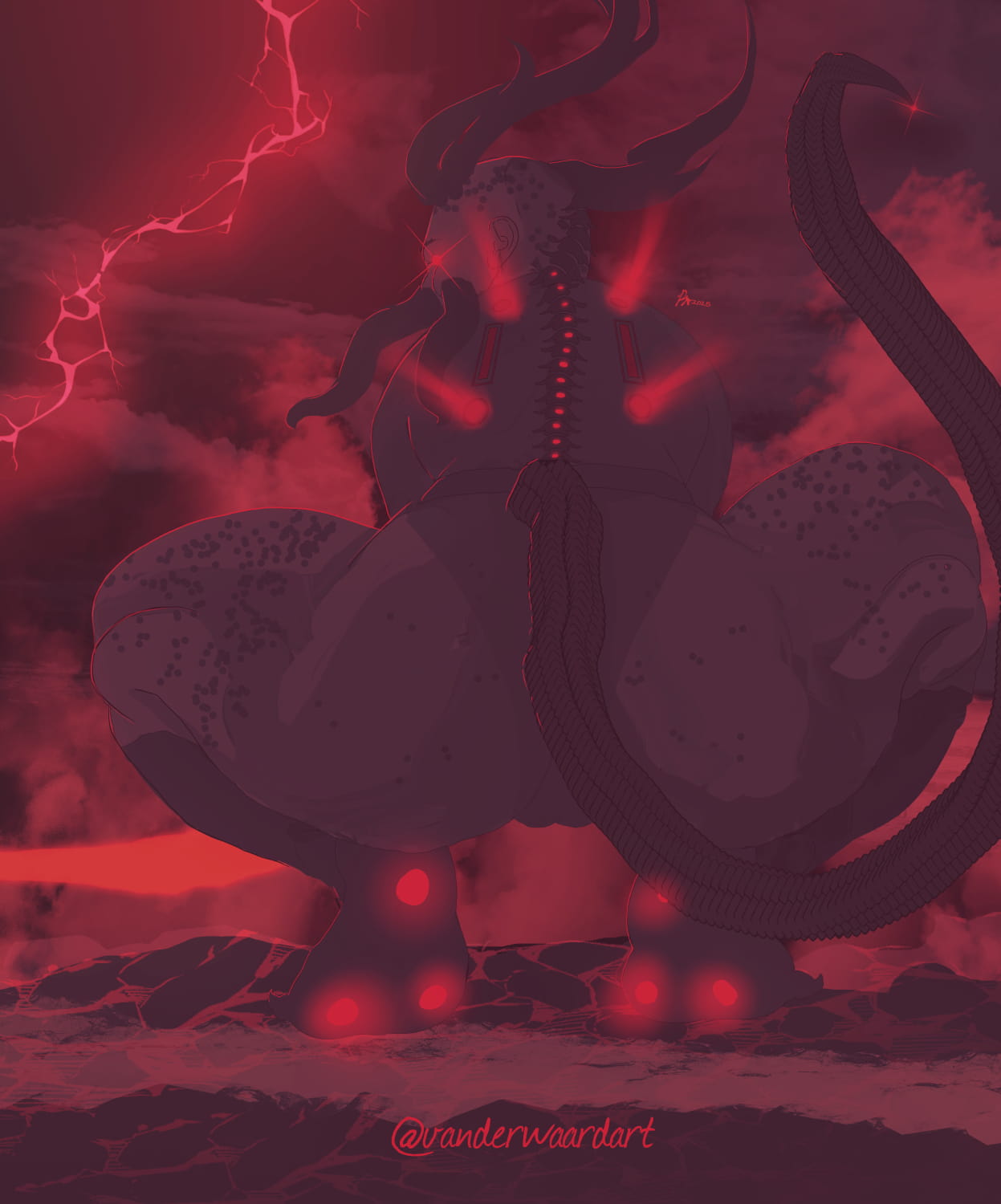
(model and artist: Maddie Minx and Persephone van der Waard)
So we satirically show others our ass, but differently mid-duality than the state and its gargoyles—with bite, flowing power towards ourselves in actionable ways; i.e., that discover inside the maze where people are, and that simultaneously imitate the confusions life offers under generational trauma (which capital replicates for profit):
It's not just an otherworldly aesthetic, but ability to command power in paradoxical ways both strict and gentle, light and dark, etc; i.e., like Medusa, whose "shadow" (simulacrum) Maddie nails with aplomb. It's "to meet someone where they are," my husband explains—appearing fierce but actually a sign of respect (as the Maori phrase it), one made seemingly to ask, "Are you here for peace or war? The land welcomes you and you it" through various profound exchanges crossing boundaries; i.e., building a rapport between host and visitor(s) from tapu to noa (a ritual of sacred restriction* to ordinary/safe, moving energy in warrior-like ways)
*"The ātea (space outside)," Bay explains, "is considered the domain of the God of War (Tūmatauenga), while the wharenui (meeting house) is the domain of the God of Peace (Rongo). The ceremony moves visitors from the domain of war to peace." It's very Gothic! (source: review for my cover model for Volume Four of my book series, Maddie Minx).

(source: Gymeagary's "Tamaki Wharenui within the Clan Marae," 2015)
A champion of the people speaks for but also among the marginalized in terrifying zones, the very graveyard sort that however embedded/concentric they seem nonetheless bleed into reality and for which reality bleeds back (and which Gothic theatre does, novels or otherwise). Terror or otherwise, there's always room for play and revival in defense of the land and sustainability (Gothic Communism written with Bay's help, an Irish-Maori ecologist).
And here we arrive at Brigitte's tombstone, the corpse of their own argument "in strange aeons." Burying the aforementioned lead (or bishop) aside, Brigitte's argument—once it dropped the mask, like Chaplin—presumed a monopoly on satire and its function, which frankly isn't possible. As the above examples show, all language is dualistic, the spaces, costumes and bodies thereof shared by different parties for different aims, mid-masque; e.g., Amazons being classically subjugated in token ways workers can camp to further action—and through subversively Promethean advertisements; i.e., of more-than-capable, warrior-like bodies breaking boundaries in weaponized satire, stealing power from the past while arguably "of it" (above and below):

(artist: Persephone van der Waard; source: "From Master's to PhD," 2025)
Again, it's workers vs the state, generally regarding monstrous-feminine beings of violence, terror and morphological expression as given and received (re: "The State: Its Key Tools" from "Paratextual Documents"): controlling sex through force, therefore all of nature under Cartesian norms with heteronormative, settler-colonial and ultimately Patriarchal flavors treating nature as monstrous-feminine; i.e., "homo sacer" (which whores are) under nuclear models (which feed under false flags calling for pre-emptive revenge). Such things aren't merely generational, but concentric and Numinously buried alive! Power remains in ways we might seize upon, regardless. We must or we won't survive, but endure all the double standards whores (or those treated like whores) experience by pimps (de facto or otherwise, below). Indeed, with such a confederacy against us, what's a girl to do but use what she has to prevent harm however she can, the-horse-before-the-cart?
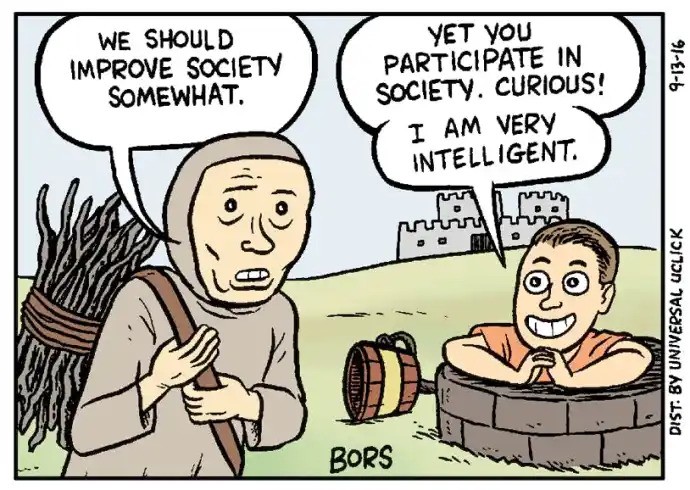
(artist: Matt Bors; cited: "Dead on Arrival")
States chattelize, needing sex to survive; i.e., concerning nature more broadly as something to "pimp out," accordingly. To put it bluntly, they rape by design; re: under the usual cops/victims contradictions, demonizing nature to tokenize, then gentrify and decay* back into unarmed submission (with Cameron's Ripley a deeply pernicious example—something to couch forever inside motherhood-as-compelled, a White Indian genociding black planets†; re: "Unto the Breach," 2026). In the graveyards where capital lives and dies, workers desperately seek protection and performative isolation among the home-as-false, specifically doubles thereof; e.g., evil monks and femme fatales; i.e., Lewis' The Monk and shapeshifting Matilda stressing bad actors while outplaying them: in the usual dogmatic spaces of concealment and abuse, any state variety levied against our own. We drink from the same chalice, one the state can't monopolize. "Terror is the kissing cousin of force," Asprey notes, reinvented by state authors playing at detectives (re: me vis-à-vis Crawford, 2013; see: "Radcliffe's Refrain"). Capital scapegoats such things to prey on nature; we summon things to play with them, thus understand desires for protection amid confusion that doesn't alleviate. We can only seek (as I'm doing here) and hope for the best!
*Called "enshittification," online, though the concept applies to anything capital touches under Capitalist Realism.
†Think "white skin, red masks," whose ensuing kayfabe reverses Coulthard's position (2014) to favor the colonizer acting the rebel in bad faith (a false revolution, as Parenti puts it, and one employed by good actors and bad; e.g., Autumn Ivy "taking the soup" while talking the talk; re: "Toxic Schlock Syndrome," 2025). A terror device like any other (re: Amazons and anal sex), we can reverse that in duality but must do so consciously "among the storms" (as Porpentine puts it, 2015). In other words, we share the same cave—one whose Platonic shadows have as much power to blind and tokenize as not. It's all about who we prey on and why (with Rasputin a hung-like-a-horse con man famously preying on the czars [which is awesome] but not exactly furthering Communism in the bargain).

(artist: Seb McKinnon; source: "The Nation-State")
Per Plato's cave (and simulacra), the lines between predator and prey straiten during crisis; i.e., nudity and danger the bait and the switch/strength that, thoroughly Stygian, appears paradoxically as "weakness." In turn, lies and alienation dualistically fetishize—a praxial distinction I generally frame as canon/camp, and which, "on the Aegis," are poetically anisotropic. These inform (and scrutinize) satire accordingly but canonically means whatever the bourgeoisie need: to play the victim and the hero then exploit whoever using dated, seemingly "dead" language. The usual qualities persist, mid-dress-up, a given assignment of value per object elusive (and futile). What are the porcupine's quills for? Which one's which?

Zombies, for example, are "homo sacer" or someone zombie-like to kill without ceremony during state crisis/the state of exception (whose "apocalypse" reveals this predation on the homefront; re: "Police States, Foreign Atrocities and the Imperial Boomerang," 2024); i.e., where Amazons—already an Athenian fossil having undead qualities (recipients of trauma that turn them into state feeders)—are commonly employed (and fetishized mid-deployment, above and below) to clean up the mess, but also be the mess should they bite their masters: naked and exposed to state censors and surveillance while handed a gun, use-it-or-lose-it. It's suitably silly and serious; re: exploitation and liberation sharing the same stage mid-satire of an ongoing Gothic, and whose Neo-Gothic revival in the late 18th century into the 19th suddenly saw a resurgence of femme fatales/fortes and monstrous-feminine. Even so, Lewis' crafty Matilda dualistically "flipped the script"; re: a cross-dressing assassin, one who infiltrates a hypocritical space of sin and concealment (and forty years before Hawthorne's "Goodman Brown") to take the privileged rapacious dummies therein apart (dissecting a corpse that doesn't know it's dead, similar to the drawing above). Satan's literally the hero of the story but, appearing femme and delicate, camps Milton for good measure decades before Shelley's Modern Prometheus in deeply Amazonian ways (re: from Broadmoor to me, 2021 and 2023).
Since we're here—and bridging the gap between Brigitte and myself, sharing the graveyard with so many other Amazons—let's holistically conclude this graveyard tour with some more! Why Amazons? Because they're my forte, my femme forte (thick thighs save and take lives, below)! But also, as terror weapons, can be played with to break monopolies; re: "Terror is the kissing cousin of force and, real or implied, is never far removed from the pages of history. To define (and condemn) terror from a peculiar social, economic, political, and emotional plane is to display a self-righteous attitude that, totally unrealistic, is doomed to be disappointed by harsh facts" (source: War in the Shadows, 1975). Shadow warriors fight shadows with shadows! So let's do just that, reviving them necromantically to play with Promethean fire! "Amazing chest ahead" (and various other puns, me at my most Gothic thus playful with dead things for their "booty"); time for a tangent, however sexy (the monstrous-feminine irony under Patriarchy similar to trans people, the latter satirizing straight existence in ways that sometimes tokenize, too)!

(artist: Lera; cited: "Amazons as Whores," 2025)
More Amazons; or, a Panoply of Warrior Ass: A Quick Peak at Some Zombie Babes, during the Promethean Quest
The past is littered with graveyards, containing bones of different kinds. That includes effigies of a marital character that defy modern standards and stereotypes, but also hauntologically uphold them if we're not careful (division is futile, regardless)! Such are Amazons, conjured for my service while seeking power (wisdom or otherwise) but haunted by various betrayals, per Promethean Quest: tramp-stamped with the same Numinous character in pauper/prince and lady/tramp ways when touring Hell (re: "I'll See You in Hell," 2025). The dualities remain/are all that remains when the spirit has seemingly fled. The Gorgon is not so easily packed off as that, but traitors still lurk among the midden (the usual Gothic impostors; e.g., Rowling and her autopsy bastardizing such things [and their Gothic pastiche] in bad faith, below). Shadows are confusing and shared by good actors and bad:

(source: Raven Smith's "J.K. Rowling’s Transphobic Tweets and the Erosion of the Harry Potter Franchise," 2020)
We all steal from the same "past," whose act of doing so I call the Promethean Quest on top of Shelley's own;
A stealing of power from the imaginary past; i.e., as half-real—quantum, but tied to reality (coming from Jesper Juul's "half-real zone between the fiction and the rules" [source] but for which I apply through ludo-Gothic BDSM to liminal spaces: "grey areas" of power and performance between fiction/nonfiction, commonly framed as "trashy" or "shallow" to disguise a critique of power [double operation] through camp/playing with taboo things; e.g., sex and monsters behind/upon various buffers; re: "Introducing Revolutionary Cryptonymy" and "Transgressive Nudism") (source: "Dead on Arrival," footnote 11a).

(exhibit 11b1b: Artist, right: Nya Blu. We all have skulls inside us. According to the Gothic tradition inside the Imperial Core, inheritance anxiety historically-materially communicates internalized trauma as suggested within workers but expressed according to their surface-level appearance in the material world; i.e., who, regardless of their origins, will be judged and consumed based how they appear relative to a cultural understanding of the imaginary past as something to constantly look at, vis-à-vis Segewick's "Imagery of the Surface" [1980]...)
i.e., stealing from the imaginary past (where power sits) in dialectical-material ways; re: where friend and foe are never obvious, onstage and off. So do fretful queries like "Who's behind the mask?" grapple with the usual "dead ringers" that historically-materially result, mid-dialectic: a continuation of tension abusing the usual tools* of espionage and war, mid-cryptonymy (and middle-class fear of highway bandits, from Radcliffe onwards). The more states kettle workers, the more they play (and otherwise use language) to navigate the present as "shady"; the more play occurs, the more is left behind, mid-regression. Duality is part of the puzzle—something to play out and learn from, then take up the mask yourselves; i.e., one you can't learn from without playing with, the secret to liberation buried inside and hiding upon the surface of a given veil (re: Segewick [above] alluded to by Mercedes' fetish-gear "mil spec," below)!

(artist: Mercedes the Muse; cited: "Toxic Schlock Syndrome," 2025)
However Quixotic or "thirsty" such play appears, there's a lesson to be had; re: when conjuring dead whores (which Amazons are): on ourselves. "If you want to critique power, you must go where it is" (source: "Interrogating Power through Our Own Camp," 2023); i.e., you must reify it in duality as inevitable, time merely a circle under capital yielding such refrains. This means the graveyards that crop up in its wake, the Gothic rooted in power of a chronotopic sort (re: Gothic castles but also those who embody them in good faith and bad, above and below). Pussy-on-the-chainwax, we play the same games for different prizes; i.e., wearing all manner of campy outfits that fool others "for a time." So do lies and force walk a tightrope (sex a classic lie to fool others with, whose means of doing so can control an otherwise unstable scene).
On one hand, a pale rabbit—the most foul-tempered rodent you ever laid eyes on! Then again, Trojan bunnies invading this or that (the Trojan Horse made by Athena like the Aegis was). Who's the cop and who's the whistleblower? Chaos, then, is endemic, the game being played to simulate reality as Absurd, Numinous, Weird, etc—part of war as preceded by reliable confusion, under capital's usual fumes (the cause and the effect). In turn, all war predicates on deception through the usual dualities at work (with play [and poetics] a form of work that ludo-Gothic BDSM illustrates through past "run ins," below). Hilarity often ensues, but also bare-skinned shenanigans of some kind or another (rooted, as they are, in the language of distant "barbarian" things come home to roost; re: "Gothic" as Baldrick puts it, a deeply confusing term inherited from others).

(artist: Autumn Ivy; cited, left and right: "Death by Snu-Snu" [2024] and "Toxic Schlock Syndrome," 2024 and 2025)
I digress. Centuries after Lewis, zombies and Amazons would seem (to the untrained eye) fully played-out—a dull, toothless trope (and one he authored as a British MP after Walpole [son of the first British prime minster] wrote the first Gothic novel, The Castle of Otranto, before passing it off as "historical document"; re: "Gothic" fakery and action, as Walpole called it, rooted in play to perform with dead things of many different kinds). And yet, state forces (the ruling class) cannot monopolize satire, therefore satire doesn't have one set function. But the performers nonetheless operate under preset conditions—those they try, however futile that might seem, to change through satire-as-action; re: function flowing power up or down accordingly in ways that do sell out (as Autumn arguably did, above).
Workers operate for ourselves or the state, in this respect, selling out or not selling out; i.e., mid-performance satirically adopting the usual Gothic qualities and devices in duality. There's always a double, "darkness" meaning a great many things:
Under Capitalist Realism, something is "dark" if it ostensibly moves anything of value (re: power and knowledge) away from the status quo. Generally this darkness is associated with the vengeful imaginary past based on buried historical atrocities, the latter paradoxically twisted by the former to keep control right where it is (among the elite). Anything that challenges this paradigm is canonically framed as dark, evil, profligate; i.e., nature as vengeful whore, which capital takes revenge on through DARVO-style police violence/obscurantism, witch hunts, tokenism and moral panic; e.g., Medusa and her Aegis' forbidden sight (source: "Demons: From Composites and the Occult to Totems and the Natural World," 2024).
To it, abjection may further or reverse using different monsters, which commonly assume campy, kayfabe-style theatrics as old as Plato (Gothic castles, while hauntological, being far more recent)—an Athenian aristocrat whose own nickname, "Platon," meant "broad-shouldered." Brains and brawn characteristically share one's body-as-stage, strength dimorphically arranged yet classically upset through shadows in more recent seances: our panoply of zombie babes and warrior princess ass, a given hauntology pushing into GNC realms that modern language employs while gazing upon Antiquity (as burly and hairy but also weirdly nurturing to onlookers; i.e., in vampirically witch-like or werewolf-ish ways, below).

(model and artist: Autumn Ivy and Persephone van der Waard; cited: "Amazons")
From Plato to us, politics and satire were not discrete, anymore than kayfabe wrestlers are, today, or Marx from his own immortal spectres (or others from his; e.g., Derrida and Castricano, 1993 and 2001). The same goes for Gothic and its poetics' and our own sex, drugs, rock 'n roll demonstrating how human language routinely works; i.e., concerning power performed in the same dualistic, half-real ways I forever point out, mise-en-abyme (again, while favoring Amazons and Gorgons). That's called "teaching" and every lesson we embody leaves a double behind, behind, behind... All share the same stage, the same Russian-doll Aegis as states recursively enter crisis, boom-or-bust. They do so by design, and workers can either aid or resist the predation that occurs before, during and after these critical junctures.
To conclude this funhouse (which haunted houses generally are), monsters = arguments, death as much an aesthetic as a functional indicator of one's political stance and all-around efficacy that sends terror up or down ("undeath" both a curse and a gift, depending on circumstance and usage). Superheroes reify such elements; Amazons or otherwise personify the usual castles (and their satire) "on the move": as shadow warriors, Medusa (and her killer) waiting patiently and dualistically among the ruins. "Those who fight" keep fighting to camp the procedure without end—to place "rape" in quotes, ludo-Gothic BDSM "storming the Gorgon's castle" again, again, again; i.e., with and within puns, fun, silliness, and good-old-fashioned conquest: to surreptitiously acclimatize the viewer as a player with some degree of fluency and agency despite the maelstrom simulating capital's mess and mastering of them in more underhanded* ways (and where players can identify with anyone onscreen, below).

*The ludological, ontological and pedagogical overlapping each time:
Game mastery is a large part of my research. However, I'm interested in players being dominated by the game, not the other way around. Seth Giddings and Helen Kennedy touch on this in "Little Jesuses and *@#?-off Robots" (2008). They write:
conventional assumptions that players learn the game system to achieve mastery over it—and that this mastery is the source of the prime pleasure of gameplay—is in fact an inversion of the dynamics and pleasures of videogame play. Games configure their players, allowing progression through the game only if the players recognize what they are being prompted to do, and comply with these coded instructions (13-14).
This backwards means of instruction is Radcliffean in our aforementioned Amazonian satire: the black castle (and Veil, inside) appear and must be explored, incentivizing players in safe/dangerous ways (and monomythic code with Promethean elements; e.g., heroes, damsels, swords, and bad guys) that never fully divorce from real life; re: half-real—with videogames rising under neoliberalism in ways that, similar to Amazons, are used to hypnotize and motivate players (thus workers) to conduct violence in real life. "Hidden" is both a theme and performative device to show/conceal this-or-that for different parties. The more "chaff" the elite flood the market with, the more we occupy to yield better vision wherever we are! Everyone tilts at windmills to some degree; do it to "tilt" things to our advantage (with me conjuring Amazons as regular teaching devices)!

(cited: "Policing the Whore")
Got it? "Alright, everyone, let's mosey!" Onto Brigitte's final resting place, specifically her thesis argument as something to dissect and salvage (the best for last)!
A Cruel Angel's Thesis: Dissecting Brigitte's Argument before Salvaging it (a Ghoulish Quickie)
Tombstones surveyed! Now let's return and finally-yet-quickly dissect Brigitte's argument, then salvage it while keeping the prior sections in the back of our minds (monsters = satire as political action, including enjoyment mid-crisis keeping us and our stories dualistically alive; i.e., in deeply ludological ways that bear a Gothic stamp, below). I'll make it quick, then close things out!

(artist: Mike Judge; cited: "Challenging the State's Manufactured Consent and Stupidity," 2024)
Dissection
Brigitte first says The Boys "failed at satire," only to then say deeper in the video—indeed, nearly towards the end—how satire cannot achieve action; re: by building an alternative to a world "beyond parody" (often of so-called "heroic" figures) through these aforementioned points:
- One, this argues that parody is no longer possible in Trump's America, which is to say monopoly Capitalism in its neoliberal form decaying into fascism around the world (as global US hegemony extends to Britain, where Brigitte lives).
- Two, it makes The Boys' failure theoretically impossible, insofar as satire cannot succeed to begin with (or so Brigitte says, not really specifying what failure and success mean for workers vs owners beyond "satire isn't praxis").
- Three, it presents satire simply as humor or the absurd that focuses myopically on single persons or scapegoats.
- Four, satire is something—described collectively as "we," "our" or "us," by Brigitte—that would appear to belong entirely to the ruling class: Erik Kripke of The Boys and Matt Parker and Trey Stone of South Park; i.e., as that most banal of evils, pooping out bread-and-circus (don't blame Dada for fascism).
This isn't just false (while tying "us" dubiously to the ruling class), but I frankly can't see Brigitte drawing any other conclusion while using those examples; these men are/serve billionaires, thus have vested interests similar to Fox and The Simpsons' gradual self-lobotomizing into "braindead" forms, over eight-or-so-seasons (versus The Boys "speedrunning" its "brain drain" in two or three). Red pill, blue pill; no one controls the pharmacy nor its distribution, those who refuse to change (or help others) merely pimps content with the world "as is": a dearth of empathy behind a "human," uncanny skin mask (and setting aside token "pinkwashing" examples, for now).
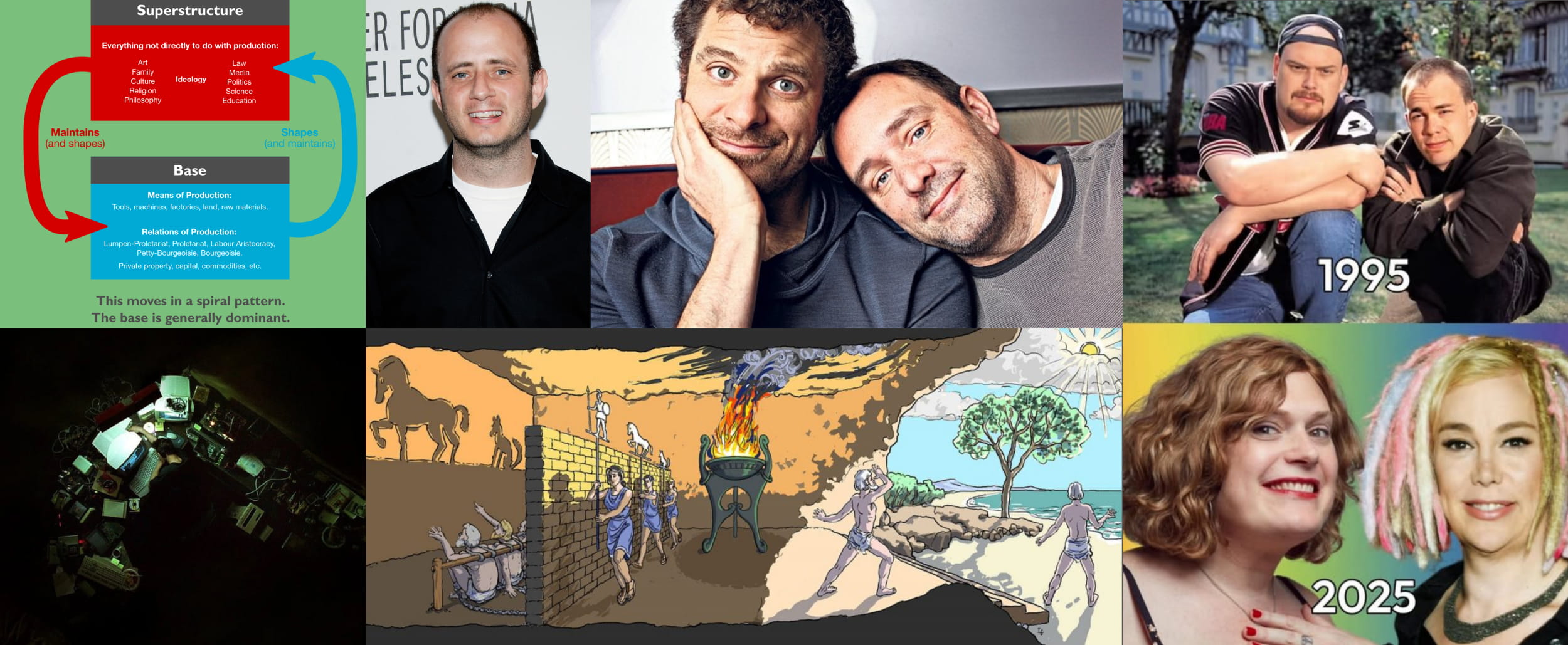
(source, top-left: Rana Indrajit Singh's "Base and Superstructure Theory," 2013; bottom-left; bottom-middle; right: Facebook)
Such operators don't work in a vacuum, and some change while inside. The straights usually don't because the state favors them (excepting those who actually reflect, post-gaff, like Fredrick Brennan), while others change to voice what normally hides "in the cave." These performers satirically show what was always there, as with trans folk; e.g., the Wachowskis (aping Plato, above) but also myself as changing overtime to showcase living ironically in ways that satirize the status quo; i.e., existing in public as performers in different ways; re: from Milton's Satan to those who run with the devil more actively than he did (famously a blind man): existence as satire, which requires action to punch up by existing in Gothic ways. En medias res, out of the closet and into the fire (of the gods)!
So we transform after we're born—born again to leave us feeling bare-and-exposed in ways that regain their monstrous-feminine "teeth"; re: among the tombstones, writing a book that I seemingly never want to put down (mine, my mind laid purposefully bare). We are all that "most clever of witches," working with our own variant of Prince Hamlet's commonplace book:
I'll wipe away all trivial, fond records,
All saws of books, all forms, all pressures past,
That youth and observation copied there,
And thy commandment all alone shall live
Within the book and volume of my brain (source).
Here, the whore's revenge is had—not Plato's fear of the death of memory but a revival and strengthening of it, accordingly! The sword and the shield, but also the pen growing mighty like the sword. "She mighty mighty!" To that, nothing's writ in stone, the Medusa (and those who dualistically embody her in service to nature) are harder to kill than state gluttons would like. We transform to haunt our proceedings, bringing new life that doesn't merely dodge the axe but prevent its swinging down the road. "The tree remembers." Does Brigitte?
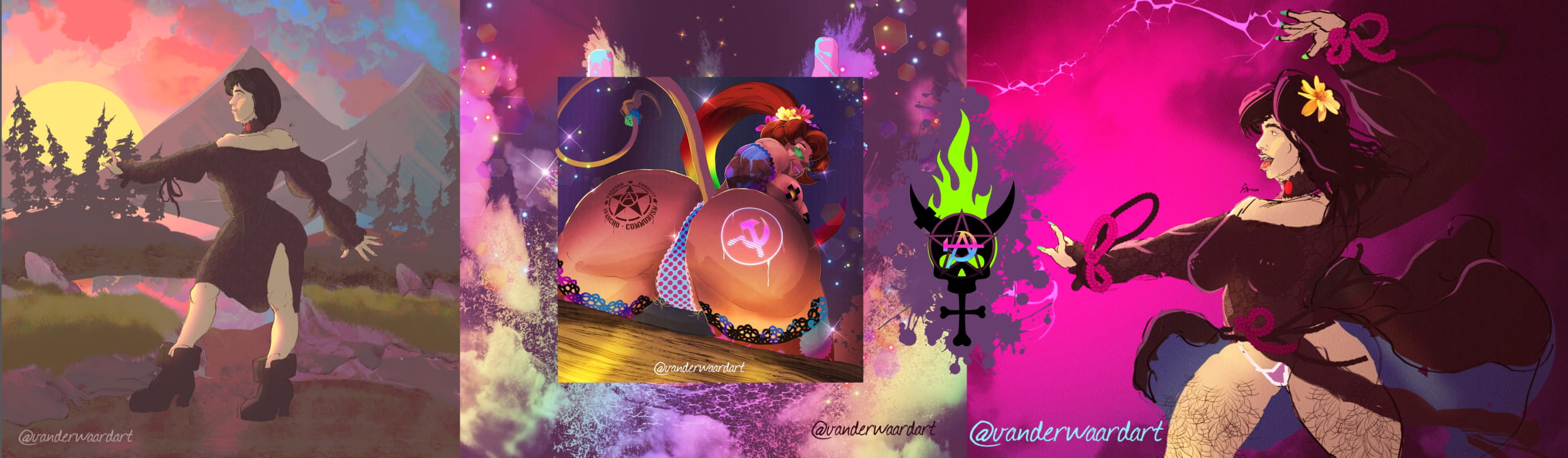
(artist, Persephone van der Waard: left, middle inner/outer, and right; source: "I'm Still Here," 2026).
To that, and keeping stories like The Matrix (and its queer iconoclast authors) in mind—but also Frankenstein, Paradise Lost and Plato's allegory of the cave from Republic—any action occurs within illusion as extant, endemic, and endless in all directions; i.e., human language itself a form of play regarding power-as-performative, simulating reality as idealized, chaotic and half-real. Paradox is par for the course, in this respect, and key to our liberation when used in ways conducive to action as satirical, mid-confessional; re: through a dualistic nature of things, mid-Gothic. Satire can be done by anyone, not just billionaires, and remains satirical amid humanistic appeals to drop the act; the flow of power succeeds for them when it flows up, and for workers seeking liberation when it goes down, either side furthering or reversing abjection, mid-cryptonymy. We share the same pot, stirring it in duality for diametrically opposite aims: what you're fucking with!

(artist: Michael Whelan; cited: "Replying to Jon Barbas," 2025)
In turn, my books (and those who helped make them) "hold the spoon," borrowing from the likes of Ann Radcliffe and Matthew Lewis (the early Gothic famously produced by women and gay men); i.e., who themselves before Shelley already borrowed and built upon Ovid, Dante, Chaucer and Shakespeare's various transformative (and taboo) works; e.g., those like Metamorphoses (c. 8 AD), Inferno, "The Miller's Tale" (c. 1380-1390) and Titus Andronicus (1593)—all to draft a witch's-brew concoction that might yield better outcomes when poetically "drunk" (as food for thought).
So if satire is "dead," as Brigitte posits, it can very easily revive in ways more conscious—undeath not simply the blind and drooling dead to walk the Earth for target practice (as the state wants), but something more aware; re: as older authors have touched upon with darkness visible, those so-called "spectres" Marx conjured to his service not exclusive to him (with Mary Shelley releasing her own Cartesian polemic the year Marx was born). There's nothing "new" under the sun, anything as gross or eye-opening (so to speak) in The Boys done, millennia prior, by Sophocles' Oedipus Rex (429 BC)... before then being one-upped by Horace Walpole in his own double-incest parody, The Mysterious Mother (and alluded to by even more recent [and openly queer] reenactments, below):
Whatever the form, there's always something stranger and unequal in terms of power to uncover (and play with), behind closed doors; i.e., Gothic nostalgia, abjection and poetic reinvention walking arm-in-arm with politics, philosophy/paradox, poetry and shadowy spaces of play since Matthew Lewis (ripping pages from Dante, Shakespeare and Milton as Broadmoor argues, among many others by his own account): an open-secret gay man collecting oddities/darkness visible from "confirmed bachelor" Horace Walpole's Strawberry Hill and its corresponding media's giant, fake, castle-grade museums of wacky psychosexual strangeness, warring ideas/fears/desires (e.g., rape[3]), and alien taboo things (a "sinister corner of the Western imagination," as Baldrick tells it—1764's Otranto, yes, but also double-incest[!] yarn, The Mysterious Mother, inspired by Sophocles' Oedipus Rex[4] [429 BC] and never meant for widespread publication or consumption). Gothic plays with "past" as a flexible document, not something writ in stone—one in where exploitation and liberation occupy the same spaces, onstage and off: used by actors, good and bad, through different aesthetics in duality that poetically interrogate and send power flowing up or down.
Theatre—but especially Gothic theatre—allows for violence without harming anyone, commenting paradoxically on unspeakable things through "darkness visible" (or whatever you want to call it):

(source: "Room for Both: Horror and Social Commentary in 3 Japanese Classics," 2018)
Sublime, Numinous, Absurd—satire is satire, Brigitte; per Gothic, liberation anchors in fakery while "inside the castle" as fractally recursive. To say "satire is dead" then call for action is to mislabel the cure, close one's eyes and fumble around in the dark, mise-en-abyme. One sympathizes, but far be it from me to keep quiet when I might just as well point out, "Yeah, we can't just unmask the villain, then say 'All is well' (as Rowling did, her own Gothic pastiche aping Scooby Doo's palimpsest, Radcliffe). We have to take the same devices and use them to make people aware, meaning enough to act in ways that speak out and conceal, onstage and off." Better to rule Hell than serve in Heaven, but such pandemonium requires things both taught and not taught in school; re: my books borrowing from column A and B to synthesize praxis, marrying satire with action in highly poetic and, yes, sexy ways (not Chaplin's forte, I fear); re: to be gayer than Marx, thus funnier and sexier than him to break Capitalist Realism (which The Boys fails to do, and which Brigitte correctly asserts). Same goes for Chaplin, Matthew Lewis, or anyone else; i.e., they're a starting point, not a destination!
That's enough dissection. Let's quickly modify or salvage Brigitte's argument, then wrap up!
Salvage
This is where satire (and Gothic) really shine—not as clones with identical function to state-penned supermen (whose costumes and masks cloak Kiwi copycats and IDF impostors), but our own variants' dualistic operation to flow power down to ourselves (ergo all of nature exploited by state powers). Brigitte argues how Charlie Chaplin did this by breaking the boundaries of satire, a kind of mask to discard. "Satire is an onion," I would reply (taken from Lewis and his own medieval metaphors camping the Black Veil Radcliffe helped make unironically infamous and lucrative); "it has layers." Indeed, satire's function goes beyond mere commodity to paradoxically direct workers towards salvation; re: while inside a given maze, which Gothic explores through interrogation of the home as dead, alien, waking up to eat people—the house-as-zombie, vampire, demon, werewolf, evil Italian monk, big-booty ghost (of the Gorgon and her peach squeezed previously by state "juice men," below). Whatever the form, the paradox of exposure cuts both ways, letting us testify to a given curse while paralyzing the very things that normally feed in silence behind closed doors; re: Plato's cave. Gothic, by comparison, invites those who stare to cross over and see what's behind (so to speak)!

(artist: George Roux; cited: "Paratextual Documents")
Some might call it absurd, played-out like a piano. I call it Numinous, "where power is" a thing to find and use in better ways than white straight men with corporate ties. Brigitte even highlights the issue in her video description: "Liberal writers try to imagine a world where systemic change is possible instead of just killing the most evil guy in sight challenge*: impossible." However, she then writes off satire entirely, effectively handing it over. She does so despite how satire and the breaking of its prescribed boundaries—to occupy a productive and awakening "grey area" that satirizes reality—is entirely the point of Gothic; i.e., in iconoclastic hands, those seeking liberation by playing with dead metaphor and convention to revive awareness: out of dead things, of simulacra that endlessly forged serve to flow power down, mid-incarceration, when camped. "The mind is its own place, where one can make a Heaven of Hell, a Hell of Heaven." Act accordingly.
*With Brigitte correctly marking Kripke's villain making a gold idol, losing its irony by aping Trump in ways that obscure capital's hand in things. It appears iconoclastic but is actually canonical, dogmatic.
To that, language (satire or otherwise) is merely a tool. If The Boys and similar stories scapegoat the man in front of the curtain, then Chaplin's Great Dictator implored for a call to action targeting those behind it (to give him [and Brigitte's mentioning him] some credit). Doing so is still satire, dualistically helping power flow down. I stress Gothic as such—a campy domain of evil supermen, Amazons, incest, sexual depravity and one-upmanship, alien invasion, black magic, cold-blooded murder (and revenge), and the walking dead. Commodified in ways that evolved into capital, Gothic canonically became the voice of nations (and cash cow of token women). Yet it likewise let Lewis and later Shelley camp Milton, doing so consciously as praxis: becoming aware despite the mess we find ourselves in—indeed, bending it to our will, our advantage! What is a mask? A performer with or without one can still speak truth to power!

(artist: Zdzisław Beksiński; ibid.)
Whatever bullshit Gothic posers like Kripke and others get up to, they're also not the only masque in town. Fakery is a two-way street, and only feels one-sided when satire seems dead (or people call it such). In turn, its utility's resurrection happens through whatever we drop and wear as we choose; re: "among the tombstones" to revitalize dialectical-material critique, turning the tables (that's our cue); i.e., achieving what I call the whore's revenge during my own coinage: ludo-Gothic BDSM as fake/performative in ways that induce action, anyways, through play, dark illusion, and uneven exchange and performance. All can reverse abjection through cryptonymy as mask/unmask, therein: paradoxically "fake" and forged, but true nonetheless by assigning meaning and utility in a time when these (and the action their encourage) seem scarce, or otherwise "beyond" us. Satire isn't dead, Brigitte; it's merely waiting to wake up and wed to action—meaning whatever we need to survive and have the whore's revenge upon ourselves; re: where power is stored, expressed and conveyed (camp, kayfabe or otherwise). "If you want to critique power, you must go where it is." Pussy on the chainwax, babes; spank what must be spanked to carry the song forwards/paint an image in peoples' minds they won't soon forget! "Damn, girl! You shit with that ass?" So the barest thing can still mask a larger operation.

(cited: "I'm Still Here," 2026)
In Conclusion: Turning the Tables (with Masks)
This lesson has explored Gothic satire, which I'd like to invite readers to think about as a kind of mask. Wearing them, we can't always be right about everything (though Brigitte often is); and while I hate to needle a comrade, I felt qualified to do so here (setup and demo). Satire isn't dead; it's as much in our hands/on our bodies (above) and always has been, working dualistically as parallel societies (and levers) to turn the tables on state varieties. Any mask will do, some bigger than others and having mirror like qualities to show our enemies what they refuse to see: us playing in the ruins to upstage them! As I write elsewhere,
"When such a castle appears, it is time to be afraid; the colonial harvest is at hand. Yet, precisely because the state does not hold a monopoly over violence, terror and morphological expression, a demon or castle needn't spell our end; it can represent our sole means of attack, reclaiming said poetics' endless inventiveness to turn colonizer fears back into their hopelessly scared brains" (source: "Prey as Liberators," 2024).

(artist: Doc Zenith; cited: "Silksong Symposium," 2025)
Any contradiction or pulling aside of the veil to render workers praxially inert, then, is merely Capitalist Realism, cutting off Medusa's head for state usage. When that happens and the Man comes around, show them your Aegis; i.e., dualistically upon yourselves calling for land back, labor back and sex back to petrify capital with (class war is ass war as pushing holistically for intersectional consciousness and solidarity): reviving the Gorgon (nature as monstrous-feminine) to scratch the liberal as fascist—unmasking them and the state while being "of nature" in ways our enemies will demonize through contradiction. We share the same stages, the same charnel house those afraid of death shit their pants to see reclaimed; i.e., when faced with unruly nature, which makes them freeze, drop the mask, and froth at the mouth. Make them fear the chamber of Mazarbul; consume your enemies with fireballs from your eyes and bolts of lightning from your ass, class-war-is-ass-war (transformation frankly a pretty big thing in Irish stories, delving into freaks of nature torn between society and battle; see: Sarah Erni's "'Inside Out… and Upside Down': Cú Chulainn and His Ríastrad," 2013; cited: "Overcoming Praxial Inertia," footnote 15)!
I repeat: show them your Aegis—doing so by finding joy among the chaos as a chance to take our power back, and in all the usual ways (sex and force, but also bodily puns weaponizing abjection). Survive, solidarize, and speak out (even if your mic volume is too low); steal back hearts-and-minds, head-to-toe, mise-en-abyme among the storms we build among (castles in the flesh)! Goebbels didn't monopolize those, anymore than Hitler did mustaches (re: Chaplin) or Lewis and company tombstones, or Autumn Ivy Amazons; and Gothic commentary informs action synthesizing praxis among our daily deeds: art a mirror to life in ways that inform action, picking up the enemy's weapon (the fire of the gods) to bounce their own energies back at them.

(artist: Persephone van der Waard; cited: "Away with the Faeries; or, Double Trouble in Axiom Verge," 2024)

