This write-up summarizes and responds to S. R. Holiwell's "A Maze of Murderscapes: Metroid II" (2015/1991), exploring homelessness, trans rights, genocide and other Gothic themes and poetics (the home as alien, battlefield, fake, etc). It joins my research on Metroidvania, Amazons and ludo-Gothic BDSM (thus appears in v2.25 of my Metroidvania Corpus), but applies just as well to my series on state vampirism, anti-fascism and anti-racism (some of these research bodies have a SFW version on this blog and some don't).

Table of Contents
Note: I've expanded "Unto the Breach" greatly since first publishing, table of contents included; and while I've made numerous changes throughout, the clear-and-obvious addendums are in bold and color-coded. —Perse, 3/18/2026
- Concerning State Vampirism
- Disclaimers
- Changelog
- Thanking Chozologist and Holiwell
- Nature vs the State; or, Further Explorations on a Classic Conflict Present in Metroid, as Raised by Chozologist after "Unto the Breach"
- Foreword: An Axe for the Frozen Sea within Us
- Preface: Some Context before We Start
- Metroidvania Guru (and Metroidvania definitions)
- Chozologist, Their Video, and Discovering Holiwell's "Murderscapes"
- Summary and Theory (re: Gorgons and Amazons)
- Summary (of "Murderscapes")
- Theory
- Canonical Metroidvania; or, Geopolitics, Cartesian Dualism and Token Amazonomachia Enacting State Predation, under Capitalist Realism
- White Indian, Black Planets; or, Navigating Amazon Confusion in the Shadow of Pygmalion (alongside the General Duality of Gothic Poetics)
- White Indian, Black Planets
- The General Duality of Gothic Poetics
- Full Commentary on "Murderscapes"
- Footnotes [blog version only]
Concerning State Vampirism

(artist: Karen B.; cited: "The World Is a Vampire," 2024)
This piece (essay or otherwise) is part of a larger series on state vampirism. As I conceive it, state vampirism = feeding through the state mid-abjection*, be it openly capitalist or Marxist-Leninist. These are largely questions of aesthetic, whose Promethean (self-destructive) function extends to other configurations "of Omelas"; e.g., Zionism. Furthermore, there's overlap between my anti-Zionist work and my work critiquing Marxist-Leninism/state vampirism alongside capital, so consider reading both.
*Which state predation and revolutionary action both rely upon to function; i.e., "on the Aegis" as something to further or reverse, mid-vampirism, through paid/unpaid labor (re: me, vis-à-vis Julia Kristeva). To that, abjection (us versus them/alienation and fetishization) is one of four main Gothic theories my book series utilizes—the other three being hauntology (retro-future), cryptonymy (show/hide) and chronotopes (time-space) alongside smaller theories; e.g., Jerrold Hogle's ghost of the counterfeit† and Barbara Creed's monstrous-feminine (Gorgons and Amazonomachia, as I study it). As a queer sex worker and academic, I dialectically-materially prioritize abjection and vampirism through unpaid labor—chiefly sex work as exploited by Cartesian dualism and its harmful, maximalist binaries under Capitalist Realism, treating nature as monstrous-feminine (re: "Nature Is Food," 2024)—but mention the other theories, too (access "Four Main Gothic Theories (the Four Gs)" in "Paratextual Documents" for their longer definitions). In essence, capital/the state rape by design, which unpaid labor prevents by breaking Capitalist Realism mid-abjection; i.e., reversing abjection during ludo-Gothic BDSM (rape play) when having the whore's revenge (which "State Vampirism" explores at length): "to break the profit [and productivity] motive by making a world for which it (and rape) are no longer possible using these methods; i.e., by using the same demonic and slutty language capital does, but at cross purposes" (source: "Rape Reprise," 2024).
†Re: "Raising Awareness" (2025), footnote 1.
Disclaimers
"Responding to S.R. Holiwell" is part of my Sex Positivity book series, which continues after its June 2025 finale in small-form content; e.g., essays on and interviews with other sex workers, all of whom I credit on my Acknowledgments pages and Sex Work page. This piece doesn't focus on sex work itself (which Holiwell doesn't do), but widespread exploitation; i.e., in a shared predatory system, "whoring nature (and workers) out" in highly abject ways.

(artist, left: Bay Ryan; right: Persephone van der Waard)
For the Visually Impaired: I read this essay out loud on my YouTube channel ("Metroidvania Series #10: 'Murderscapes,' Metroid II, and Gothic").
Disclaimer Regarding Essay Contents: All opinions are my own; i.e., as part of my research, conducted alongside my book series, Gothic Communism (2023). The material within is written/speaks about public figures and popular media for purposes of (sex) education, satire, transformation and critique, hence falls under Fair Use regarding copyright and free speech regarding defamation/obscenity laws (the Miller Test; source: Justice.gov). Click here for my entire series disclaimer. Lastly many of the links on this page lead to my age-gated 18+ website where my entire work on Gothic Communism is stored and exhibited.
CW: fascism/the Holocaust, genocide and rape*; police brutality and carceral violence; transphobia, racism and sexism
*Meaning (from my definition) "to disempower someone or somewhere—a person, culture, or place—in order to harm them," generally through fetishizing and alienizing acts or circumstances/socio-material conditions that target the mind, body and/or spirit) […] Rape can be of the mind, spirit, body and/or culture—the land or things tied to it during genocide, etc; it can be individual and/or on a mass scale" (source: "Psychosexual Martyrdom," 2024).
Concerning Keywords: My arguments rely on various keywords I've previously coined, which here present in bold while color-coded (usually only once, while stressing their keyword status; e.g., ludo-Gothic BDSM, Metroidvania, or the palliative Numinous, etc). While some are given here, in abridged form, "Paratextual (Gothic) Documents" (2024) provides all neologisms, in full.
Changelog
—4/1/2026 (v2.25c/c1/c2): Added a postscript regarding Chozologist, "Nature vs the State," in the table of contents (re: "Peer Review" and "Nature vs the State"), plus an asterisk footnote in exhibit 0 concerning Jodi Byrd and Indigenous zombies vis-à-vis survival horror media; e.g., the Resident Evil franchise. / Added "Nature vs the State" after "Thanking Chozologist and Holiwell," and tweaked it slightly. / More tweaking.
—3/24/2026 (v2.25b): Added "Thanking Chozologist and Holiwell" at the start; expanded on the map as a technology of conquest, in my conversation with Chozologist; added various other small changes, including adding info about the instruction booklet to NEStroid [1986] during the Full Commentary section.
—3/23/2026 (v2.25a/v2.25a1/2): Fixed the footnotes (for the blog version); added info about rape and incest themes in Walpole's fiction; updated several other footnotes and various small changes throughout. / Clarified the essay thesis in the foreword, and some definitions (and the first footnote about the Promethean Quest) in "Metroidvania Guru (and Metroidvania definitions)." / Various small addendums and small changes.
—3/22/2026 (v2.25): Spot-checked the whole document, but also added addendums [mostly footnotes] about state vampirism vis-à-vis Socialism for All (a moderate SWERF/TERF through Stalinist rhetoric).
—3/21/2026: Finished the proofread and spot check, before I read it on YouTube; added various footnotes and small addendums, throughout (stressing my essay thesis argument).
—3/18/2026: Added a foreword, expanded "Summary and Theory" (content, titles and visual aids), signposted the preface, added images throughout, and updated the table of contents. It's basically finished, save for the final proof-and-polish/spot check before I read it for YouTube.
—3/16/2026: I polished a bit, correcting various mistakes while adding links and visual aids; expanded on the Gorgon section, color-coding Holiwell's snippets.
—3/15/2026: The initial release.
Thanking Chozologist and Holiwell

Before we start, a very special thanks to Chozologist and Holiwell, without which "Unto the Breach" would not be possible. Thank you, Chozologist, for putting me directly in touch with Holiwell—meaning of their own accord, completely unprompted by me; and thank you, Holiwell, for writing "Maze of Murderscapes," an amazing piece in its own right that—as a fellow trans woman—spoke thoroughly to me and my work. To it, your own work has value, and I see you, comrades (to Chozologist in particular, I adore your essay "Metroid and Tomophobia" [2026] and plan to respond to it eventually). Solidarity to you both!
Nature vs the State; or, Further Explorations on a Classic Conflict Present in Metroid, as Raised by Chozologist after "Unto the Breach"
Capital, and by extension Capitalist Realism, upholds state hegemony (and predation) through a classic dichotomy—one found more broadly in Gothic, but especially the Metroid franchise's furthering of abjection: nature vs the state, which my "White Indian, black planets" argument builds on, here. Stemming from the Promethean Quest, its broader conflict remains part of a larger conversation on state vampirism I continue to work on; i.e., holistically after "Unto the Breach" largely concluded.
(source thumbnail: Chozologist's "Metroid and Nature," 2026).
To it—and for an update that concerns similar material, specifically from Chozologist—refer to "Metroidvania Series #11: Peer Review - 'Metroid and Nature'" (2026), summarized in its own separate Reddit post:
tl;dr - Chozologist reductively isolates a broader theme in Metroid, one that needs a less eco-fascist*/more dialectical-material approach. They argue the franchise isn't ideological, it's ecological. I think it's both; re: "The game (and franchise), I would argue, is [canonically] eco-fascist" (source YouTube community post #2, Persephone van der Waard: 3/29/2026, in response to Chozologist's "Metroid and Nature").
*Fascism operates through false flags; e.g., the Chozo, the "Space Pirates," the metroid crisis, etc, as weak/strong threats invented by the Federation; i.e., from whole cloth for Samus, a death-dealer for the state, to kill through necropolitics: deciding who lives and dies inside a necro-biome of former empire tied to her as token insider/outsider.
[...] Original response to Chozologist; re: who says, "Metroid (the franchise) isn't ideological, it's ecological," and which I reply: "The game (and franchise), I would argue, is eco-fascist. While many of the creatures inside simply exist and don't have or follow any kind of plan, Samus does; and her following of said plan leads routinely to the destruction of nature as either outright enemy, mid-abjection, or accidental scapegoat: life is a virus to extract, exterminate and/or replace under state power consuming itself and everything around it. The state (in this case the Federation) is the destroyer of life while pimping and policing it through Samus; re: as White Indian on black planets, as my essay response to you and Holiwell argues. / Edit: I also wrote about this in a previous essay about different shooters and videogames simulating the larger conflict: 'Call of the Wild, part one: Hunter and Hunted; or, Nature vs the State' (2025) from my book series" (source YouTube community post #1, Persephone van der Waard: 3/29/2026, in response to Chozologist's "Metroid and Nature").
Furthermore, this larger dialog is half-real, happening in media and out; re: "Nature vs the State" (alluded to, above); e.g., as I write in this 3/31/2026 YouTube community post (to several other creators, below):

(artist: Gerald Brom; cited: "Nature vs the State")
In Gothic/the Promethean Quest, the divide between science and military is generally thin; in the real world, said thinness (and viewpoints beyond normal experience or status-quo attitudes) can be seen by those whose opinions on state exploitation convey complicated feelings about science and/or the military. Often—especially as capital decays into fascism and the veil of Capitalist Realism straitens, mid-abjection—it becomes merely a matter of voicing our thoughts and feelings about such things, and others replying in kind: to find common ground from different abject (alien) positions. Capital rapes (abuses power) by design. What matters, here, is how different workers feel about it in ways that break the spell, "on the Aegis."
To it, defense of the state is not homogenous, dissenters of the state and its abuse often coming from lovers of science and/or military servicemen; i.e., "where people are" as meeting them at and speaking frankly to already-frank opinions; e.g., Peaked Interest's "The Untold Story of the Challenger Crew Cabin" (2026) discusses the science side of state predation, and Sector Seven's "The Time that I Killed and Why I Doubt Other Veterans" discussing something equally uncomfortable/taboo: killing for the state, and counteracting fascist braggadocio.

To Peaked Interest, I—a sex worker academic trans woman and Gothicist—respond: "So, an American propaganda symbol that - through capital being capital - was actually a death trap dressed up as 'technologically superior.' Russia had Chernobyl in 1986, and America had Challenger. Both easily preventable disasters allowed to happen by state power concerned more with appearances (and the status quo) than safety. Nazi rockets through Paperclip that became giant dick-measuring contests with little practical value for solving problems on Earth - in short, for addressing capital and its built-in predation: the Challenger crew gobbled up by the greedy and vain American machine, post-WW2."
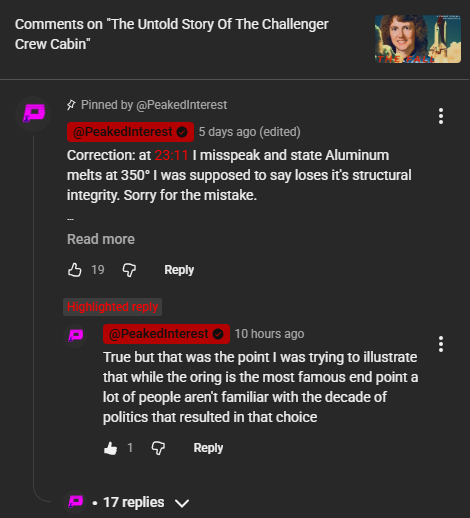
They reply, "Pretty accurate"; but elsewhere, also write to someone saying "the problem is Capitalism": "True but that was the point I was trying to illustrate[—]that while the O-ring is the most famous end point, a lot of people aren't familiar with the decade of politics that resulted in that choice."
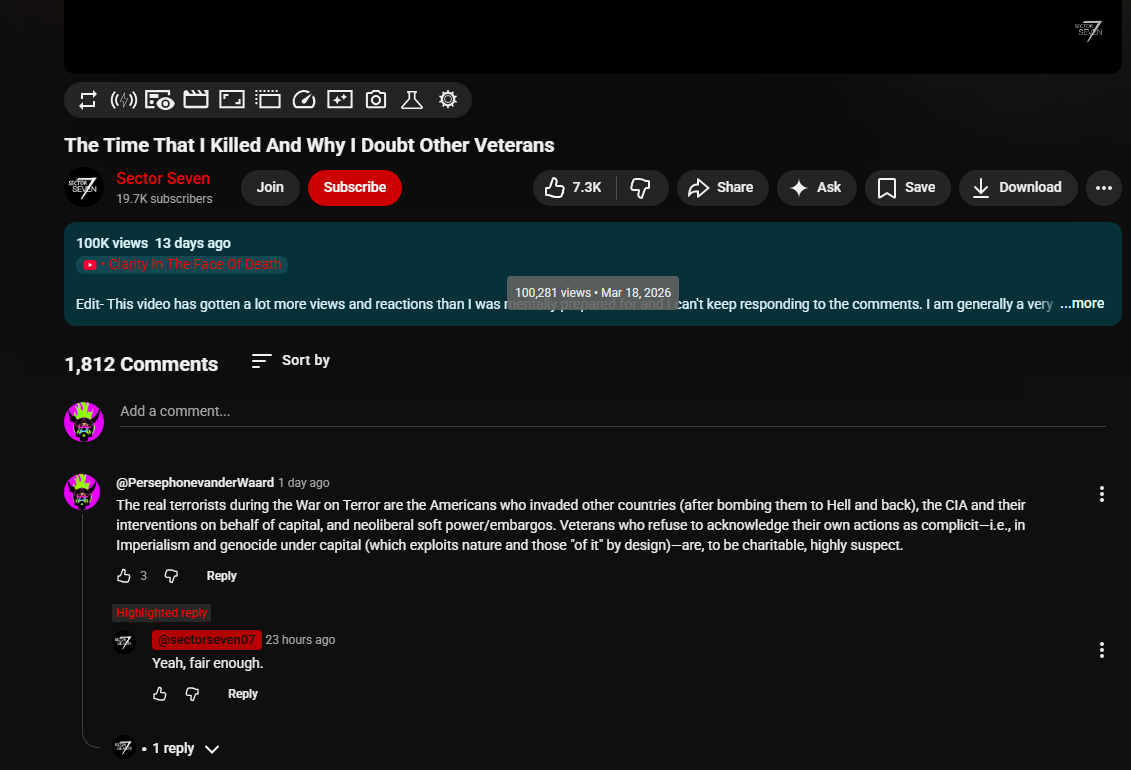
To Sector Seven, I write: "The real terrorists during the War on Terror are the Americans who invaded other countries (after bombing them to Hell and back), the CIA and their interventions on behalf of capital, and neoliberal soft power/embargos. Veterans who refuse to acknowledge their own actions as complicit—i.e., in Imperialism and genocide under capital (which exploits nature and those "of it" by design)—are, to be charitable, highly suspect."
And they write, "Yeah, fair enough."
Brevity is the soul of wit, in both cases. More to the point, we're different classes of worker finding common ground facing state exploitation (and obfuscation): unpaid vs paid, sex worker vis-à-vis scientist and soldier. Reversing abjection—the black mirror raising empathy regarding state prey reclaiming the language of predation (the monstrous-feminine)—is about confronting hard truths; i.e., in ways where people see eye-to-eye, from different positions. Or, as I describe, the state rapes by design in ways workers investigate from these positions—scientist, soldier and sex worker in ways that, in Gothic, generally overlap onstage and off:

(artist: Less, "I Can't Decide," 2021; cited: "Healing from Rape," 2024)
At its most basic level, rape is a violation of basic human, animal and environmental rights enacted through Cartesian power abuse; this postscript concerns the complicated process that healing from rape entails—i.e., its corrupting presence through codified trauma, wherein the surviving of police abuse becomes something to relate to others through Gothic stories that constitute radical empathy as a thing forever out-of-joint: the attempt to empathize with alien experiences to gain new perspective. Such empathy needn't concern both parties equally and its Gothic dialogs concern intense, poetic liminalities still bearing an intense potential for disguise that is haunted by the shadow of police forces [...] In other words, it's entirely worthwhile for us to ask how different people (with their traumas) relate to Gothic stories, but especially their monsters, heroes and haunts as things to consume, create and perform ourselves. For any who have been raped, a hero (or heroine) will generally be monstrous in ways that might seem alien to those who have never experienced trauma themselves; but bonding through trauma is generally lopsided to some extent" (source: "Healing from Rape" from my book series*).

*Age-gated; see: my SFW book promo and go from there. The broader idea concerns hugging the alien as something to normally attack, exploit and discard as criminal, vermin, etc; i.e., to subvert canonical norms, thus raise empathy mid-abjection through intersectional awareness and solidarity (teamwork)—all concepts I unpack in "State Vampirism."
In short, not only is there an ideological and political element present within Metroid, but one whose nature/civilization binary concerns abjection: a thing to further or reverse regarding the real world that Metroid echoes upon itself, and back onto players (who can be soldiers, scientists and/or sex workers) plumbing its depths while facing fascism alongside Communism (which share the same kayfabe-style stages and bodies, therein).
Foreword: An Axe for the Frozen Sea within Us
"I think we ought to read only the kind of books that wound or stab us. [...] we need books that affect us like a disaster, that grieve us deeply, like the death of someone we loved more than ourselves, like being banished into forests far from everyone, like a suicide."
—Franz Kafka, in a letter to his friend, Oskar Pollak, 1904

I wrote this document on Metroid II for my 2025 Metroidvania Corpus (which, again, I'll update when I finalize "Unto the Breach," for the 2026 edition). Most of the keywords already appear there, hence why I don't go out of my way to redefine them (except for Metroidvania). I do rehash some talking points, here, but only to revisit and build further on them using terms that didn't exist before (e.g., Amazon confusion). Per my usual "start backwards" approach, the Full Commentary portion is more conversational—written first and unpacked in the subsequent Theory subsection; i.e., added after "Summary" as the academic or "essay" half to my initial response to Holiwell (the preface is pure context, written before Holiwell and I even spoke). Basically "Summary and Theory" outlines my overall approach, one whose underlying thought process fits my conversational elements into a larger preexisting body of work: what I had in mind when pulling these paragraphs "out of my hat." Furthermore, the document was originally called "Reading and Responding to S. R. Holiwell"; I tacked on "Once More unto the Breach" after writing what I feel to be its thesis argument: "As my corpus determines (re: "Regarding My Amazon Research"), Metroidvania have a canonical role: upholding Capitalist Realism to hide state predation—generally through Cartesian dualism and token Amazonomachia ("monster battle"), mid-abjection and in heroically monomyth language: "metroid" = alien, and alien = bare life/the unhoused as something to canonically feed on; i.e., while fearing it, and which—like Frankenstein's Monster/Creed's monstrous-feminine (the Promethean Quest)—reliably return to seek revenge/subvert the status quo, doing so "from inside the house" (an iconoclastic/campy role). Moreover, the language shares "in duality" between workers and the state; i.e., fighting over power in rarefied forms of canon vs camp, change a painful thing for both: as being "trapped under ice" and, at the same time, having what Kafka calls "an axe for the frozen sea within us" (from the same letter in the epigram, above) during competing bids for power.
Originally found deeper in, I've relocated said thesis up here to frontload things/give the reader something to keep in mind (food for thought). To that, bold font will be used when signposting and/or highlighting important sentences (thesis or otherwise, above).
Preface: Some Context before We Start
This preface gives the context behind "Unto the Breach": the catalyst with Metroidvania Guru (and definitions for Metroidvania) alongside my conversation with Chozologist before speaking with Holiwell, about Metroid II.
Metroidvania Guru (and Metroidvania definitions)

(source: Metroidvania Guru's "Top Twenty Metroidvanias of All Time! (2025 Update)," 2025)
Despite compiling my older Metroidvania research into its 2025 corpus, I continue to make new content concerning Metroidvania in 2026. This includes essays, but also interviews (which I used to do more of, 2019-2021; e.g., my "Alien: Ore" series in 2019, and Metroid speedrunner series in 2021). After hoping to interview Metroidvania Guru (above), I learned he actually dislikes Metroid-style Metroidvania; i.e., as I define them—meaning the genre
Metroidvania are a location-based videogame genre that combines 2D, 2.5D, or 3D platforming and ranged/melee combat—usually in the 3rd person—inside a giant, closed space. This space communicates Gothic themes of various kinds; encourages exploration* depending on how non-linear the space is; includes progressive skill and item collection, mandatory boss keys, backtracking and variable gating mechanics (bosses, items, doors); and requires movement powerups in some shape or form, though these can be supplied through RPG elements as an optional alternative.
*Exploration pertains to the deliberate navigation of space beyond that of obvious, linear routes—to search for objects, objectives or secrets off the beaten path (source: "Mazes and Labyrinths," 2021).
and the Metroid side of the larger spectrum:
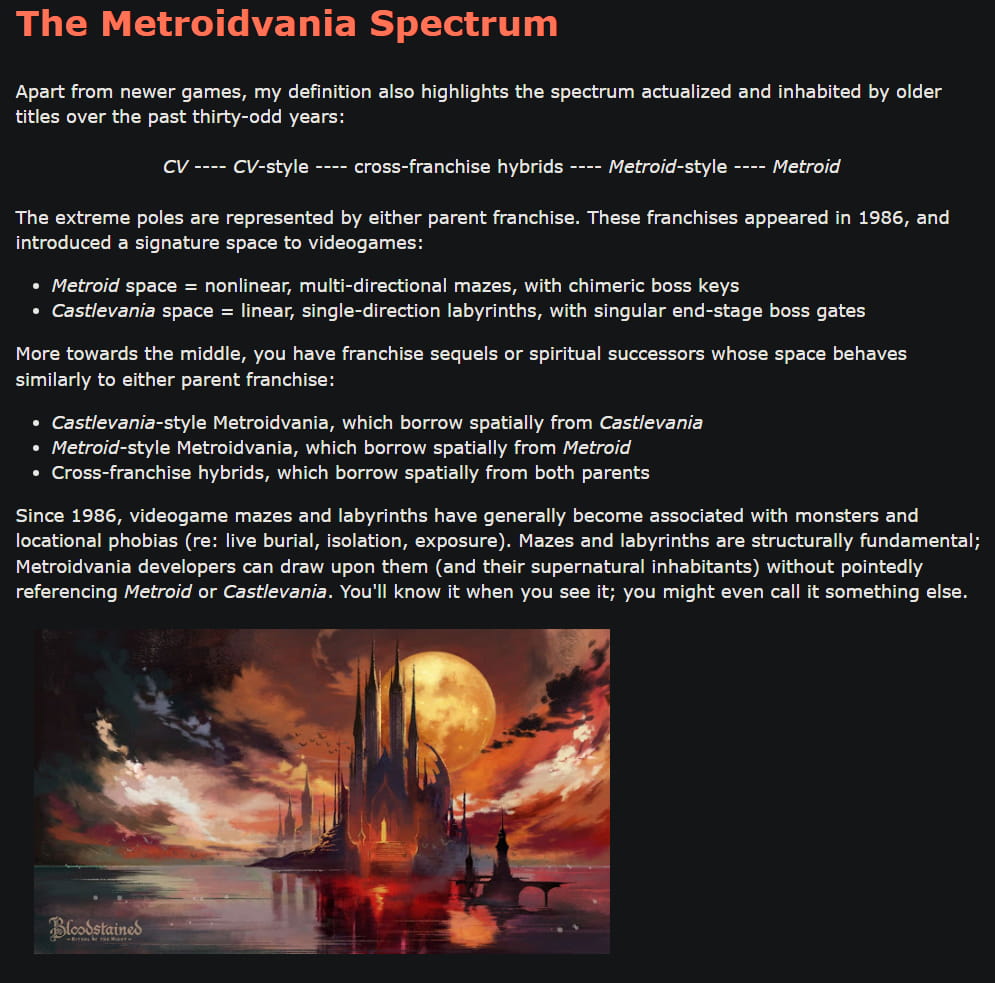
Apart from newer games, my definition also highlights the spectrum actualized and inhabited by older titles over the past thirty-odd years:
CV ---- CV-style ---- cross-franchise hybrids ---- Metroid-style ---- Metroid
The extreme poles are represented by either parent franchise. These franchises appeared in 1986, and introduced a signature space to videogames:
-
- Metroid space = nonlinear, multi-directional mazes, with chimeric boss keys
- Castlevania space = linear, single-direction labyrinths, with singular end-stage boss gates
More towards the middle, you have franchise sequels or spiritual successors whose space behaves similarly to either parent franchise:
-
- Castlevania-style Metroidvania, which borrow spatially from Castlevania
- Metroid-style Metroidvania, which borrow spatially from Metroid
- Cross-franchise hybrids, which borrow spatially from both parents
Since 1986, videogame mazes and labyrinths have generally become associated with monsters and locational phobias (re: live burial, isolation, exposure). Mazes and labyrinths are structurally fundamental; Metroidvania developers can draw upon them (and their supernatural inhabitants) without pointedly referencing Metroid or Castlevania. You'll know it when you see it; you might even call it something else (ibid.).
Different strokes for different folks. Interview-wise, though, he put things off and never got back to me. It happens. I moved on, writing new essays; re: after my book series ended, but also my corpus according to its latest addendums (re: "Persephone's Silksong Symposium," "X Marks the Spot" and "A Beautiful Lie," 2025). This addendum, featuring Holiwell, is part of the 2026 edition (which will also interview her). And everything my work explores follows a basic theme: Metroidvania, as I study them, reify power as something to interrogate (camp)—all in pursuit of a palliative Numinous (mighty comforting alien force) whose Promethean Quest[1] (stealing power from the past) breaks Capitalist Realism[2] during ludo-Gothic BDSM (as I call it): playing with rape using unequal power exchange, namely Amazonian Gothic heroines hugging Medusa (the alien), death-by-Snu-Snu/mid-dialectic; i.e., in abjectly terrifying spaces of sex, drugs, and rock 'n roll, each unheimlich emblematizing cryptonymically different taboos, fears, stigmas, shames and desires, etc, in each "artificial wilderness"/retro-future playground with neo-feudal components (to cover our Four Gs). Power is performance—one to camp and quest heroically (mid-monomyth) for Numinous things, like and inside Metroidvania-as-whorehouse/the Gorgon's domain as abject poster girl (re: "Notes on Power" and "The Quest for Power, part two: Interrogating Power through Our Own Camp," 2023).
Chozologist, Their Video, and Discovering Holiwell's "Murderscapes"
I digress. Several weeks ago, my YouTube feed recommended Chozologist's "Metroid and the Chozo" (2026), whose description reads: "The Chozo are not the peaceful and wise people they want you to believe." My attention piqued; the video cited S. R. Holiwell's "A Maze of Murderscapes: Metroid II," a write-up I—a Gothic ludologist, having studied Metroidvania for years—had never heard of. For reasons we'll get into, "Murderscapes" resonated with me. However, I accidentally mistook Chozologist for the author and reached out, whereupon the following conversation ensued:
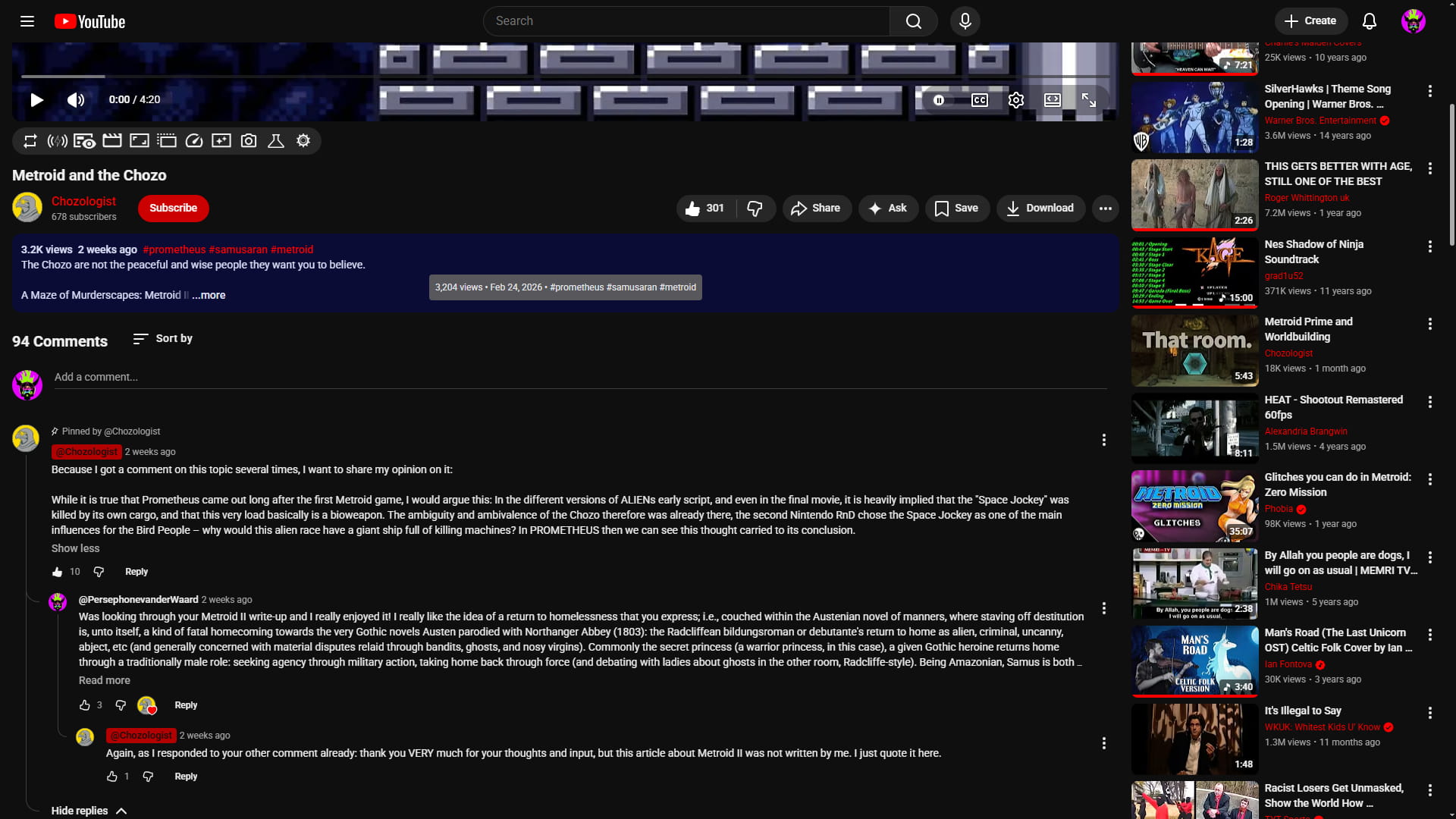
Chozologist (pinned comment): Because I got a comment on this topic several times, I want to share my opinion on it: / While it is true that Prometheus [2012] came out long after the first Metroid game [1986], I would argue this: In the different versions of Alien's early script, and even in the final movie, it is heavily implied that the "Space Jockey" was killed by its own cargo, and that this very load basically is a bioweapon [a metaphor for weaponized chattel/slave power during the Trans-Atlantic slave trade]. The ambiguity and ambivalence of the Chozo therefore was already there, the second Nintendo RnD chose the Space Jockey as one of the main influences for the Bird People – why would this alien race have a giant ship full of killing machines? In Prometheus then we can see this thought carried to its conclusion [uncanny doubles of the West, empire, and Cartesian thought/the Enlightenment (mad science): abjected onto a noble-savage warrior race; i.e., akin to Lovecraft's Old Ones from At the Mountains of Madness (1931) or MGM's Krell in Forbidden Planet (1956) as laid low by Promethean hubris, namely "playing god" to birth a hostile (and manmade slave) race treated as alien, respectively the Shoggoth and monsters from the Id—all species-wide versions of Shelley's Victor Frankenstein/the Creature, tragically enacting the Promethean Quest only to leave their Numinous (Ozymandian) wreckage behind for others to astronoetically[3] discover].
Me (replying to the pinned comment): Was looking through your Metroid II write-up and I really enjoyed it! I really like the idea of a return to homelessness that you express; i.e., couched within the Austenian novel of manners, where staving off destitution is, unto itself, a kind of fatal homecoming towards the very Gothic novels Austen parodied with Northanger Abbey (1803): the Radcliffean bildungsroman or debutante's [coming-of-age] return to home as alien, criminal, uncanny, abject, etc (and generally concerned with material disputes relaid through bandits, ghosts, and nosy virgins). Commonly the secret princess (a warrior princess, in this case), a given Gothic heroine returns home through a traditionally male role: seeking agency through military action, taking home back through force (and debating with ladies about ghosts in the other room, Radcliffe-style[4]). Being Amazonian, Samus is both the female detective and male warrior revived, Scott-and-Cameron-style, as space Amazon for the 20th and 21st centuries (under Pax Americana[5], out [from] the Cold War and into [its] End of History/capital's decline under Capitalist Realism); re: Creed's monstrous-feminine, caught between state duty, fascist intimations, and Indigenous sentiments (revenge or otherwise).
In any event, I'd love to pick your brain sometime and interview you as part of my series on Metroidvania? Only if you feel comfortable with the idea of course! My series originally focused on interviewing players of the game (namely speedrunners) while asking them about themes of power as they manifest in a Neo-Gothic [sense. But] with you I'd really just want to explore your thoughts on the game alongside my own (see: "From Master's to PhD (and Beyond): My Entire Work on Metroidvania" [2025] in my channel links). For example, I noticed you write from trauma. I do so as well, focusing [on] decay of home as "Gothic": swept up in fallen mastery amid ever-present disputes of sex and force (the Gothic chronotope/time-space, from Bakhtin's Dialogic Imagination [1981]: "The castle is saturated through and through with a time that is historical in the narrow sense of the word, that is, the time of the historical past [...] the traces of centuries and generations are arranged in it in visible form as various parts of its architecture [...] and in particular human relationships involving dynastic primacy and the transfer of hereditary rights"). Big fan of Shelley's Modern [retro-future] Prometheus as well, but also Scott's Alien films (Cameron's Vietnam revenge porn, while well-made, is really problematic in its own right).
Sorry for the big messages. This is, like, exactly my jam and I like your take on things/the perspective you offer tied to Metroid II, which is one of my favorites[6] alongside Shelley's novel and its many incarnations [re: Alien, Metroid, Prometheus[7], etc]. —Perse
Chozologist: Again, as I responded to your other comment already: thank you VERY much for your thoughts and input, but this article about Metroid II was not written by me. I just quote it here.
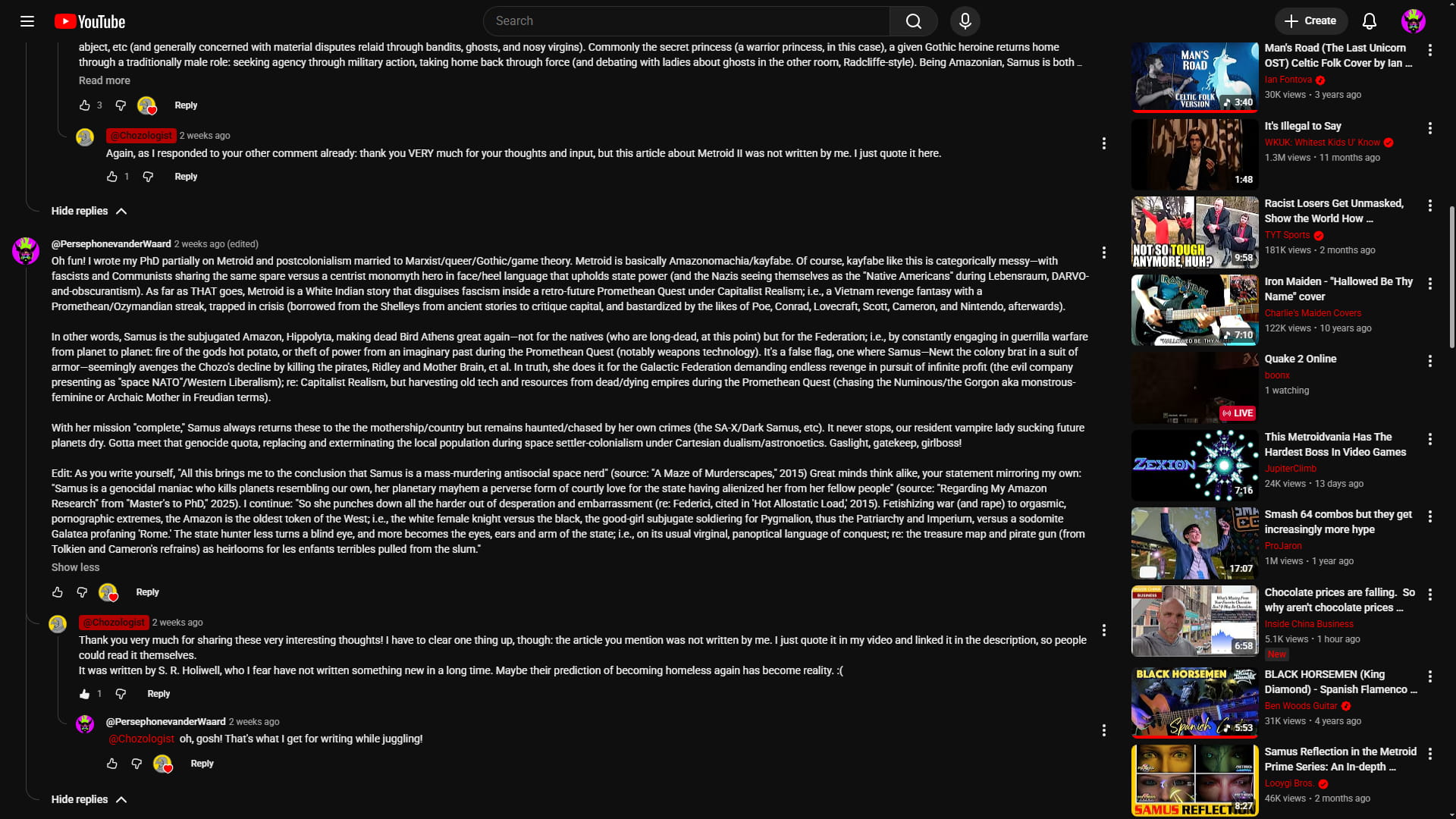
Me (leaving a separate earlier comment): Oh fun! I wrote my PhD partially on Metroid and postcolonialism [holistically] married to Marxist/queer/Gothic/game theory. Metroid is basically Amazonomachia/kayfabe. Of course, kayfabe like this is categorically messy—with fascists and Communists sharing the same [space; i.e., versus] a centrist monomyth hero in face/heel language that upholds state power (and the Nazis seeing themselves [as] "Native Americans" during Lebensraum, DARVO-and-obscurantism). As far as THAT goes, Metroid is a White Indian story that disguises fascism inside a retro-future Promethean Quest under Capitalist Realism; i.e., a Vietnam revenge fantasy with a Promethean/Ozymandian streak, trapped in crisis (borrowed by the Shelleys from ancient stories to critique capital, and bastardized by the likes of [Marx,] Poe, Conrad, Lovecraft, Scott, Cameron, [and Nintendo, etc).]
In other words, Samus is [a] subjugated Amazon, Hippolyta making dead Bird Athens great again—not for the natives (who are long-dead, at this point) but [the] Federation; i.e., by constantly engaging in guerrilla warfare from planet to planet: [fire-of-the-gods] hot potato, or theft of power from an imaginary past during the Promethean Quest (notably weapons technology). It's a false flag, one where Samus—Newt the colony brat in a suit of armor—seemingly avenges the Chozo's decline by killing the pirates, Ridley and Mother Brain, et al. In truth, she does it for the Galactic Federation demanding endless revenge in pursuit of infinite profit (the evil company presenting as "space NATO"/Western Liberalism); re: Capitalist Realism, but harvesting old tech and resources from dead/dying empires during the Promethean Quest chasing [the Numinous-as-Gorgon, or monstrous-feminine; re: Creed (or Wandering Womb/the Archaic Mother in Freudian terms, which Creed builds on/I respond to both her and Freud, in dialectical-material ways).]
With her mission "complete," Samus always returns [any "booty"/stolen plunder] to the [mothership] but remains haunted/chased by her own crimes (the SA-X/Dark Samus, etc). It never stops, our resident vampire lady sucking future planets dry [which "White Indian, Black Planets" explores]. Gotta meet that genocide quota, replacing and exterminating the local population during space settler colonialism under Cartesian dualism/astronoetics. Gaslight, gatekeep, girlboss!
Edit: As you write yourself, "All this brings me to the conclusion that Samus is a mass-murdering antisocial space nerd" (source: "A Maze of Murderscapes"). Great minds think alike, your statement mirroring my own: "Samus is a genocidal maniac who kills planets resembling our own, her planetary [scorched-earth] mayhem a perverse [and pervasive] form of courtly love for the state having alienized her from her fellow people" (source: "Regarding My Amazon Research" from "Master's to PhD"). I continue:
So she punches down all the harder out of desperation and embarrassment (re: Federici, cited in "Hot Allostatic Load," 2015). Fetishizing war (and rape) to orgasmic, pornographic extremes, the Amazon is the oldest token of the West; i.e., the white female knight versus the black, the good-girl subjugate soldiering for Pygmalion, thus the Patriarchy and Imperium, versus a sodomite Galatea profaning "Rome." The state hunter less turns a blind eye, and more becomes the eyes, ears and arm of the state; i.e., on its usual virginal, panoptical language of conquest; re: the [High Fantasy treasure map/outdoor melee and urban shooter/pirate gun] (from Tolkien and Cameron's [cartographic refrains): as retro-future "heirlooms" for les enfants terribles pulled from the slum/native land as owned a priori by the ruling class—or as Patel and Moore describe in A History of the World in Seven Cheap Things, concerning the Cartesian Revolution (and capital's cheapening of nature): "Finally, the Cartesian revolution was made thinkable, and doable, the colonial project of mapping and domination," adding "The modern map did not merely describe the world; it was a technology of conquest" (source) that translated, as I argue, to videogames/capital-in-small: as selling colonizer power fantasies to the middle class during the neoliberal era/capital-in-decay (re: "A Note About Canonical Essentialism" citing "Scouting the Field," 2024 and 2023; see, also: my research on Tolkien and his gentrified racism). Samus is a cop, ipso facto, but appears (despite her Amazonian "space knight" aesthetic) as "White Indian": through the rebel fantasy during home-as-invaded/alien—one turning a black castle and by extension, planet, white again (or blowing it up, scuttling "tout le monde" to deny the prior residents a home evermore).]
Chozologist (replying to my separate comment): Thank you very much for sharing these very interesting thoughts! I have to clear one thing up, though: the article you mention was not written by me. I just quote it in my video and linked it in the description, so people could read it themselves. / It was written by S. R. Holiwell, who I fear have not written something new in a long time. Maybe their prediction of becoming homeless again has become reality.
It bears repeating that, while transphobes tend to gatekeep the franchise by dismissing my work as "political" or not responding at all (re: "Those Who Walk Away from Speedrunning," 2025), Chozologist's initial response felt encouraging. To that, the actual author of the article reached out, several weeks later. Chozologist had tracked Holiwell down, putting her (a fellow trans woman[8], below) in touch with me!

To that, I had been planning to respond to Holiwell's article, anyways, but still needed to read it in full. Having done so, now, I wish to summarize my thoughts, here, then give an extended commentary afterwards (written first).
Summary and Theory (re: Gorgons and Amazons)
After reading "A Maze of Murderscapes" in full, I wrote down my basic thoughts; i.e., summarizing and sending them to Holiwell. I've since expanded and divided these in two (focusing on Gorgons and Amazons, Amazonomachia a core Metroidvania staple): summary and theory (the latter frankly a bit dense/academic, whose jargon I'll "translate" in the Full Commentary section).
Summary (of "Murderscapes")
This portion lays out what I enjoyed/wish to respond to and expound on, regarding "Murderscapes." It read as follows (with various changes currently thrown in):

I was reading your article again when I came across this passage: "I lost myself in a game of murder and mazes because suffering in the bondage of a Game Boy screen is easier than the suffering awaiting beyond its borders. It's something palatable to my pain. It's something uncomfortable I can deal with, because people ruined me and then threw me away, as they do with all broken toys" (source). This speaks to me, my work and my trauma as also concerning home; i.e., homelessness and alienation/power abuse, as things to navigate through play (e.g., through the language of doll and dollhouse; re: "Back to Jadis' Dollhouse," 2024). I frankly loved the whole piece. You make a lot of really great points, and a few things leapt out at me that I want to expound on; e.g., the killing of the hive to restart the cycle of life, which death invariably joins as "two sides of the same coin": old queens destroyed and eaten by fledgling queens—a secret princess of two worlds/minds who take up the company mantle while being painfully reborn "in Hell" (which I previously wrote about while dating an entomologist: before applying "insect politics" to the Gothic spaces [and monomythic bodies] that Metroid games typically feature; re: "War Vaginas," 2021).
The commentary on trauma and abuse in your own life—escaping into Gothic spaces of violence that paradoxically afford and assert control lacking outside them ("murder nightmares," as you put it)—is also incredibly germane (re: "The Quest for Power," 2023). In my case, I was also abused, and Metroid—whatever my age—was always the place I came back to; i.e., a fellow trans women regressing to seek control and ultimately shapeshift, stealing Numinous power from a derelict past describing home as alien: as "ancient," newly decayed and up-for-grabs, per Promethean Quest (exploring different queer themes, but especially seeking home while homeless/feeling homeless in alien ways; e.g., the Amazon and Gorgon as classic symbols of feminism, but also trans struggle, mid-abjection; re: I'm a rape survivor [see: "Raising Awareness"] who, educated to play with trauma during ludo-Gothic BDSM, uses Metroidvania to understand my own/that of different members of my family including my grandfather, a Holocaust survivor).
Lastly, I really enjoyed your notes about Metroid II—praising its game design, music and narrative arc, versus the usual "glazing" of Super Metroid (1994); e.g., from snobby critics like Jeremy Parish (a rival of mine; re: "Modularity and Class," 2024). Music-wise, I remember the early '00s when videogame remixes were far harder to do (and more grassroots; e.g., The Minibosses, Metroid Metal, or NESkimoes basically bar bands, bootlegging their shows in CD form). I specifically remember this one by Mellogear on OCRemix (2001); it felt very horror-themed, the hearing of which inspired me to try a cello recording of the game's opening track (which—like Alien and Star Trek—lifts Romantic elements from Jerry Goldsmith and Howard Hanson, out from older tone poems). It's super not good, but the game's gloomy atmosphere always bore a special place in my heart. That being said, I always loved the music; i.e., despite only a handful of tracks having discernible melody (and the rest basically being drone/noise[9])—with the title/ending themes, but also "Surface Runner" and "Secrets of the Chozo," all being great because they're oddly somber/cheerful (and "Runner" being my pick for the single best track in the game, if not the entire series).
I actually grew up on Super and II, coming to play NEStroid after Zero Mission, in 2004 (which lets players unlock the original game). And you're totally right: most Metroid titles fixate on the optimistic slaughter of different monsters; i.e., targets from nature-as-abject, who receive state force through displaced genocide: both "from space" and "A Long Time Ago, in a Galaxy Far, Far Away..." (re: the monomyth) as disturbingly close to home. Their uncanny arrangement codes settler-colonial violence by way of replacement—rephrased but couched nonetheless in structures of invasion (a prison house); i.e., vis-à-vis Patrick Wolfe's "Settler Colonialism and the Elimination of the Native" (2006) and Foucault's Discipline and Punish (1975), but tied to nature as monstrous-feminine under Cartesian thought furthering abjection; re: Gorgon-esque, Amazonian, insect, etc, as White Indian "playing with fire" (of the gods/forbidden knowledge gatekept by godly spaces, guardians and impostors; re: black planets). During holocaust "on loop," its circular apocalypse populates with retro-future "zombies" or "demons" as giver/receiver homo sacer (someone who or something that may be killed with impunity but not sacrificed in [open] ritual—to be unceremoniously killed in what Agamben calls "zoe" or "bare life" [and Foucault "bio-power"]; e.g., Akshra and Lakshay Mehla's "The Palestinian Homo Sacer," 2025). To that, Metroid II stays far franker about genocide than Super or NEStroid, which—alongside many future titles—pointedly fetishize (and worship) Samus running in Ripley's footsteps: as Competent Women, "striking back" for empire during military optimism enacting the Promethean Quest (2021). As much a detective (working in the dark, below) as warrior princess, it's classically a sham—one hiding state piracy (and abject lineage) behind feminism into the (retro-)future prison-home: the shooter (aka "Cameron's refrain," as I call it; re: "The Quest for Power").

Theory
This portion gives a relatively brief (~fifteen-page) history of Metroidvania; i.e., as I study them, applying themes raised by Holiwell—namely home vs homeless, or insider/outsider (alienation)—to different Gothic theories (especially abjection, but also cryptonymy and retro-future castles; re: the Four Gs). It stresses pointedly Amazons and Gorgons—or fetishized (monstrous-feminine) sex and force being played with—that poetically enact, assimilation-vs-alienation, under neoliberalism (videogames): Cartesian dualism pimping nature as monstrous-feminine, and whose geopolitical quandary of friend and foe—namely token half-alien Amazon avatars, hugging or harming Medusa, the full unruly alien-in-a-cage, in abject pimp/whore revenge language, under Capitalist Realism (re: "Hugging the Alien," 2024)—Metroidvania (and its avengers) encapsulate. And yet, they also decentralize, conceal, and scramble what they contain, in maze-like ways (the double operation of the home-as-prison, hiding and showing its carceral function/unholy cargo[10]). In doing so, they potentially disrupt and destabilize present models of thought; i.e., to think critically about the world as Platonic, steeped in allegory (hidden meaning) and illusion; re: from Gloggins to me, through half-real poetic devices that—when critically engaged with—break Capitalist Realism, "on the Aegis": in dialectical-material ways during ludo-Gothic BDSM, and where Holiwell's "Murderscapes," Metroid II and similar queries of power-as-home exist alongside my book series/corpus. There, my fellow models, muses and whores (unpaid labor) collectively reverse abjection by hugging the alien, thus personify the Gorgon; i.e., in highly campy ways, having their revenge against capital as/for the Dark Mother come home to roost; re: nature as monstrous-feminine, often framed as impostor-invader in virgin/whore, inside/outside, "hag horror" ways, parody and pastiche; e.g. witchcraft and piracy—with Samus (and similar heroes, below) basically Dorothy Gale, hunting the Wicked Witch of the West for the Wizard of Oz:
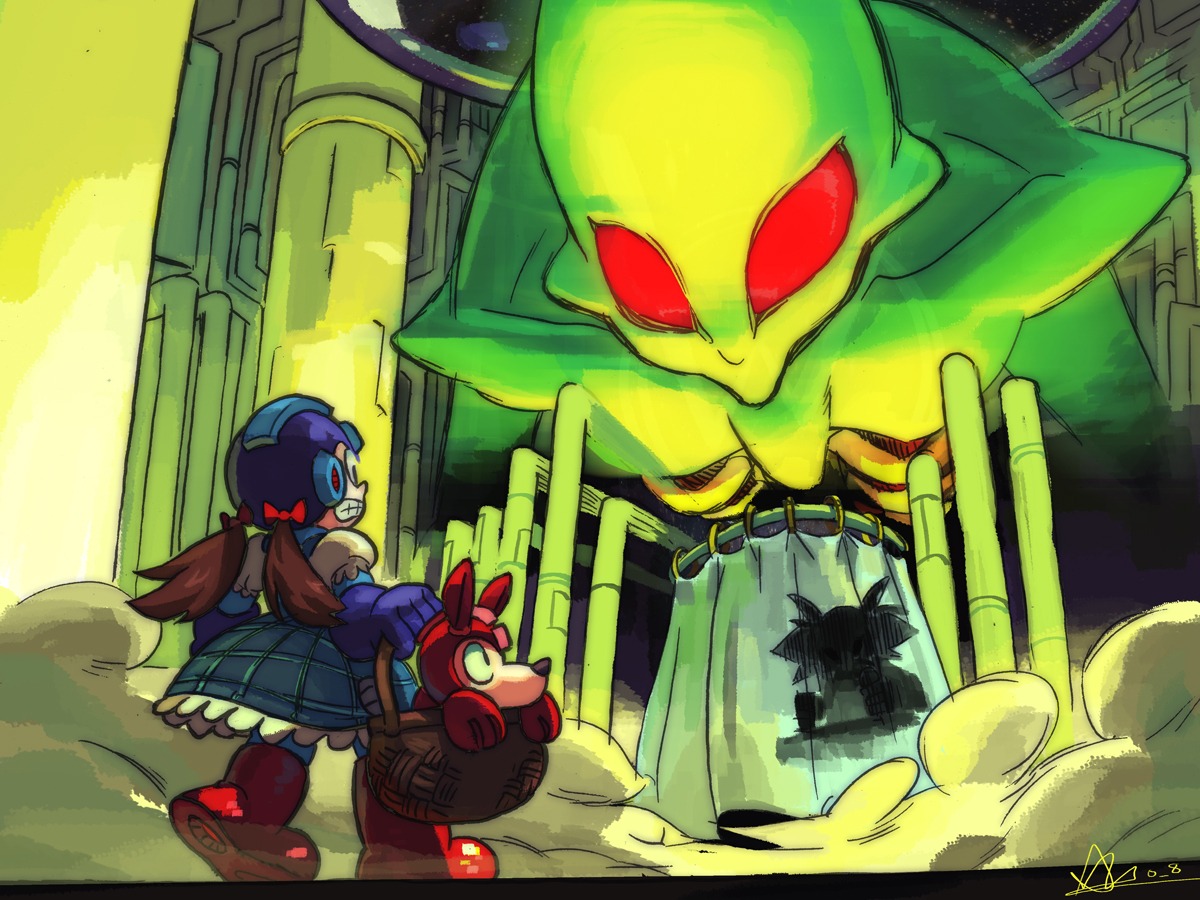
(artist: Alex Ahad)
Keeping the Amazon in mind, I explore the Pygmalion myth. To alleviate the confusion it causes, in practice, I also explain Gothic poetics, in general—namely how concrete boundaries and binaries don't exist, in Gothic, but rather when concentrated tend to confuse, oscillate and overwhelm mid-play to shock thus alter how people think; e.g., home as alien (as prison, as vampire, etc) to structurally navigate, confront and delegate its uncanny gradients, mise-en-abyme/per Promethean Quest: to subvert capital's Cartesian, monomyth aims under nuclear orders, reifying Numinous power to interrogate "where it is" when summoned (the castle, like a demon, called to appear).
To it, "Theory" is something of a two-part tangent—one inside my original summary to Holiwell, which continued as follows (with many changes thrown in, frontloading important ideas that reappear later):
Canonical Metroidvania; or, Geopolitics, Cartesian Dualism and Token Amazonomachia Enacting State Predation, under Capitalist Realism
Gothic is a deeply nostalgic mode, one of subversive reclamation during fatal homecoming (the decay of mastery and uncertain lineage through tremendous obscurity and power). To that, and which the foreword already explained, "Metroidvania have a canonical role: upholding Capitalist Realism to hide state predation—generally through Cartesian dualism and token Amazonomachia ('monster battle'), mid-abjection and in heroically monomyth language: 'metroid' = alien, and alien = bare life/the unhoused as something to canonically feed on; i.e., while fearing it, and which—like Frankenstein's Monster/Creed's monstrous-feminine (the Promethean Quest)—reliably return to seek revenge/subvert the status quo, doing so 'from inside the house' (an iconoclastic/campy role)" (our thesis argument). "Once more unto the breach," said Henry the V (who Ripley was modeled after). Same idea with Samus, the space knight/cowgirl/tomboy who patrols a frontier in space—one both "vacant" of civilization and occupied by an ancient race that isn't (according to her movie double) Indigenous, but rather abject invader-impostor who must be tracked and killed with stolen armor and weapons (of power, called power-ups in Metroidvania; e.g., Samus' power armor). For fear of deportation/reenslavement (thus destitution if not outright homelessness), Samus triangulates to make others homeless out of state revenge. To that, she's always returning to old homes, banishing Grendel's Mother (or some-such "despotic" scapegoat, during regime change) through force/with extreme prejudice. Just one more war, one more score to settle by White Indians on black planets. Forever. Because capital demands it, and Metroidvania canonically play with such things, mise-en-abyme in small: "Pray for a true peace in space!" The cake is a lie.

(source)
Of this, there are geopolitical elements to consider, offstage. For example, and after Samus' prior return (above), Metroid Fusion released in 2001; i.e., during Bush's War on Terror as a time of rising crisis, and—for a short window, at least—one whose manufactured fear and scarcity lacked an obvious "prime" target: an immediate enemy abroad to keep money moving up, nature both the vector (and source) of ongoing theft (the climbing of police action and surveillance a state trademark, raping nature-as-alien while calling it "stability"; e.g., the GFMC in Fusion and Prime 2 [2004] and the GFA in Other M [2010] only appearing[11] after Samus [and similar mercenaries] "paved the way[12]"). Or as Patel and Moore write, "Capitalism is a process in which money flows through nature [emphasis, me]. The trouble here is that capital supposes infinite expansion [growth] within a finite web of life" (source: Seven Cheap Things). Metroidvania are capital "in small," decaying through the feeding process. The more the state eats, the more it takes; the more it takes, the more it pushes our planet to collapse (echoes of Samus, policing Omelas before scuttling it; i.e., borrowing from Alien, Forbidden Planet and similar ethnocentric naval metaphors). But it cannot stop because capital kettles and rapes Medusa by design, abjecting nature as whore to blame (and rob); i.e., while furthering abjection in tokenizing ways. So it merely invents new enemies borrowed from old parts, forcing state machinery (and media) to work all the harder (to cheat death, which is impossible); i.e., while historically monopolizing violence, terror and morphological expression/monsters (re: Weber, Asprey and me; see: "The State: Its Key Tools" from "Paratextual Documents").

Before 9/11, the idea actually dates back (at least in videogames) to NEStroid and Aliens (1986)—both crystalizing Cameron's refrain, itself stealing bullets-and-bombs colonialism from Heinlein's Starship Troopers (1959); re: abjecting nature as monstrous-feminine, yes, but also Communist food for capital's continued nourishment (see: "Nature Is Food" and "A Deeper Look at Cartesian Trauma in War Culture," 2024). So does capital feed in fascist ways it routinely decays towards: a nuke-the-Reds death cult founded on machismo and wunderwaffe (re: Eco's "Ur-Fascism," 1995) that—under neoliberalism, endlessly freeing and expanding global markets—includes the Amazon-as-token-wunderkind, chasing the Numinous whore during capital; re: as something to explore and act inside, Metroidvania reify capital-in-small, mise-en-abyme (the belly of the beast a derelict, "ancient" castle inside a castle, hyphenating this-or-that; e.g., Samus, the Athenian spitfire, as suitably "stacked," but nevertheless swallowed whole by bigger [and badder] bitches, playing "top dog"; re: "Castles in the Flesh" [2024] and "Giger's Xenomorph").
So do Metroidvania showcase capital as routinely abjecting "spectres of Marx" (and Shelley/the Gorgon)—all to feed/maintain state hegemony in tokenizing ways; re: White Indians, black planets. When subjugated by the state, Amazons historically tokenize; i.e., the ur-token of Athens revived in latter days—a nonstop femme forte/fatale, monstrous-feminine lie that, from the 1800s onwards, describes "the oldest profession" (and struggle), prostitution, as policing unpaid labor/nature-as-abject: Radcliffe's detective suddenly handed a gun to blame Medusa for state abuse, terror/counterterror[13] (the built-in contradictions/ensuing turmoil what I call mirror syndrome, or seeing the destroyer in oneself and oneself in one's prey). And so the battered housewife—betraying Medusa to kick her in the pussy while raping nature stone dead—triangulates "for crumbs," but namely the chance to punch down versus up (armed subservience). Doing so historically happens in monomyth ways, and whose suitably wonderous promises of power remain Promethean/stolen "from Hell," by Cartesian actors "scorching earth"; i.e., for capital, onstage and off:
[Francis Bacon, the father of modern science,] argued that "science should as it were torture nature's secrets out of her." Further, the "empire of man" should penetrate and dominate the "womb of nature." […] The invention of Nature and Society was gendered at every turn. The binaries of Man and Woman, Nature and Society, drank from the same cup. Nature, and its boundary with Society, was "gyn/ecological" from the outset (source: Seven Cheap Things).

Male or not, a cop's a cop, a pimp's a pimp, and TERFs are pimps modeled after Ripley and Samus under current geopolitics. Loaded with Neo-Gothic code (and trauma), nature = Hell, abject, whore, criminal, etc, to rape by pimps (token or otherwise); i.e., for life everlasting (under state guidance)—meaning for those "special few" able to see genocide through: defending home from homewrecker a veiled threat, state employers giving "do it, or else" ultimatums for millennia. Under capital, women are systemically denied pay/threatened with homelessness (thus rape) on purpose; i.e., furthering abjection to enable state vampirism; re: Metroidvania are capital-in-small, namely training grounds to further abjection inside/outside themselves. "To ask for capitalism to pay for care [and sex work] is to call for an end to capitalism" (source: Seven Cheap Things). So the state, a big vampire, pays little vampires (which TERFs are) in blood; e.g., stolen land, labor and goods—all acquired through a Promethean, neo-conservative marriage-of-convenience; i.e., of monomyth sex and force, which separate/return to tradition, after the quest concludes: the nuclear division of labor, whose double-standard euthanasia effect bridles the tomboy while fetishizing her masculine side, beforehand (the crimefighter "alter-ego" versus the Id under Capitalist Realism, alien-on-alien violence as black/white, straight/queer, etc, per the usual monopolies and qualities of capital; re: the state [and its fantasies of assimilation] are white, straight and male, thus Cartesian, settler-colonial, and heteronormative to modular degrees; see: "The State: Its Key Tools").
Before and after videogames, doing so revives the imaginary past of older ethnocentric (racist, sexist, homophobic) fears; i.e., refrains, rooted in popular stories like Metroidvania "but before," and whereupon Cartesian dualism divides Society and Nature into "thinking beings and extended beings" (source: Seven Cheap Things). Thus Metroidvania "get in line," territories of war canonically abjecting empire's crimes (and vampirism) during token fears of imminent imperial collapse: towards a vengeful barbarity waiting to return (and exact its revenge against so-called "moral territories" and bodies; e.g., white women who "hold the line"; re: "A Note on Canonical Essentialism"). During Capitalist Realism, capital (and those who support/rely on it, in Plato's cave[14]) fear revenge; i.e., capital historically built on pimps-and-whores revenge, the state pimping nature as monstrous-feminine to further abjection for profit (re: "Nature Is Food" and "Rape Reprise"). Taking revenge, capital fears revenge from whores "wrecking home"; i.e., those it treats like pests and chattel, and which nature—specifically Mother Nature (the Gorgon)—enacts "land back" to avenge: the whore's Numinous revenge reversing abjection during state shift terrifying capital fearing approaching death/retribution; re: for raping the world by design (climate change/environmental collapse from state vampirism). Here, a historical-material pattern starts to emerge, onstage and off—indeed, has emerged time and time again when empires approach death (with "bread and circus" wish fulfillment/guilty pleasures dating back to the Roman empire's twilight years): a shambling "zombie" extension[15] of state predation. Suddenly alive (or at least animate), the gargoyle/golem activates to hunt down the hero (for food, sport, what-have-you)! It's a scapegoat, one which capital abuses to further abjection/feed all the more while "circling the drain." Per our thesis argument, so do home and homeless overlap, in Gothic, and where Metroidvania play out, mid-abjection; i.e., as housed/unhoused through endless simulacra of motion and combat (what Japan calls "search/action"): enacting "White Indian, black planets," on loop.

(source)
White Indian, Black Planets; or, Navigating Amazon Confusion in the Shadow of Pygmalion (alongside the General Duality of Gothic Poetics)
You can't scapegoat capital, but you can subvert (transform) it in stories that contain scapegoats (Gorgons, Minotaurs, or otherwise). Most stories combine this or that, a given sequel taking old things and recombining them, palimpsest-to-palimpsest. Metroidvania—especially of the Metroid-style—take "Arena" (1944) or the "Sound of Thunder" (1952), a tourist in a savage continent, and make the long-discovered territory "lost" again (Shakespeare's "undiscovered country" alluding to suicide missions on "coffin ships"). That's basically what "White Indian, black planets" means: a cycle of forfeiture and reassimilation by the ruling class through useful idiots waving false flags in bad faith/duality. Capital demands it, the actual natives long made extinct by someone inevitably taking their place: through abject terror/counterterror revenge dialogs that funnel resources up; re: capital in small. It takes Shelley's Quest and recuperates it, the ensuing (and repeat) disasters simply Capitalist Realism playing out. Samus, then, is Frankenstein's Monster if the monster was the little girl and she worked for the maker to assimilate and conduct Imperialism (the highest stage of Capitalism, as Lenin put it). She's a pirate, a soldier of fortune, a catwoman of the moon who's been spayed and weaponized; i.e., one without a home, the genocidal vessel of Caesar, Columbus, or Descartes sacking rival castles and pillaging an endless countryside—first for players to feel scared of different barbarians (Radcliffe's "banditti"), crossfading towards triumphant "heroism" when David "goes hysterical/ape" and kills Goliath (the Jabberwock, Grendel, the dragon, etc). That's the fantasy being sold, Metroid effectively Star Wars without the irony (which Aliens, Metroid and Doom all basically are—albeit to varying flavors and degrees); re: gaslight, gatekeep, girlboss.
A centrist, highly neoliberal scheme—one "boiling down" to bread-and-circus kayfabe of the videogame era (from 1973 onwards, though arguably not forever)—Metroid (the franchise) calculates risk in a highly particular style: the Pygmalion fantasy (re: the female avatar for straight boys to pilot [and drool over] and cis girls/fascist feminists [female or not] to kills trans people with). In the Shadow of Pygmalion (the ghost of the Patriarchy hijacking feminist voices to defend state power), Amazon confusion is wherever the role of the Amazon becomes ambiguous; i.e., the heroine—just like the gameworld they explore and monsters they vanquish—having a canonical function (to further abjection), but one to campily undermine the intended interpretation/function for something anti-capitalist, mid-refrain; re: a White Indian on a black planet (echoes of Fanon and Said, but also Walpole's giant suit of armor/castle, from Otranto, 1764). Yet, Gothic keeps things "grey" versus strictly black/white. Think of it as playing while confused, saying different things at once (as allegory normally does): good actors and bad, in which exploitation and liberation—per abjection as something to further or reverse—share the same space (castles), but also bodies and costumes, in duality.

(artist: Josef Axner; cited: "In Search of the Secret Spell")
White Indian, Black Planets
"Black" = different things, including "corruption," "devastation," and "radical change" (death). To it, Samus routinely conveys White Indian themes; i.e., operating armored/unarmored (above) inside territories of forever war/colonial decay and collapse—black planets that, per Promethean Quest, cloak-and-dagger "advisors" reclaim while working from/on "the inside": a stolen house turned into prison (usually a castle); re: of a Rambo, Amazonian bent, a given false flag (and CIA double) evoking a desire for protection that Amazons (of a subjugated "copaganda" sort) have historically evoked, Athens-to-America, across all registers; e.g., on television:
As Edward Said astutely notes in Culture and Imperialism, most societies project their fears on the unknown or the exotic other. This barren land, where the viewers are kept disorientated, is threatening. It is a place between the familiar and the foreign, like part of a dream or vision that one cannot remember clearly. There is always a sense of a lurking danger from which the viewers need protection. Nikita provides that sense of protection (source: Laura Ng's "'The Most Powerful Weapon You Have': Warriors and Gender in La Femme Nikita," 2003; cited: "In Search of the Secret Spell").
In videogame form, Nintendo sells token alter-egos (exotic warriors) to American children; i.e., those reared, from cradle to grave, on capital intervening on a global stage/smothering Communism "in the crib":
From the early days of Space Invaders (1978), Pac-Man (1980) or Donkey Kong (1981) to Mario, then (about seven years—about twelve, if you start from 1973 when the elite began their first experiments with neoliberalism in South America), the usual place of neoliberal business and indoctrination transitioned from single arcade machines to larger amounts of money (from quarters to hundreds of dollars) per customer in each household (where there is more money to be had, and seasonally at that); i.e., a Stepford Wife, purchased for paychecks, not pocket change, and ready to implement the business model into the first generation of what would become the New World Order under neoliberal Capitalism: a world of us-versus-them enforced by neoliberal, monomythic copaganda's harmful simulations of Amazonomachia to maintain the status quo at a socio-material level; re: the shadows of a new republic's man-cave walls.
In turn, the American middle class (so called "gamer culture") would gatekeep and safeguard the elite through videogames being an acclimating device to neo-feudal territories to defend in reality (outside of the game world[s] themselves) as capital starts to decay like usual. Meanwhile, the companies making these games have progressively privatized and digitized them to such a degree as to make it easier to pick the pockets of said middle class, leaving them brainwashed, broke and looking for someone to blame—all while being routinely desensitized to us-versus-them violence against a flexible scapegoat refrain (source: "Modularity and Class"; see, also: "In Search of the Secret Spell," 2024).
II, then, is Metroid at its most bloodthirsty/abject (versus paranoid, like Fusion is), but still reverses abjection at the end to comment on forced motherhood and homelessness (which the full commentary unpacks). But understanding how requires having a basic grasp of Gothic poetics (and kayfabe), too, whose duality and fakery I'll quickly unpack.

The General Duality of Gothic Poetics
Metroidvania are—at the end of the day—Gothic castles (re: "Lost in Necropolis," 2018), so first thing's first. "Hogle argues that modern Gothic is grounded in fakery," writes Dave West (source: "Implementation of Gothic Themes in 'The Gothic Ghost of the Counterfeit,'" 2023). In turn, he adds, "Hogle's observation of the history of [Horace Walpole's 1764] The Castle of Otranto forms the basis for understanding the concept of counterfeit as a result of the abjection process." I argue, abjection can reverse through our aforementioned "Amazon confusion," doing so in a shared operatic[16] space—not just Samus kettling Medusa and her brood (above), but through various performers of different kinds, canon-vs-camp: a sequel enterprise, enacting White Indians and black planets like Metroidvania classically do; i.e., through sex and force, married mid-Amazonomachia. Rebellion, whether true or false, is a commonly sexy affair (from Milton to Percy and Mary Shelley to retro-future forms of Ozymandian myth, below).
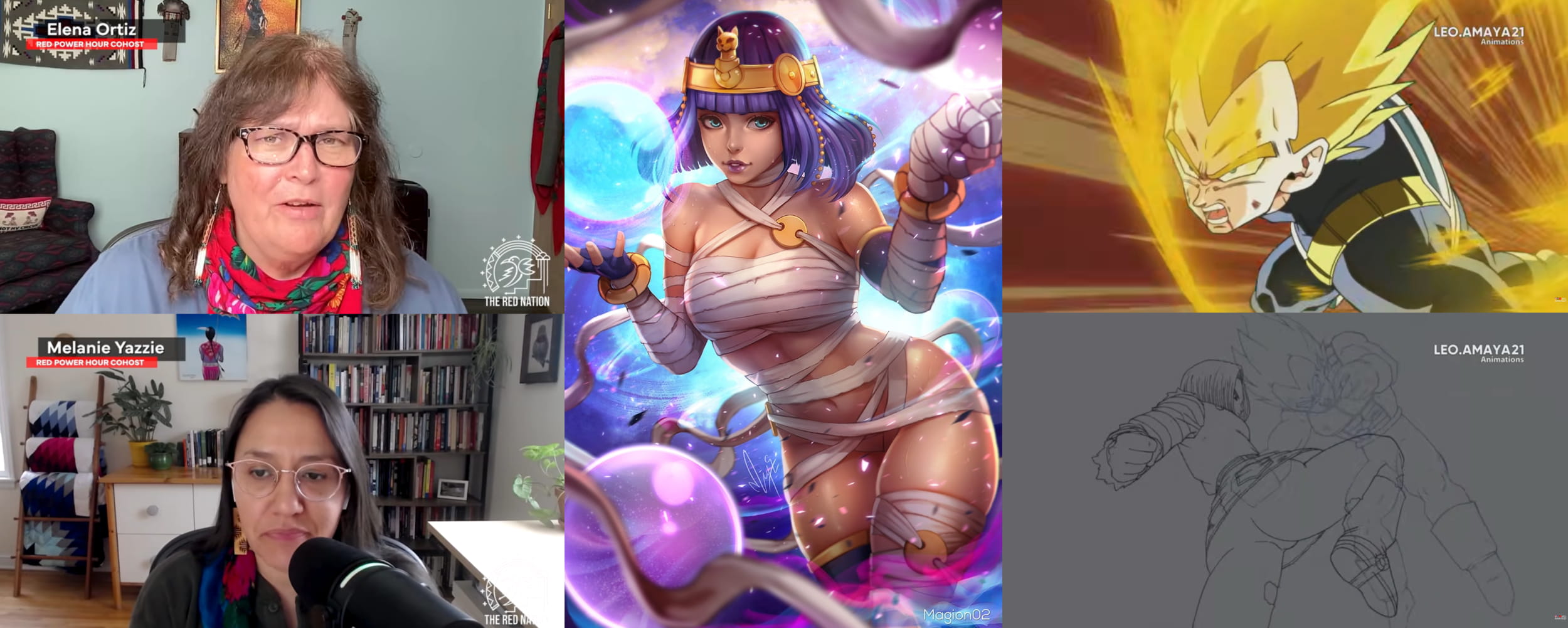
(exhibit 0: Artist, middle: Magion02; cited: "In Search of the Secret Spell"; screencaps, left and right: The Red Nation and Led.Amaya21. Escapism and rebellion aren't mutually exclusive. Furthermore, resistance and submission—while categorically separate—share the stage while fetishizing under state dialogs/capital; i.e., that workers reclaim, mid-abjection. They do so in Gothic dialogs on nature-as-criminal, whose critiques allow for cultural appropriation and appreciation: terms like "White Indian" and "black planet" taken back from white-savior vaudeville and/or explored in exports to America; e.g., The Red Nation's "RPH vs. Avatar: Fire and Ash[16a]" and Leo.Amaya21's "[preview #4] - 18 vs Vegeta" [2026]. The irony isn't always there/must be added by the critic[s] skeptical of representation; i.e., as a state tactic of cunning recognition [e.g., "The Cunning Recognition of Palestine," 2025] meant to stymie resistance; re: me vis-à-vis Glenn Coulthard's Red Skin, White Masks [2014]. Amazons are Numinous, yes, but also deeply trashy actors sitting between worlds: the Wisdom of the Ancients, or "cultural understanding of the imaginary past" in Gothic, but also Indigenous Culture's Wisdom of the Ancestors [which my Indigenous partner, Bay Ryan, helps me catalogue and explore, in "The Value in Showing Intersectional Solidarity When Combating Fascism," 2026]. SWERFs are TERFs and TERFS are fascist, but react through grievance on kernels of truth used for state revenge.
To that, nudity and bodies aren't automatically "sinful," but exist that way canonically in Western eyes; i.e., that, to reverse abjection, must view things through a radically empathetic lens: from those with more/different oppression, a pedagogy of the oppressed hugging the alien in ways, which—like a curse—carry across space and time, in written/oral forms; re: "Healing from Rape" [2024]. Alienation ends when fetishization [the making of something into an object of power] serves worker needs tantamount to universal liberation: the poetic merger of sex and force that Amazons represent, and which Indigenous cultures envision through their own stories revived by themselves and others at cross or shared purposes. Closing the gap requires care, courting good actors while avoiding bad ones; e.g., weird Marxist-Leninists waxing nostalgic—meaning for a time before trans people entered public discourse, whereupon MLs spout platitudes[17] like "Socialism for All" before blocking trans critics of Stalin's queerphobia [as Socialism for All and Deculturation do, below].)

(source skeet, Persephone van der Waard: 3/19/2026*)
*Click here for a follow-up where S4A's fans rise weirdly to his defense in bad/blind faith (ibid., 4/19/2026).
Language is a tool, one whose optional expanding of the mind/empathy (awareness and teamwork) happens through Gothic stories' subversive potential. Said spaces employs abject qualities since Walpole, of course—the Numinous historically terrifying viewers, of course, but doing so alongside a gingerly flirting with taboo things tied to literal buildings: "through the oxymoronic categories of 'venerable gloom,' 'venerable barbarism,' and 'gloomth'—a compound word formed of 'gloom' and 'warmth'—that Walpole was able to negotiate the discursive impasse at the heart of eighteenth-century perceptions of Gothic architecture," writes Dale Townshend, in "Horace Walpole's Enchanted Castles" from Gothic Antiquity: History, Romance and the Architectural Imagination, 1760-1840 (2019). He continues
Just as Walpole the architect had taken care to combine the requirements of modern convenience with "the rich, varied, and complicated tracery and carving of the ancient cathedral," so, in Otranto, it was his aim to combine the "imposing tone of chivalry" and "marvellous turn of incident" of the ancient romance with the "accurate exhibition of human character" to be found in the modern [quotidian] novel. To read Otranto, Scott concluded, was to experience the same degree of supernatural awe and terror that one felt when spending a solitary night in an old, tapestry-strewn Gothic mansion. Walpole's ingenuity lay in his extracting in Otranto the sensations of melancholy and supernatural awe that, though easily elicited in truly ancient piles, were "almost impossible" to evoke in "such a modern Gothic structure" as Strawberry Hill, thus "attaining in composition, what, as an architect, he must have felt beyond the power of his art" (ibid.)

(source; cited: "Prey as Liberators," 2024)
Again, these are playgrounds—so-called "haunted houses" built on fakery and revival that poetically play with "rape," in quotes; e.g., blood libel, sodomy and witchcraft, etc, as terror language that Radcliffe and Lewis (a woman and gay man[18]) expounded on, after Walpole[19] (re: "Idle Hands"). I borrowed the same concept when discussing rape; i.e., as something "Amazons" play with to reverse abjection, during ludo-Gothic BDSM: of courtly love/calculated risk, my version tied to knights and Amazons playing inside (through play/care/sex-as-work) the Radcliffean model of mutilative desire, virgin/whore syndrome, and hero/demon lover (re: Wolff, 1979). This includes
gender and queer expression through animalistic monster dialogs (furries), whose "sodomy" within public discourse [e.g., of Amazons (and anal sex) as classic terror weapons; re: "Our Sweet Revenge," 2024] emerged from performative locations[—]first introduced by Walpole, then reexplored by Matthew Lewis and others building on Walpole's faithless reinventions: the Gothic castle as an operatic, ghastly site of campy violence and "rape" per ludo-Gothic BDSM, but also a hunting ground of targeted actions and bodies being tacitly associated with theatrical harm as a canonical means of preparing them for state punishment (source: "Prey as Liberators").
Gothic—from Dante to Milton to Walpole, Lewis and Shelley—is iconoclastic; iconoclasm is central to the Promethean Quest, "playing god" (through creation) to critique power while reifying it. In short, it's a vital means of system shock inside Plato's cave (or simulations of it): of poetically "stopping the heart" by cryptonymically transgressing boundaries that—under a growing shadow of state abuse violating worker rights (the planet turning black, in a different sense)—would both expand and toxify in the 19th, 20th and 21st centuries alongside campier forms (re: "Whores, Heart Attacks, and Those Who Cause Them; or, Reversing Abjection to Find Joy Under Fascism" and "Toxic Schlock Syndrome; or, an Early Stab at Cryptonymy: Amazons, Body Hair and Whistleblowers," 2025). Irony or otherwise, context matters; the illustrating of mutual consent—which invigilates, dialectically-materially, onstage and off—happens between different workers; i.e., during Gothic Communism, whose holistically informed labor exchanges and play comprise the exhibit in duality and totality while breaking Capitalist Realism, "on the Aegis" (re: "Illustrating Mutual Consent" from "Paratextual Documents"). There lies Medusa, "shaking her gory locks": "risen," from beyond the grave, during mirror syndrome/Amazon confusion to betray canonical ideas of "White Indian, black planets."
In other words, there's a fine line between consent and non-consent, Metroid (and Alien, before it) basically Planet of the Vampires[20] (1965) and Barbarella (1968): diegetically minus the overt, Frazetta-style fetish, while still tokenizing "woman is other" to unironically "whore nature out," all-our-yesterdays; re: state vampirism, "hogging the stage" (to further abjection) across different media types within the Gothic mode. Sequels revive the larger tradition (of abjection); i.e., as something to play with once more, including The Return of Samus (again). They beget from capital and its predation, but also from the dialectic of the alien and of workers vs the state, accordingly. Infinite power, infinite form—the iconoclast having the whore's revenge against the pimp, the potential for iconoclasm always present within state binaries scapegoating entire peoples and worlds for its own; i.e., in echoes of Samus, which states can't monopolize. So can players freed from Plato's cave but still inside (re: The Matrix) subvert a given "Hippolyta": away from subjugation, doing so through performative context during ludo-Gothic BDSM; e.g., Shelley Bombshell in Ion Fury (2019): "there's room to enjoy the heroine as a nerd playing a cop, versus a cop whose actions reinforce the game's underlying police state. The outcome is performative, but at least I have the option—to hold my nightstick like Sarah Connor instead of Judge Dredd" (source: "'Neutral' Politics: Feminism, the Gothic, and Zombie Police States in Ion Fury," 2021).

(exhibit 1: Source: left, middle, top-right; artist, bottom-right: Alex Pascenko)
Whatever the game (or game-like space), and whether canon or camp in performance, Metroidvania occupy the same cop/criminal zone—one sitting "in duality" and which poetically concerns, cryptonymy-and-abjection, impostors and locals warring over stolen land (and language) during kayfabe-style reversals (or "sides," in psychoanalysis). Here, Metroidvania—like any Gothic space in any media form—examine/perform different bigotries that unfold and overlap through modular binary aesthetics (appearance and argument): black/white, life/death, cop/criminal, house/wilderness, etc, as canonically having racist, sexist, anti-Communist, transphobic, fatphobic, ableist and/or Islamophobic applications (etc), and which occur through imbricating persecution language (e.g., witchcraft, sodomy and blood libel; re: "Idle Hands") but also anisotropic, apotropaic potential (to mean different things in different directions that ward off evil/prevent harm).
For example, Samus the white princess/rising "true" queen canonically reclaims house and home versus Medusa as the black/reigning "false" queen, but for which an anti-war trans woman like me or Holiwell can easily call Samus the villain and Her Majesty the hero (re: "Always a Victim," 2024); i.e., as positions to embody and apply force, controlling sex through highly dualistic value judgements: ambiguous threats to home/of destitution and exile from home being equally poetic/plastic. All speak through the paradox of exposure, offering those martial displays—of physical prowess and looks that kill—known cryptonymically to Amazons and Gorgons: defensive/offensive public nudism (naked force). These educate through performance, which in subversive varieties collectively inform consent, reduce harm, and raise intelligence and awareness through play—ludo-Gothic BDSM giving rape survivors a voice when acting "rape" out, in quotes; i.e., not to endorse but describe: a given calculation of risk dodging censors during hard/soft prohibitions, while speaking to the realities that sex workers (and other actual/would-be victims of rape) face, all the time (re: "Introducing Revolutionary Cryptonymy" and "Transgressive Nudism").
To that, function = flow of power, mid-aesthetic; abjection = flow of power up or down, state's rights vs worker rights when theatrically furthering or reversing in duality/good faith or bad—i.e., depending on who's making, using and/or consuming them, canon-vs-camp. It's why Shelley's Creature or Milton's Satan can be heroes despite appearing "dark[21]" (vice characters/villains to "root for" and seek out), and why Samus—despite being fair-skinned and feminist-coded—classically labors from reactionary positions of grievance that do more harm than good: the actual homewrecker raping nature in bad faith, enacting "pick me" behaviors that tokenize, gentrify and decay for the Man through controlled opposition (tilting at windmills while acting like a man; e.g., Perseus, below). Mid-Amazonomachia, she's bogus, insincere, and fake (as Gothic often is; re: Walpole/the ghost of the counterfeit), but whose purported "monopolies" on power and lies are as mythical as she is.
All war predicates on deception, Amazons and Gorgons just another lie to get at painful realities twisting the human condition into knots (state secrets/generational trauma): those with privilege betray out of convenience; those with oppression, out of desperation; and all meet in/upon abject spaces of play that Metroidvania dialectically-materially encompass, under capital's built-in predation—to either hug and house the alien-as-whore through dialectics thereof (re: "Hugging the Alien"), or harm and evict her in pimp-like ways (the Gorgon accustomed to bad haircuts and barbers). Gods symbolize unattainable things; they abstract human struggles in different ways, including the struggles of ordinary women, people of color and queer folk in duality. As abjectly furious as Medusa classically appears (often having a calm/enraged plurality with "hag horror" elements), her rebirth as death goddess guides equally through intense sadness and betrayal: the ancient mother raped in her sleep, then killed for it—for merely existing at all—in ways that refuse to die; they survive, transform and invade the home, turning victimhood into vengeance by devouring it, instead (re: me vis-à-vis Creed, but also Elizabeth Hadley's "Medusa Misunderstood" [2024] in "Always a Victim"). All occupy the same spaces of fakery, play and reinvention, and where we whores—used to confusion/cataclysmic threats of sudden, violent homelessness—dualistically work our magic; i.e., "on the Aegis," to anisotropically reverse the terror/counterterror binary and abject (flow) power back down.

(artist: Doc Zenith)
To conclude, Gothic tends to blur or confuse binaries and boundaries, in duality. It flirts with theatre, its abject villains often deeply magnetic, charismatic and/or intimidating as both authors of state hypocrisy and lies, and deeply intense (and attractive) alternatives: rebel player-as-authors embracing so-called sin/forbidden power and knowledge/dark desire, while freezing and feeding on traitors. To that, reversing abjection remains an extremely effective anti-predation tactic: the would-be victim, allegorically reminding their attacker (during mirror syndrome) how White Indians are traitors, and traitors suck/are mortal on black planets; i.e., the nuclear home reliant on slave labor while pimping it (the centurion slave holding the whip), the Medusa relegated to shadowy spheres. There the Gorgon, seemingly "slain," waits patiently in her supposed "prison": a famous undead/demon/chimera who appears "in small," having the whore's revenge; i.e., of unpaid labor as a whole—one had through Holiwell and me, but others workers, too (sex or otherwise); re: those who make up this article, my book series, and Gothic Communism reversing abjection "from Hell/the underworld"; e.g., my friend, model and muse, Maddie Minx (wearing Medusa on her skin as someone I interview, below) showing the audience how nudity isn't a weakness; it's power to summon and reverse, mid-performance: onto bad actors (nuns[22] playing at pimps), while letting the whore testify through confusions that capital curses labor with. From Marx to me, capital alienates and sexualizes everything (1844 and 2023). Inside the ensuing chaos and confusion, Galatea reclaims her power—taking it from Pygmalion to reverse abjection in many different ways (tying the pimp-like barber [the White-Indian girlboss] "in knots," on fatal portraits; e.g., Lewis' crossdressing Matilda, The Monk [1794] making Satan the hero while "topping from below").

(artist: Maddie Minx)
All this being said, there's always another castle (and princess inside); re: Gothic Communism stressing holistic study from inside spaces of concealment, when reviving the Gorgon long after the party's seemingly "over" (re: "It Began with a Whisper," 2025). Medusa cannot die; or, as Creed correctly asserts: "When Perseus slew the Medusa he did not – as commonly thought – put an end to her reign or destroy her terrifying powers" (source: The Monstrous-Feminine, 1993). Workers reclaim those powers, their bodies and labor tied to the land as paralyzing capital; i.e., something workers transform and turn away from predation—generally through pre-capitalist myths and ideas[23] retooled for post-scarcity aims. Reexamination is key while meeting people (and things) where they are (versus someone like Socialism for All, who seems stuck in the 1920s and 1930s; e.g., "'Prostitution[24] and Ways of Fighting It' (1921) by Alexandra Kollontai. Marxist Audiobook/Discussion," 2021).
To it, let's reexamine "A Maze of Murderscapes," in full. The themes remain abjection through home as vampire and battleground, mid-Amazonomachia, so keep the foreword, preface and summary/theory sections (re: White Indians, and black planets) in mind!
Full Commentary on "Murderscapes"
This portion comments, piece-by-piece, on "Murderscapes"; re: as I wrote it originally before writing "Summary and Theory" but after the preface. To keep things short(er), I'll highlight specific portions that "leapt out," in italics and color code, then reply with one paragraph; i.e., while referencing other essays, if you want to know more (and using Holiwell's visual aids—save for the bookends, below). My commentary omits her conclusion, which discusses trauma specific to the author (who we'll interview at a later date).
(source: Metroid Database)
I first played Metroid II: Return of Samus in the women's wing of a homeless shelter in Providence, Rhode Island. There I endured five months of homelessness; the rest of the time was spent on streets or in psychiatric wards. I screamed a lot and frequently lost my mind. It wasn't the first time I'd been homeless or nearly died, and it won't be the last.
I see you, girl, and you're valid. As for Gothic, it generally speaks to home; i.e., as something alien, violent and false to interrogate through displacement—an anti-home to explore and dredge up buried atrocities that, when exposed, undermine nuclear models/power fantasies normally made to maintain state hegemony (order vs chaos, man vs nature/woman/animal/the elements, etc):
The Western world is generally a place that testifies to its own traumas by fabricating them; i.e., as markers of sovereignty that remain historically unkind to specific groups that nevertheless survive within them as ghosts of unspeakable events linked to systemic abuse. Trauma, in turn, survives through stories corrupted by the presence of said abuse. There is a home resembling a castle, where a ghost—often of a woman—lurks inside having been met with a sorry fate. But undeath is something that can be felt through echoes of ourselves that aren't diegetically spectral; they feel spectral through an uncanny resemblance, like standing over our own graves. This becomes something to play with during ludo-Gothic BDSM (source: "Healing from Rape").
For me, Metroid was a gift to keep us brats busy/out of our mother's hair. But home was partly a sham—something where abuse lingered but wasn't discussed, making these spaces of play all the more vital: my father abused my mother and her children, as did our stepfather after him (and other patriarchs before him harming earlier generations). I spent time in mental wards, as did Mom; i.e., before, during and after being homeless, herself, or being kept in a home that was more prison/space of rape than anything else (the abuse a black mirror that shows on doubles of one's home consumers play with, in Gothic stories).

A veneer of light and sound materializes before me, like the face of god in a machine. / This ritual is performed daily as I try to make sense of the way it makes me think and feel about myself and the world around me. I can dismantle the software and the hardware, analyze them, write about the technical aspects of them after great study, but that way of summing them up doesn't quite actualize how they affected me—what it all meant that first time, in the moment. Our experiences are ineffable, even when we seem to be simply pressing buttons to move light on a cave wall. [...] To talk about our experiences is to talk about the ghosts of feelings, because sometimes it's worth keeping the spirit alive.
Allusions to Plato, aside, the capturing of childhood's feelings (and trauma associated with those feelings) are a core staple, in Gothic: a "fatal" homecoming one returns to, embracing home as fallen to control it by voicing it; e.g., Shelley's Creature: "It is with considerable difficulty that I remember the original era of my being: all the events of that period appear confused and indistinct" (source). Instead, we leave behind "shadows" (simulacra) that are, themselves, both more tangible and dead, Percy Shelley's "bare and level sands" evoking Milton, Plato, Prometheus (ancient or modern), etc: the chase of something off-limits thus out-of-reach—the fire of the gods/mad science, where Numinous ties to forbidden power create but "for a time" (until the gods [abstractions of fate but also material conditions] angrily take revenge). Metroid generally frames this through guerilla military action: as come home to a fallen colony Samus plunders and destroys, place-to-place. It's her job, but for us speaks to a feeling (or "likeness") felt alongside Samus; i.e., while inside her (and her armor), Russian-doll: standing and moving recursively in her shadow (and the planet's), mise-en-abyme.
When we switch on Metroid II: Return of Samus, we are confronted with eerie, creeping screeches framing a constrained view of space and starlight, of passing comets and dust. The music's deceptive stillness is evocative of outer space. It chilled me; I felt tenderness and respect welling up inside me. The title screen for Metroid II is one of the most effective and fitting I've ever seen for a game. [...] To press start is to embark on an isolated journey into the unknown. Times will be difficult and tense, the music intones, maybe even scary. We will lose our way. But, if we endure, maybe we'll find the whole mess worthwhile.
This harkens to Coleridge and the "General Character of the Gothic Literature and Art" (1818): "…the Gothic art is sublime. On entering a cathedral, I am filled with devotion and with awe; I am lost to the actualities that surround me, and my whole being expands into the infinite; earth and air, nature and art, all swell up into eternity, and the only sensible impression left, is, 'that I am nothing!'" (source). The space on SR388 is loaded with the Numinous, its neo-feudal reminders of the historical past as partly imaginary/abject (furious). But it nonetheless becomes a routine exercise of return, done during ludo-Gothic BDSM for all the usual reasons (re: the palliative Numinous playing with "ancient" power that—however fake the story actually is—touches on ghostly things capital hides behind/upon; re: liminal space, during recursive [ergodic[25]] motion).
Metroid II's music is unaccommodating and discomforting because it's reflective of the premise of exploring outer space and alien worlds. Games should be uncomfortable if they have purpose, if they're handled with tact and emotional intelligence. Too often games are about endless pleasure loops—the moment we're frustrated or confused, we're taught to see this as a flaw because videogame tastemakers of yore sold us the toxic myth that fun is paramount. / What is fun? I honestly don't know or care. / Games about killing should probably make you uncomfortable. They shouldn't be carefully crafted to be pleasant. Metroid II is openly about killing.
True. There's a duality to the experience, though, one whose frankness in this case doesn't celebrate Samus' work (at least not entirely). Indeed, her return (as instrument of state revenge) finishes what "she" started; i.e., by making short work of the metroid species: from Zebeth to SR388, she hounds them from one corner of the universe to the other—not as defender of "home" (the colony brat modeled after Newt, from Aliens), but furious avenger working under a false flag.
Tanaka said he only wanted someone who navigated the game's lonely maze and wiped out Mother Brain and her minions to feel maximum catharsis. He wanted it to be earned. To make the catharsis more powerful, Tanaka filled the game with oppressive music and eerie ambience meant to evoke a living organism. The music was to coexist with the setting. He used minimal sounds and silence to evoke feelings of tension and loneliness. Yoshitomi Ryoji took this approach and expanded upon it for Metroid II, achieving the Metroid series' apex in hostile alien ambience.
The postcolonial idea, here, is that Samus is the invader, thus isn't welcome in a world that one, feels alive; and two, has bourne out multiple cycles of empire living and dying inside itself: a grave, on which she, the gravedigger (and tomb raider) must "wipe the moss from." It delivers a live-burial motif—one whose mythical military language debates ancestry (and false inheritance, Radcliffean pirates and ghostly theft) through force: the subjugated, Amazonian kind/token monstrous-feminine, Samus a detective and demon with virginal elements punching Medusa (and her pet dragons/vampire babies) to conduct state vampirism/further abjection (a reoccurring theme, in the franchise and its peers). Basically there's good bitches and bad; "woman is other" but good girls serve Daddy (the state) to punish Mommy as nature, cherchez-la-femme (echoing Shelley's emphasis on bad parent/vengeful child, Metroid framing genocide as familial strife inside a single unhappy home: the ensuing Gothic drama shoving "space Imperialism" aside, blaming the whore-as-homewrecker).

Metroid II elicits moods that share a kinship with games like Silent Hill, King's Field and Yume Nikki. Lonely games for lonely, sensitive people wherein one explores a tangentially connected series of dreamy hellscapes. The oneiric aspects of games like these are accentuated by the restricted, deliberate movements of their protagonists, as if everything were submerged in the syrupy nightmare fuel of the subconscious.
Survival horror generally "strips" heroes down, turning them accordingly into slow, naked, vulnerable survivors (re: "Mazes and Labyrinths"). Samus generally starts slow (and in armor), but grows increasingly fast, naked and strong, per quest; i.e., the more she vampirically absorbs, the weaker her enemies become—a scapegoat whose death by the resident girlboss celebrates feminism of a fascist sort: a "feral" white-turned-black knight becoming the Destroyer while punching down into Hell, a neo-feudal territory of illusory play (and lies) that cops and victims share (centrist kayfabe, invested fully in American decay under capital-in-decline: as built to decline, exploiting workers amid the chaos that unfolds in half-real [quantum] stories). As Eco would put it, "The enemy is both strong and weak" (source: "Ur-Fascism"). Fascism/capital and Communism aren't just enemies; they're mortal foes, occupying a borrowed venue (and robes) to pimp or liberate nature, accordingly (and where Western Liberalism decays into fascism, but befriends beforehand to demonize Communism as "ultimate foe"; e.g., Kain's optional rehabilitation from Legacy of Kain: Blood Omens [1996] and Kirby vs the "dark force" possessing King Dedede, in Kirby's Dreamland 2 [1995]; re: exhibit 1a1a1b from "Thesis Body" and exhibit 34b2a1a1 from "What I Learned Mastering Metroidvania," 2023 and 2024).
Soft sounds of footfalls remain your sole companion through much of Metroid II. At one point in the game, your only proof of locomotion is the sounds of Samus' collisions with an environment thoroughly immersed in gloom.
The Gothic castle is classically liminal, a gloomy space (or "gloomth," in Walpole's language) to move through and feel haunted by ghostly (re: quantum) occupation; i.e., the "haunted" refrain of the seemingly abandoned castle, mansion and/or church, explored by nosy and—for Samus—forceful heroines "punching the numen (divine presence)." From Udolpho's (1794) Emily St. Aubert and Ludovico—initially debating the presence of ghosts[26] in the other room (which wind up being pirates pretending to be ghosts robbing the castle, mid-occupation)—similar Neo-Gothic stories (e.g., Scooby Doo) would "hash out" material disputes leading up to Metroid and Samus. These focused equally on exploration and confrontation, skull-equals-theft (the pirate flag chasing off curious busybodies): novice detectives facing fear as something to fight or fly from (originally quite passively—whereupon the 1800s granted a "pushier" femme fatale/forte/monstrous-feminine stamp, which the ruling class eventually recruited: through moderate/reactionary feminism, a given "phallic woman" [avenger] abusing Amazonian myth [a relic of Athenian patriarchal sexism] to uphold capital under virgin/whore paradox[27]).

We see an energy tank at the lip of a well occluded by a discarded metroid husk. In order to acquire it, you must dive into an adjacent well and grope around in the dark in ball form. The mention of genocide brings us to one of Metroid II's themes. Playing as a cold, lonely figure, you comb through the ruins of a long-dead avian species and kill in ecoscapes evoking claustrophobia and agoraphobia. It would be dishonest to overlook that Metroid II is about the genocide of the metroids, an extraterrestrial species that is already nearly extinct. The game's premise of systematic extermination cannot be denied [...] Metroids are a constantly exploited species that are incapable of interplanetary travel, but they're frequently treated within the Metroid series as some sort of galactic threat. This is bullshit. Samus is the true chthonic horror that threatens the universe and haunts every cavern, corridor and column wired to a self-destruct device. The tension and dread in controlling Samus isn't solely from what she will encounter in the void, but her seemingly soulless intent in what she silently agrees to do.
As I write, "Under Capitalist Realism, Hell is a place that always appears on Earth (or an Earth-like double)—a black fortress threatening state hegemony during the inevitable decay of a colonial body. Its widening state of exception must then be entered by the hero during the liminal hauntology of war as a repeatable, monomythic excursion" (source: "Scouting the Field"). It's the Rambo fantasy—one the state imprints onto Amazon-as-neoliberal, a feminist symbol gentrifying to assimilate into/uphold nuclear models that decay by design (the home as fallen, Samus "cleaning house" of older whores/witches-in-disguise); i.e., out from older forms, Marston's Wonder Woman dovetailing into Ripley after Starship Troopers revived her (and in videogame form, with Samus) to do capital's dirty work: Red Scare, xenophobia, ethnocentrism and Orientalism[28], etc, existing hauntologically under Capitalist Realism abjecting the Queen of the Commies as "space AIDs" (conflating Communism with fascism, "degeneracy" and mad science, etc—all while chaining Her Majesty to a fallen colony's heart, one Nintendo abjects onto "another empire[29]" chased by the Galactic Federation). Gaslight, gatekeep, girlboss; Samus is a token cop—one part of a long chain that workers subvert "inside the house" (re: "Always a Victim" and "Our Sweet Revenge").
This is the last Metroid game where Samus does contract work befitting the galaxy's best mass-murdering bounty hunter. She kills for a living, and her mission cannot be overlooked as you make her traipse through the maze. She's not the type to simply nuke a planet from orbit. No, Samus is hands-on: she likes to explore and kill to her satisfaction first before she blows the place up. [...] Metroid II exhibits no pretentions about what it is. Taken as a standalone game, Return of Samus is a lonely discomforting killquest with no words inserted by authors to slightly mar the silent sci-fi horror like in every other Metroid game.
It's true that every game after II shows Samus more as state employee/cop, not private mercenary. To it, later games would legitimize Samus (and her violence); i.e., by making her less openly mercenary than her foil, the Space Pirates. The hypocrisy here is plain, the double standard always temporary (the player "bridling" Samus by putting her more quickly to work, running her clothes off marathon-style: assuming the naked, masculine status of a Spartan woman's public exercise).
At the game's outset, Samus stands at the screen's center-right, flickering into existence under the shelter of the wing of a large starship. The wing Samus stands under tapers to a point like an arrow, seeming to signal that we go right. If we do not press a button, Samus endlessly stares outward, as if conferring the choice of action to the player [the ludic contract; re: Huizinga, 1938].
It makes her "teleport" in, similar to Mega Man; i.e., as a kind of ghost who gets in, does damage, and gets out again (a state guerrilla). Also, the "go right" trope started with Super Mario Bros. (1985), Parish explains: "In 1986, side-scrolling games almost universally worked in one direction: Left to right" (source: "Welcome to Zebes" from The Anatomy of Metroid, 2014). Metroid, he adds, makes players to go left but doesn't immediately say so. Instead, it leaves you to figure it out, trial-and-error. The space teaches the player while withholding information (and whose ludic contract, I argue, is Promethean: questing—through flexible, unequal dialogs of mastery and surrender that search, during ludo-Gothic BDSM—for Metroidvania as "the perfect dom"; re: "Interrogating Power through Our Own Camp").

Also noticeable is the metroid counter in the lower-right corner of the screen reading 39. If the game's goal isn’t already apparent, it will be after you kill your first metroid and the counter scrambles, stopping at 38. You're not leaving until you reduce that counter to zero by shooting all the metroids to bits. The numbers are cold, inarguable. Absolute. The number of remaining metroids almost never leaves the screen between the title screen and the credit roll. When you pause the game, the counter changes to an L meaning "left," meaning this is how many metroids you have left to kill before the acid lowers.
"Seek power and you will progress," wrote Clint Hockings, in 2007 (as Pat Healy documents, in "Ludonarrative Dissonance: What It Meant and What It Means," 2018). In 2008, Manuel Aguirre described the infernal concentric pattern as a place of power whose Promethean Quest (radical power) undoes heroic action:
where the hero crosses a series of doors and spaces until he reaches a central chamber, there to witness the collapse of his hopes; [this infernal concentric pattern has] in Gothic one and the same function: to destabilize assumptions as to the physical, ontological or moral order of the cosmos [… It is like a Mandelbrot set:] finite, and yet from within we cannot reach its end; it is a labyrinth that delves "down" instead of pushing outwards. From the outside it looks simple enough: bounded, finite, closed; from the inside, however, it is inextricable (source: "Geometries of Terror").
This includes physical trials, but also the grisly (deeply uncomfortable, abject) revelation Metroidvania excel at; i.e., of what the hero's actions stand for/contribute towards, genocide a notably unheroic and hypocritically monstrous thing (with Samus based on 1979 Ripley as Rambo genderswap (after 1985's Rambo II, in particular): a state killer come back for revenge, by reinstating Vietnam-era kill counts to quantify victory through countable dead (re: "Military Optimism"). Samus is a vampire, avenging state defeats in fascist/neo-con ways (that reinvent the past as "great" while reclaiming it for empire's holdovers, second wave feminism a classic tokenizing force).
When you're lost in a game you'll try anything, so you might try going through the acid like I did. Submerging Samus in acid is to make her endure a searing, corroding agony just to kill a couple metroids earlier than intended. The implications these actions have for Samus' psyche aren't promising. It makes it seem as though Samus wants to murder all the metroids so badly that she’s willing to go through unimaginable pain.
Verily. Samus is basically Ron Burgundy—a sadomasochist fossil, shoving people out of the way so he can "read the news." She's a robot, one built like Mega Man for one goal: to destroy through police violence (the Pinocchio fantasy and Pygmalion fantasy chasing assimilation: to become "real boys" and "real girls," Peter Pan's Lost Boys [and Girls] defeating Captain Hook to consequently grow up and rejoin polite society). Per fascist thought, the whole thing sweeps up in national, heroic cults of machismo and death (re: Eco), but channels through neoliberal assimilation fantasies; i.e., the girlboss, specifically the subjugated Amazon as shameless glutton for punishment. She's, pardon the expression, a Mary Sue with a wild side (the jungle herbo with an axe to grind, killing rival pirates to avenge the Chozo and enrich the Federation). Being sold to '90s kids based on '80s material, she reminds me of several characters from my childhood: Arlene Sanders from Hugh and Linaweaver's Knee-Deep in the Dead (for the early Doom games' novelization series, 1995), and Tum-Tum from 3 Ninjas (1992). Arlene is a sexpot military brat, a bit like Dizzie from Starship Troopers (1997) or Meryl from Metal Gear Solid (1996) and one who—when faced with multiple hell knights, in a cul-du-sac—crawls desperately through a crack in the wall to escape (tearing all her clothes off in the process, giving the story's male protagonist something to ogle). Tum-Tum, by comparison, is a hungry little bastard/ninja who loves videogames, defending his house (with his two ninja brothers) from surfer-coded home invaders while their FBI dad and mom are away (aporophobia for kids)—basically the human version of a Pac-Man frog. Samus, then, is both Male-Gaze sex object, TERF power fantasy and goofy enfant terrible that eats everything in sight and barfs it all back up for her baby-bird bosses. She even eats the metroid, when it suits her (the series commenting on abject motherhood—an inwardly monstrous, "sinister spinster" changeling mother eating her cuckoo/stolen, outwardly monstrous baby to not only stay alive, but continue destroying worlds no-honor-among-thieves).

Cold alien rock surrounds Samus, obscuring the sky as she enters the cave that constitutes the rest of the game. Gray clusters of starlight offset the sky from the oily stillness of the cave walls, and the game's most pleasant songs play when the sky is visible. We barely see any sky.
The world is one of endless night, a plunge into Styx/the underworld—a space of the Numinous being both home and wilderness (anti-home) evoking Beowulf spelunking into Grendel's Mother's "cave" (famously under a lake, evoking Hell as dark, wet, and hostile). Picture nature as monstrous-feminine: Mother Nature/the wild in a primordial "land back" story where the state, taking said land (the black planet) back-back, recruits Samus from outside (the White Indian); i.e., before sending her back to Hell to abject and forestall the state's inevitable collapse, time and time again (a subversion of that classic "battle of the sexes": to serve Patriarchy under Pax Americana carried backwards—meaning into the imaginary past echoing the present; re: the ghost of the counterfeit [which Medusa is] a notable fake, one whose "spell" the middle class summons [through Gothic consumerism] to historically "fall under" without fail; re: Hogle and Punter).
To descend into the caves of Metroid II is to get a taste of the overwhelming feeling of being lost and confused. [...] The level design carefully alternates between enclosed environments and wide-open dead space, all of which is augmented further by the squint-inducing green screen of a Game Boy. Some areas are intentionally designed to resemble one another, with slight details altered to tip off more observant explorers while others think they’re going in circles. Other areas loop and overlap to simulate 3D space in an otherwise 2D environment. This all works in concert to make the player feel lost in a shrewdly twisted web.
In canonical parlance (chattelizing nature as "deadly vermin"), such spaces commonly code as "female," treacherous and hungry vagina dentata[30] (the Archaic Mother and Wandering Womb, from Freud to Creed to me; re: "War Vaginas"). But the black screens and their Miltonic "darkness visible" are achieved, as C.S. Lewis might describe, through "dread":
Suppose you were told there was a tiger in the next room: you would know that you were in danger and would probably feel fear. But if you were told "There is a ghost in the next room," and believed it, you would feel, indeed, what is often called fear, but of a different kind. It would not be based on the knowledge of danger, for no one is primarily afraid of what a ghost may do to him, but of the mere fact that it is a ghost. It is "uncanny" rather than dangerous, and the special kind of fear it excites may be called Dread. With the Uncanny one has reached the fringes of the Numinous (source: The Problem of Pain, 1940).
From Lewis, Varma and Otto to me (1923, 1917 and 2023), the same secular hierarchy of spirits (and spiritual sensations) date back to Edmund Burke's Sublime (1757), and which the Neo-Gothic authors of yore contained in various spaces—often castles (re: Bakhtin) but also what Milton called "pandemonium" (and Swift "splendid mendax"). Nintendo, by comparison, achieves a similar Numinous effect; i.e., with seemingly vacant buildings filled with literal darkness—an effect they achieve using a simple black background (Video Game Animation Study's "How Metroid II Creates Dread," 2017). It's crude but effective, evoking Milton's darkness visible (and Plato's shadows) to sell another code to Americans: "Nintendo" translates to "Heaven rewards hard work," evoking the Protestant ethic (and Japan-authored Neo-Gothic pastiche) furthering war and rape, under Capitalist Realism ad nauseam.
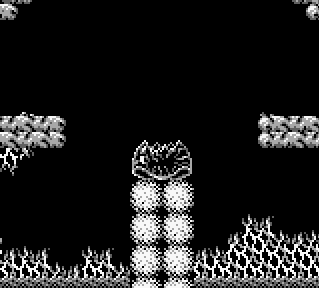
The feeling of being overshadowed by the immense scale of Metroid II's dome-like caverns is magnified by the reduced scope of the Game Boy screen in correlation with the generous size of Samus' sprite. Within these large domes are the underground ruins of an extinct civilization—towering edifices the player can both scale and enter. Each of the game's five most spacious areas contains a building swallowed by earth. Some buildings seem to be sinking into groundwater. One is embedded into crumbling rock and hangs precariously, doomed to fall.
Keeping with Frankenstein and "Ozymandias," a similar trend—one exploring dead empires (the mighty past) heroically in search of power—would survive into Poe, Conrad, Scott and Cameron, etc; i.e., as notably "doomed," pushing collectively into a new millennium beset by old problems (and Capitalist Realism): power's transference from older to newer empires, the latter's heroic explorers Heinleinian "Competent Men" who operate through astronoetics to enact capital. Samus swaps the gender but keeps the role—a weird token nerd, stuck inside Greene and company's Man Box while acting "like a man" (essentially Plato's cave).
Return of Samus is the only 2D Metroid with buildings the player can walk on and enter. Every door in Metroid II is located in abandoned buildings, and behind every door is an item that's been sealed away like a time capsule. Each door is a barrier that is hopelessly locked, necessitating that you blast through it with missiles. Compare this to Super Metroid, where the continuity of the map is constantly sabotaged by ridiculous bottle-necking via bubble doors, which serve as a transition into the next room. [...] Some doors are located in outside areas where the sky is visible, making the game world feel like a box with holes poked in the sides of it. This problem reveals the artificiality of areas intended to seem organic and reveals the game designers’ guiding hands. The Space Pirates—somehow an entire species—mill around inside rooms between these doors as if they're doomed to wait forever. Space Pirates don't have missiles or Power Bombs, so how would they be inside places where these weapons are needed to ingress? Why would they build a door that can only be opened with nukes, ending all life in their immediate vicinity?
I'm inclined to agree (ignoring the scuttled Pirate Ship, in Super, which rock mostly covers). I never noticed the incongruous nature of the doors, in Super, but you're completely right (the "monster door" seen in previous Gothic to Neo-Gothic stories, like Romeo and Juliet [1597] and Forbidden Planet, but which dates further back to Greek sarcophagi [meaning "eater of flesh"]; re: live burial; see: "A Cruel Angel's Thesis," 2024). Also, the "kill room" idea comes from Doom (1993)—an FPS styled on Tet-Offense urban combat, itself preceded by neoliberal "shooter" dialogs in Aliens and Metroid, TPS[31] "reviving Vietnam" (re: Cameron's refrain); i.e., of the state versus nature as monstrous-feminine scapegoat: something to shoot (re: "Nature vs the State," 2025). To it, different shooters would historically complement each other, in this respect.
As in the first Metroid, Samus can unfurl from her ball-form in mid-air and gain an extra jump. You also get an extra jump when you take damage, allowing the use of enemies as momentary platforms without the Ice Beam. When landing in ball form, you can hold down on the D-pad when you touch the ground to cancel or delay your bounce so you won't bump into an enemy. You can also jump away from the edge of a platform and launch yourself downward (this is the hardest of them all to do consistently). I was elated to find that nearly all of these discoveries I made have long been incorporated into speedruns of the game. The mechanics in Metroid II were graspable enough that I could intuit the possibilities on my own in a homeless shelter with no internet access or outside help.
Exactly that! Having interviewed multiple Metroid speedrunners (e.g., Behemoth87 for "Mazes and Labyrinths"), I saw how the grassroots nature of speedrunning "took root" inside these gameworlds—owed in part to their hidden systems of reward (re: "Always More: A History of Gothic Motion from the Metroidvania Speedrunner," 2019) but also player responses, when done well: "The game is not timed, has no in-game map system. Its world is a giant map that can be explored, in-game, but also charted out-of-game by the player. In Super Metroid (1994), an 'automap' feature would be introduced. However, from a narrative standpoint, this merely illustrated what the player was already doing themselves" (source: "Lost in Necropolis"). So do mazes house and hide monsters/monstrous treasure (e.g., classically the Minotaur in the Labyrinth of Crete, the allegory these clearly fictional stories supply granting users poetically useful abstractions; i.e., comparisons for real-world examples, across space and time; re: the Gothic chronotope [and navigations of power it describes] haunted by dead Greek metaphors).

Another maneuver I intuited on my own is that, after acquiring the Spring Ball, if you jump to the left in ball form and press down on the D-pad to initiate the Spider Ball, Samus is launched in an arc that is the fastest mode of travel in the game. However, this only works when jumping to the left. Acquiring the Varia Suit increases Samus' speed to the point where rolling on the ground is no longer the faster mode of travel. This results in a state where activating the Spider Ball while Spring Ball jumping is the fastest way to move to the left, but running in the Varia Suit is the fastest way to move to the right. This provides Samus' moveset with breadth and depth and renders each of her movement methods practically useful depending on context.
I call this "the runner's gait," which, in Metroid, varies through power-ups that alter the avatar's base movement scheme (re: "Mazes and Labyrinths"). However, I've never seen one that is left/right dependent on different glitches and gear. Nice catch!
It occurred to me then and later on, when I kept killing for energy and missiles, that the Metroid series' insistence that players be awarded with items and health pickups for murdering things was an unfortunate leftover from, perhaps, The Legend of Zelda. [...] Enemies dropping health or items or money is an outdated videogame dogma, a lazy excuse to pad out games by making players kill-grind in order to complete the game. [...] These supposedly indigenous creatures exist for grinding in some areas and clash with the ecological storytelling.
I would argue they fulfill the game's vampiric aesthetic (argument and function)—the castle of the "vampire boss" invaded by the vampire-in-disguise; re: Samus leeching the land of its resources (and flora/fauna lifeforce). Put differently, she's a moving racecar zooming through capital-in-small; re: mise-en-abyme to enact exploitation as built into the game under state crisis (from the Cold War to late-stage capital, afterwards). You're not wrong about it being dogma—the "farmer" working the land, under settler colonialism, to extract resources by replacing the locals—but the ludology still informs the experience; i.e., of said dogma as something to play out: feeding on the land to steal its power, each and every time (and generally through dialogs of return and revenge, beheading Medusa). Samus obeys the Man, each-and-every-time (made most clear in Dread [2021] when Samus acquires the Metroid Suit: fleecing Raven Beak [specifically a X clone of him] to "debride" him, doing so with twice-stolen power as turned back on his giant rotting corpse).

In the first Metroid, always resuming the game with 30 energy necessitated grinding through creature-killing for most players, as it is the only way to recharge Samus in between the game's energy tanks. Leisurely shooting creatures was mechanically encouraged. / Metroid II contained the most energy and missile recharge stations out of any Metroid game for a decade. It is the only Metroid game where the contents of the creature chutes run out before you're fully recharged, implying that the life Samus wipes out is finite. Unfortunately, leaving an area and coming back replenishes the creature chutes, yet some rooms in Metroid II are full of empty chutes from which no creatures emerge, reinforcing how indiscriminately killing makes the game world emptier. Since Metroid II is a game about how a killer seems to change her ways and stops killing, the game's themes could have been reinforced by making its defeated creatures crumple into corpses with no energy or missiles given. Killing should've made the world feel deader and made you feel like a jerk.
I'm reminded of Patel and Moore, who again write, "Capitalism is a process in which money flows through nature" (source: Seven Cheap Things). Under state vampirism, state actors (cops, soldiers or otherwise) suck power from nature and those "of it" in bad faith; i.e., under Cartesian dualism to empower Samus and her guerilla maneuvers; re: White Indian, black planets. Again, she's literally capital-in-small, specifically tokenized capital pilfering dead labor to armor and feed herself, per mission (then cut herself down to size, afterwards). The decay and retro-future lineage hides the elite "behind the curtain"; i.e., Black Veils all the way down, Samus a fake steward of nature (whose own keeping of the metroid larva, in II, she repeats with the [mascot] animals, in Super).

Many things in Metroid II only appear once. For example, near the game's end, you encounter a round rock with a texture you’ve never seen before. You need to damage it with a missile instead of the usual bomb. At this point, figuring out a way through should be easy using the game’s established logic. / Compare this and Metroid II's acid to Super Metroid's introduction of contrived picture tiles showing you which weapon-key you need to unlock a bubble door. One of Super Metroid's most condescending concessions is its codification of paths to progress with pictures of speed boosts, bullets and bombs. Tiles that the player would usually morph-ball bomb in earlier games are inexplicably replaced by more bottlenecking blocks that need to [be] destroyed with Super Missiles, Power Bombs and Shinesparks.
I always enjoyed this about Metroid II. There's so many unique enemies (more so than Super, in my opinion). As for the block marker system, it's kind of a Super Nintendo staple (e.g., Super Mario World, 1990). In moderation, they're not so bad, though Metroid II works well enough without them. By comparison, later Metroid games feel increasingly dependent on block gates, ergo more like raw mechanics and less like stories centered on concealment; e.g., in the much-touted "total conversion" mod, X-Fusion (2025): "X-Fusion's design is notably regressive, deliberately falling back on that early 'Action/Adventure' style the Metroid franchise eventually grew out of; e.g., invisible doors, 'pick a pipe(dream)' gimmicks, dead ends, offscreen tunnels, one-hit kills, and far too many variations: of destructible blocks acting as 'soft gates,' and indestructible, switch-activated 'hard gates'" (source: "A Beautiful Lie"). It breaks the spell of so-called "atmosphere," when exposed, but whose "speedbumps-in-camouflage" also cramp the player's ability to race (which, while some don't mind, still works at odds with going fast; i.e., an off-putting clunkiness that frustrates until-and-if players "get the hang of it"; e.g., SEGA's Sonic the Hedgehog [1991] visually promoting speed, only to punish you for "speeding" when trying to free that game's animals).
Metroid II has no elevators marking entry into a new area like every other Metroid game; it switches tile palettes with fade-outs and fade-ins. The lack of elevators makes narrative sense, since nearly all traces of technology are either gone, malfunctioning, or sealed away behind reinforced rooms. / The technology Samus finds is that of an extinct avian species. This avian species built statues bearing their likeness and enshrined them. These statues hold still-functioning weapons systems and movement technology, which enhances one's ability to move in virtually any space with weapons in tow. No creature could hide from the avians' wrath. The avians worshiped themselves and war and how clever they were at doing it, and then they died.
Again, this leans into "Ozymandias" and the Promethean Quest. Beyond the Space Jockey in Alien and Chozo in Metroid, there's the noble savage as a larger storytelling device. First, Gothic portends the return of a legendary barbarian (often Indigenous), enslaving Earth "from the past" as coming home "from the stars" (or the deep, from beyond, etc). In turn, liminal hauntology of war = graveyard of alien power as replete with primordial monsters, a given fortress evoking "space Orientalism" (a Star-Gate-meets-The-Dark-Crystal mishmash, 1995 and 1982). From here, their uncanny "ghost" (of the counterfeit) abjects imperial sin—projecting away from empire's current hegemon, offstage, and towards scapegoats, onstage; i.e., onto chimerical, hauntological replicas of older non-Western empires, their noble-but-doomed allegory betraying the lie with bits of truth; e.g., the Maya, Aztecs and Incas—renowned for/reimagined through pagan forms of slavery and ritual sacrifice, but also technological marvels: their "fire of the gods" seemingly lost to time and conquest, a Great Destroyer/fabled Promethean destructor working the controls when woken furiously from prior slumber (notably of earlier defeat, the "curse of the Pharaoh" rising to threaten genocidal revenge, fear-of-a-black-planet). It's capital scapegoating itself with further abjection, Samus the White Indian foiling the returning conqueror's plans: to turn a formerly black planet black once more* (and returning herself to raise, in place of the initial false flag, the flag of "final" victory).
*Echoed in Scott's Prometheus: Elizabeth Shaw, the film's Christian "true believer," dumbly asking the last Engineer, "Why do you hate us?" In doing so, she ignores centuries of devastation her own god, a false idol, enacted upon a gifted world: its "makers," per the Promethean myth, deeming the human race as "unworthy"; i.e., of the fire of the gods (which, to be fair, the Engineers stole from someone else, on and on). She's a dumbass, one easily misled by David (also playing god but given a Miltonic, "terrorist" character with rebel elements; re: "Fire of Unknown Origin" from "Making Demons," 2025).
Metroid II is a hellish labyrinth of the mind, even if it seems like gray clusters of caves you blow shit up in. The sources of your obsessions sequester into the corners of your mind. In avoiding your agonies, they have become alien. Whatever form they take in your neural tracts, they wait for you to face them, because neither of you will ever stop until one of you perishes. [...] The vampires of the past.
Mid-abjection, the hero (for the state) sees state crimes upon state victims: the state devours workers, one-and-all. This forces Samus to reconcile with home; i.e., as one she endlessly destroys and reclaims, heart-of-darkness (through future fictions, repeatedly revising the past in "canceled," retro-future ways). It's always scary but the focus of the fear changes; i.e., depending on how and if she feels like it's home or not, mid-abjection: the girl "raised by wolves" (or birds), thinking she's human (an effect not dissimilar to Lovecraft's "Shadow Over Innsmouth" [1931]: the Providence hero, at the very end, learning he's raised by killer fish folk). Like all Metroid titles, II teases home to deny Samus comfort: the girl's "true parents" (the colonists) "killed by pirates" (the hero creation myth), followed by her found parents (the Chozo), ultimately settling for foster parents (the Federation, who weaponize her to graverob the others). Her lineage is one big lie/retcon, hiding her robotic design behind/upon an Amazon aesthetic: "bred to kill, not to care." So she blows up unruly planets to protect Federation land.
The deeper we descend, the more oppressive the world and its ambience become. Tension knots as the number of living metroids dwindles. Each battle becomes a drain, a gauntlet with no rest stops. This oppressiveness is calculated with greater meticulousness than in any other Metroid. Everything seems to happen in the right spot, especially the musical cues. All the killing is as uncomfortable as it should be; its tedium masks no pretensions. / Exempting one case, metroids always guard their territory and will not seek Samus out. They won't bother her until she encroaches on their space. Samus is the trespasser.
Verily. She's the state exterminator working imposturously under false flags, judge-jury-and-executioner—a one-woman army/settler-colonial cop raping the land through Cartesian doctrine (the map a technology of conquest, perfected by Enlightenment thought; re: Patel and Moore): a DARVO-and-obscurantism strategy used currently by Israel, offstage (the theatre of war), who borrowed it from the CIA infiltrating Communist spaces (re: Blum), and where WWII Nazis copied the American genocide, onstage and off; re: by self-identifying as "native" versus their Soviet foes, under Lebensraum—all to imitate Manifest Destiny on new moral geographies (wherein the Soviets had already done their fair share of pogroms and slaughter[32]). From Metroid to Stalingrad, all roads lead to Rome; war predicates on deception, power a liminal proposition to cryptonymically and cryptomimetically[33] "pass down" across all registers (which Gothic happily confuses).

The exception is the encounter with the last alpha metroid in the game. We discover another metroid husk behind the husk of the alpha metroid. Killing the alpha metroid triggers another telltale earthquake. According to formula, the acid should have lowered, but instead the acid has risen, trapping us. We circle back around to where we saw the two metroid husks since we've only killed one, and find a new metroid form we've never seen before—that of the omega metroid. / Metroids are smart enough to lay traps, and they seem to be able to control the acid around them, making it rise in certain areas to block passages in order to protect the rest of the hive. The metroid hive works in a system of hierarchical defense. When every metroid on a certain tier of a cavern dies, the acid recedes. Since metroids are capable of flight without any propulsion and can shoot thunderbolts and fireballs out of their faces, why can’t they control the volatile chemicals seeping through the planet's surface?
The land, here, essentially defends itself from Samus; i.e., outwardly alien (abject) "space vampires," protecting themselves (and their home) from a seemingly "human" UFO (re: a state vampire; e.g., the saucer-shaped "space cruiser" helmed astronoetically by Captain Adams, in Forbidden Planet[34]). It's also a guerrilla tactic, dualistically breaking monopolies of violence, terror and morphological expression (re: Weber, Asprey and me)—the real residents repelling the home invader by "deceiving the deceiver" (to borrow from Matthew Lewis). Cops pimp nature under a terror/counterterror binary that forces the victims to fight back however they can (the metroids—limited by Game Boy technology [and designer myopia]—can't use colonizer technology as "planted" by Nintendo on their land, so they settle instead for natural weapons of a more primordial sort: fire, lightning and floods).
The wordlessness of every event invites one to fill in the blanks to their own satisfaction, no matter how strange things get. The whole damn game is strange and feels like a murder nightmare. / After killing so many metroids that the counter says one is left, we delve deeper into the metroids' dwellings only to discover they're empty. The metroids may have picked the place clean in their hunts, but Samus has left the game world much deader than they have. Everything begins to sound like rasping, irregular breaths and rumbling heartbeats—an increasingly rapid arrhythmia. The music's breathing sounds match the movement of the metroid sprite in the game's HUD.
Again, the thing to reconcile with, here, is Samus; re: she's false—a colonial "cuckoo wasp" mimicking the natives, feasting on them until she kills the planet. It's a leather-stocking story on par with The Last of the Mohicans (1826), except it's the last metroid in captivity (on par with Napoleon's crimes, in Egypt, helping Egyptology catalogue genocide). Abjection is abjection. Swap "metroid" out with Palestinian, Syrian, Kurd, Native American, etc, and the basic colonial mechanism/movement of capital remains (or spectres of it): "peace" is a lie/white man's word, one whose state cryptonymy shows and hides endless exploitation (which requires extermination; re: Wolfe).

An optional discovery within the lab itself is a defaced avian statue sitting directly under the metroid queen's abode. The statue once held the Ice Beam no doubt used for metroid containment. Extreme cold is a young killer-jellyfish's weakness. The metroid queen seems to know who the avians are and that the Ice Beam posed a threat to her children, so she attacked the statue. But, rather than destroy the Ice Beam, the metroid queen knocked it behind the headless statue. The face of the statue was destroyed because the metroid mama remembers her parents, and she doesn't like them.
The fun, here, comes with inferring the origins and politics. Doing so boils down to a lie-within-a-lie—a rememory[35] tactic borrowed from Shelley's framed narrative; i.e., by throwing "native" into doubt, depicting the metroid people as "savage," yet seemingly siding with them as noble over Samus/the Chozo upon honest reflection: the latter crying "rape!" while shooting their prey in the face/enslaving nature in token ways (the TERF school of thought; re: fetishizing anything Indigenous, mid-vaudeville). As for the metroid queen, she's the Archaic Mother trope (as borrowed from Aliens, versus Mother Brain's "bottled hysteria" being M.U.T.H.U.R., from Alien). The queen profanes her zookeeper's temple out of revenge (echoes of Grendel's Mother); i.e., Her Majesty (the Gorgon) beheading the statue of those who pimped her children, whom state fearmongers ethnocentrically abject while sending cops to extirpate (and capture): the endless enemy it needs to abject, thus keep money flowing through nature; re: Patel and Moore. As Marx argues, capital is dead labor feeding on living labor (source: "Limits of the Working-Day," 1867); Samus is undead, as such—a bio-mechanical cop who serves a factory-like role, harvesting the planet in bad faith: the White Indian who, mad with preemptive revenge, wants to "paint it [the planet] black." Her blood debt continues, jumping across planets: to destroy a given species, one-to-the-next, for the Greater Good. And so the Federation is ultimately eco-fascist; i.e., behind a neoliberal façade—an intergalactic menace bringing "peace and prosperity" through "regime change."

Soon we see the egg from Alien that everyone ever has already pointed out. It foreshadows Samus' imminent change of heart, passing above her like a thought crossing her mind. Players are required to pass under the egg in ball form so Samus resembles the egg.
Oh, nice; I never caught this! It's certainly Freudian—of different, symbolic, seemingly rival species, sharing the same basic life cycle (and competition) Ego-to-Id; e.g., eagle and snake embossing Athena's mirror shield (or Gorgon girl who's also part-bird, Samus' helmet oddly snake-like). So Samus appears to relate to her "natural" enemies—the metroids, who she just eradicated, but also their Archaic Mother as "dark"/debatably older (thus more alien) than her human or Chozo lineage (with birds descending from snakes, and eggs representing a radical potential to change; e.g., trans people and egg discourse); re: the secret princess trope, fusing teenage virginal huntress (with trauma) to a half-hidden destroyer gimmick, one that threatens legitimacy on fatal portraits: showing human girls their abject animal side (descending from "extended" to "thinking" status, under Cartesian thought). It's a Gothic classic, the arch-rival "psychomachy" (mind battle) jeopardizing dynastic primacy and hereditary rites. To a binary degree, Medusa = female Darth Vader (the whorehouse bastard, black knight, pirate) to make Hippolyta sweat—the Aegis made by Athena, daughter of Metis aka the Medusa;
When Perseus slew the Medusa he did not – as commonly thought – put an end to her reign or destroy her terrifying powers. Afterwards, Athena embossed her [mirror] shield with the Medusa's head. The writhing snakes, with their fanged gaping mouths, and the Medusa's own enormous teeth and lolling tongue were on full view. Athena's aim was simply to strike terror into the hearts of men as well as reminding them of their symbolic debt to the imaginary castrating mother. And no doubt she knew what she was doing. After all, Athena was the great Mother-Goddess of the ancient world and according to ancient legend – the daughter of Metis, the goddess of wisdom, also known as the Medusa (source: The Monstrous-Feminine).
i.e., as someone Samus, occupying a man's role and taking Zeus' orders (an egg that never hatches), doubtless feels momentarily worried/confused about: animals live outside/don't have homes (of a comfortable sort). It's a mind fuck—a fearful "what if?" that has two basic aims, when making the planet black (or watching it turn back in that direction): to make the middle class pearl clutch enough to play the White Indian (the girl in a man's world, dreading execution[36] as something to self-impose), and broadcast "fossils" out from older Gothic schools/psychoanalysis; i.e., that linger in latter-day media as "hermeneutic baggage": virgin/whore syndrome under a colonial gender binary that furthers abjection, mid-confusion. In cis-heteronormative terms, Amazons are classically women who act like men; re:, coopted by TERFs, from Athens to America, who accordingly experience gender trouble (thus identity crisis; re: Butler); i.e., when facing the—in their eyes, at least—girl with a penis. Of course, "Gorgon" is dualistic and performative. Trans people can use her to punch up, while TERFs can adopt a "Gorgon" stance to punch down, Trojan-style; they also can/will scapegoat her as "lightning rod," meaning those "lower" on the totem pole's presumed hierarchy prescribing violence from a superior to lesser group: birds and snakes, dragons and knights, TERFs and trans women, etc, per master/slave arbitration (us versus them or in-group/out-group, etc). Abjection is arbitrary. In that event (and per our thesis argument), Gorgon = trans and trans = alien to receive violence; i.e., the Gorgon aggressively masculine to abject fearful extremes—a "man in a dress" to behead/castrate, not bridle by "pick me" tokens seeking assimilation who self-castrate (whores policing whores, a downtrodden whore shaming token pimps by evoking their whorish origins, postmortem; re: "Policing the Whore").
The nature of descension is evoked, and we see the empty downward spiral that comes with killing. Eight new lives arrive in Samus' sights, so she must wipe them out. Through much of the game, Samus seems heartless. [...] Metroid II plays like a hard-boiled sci-fi detective story. We've investigated the caves and ruins and seen the many metamorphoses of the metroids' life cycles and the shells they leave behind, but a lingering question pervaded each discovery: where are all the metroids coming from?
Re: the Archaic Mother trope, specifically echoes of Grendel's destroyer, Beowulf, in female form: the "good" Amazon losing her humanity mid-appetite while pimping the Gorgon/destroying her home (and Samus' though she doesn't realize it); re: as Ripley does, made homeless after she kills the Queen and her babies; i.e., the euthanasia effect where state powers euthanize or exile "rabid" Amazons—all for being "too close" to whorish powers to rejoin civilization: her Agent-Orange, "nuke the site from orbit" approach turning the planet black, Samus made the radioactive homewrecker to replace the Queen as actual dumbass. Doing so echoes the baby-killing Americans in Vietnam, Ripley (and Samus) completing a "rung" on ladders of genocidal revenge; i.e., by destroying a generational enemy through "final" victory (a lie popular among Nazis). Per capital, said ladder (and its DARVO and obscurantism) go on forever, including in Metroidvania echoing state predation; e.g., when Hornet rescues Lace, in Hollow Knight: Silksong (2025). There, the game's villain mirrors the Alien Queen, Mother Brain, Medusa, etc, inside a murderous womb: as devouring civilization per state lies, but also luring the traitorous heroine to her monstrous-feminine doom; re: to see the snake upon herself, virgin/whore (the ghost of rape corrupting the otherwise perfect image, in state eyes). In other words, Medusa can't die, lingering memento-mori in those very stories/worlds meant to lionize her destroyers (the Gorgon terrorizing state actors with state contradictions, a wild animal living in/command[eer]ing what Cameron's Colonel Quaritch might call "mean bush").
This answer is revealed as we drop into the metroid queen's chamber. The queen's visage resembles the toothy grimace of a crocodile—if the crocodile had eight eyes [combining an ancient apex predator with the spider]. Her neck extends similarly to the game's indestructible plant creatures. If you don’t put the metroid queen out of her misery early by letting her swallow you and then ball-bombing her belly, the battle is more grueling and more thematically appropriate. If you torture the queen to death with missiles, repeating the age-old loop of the boss pattern, her dying cries become more plaintive and pitiful. You might even feel something, and it won't be nice.
Abjection is an inkblot, one that can mean different things regarding sex and force. Here, nature's defeat seems foregone, but couches within dialogs of a "natural" order that is highly unnatural; re: Cartesian dualism, capital, and the profit motive: up-and-coming girls, hungry for advancement, kill big strong ladies (re: Dorothy and the Wicked Witch). State abjection historically demonizes nature; re: as monstrous-feminine to rape for profit, furthering the lie as something to commodify as abject (so-called "hag horror"). Here, the whore—specifically the Big Whore, or Pirate Queen—is something for Athenian heroines to "spank," aping Perseus while rescuing Andromeda (a larger meta-pattern that T.S. Eliot calls "the mythic method," but I digress): to torture the Gorgon to death, having the pimp's revenge through bad-faith feminism making the planet black. It's TERF-delivered ecocide, the Amazon betraying the planet only to face exile: a "battered housewife," triangulated by state powers (under mirror syndrome) to punch down at her fellow women (and trans men, intersex people, etc); i.e., policing the whore to serve capital, all despite knowing she'll always be lesser in state eyes/will always be somewhat abject (the whore's paradox, the virgin always something of an animal/whore; re: "Rape Reprise"). Classic neo-con symbols "defending Athens," Ripley and Samus are cops dressed up as barbarians fending off wilderness to rape nature. Spiteful, reactionary and blind, they're no different than Darth Vader. Worse, they're token (and monopolizing oppression/acting oppressed; re: as TERFs do: "basic" bitches/white or at least cis women [or gay men/male feminists] who—dressing up as exotic warriors/risqué figures with a victim complex—evoke older oppression to aggressively self-aggrandize/scapegoat others in their place, Holocaust-style). Assimilation is poor stewardship, segregation no defense; tokens get spent, destroying the environment for billionaires (mostly men): those who would rather burn the planet to ashes (and warm themselves as they do) than surrender control. It's all they know, alienated from (and dependent on) nature as something to partition and rape.
When the queen dies, she triggers one last earthquake, sealing Samus in the room. Samus cannot return to the surface the way she came in. She is seemingly trapped in the labyrinth forever. Relieving, disorienting music fades in after the metroid queen's corpse has faded out. It’s a melody that folds into itself with offset overlaps. It's optimistic and forward-looking after a harrowing trek through hell. You've just committed genocide; here's a musical door prize.
In killing the whore, the pimp suffers the whore's revenge—live burial (the Gothic master-trope)! But yes, perhaps more galling is just how hollow the music feels, given what the heroine has just done: holocaust, only to fall on her sword (what Shakespeare called "the Roman fool"; re: Macbeth, 1606).

And then comes Metroid II's crowning moment that it would be soulless without. [...] In order for the player to proceed, the newly hatched metroid must consume immovable foodstuffs preventing their progress. Samus must nourish the metroid child after killing their entire family. Without the traditional Metroid mechanics of exploring and extermination leading up to it, this subversive ending would not have the resonance that it does. To portray Samus' sudden refusal to carry out her genocide mission, the game has the player nurture and nourish life instead of ending it. The fundamental nature of Metroid's game-design ethos is subtly changed to reflect the altered tone. Paths are no longer opened with destructive weapons; instead, progress can only be made when the player provides life-giving nourishment to a newborn whose entire family they've just killed. The player cannot stand idly by while the metroid child eats; they must lead the child to the food and take part in feeding them.
Quite! Instead of using the head of the Gorgon to escape (as Perseus does, weaponizing Medusa's corpse), Samus nurtures the Gorgon's offspring to return to motherhood (something to camp, often in abject ways; i.e., that view babies like anchors to prison-like homes). Of course, her misdeeds haunt her charity—a pioneer trad wife enacting "kill the Indian, save the man" by assimilating a monster child, once the planet is black: like Ripley if she rescued the Queen's brood; i.e., by dressing up as the Queen, instead of rescuing Newt while appearing human. It forces the mother to face her crimes by helping the survivors, subverting genocide to a matter of degree (and generally through some level of guilt, shame, desire, instinct and/or fear): a chance to atone, hugging the alien at its most vulnerable (and alone) to reverse abjection. Mirror syndrome freezes the attacker by having them see themselves in/upon those they persecuted; i.e., Samus seeing herself in her victim's offspring—not because the metroids were actually bad (no more than her, anyways), but from Samus being the thing she accuses them of, DARVO-and-obscurantism. That's one interpretation, one Samus will reject to justify her actions/whitewash her crimes: by trying to assimilate the child—to "tame" and keep it as a pet, or at the very least rescue it from the "real" pirates, in a future title. But the guilt remains, out-out-damn-spot; re: Samus the cuckoo wasp invades a rival hive and destroys it. In doing so, she unwittingly resets the cycle that matriarchal societies embody… except she ultimately serves a patriarchal master through the Galactic Federation (who won't be happy with her "failure," but also make an exception—with Samus the White Indian, post-mission, kidnapping the black baby and saying to her horrified boss/parents, "Can I keep it?" and for them to take the child and chain it up, Omelas-style, in the basement[37]). The queen's revenge horrifyingly indebts/endears Samus to the child, making the newfound mother forever question herself (and her employers—a psychomachy that extends into the SA-X and Dark Samus, who Samus divides from to avoid facing facts: she's a heartless killer/giant idiot tilting at windmills).
This is the first and last moment in the Metroid series wherein Samus has a companion who follows her [until Prime 4 but I digress]. It was a stroke of brilliance to be ignored in Metroid II's sequels for the sake of appealing to a wider audience with pleasantly crafted murder mazes. [...] Super Metroid's ending is about who the metroid baby will defend and throw themselves [at] when their adoptive parents they've known for less than a week try and kill one another [the lesbian divorce]. The kid died for the genocidal protagonist who massacred their biological family, so we get the silly rainbow beam and our precious escape sequence. [...] Super Metroid's ending is emotionally unearned and piggybacks on Metroid II's ending, especially when viewing Super Metroid as a standalone game. (Its reliance on visual and textual flashbacks to the first two games corroborate this.)
The game, like the franchise, rewrites itself constantly to further abjection. The first game is pure copaganda, to be sure (see: "The Metroid Story" from the original instruction booklet, which reads like George Bush Sr.'s "New World Order" speech [1991]: "We have before us the opportunity to forge for ourselves and for future generations a new world order—a world where the rule of law, not the law of the jungle, governs the conduct of nations"), and the second is nakedly genocidal, but the third combines them to lean into Samus' bloody show (so to speak); i.e., the killer debutante who, having slain the mother of demons, forever indebts herself to the one "good" metroid: a casus beli that perpetuates genocide in bastard-baby forms (the rape child of the Gorgon being the Pegasus, which sprang from Medusa's neck stump and which Bellerophon rode into battle). This effectively makes the last metroid (code for Mohican, orc, etc) into Space Jesus, and Samus the Roman soldier holding the Spear of Destiny that sets about an endless crusade/self-devouring conquest of space. It's "noble savage" rhetoric married to Christian dogma under a Protestant ethic: work is holy and war is work/must continue until the last planet explodes/turns black. "Pray for a true peace in space," indeed! Space NATO's full of it, echoing its earthly double. Here, Samus is "armed for bear"; i.e., with missiles, beams and bombs (and optional armor) that—framed as "Indigenous" technology—give her American ass unfair advantages while fighting the Most Dangerous Game (the paradox of rape/danger and pain, in Gothic stories); re: an ethnocentric cross between safari, crusade and settler colony that supplies the avatar with a dual (cryptonymic) purpose: not merely as vehicle to move but mirror to reflect on while inside Samus, inside the gameworld (and concentrically inside the queen or her babies, at one point). Samus isn't a vampire, alone, but cyborg with murky origins/enhanced eugenically with bird (and later) Metroid DNA (the power of her enemies, Samus "killing for company" while cannibalizing her prey like a serial murderer). Blood quantum/drop doesn't apply to her so long as she keeps attacking her fellows. In turn, doing so conscripts her from a one-woman prison battalion. A child soldier growing into her stolen[38] materiel (armor and weapons), peace becomes a far-off memory for Samus; i.e., her lost childhood (and innocence) replaced by ubiquitous theatre: of war (and its deceptions) tarring the universe under Pygmalion's guidance. War is all she's ever known, a deeply tragic, loss-of-Paradise backstory justifying endless death and destruction: a walking Death Star and human Swiss army knife—as both explorer/gladiator per Japan's search/action model—her tagline may as well be, "Specialization is for insects," "Search and destroy" or "A queen has her reign and then she dies" (a given female monarch living in the Shadow of Pygmalion/Cycle of Kings).
All this brings me to the conclusion that Samus is a mass-murdering antisocial space nerd. While this fits Samus character considering her actions in previous games, it's reflective of the designers having no idea what they were doing with Samus from the beginning. Especially since Samus being a woman was a jokey whim in the first Metroid. The whole twist is "bet you didn't suspect a woman could do all that!" The hidden endings to the first Metroid are sexist not just because you're rewarded with Samus in a leotard if you beat the game in under three hours, but because if you beat the game in under one hour, she's wearing even less clothing.
The state pimps nature in virgin/whore ways; i.e., Samus a warrior-maiden historically piloted by the publisher's target audience, their breaking of the glass ceiling a secondary consideration (one that historically hides TERF schools of fascism under concentric veneers; re: "Trans TERFs, NERFs, and Queer Bosses," 2022). All monsters are dualistic; their function determines by flow of power (and its perception), mid-abjection. Here, for example, the Amazon allows for statements of androgyny and strength, for (and from) women and/or GNC people; its canonical (unironic) role is unabashed eye candy for crossdressing straight guys/fascist feminists, killing Reds for the Man. And while I, under Gothic Communism, stress the holistic liberation of unpaid labor through paradoxical exposure—namely public nudism of the Gorgons-and-Amazons kind (as granting anti-predatory qualities of weapons and armor, in hunter/hunted language; re: "Prey as Liberators")—the fact remains, we share the same stages (and avatars) with our jailors. To it, sex-as-weapon serves no one exclusively. Neither workers nor the ruling class can monopolize it as violent and terrifying "monstrous-feminine." Instead, the context of nudity matters; i.e., "shooting shit and quickly collecting number-go-uppers in order to see bikini-girl," as you put it, able to be enjoyed and critiqued by players of all different walks (re: me vis-à-vis Anita Sarkeesian; see: "Borrowed Robes," 2021). They share the same stage—the same dollhouse and dolls, inside said stage speaking to individual traumas (e.g., mine; re: "Back to Jadis' Dollhouse")—one where trauma performs/speaks to a historical-material lack of perfect abusers or victims. They're liminal, performing power as something to Quixotically reify and question (reclaim) while forever changing hands (re: "Notes on Power").

Regardless of the designers' intent, Metroid II ends on a promising note that implies murder mazes aren't the future of videogames. Imagine a game where Samus' goal is less about killing and more about exploration. She befriends the fauna and they help one another. / Yeah, I can dream, but the reality is that the bulk of the Metroid II [experience] will always be a maze where Samus does her murderscaping.
Such is the nature of allegory (re: Plato). The state demands whores to pimp, and to be pimps pimping themselves in bad faith (re: "Policing the Whore"). So the fantasy of escape (and universal liberation) exist "within Omelas"; i.e., as something to walk away from (as Le Guin argued, 1973). Or as I tell Mom, "Imagine a world in which we're friends with the xenomorphs." It drives my mother nuts (furthering abjection, in her case), but that's the point. White Indians blackening the planet isn't good or cool; it's a death cult. Sooner or later, we have to hug the alien; i.e., before the planet dies in real life (the ones in Metroid enacting death omens under class nightmares—what Patel and Moore call state shift, aka climate change something Gothic historically portends): setting the whore free by making a world where one can safely wander without fear of destruction (causing or suffering it). This starts in Metroidvania; re: as playgrounds of death to interrogate and learn from, putting "rape" in quotes to subvert state lessons in duality (e.g., that trans people are alien, and who humanize ourselves in abject language taken back with the land, our labor, etc). Bitches love monsters, both while inhabiting and wrestling them: as part of a life-long series of changes[39]/dueling banjos, one whose journey (and racket) never stops. Abjection = war and war (especially its theatre and lies) go both ways. The planet turns black, the future refusing to change; once more unto the breach! Storm Medusa's "castle," fuck what must be fucked, and cut off the state's head! I'll see you Hell, comrades!

(cited: "I'll See You in Hell")
[1] A stealing of power from the imaginary past; i.e., as half-real—quantum, but tied to reality (coming from Jesper Juul's "half-real zone between the fiction and the rules" [source] but for which I apply through ludo-Gothic BDSM to liminal spaces: "grey areas" of power and performance between fiction/nonfiction, commonly framed as "trashy" or "shallow" to disguise a critique of power [double operation] through camp/playing with taboo things; e.g., sex and monsters behind/upon various buffers; re: "Introducing Revolutionary Cryptonymy" and "Transgressive Nudism," 2024 and 2025). To it, the modern Promethean Quest comes from Shelley's novel, Frankenstein; or, the Modern Prometheus (1818), whose palliative-Numinous potential during ludo-Gothic BDSM I've written about extensively (re: "Celebrating Mary Shelley's Immortal Legacy," 2025): the Neo-Gothic revival of retro-future spaces of play that quest for elusive and decaying mastery in trademark spaces thereof (often castles). To that, Metroidvania = abjection/capital "in small" as half-real spaces of play—namely retro-future castles that revive and perform the Promethean Quest, mid-Amazonomachia ("monster battle"). Other names for them include the liminal hauntology of war (traveling castle, as I put it) and infernal concentric pattern (re: Aguirre, concerning multimedia examples). Theft of power comes at a cost, in Gothic—generally tied to revenge and ignominious death (often live burial or some such imprisonment/enslavement inside the home: as nightmarishly still-a-dungeon).
[2] From Mark Fisher's 2009 book of the same name: "It is easier for people to imagine the end of the world than it is to imagine the end of Capitalism" (what Patel and Moore call the Capitalocene, in A History of the World in Seven Cheap Things [2017], and which I study through the canceled future of the Metroidvania).
[3] Astronoetics = the colonial gaze of planet Earth; i.e., as found among the stars/ancient aliens on hellish, formerly Earth-like worlds; re: me, vis-à-vis "Ozymandias" [1818] and Michael Uhall; see: "She Fucks Back," 2024).
[4] The Black Veil cryptonymy device, Udolpho (1794) onwards: skull = theft/the presence of pirates playing at ghosts (the explained supernatural a seemingly Numinous [awesome] mystery solved by female detectives; i.e., of an increasingly martial character after Radcliffe—a spectrum of the Scooby-Doo-style virgin nerd [1969] unmasking villains, and the warrior huntress [classically also a virgin] blowing them up; re: "Radcliffe's Refrain," 2025).
[5] "Pax" = "peace," historically made in reference to/association with empire; i.e., making war while furthering abjection to rape nature and those "of it": classically whores and barbarians, but expanding under capital's generation of wealth to include a panoply of threats to "peace" (exploitation); e.g., trans people, unruly feminists and care/sex workers (re: unpaid labor), and Pagans/religious minorities, etc—state police, official or vigilante, "defending home" under various moral panics and persecution mania, which expand empire/exploit labor by tokenizing it, divide-and-conquer (which we'll get to).

[6] It also involves probably my favorite James Rolfe moment ever (not including the classic years but definitely before he sold out): him and Mike Matei playing Metroid II for James and Mike Mondays, finding Space Jump, and going "Yeah, yeah, yeahhhhhh!" into the camera ("Metroid II: Return of Samus (Game Boy) Part 1," 2016; timestamp: 14:05).
[7] One of my favorites over Aliens (and its toxic fandom; re: "Outlier Love: Enjoying Prometheus/Covenant in the Shadow of Aliens," 2021), and which I made into a fan edit with different music, scenes, and sound effects (re: "Maculate Conception: The Making of My Prometheus Fan Edit," 2021). Doing so is not unheard of—with "fan-edits" being commonplace since the early '00s into the 2010s; e.g., Weyland Industries' Alien: Covenant - Necropolis Edition (2018), which I've also covered before. I also love Creative Assembly's Alien: Isolation (2014)—both having discussed the original game, at length (re: "IGN Alien: Isolation Review Introspective," 2014), and making risqué fan art of Amanda/the monster for years (the "girl and the monster" trope being as old as courtly love stories/captivity fantasies; re: "I'll See You in Hell," 2025).
[8] With trans women often relating to Amazons/the Gorgon under Cartesian norms, the latter framing us as "of nature" in abjectly criminal ways; i.e., as freaks of nature that—unlike Samus—don't assimilate (despite their baggage/occupying the same "fuzzy" areas of play our inkblot avatar [and her double, Mother Brain] do). Even so, we generally oscillate before the mirror/suffer mirror syndrome on Athena's mirror shield (the Aegis) during Amazon confusion; i.e., seeing the destroyer in oneself as victim or vice versa, and the making ambiguous of the Amazon's performative role (two terms of mine, which we'll unpack deeper in).
[9] Which isn't a criticism, just an observation; i.e., plenty of people like drone music (an entire genre), and music without melody is likewise perfectly fine; e.g., the "electronic tonalities" from Louis and Bebe Barron's Forbidden Planet score, Tangerine Dream's early catalogue, or Aubery Hodges' Doom PSOne OST (1995), etc. Melody shouldn't be mandatory.
[10] The core function of prisons being population control, which elide during settler colonialism to serve capital's pimping of nature-as-alien, mid-genocide.
[11] Essentially "Space NATO," neoliberal world-building weaponizing "defensive weapons" through child soldiers. Growing into adult bodies (or Heinleinian "power armor" of a "knightly" sort), these Power Rangers "defend the realm"; i.e., paramilitary "teenagers with attitude," who pimp, police and terrorize American prey Elsewhere, but also turn blind eyes regarding state abuse enacted by others; e.g., the warrior princess furthering abjection, like Amazons canonically do (with Samus being a classic male vehicle and TERF power fantasy of assimilation). Western Liberalism historically hides fascism inside itself—with America's ruling class absorbing the Axis powers, in WWII, only to grow and expand under Bretton Woods, then neoliberalism, to proliferate capital: as "feeding zones" (often colonies) decaying into fascism. States die (and regenerate) by design, but their feeding never stops. Having spread worldwide, capital can feed and police state territory, mid-abjection; i.e., while continuing to rape the planet behind shams of security and protection. Good cop becomes bad cop under Capitalist Realism, a moderate leech decaying into open pirates, banditry and plunder (an age of theft). Here, the "skull = theft" equation cryptonymically indicates abjection; i.e., in highly uncanny ways, doubling as illusion—of anything grown to cover the skull, which drops away to cut costs after growing too costly to maintain (re: me vis-à-vis Zappa, but also Radcliffe's refrain).
[12] Doing so in "men's clothes," aka the Beowulf or Rambo fantasy but gender-swapped—a neo-conservative, peace-through-strength means for boys to pilot warrior-women avatars, and TERFs to play "cop for a day"; i.e., in patriarchal ways dressed up as false rebellion/fascist feminism with moderate veneers that fetishize and decay women's rights (re: me vis-à-vis Parenti's Blackshirts and Reds, 1997). Doing so happens on a spectrum of oscillating villainy and heroism, but also destroyer/care worker as arming themselves, TERF-style, to surrender just as fast; i.e., after punching "up" (down-in-disguise) to defend nuclear models from "enemies at the gate/within" (trans "homewreckers" and other marginalities): as occupying the state of exception that gives and receives state force (re: me vis-à-vis Agamben; see: "Police States, Foreign Atrocities and the Imperial Boomerang," 2024). So do good girls (maidens) pimp, police, and rape bad girls (sluts), and all to preserve the former's "market value" and euthanize/convert the latter under capital; i.e., virgin/whore in a police-state zone of work (the nuclear home, extending out from state bodies and into colonies "under siege" by alien invaders, DARVO-and-obscurantism)—all women "whores" until proven otherwise, and always proving their chastity per witch hunt as part of a larger tokenizing scheme (re: me vis-à-vis Porpentine and Silvia Federici; see: "Policing the Whore," 2024). Within that scheme/myth of the planet as owned by the state (and men/those acting like men), tokens play a dangerous game; i.e., they self-alienate from nature—just enough to ward off actual marriage, but still seem dutiful and predatory enough to please Pygmalion while shamelessly betraying other women (and allies). Each mission, then, gives "Puritanical reprieve" to marriage; i.e., clemency-through-combat as "married to the job"/war-as-holy a matrimonial act (of self-sabotage) under capital's Protestant ethic (re: Weber). It's a bandage for a bullet hole—a holocaust-by-bullet tactic of the home as sacred and vampiric, saving the traitor "for last." Nazis and Commies, exploitation and liberation—TERFs play the hero/victim in bad faith, raping nature while stupidly ignoring their origins (and fates). Assimilation is poor stewardship; segregation, no defense; silence, genocide (the devil in the details, playing out through kayfabe of a "Gothic" [counterfeit, Promethean] sort).
[13] Re: me vis-à-vis Crawford's Gothic Fiction and the Invention of Terrorism (2013): "The preoccupation with evil, fear, and violence, which is the defining characteristic of later Gothic literature, did not become a prominent part of the genre until the success of Radcliffe's later novels in the 1790s" (source). Amazons, after Radcliffe, turned into detectives (a classic male position); i.e., as upholding state hegemony by scapegoating various "bad apples" through force (the Gothic villain often a foreigner hidden inside a space, generally behind concentric illusions with a "black" premonition; re: "Radcliffe's Refrain"):
Under Capitalist Realism, Hell is a place that always appears on Earth (or an Earth-like double)—a black fortress threatening state hegemony during the inevitable decay of a colonial body. Its widening state of exception must then be entered by the hero during the liminal hauntology of war as a repeatable, monomythic excursion—a franchise to subdue during military optimism sold as a childhood exercise towards "playing war" in fantastical forms; e.g., Castlevania [1986] or Metroid. Conjure a Radcliffean menace inside the Imperial Core, then meet it with American force [seemingly enacted Elsewhere] (source: "Scouting the Field").
Such things always "map out," in advance, then play out from parent to child; i.e., the cryptonymy of genocide, recursively furthering abjection through a lineage of the same-old game: cowboys and Indians (re: "Giger's Xenomorph," 2025). Ripley's a TERF and one Samus doubled, in videogame form (embodying Janice Raymond, hatefully attacking "the transsexual empire" [1979] for territorial gain).
[14] A space of concealment and illusion I historically invoke; i.e., whenever critiquing capital "in small," through Metroidvania; re: me, vis-à-vis Gloggins; e.g., in "Whose Fredrick Brennan?" (2026) where I write:
the state kills empathy to preserve itself/suit its needs by abusing power mid-abjection (which rape ultimately is, whatever the form); i.e., to prevent change by keeping power vampirically "top-down," fascism defending capital by denying redemption while raping worker minds, cryptonymy-and-abjection (our focus being on Plato's Allegory of the Cave [c. 380 BC]—with The Matrix and similar simulacra [meaning "shadow" or "likeness"] informed by Plato's famous thought experiment: casting shadows on cave walls to fool ignorant onlookers in ways games let workers interrogate; re: me, vis-à-vis Gloggins; e.g., "The World Is a Vampire," 2024). Keeping our premise and thesis argument in mind, empathy—as something to encourage, under capital as inherently divisive (Cartesian or otherwise)—demands work to "unfuck" ourselves, mid-abjection (facing shadows); without work (which play and poetry are, "Gothic" or otherwise), people can't redeem thus change themselves and society/the material world: as having shaped so many peoples' way of seeing the world, before, during and after one's "hour upon the stage" (source).
In short, and from Marx to us, poetry and play shape how people see (matter [the Base] shapes consciousness; consciousness [the Superstructure] maintains matter).
[15] Smaller-to-larger scapegoats, in Metroidvania; i.e., classically in cis-gendered (nuclear) terms—with lesser ordinary monsters preceding a giant Freudian Numinous, a given Dark Mother or Father waiting "at the top." Namely the Archaic Mother and Skeleton King/Dragon Lord (re: exhibit 1a1c, from "What Is the Gothic?" 2023), these homecomings' divine reunions (and revenge) are concentric, anisotropic, and dualistic; re: per Aguirre, and generally delay through smaller-to-bigger encounters, as such; i.e., with their children and/or servants' minion/boss/final boss arrangements, hyphenating home and homewrecker in neo-feudal ways; e.g., Dracula's endless legion of demons/werewolves/the walking dead—faithfully defending their liege while torturing Alucard, his prodigal son storming said castle (the tragic prince). The same goes for Mother Brains' dragons, metroids and natural-to-unnatural barriers barring Samus—the long-lost "daughter of the Chozo" and (maybe Mother Brain)—from entry (re: War Vaginas"). To reach the center and escape, the hero "peels the onion" in monomyth ways; in Promethean ways, Metroidvania curse any supposed (monomyth) "gain," post-confrontation: with fatal unsightly knowledge—pointedly of one's dearth of virtue, embarrassing lack of vision, and/or encroaching mortality stalling resolution, live-burial (with Samus, on every mission, growingly eerily similar to Mother Brain/the metroid queen's babies, mid-abjection; e.g., Fusion's SA-X policing a denuded Samus for incubating* metroid DNA, below).

*A "going native" (white savior) theme, abjecting state abuse onto Samus' "walking shadow"; i.e., the bad-cop double tracking and hunting its "good" side, symbolizing capital's blind vampirism (the zombie) by dualistically speaking to previous copycats "gone haywire/rogue"; e.g., the Shoggoth, xenomorph, Creature, monster from the Id, cunning dinosaur clone (the velociraptor), Thing, terminator and body snatchers, etc, as false, viral and/or zealot sources of runaway predation (a natural being with weapons-grade potential; re: the fire of the gods). Here, the imitator—from Samus overhunting the metroids/driving them to extinction (making the X an eco-fascist device)—overpopulates the current locale, replacing the colony with evil doubles (scientist or specimen); i.e., post-replacement. In doing so, the X also clone Samus, whose still-living presence (thanks to quarantine) threatens to expose the "true" vampire—meaning one canonically worse than the Federation or the metroids, but invisible (a foreign plot/enemy within). Samus, the token witch, suddenly becomes a threat; i.e., inside a false home made "black," overnight, while still appearing white. So the anti-home scenario—one where a shapeshifting impostor replaces nightmarishly a dutiful Cartesian servant (afraid of alien proliferation, a virus not technically alive)—transpires under Numinous architecture borrowed from Radcliffe:
In addition to this, Radcliffe's setting (the castle) derives its claim to sublimity also from its being "not-here, not-now, an Other place, an Other time." Critics have often remarked on the choice of the exotic, the foreign, the barbaric as the background for and source of Gothic thrills. In other words, the Gothic castle is the world of the Numinous. As David Durant notes, "the ruined castles and abbeys are graphic symbols of the disintegration of a stable civilization; their underground reaches are the hiding places for all those forces which cannot stand the light of day." In Radcliffe's novels the Gothic castle is in the first place an anti-home, a nightmare version of the heroine's perfect past, in which many of the elements of her home are exaggerated and replayed in a Gothic form (source: Audronė Raškauskienė's Gothic Fiction: The Beginnings, 2017; cited: "Solving Riddles; or, Following in Medusa's Footsteps," 2024).
Spaceship = house of a colony sort threatened by infection. First, the game (and its authors) persecute in different ways, the X parasite a vector thereof (the latest scapegoat after the metroids are gone/worn appropriatively by Samus like a suit of dead skin, above): for being "a mindless killing machine." Said argument then goes both ways, one where the X seek revenge while having the upper hand; i.e., by using methods that whitewash Samus and the state in "horseshoe" (centrist) ways, "their" technology stolen by a "sleeper" terrorist; re: by bashing fascism and Communism, on the latest abject inkblot. So flourishes Nintendo's kayfabe, doing so under Bush-era Orientalism while Samus plays "pick me" to prove her worth; i.e., instead of rethinking her priorities (and employer). It's DARVO and obscurantism, as usual, the hero playing the victim, mid-Patriot-Act; i.e., while fearing replacement during the false flags' raising over the colony: one doubling as "science lab" with secret military aims, which Samus—ever the good girl, defending capital from evolution/decay—saves from its baby-like self when she thanklessly eradicates the X (which, of course, always come back, the state needing an enemy while gaslighting feminism to punch down, mid-chaos; re: Amazon confusion and mirror syndrome, X-marks-the-spot). Samus, then, is the cure, curse and the nurse—meaning for a Promethean virus, one the state chases like a dog after a car and where Samus "proves her mettle" (again): as admittedly reluctant-but-faithful governess. She's Athena abjecting Medusa to blow mini-zombie-Athens to bits; i.e., through a monomyth "loyalty test," one whose hellish symbiosis relegates Samus to Hell while stabilizing and sanitizing the Federation (all while drugged [without consent] with "alien DNA," giving Dr. Jekyll's potion [mad science] a eugenicist flavor).

[16] Another term for the liminal hauntology of war (which Metroidvania are) being "danger disco": a Numinous space of camp, its ludo-Gothic BDSM haunted by generational trauma/unironic rape (without quotes).
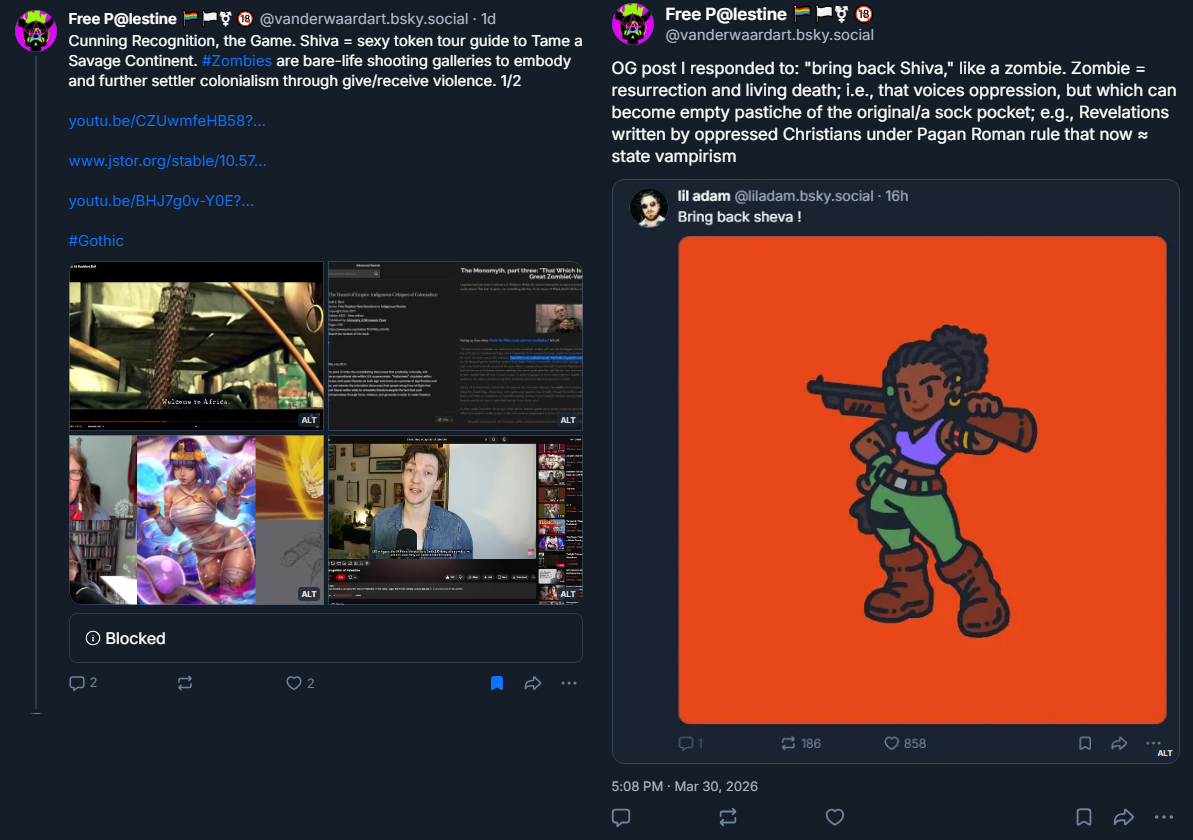
[16a] Where a speaker in the video recommends The Transit of Empire: Indigenous Critiques of Colonialism (2011) by Jodi Byrd. Byrd's book discusses Indigenous Peoples and zombies, and which I respond vis-à-vis the Resident Evil (1996) videogame series [citing Byrd alongside John the Duncan's aforementioned "Cunning Recognition" video and Noah Caldwell-Gervais's excellent "A Thorough Look At Resident Evil," 2021; timestamp: 2:55:26): "Cunning Recognition the Game. Shiva = sexy token tour guide to Tame a Savage Continent. / Zombies are bare-life shooting galleries to embody and further settler colonialism through give/receive violence [against nature. ...] OG post I responded to: 'Bring back Shiva,' like a zombie. Zombie = resurrection and living death; i.e., that voices oppression, but which can become empty pastiche of the original/a sock [puppet]; e.g., Revelations [from the Bible] written by oppressed Christians under Pagan Roman rule that now ≈ state vampirism" (source skeet, vanderWaardart: March 31st, 2026). Again, skull = theft, specifically the presence of abject generational trauma (and concealment) under criminogenic conditions—the state and its predation, treating nature (and those of it) as the alien-fetish undead, demonic and/or werewolves through dualistic modules of imbricating persecution language; e.g., blood libel, sodomy and witchcraft, but also Orientalism (re: "Idle Hands," 2024).
All reify nature as monstrous-feminine recipient of state revenge, a given scapegoat tokenizing through pimp/whore (terror/counterterror) dogma to triangulate versus other prisoners: those they condition to give/receive state violence, Fanon-style (or Said, Coulthard, me, etc). The state is white, straight and male, but colonizes "Gothic" to police capital and its territories, on and offstage; i.e., in modular ways, and where canonical unironic varieties (of violence, terror and monster language) partition, humiliate and destroy campier ironic forms: those that historically- and dialectically-materially challenge state predation (re: "The State: Its Key Tools"). The fact remains, any minority—and poetic intersections of minority devices concerning oppression and rebellion, submission and betrayal—can tokenize, assimilating to re-infiltrate and devour their own in zombie-like ways: house slaves vs field slaves across a concentric prison, one whose Foucauldian gang-like privileges discipline and punish, mid-panopticon, a larger "diseased" population through itself. Canon-vs-camp, such things are always dualistic and anisotropic, determined ultimately by flow of power (or entrails) towards workers or the state (re: the whore's revenge versus the pimp's; see: "Rape Reprise" cited in "State Vampirism"). All paradoxically share the same spaces, bodies, and costumes, etc, to perform power's perception and flow across space and time, mid-dialectic. The zombie, like any alien, wants a hug. Survivors of state abuse must still determine good actors from bad, case-by-case.
[17] As I write, in "Raising Awareness": "his channel seems to have more Stalinist apologia in it, jacking Stalin off as some kind of well-spoken 'charmer' versus any valid, extended critiques of the guy. It's not 'Red Scare' or 'horseshoe theory' to critique tankies, my dudes; and it takes more than pretty words from men of great violence and power to win over their usual historical victims. 'Socialism for all,' you say? Unless you're gay, right? Fascism is a system of exceptions, one of the first exceptions that Stalin made (to he and Lenin's dictatorship of the proletariat) queer folk, followed by women" (source). Universal liberation means universal liberation, no scapegoats or exceptions (so-called "Omelas children")!
[18] Re: Broadmoor's "Camping the Canon" (2021), which inspired my own PhD section of the same name (2023).
[19] Who died a "confirmed bachelor" at 79 years old, in 1797 (source: Amanda Vickey's "Horace Walpole and Strawberry Hill," 2010)—the same year Radcliffe released her most famous (and final) novel, The Italian, or the Confessional of the Black Penitents: A Romance ("Romance" meaning "stories of high imagination"; or, in Robert E. Howard's words [themselves lifted from Radcliffe's novelization—of castles and pirates, but also rogues and barbarians, princesses and thieves]: "of high adventure"). Rape-wise, Otranto concerned a young woman being chased through a castle by a rapacious old man... after his son is suddenly and tragically killed by a giant falling helmet (don't ask). Meanwhile, double-incest(!) yarn, The Mysterious Mother (1768), was both inspired by Sophocles' Oedipus Rex—a story about patricide and incest from 429 BC, and attributed much later to Freud (who also wrote "Medusa's Head," published after his death in 1922)—and, never meant for widespread publication or consumption, was instead pirated multiple times, forcing Walpole to reluctantly publish it (source: Hordern House). Mother was also the favorite of one Lord Byron, "calling it 'a tragedy of the highest order, and not a puling love-play'" (source: Thomas Christensen's "Introduction" to the Mercury House edition of Walpole's Hieroglyphic Tales, 1993). This tracks, given Byron famously sired a child with his own sibling: "It was his one sincere attachment (1813-16), to his half-sister, Augusta Leigh, that led to his downfall in London society. That dangerous liaison, confirmed by Leslie Marchand's biography, destroyed Byron's brief marriage (1815-16) to Annabella Milbanke. While incest was not illegal in England [emphasis, me], it was considered beyond the pale even in that licentious era. Thus, when rumors surfaced, Byron found himself ostracized" (source: Miriam Lang's "How Lord Byron Became Mad, Bad and Dangerous to Know," 1989). Regardless, rape and castles go hand-in-hand, Bakhtin's "dynastic primacy and hereditary rights" speaking of compelled bloodlines—whereupon the women involved were generally taken against their will to serve as unwilling baby factories (and whispered about in Walpole's stories, themselves known to revive "medieval" as a cartoon of the actual period; re: "a stagey manipulation of old and hollow stick-figures," as Hogle writes of Otranto, "in which tired conventions from drama and romance are mixed in ways that emphasize their sheer antiquity and conventionality" (source: "The Ghost of the Counterfeit in the Genesis of the Gothic," 1994).
[20] A film Ridley Scott paid homage to, when designing his bubble-shaped spacesuit helmets (and skullcaps) for Prometheus.
[21] I.e., darkness visible, Milton's famous (and productive) oxymoron—with medieval language classically hyphenating various, seemingly opposite things (e.g., sickness and food, war and death, eyes and mouths, buildings and bodies) to convey different poetic* ideas, mid-paradox (often crude puns). So does Neo-Gothic borrow the same basic approach, one concerning the battle of good and evil as symbolically "up in the air." Here, "dark" represents "evil" as something to attack, but also attract and transform (to replace): "Under Capitalist Realism, something is 'dark' if it ostensibly moves anything of value (re: power and knowledge) away from the status quo. Generally this darkness is associated with the vengeful imaginary past based on buried historical atrocities, the latter paradoxically twisted by the former to keep control right where it is (among the elite). Anything that challenges this paradigm is canonically framed as dark, evil, profligate; i.e., nature as vengeful whore, which capital takes revenge on through DARVO-style police violence/obscurantism, witch hunts, tokenism and moral panic; e.g., Medusa and her Aegis' forbidden sight" (source: "Demons: From Composites and the Occult to Totems and the Natural World," 2024).
*While Gothic poetics involve monsters, application and history are two different things. To see exactly how—and to grapple with Gothic Communism as a holistic, intersectional discipline (raising awareness and teamwork, as such)—refer to my Poetry Module (emphasizing general poetic application) and my Monster Modules, Demons and the Undead (emphasizing poetic history per monster type).
[22] Or people acting like nuns; e.g., Stalinists (or Maoists, but I digress): "In 1936, the Soviet Union also made abortion illegal and made it harder to divorce one's husband. Two years prior, they also had made homosexuality illegal [again] under Stalin and company. Queer women were often institutionalized. While the exact treatment of queer people (cis or otherwise) varied throughout the Union, homosexuality was illegal until after the Fall, in the early '90s [and made illegal again, in the early 2020s]. Abortions were re-legalized in 1955. Guarantees don't preclude abuse, especially from bad actors tied to various motives (e.g., profit and productivity)" (source YouTube Community post, Persephone van der Waard: 2/12/2026, in response to Lady Izdihar's "1936: The Rights the U.S. Still Won't Guarantee," 2026).

[23] And not just Amazons, in Metroidvania; e.g., the Maori idea of "taonga" (treasure) used to combat capital/state-induced ableism. As Dr. Huhana Hickey explains (and which Bay—Maori and Irish—introduced me to), "I want us to try and find a way to teach Māori the pre-colonial beliefs around disability. Because the post-colonial beliefs have led us, where some whānau [family, or a group of people connected through such ties] believe we hold a makutu (curse) or a hara (fault), which is that we are a deficit, that we are a curse, we're a sin. / We're none of those things. Prior to colonisation, we were a taonga [treasured possessions, both tangible and intangible, that hold deep cultural and spiritual significance] (source: Facebook). Socialist Realism is guilty of destroying many things; i.e., that might otherwise be passed down, helping workers transform capital (which the Soviets utterly failed to do—from their rampant sexism and homophobia, yes, but also Molotov Ribbentrop Pact, Holodomor famine, Sino-Soviet Split, and Afghanistan debacle, etc, paying way to Pizza Hut, Putin, the war in Ukraine, and so on, after the Fall of the Union).

[24] The problem with "prostitution" is that it frames sex work in the vein of criminal language instead of valid work; i.e., it's SWERF behavior at best, blaming the whore for the pimp's actions, and all while forcing care/sex work into the household's unpaid zones (of optional-but-regular violence, terror and rape): slaves to the state under "a 16th century ecology" (re: me vis-à-vis Patel and Moore; see: "State Vampirism"); e.g., Stalin and the state betrayed Kollontai—a prominent feminist/queer activist of the Worker's Opposition, under Lenin—forcing her into a "kept" position: one where she feared torture and death until the end of her life (source: Jenny Morrison's "Women on the left: Alexandra Kollontai," 2012). In many ways like their Nazis frenemies, the Soviets were conservatives in red paint, but especially in their imprisonment of "degenerate" queer people (who they also called "counterrevolutionary"; re: "Anarcho-Communism vs Marxist Leninism, a Critique; or, Charlitics: a Queer Marxist TERF and SWERF," 2026) and pimping of unpaid labor under state bureaucracy. Rape happens when choice is gone/uninformed, ultimatums enforced to uphold state power by creating and attacking state enemies (with Stalin "love bombing" women and queer people before and after Lenin, while also destroying the environment; e.g., the draining of the Aral Sea, Chernobyl, Chelyabinsk-40, the impracticality of the Tsar Bomba, etc). We learn from listening to rape victims (and their ghosts, above) to combat generational trauma/state abuse, not hushing them/shoving them aside; re (from "Raising Awareness"):
As we'll see with Marx and Lenin but also Bad Empanada, calling dictators "necessary" isn't just a fatal flaw in Marxist-Leninism; it's deeply regressive, even fascist insofar as women and queer people go: (some) MLs are kind of incel-y at times—straight or not, male or not!
The same goes for Marx and Engels. They weren't just queerphobic, but sexist, too; i.e., when trying to control sexuality through broader discourse (e.g., "Working Men of All Countries, Unite!" 1844). While they would get better about the sexism—re: Engels speaking to "a generation of women who have never known what it is to give themselves to a man from any other considerations than real love" in "Origin of the Family, Private Property and the State" (1883)—their homophobia never went away (re: "Making Marx Gay," 2024). Furthermore, the rights of women were eventually negatively impacted by the Soviet Union, too; i.e., rescinding its own feminist, liberatory policies after WWII (re: Red Pen's "Women at War: Communism," 2025)—so much so that my own mother (a scholar of Eastern European studies with a focus on the USSR, below) walked away from her studies with a profoundly negative opinion of the Soviets and their treatment of women, but also queer people (read: her daughter)! She was not a fan of Stalin (nor did she like the CIA, before anyone asks); re (from "It Began with a Whisper"):
(source image [and quotation from "Raising Awareness"]: A Polaroid taken of my mother when she was younger, shortly after the Fall of the Soviet Union; i.e., circa. 1991, while hanging with the Red Army. Mom's incredibly educated, but one whose streetwise past ensures that she always has a trick [or two] up her sleeve! She also gave me a room of one's own, in essence funding entire my book series.)
Again, the state is straight: "historically the ultimate and constant enemy selling out and wearing down to abuse its own people [...] our survival [both] antithetical to its own and something it needs to prey upon and extirpate to carry on—like a vampire, in other words" (source: "Understanding Vampires," 2024).
[25] Meaning "with non-trivial effort," from Esper Aarseth's Cybertext (1997), which my master's thesis expounds on; i.e., regarding recursive (endless) motion while inside closed space (re: the infernal concentric pattern, as explored by later essays; e.g., "Geometries in Terror" or "Away with the Faeries" from "She Fucks Back," 2024).
[26] Radcliffe's "explained supernatural," one standing behind echoes of the famous Black Veil, in Udolpho.
[27] A warrior-maiden whose nudity is paradoxically armoring and vulnerable (a treat for the men and power fantasy for the women, in cis-gendered terms; a statement of androgyny under crisis, for GNC actors).
[28] A theme of exotic racism I've explored myself, in videogames (re: vis-à-vis Edward Said, in "Search of the Secret Spell"), but one others have, too; e.g., skittybitty's excellent "What's Wrong With The Gerudo? A Response to Octorok Reviews" (2026).
[29] Including the Soviet empire, a doer of Imperialism (not just an age thereof as Lenin put it, in "Highest Stage" [1916]: "to give the briefest possible definition of imperialism we should have to say that imperialism is the monopoly stage of capitalism [...] a colonial policy of monopolist possession of the territory of the world, which has been completely divided up"); i.e., whose own Socialism only went so far (and not nearly enough).
[30] And/or spaces of sodomy—insofar as a "mouth," in Gothic, can hyphenate as eye, tooth and claw, and yes, vagina/asshole: oxymorons paradoxically symbolizing "chaos" through a medieval, disordered aesthetic borrowed by later reactionaries calling certain powers "forbidden," "unknown," etc; e.g., anal sex being a terror weapon chased by/weaponized for state aims, which workers reclaim with their bodies tied to land, labor and sex taken back through Neo-Gothic threat displays (re: "Our Sweet Revenge"). Canonically, though, Samus is good nature pimping bad; i.e., when "threatened" (through DARVO and obscurantism) with rape as something to visit upon the colonized by the colonizer playing victim; re: a false flag (and one with kernels of truth; e.g., TERFs, often being rape victims who—triangulating criminogenically under state assimilation fantasies (duress)—go on to tokenize, betray and pimp/rape others in police-like ways).
[31] Aliens being third-person for the audience to watch, and Metroid being third-person for the player to control.
[32] Which Stalinists happily ignore/overlook on purpose, passing the buck and blaming the whore; re: Socialism for All, who happily accuses others of "utopian" thinking and "ineffective" education, while hypocritically refusing to join a political organization and monasterially reading dated Marxist-Leninist texts ("S4A Livestream #131: Deprogram on China; 'Religious Communism'; Communist Chat & Audience Questions," 2026; cited: source skeet, Persephone van der Waard: March 19th, 2026). These aren't outmoded for their aesthetic, but their harmful exclusionary character that requires we make Marx (and Lenin) gay—meaning in ways that abandon Socialist dogma (while keeping the useful bits); re: language is a tool, one whose use determines where power flows (and stays): Stalin and Lenin's approach failed after they died but also while they lived. God forbid women, queer folk, BIPOC, and sex workers (unpaid labor) have a chance to weigh in/push towards universal liberation (and if Socialism for All wants to get mad at China for saying "Socialism later" while keeping capital "in a bird cage" [ibid.], then I'm going to get mad at him [and Stalin] for infantilizingly caging women and queer people, mid-gaslight).
[33] Defined by Jodey Castricano, in Cryptomimesis: The Gothic and Jacques Derrida's Ghost Writing (2001), as "a writing predicated upon encryption: the play of revelation and concealment lodged within parts of individual words" (source); i.e., "writing with ghosts." I expound: "As Castricano writes of cryptomimesis [...] in regards to ghosts, I would argue the same notion applies to all undead, demons and animalistic egregores; i.e., writing with both as complicated theatrical expressions of the human condition under Capitalism [and the state]" (source: "Paratextual Documents").
[34] Who encounters the Ozymandian Krell, setting off a Promethean chain reaction that destroys the whole planet (denying the wonderous "Philosopher's Stone" to maintain capital, Adams literally telling his child bride [and the audience] that "we are, after all, not God"; re: "Ghosts of Freud," 2024). Allusions to Lovecraft, the Shelleys (and Faust), aside, the story more consciously alludes to Prospero, the paternal and vengeful wizard from Shakespeare's The Tempest (c. 1610): "They now are in my power" (source).
[35] Re: Toni Morrison, who writes: "Rememory as in recollecting and remembering as in reassembling the members of the body, the family, the population of the past" (source: "I wanted to carve out a world both culture specific and race-free," 2019; cited: "The Roots of Trauma, part one: Assembling Trauma and Questions of Betrayal," 2024).
[36] Who see "hatching" into an alien as one-in-the-same with capital punishment, and one Samus rejects death-before-dishonor (the Force of Will approach). She's literally a "bad egg."
[37] Which Ridley (the dare-I-say dashing leader of the Space Pirates) liberates from Ceres space station (whose mad/unethical science experiments treat, like Samus, the metroid [a slave baby] as "the answer" to an ongoing energy crisis, "in space"; i.e., one echoed by the crisis in Doom [2016] or Andor's [2022] purging of the Ghorman planet: to allow imperial powers to extract resources while killing the locals, state-of-exception). "One man's rebel is another man's terrorist." In Samus' case, she learns nothing from the Chozo's folly (thinking she can exploit the metroid as a fossil versus active species, weaponizing its corpse to keep herself and the state alive).
[38] Ostensibly to actually—with Samus told to reclaim stolen things the Federation stole first, "boundaries for me, not for thee." It's might makes right, a given show of force built on endless (circular) lies that shape how the player sees the world: as something invade and raze, enacting the shooter's refrain in disguise to achieve capital (moving money through nature, mid-abjection; re: White Indian, black planets). Rambo was a victim, in First Blood (1982), notably an abuser with victim qualities; i.e., perfect victims (or abusers) don't exist—a sad quality that extends from Rambo to Ripley and Samus to real-world counterparts: chasing revenge as futile, as white whale, as ghost of one's family to avenge hoisting the "hero" on their own petard: "From Hell's heart I stab at thee!" (and often in drug-like, vampiric ways obsessed with torturous delusions of grandeur that collapse into madness; e.g., Mandy [2018]; re: "Mandy, Homophobia and the Problem of Futile Revenge," 2024).
[39] Some more radical than others, the veiled path towards radicalization (abjection) one workers can't always see, from inside; i.e., the closet, which—like Plato's cave/the Matrix—is largely invisible; e.g., me and my best friend, Ginger (also trans). Last night, Ginger explained how—years ago, when they came out to me—they thought I might be trans, too. Though neither of us knew it back then (and Ginger kept their own counsel until now), they ultimately nailed it (and usually do). Furthermore, such transformations generally happen slowly before all at once, meaning without total foreknowledge (or awareness). In my case, I had already been bullied for years; i.e., in ways I didn't have the language to realize, explain or fully understand, until much later (after I "hatched" and mastered my powers; re: my book series). Being bullied, I slowly left the closet (always a dice roll, given many reactionaries punch down from actual grievance): by identifying initially as femboy in the late 2010s, trans from 2022 onwards, and now (as of my last conversation with Ginger) as trans puppygirl. "How did you know?" I asked, amazed and abashed. "But also, why are puppygirl trans women even a thing?" / Ginger replied, "Due to a rise in fascism, many trans girls [and boys] try and think of something that's universally loved/cared for and isn't a threat—the puppy." Again, Ginger spoke true. I had, for some time, been favoring petplay in bed—mostly collars and theatrical antics (use your imagination) which, at the same time, bled into daily conversation (usually with furries/furry-adjacent people; re: "Call of the Wild," 2025). As with many GNC folk, I did so though exposure to others, master/apprentice; i.e., someone else, already doing the same, and me curious (aka "questioning") enough to find them: instinctually through experimentation and play to move towards something I couldn't see, but rather while taking an uncertain path that "felt natural," safe, etc, while "in the dark." Or, as Milton's Satan famously put it (a GNC terrorist [of darkness visible] transforming throughout the poem to radically undermine God's carceral Paradise): "Long is the way and hard, that out of Hell leads up to light." A similar process of abjection concerns the Amazon and Medusa; i.e., as highly gradient beings to face and grapple with that, when confronted, slowly start to change us in highly chaotic ways. For allies, that means empathy for the radical; for trans women like Holiwell and I, it means becoming the Gorgon (or some-such monstrous-feminine), and generally while operatically "at war" inside oneself (and with society looking in/doubling our struggles, below). By bringing Hell dualistically to Earth, it's often scary and exciting (what many queer people call a "second puberty" and, in body-horror circles, a metamorphosis; e.g., from Ovid to Shakespeare to Kafka to Lynch and Cronenberg, etc). So does Capitalist Realism break, hatching a different "egg" (the caterpillar and the wasp as I call it, 2024); i.e., while fighting monopolies on shared language of the alien—of violence, terror and monsters. Abjection = flow of power fought over by different players for different goals, mid-spectacle.

(artist: Nunchaku; cited: "Thesis Body: Gothic (gay-anarcho) Communism vs the State; or, Galatea inside the Shadow of Pygmalion")