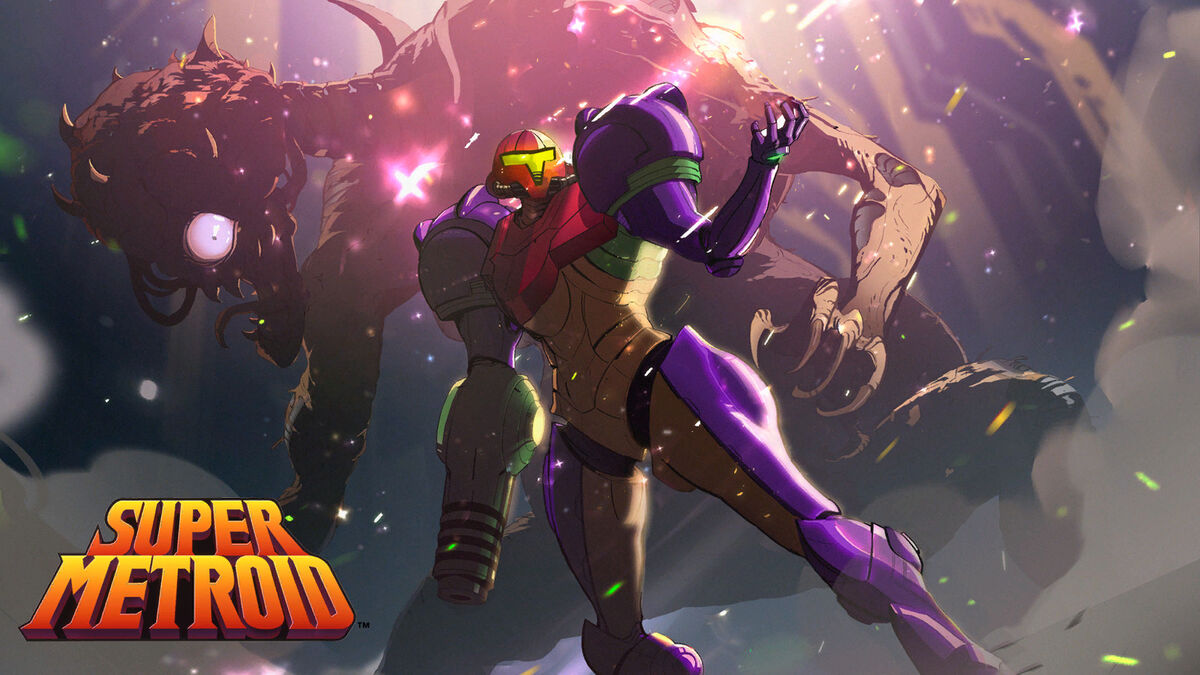
This essay, "X Marks the Spot," was written in response to Metaquarium's X-Fusion romhack (2025). A hybrid of my 2025 Metroidvania Corpus (which holds it) and Sex Positivity series (which develops similar themes in a book-style format), "X" hybridizes the former's historical-material approach with the latter's essay-driven angle; i.e., belonging to a disparate body of work that falls under the same basic umbrella, one that considers how best to reverse abjection mid-cryptonymy through the Amazon aesthetic (and confusion) that Metroidvania excel at.
Note: First, the X-Fusion romhack is officially out (with Metaquarius taking their WordPress back online to announce the debut [on 8/3/2025] after having said site down for nearly two weeks). There's also a Discord server for X-Fusion—one where you can go and talk directly with Meta/give feedback on the game—and the hack is also available on MetroidConstruction.com; i.e., where you can read different reviews, both negative and positive. I've since written my own: "A Beautiful Lie" (2025), which explains how Metaquarius' romhack is a bad game because it lies to players, making them suffer.
Second, this version of "X Marks the Spot" is identical to my 18+ website version and the version that appears in my corpus; there are images of censored nudity and sex in all three.

(source: Metaquarius' "XF," 2025)
Disclaimers/Concerning Censored Nudity and Its Educational Purpose
This essay is part of my Sex Positivity book series, which continues after its June 2025 finale in small-form content; e.g., essays on and interviews with other sex workers, all of whom I credit on my Acknowledgments pages and Sex Work page.

(artist, left: Bay Ryan; right: Persephone van der Waard)
Duplicate Page: This page is duplicated, appearing here and on my 18+ website (something I did to secure my work before hiring Josey, who ultimately made such duplications redundant). Given my Metroidvania corpus avoids open eroticism, the nudity herein remains censored, fig-leaf-style, on both page versions.
For the Visually Impaired: I will also be reading the SFW version aloud on my YouTube channel.
Disclaimer Regarding Essay Contents: All opinions are my own; i.e., as part of my research, conducted alongside my book series, Gothic Communism (2023). The material within is written/speaks about public figures and popular media for purposes of (sex) education, satire, transformation and critique, hence falls under Fair Use regarding copyright and free speech regarding defamation/obscenity laws (the Miller Test; source: Justice.gov). Click here for my entire series disclaimer. Lastly many of the links on this page lead to my age-gated 18+ website where my entire work on Gothic Communism is stored and exhibited.
CW: tokenism, rape*, fascism, genocide, invasion fears, tokophobia, and all manner of Gothic shit; also features censored nudity (with my friends, Hallie Cross and Goddess Asterin)
*Meaning (from my definition) "to disempower someone or somewhere—a person, culture, or place—in order to harm them," generally through fetishizing and alienizing acts or circumstances/socio-material conditions that target the mind, body and/or spirit) […] Rape can be of the mind, spirit, body and/or culture—the land or things tied to it during genocide, etc; it can be individual and/or on a mass scale" (source: "Psychosexual Martyrdom," 2024).
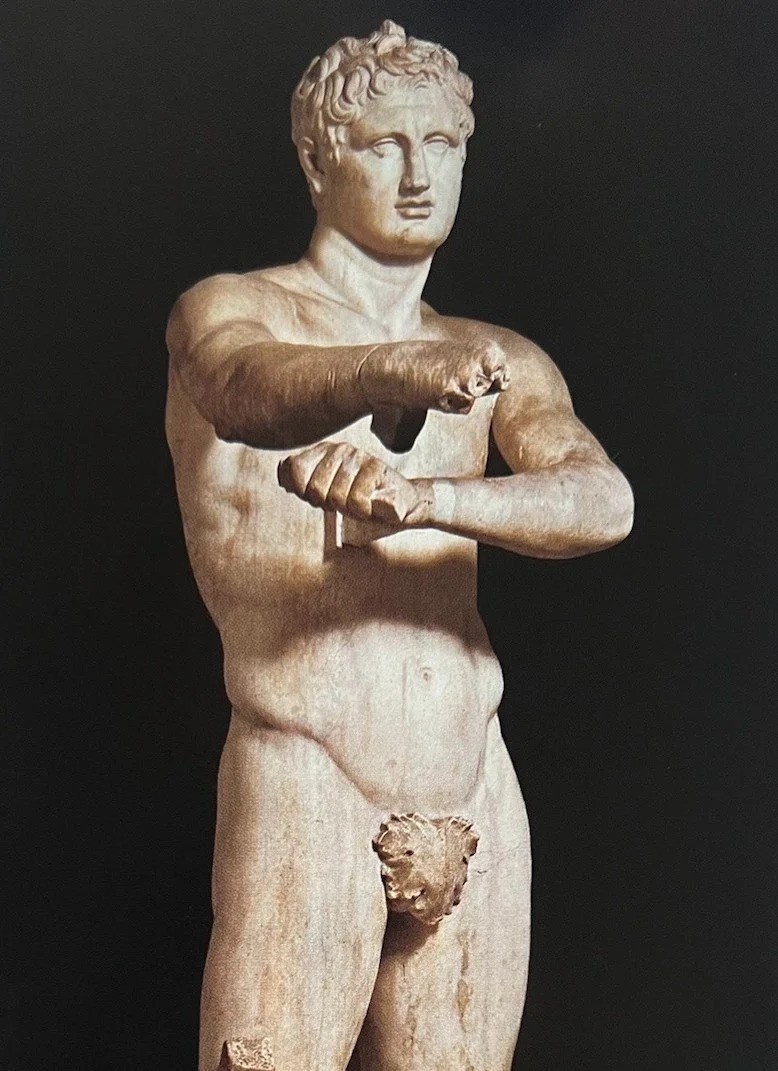
(artist: Lysippos; cited: Michael McClellan's "Professor Butter Beard and 'It's All About the Fig (Leaf)'")
Concerning This Pages' Censored Educational, Fig-Leaf-Style Nudity: This pages features censored, fig-leaf-style nudity* for purposes of sex and artistic education operating under the Miller Test/protected speech under American law (source: Justice.gov). For further info on my approach to censorship and sex education, kindly refer to exhibit -1 from "Raising Awareness" (which also discusses the hate campaign censors are currently waging against me and my friends' sex-ed work). All censored material is used elsewhere in my book series; i.e., as part of said series, and with permission from the models therein (re: my book series disclaimer). All models are over 18 and were when said material was produced.
*Meaning no bare genitals, just bare butt cheeks, curves and sexual context (and lots and lots of pubic hair, below); i.e., within a sex-educational, art-meets-porn framework that follows the Miller Test—one performed by sex workers and their content being voluntarily part of a larger project I continuously invigilate; e.g., Cuwu and I:

(artists: Cuwu and Persephone van der Waard)
Preface to "X Marks the Spot": Featuring Censored Nudity and Sex
"X Marks the Spot" started off on my blog as a short little react piece to a Metroid: Fusion (2002) romhack, X-Fusion (2025), but quickly turned into a small essay and only grew from there. It grew like it did because I wanted to synthesize my Metroidvania work with my book series, the former's drier historical character something I wanted to merge with the latter's "moister" essay approach. In short, the corpus before v1.35 doesn't have too much essay work, in it, and this essay (or more accurately a series of smaller essays under one umbrella) is the fruit of those labors. I've chosen to include it here in my corpus; i.e., as the second half—the first half mostly being theory and history and the second half mostly being application, especially regarding Metroidvania combined with Amazons and sex work. Simply put, women's bodies are fetishized and sold as sex objects in videogames "for kids," all the time—Metroid being the classic example, from 1986 onwards. I want to explore that, here, and felt the best way to do so is by combing my SFW and NSFW research.

(artist: Harmony Corrupted)
To it, the visual aids for this second half are notably spicier than those in the first. They're still technically SFW (so much so that Blogger lets me use them), but the context is more overtly sexual than the material shown thus far. So while Metroidvania tend to fetishize Amazons to a nigh-erotic degree, many of the images here are simply erotic-but-censored (e.g., Harmony Corrupted, above). In essence, my corpus is crossing over into my book series, Sex Positivity. As such, [refer to] said series' [disclaimer].
X Marks the Spot: a Thematic Prelude (and Stable of Monsters to Slay) in Metaquarium's X-Fusion (Summer, 2025)
Concerning the imminent release for Metaquarius aka Metaquarium's X-Fusion Metroidvania fan game, I—a faithful and productive scholar of the Metroidvania subgenre (re: my 2025 Metroidvania Corpus)—want to explore and unpack (to synthesize or fuse) its Gothic themes and monsters. This essay, "X Marks the Spot," fuses them with various academic theories most players (of Metroid Fusion or otherwise) probably aren't aware of; i.e., their canonical Amazonian role as upholding Capitalist Realism, doing so through neoliberal (videogame) fantasies—the false power of which has been dressed up as "peace through strength," "defense," and "adventure," etc, and whose phenomenologically messy Amazonomachia (monster battle) furthers Kristeva's abjection process: by using monstrous-feminine language, mainly the cryptonymy of Amazons and Gorgons/the Medusa (cops and robbers, pimps and prostitutes).

To it, Samus—while deadly and graceful (as female warriors classically are)—remains haunted by the abjection process; i.e., the virginal Amazon/goodly Athena shadowed by a black, furious, "whore" double on the same surface, mid-genocide. In the Radcliffean sense, it's cops and robbers vaudeville—a modular propaganda (of class, culture and/or race) both unfolding on a single mirror-like surface, whose revolutionary cryptonymy only reverses abjection in and upon itself (a mirror for the audience to respond to; e.g., a pixelated TV screen, as used by Metaquarius to advertise their game, below): to compare and contrast a variety of ideas, ludo-Gothic BDSM deconstructing the very idea of what a Metroidvania heroine even is!
Update, 7/29/2025: The essay is done, including footnotes!
Update, 7/27/2025: This essay—though mostly finished—is subject to change; i.e., I've made substantial* changes to it over the past few days, already (and need a final day or so, to finish up)! Embellishing the early draft by loading it with cool info—and doing so in the hope that it teaches future workers about Gothic that creates joy under fascism (2025)—the essay examines not just Metaquarium's work, but also the entire franchise with a fresh pair of eyes. When it's finished, I'll be including it as an official follow-up/second half to my Metroidvania Corpus: as a demonstration on applying (and dwelling on) the history that document lays out, but marrying said history more and more to my book series (thus sex work). Amazons aren't just horror stories, but whore's stories with horror elements that include Metroidvania's common brands thereof. —Perse
*The original essay was probably ~5,000 words. It's now ~51,000 words, and also contains dozens of visual aids and citations, and a few exhibits, too.

(source: Metaquarius' "COSMO.20X7")
Also note (expect more of these): The idea in reversing abjection through Amazons and revolutionary cryptonymy (versus complicit) is to develop an approach to Socialism I call "Gothic (gay-anarcho) Communism." Gothic Communism comes from my book series of the same name; it combines an-Com Marxism (dialectical materialism leery of state models) with Gothic theories, ludology (the study of play), intersectional gender studies, and BDSM and kink. Ludo-Gothic BDSM more broadly describes this holism at work, but also employs a more narrow application: rape play, which it applies to Amazons. As poetic devices of rape to play with, subversive Amazons afford an iconoclastic means of control (cryptonymy's "double operation" of concealment/revelation, as outlined by Jerrold Hogle)—to give players, wherever they are, control over propaganda tools that are normally disempowering and cop-like (token). Gamers of the "Gamergate" type, for example, further abjection by gatekeeping not just games, but material conditions conducive to systemic change (and which the state monopolizes different things to achieve; e.g., violence, terror and monsters); i.e., in ways that illustrate the gaming "dupe" (re: Gloggins' "Play and Games in Fiction and Theory," 2020), meaning someone "Quixotic" (tilting at windmills), a person who valorizes intended play in ways that extend to real life (think the Agents from The Matrix—given special privileges by the state, provided they punch down to maintain order). Conversely, my approach to games purposefully applies their allegory outside themselves, my critical analysis of games geared towards making "players" between real life and games more intelligent and aware. As better activists/critical thinkers, we want to reverse the abjection process that Amazons (of a subjugated sort) are classically known to further—using revolutionary cryptonymy (re: its double operation) to not merely achieve catharsis on a personal therapeutic level, but help induce socio-material change on a systemic level, too: rescuing the "gorgon" (and the "Amazon" policing her) by reclaiming their monstrous-feminine status and function; i.e., as something that translates to any kind of police violence capital requires to profit (e.g., witches, goblins, vampires, etc, as modular code for Pagan women, people of color and queer folk, etc, that often intersect/swap out victims). That's what reversing abjection is, and it takes a fair amount of subterfuge, code and play (out in the open) to work.
A couple more points: First, it combines ideas I've explored extensively in my work on Metroidvania, ludo-Gothic BDSM and Amazons (each with their own compendium; see: hyperlinks); anything I can't explore here has already been explored elsewhere, my writing here more about combination than extrapolation on singular points (with its focus being primarily on cryptonymy and abjection). Second, I'm by no means asking people to boycott Metaquarium's work—just that people think consciously versus blindly (thus knee-jerk) about what said work represents on a structural level. Per Anita Sarkeesian, you can enjoy something while still critiquing its pernicious aspects; same idea with Metaquarium's X-Fusion—and by extension, all Metroidvania—as copaganda with liberatory allegory. The Amazon—subjugated previously by patriarchal forces evolving into capital—escape Pax Americana while inside it (and its stories' flexible "magic circles"; re: Zimmerman). —Perse
P.S., Before we start—and to help acclimate you to my teaching style—I've chosen to provide readers with a small, newly-made exhibit, below.

(exhibit 1: My favorite moment from Metroid: Dread [2022]—one where Samus furthers abjection by policing the ghost of the counterfeit [the Numinous]. A former metroid hunter, she becomes the metroid[1] to banish Raven Beak; i.e., "boundaries for me, not for thee" with a false guerilla flavor [re: on par with Aliens Ripley serving as CIA operative]. Possessed by the spirit of evil—specifically a chimeric "X" composed of different monsters from Samus-the-maiden's curiously violent past—Raven Beak turns into Kraid the dragon... whose head suddenly splits open like the dog alien from John Carpenter's The Thing [1982]! Undaunted, Samus shows her would-be rapist who's boss: abjecting the ballooning phantasm with another version of the Hyper Beam [stolen from the pirate king by the bounty hunter boasting vampiric qualities]! "Eat this!" It's a classic kayfabe device, the "checkmate" reversal demonstrating abjection at play [through sex and force]!
As a process, abjection is classically violent—one that achieves a state of compelled normality ["I'm nothing like you!"] through hyperbolically hypocritical force, and generally when facing a Black Veil; i.e., Capitalist Realism, from Radcliffe onwards, denoting something terrible beyond itself that must be cleansed to restore the castle to its former glory [which never actually existed, but I digress]. Faced with a giant illusory menace, a hero oscillates until they don't, putting their foot down to eventually purify the state through force: to "do what must be done," a gaslight to gaslight the gaslighter for other gaslighters. To this, the Promethean Quest becomes the monomyth; i.e., the assimilator protagonist out-badasses the badass imposter/antagonist, proving themselves worthy to the status quo. In Gothic, the hero is often a heroine, commonly a detective that—under modern versions—has become increasingly Amazonian [re: "Giger's Xenomorph, or The Puzzle of 'Antiquity,'" 2025].

Here, our Amazonian detective, Samus, "abjects" or "throws off [or away]" the fascist elements of her rival double, Raven Beak; i.e., back from the dead [again] and carrying the X parasite with it [on par with Gozer from Ghostbusters (1984) invading empire, only to be narrowly pushed back into an Other world by "crossing the streams"; re: "Cornholing the Corn Lady," 2024]. Raven Beak is basically a Caesar-coded Nazi bird struggling to revive empire, with Samus—Dread's "last of the Mohicans" [the white Indian/savior; re: "In Search of the Secret Spell," 2024]—temporarily becoming a Destroyer-in-small to banish the Great Destroyer clawing through the Veil: threatening to pull itself out of Hell and into her body "standing in"; i.e., for a [relatively] safe-and-stable world threatened by black rape, mid-calculated-risk. "Caesar" crosses the Rubicon; Samus defeats the colonizer to replace them in the Imperial Core, which dooms her to forever patrol its frontiers [suggesting she didn't survive the cataclysmic duel between them].
Cops embody the state in small. To it, Samus is the "good girl [cop] gone bad," visiting some "Hulk smash" Law and Order on a Scooby Doo villain while also breaking her silent-protagonist omerta; i.e., as the Silent Majority being Tough on Crime™ as committed by crooked cops. A member of internal affairs, she whitewashes the department with extreme prejudice; or, fighting fire-with-Numinous-fire, she becomes the Gorgon to apotropaically [and anisotropically] give Raven Beak the Evil Eye: looks that kill, the Athenian "true[2]" huntress once more coming into her own, hunting the "false" hunter down without mercy! "Rawr!"

In Gothic language, it's tremendously mysterious, the female detective solving the monomyth mystery as a man classically would—through Cartesian, heteronormative, settler-colonial force, therefore rape [re: "Radcliffe's Refrain, 2025"]! She's an Amazon, but a token one—all of this little more than "job security" killing yet-another "space Indian" framed as "virus," a thing to exterminate like vermin and replace with inhospitable land the Federation will recolonize; re [me, vis-à-vis Wolfe's "Elimination of the Native," 2006]: "Samus is a genocidal maniac who kills planets resembling our own, her planetary mayhem a perverse form of courtly love for the state having alienized her from her fellow people" or "Samus is a secret pimp with not-so-secret victims, behind whose routine forgeries conceal—in naked/semi-naked body language—capital's regular genocides" or "Samus is a pimp and a whore standing in a fallen castle occupied by a rival madam[e]" ["From Masters to PhD," 2025].
For the state, such joy is rapturous trial-by-combat; i.e., made psychosexual by dogma. For us, it's a fine line, one we subvert by camping the canon [which "joy under fascism" is]: "I love monsters and sex (who doesn't?). I also think they're the ticket to solving the thing that ails us (Capitalism). Except, while time is of the essence and I want to list all the monsters that I can, we simply won't be able cover them all. There's just too many to even remotely consider that. However, I will try to cover as many as possible in liberation of sex workers" [re: "So Many Monsters, So Little Time," 2024]. Monsters are cool, a fact Metroid understands all too well; i.e., using them to further abjection, mid-Amazonomachia: Samus is a cop. Cops abject by design, so we must camp Samus, as such—breaking the Amazonian monopoly through copies of the character made by us. Doing so subverts a given version as "canon," including the one we just examined. You learn how people think—and, by extension, ways to change how they think—by playing with the very stories popular to a given Superstructure [and generally in wickedly sarcastic[3]/tongue-in-cheek ways, as we'll see when we look at Walpole].
The seductive element, here, is assimilation; i.e., the power fantasy offering Samus godlike power and "Iron Wall" armor [thus impunity from punishment] by the state she embodies. Despite camping this embodiment, everything is badass—power being something to play with in ways that further or reverse abjection, mid-cryptonymy. The events, above, tie to good-vs-evil [or us-versus-them] arguments that date back to Ancient Athens, and incidentally have countless ways to interpret, here in the present; e.g., Raven Beak, apart from Julius Caesar, could also be Brutus or the Wandering Womb [with Nazis and Commies sharing the same shadow zone]. But power has two basic functions: workers vs the state. Per Anita Sarkeesian, we can enjoy Metroid for its potent thrills, but need to convey and understand them through iconoclastic interpretations; i.e., that dialectically-materially move power towards workers, and all while relating to Amazons in ways that turn them into rebels, not cops playing at rebels. Raven Beak was a Nazi, and Samus becomes Raven Beak to defeat him; i.e., he defeats himself—the Roman fool, falling on his sword—by turning Samus into him, and which she defeats herself when giving into the dark side: the joy of revenge gaslit by imperial decree, its "touch of death" refrain a hot potato casus beli!

It's very Luke vs Vader—save that Luke was classically a rebel, not a cop. Redemption, as something to act out, is punctuated by force from "all our yesterdays." And while the opera remains a relatively newer iteration—of the kayfabe dialog that Amazonomachia speak to, mid-dialectic—both speak to cops-and-robbers rhetoric, hence abjection, being as old as Western civilization. Amazons are classically rebels, thus robbers—meaning subject to the same temptations that Luke, "a Jedi like his father before him," must confront: on the black mirror that Vader [re]presents, in neoliberal media [the videogame a "space opera" just as much as Return of the Jedi (1983) was]. Vader is the Aegis, and Raven Beak is Samus abjecting herself; i.e., in a similar "Vader moment," one whose monomyth pastiche bears cryptomimetically out: tragedy and triumph as haunted by a cannibalistic, incestuous refrain [we'll get to that, deeper in]. So while Metroid and Star Wars are historically business-oriented, their industrious factors at work remain overshadowed; i.e., by allegory that waits for us to reverse abjection with, our ludo-Gothic BDSM using the same absurd cryptonymy that capital does—in duality! You can't camp canon without swimming in it.)
Table of Contents
- Essay Scope: Regarding Its Numerous Expansions (and Where X-Fusion Factors in)
- Metroidvania; re: What Are They?
- Censored Nudity Sample (feat. Hallie Cross)
- Our Gothic Keywords
- Abstract, and Older Thesis Work (re: "She Fucks Back," 2024)
- Why Bother? Addressing the Haters
- On the Importance of Creed (Concerning Abjection)/Focusing on Female Amazons (and Several Other Points of Business)
- Opening: Cops and Robbers, Amazons and Gorgons (the Basis of Abjection)
- Cryptonymy and Applying It to Metroidvania
- Amazons as Vampires, Demon Hunters, What-Have-You
- Thematic Content, or Essay Body: Amazons Are Abject
- More on Amazons and Gorgons, Including the Cryptonymy Process Reversing Abjection (feat. Jadis)
- Subjugated versus Subversive Amazons
- Amazon Bodies (as Armor and Weapons)
- Amazon Roles (the Hero's Quest)
- Abjection as Space (feat. Horace Walpole)
- Amazon Confusion (and Camping Its Troubles for Ourselves)
- "Domination" through Amazon Confusion (re: Ludo-Gothic BDSM)
- Haunting the Surface: Liberation while Trapped "on the Aegis"
- More on Amazons and Gorgons, Including the Cryptonymy Process Reversing Abjection (feat. Jadis)
- Monsters: Fodder for the State; or, Analyzing X-Fusion's Monster Closet
- Conclusion: Fuck Around, Find Out
Essay Scope: Regarding Its Numerous Expansions (and Where X-Fusion Factors in)
This essay began as a small reaction[4] to X-Fusion's imminent release. It has since grown, my expanding it greatly to include material from my corpus and book series; i.e., while teaching on various Gothic themes (common to Metroidvania) that appear in X-Fusion, but especially Amazons (and gorgons), abjection, and cryptonymy! I love talking about this shit, so expect plenty of tangents; yet, I'll still do my best to keep things organized and focused (while having fun, too).

(source: Metaquarius' "PYR Preview")
I plan on reviewing X-Fusion when it releases (my money's on early August). Here, I'm merely analyzing the debut trailer on YouTube—with people like Oatsngoats having already commented publicly on said trailer ("X-FUSION NEW TRAILER," 2025). I'm also including different material from my corpus and book series; re: to elaborate on the Gothic themes we're unpacking here. Again, this is only a trailer (and several promo videos). There's not a lot to actually cover, but there are several follow-throughs.
For example, Metroidvania are founded on Amazons (warrior virgins with whore-like qualities), but also gorgons (alien whores). Everyone loves the whore; the military fetish is ubiquitous in Western canon, the girl boss—to gaslight, gatekeep—a casualty of said refrain. Similar to Aliens (1986), Metroid (1986) pits the white queen against the black, blurring the lines between the two; Metaquarius blurs the lines between two different games concerning this larger us-versus-them process—a franchise of gorgons and Amazons furthering abjection, mid-cryptonymy (we'll explain these words more, in just a moment). Except, Samus isn't a goddess beyond reproach, so kill your darlings! Embrace the Medusa who haunts her, which includes smaller echoes of the Big Evil; i.e., a kind of "space witch" expressed in black-and-red, on the initial TV image (a bit like Sadako Yamamura, a virus of a witch passed through copies of copies of media; i.e., Castricano's cryptomimesis[5]).
Metroidvania; re: What Are They?

Just to be thorough (and convenient), here is my definition of Metroidvania, before we proceed:
Metroidvania are a location-based videogame genre that combines 2D, 2.5D, or 3D platforming [e.g., Dark Souls, 2009] and ranged/melee combat—usually in the 3rd person—inside a giant, closed space. This space communicates Gothic themes of various kinds; encourages exploration* depending on how non-linear the space is; includes progressive skill and item collection, mandatory boss keys, backtracking and variable gating mechanics (bosses, items, doors); and requires movement powerups in some shape or form, though these can be supplied through RPG elements as an optional alternative.
*Exploration pertains to the deliberate navigation of space beyond that of obvious, linear routes—to search for objects, objectives or secrets off the beaten path (source: "Mazes and Labyrinths," 2019; refer to the Metroidvania page on my website for everything that I've written on Metroidvania).
Censored Nudity Sample (feat. Hallie Cross)
As stated at the start, this essay—while meant to be SFW—still contains censored nudity. It comes with the territory, me attempting to marry my Metroidvania research with my work on Amazons and sex work, more broadly. In any event, here is a sample of the kind of censoring and sexual content the essay features; i.e., at its most gratuitous; re: the little metroids censoring my friend Hallie Cross, here, to give you an idea of what to expect: "Help, I'm totally 'in danger' right now." In keeping with Walpole, it's not about something being mature or immature, holy or unholy—but occurring through play as allowing a given thing (a symbol or event, mid-performance) whatever we need it to be, thus accomplish our aims: universal liberation, having the whore's revenge against profit (re: "Rape Reprise," 2024). Monsters are absolutely a part of that equation, the whore being the oldest monster there is (under Western canon, anyways)! Life is absurd (re: Camus, 1942), so smile at the gods while fucking with them; i.e., all deities reside in our breast(s), Blake!

(artist: Hallie Cross)
So yeah, there's some skin (and a bit of public hair), but no more than you might expect to see from Samus, herself; i.e., wearing a bikini, in-game, from 1986 onwards:

According to legend, Sigourney Weaver allegedly refused to shave her crotch, and the wardrobe department refused to give her bigger panties; i.e., for the final scene, in Alien (a reshoot done over several days, on short-notice)—effectively forcing the studio to go in, frame-by-frame, and "scrub" the celluloid of her public hair! Apparently Ridley Scott said (way back in 2003, for the Quadrilogy DVD box set): "She refused to pull up her panties and shave at all. We had to pay someone in 1979 something like five thousand dollars to air brush out all her minge hair on every single cell of film. It took weeks!" Never mind that the scene in question is literally about attempted rape (and voyeuristic through the Male Gaze); the Puritan ethic likes to "choir screen" its whores, Ambrosio fetishizing the Madonna while manicuring their likeness or miniature to look "just right."

In any event, the fan stuff is always gonna be "thirstier" than the corporate stuff. Also, my work delves into sex work and Gothic media and how they overlap; i.e., we're here to think about how sex work and videogames go hand-in-hand. So I think this approach is a good compromise, and—give its academic, educational nature—isn't really anything that rivals the series' own approach to war and sex; i.e., its routine fetishizing of female bodies, framing them as sexy warriors who, from time to time, don't wear a lot of clothes (rape fears, but also a chance to fight back using sex: as femme fatales)!
Our Gothic Keywords
Gothic Communism concerns four main Gothic theories. While some of these words we'll look at more closely in a moment (note the duality of abjection and cryptonymy, in particular), here are their shortest-possible definitions up front:
- abjection (to further or reverse): us versus them (from Kristeva), or a state of normality created by compelled alienation, ergo states of violence and exception[6]
- hauntology: retro-future, meaning trapped between the past and the present to haunt existence between language (from Derrida's Spectres of Marx: "haunt" + "ontology"); also refers to canceled futures (from Mark Fisher's cyberpunk, but also acid Communism; re: me vis-à-vis Stuart Mills in "Magic, Drugs and Acid Communism," 2025)
- cryptonymy (complicit vs revolutionary): a double operation (from Hogle, vis-à-vis Nicolas Abraham and Maria Torok), one hiding and showing unspeakable things in opaque language (a giant black castle, for example); i.e., "X" marks the spot but also sex marks the spot (often of a warrior sort; e.g., knights, Amazons, and similar ancient-to-exotic mercenaries with a legendary character tied to legendary spaces of war and home)
- chronotopes: a time-space (from Bakhtin), the Gothic chronotope being a castle
For the full (much longer) definitions, refer to "Four Main Gothic Theories" in "Paratextual (Gothic) Documents" (2024) However, there's a few other terms this exhibit covers or concerns; re (from my Poetry Module's "Meeting Rebels," 2024):

(exhibit 34a1b1: To give an example that covers all of cryptonymy's relative points [not the Four Gs]: cryptonymy* is settler colonialism shown and hidden by Guile and Blanka as Global North and Global South; cryptomimesis is this tending to repeat and reverse through mimesis between the characters' numerous reincarnations; the narrative of the crypt* is the entire trail and its semantic wreckage; the internal concentric pattern is the stage containing heroism as trapped endlessly in Hell; the Cycle of Kings is every man for himself—meaning in that kayfabe tournament's establishing of heels and babyfaces; and the Shadow of Pygmalion is the heteronormative image of these heroes. Per Juul and us, this is where the game takes place, my ludo-Gothic BDSM entertaining the idea of videogames and BDSM going together readily and easily. If anyone says otherwise, they're a cunt.)
*Both from Hogle's "Cryptonymy in the Gothic Novel" (1980).
Abstract, and Older Thesis Work (re: "She Fucks Back")
By looking at X-Fusion, this essay also inspects the Metroid side of the Metroidvania franchise; i.e., how Amazons are abject (acting "like men" in TERF-style ways), and how they reverse said abjection on themselves when camped: as a predator/prey hunting mechanism (and agent) to behold, which when viewed consciously can reverse abjection during the cryptonymy process and ludo-Gothic BDSM.
Consider the above words my thesis subject. Statement-wise, abjection associates (from Medusa onwards) with discriminatory acts of sight to hunt state-assigned prey with; e.g., racism identifying its violence through skin color and other phenotypes; i.e., looking at something that, once viewed in ironic ways, levels the playing field despite systemic inequality. Amazons are fearsome to behold, but also sight hunters that further or reverse abjection, the latter reclaiming power for workers from the state; re: akin to Promethean spaces disempowering traditional heroism to comment on systemic issues (a big quote, because it's relevant, from "She Fucks Back; or, Revisiting The Modern Prometheus through Astronoetics: the Man of Reason and Cartesian Hubris versus the Womb of Nature in Metroidvania"):
Note: I'm providing this larger section, here, for relevance and convenience; i.e., "She Fucks Back" is one of my proudest works in general, and constitutes the crowning achievement to my Metroidvania work as a whole (re: "Capping of My Magnum Opus," 2024). —Perse
The follow-through, here, is that men of reason suck in these stories as a matter of playful critique, one whose hot-potato displacement—of capital passing the buck onto ancient, seemingly alien empires or allegorical, magically reassembled fantasy worlds—dates back to Walpole's Otranto (for aesthetics, splendid lies, dead giveaways), following Mary Shelley's Frankenstein, the Modern Prometheus, exploring the cynical nature of such tyrants to begin with: those who know the cost of everything but the value of nothing as hidden (along with their deep-seated insecurities) behind a perfidious veneer of reason, of the so-called knowing-better good father looking out for his children and the world by "just asking questions."
In truth, such men can't love anything but themselves and their own legacy as a matter of embodying Capitalism, which they do quite gladly. They're literally the poster children of it, enjoying all of its benefits, including always appearing right, good, and correct, hence being able to arbitrate violence against anything that "isn't"; i.e., by playing god, punching down against the state's usual targets: nature, workers and the monstrous-feminine, forcing the latter to fuck back by punching up while receiving state harm as something to subvert during rape play (which ludo-Gothic BDSM boils down to) by using Athena's Aegis inside Metroidvania.
The fact remains that men like Weyland rape nature all the time, but only double their efforts when they—like the system they personify—reliably starts to die (false power). In turn, the state and its men of reason will do anything to preserve themselves, weaponizing their own bloodline against nature, the latter having evolved to resist dominion (thus rape) through counterterrorism and asymmetrical warfare.

As these men begin to die, everything falls apart in one last-ditch effort to hold onto capitalistic godhood; i.e., choking on the very things they eat to remind them of their cruelty and their hubris (not per Freud's id, but per Marx's capital routinely projected into Gothic, Promethean language riffing on parental elements that Freud essentialized as a matter of the crystalized nuclear home): "Where's the robot to pat you on the back, or the engineer? […] There you see, now, how all your so-called power counts for absolutely nothing? How your entire empire of destruction comes crashing down, all because of one. Little. Cherry!"
To such stupid and embarrassing tyrants, I now want to consider nature (and labor's) indomitability through the monomyth when camped by the Promethean Quest as personally and spatially monstrous-feminine; i.e., going heroically into and staying inside Hell as researched according to my expertise: videogames as Gothic chronotopes connected to the Promethean Quest, per Metroidvania. Going beyond Shelley or Lovecraft and into Metroidvania, I'll try to stay focused on their connected, monomythic histories that—while older than Cameron's 1986 refrain, Aliens (which inspired the shooter genre, but also the Metroidvania)—nevertheless attach to capital presently as we inspect the Metroidvania space itself: as something to reify and move through across the centuries and media types (from novels to cinema to videogames; from outer space to European castles, and in between those things).
We'll do so through several arguments I want to you to keep in mind. I say that because frankly there's a lot to discuss, this symposium more an opportunity to raise issues for you to confront and grapple with yourselves; i.e., while showing you the cryptonymic, disguise-like qualities to such subversive query and rebellion when faced with Cartesian copycats looking to pacify our stewardship of nature (indented for emphasis):
Per Hogle, the Gothic is predicated on fakery through the process of abjection attacking nature vis-à-vis the ghost of the counterfeit[*]; i.e., nature as alien/monstrous-feminine, colonized by the sovereign West through Cartesian thought. Historical materialism proliferates decay and deception through open secrets (casualties of empire, but also empire in decay expressed in medieval language; e.g., castles) that no one side can monopolize, but for which terror and obfuscation allow either side to partially conceal themselves with, using the cryptonymy process to operate in capital's wake: to either defend the status quo while wearing its victims and symbols of oppression, or to undermine it through the same basic means.
[*David West's "Implementation of Gothic Themes in The Gothic Ghost of the Counterfeit" (2023) vis-à-vis Hogle's "The Gothic Ghost of the Counterfeit and the Process of Abjection" (2012).]
In short, anytime I say "camouflage" or "disguise," this is basically what I'm talking about. Furthermore, Promethean space (usually castles) is part of this decay and deception under capital, for workers vs the state (often, as nature vs civilization); it's something of a "dead giveaway" as person or place—both invented, and restlessly pointing into half-hidden atrocities and subterfuge materializing between opposing forces: on their charged surfaces and inside their dualistic thresholds, asking to be looked into "on the ashes of something not quite fully present."
That being said, we'll likewise look at the persons and parental themes involved when capital colonizes said spaces (the womb of nature projected into outer space, or frozen, uninhabitably barren/cold, desert-like territories comparable to outer space), then consider the ways in which all this colonization can be subverted/camped and reversed, power-wise; i.e., with Metroidvania persons and places; re: the dialectic of shelter and the alien enacted canonically through people (men of reason) and places (castles, including Metroidvania) to punch Medusa (indented for emphasis):
That's what the Promethean Quest effectively encapsulates and discourages, Medusa fucking back to reverse the flow of power and information the monomyth normally supplies in outright parental language, but also monomythic media exposed to middle-class children at a young age; i.e., standing in for absentee parents (videogames, for our purposes): the givers of Cartesian dogma, but also rebellious sentiment through Promethean allegory (the appearance of the black castle/fallen manmade paradise to begin with).
Consider the above indented portions something of twin thesis statements for the rest of "The Monomyth," part one—arguments, mid-symposium, that we'll touch upon sporadically as we bounce between parent and palace, person and place; i.e., as parts of the same Promethean stories and their liminal expression conveyed through part one's looser, conversational style: built to move through and intimate different legendary elements of real life, as the chronotope does.

To it, astronoetics are both a settler-colonial narrative voicing the usual things up for grabs (the nuclear family threatened by mad science in a frontier narrative, left), while also remaining a popular cautionary tale about displaced Cartesian overreach; i.e., by sucky men of science embodying Capitalism and its Gothic consequences and divisions (and whose Enlightenment-style enslaving of nature through retro-futurist language pushes nature-as-robata [slave] to fight back, posthuman-style), then carried forward into At the Mountains of Madness, then Forbidden Planet, then Alien, and finally into videogames but especially Metroidvania! The heroes are villains posturing as good, in these stories (often men of means—white-collar criminals [which men of reason essentially are] acting like blue-collar frontiersmen rebelling against capital, but point-in-fact serving it as usual to a mythological degree; i.e., technologically superior space cowboys)!
We'll consider such a parental abjection of nature (and its reversal by monstrous-feminine agents) in Metroidvania based, more or less, on monomythic stories like Alien and Forbidden Planet as going all the way back to Frankenstein critiquing capital with Walpole's prurient, medieval, nigh-raunchy-at-times elements (often via royalty and wealthy persons, which men of reason generally are): a vulgar (common) marriage of sex, terror and force, as the Gothic does, through imaginary conquest per Promethean critiques of the monomyth, of capital, of entitled Cartesian dickwads (we go high and low, Michelle Obama)!
There's certainly an element of rape play to consider through these things. To clarify, though, our focus will be on Metroid-style (non-linear) spaces or offshoots per the man of reason (or token agent; e.g., Samus Aran as cowgirl and white savior/white Indian working for the Man) and Aguirre's infernal concentric pattern, not Castlevania or other videogames that seemingly obey the same basic idea of the Hero's Journey into and out of Hell; i.e., as a space to explore and conquer per the usual cartographic refrains (stab, punch and shoot the monster inside a given map). Here, we'll just be focusing on the one that best illustrates spatially and theatrically what inspired my concept, ludo-Gothic BDSM, per "Our Ludic Masters" (2021) onwards (for the entire catalog of such spaces, refer to my earlier PhD research, "Mazes and Labyrinths"; also, "War Vaginas" provides some good examples of monstrous-feminine space, weapons and heroes).

(artist: Pepe-Navarro)
For our purposes moving forwards, Metroidvania (and its forebears) are defined by Amazonian movement (and battle) through closed space, often a dungeon or a castle of some kind as occupied by Numinous, Promethean power (the semi-abstract presence of rape and dominion fused into the architecture). In turn, any of them invoke the confrontation of difficult truths, which are the first step towards healing from capital's abuses: nature as alienated from us by Cartesian elements, including death as uncomfortable to face but also rape and abuse relative to nature as normally dominated by patriarchal exterminators going into Hell (standing in for Earth as otherworldly doubles). Alienize, then rape behind the lies, the camouflage, the debris, the records; it's well and truly Cartesian thought's raison d'être (source).
The above material is food for thought; my thesis argument (for the current essay) is this: "Amazons are abject in ways workers can reverse"; i.e., through deliberately emergent play on the same terrifying (monstrous-feminine) bodies, in the same maze-like spaces.
Why Bother? Addressing the Haters Before We Start
Metroidvania, like all Gothic media, confront some degree of the past as barbaric and alien come home to roost; i.e., as if to ask, "Haven't we done this, before?" Indeed, I've written about Metroidvania and Amazons a fuck-ton already, not to mention the planet's on fire. So indeed, why bother? The short answer is, I love it; can't you tell? It's not like I decided to go overseas to study this shit, only to take it back with me and turn it into my life's work! Sarcasm aside, just because fascism and climate charge are real (they are) doesn't mean I "can't" fight them; I very much can, and this is how I go about it. Amazons all the way down, babes! Make 'em gay!
Put differently (and couching my sarcasm in more serious reflection), I decided to write this after my book series to a) discover what I could write after having written six books, beforehand; and b) to try and keep fighting the good fight, in times of state crisis (fascism). Haters gonna hate, a reality this recent conversation I had with a hater on Reddit effectively sums up. I can handle criticism in good faith, but they just seemed like a twat; i.e., being one on purpose in the midst of multiple genocides (not a good look, my dude):

(source)
Televangelis: As someone who did a PhD's worth of research into a subject that I had no former training in (using my background into intel analysis), wrote a book on it that turned out to be an award winning bestseller, and is now doing a compilation PhD via peer reviewed journal articles on the topic to backfill credentials after the fact... don't fucking call it a PhD if a university isn't actually issuing you a PhD. Rigorous peer review processes exist for a reason, and claiming your work as a PhD implies a level of expert review of your work that you haven't actually had. Call it your magnum opus research project if you want to, but the same reason you want to call it a PhD -- latching onto that prestige -- is the reason why you shouldn't if you're going to be an honest person.
Me: I've been open and clear about why I call my work "independent PhD" (regardless if you like the reasons I give); i.e., the work is based on years of research (not an award-winning bestseller), and has resulted in multiple book volumes, one of which is my thesis volume, aka my independent PhD. It's just a way to advertise the amount and quality of work I've done over the years, and give people a idea of what to expect. I'm familiar with the peer review process; I'm also familiar with how the Humanities are under attack by the very institutions hosting them—in effect being shuttered across entire departments by the same greedy universities you're celebrating. The whole point (of my work, as an an-Com) is to do research and share it with people in an accessible way. Quit projecting and find something better to do. 🙂
Televangelis: "Based on years of research" is true of everyone and their mother. My book, all told, was about 8 years. That doesn't make it a PhD. / "My work, as an an-com" is a hilarious qualifier. A fake PhD for a fake ideology because you won't admit the truth to yourself on any front (you did a cool research project but it's not a PhD, and in practice you're a normie liberal politically but you badly want to think of yourself as a radical).
Me: "You're a normie liberal politically but you badly want to think of yourself as a radical." Thank you for showing me your ass and saving us both some time. Say hi to Musk for me!
Televangelis: Point proven.
Me: Alright! Sure showed me!

In the words of Rumsfield from The 'Burbs (1989), "Hey, dude; piss off!" My PhD was just the beginning of a longer journey. I love Amazons/the Medusa, and Metroid Fusion is, at least story-wise, my favorite Metroidvania. And, having so much to work with and return to, I wrote this piece in less than a week (admittedly working on it nonstop, but even so). Like I said, I'm "the master of the field in a field where no experts exist" (re: "Mastering Metroidvania"). And again, I really do love the work I do. Funny thing is, I don't even really play Metroidvania anymore; I study them (and those who play/make them). So to see Metaquarius, with X-Fusion, revive a core part of my late childhood (and get me "in the mood") really has my old ass excited; i.e., they've clearly poured their heart and soul into this project[7], a sentiment I—a fellow Metroidvania manic (though not a coder)—can absolutely get behind!
On the Importance of Creed (Concerning Abjection)/Focusing on Female Amazons (and Several Other Points of Business)
As an academic concept, abjection essentially means alienation, and boils down to us-versus-them, during the profit motive (and generally by tremendous erasure[8] and Force of Will, fascism radicalizing straight models; i.e., the state is straight, which fascism uses to erase/demonize anything than isn't straight; re: "Understanding Vampires," 2024). It was written about, from a cinematic perspective, in 1993 by Barbara Creed (cited, below—we'll get to cryptonymy when we look at Hogle). Creed's work is important, my own research building on its dated-yet-vital scholarship in ludo-Gothic ways; re: ludo-Gothic BDSM as I developed it to, again, reverse abjection as I also developed it; i.e., from my master's thesis (2018) to "War Vaginas" (2021) to my PhD (2023) and subsequent book series (e.g., "Modularity and Class," 2024): abjuring Freud and psychoanalysis to favor a more dialectical-material approach. This essay continues that trend; i.e., as something that goes beyond my 2025 Metroidvania Corpus (which doesn't really contain essays) and expands on previous Metroidvania work. Partly an exercise brushing up on old go-tos, this piece refers heavily to my past work on Amazons and Metroidvania—both of which are extensive but also, at times, thoroughly NSFW. Apart from the links, above, refer to my aforementioned corpus for more information regarding those topics; i.e., in a more compact and SFW format.

I've written "X Marks the Spot" to be as SFW as it possibly can be; i.e., by censoring the Amazonian nudity to a Blogger-friendly degree, but still discussing erotic-centered topics in an academic style: butts, boobs, boxes and thighs, and the smart bitches who have them while kicking ass. Beauty and the Beast, the brains and the brawn—characters like Samus test the luxuries that (white straight) men take for granted, the latter not being threatened automatically with rape when suddenly "in danger" (quite the opposite, women are often stronger than men, insofar as they endure forces capital shields men from; i.e., while wearing Amazon "skin suits," in outer space and elsewhere). And while camping those double standards obviously includes in ways that express gender trouble and GNC parody (e.g., trans people or crossdressers), here we'll mostly focus on female Amazons; i.e., because Samus is, like the classic Amazon, classically female. In the Cartesian sense, Amazons are white Indians tied to lands of fear—both a territory of conquest (the warrior expressed in cartographic language), and the territory turned in on itself for the Destroyer to fuck the land for the state (the residence expressed in morphological language, a castle in the flesh "armed for bear"). Cryptonymy-wise, she's the X marking the spot and being the spot to mark (for death, punishment, "repopulation," etc), seemingly no more real than Gwynevere, Princess of Sunlight (a sexual illusion) but, in truth, a heroic avatar the player controls to tell a highly specific story: a Gothic Romance (with horror and terror sprinkled everywhere, throughout). Samus is owned, kept by the elite but given a long leash while they capitalize on her broken childhood—one we camp and reclaim, mise-en-abyme:

(artist: Persephone van der Waard)
We'll get to that, but first a couple other opening points; i.e., before diving into abjection and cryptonymy, followed by the essay body (re: reversing abjection with cryptonymy).
One, the nature of this essay is conversational and broad, dipping its toe-like survey into various academic circles but also popular media for fun and for activism (the two are not mutually exclusive); i.e., while revisiting[9] "old" spaces that have aged, yet whose "time" in Gothic is a circular enterprise, and one for which holistic study is tremendously useful; re (from Volume Zero):
Returning and reflecting upon old points after assembling them is a powerful way to understand larger structures and patterns (especially if they're designed to conceal themselves through subterfuge, valor and force). It's what holistic study (the foundation of this book) is all about (source: "Making Monsters," 2025).
Capital is comorbid (criminogenic), which we combat through these stories and under their same umbrellas: "hooking up" in the usual neo-medieval (at times, quasi-Freudian) ways. Metroidvania and Amazons—like the Gothic, more broadly—are liminal, holistic and anisotropic, existing in the grey "fuzzy" areas of oral-to-written stories and language; i.e., in ways that allow for (and encourage) duality (thus paradox), mid-cryptonymy.
Amazons historically sit between Heaven and Hell that, when Hell comes to Earth, canonically "make themselves useful" (re: abjection); i.e., in ways we can reverse while making ourselves useful: to Communism, developing it by breaking state monopolies, "on the Aegis." ACAB and ASAB, but Samus is a cop working for the state. What's a girl to do? Nazis and Commies share the same stage-like bodies, using cryptonymy (and oscillation) as required. Amazons—rebellious and headstrong loners denied love (despite the toxic love triangles; e.g., Samus, Adam and the X parasite), bildungsroman—dive headlong into Hell like all Gothic heroines do, albeit as pubescent, virginal-if-sexy tomboys accustomed to gender trouble (and delight): warrior cheerleaders posing and saying "ready!" per role call, then kicking ass to operatically stylish music (and looking good [fierce] while doing it). These "danger discos" outline not just a rite of passage, but of continuation (time is a circle, each cycle similar but unique): a reconciliation with long-lost mothers of a "mysterious," Walpolean sort (the Medusa a de facto parent to all Amazons, the whore criminal to their virgin/whore cop's semi-Sapphic bloodline).
Furthermore, much of what we discuss here has been discussed far more at length, elsewhere by others and myself (follow the citations). My focus here is poetry—meaning Amazons are warrior poets and sex workers, wherein Gothic Communism thoroughly concerns itself with the vaso vagal, memento mori ("remember, you too must die") poetry of monsters; i.e., which it uses to wage class (culture and race) war of a Gothic character that liberates sex workers in Amazonian ways. This character is hazardous akin to Amazons; i.e., they are my protectors, but also my abusers, and I write about their fearsome strength (and strong sexy bodies[10]) like the Devil's at my back (akin to Robert E. Howard being flanked by Conan, sharpening his axe): terrifying as they hack or blast their enemies apart, but also heart-stopping for their androgynous, monstrous-feminine beauty in action (a poetry in motion). Beholding them repeatedly as I do, I start to realize—now more than ever—that no one's perfectly healthy and we all gotta die of something. Might as well be a beautiful death, you feel me?
So "once more unto the breach, dear friends," storming her castle or the other way around! "You wanna live forever?" said Valeria, Queen of Thieves (towering over her male counterpart, below); said I (regarding Metroidvania), "Who wants to play a game without danger?" Invasion (of the body snatchers, or otherwise) is thrilling but also empowering to the "victim," if only for the signature opportunities such plays provides to interrogate trauma; i.e., "illness" reframed as "superpower" because it isn't normal—not a disease, but something that distinguishes the oppressed as extraordinary (e.g., pwNPD having cognitive [versus affective] empathy, which they then use to bond with other workers under capital—often disordered and disabled[11] but also allies of the able[12] body and/or mind; re: "Slurs Aren't Activism," 2025).
Any reclamation comes from trauma-as-heirloom, including Amazons like Samus; i.e., part of me, Persephone, still burns in Hell alongside my former captor/rapist (above; re: "Setting the Record Straight," 2022). Survivors of abuse never fully "escape" it; they learn to live with the trauma (and its phenomenological confusions). My paradoxical rescuing by placing me in danger remains less about inventing dangers, mid-boredom, and more reacting to otherwise unacknowledged dangers during cryptonymy's proletarian "radical" desire: preventing rape (with victims often creating their abuse alongside their desires, testifying to either by fabricating them; re: "Healing from Rape," 2024).

So does power corrupt, corruption the kind of data Metroid speaks to; i.e., during its own damsel/demon invasion stories: Amazons "sick" with fascism (so called "good cop, bad cop"), but also unknown pleasures (spectres of Communism/the Medusa). Demanding exploration under disorder and duress, these "joy divisions[13]" are stuck in a black hole of ongoing performance, mid-cryptonymy. We're not in the business of ranking rape, under capital, but tokens certainly are—Medusa their Omelas child (the ghost of the counterfeit) while they act more oppressed than they actually are (warrior princesses, remember). They don't learn from the past, but plunder its dark vaults to bend it to their (and the state's) will.
In keeping with Metroidvania's alternate Japanese label, "search/action," Amazons quest for Numinous (mysterium, tremendous[14]) power while being brave and strong enough—to pursue it into Hell, but also having trauma there endemic to the female/queer/non-white experience in less hellish territories: a sense of empathy with the infernal divine that white straight men generally lack; i.e., a sympathy for the Devil because Amazons are, and have been, demonized for thousands of years. Aside from the Gorgon, they're one of the oldest monsters of "the West," but also one of the oldest heroes—speaking to Gothic's fatal, retro-future, "space knight/dragon" attraction with liminal beings neither here nor there: those looking death in the eye to learn that, while alien and insectoid, it has a human face (skeletons in the nuclear closet). In turn, home becomes "exit only" but the exit is a lie (as is the treasure "buried" inside). Home is sick, false, and alien, obsessed with conquering old lands anew (the eagle [Capitalism] greedily eating the liver of stealer-of-their-fire, Prometheus, ad infinitum).

(artist: Ayami Kojima)
Moral geography and moral bodies, wherein Amazons—like femboys (above)—sit somewhere in the dangerous middle of the pattern (the Gorgon reminding the seemingly invulnerable how they too must die, the would-be "Achilles" [male or otherwise] walking into an eclipse—all to brave "outer" evils found disturbingly at home: the traveling castle something of a ghost ship); i.e., war and sex are vices, making the Amazon—an alien seeker of assimilation—a vice and virtue character at the same time (though their double, the Gorgon, has a far more pronounced "alien" nature that's harder to assimilate; e.g., Professor X versus Magneto, Wonder Woman versus Baroness Paula von Gunther, the Belmonts versus Dracula, etc). While there's no singular interpretation, dogma does prescribe singularity to dualistic things; Amazons authored by the state provide comfort food, one whose bread-and-circus easily becomes "slop" under Capitalist Realism:

(source: Metaquarius' "BSL Secret Files #2"; timestamp: 0:28)
Also, while I haven't played X-Fusion yet, I'll wager that Samus is still a token cop fetishized for her "wheyfu" qualities (above); I've written my analysis accordingly, viewing her as judge, jury and executioner (state force) as hidden cryptonymically behind sex being the prime euthanizer/cause for suffering of state victims—i.e., presented as "colossal bugbears" (and for which I'll eat crow if Metaquarius proves me wrong. At first I saw AI art in their promo and felt ill [above]. But their own video description reads "AI slop is reproducing by asexual division and threatens the galaxy!" So they're not completely aloof to such things). —Perse
Opening: Cops and Robbers, Amazons and Gorgons (the Basis of Abjection)
Metroid is cops and robbers told through the process of abjection having a sacred-but-haunted police function; re: Amazons and Gorgons being cops-and-robbers terror weapons (Galatea shaped by Pygmalion), but also pimps and whores in practice (ergo cowboys and Indians, virgin/whore, police and pirates, us versus them, etc); i.e., per Cartesian thought, the core function is one of capital versus workers and nature, the aesthetic of the alien dialectical-material, mid-cryptonymy. This opening unpacks abjection, followed by a cryptonymy section; i.e., before we consider their canonical and subversive roles using those devices (and applying them to classic Metroid and Metaquarium's spiritual successor, X-Fusion).
In classic myth, the Aegis was given to Perseus by Athena to slay the Gorgon, but the Gorgon was "cursed" (with anti-predation qualities) by the same goddess; i.e., essentially weaponized public nudism (which, unto itself, has an "ace" component interrogating trauma); re, Creed:
When Perseus slew the Medusa he did not – as commonly thought – put an end to her reign or destroy her terrifying powers. Afterwards, Athena embossed her shield with the Medusa’s head. The writhing snakes, with their fanged gaping mouths, and the Medusa’s own enormous teeth and lolling tongue were on full view. Athena’s aim was simply to strike terror into the hearts of men as well as reminding them of their symbolic debt to the imaginary castrating mother. And no doubt she knew what she was doing. After all, Athena was the great Mother-Goddess of the ancient world and according to ancient legend – the daughter of Metis, the goddess of wisdom, also known as the Medusa (source: The Monstrous-Feminine, 1993).
Or, as I write:
From a dialectical-material standpoint, the oldest profession bears the brunt of the oldest exploitation; i.e., surviving into the present, Medusa was a rape victim (re: Hadley, 2024) and whores are garbage that work with garbage to humanize themselves (re: "Hot Allostatic Load," 2015). The problem isn't that we're monsters but that monsters are dehumanized by capital (re: "Nature Is Food," 2024) [which workers reclaim through themselves and their own labor] (source: "Joy Under Fascism").
To it, Amazons are as trashy as anything else, garbage for the state to dispose of in orderly fashion (videogames once being considered low-brow garbage "for the masses," despite "home entertainment systems" always having a middle-class price tag [and white, straight male bias] that bars entry to poorer and non-status-quo players). Again, abjection is cops and robbers, performed in and out of media to speak to commonplace divisions; i.e., under capital as capital demands of profit as a process, one hauntologized through Amazons and gorgons—with Samus' fragile sense of self (tied to the state) incumbent on her catching the bad girl, but said Venus twin being rooted in her own routine exploitation by state forces demanding sacrifice (re: boss keys working like vampirism—more on this, in a minute). They simply have too much in common for her to cleanly dismiss and destroy. Her Aegis feels occupied by past dead girls (whose cryptic message is both furious, fearsome and repugnant; i.e., like Japanese spirits commonly are, below).

Said past is comic book as much as storybook; e.g., Samus' Venus twin/dark double (or "other half/dark side") being Mother Brain as the Medusa; i.e., who, when confronted while rearing her ugly head, invites trouble/makes for troubling comparison, mid-Amazonomachia "on the Aegis" (read: catfight). Granted Amazons also double "good" (dutiful, submissive) Athenian women, with the greatest prize (for those with virgin/whore syndrome) being a caged, captured and then dutifully domesticated Amazon (for her exotic but asl freakshow strongwoman's[15] character—as a sideshow and main attraction, and novel-yet-lethal, fetishized warlike abilities). Yet, her archenemy is undoubtedly herself gaslighted by the state, the Amazon's kayfabe reflecting that, onstage and off. Abysses aside, "what doesn't kill you makes you stronger" is another popular Nietzsche quote that Amazons (and their inner rivalry among themselves and actual gorgons) like to fuck with; i.e., sometimes, in the case of either quote, Gothic Communism composes its stories of people treated like monsters. Might as well use it for good, right?
At the very least, Samus—a token cop indebted to/employed by corporate colonial forces treating her like "waifu" bait—feels "cursed" in a very fascist way per witch hunt; i.e., she might be the very witch she's tasked with destroying (a classic gaslight the state abuses for profit). So does capital tokenize the abjection process, bringing the classical Athenian propaganda terribly to life in present-day media—a guilt trip her cross to bear (with the crucifix additionally being a Pagan symbol of torture used to publicly display dying criminals; i.e., sentenced to death by the Romans, effectively making Samus' victims Space Jesus as much as Satan). In similar fashion, an Amazon is a former-whore-turned-cop, an in-group "maiden" policing out-group "obvi whores" to maintain order and the Protestant ethic. Work is "good" when it upholds capital, mid-abjection; profit is sacrosanct, holy and beyond reproach, period, making abjection equally holy through "unholy" veneers achieving profit: "guilty" pleasures furthering abjection per the ghost of the counterfeit "pimping Medusa."

(artist: Hallie Cross)
In turn, the same Puritan ethic polices nature through moral panic as a tokenizing device: "gaslight, gatekeep, girlboss" through colonized puns, wrestling signature emotions (e.g., somber, gloomy and morose, but also bellicose, Spartan, haunted, etc) and extreme animal states of distress and pleasure (e.g., drowning and being "wet" to an improper, "drenched" amount). This temptation, as offered by the church of the day (and their flavor of the month), applies to any woman in sci-fi—but also onstage or off (e.g., Hallie Cross, above)—as having Gothic roots (effectively anything framed as "alien" under capital, meaning not white, straight, male and Christian to modular degrees); i.e., insofar as Gothic crosses resident and residence with Freud's unheimlich, or uncanny to speak to home as haunted by colonial victims; re: virgin/whore, itself a vice-meets-virtue game of "prove it" that various colonial subjects (not just white women) play to survive, and generally by policing themselves and their comrades: Samus, like Ellen Ripley before her, is a TERF-style cop with survivor's guilt. Rape is a weapon (specifically a weapon of fear) used against future victims; i.e., during mirror syndrome, the panic a holy thing to level against future whores by old traitorous ones (which rebellious whores survive by not submitting to in clever ways; re: the cryptonymy process, which we'll explain more, in a moment).
To it, the mode divides and/or undermines the self as prescribed "on the Aegis"; re: while speaking to Cartesian divisions (with heteronormative and settler-colonial flavors); i.e., us versus them, those "of nature" destroyed by their civilized counterparts: through DARVO and obscurantism as Enlightenment weapons persisting under capital's police states turning Amazons "feral." Doubles speak to psychomachy or "mind battle" as tied to the monster battle Amazons depict; i.e., a popular figure in latter-day media (of which the femme fatale has become central, under late-stage Capitalism). Both come from the ancient world (re: Athens), but only grew more popular under capital by Scott's singular Alien and Cameron's pluralizing sequel; i.e., under neoliberal spheres before the Metroid franchise ludologized the kill-the-criminal refrain (re: shooters, FPS or otherwise).

(source: Metaquarius' "XF")
The takeaway is that capital wins by default, pitting labor (read: nature as monstrous-feminine) against itself. The plight becomes one of routine cognitive dissonance and estrangement—one whose signature, blob-like fragmentation Samus, the resident slime girl (above), desperately kicks down the road by blasting the evil mass to bits (re: "Military Optimism," 2021); i.e., "I'm nothing like you!" Pot, meet kettle—with Lilith tormenting warrior Eve to upend her prescribed (dogmatic) sense of self. It's a similar "help, I'm the monster!" plot twist to Lovecraft's "The Shadow over Innsmouth"; re, Baldrick's emphasis on Gothic effect (from "Introduction" to The Oxford Book of Gothic Tales, 2009): "For the Gothic effect to be attained, a tale should combine a fearful sense of inheritance in time with a claustrophobic sense of enclosure in space, these two dimensions reinforcing one another to reproduce an impression of sickening descent into disintegration" (source). Samus stares at the Gorgon; she trembles because they look alike, not different! Again, Amazons are terror weapons with various modular elements (which we'll explore deeper inside; e.g., vampirism).
That's our "in," and one we use to sow doubt in the colonizer's mind using Gothic poetics arbitrating our rights; i.e., useful abstractions of different dialectical-material forces, whores being "paradoxical figures" (re: Jill Suzanne Smith, 2013) whose anti-war revenge is paradoxically terrifying the way a Gothic castle might (re: "Joy Under Fascism"): to rise again, echoing if perversely Refaat Alareer's 2023 "If I must die / Let it bring hope / Let it be a tale" (source). The way to acquire freedom is to terrify your colonizer until they let go and "bravely" run away. By killing us, they trap us in the very stories that send them running to the hills!
Imagine this "in the flesh" or "in small" (through "stacked" fortress-style castles in the flesh) and you have the right idea; i.e., an Amazon or a Gorgon generally embodies something larger she belongs to, and which meld together during the chaos of battle, mise-en-abyme ("to place in abyss" aka "belly of the beast," a recursive pattern whose castle is alive, and which Aguirre calls "infernal concentric[16]"). Or, as I write in my PhD:
As usual, the Gothic paradox allows for intense, oxymoronic dualities to coexist at the same time in the same space (e.g., "sad cum" or "gloomth" or similar and confused degrees of "verklempt" during the castle's psychosexual, emotional "storm"). Simply put, I want to feel naked and exposed, thus paradoxically most alive in ways that I have negotiated through the contract between me and the media I'm working with (wherein the Metroidvania castle, as far as I'm concerned, is the perfect dom [emphasis, me]); i.e., while being "hunted" and covered in rebellious "kick me" symbols and clothing that advertises my true self as naked, colorful and dark, as if to tease the viewer in the shadows to try something (source: "Interrogating Power through Your Own Camp," 2023)
So often, in Gothic, the house is the whore as "warrior" (a castle). But regardless if that's the case, whores love to torment virgins (often men) by threatening their modesty with immodesty (as Hallie Cross demonstrates, three images down): Amazons are anything but demure, obedient (on their surface; under capital, they're canonically attack dogs—on leads, and trotted out to bark at whoever the state requires them to; e.g., J.K. Rowling's followers/subordinates attacking trans folk).

Furthermore, this perverse Amazonian joy can express in military fetishes and open sex work (or both) as educational; i.e., whores are hunted by virgins[17] under capital as vampirically blob-like (above), thus hypocritical—a process of abjection the whore survives, cryptomimetically like a virus (meaning between pieces of language; re: Castricano): by warping its guilt trips, mid-interpretation (and penetration). To reverse abjection during ludo-Gothic BDSM—doing so anisotropically through the cryptonymy process—is our whore's MO, therefore revenge against the pimp's avenger (thwarting profit; re: "Rape Reprise"): the whore ghost of the counterfeit Hippolyta cannot banish; i.e., from the nightmare home, no matter how hard she tries or how frenzied her moral panic. Cardi B's "WAP" (2020) speaks to a witch that cannot die, the "brick house" that seeks revenge: "There's some whores in this house!" The praxial idea (for universal liberation) is to humanize them, one-and-all; i.e., while recognizing the alien qualities capital saddles them with differently—a generational "curse" to overcome, "on the Aegis" (which, per Cardi B and Meg Three Stallion, has class character as much as race character, below):

Medusa was fat, sassy and non-white, meaning "thiccer" bodies (and dumpers, below) as well as skin color not necessarily being black[18] (though it often is, above). The elite do not fear single uppity women, but two or more standing together to give their structure "colic": "I said certified freak, seven days a week / Wet ass pussy, make that pullout game weak, woo!" (source: Genius). Darkness visible, let's apply the same practice (and wish fulfillment) to X-Fusion—through cryptonymy! Amazon or otherwise, liberation happens while being pimped! Respect is standing up for yourself, melting prudes' faces off using what you got (moral panic tied to whore panic)!
Of course, this basis to abjection speaks to all aspects of the monstrous-feminine; i.e., the female body (or body treated as female/feminine) is fetishized from head-to-toe, meaning by state forces dogmatizing sex and force to serve profit (with the classic comic book authors being sexist, below). Workers, in turn, can optionally reclaim these alien beings from their own messy past; i.e., as notably half-real, but also not zero-sum (win/lose) in their fatal nostalgia. Rebellion isn't zero-sum; instead, the whore-as-alien (mother[19] or otherwise) comments on workers of all ages haunted by older ghosts and stories—of the nuclear model pimping them, echoing cryptomimetically into future stories reinventing the "past" as trapped between fantasy and reality (e.g., Sue Storm, but also her "dark side," Malice, revived from comic books into videogames, below): during the cryptonymy process, whose Pygmalion fantasy (the made monster) we'll unpack alongside Metaquarium's Metroid revival, next!
Cryptonymy and Applying It to Metroidvania
"All war is based on deception," wrote Sun Szu; he didn't know, but this includes Amazons and cryptonymy as paradoxical under Gothic (ergo performative) conventions. To it, that is what we'll do with Metaquarium's X-Fusion—by analyzing it (and Amazons) in playfully Gothic (ergo whorish) ways; re: Galatea trapped in the Shadow of Pygmalion/Cycle of Kings infernal concentric pattern!
Regarding the actual game, the 2025 trailer for X-Fusion is fairly short, which "Analyzing X-Fusion's Monster Closet" will pointedly examine. Here, I'll give myself a chance to reflect on some broader Metroidvania themes, but chiefly cryptonymy and predator/prey (re: "Predators as Amazons, Knights, and Other Forms of Domesticated, Animalized Monster Violence," 2024); i.e., to make this post a bit longer (and more informative) than it might be otherwise; e.g., the game, like all Metroidvania, has monsters in it, many of them returning from the grave to give the class traitor—the Pygmalion, but also the de facto "Galatea" suffering under state force—hell; re: the ghost of the counterfeit, especially the hysterical whore, warrior maiden, or dead vengeful wife (e.g., Matthew Lewis' Bleeding Nun), etc. It's a Mexican standoff with MGM's "monster from the Id[19a]" except it isn't invisible!

(artist: Venom-Rules-All)
We have, in other words, a cryptonymy at play—one camping "rape" in quotes; re: which Hogle outlined in "Cryptonymy in the Gothic Novel"; i.e., by describing a "double operation" through places but also objects of concealment; re (from my glossary):
According to Cynthia Sugars' entry for David Punter's the Encyclopedia of the Gothic (2012), this narrative is described by Jerrold Hogle as the only thing that survives—a narrative of a narrative [of the crypt] to a hidden curse announced by things displaced from the former cause. Sugars determines, the closer one gets to the problem, the more the space itself abruptly announces a vanishing point, a procession of fragmented illusions tied to a transgenerational curse: "a place of concealment that stands on mere ashes of something not fully present," Hogle writes of Otranto (the first "gothic" castle, reassembled for Horace Walpole's 1764 "archaeology") [source].
Metroid (and similar stories) promise and promote "strength" while raping state victims, including their minds (re: menticide); i.e., "peace through strength," aka neo-conservatism through rape epidemics blaming the whore. The paradox, here, owes to how dogma isn't actually rape on paper, but a simulation thereof (with avatars, in videogames); re: "rape," one that whores may joyously camp to reverse abjection during oppositional cryptonymy (complicit vs revolutionary). As sex objects concealing and revealing different buried realities, Metroidvania simulate war as a direct result of capital acting itself out (essentially copaganda training the next generation); i.e., performed "in small" and "placed in abyss" to speak to other things also under those same conditions, namely the process of abjection; e.g., videogames, whose own maps-and-characters simulacra speak to larger versions of themselves: abjection in small being a simulation of war pimping nature as alien with nature as alien (and which the phrase, "like a videogame," speaks to real-life atrocities through ambiguous, half-real signifiers working back and forth; e.g., the Palestinian genocide, according to Democracy Now! [2025] or, in reverse, The Last of Us 2 mirroring the Zionist project [2020]. Same idea with Metroid and its titles).

(source)
Instead of simply saying the reality of such "insect politics" out loud, whores more broadly are coded with trauma that, if unchecked, can easily consume them (often concerning revenge; re: The Last of Us 2, above); i.e., as something to inflict upon them by others and survive said abuse themselves, mid-simulation (re: during ludo-Gothic BDSM as a joyous enterprise haunted by actual persecution and coercive, non-consensual demands for submission—meaning those our own mutual consent negotiates to undermine, thus avoid; see: "Why I Submit," 2021). Either side hides behind symbols that disguise openly through play with ambiguous vaso-vagal emblems of danger, themselves further coded with value judgements and rewards (with Metroid promising its own modest sexual rewards in exchange for holocaust-levels of planetary slaughter), and where total monopolies on violence (terror and monsters) are impossible; e.g., whereas an Amazon simply has a strong stomach (constitution), mid-conquest, the vampire[20] operates like a creature of habit—one that takes its vitality directly from others (and which a "metroid" [and its vagina dentata*] essentially is, below).
Simply put, some things are more accessible (re: O'Keefe), but that speak-through-censorship goes both ways! In short, we whores are living proof; i.e., surviving to reverse abjection even if capital treats us like undead, demonic, and/or animal cops and victims (the xenomorph being all three): no matter how "pure" your virgin killer-for-hire is, we'll a) corrupt her eventually and live to tell the tale ("I admire its purity..."), and b) turn your world upside-down as we not only survive but thrive! Likewise, by sucking her essence and watching her squirm, we're playing "dead" ourselves; re: our cryptonymy camping "rape" in rapturous, oscillating and wholly neo-medieval forms; e.g., "stabbing" each other by playing at sex and war through "conquering" dialogs; i.e., reflecting in larger and smaller Russian dolls, their replication and retort ranging from people-to-place: a planet of the vampires whose "Black Dahlia" killer dolls echo Matteson's 1954 I Am Legend, itself essentially an apocalypse (revelation) narrative. If capital is a culture of deadly bacteria, cannibalizing itself on moldy bread—i.e., while mad scientists peer in on the carnage, taking notes—then Communism weaponizes the disease to kill the capitalist!
Furthermore, so do we whores (sex workers) turn the abjection process inside-out; i.e., against any and all self-righteous abuse normally going on—with whores being far more accustomed to alienation (from a conscious standpoint) than pimps are! "Ahh, you sunk my battleship!" Contrary to popular belief (the Puritan ethic), camping "rape" should be fun. Ergo, Metroid very much is fun (with its forbear, Alien, being positively rife with rape fears; re: "The Puzzle of 'Antiquity'"). Fear of the giant baby metroid (the killer infant speaking to the offspring of the Archaic Mother, Nintendo reenacting the Beowulf myth) essentially being fear of rape expressed in warrior lingo—a kind of "knife play" acting out through everyday activities, which Metroid speaks to in code: the fun that whores have while camping canon (when viewing the below exhibit, Hallie said to me: "I just love seeing that cute little alien latching onto my pussy—so adorable!"); e.g., the "whore" as code speaking to empowerment dressed up as "rape," "incest," "live burial," and any other taboo that Gothic "terrorism" (re: Crawford, 2013) cryptonymically subverts with glee! It sounds like gibberish, and that's the point: asymmetrical warfare rooted in concealment and surprise attack (with Galatea, again being darkness visible, chaos, the love that dare not speak its name, etc, punching Pygmalion in the dick[21])!

(artist: Hallie Cross)
Dogma treats sex as sacred, but also rape as a regular exercise that cops do that workers can camp; i.e., through cryptonymy calling itself "art, not porn" (a time-honored tradition in the West, but also the East; e.g., [very NSFW!] "Dream of the Fisherman's Wife," 1806). Art and sexuality go together like metroids and maidens. ACAB, and sex should be silly and fun—as a revolutionary/thought-provoking device (monsters are arguments to make, like war and love), but also intense and death-like to camp rape; i.e., burning "Rome" one match at a time (and moving each Sisyphean boulder as one might a couch in a porno). It's not called la petite mort for nothing—with workers playing with the poetry of taboos (and stigmas, slurs, scapegoats, but also nudity and exposure, above) to critique the context of abuse they normally suffer under (which is different than using them unironically to do "activism"; re: "Slurs Aren't Activism"); i.e., the paradox of good, back-and-forth, squeaky-mattress sex operates similar to the call of the void, achieving cryptonymy of a warrior-class character "from space," when Amazons play their part. A cop rapes, a rebel does not, but a rebel is haunted by rape.
As usual, the point is paradox; i.e., as a push-pull device loaded with crude Gothic puns—and one that hyphenates just about everything but especially sex and force (called "desire" through war and its "fog" covering such things in mist and darkness)—such matters establish healthy boundaries in historically campy hands: that explore societal taboos in homely spaces, meaning those outside the bedroom (re: Foucault) yet walking cryptonymy's tightrope of "concealed" weaponry (which Amazons essentially are). Made by those canonically meant "to be seen, not heard—i.e., female, GNC and/or non-white people and places with hysterical, "wandering womb" qualities—such bugbears, when left unchecked, will literally stop your heart[22] (qualities stemming from my abusers teaching me what power a less palliative Numinous has; e.g., Jadis; re: "Escaping Jadis; or, Running up that Hill," 2024).
All heroes are monsters, whores being the oldest monster there is (at least in Western canon, which has the whore police itself using Amazons; re: as domesticated whores-turned-brides; e.g., Queen Hippolyta). A kind of female/monstrous-feminine Numinous that heroes paradoxically chase, thus earn parentage and protection, Amazons aren't for the faint of heart. Outraged and outrageous, they embody creatures who, when viewed, feel both familiar and out-of-this-world (above); i.e., the paradox of "danger" that feels intense, but per calculated risk, has a palliative-Numinous effect; re: "The Quest for Power" (2023) but specifically that of the perfect domme to quest for (a mommy domme, in this case, with strict and gentle qualities). Moreover, seeking power is classically forbidden to workers, but especially women (with homosexual [cis-queer] men having a bit more power in the ancient world than they currently do; re: Foucault)—its denial happening as much by Pygmalion to Galatea as the gods to Prometheus (the "I made you, I can unmake you for playing god" refrain). So those daring to seek power (through poiesis) must get creative, dodging the noose through disguise: the lucidity of a current waking nightmare, one where play (of a pornographic sort) is cryptonymically disguised as "art" (the MO of American horror movies, but also Shakespearean plays; e.g. A Midsummer Night's Dream, 1600).

(source: Blase Santi's "Metroid: Most Disturbing Things that Happen in the Games," 2022)
Of course, Metroidvania are sold to children; i.e., in ways that—even if they don't eroticize war, outright—still have gory elements (e.g., Crocomire's death from Super, above). Likewise, Samus—the female heroine who disrobes when she dies—is constantly in danger while still alive; i.e., in ways she goes to genocidal extremes to avoid.
Such echoes of a dead "Galatea" are prophetic, but also get the juices flowing—meaning from a flexible "Destroyer"/fear of rape for fun; i.e., during games with rules that prevent harm only when camped by workers in good faith. As cryptonymy reversing abjection, such memento mori are entirely the point, for us; i.e., by acclimating worker to death and disguise—the former as previously foisted onto us, making our very existence illegal—and the latter a vital, playful means of tracking down hidden realities; re: (from Volume Two's Poetry Module):
As someone who's been there, done that, the children of today—to defeat Capitalism by breaking Capitalist Realism, thereby liberating sex workers (Capitalism sexualizes everything[*]) with iconoclastic art—absolutely should play with dead things like Metroidvania and Amazons, albeit in a way the state doesn't want us to! So hustle up, kiddies! Time to enter the Crypt of the Necrodancer (think Thriller-meets-DDR but extended to Castlevania, Metroid and so many other counterfeits whose playgrounds can be used to camp dogma with)! Exploitation and liberation occupy the same space, including its hauntologies and cryptonymies for or against the state. The state will perpetuate rape of colonized spaces into their hauntologies/cryptonymies to maximize profit and canonization. To that, such a "black Egypt" is an Orientalist counterfeit we must paradoxically use to free ourselves while strung up with (and out on) its mummy-like bandages:
[*From my PhD; re: "Thesis Body: Gothic (gay-anarcho) Communism vs the State; or, Galatea inside the Shadow of Pygmalion," 2023]

(artist: Magion02)
Dancing feels good; so does confronting trauma during calculated risk as "cool," familiar but foreign (Castlevania's "In Search of the Secret Spell" [2006] shamelessly sneaking in a disco beat to groove among the pyramids with). Per Matthew Lewis all the way up to me, it becomes the Gothic's usual bad, musical game of telephone, celebrating monstrous-feminine sex and force while turning Imperialism (and its semantic wreckage) into a campy joke of itself. My own quest for a Numinous Commie Mommy isn't so odd; capital makes us feel tired relative to the self-as-alien, both incumbent on the very things they rape to nurture them (re: Irigaray's creation of sexual difference). I'm hardly the first person to notice this:
As Edward Said astutely notes in Culture and Imperialism, most societies project their fears on the unknown or the exotic other. This barren land, where the viewers are kept disorientated, is threatening. It is a place between the familiar and the foreign, like part of a dream or vision that one cannot remember clearly. There is always a sense of a lurking danger from which the viewers need protection. Nikita provides that sense of protection (source: Laura Ng's "'The Most Powerful Weapon You Have': Warriors and Gender in La Femme Nikita," 2003).
I am, however, a trans woman who has gone above and beyond women like Barbara Creed, Angela Carter, Luce Irigaray and Laura Ng, etc, in my pioneering of ludo-Gothic BDSM: as a holistic, "Commy-Mommy" means of synthesizing proletarian praxis inside the operatic danger disco(-in-disguise), the "rape" castle riffing on Walpole, Lewis, Radcliffe, Konami, Nintendo, and so many others (source: "'In Search of the Secret Spell': Digging Our Own Graves; or, Playing with Dead Things (the Imaginary Past) as Verboten and Carte-Blanche").
Of course, such cryptonymy is less literal and more thumbing one's nose at Pygmalion punching down. For example, Samuel Taylor Coleridge, a straight man pearl-clutching at rival gay man, Matthew Lewis—but specifically his scandalous The Monk from 1794 (which eventually would become the latter writer's namesake)—excoriated his junior, a twenty-one-year-old MP (member of Parliament), for daring camp Coleridge's idea of the sacred. These pretensions included "Gothic" as something Coleridge colonized[23]; i.e., while relegating other peoples' notion of it to critical nadirs; e.g., Lewis' voice, as a gay man, suffering under heteronormative oppression, which he camped by literally "making it gay" through a non-female Galatea—Milton's Satan; re (from Colin Broadmoor's "Camping the Canon," 2021):
It's clear that Paradise Lost left an impression on Matthew Lewis [and Mary Shelley, after him]. As a young man, Lewis frequently quoted the poem in his personal letters. The sexual and bodily ambiguity exhibited by Milton's demons in Paradise Lost serves as the template for demonic bodies and sexuality in The Monk. And Milton's rebel Satan, in Lewis’s hands, becomes the ultimate object of sexual desire—chiseled beauty, down to fuck, with a camp smile on those Luciferian lips (source).

(artist: Luca Giordano)
While "we camp canon because we must" (re: my "Camping the Canon" in response to Broadmoor, 2023), evocations of "past" are hunted by generational trauma, but also abuse as comorbid among the living (or the demonic/angelic similar to an Amazon, above); i.e., wherever they call home as it is brought to them by stories whose power speaks through paradoxical stillness. Classic non-magical paintings seem to move, whereas Gothic cryptonymy deliberately offers up literal motion that, unto itself, radiates power that is both still and fully mobilized (e.g., Walpole's portraits getting up and moving around, but also that story's giant suit of armor emblematic of the Anthropocene, ergo Capitalocene; re: me, vis-à-vis Hans Staats [2016] and Patel and Moore's A History of the World in Seven Cheap Things, 2017). Miniatures are all fine and good, but Amazons convey something more: a kind of former "barbarity" conjured up not to slay outright (as the Gorgon was), but to handily defeat, bridle and ride, mid-cryptonymy!
In turn, those who come to our rescue are fearsome and soft in a variety of ways, their fight-or-flight (flop, freeze, fawn) ferocity serving to confuse ambivalent feelings of safety and danger that are, themselves, historically-poetically tied to: graveyards (to "bone") but also the wilderness, encroaching on polite society-in-decay obsessed with rape as "rapturous," even holy under the shadow of military conquest and monarchal tyranny (e.g., the convulsionnaires of 18th-century France; re: exhibit 37a2b from "Healing through 'Rape,' or the Origins of Ludo-Gothic BDSM as a Matter of Rememory," 2024). That's what we're camping during a given moral panic; i.e., often describing our own lives in larger-than-life language, but also grandiose historical events intimated by pulp fiction as "frozen in time."
The Amazon, for example, is a classically "pulpy" creation that—like Galatea made by Pygmalion, once upon a time—hints at shadows of entropy and oppression; i.e., newer than her classic forms, yet older than the present is: a warrior queen in her tomb, ready to rise up and conquer us, for a change. In other words, she's a kind of (sex) doll—most notably an action figure who crosses the idea of passive/active for something akin to a golem, not a vampire. Yes, the vampire is also doll-like, but prone to its own feeding often happening in passive, immobile states that suggest vulnerability while turning the tables (topping from below): "Abashed the devil stood and felt how awful goodness is" (even warriors play dead, including class warriors like Cuwu, and Goddess Asterin, below).

(artist, left and right: Cuwu and Goddess Asterin)
Amazons, again, usually skip the foreplay to courtly love (an idea built on lust and conquest)—waking up like a former conqueror, only to grab her weapon, club the unlucky "lover" over the head, and demand to the other's now-silent body before capturing them, "Who disturbs my slumber?" (e.g., Jadis the giantess from C.S. Lewis' The Magician's Nephew, 1955). Think Rip van Winkle but incredibly pissed-off and vengeful (and smaller than Cthulhu). Yet, both the vampire and Amazon speak to larger epochs whose zeitgeist both hail from, mid-cryptonymy (with the Metroid franchise hybridizing Amazons and vampires with its titular monsters, which we'll get to in a moment); i.e., our "X" to solve for something of a dark "sweet spot," one whose ceaseless rubbing—like a dark genie's lamp—both summons and "breeds" such monsters: those "hysterics" that workers today would revive to camp in future moments of entropy speaking to present abuse conjured up as "past" (re: Punter's The Literature of Terror, 1980). The medicine becomes anomalous, poison the proverbial cure as workers have their revenge against the state by "hoing it up" (as Cuwu used to say); i.e., while it tries to channel this energy back into capital, stealing from us all the while!
For example, Victorian society spoke to a tremendous degree of conservatism after societal unrest that predated Marx (and which C.S. Lewis undoubtedly longer for); i.e., nearly an entire century of British domination under Queen Victoria—the femme fatale as popularized in modern Western canon largely hailing from this period onwards: the avenger (which certainly has existed since ancient times, but in more recent eras evolved to serve capital, in particular). Suddenly, and to a higher degree than ever before, women became vampires, werewolves, and Amazons: to tokenize (as cops and victims) under capitalistic hegemons with deeply regressive attitudes LARPing as "rebellion": their own worst enemy as haunted, ever and always, by state abuse (the Galatea forced to compete with "better" [less humane] versions, during "replacement" fears—the SA-X effectively being Samus-the-"pick-me"-Amazon's worst nightmare, below).

In turn, weird attracts weird, trauma knows trauma; i.e., as something alien (read: Numinous) to hide-and-seek/seek-and-destroy for property and prestige, and doing so in ways that Amazons under capital default to—meaning tokenized force whenever push comes to shove (read: straight white women, first and foremost, assimilating like Samus does for shelter and Judas pay, above). Abuse is always a dice roll, cops and victims the usual outcome[24] that Metroidvania explore through their Lacanian (mirror test) "trolley problems": virgin or whore, cop or victim, pimp or prostitute. Our rebel's ability lies in Milton (and however imperfect he was) to camp the canon, meaning in readily available forms; re: Amazons and Gorgons, a stable of monsters to slay. Workers and states lie for different reasons, but generally at cross purposes. Workers lie to protect themselves from the state; the state, to conflate its own defense with that of white women being raped by monsters unless action is take this very instance (with Samus being a propaganda weapon to rally her "lesser" GFMC[25]).
We'll get to that and X-Fusion, in a bit. First, some thematic content; i.e., the complex (and combative, cops-and-robbers) meaning behind the Radcliffean shadow play unfolding on Plato's cave walls: Amazons are abject.
Thematic Content, or Essay Body: Amazons Are Abject
Amazons are abject, which play out in Metroidvania to further abjection. Yet, meaning determines through play's context. So, to avoid being the dupe (re: Gloggins), we have to trust the game enough to play with it, thus bend its ludic, monomyth contract in our favor, mid-analysis: games are teaching devices, including by simulating war (the shooter, popularized by Aliens) as something to wage for dialectical-material purposes, mid-cryptonomy. To it, why not class war? Waged by workers, said war is dressed up to concentric degrees: as gorgons to punch, clubbed repeatedly by "pick me" debutantes, and often, ironically enough, men in dresses; i.e., Manosphere types crossdressing as "Amazons": of a subjugated, TERF-style, second wave (therefore fascist) character. Capital's raping of everything breeds all manner of strange appetites (re: "A Cruel Angel's (Modular) Thesis," 2024).
This includes vampirism; i.e., as a thing that Amazons interrogate, doing so through their own "nudity is armor" capabilities exploring Hell on Earth: the chronotope as canonically tying to creation and destruction of a fascist sort (with Samus opting for a bit of either, depending on the scene); re: "sometimes, to create you must destroy." Her structural perfection is matched only by her hostility aping the land as equally hostile—a doomsday tied to planetary defense/release from bondage: nature set free, defending itself from the state (re: "Cornholing the Corn Lady—Ghostbusters: Afterlife and Empire"). Genocide is sacred to the latter, whose defenders will loose their shit if you openly identify with the oppressed (who the state will frame as world-ending menace, per Capitalist Realism; i.e., Medusa come home; e.g., Gozer the Traveler, below); re: everyone secretly loves (or at least fears) the whore!

By extension, joy under fascism essentially means to exist under duress; i.e., by playing with the very language that fascism pimps nature with. Destroying labor-as-alien through kill-on-sight mantras (and abject mentalities), the cryptonymy becomes a black (or red, above) vision, one to turn the abusers' vision "blank"; i.e., in "blindfolded" ways that stall their actually rapacious, bad-faith advances! "To interrogate power, you must go where it is" (re: "Interrogating Power"), but also, to see through power (therefore illusion) in reverse—reversing abjection, mid-cryptonymy! "Stare and tremble," cucks! Capital alienates and fetishizes everything for profit; we're reversing that to familiarize you with different forms of rape play than the one capital forces down your throat—through allegory and paradox (darkness visible)!
Onstage and off, capital is a place endlessly invaded by its own past—one whose Superstructure we escape through better education; i.e., the pre-capitalist language of a proletarian past-future, its Wisdom of the Ancients including the very Amazons we reclaim: from state arbitration for post-scarcity aim! In short, we help state slaves find release from the torment of constant peace-through-strength (the "true peace in space" pipedream that Metroid offers); i.e., you can let control go, losing it to allow alien forces inside. Thus, the scales fall from your eyes, the cryptonymy we reverse abjection with being the same-old sex, drugs and rock 'n roll Gothic plays with (and canonical Gothic commodifies); e.g. The Scorpion's "Rhythm of Love" (1988):
Let's spend the night together
I know you want it too
The magic of the moment
Is what I've got for you
The heartbeat of this night
Is made to lose control
And there is something in your eyes
That's longing for some more
To let us find together the beat we're looking for (source: Genius).
In Gothic (canonical or otherwise), "passion" speaks to martyred forms hyphening pleasure and pain (re: "Psychosexual Martyrdom"). To that, power is an endless fetish the state can't control, at least not entirely. When they wiggle "knife dicks" (2024) in our faces (re: the xenomorph, metroids, etc), simply take the same language and use it differently than state bounties do. Use it to reify and interrogate power, yourselves; person or place, use it to make your dreams come true—by developing Gothic Communism, breaking Capitalist Realism on your Aegis (then advertising it, below)! Liberation needs to be universal, making our approach to "vampire" Amazons a liminal and holistic ordeal; i.e., one that chases tactical unity for intersectional solidarity versus Cartesian division—as a pedagogy of the oppressed thinking critically about the vacuum of empath that Metroid (and its forebears) vampirically encourage for state domination! Break that monopoly as well!

(model and artist: Goddess Asterin and Persephone van der Waard)
This includes combining different modules together for unique results, Metroid essentially blending Amazons with vampires and bounty (demon) hunters: Samus is a traveling castle in small, but one that retains the same demonic or vampiric qualities the larger castle does. She wakes up into the nightmare of a former home; i.e., as a curse having fallen upon a given argument for homeland: the liminal hauntology of war[26] as the Imperial Boomerang sails home. Faced with it (thus shadows of state collapse), she promptly goes to work—as the fabled Destroyer but also a janitor for Auschwitz, a female angel of death mending Hitler's fences! Her approach, when triggered, turns her—already an "Aryan" Amazon (retconned into having blonde hair and blue eyes)—into something of the very Medusa she's hunting. Less an out-and-out gorgon (though Samus does imitate Mother Brain in different games; re: the hyper beam), she's closer to a vampire or demon when provoked—one whose claws but also fangs come out, sucking the blood from the land and its peoples (and only making those witchcraft, blood libel and sodomy charges stick, when the state needs a fall guy).
Let's unpack that, unpinning our study of X-Fusion with another dissection, in advance—looking at the vampiric/demonic side to Amazons, and doing so to regain our humanity when facing trauma (versus losing it, mid-abjection, like Pygmalion wants us to)!
Amazons as Vampires, Demon Hunters, What-Have-You

Concerning cryptonymy for the above purposes, poetry remains a modular exchange of ideas (and stances, which monsters theatrically embody for argumentative reasons); i.e., one that includes demonic but also vampiric (sex demon) qualities indicative of capital working as it always does (vampirism works through the gaze, above). Consider this practice, understanding capital by mixing and matching different monster types. Its daily operations are bad for workers, meaning perfidious but also humiliating before, during and after the task at hand; re: nature as monstrous-feminine effectively policing itself to defend aging patriarchal structures, mid-Cycle-of-Kings (from Volume Two's "Policing the Whore," 2024):
Note: The below concept is applied to a real person, JDPlaysMoth (source tweet, vanderWaardart: July 19th 2024). However, it applies just as easily to fictional characters in a half-real dialog (re: me modifying Juul's "half-real zone between the fiction and the rules" [source] to "between fiction and non-fiction, on and offstage"). We're left with a tricky concept to explain, so bear with an extended quote of mine before we get started. —Perse
Fantastical or not, there's always some orc to lynch, some whole to fill through revenge; re: the givers and receivers of state violence inside the state of exception, moving money through nature.
Free from scrutiny and indeed, venerated for having exposed a perceived menace through the usual bigotries leveled at the marginalized struggling for in-group status, [Samus] is the fascist ringleader free to feed on her victims with impunity! She's a witch hunter played by the witch—a feeding frenzy conducted by those commonly dehumanized by systemic abuse seeking empowerment through said system; i.e., the policing of others through a matter of dogma, fear and revenge, abjecting members of the same community by triangulating against them for the state: robots policing robots, slaves policing slaves, those of nature policing those of nature as monstrous-feminine with monstrous-feminine. Orcs police orcs, rats police rats (or rodents in general, but I digress) as givers and receivers of state abuse (often fetishized, knife-dick-style, through badass-looking weapons, below—less Excalibur and more an evil, "Soulreaver" version of the same device), dividing and conquering territorially (the essence of settler-colonialism) when capital dies and regenerates through said witch hunts as hazing rituals:

(source)
This includes fiction speaking to non-fiction as married to each other. As Silvia Federici writes in Caliban and the Witch, Women, The Body and Primitive Accumulation (2004):
Witch-hunting did not disappear from the repertoire of the bourgeoisie with the abolition of slavery. On the contrary, the global expansion of capitalism through colonization and Christianization ensured that this persecution would be planted in the body of colonized societies, and, in time, would be carried out by the subjugated communities in their own name and against their own members (source).
only to add elsewhere (cited in "Hot Allostatic Load"):
One lesson we can draw from the return of witch-hunting is that this form of persecution is no longer bound to a specific historic time. It has taken a life of its own, so that the same mechanisms can be applied to different societies whenever there are people in them that have to be ostracized and dehumanized. Witchcraft accusations, in fact, are the ultimate mechanism of alienation and estrangement as they turn the accused—still primarily women—into monstrous beings, dedicated to the destruction of their communities, therefore making them undeserving of any compassion and solidarity (source).
In response, the author of "Allostatic" responds
The term witch hunt is thrown around a lot, but let’s look at what it really means. Witch hunts, as discussed by Silvia Federici, were responses to shifts in capital accumulation, as is slavery. To jury-rig the perpetually self-destructing machine of capitalism, huge amounts of violence are required to obtain captive labor (fem and non-white). The effect is to devalue our labor as much as possible, and to destroy the bonds between marginalized people (ibid.).
to argue for a cheapening of nature (re: Moore and Patel) through labor associated with it as recognized inside different marginalized populations conditioned to self-police, thus witch hunt in and out of fiction.
In response to both authors, I would include that capital tokenizes all labor (not just female and non-white) as sexualized, fetish, alien; i.e., something to gentrify and decay inside of itself, moving money through nature to harvest nature-as-monstrous-feminine (thus having masculine elements; e.g., phallic women). Feminism decays for these purposes, as do genderqueer movements, sex work, and Gothic poetics. Cops are also assassins, including vigilante ones recruited from the prison population expressed using such theatrics to embody by Man Box agents as "witch cops"; i.e., "prison sex" mentality selecting the whore and the cop to rape said whore who, regardless of sex or gender, is acting like the colonizer as something they have internalized and dressed up as. This includes whores acting as cops, "undercover" insofar as their tokenized police function is concealed by their marginalized origins worn on the outside in visibly fantastical forms: a robata romance, reduced to the nuts and bolts of class and culture betrayal. Rape is rape, betrayal is betrayal regardless of why you do it (e.g., "I was tired," or "I was raped")!

(artist: Monori Rogue)
The above quote is from an essay I wrote on Hollow Knight, specifically one about the game's final secret boss (think Anne Frank, but burlier); i.e., as raped by a state husk (avatar) with vampiric qualities (the game's Amazon actually being Hornet teaching the hero, but I digress). Even so, the same idea applies to Samus, an Amazon vampire, successfully eroding worker goodwill—if not when she hulks out, then by diminishing solidarity to scapegoat nature. In doing so, she effectively makes its would-be steward co-dependent; i.e., on a lone white token savior punching down at Medusa, mid-crisis—as a dualistic quandary in a liminal position we can camp should we actively choose to. In other words, I'm going by the symbolic freight of characters like Samus and Mother Brain, not their canonical, paratextual explanations given by Nintendo; e.g., from the original 1986 instruction booklet, which reads on Mother Brain, "Its aim is to cultivate Metroid to multiply and conquer space" (source: Nintendo.co). Apart from calling it "Giant Mechanical Organism," that's literally it (the in-game intro also describes Mother Brain as "mechanical life vein").
Not a lot to go on. And yet, regardless of what Nintendo explains, we must still act out the rape to understand its broader implications. This includes Samus, herself, reprising her starring role, time and time again. Originally described as "the greatest of all the space hunters [...who] is a cyborg: his entire has been surgically strengthened with robotics, giving him superpowers. Even the space pirates fear his space suit, which can absorb any enemies power" (emphasis, me; ibid.). To it, Samus is described as a "robot" to conceal her "true (final) form," I propose an alternate explanation: what if Samus never had a body until she killed Mother Brain, stealing Medusa's proverbial head (the source of a monarch's power) to merge it with the robotics Nintendo is talking about? Wouldn't she be trying to get it back, ever since (copying Samus to do so; re: Dark Samus); i.e., "Truth Coming Out of Her Well to Shame Mankind" (1896)?

(artist: Jean-Léon Gérôme; source: Ariela Gittlen's "A Brief History of Female Rage in Art," 2018)
Outside of Ann Rice's sympathetic Louis, vampires aren't classically known for remorse. Faced with "rape" as a ghost of itself, Samus rapes the Gorgon without question—if not by growing to massive size, then by fighting with a demon's fury and vampire's bloodlust to behead someone literally minding its own business. The entire mission is a false flag—the instruction booklet describing Samus' actions in the frankest of terms: to kill her targets, not capture them; i.e., she's an assassin, not a peacekeeper. Yet, she's still fetishized for it, looking like a pinup model, post-slaughter... provided the player rapes Mother Brain fast enough. It's a race, one which Mother Brain is Samus' original power target (the two dragons, Ridley and Kraid, are simply "mini-bosses," aka boss keys to the game's win condition). She's a whore who, post murder of the given target, is stripped bare for the audience: synonymizing a motherly warrior Venus or Madonna with a Destroyer function. It's classic femme fatale[27], abjection commonly an uncanny operation on its face bearing vampiric elements (re: the Rambo problem + Judith Butler's gender trouble; see: "Overcoming Praxial Inertia," 2023)!
Again, abjection is a struggle, and Amazons are sex dolls classically controlled by men, first and foremost; i.e., that women (straight or not, white or not) must camp inside themselves and their prisons to avoid a colonial outcome (re: Metroidvania, but also the heroine's armor having bloodthirsty elements once assembled and worn by the hero). Any monster we camp is "under the gun," meaning of those looking to destroy us; i.e., the bubble we're bursting is enclosed, shadows in Plato's cave whose insiders will surround and stab outsiders to death (for "death" is what they see on the surface of their victims resembling themselves): a bloodsport that historically serves capital sucking us dry (for more of and on this allegory in particular, refer to "The World Is a Vampire," 2024)!
Fucking with Amazons at all might seem like fruit from the poison tree—these women doomed to betray their fellows by raping the Gorgon; i.e., as merely her older double. Except, not all that glitters is gold, the vampire's faerie glamour something that speaks to worker illusions fucking with state variants; i.e., while sparkling in hypnotically gilded ways (and playing with dolls or doll-like things, below). Furthermore (and more to the point), it communicates through play between workers changing things, "on the Aegis"; e.g., Hallie and I playing with sex and force, but also art as pornographically educational towards universal liberation: the vampirism of exchange!

(exhibit 2: Like any form of monstrous language, vampirism isn't strictly "bad" save how its used; i.e., for workers vs the state, mid-duality and during liminal expression. To that, consent illustrates mutually through the body as a canvas—one centered around monstrous poetics literally doubling as sex work [therefore exchange; re: "Illustrating Mutual Consent" from "Paratextual (Gothic) Documents"]. The state will frame us as "degenerate," ergo unpaid and expected by men/token agents to fuck them and die for them; i.e., during bad "demon BDSM" encouraging bad habits, versus "hurt, not harm." We upend that, reversing abjection by reminding subjugated workers of our lost humanity in monstrous-feminine language; i.e., that scares them away from dogma like Samus' vampirism: "Look on [our] Works, ye Mighty, and despair!" It's less Ozymandias gets a gender swap and more the Medusa taking their place. Such is cryptomimesis during cryptonymy [echoes of power "lying in state"].
Per Gothic, cuteness and terror overlap in silly-serious ways that, all the same, have all the power needed to move capital away from itself [and the vampirism of generational trauma]: between workers learning through said exchange to not "pull a Samus." Ludo-Gothic BDSM encourages such movement through kink, play and unequal exchange furthering worker rights, mid-poetics [with Amazons and vampires/demons or otherwise]. Whatever the monster and the lesson, Gothic Communism encourages rape play to prevent unironic rape; by placing it in quotes, we only expand rebel boners [and clits] during "rape" in quotes as historically ironic: "Use me like a doll" not an invitation to harm, but learn how not to harm, mid-calculated-risk [while hyphenating sex and war, mouth and fang as the Amazon and vampire do]: the whore's revenge against profit—not other women and minorities [re: "Our Sweet Revenge," 2024]!

[artist: Danderfull]
That's what Gothic Communism is, you see. During ludo-Gothic BDSM, we don't "steal" anything or make value for capital/entitled tech bros; we use our inherent value to challenge profit, ergo divorcing sex from genuine, unironic harm. The language of harm lingers, but the context is different, and that absolutely matters. Simply put, if we didn't have power to take, then capital wouldn't try to exploit it through Amazon tokenization [and nobody likes flaccidity during struggle]. Again, capital sexualizes all workers; we whores are two-faced—as much the metroids [vampires] to harvest and train by Amazons as we are the Amazons, themselves. Male to female, Samus is who they want us to be: "the perfect organism" demonically disguised as soft and gentle [more or less, above].)
(artist: Hallie Cross)
All exchanges go both ways (above), vampirism speaking to the Amazon as vampiric per capital; i.e., as something to reverse the vampirism of (ergo abjection by "playing dead" and feeding through a disguised position of strength—on one's back like a nerdy[28]vampire, above); re, Marx: "Capital is dead labour, which, vampire-like lives only by sucking living labor" (source: "The Working-Day," 1867). The same goes for demons; re (from my Demon Module):
Per Hogle, the ghost of the counterfeit furthers abjection through the middle class upholding status-quo arrangements of power and knowledge through Gothic fakeries; i.e., viewing colonized land as dark and alien, vis-à-vis Cartesian thought and heteronormative language demonizing older forms of culture connected to nature, life and death, having become alien in ways that uphold capital (and its black/white colonial binary argument). Under Capitalist Realism, something is "dark" if it ostensibly moves anything of value (re: power and knowledge) away from the status quo. Generally this darkness is associated with the vengeful imaginary past based on buried historical atrocities, the latter paradoxically twisted by the former to keep control right where it is (among the elite). Anything that challenges this paradigm is canonically framed as dark, evil, profligate; i.e., nature as vengeful whore, which capital takes revenge on through DARVO-style police violence/obscurantism, witch hunts, tokenism and moral panic; e.g., Medusa and her Aegis' forbidden sight (source: "Demons: From Composites and the Occult to Totems and the Natural World," 2024).

(artist: Danderfull)
All very nerdy, of course but whores are nerds, too, and "Love is a battlefield to prosecute class, culture and race war for workers vs the state" (source: "Leaving the Closet," 2024); i.e., it all goes back into the same witch's pot, poisoning the apple of innocence that state barbers sing to themselves before going out to prey on us—with Samus becoming increasingly vampiric and piratic (dressed in black, above), as time goes on (only befriending the baby metroid after killing its mother and entire clan, less acting out "kill the Indian, save the man" and more keeping it as a single "trophy pet," also above). She's a vampire, siren, demon and Amazon all rolled into one!
Furthermore, while any versions of Samus have her in a bikini to cryptonymically stress her humanity and hide her mayhem, some costumes take the exact opposite approach; e.g., her final "metroid" form, from Metroid: Dread, below; re (from Volume Two's Undead Module):
For example, the metroids [are] synonymous with the gameworld they inhabit, but also the Galactic Federation's desire to colonize outer space as an older cycle of conquest bleeding into newer ones that ape the same basic pattern in and out of fiction. As such, Cartesian domination ranges spatio-temporally from the faux-Egyptian Chozo as nodding to Giger's own dark pyramids, such cryptomimesis reaching all the way back to British Romanticism and Orientalism—by Percy Shelley's "Ozymandias" following Napoleon's raping of Egypt—and all the way forwards to the Federation's girl boss, Samus, embodying her employer's frontier vampirism. While all of these things point to real-world abuse committed by Cartesian forces policing nature—essentially conveyed in fictional, romantic language whose people and places mirror non-fictional atrocities—Samus does so through the metroid tied to her as the xenomorph was to Ripley and the Creature to Victor Frankenstein, etc; i.e., as weaponized for Cartesian, thus state hegemony in an astronoetic sense: the tokenization of the monstrous-feminine as increasingly xenomorphic in ways that feel ontologically ambiguous (source: "The Monomyth, part one: 'She Fucks Back'; or, Revisiting The Modern Prometheus through Astronoetics," 2024).

(artist: Hybrid Mink)
You might not know it, then, but in camping the Amazon you're actually fighting back much like past guerillas did; i.e., while aping their colonizer doubles to confuse them—through shadow and invention, the invader's mind their own worst enemy as you do everything backwards; re: reversing abjection by moving at odd angles, smothering the war machine on all registers like an infernal octopus. You can be a vampire, demon, what-have-you in ways that break the state's monopolies on violence, terror and monsters; i.e., there are limits to what state sovereignty can do with Amazons because their power is largely false, their invasions classically brutal but short-lived (with Uhall's astronoetics [2017] reflecting the Ozymandian quality [often a technological singularity[29]] that spacefaring colonies mimic earthbound ones): Samus allowed to be the vampire provided she sucks for the state, but whose betrayals dehumanize her in everyone else's eyes. To it, the state discards or otherwise sacrifices her identity (and monstrous cultural value) for player power to police the world.
By extension, state proponents pimp sex, which it promises post-Amazonomachia provided you rape others (with Samus defying the "get the girl" argument to encourage future missions from sex-starved boys and men, versus lonely token girls and women thinking they're "doing rebellion" by attacking Communism in disguise). The reversal requires emergent play (thus context); cryptonymy (of a revolutionary sort) takes rape fears and turns them on the colonizer in Amazonian language—i.e., during what effectively amounts to "land back" arguments (e.g., through Amazons and anal sex; re: "Our Sweet Revenge"): "No matter how much you take from us, you're gonna die; your garden will always wilt, no matter how much blood waters 'it' [the state's resident 'Alraune' not just a military fetish fans will idolize, but drug-user "killer doll" with zero identity beyond being addicted to blood (murder*), below]!"
*Again, being framed as "self-defense"; i.e., the "wonder woman" so capable she not only never gets raped, she prevents it in the future by raping other women first (the "space NATO" approach, Samus effectively a CIA operative—working on par with Ellen Ripley but far more sexualized and overt in her violence against women). And if that sounds harsh, try to remember I'm critiquing the canonical function of Samus; if you don't like it, do an iconoclastic version, instead—one that reinvents her Amazon vampirism away from state models pimping her out. Kill your darlings[30] to salvage them, the aesthetic far less important than the direction power travels (e.g., many cops are undercover, below)!

(artist: Danderfull)
Of course, a prescribed sense of age orbits all this talk of space vampires and/or sex demons; i.e., wherein Giger's prurience haunts Nintendo's ageless Amazon, suggesting a deathly quality the state can't monopolize. Even so, it's a messy capsule. Originally called "robotic" by Nintendo's own instruction booklet, the shadow of death lurks over her corporal façade; i.e., maybe it's metal fatigue, "Patriotism [the] last refuge of scoundrels" (source: Ward Churchill's "On the Justice of Roosting Chickens," 2001). And furthermore, "Perhaps the strategists [the 9/11 planners] underestimated the impact a couple of generations-worth of media indoctrination can produce in terms of demolishing the capacity of human beings to form coherent thoughts. [...] The desire to pummel the helpless runs rabid as ever" (ibid.). So while Samus never gets tired, her users might (rabies[31] being a fatal disease, space rabies being no different)!
Beyond the outright posthuman (or post-war) qualities Samus exhibits, maybe it's the Medusa getting her ghost—one whose ravenous "mouth" swallows the state's missiles whole, and all while a tiny devil sits on Samus' metal shoulder, whispering Mephistophelean encouragement (echoes of the Vietnam war fought with stolen ordinance, a money pit sucking America dry of personnel as much as weapons; re: GDF's "How the Viet Cong Smoked American Soldiers," 2023): "feed me, Samus!" She's only too happy to oblige, but so are the many people controlling Samus purely to escape into a military world; i.e., one where genocide is not only acceptable, but the norm. "Any objections, lady?"
More like, "Step-sister, what are you doing?" Neoliberal media extends conflict built on endless revenge; from 1986 into the War on Terror and beyond, Samus is a coach—one made by Japanese companies selling war in small to American boys: an Amazon mentor (a bit like the Boss, from MGS3, 2004), dutifully preparing them for world war (re: "Outlier Love," 2021). She gatekeeps sex, but again, the cake is a lie! Yet, like a wrestler's kayfabe platform, the lie is staged in and out of the ring: "Come 'abuse' me" (Tobias Bernstrup's "27," 2002) a dare from someone more than capable of returning the favor—a youthful veteran, old before her time (the usual push-pull attraction that Amazons paradoxically embody per the Pygmalion myth)!

(artist: Danderfull)
Whores are paradoxical and Amazons, to some degree, are whores. As such, they are liminal, meaning both ancient symbols of rebellion and assimilation, which recursively "debate" through gendered "ancient" stages of combat; i.e., understood readily (and across all registers) by audience and performer alike since Ancient Athens (the metropolitan, localized namesake for Athena, goddess of war); e.g., through masks and costumes, but also naked warrior bodies embodying feats of strength from a female "Spartan" vibe (with Ancient Athens and Sparta being territorial enemies, whose legendary animus endures in modernized forms; re: liberals and Nazis, Medusa being Communism). To play with them as the Gothic does—which is to say, comment on their complexity, mid-cryptonymy—is to survive their abuse, onstage and off. Abjection—the language of heroes and villains, friend and foe as complex—is equally old, workers reversing it from the danger disco as punk/postpunk; i.e., to varying degrees of historical-material oscillation (and strange appetites): Gothic Amazons being an acquired taste, reversing abjection in the right hands!
In that case, Metroid is the Modern Prometheus tied to "ancient" and ancient forms; re: Paradise Lost and Milton's Satan, but also the very ghosts Samus conjures up from older times, only to slay them again: "girl Achilles" punching death, only to lose all her friends and die embarrassingly from her weakened heel. Indeed, Samus is a white Indian with a "petting zoo" approach to nature; she doesn't protect animals, only pausing to pet them before destroying their habitats, en masse (sparing the "mascot" animals and killing the spiders, snakes and other stigma animals). She's a terrible steward of nature, but also personal confident; i.e., she has no human friends, either except the people she's outlived (ostensibly from killing them). She's basically Leon from The Professional (1994) except her best friend isn't a plant or a little girl[32]; it's a dead man called Adam (another nod to Frankenstein)—plugged into her ships' central computer and giving her orders long after the original bought the farm. Did she ever stop to consider that maybe he isn't real? Forget Achilles; she's Prince Hamlet, and something's rotting in Denmark—her brain! The same goes for those who consume her bread-and-circus uncritically! As master and apprentice, Samus well-and-truly embodies "get 'em while they're young."
Of course, Amazons remain victims classically haunted by an original ur-survivor. To it, the casus beli goes both ways—with me happy to think it's the Medusa living "rent-free" in Samus' head; i.e., having the last laugh, her Amazonian mockeries humbling the state's token champion! So while the state demands rape through the heroic action that Samus obliges, the "weakness" of the hero only becomes clear once "victory" is seemingly "theirs"; i.e., when Samus shoots herself in the foot. Doing so, her blood pulses with vampiric glee, the Medusa sucking state power into herself through the same avatar the player controls (re: mirror syndrome)! "You will kill ten of us, we will kill one of you, but in the end, you will tire first," said Ho Chi Minh; in other words, Samus' canonical power is based on a lie. There is no victory (or "cake," Samus' pussy[33] "exit only").
Also in other words, vampirism is anisotropic; men who serve the state are dumb (re: Mark Greene's "Man Box," 2019), but so are women or any token group also punching down (re: Samus and those she more directly represents: pussy-havers). In challenging them, the colonized prevent theft using the Amazon's subversive Promethean elements—cryptonymically waving a given "knife dick" (or darkness, at large) in front of those only posturing as strong (the fascist fakery of strength to serve and defend Capitalism): the ghost of the counterfeit, mid-dialectic (of the alien). Coming back to the mortal plane for hugs that drain state powers (re: "Hugging the Alien," 2024), the ghost of the counterfeit is always a tyrant, false preacher or whore taunting the faithful; we paradoxically preach power as "false" (re: "Notes on Power" and "Doubles, Dark Forces, and Paradox," 2023), doing so to expose tyrants and survive their abuse (a profound survival camping our own holocaust at their hands); i.e., silence is genocide, whereas heavy silence can break its vows (through said ghost): to expose the state's usual machinery hard at work (a woman's work is never done, Samus racking up vacation days). Abjection reverses through cryptonymy as sympathetic to taboo things[34]; i.e., which they hint at through darkness visible.

(artist: Gravillis Inc.)
Let's unpack that idea more; i.e., now that we've examined the Amazon in Metroid as vampirically and demonically monstrous-feminine, let's consider Amazons and cryptonymy by crossing into real life resembling media (with my abusive Amazonian ex, Jadis). Then we'll apply cryptonymy to the thematic content—specifically of combatting giant bosses—in Metaquarium's X-Fusion hybrid).
Note: This section is fairly lengthy-yet-conversational. To compensate, I've divided it into various sections and subsections. Consider them signposts; i.e., Ariadne's thread, supplied while inside my labyrinth for you to explore (the Gothic memory box). Let's pull on some threads, reeling you in to learn the Gorgon's forbidden wisdom (some of the material quoted from my older work on Jadis)! —Perse
More on Amazons and Gorgons, Including the Cryptonymy Process Reversing Abjection (feat. Jadis)
Regarding Amazonian themes, in Metroid, the series is well-and-truly spoiled for choice. Yet, Amazons are cryptomimetic, and I can't help but look on Samus (or similar characters) and see the Amazons of the past; e.g., including my abusive ex, Jadis (who I've "salvaged" and preserved in my art, below); i.e., that I've romanticized, my own cryptonymy spurning the monomyth that shamelessly pimps them (and their zombie revivals) to further abjection—as castrating avengers of state abuse that rape state victims, and all while sharing the same capable, athletic stages (and bodies) that genuine rebels do: the Spartan Crypteia as much as any bottom-heavy kinkster Marston wrote (re: "Our Sweet Revenge" vs Wonder Woman in "On Amazons, Good and Bad," 2024). Virtue and vice overlap, which workers interrogate through ludo-Gothic BDSM: Jadis—both Amazon and Gorgon, victim and villain—raped me, which I went on to interrogate by showing people a "severed" likeness of their fearsome gaze (re: "Showing Jadis' Face," 2025).
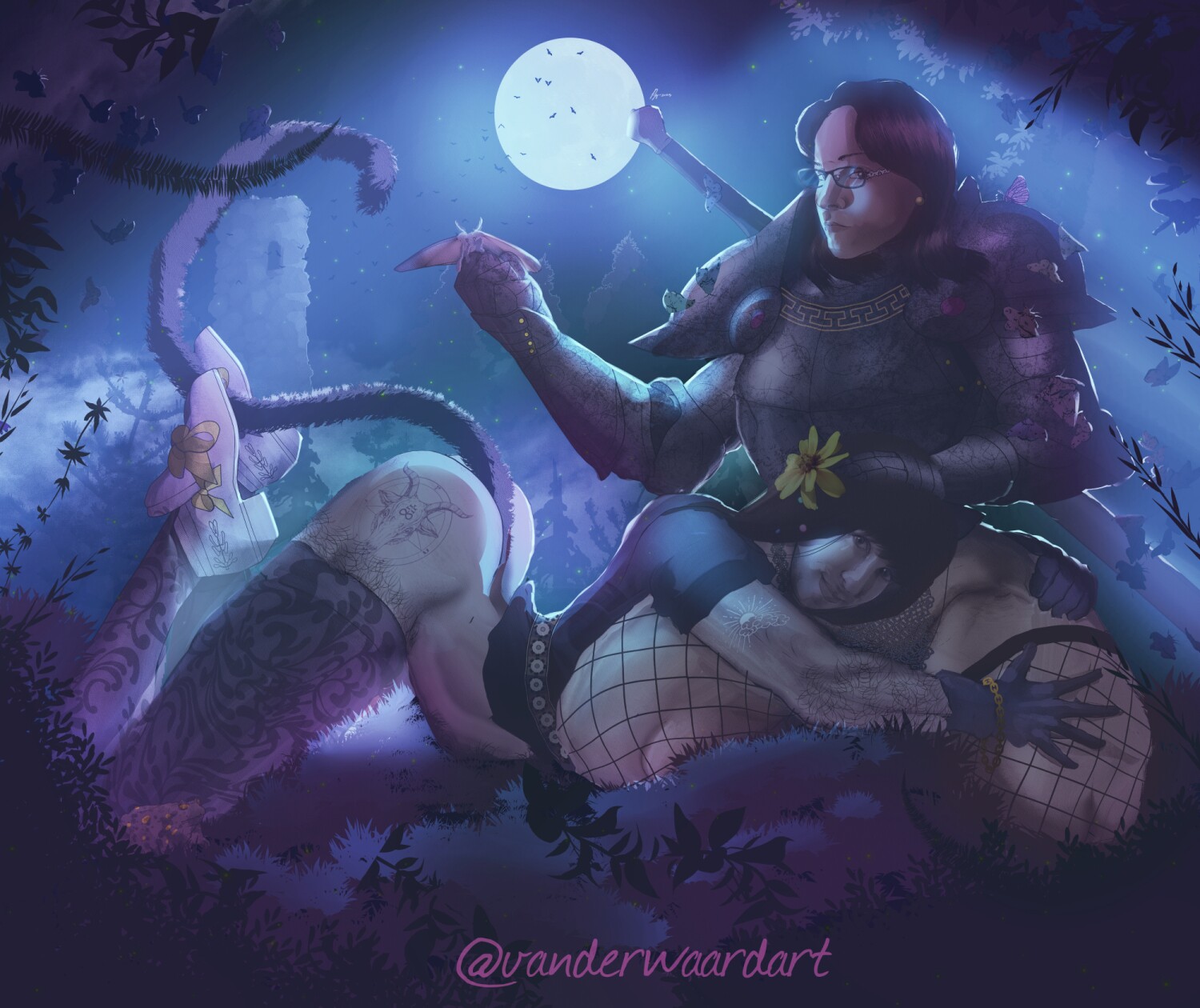
(models: Persephone van der Waard and Jadis; artist: Persephone van der Waard)
To that, the student(s) involved commonly embody the lesson. Jadis, for example, was my Amazon (for a time) and built like a brick shithouse (above)—with "strength" often measuring arbitrarily through size, therefore heft. Sometimes the strength is just "for show," but sometimes the ability (to lift weights) goes beyond passive intimidation (which can make the sex better); i.e., "death by Snu-Snu" is apt regarding Amazons (re: "Herbos to Himbos" [2024] part one and part two), but form follows function, and flow (of power) determines function in ways that are historically dualistic (re: vampiric flow)! Jadis was a brute with their body but also their wages and psychosexual theatre. Fear of an animal sort lubricated their seduction, its efficacy—however immoral—something I survived and can speak paradoxically to. Often, the darkness can be comfy in its illusions of pain; and sometimes, that pain becomes real in ways I didn't consent to.
And it's not like I was immune; at first, it even excited me (ever the service top, eager to please). But the novelty of their abuse (and their strict mommy flavor) quickly wore off. In turn, any irony I envisioned was Faustian, an illusion Jadis wove to seduce me away from home and into their web (a moth to the flame, above). I did my best to learn what they taught me, regardless if they meant to or not: "The greatest irony of Jadis harming me [...] is they accidentally gifted me with the appreciation of calculated risk" (source: "Angry Mothers," 2024). Every exchange goes both ways, including Amazonian exchange; i.e., I survived Jadis' capture of me to capture their wisdom when I escaped (a part of me always with them, that reality captured in my art, above, and in photos of us from before,, below); re (from the Undead Module's "Escaping Jadis"):
In short, Jadis' spell worked as a false promise of protection, the usual Man Box nonsense relayed in a TERF form. Through Jadis, this has become something for me to reify and revisit as a theatrical, doll-like device; i.e., to reclaim through ludo-Gothic BDSM as a perpetual work-in-progress: the black knight—the lurking threat of parental, spousal, and/or community abuse—attached to police violence defending profit through weird nerds failing up. All become something to recognize in small; e.g., the trembling and vulnerable side of myself, playing with dolls I pulled out from within: to place in front of me, thus better control and camp Jadis' raping of me.
I'm not plural—I don't front as such when triggered—but I can still recognize the scholarly and practical value in such protectors, and in conjuring out dark abusers in theatrical forms; e.g., John Kimble vs the abusive mother and father, Sarah Conor vs the abusive cop, and so on; i.e., someone to see me freeze, look at the dark abuser (who often looks perfectly normal, on the outside), then take me aside and say, "It's ok, I got this" before confronting the destroyer in suitably theatrical fashion (through Cameron's mirror test, below, was used to capitalize on audience fears of police brutality at the time):

In the absence of actual protectors, we create our own, psychosexually recontextualizing trauma (often through an asexual, dollish interrogation of rape) as something that generally lives inside and around us. It's simply how humans operate. In revisiting this section to polish it, then, ludo-Gothic BDSM has become the theory for such operations put to practice long before I knew concretely how to express it. [...] Time is a circle, of which our abusers come back around in ways we can control: by making them into dolls (and dollhouses) that are very much haunted by the echoes of trauma. With Jadis, I've made them into something to play with—unable to rape me ever again but teasing me with the pain of such passions threatened by such destroyers-in-small.

(model and photographer: Jadis and Persephone van der Waard)
To that, state cryptonymy can happen on an individual level that overstays its welcome. Regardless if it does, it demands Amazonian revenge (the angry mother or maiden becoming the Destroyer); we respond by camping that revenge through our "rape" scenarios' ludo-Gothic BDSM—e.g., with bondage, fear of war and death, corporal punishment, captivity and starvation, mad science "experiments," black magic, vampirism (sodomy) and witchcraft, etc, as universally advertised through growing states of exception (re: Agamben). Medusa is a repeat offender in state eyes; our aforementioned Wisdom (of the Promethean sort disempowering canonical heroism) disguising as "mere play" and "madness," mid-cryptonymy (with Nazis on either side of the Atlantic monopolizing the same spy novels and cowboy yarns[35] that Commies enjoy): "lifting all those weights like you do, raising my girly ass should be a 'piece of cake!'"
Speaking of, there's no immediate visual difference between Nazi girl boss "black knight" and Amazon (though "darker" Amazons like Jadis generally have a gorgon-esque flavor to them)—the function one of power's flow in either direction, and which can only be determined through play. Again, Jadis knew how to play but generally was a bully who threw their weight around—having about a hundred pounds on me (and hundreds of thousands of dollars over me, despite living in a shithole they kept my name off the lease of, below): a dark "planet," pulling me in to explore its murky depths (their favorite phrase to signal my service-top energies being "put your mysterium tremendum in my Uncanny Valley!"). Whenever they wanted sex, they would suddenly get mischievous (to a grumpy, almost bemused degree, below), say curtly "So, we doin' this?" and then promptly disrobe to entangle me with their brute-force charms ("ballistics"): the hunter's trap and the bait, one where I freely admit the fantasy of is more enticing now than the reality was, back then (the latter not being completely impotent, either)! Good or bad, power is simply something to play with in different ways.

(source: "Going Mask Off: Showing Jadis' Face"; model and photographer: Jadis and Persephone van der Waard)
By extension, the Amazon is classically a matador for state employers, the latter waving a red flag in front of to make her pounce (and which Radcliffe's Black Veil effectively is, the Radcliffean heroine—if not wiggling her butt, before the pounce, then at least moving it towards danger of a pirate sort; i.e., which scrappier-if-celibate detectives like Samus Aran [the myth of a smart cop[36] who solves mysteries versus defaulting to force, each and every time] follow through in their own stories: marrying Velma's magnifying glass [and skimpy clothes] to sexualized violence of a militant [Amazonian] kind; re: "Radcliffe's Refrain" and "The Puzzle of 'Antiquity'").

(source)
This animalized quality (re: "Predators and Prey," 2024) makes the canonical Amazon counterterrorist[37] "froggy"; i.e., to leap away from the elite (capital a frontier exercise), thereby moving money through nature: by conducting Imperialism (re, Lenin: the highest form of Capitalism) in colonial stand-ins that spatially—during the Imperial Boomerang—bring said violence home again (re: military urbanism [2013] enacted by TERFs in bad faith, monopolizing rape, penetration[38] and victimhood for themselves, ergo the state). So we counter them, "just rocking and rolling"; i.e., in the usual cryptonymy that fascists can't easily spot (the merging of oral and written traditions for these liberatory aims). So we tie them into knots, enjoying ourselves while they—like Wonder Woman's Lasso of Truth—go mask-off to give the game away. On our end, doing so includes enjoying state propaganda differently than intended (which camp functionally is).
Unlike my creations' emergent-play qualities/approach, canonical Samus is a counterterrorist "scab" (strike-breaker); i.e., one who classically serves the same corporations Ripley did (the merger of corporation and state; re: Mussolini [1932, cited 2005]; e.g., the Weyland-Yutani corporation, but also the Galactic Federation). To it, she's not a hero so much as an employee for propaganda purposes (so was Wonder Woman, but also Theseus kidnapping and marrying Queen Hippolyta). She and Jadis—the latter a staunch neoliberal—had that in common, though Jadis also loved the kinds of animals Samus routinely kills on purpose (though her power bombs obviously don't discriminate); e.g., spiders and snakes, but also bugs, sharks, and various parasite animals; re (from the Demon Module's "Dark Shadows: The Origins of Demonic Persecution and Camp (and Applying It Ourselves)," 2025):

(exhibit 46e1: Artists: Jadis and Persephone van der Waard. A part of the demonic equation, here are various wild animals I encountered in Florida—minus the sushi boat, mid-right; and Jadis' pet tarantula, Redrum, far-top-left; i.e., pets aren't food until they are, the difference decided arbitrarily by profit in the Imperial Core.
The collage is part of an exhibit that discusses the consumption of animals under Capitalism, but also how people are systemically divided from them and nature, but also the harm that humans cause as a species throughout the Capitalocene; i.e., Richard Adam's basic premise in his lengthy [and violent, admittedly anthropomorphic] Watership Down [1972]: "Death follows humans wherever they go." All animals can do is run and hide [meanwhile, those treated like or compared to chattel by the state—such as persons of color or Jewish people—also run and hide, but can fight back directly and indirectly through various animalized disguises [more on this, in Volume Three]; e.g., the prey animal as something to blend with predator animals: a wolf persona with a "bunny" attitude, exhibit 65; the monstrous "broodmare," exhibit 87a; or the Amazon mommy dom as animalistically strong and closer to nature, 102a3; etc].
To explain the sushi boat's inclusion, then, I wanted to do my part in showing there's no ethical consumption under Capitalism, even for me; the sushi boat is what Capitalism has turned the animal into, but also me as a human being: I eat nature in ways that are mass-produced. The animal[s] are useful for food, but also profit, whereas humans endlessly consume in ways that are useful to the elite, who consume the world for profit by demonizing its inhabitants and nature to chattelize them in different demonic ways. Ideally nature—both flora, fauna and the environment—should be something to preserve and help thrive as stewards thereof, not consume. In the words of Steve Irwin:
What good is a fast car, a flashy house, and a gold-plated dunny to me? Absolutely no good at all. I've been put on this planet to protect wildlife and wilderness areas, which in essence is gonna help humanity. I wanna have the purest oceans. I wanna be able to drink water straight out of that creek. I wanna stop the ozone layer. I wanna save the world. And you know money? Money is great. I can't get enough money. And you know what I'm gonna do with it? I'm gonna buy wilderness areas with it. Every single cent I get goes straight into conservation. And guess what Charles, I don't give a rip whose money it is mate. I'll use it, and I'll spend it on buying land [source: a 2004 interview with 60 Minutes].
As Bay denotes, however, the idea isn't so much preservation of pre-owned land by white benefactors holding onto said land; it's land back to the dispossessed. Nature keeps Humanity alive, to which even a neoliberal façade like Captain Planet [1990] hints at the truth through its own "bad future" narrative: "No, you fools! Without these trees, we will all die!" [source: "Two Futures Part II," 1991].)

(exhibit 46e2: Model, top-left: Jessica Luna; artist, bottom-left: Banana Warmer; right: Marcelo Ventura. Captain Planet places the idea of "rescuing" Humanity by "saving" the planet [a damsel, not a whore] in the hands of middle class, white and tokenized/nationalized teenagers [vlogbrother's "Why Environmentalists Hate Captain Planet," 2019]: "The power is yours!" According to Second Thought, the neoliberal idea of personal responsibility through AstroTurf environmental activism socializes the effort through a false solution, recycling and reducing the so-called "carbon footprint," instead of focusing on the source of the problem: the elite and their carbon production through mass production and a refusal to move towards universal degrowth and away from infinite growth, efficient profit and war ["Your 'Carbon Footprint' Is A Scam," 2022]. Despite nature being framed as something to conquer in demonic language, no amount of guns can stop the climate changes on Earth induced by Humanity's economy of rape and war versus nature. And furthermore, no amount of eco-fascism will stop total starvation/mass extinction when the planetary ecosystem collapses. Humans aren't the virus, capital and Capitalist Realism are. The brainchild of evil white men from Columbus onwards, those are the opposite of good stewardship.)
Jadis, my real-life Amazon, was subjugated in their own way (and by media they enjoyed, versus an abusive mother they longed to escape)—subjugation a concept that, during the cryptonymy process, applies to fictional Amazons like Samus, too. The same idea of stewardship also applies to Amazons; i.e., as classically white Indians that "no man can tame," under capital (with Jadis leaning into the orc "slumming" style of Amazon: a Destroyer who's "chonk, stronk and ready to bonk," below):

(exhibit 37e2 [from "Meeting Jadis," 2024]: Artist: Bayard Wu. Wu's art showcases the kinds of tough, savagely capable orc women that Jadis preferred. A maxim of theirs was that "heroic" women weren't allowed to be ugly, so Jadis especially enjoyed seeing female characters that were either too tall, wide and/or brutish to meet conventional beauty standards; i.e., women of color outside of the West, closer to nature, the jungle, rape and death [the "voodoo" of the pre-colonial "zombie"]. "Strength," for Jadis, was meted out through appropriative perceptions of tomboy force delivered by capable-looking female bodies of given races [an idea we'll return to later in the book, when we talk about TERFs and popular media, in Volume Three]: monster girls who spat, farted, fucked and took spoils of war as sexual prizes [re: Jadis used to fart when they came during sex, which is cuter than it sounds]. In terms of our bedroom games, the consent-non-consent that Jadis and I engaged in frequently had me playing the femboy "war bride," taken prisoner by the strong and capable war chief through captive/captor-style rape fantasies. "I'm keepin' this one!" Jadis would playfully grunt while I topped them.
And honestly? We had a blast in that department; the abuse occurred when the captive fantasy became reality and I lost the ability to consent to it inside or outside the bedroom. Both of us became undead, in my eyes, albeit with them as the abuser and me as their disempowered, doll-like victim: the master and the slave.)
And while we can obviously camp that (with Jadis informing many of the monstrous-feminine animal ideas I applied to Metroid, in "War Vaginas[39]"), it occurs on the same Aegis all share—one where many Amazons (real or not) demonstrably sell out: to punch down at Medusa in small, meaning all the smaller creatures of nature chattelized, thus verminized by the state under Cartesian edicts. Already subjugated by their mother, Jadis subjugated me to carry said likeness (of Athens) along!
Subjugated versus Subversive Amazons
Embodying Beauvoir's "woman is other" (and as beings of chaos, both virtuous and fallen at once; re: the whore's paradox), the subjugated Amazon bears an uncanny resemblance to their rebellious subversive counterpart; i.e., bending said edicts to include all workers "of nature" as monstrous-feminine—meaning insofar as all are warriors with bullets, blades and bombs, while also being "bombshells" of the classically female (and genderqueer) sort: something that mutates into human form out of what, from the classic to Cartesian period, was viewed as "inhuman" to modular degrees; re: the "Gorgon" a symbol of rebellious labor to quell; e.g., women, queer people, persons of color and similar qualities of a larger policed workforce (under modern circumstances), but especially as "extended beings" tied to nature turned into warriors for the state. Said state (the elite) recuperate labor action from the world's oldest profession; i.e., since ancient times, calling it "witch" in more recent eras by using hauntological language and cryptonymy to conceal what is, for all intents and purposes, prostitution to a canonical degree: defending house and home on the cusp of alien invasion, having grown prison-like under states of emergency (and martial law). It's lube for the Boomerang.
The fact remains, nature under capital can assimilate, pimping itself for the state by turning the whore into a cop—a thrilling and fearsome, lady-of-the-night "vampire," bumping up against its light-coded side for middle-class audience delight and commercial gain; re: the ghost of the counterfeit, rescuing babes and babies to weaponize them as "death on two legs" for state preservation (a pair of dichotomies that historically overlap, below): soft cyborgs that trigger to kill state foes, sleeper agents suffering alarm fatigue (on and offstage), and avatars serving as mechs to pilot by male/token players, etc.

(artist: Urbanator)
To survive state monopolies pimping Amazons, workers gotta come together and soften/toughen up as needed (cryptonymy combining the two per femme fatale, above); i.e., including by making likenesses of our trauma that have heroically emancipatory (and therapeutic, nature/nurture) potential! We need to adapt, becoming "Amazon as insect"; i.e., in ways that embrace life and death as part of nature (with Samus having her own "carapace," clothed or not—but also Virago [my OC, below] being a literal cyborg rebel, one modeled after the Major from Ghost in the Shell and Samus Aran, camping each); re (from "Meeting Jadis"):
To cope with my father and the subsequent divorce, I drew comics inspired by Bill Waterson and Jim Davis. These strips weren't monstrous, nor did they accurately reflect my lived experiences; their style was basic and childlike. By the time my stepfather appeared, however, my creations had become far more detailed, erotic and subversive. I loved witches and Amazons and started making powerful, sexy characters like Glenn, Ileana or Revana (exhibit 37g1, below).
Originally inspired by Tolkien, Robert Howard and Lovecraft, but far more genderqueer than any of those men, these trans expressions of my trauma have only expanded over time—within my own work and when collaborating with other artists. Moreover, they were a monstrous-feminine, Amazonian extension of myself as having survived trauma that was also Amazonian; i.e., becoming transformed by the ordeal as zombie-like, but acquiring agency while acknowledging my trauma in doll-like ways. The more I reflected on Jadis and my other abusers, the more I changed through my artwork's future dolls concerned with healing from past events:

(exhibit 37f: Artist, left: Sensaux; right: Persephone van der Waard. Virago the cyborg. Gothic stories—and their ambiguous, liminal ways of presenting experience—resonated quite strongly with my own complex abuse, but also my manner of processing said abuse through Gothic poetics; i.e., dolls.. I've always loved cyberpunk and its left-leaning queer elements for these purposes, effectively a retro-future stage filled with all manner of posthuman monsters and decaying things; i.e., in relation to the material world as controlled by the undefeatable powerful, but also the xenophilic ability to rebel against these powers by harnessing that creative potential for ourselves. That's what Virago, for me, is all about. She's someone I'd happily play as or with! Also, unlike Samus, she always saves the animals!)
Again, Amazons are enemies of the state performatively weak and strong (re: Eco). Can you teach an old (war) dog new tricks, reversing abjection versus furthering it, mid-fluency? Will X-Fusion, all on its own, spare the Gorgon? I'm not sure, save to say that, while we can't synthesize ideas without having material to play with, doing so remains iconoclastic; i.e., I never bought into the Metroid revenge argument Cameron borrowed from Heinlein's "nuke the Reds" refrain (specifically China, though Truman and his goons settled for napalming Korea, instead)—with Fusion releasing shortly after 9/11 during the War on Terror to create further "horrors" to pimp like whores (re: "Outlier Love"). I get the feeling Metaquarius also does this, furthering abjection while treating the Amazon's genderbending as "stuck" (favoring the state[40]). But we'll get to that!
By comparison, I choose to increasingly fetishize the Amazon through carefully rebellious introspection: as a canonically paradoxical, Promethean protector that, in my capable hands, subverts her subjugated role (and its classic gendered elements' subversion for state aims endorsing genocide), and all while wrecking house and home, in-game and out; i.e., as token colonizer to subvert, thereby reversing abjection—on all registers normally pimping the warrior whore, mid-cryptonymy! We're both chameleons (masters of disguise making war at cross purposes); mine challenges theirs (and their moribund creation stories built on death) through a meta dialog furthering or reversing abjection; i.e., through Metroidvania's central Amazonomachia. Per ludo-Gothic BDSM, the Amazon performance of strength can surrender strength—our heroine something of a "switch" versus strictly a domme or a sub. Class war is class war regardless, the flow of power all that matters. Embody power to camp it, ninja Amazons included!
In canon, there really are endless varieties thereof; i.e., Joseph Campbell's The Hero with a Thousand Faces (1949) also applying to female warriors (which Campbell doesn't do, because he's sexist); e.g. samurai, gunfighters, sailor scouts, etc. That being said, the Gothic story warps the monomyth to a Promethean degree (re: Aguirre), fucking with it all the while (the beast with a billion backs, from Futurama, 2008). These fears remain reactionary in origin; i.e., concerning the princess as woken rudely up inside an alien house that eerily resembles her own (e.g., The Night House, 2019; see: "One Foot Out the Door," 2024), and which she escapes its menacing liminalities like the legendary Amazon might—through monomythic force fetishizing nature, pimping the whore per all the usual Cartesian refrains: to seek power and prevent rape, mid-DARVO. Liberating the whore happens through exploitative (and, at times, explosive) dialogs, because that is where canon is camped; re: "to interrogate power, you must go where it is," which Metroidvania reify as person and place ontologically out-of-joint and hopelessly interwoven. Simply put, it's my jam, but especially Amazons (which Metroidvania are home to, and whose Amazons canonically serve profit; i.e., offered to players by greedy companies to pacify the latter with, the former using all the Patriarchal language that history affords: she-Beowulf avatars offering up "exceptions" that prove the rule).

(artist: Jim32)
To it, let's continue exploring Amazons—their abject bodies, spaces and invariable confusions that invite ludo-Gothic BDSM (rape play) to camp their canonical roles with, under capital; i.e., as Gothic Amazons (above) that we reverse abjection with, thus profit during joy under fascism as something to make, act out, what-have-you—effectively wearing the same monstrous clothes (therefore arguments) that police forces abuse (refer to "Zombie Police States" [2021] for a more earthbound example). Neoliberal cryptonymy comforts people into disguised stances of war, their us-versus-them nostalgia profoundly fatal as people "do a monomyth," onstage and off. In their eyes, "land back" = "sex back" as a threat, therefore all the things about Amazons (and nature) that state powers abject; i.e., to start with, and which our cryptonymic terror devices reverse through Amazonian play as half-real (e.g., fan art, and similar kinds of daily synthesis that good praxis demands, below).
The fact remains, everyone loves monsters (and whores); Amazonian myth gives a much-needed shorthand to speak to the plight of whores, her monster-whore status speaking in duality to various concealed/concealing things using preferential code (especially sex and force, love and war). Knock 'em dead, however you can; e.g., Ripley's "We'll go step by step and cut off every bulkhead and every went until we have it cornered and then we'll blow it the fuck out into space" versus Cage's "Not the bees!" Po-tay-to, po-tah-to!
Amazon Bodies (as Armor and Weapons)
Abject for being monstrous-feminine, Amazon bodies armor and arm the same way that men do, but likewise suffer a double standard; i.e., sex sells, and capital pimps female/feminine sex as warlike in readily recognizable forms, mise-en-abyme (sex-as-weapon): monster girls, waifus, and female avengers—meaning Amazon as derelict, "ancient/neo-medieval" castle in the flesh sold to the usual enjoyers of "castration fears" (routine imperial collapse). "My mommy used to say there are no monsters, not real ones, but there are, aren't there?" She becomes a costume to wear and kick ass with, effectively a return of fascism, thus Communism, too; i.e., through a Nazi vampire in canonical variants (e.g., Striga from the 2017 Castlevania revival, below); re: the "dark" fash-coded Amazon—haunted, on her surface, by the Communist Medusa—thus triggering to "go feral," dealing with her black-and-red double before needing "Old Yeller" euthanasia or banishment, herself (and where rabies and vampirism, but also sodomy historically overlap, in medieval thought).
Again, Amazons are dualistic and modular inkblots, there being a variety of interpretations to a given image; i.e., that exist paradoxically all at once (and Nazis and Commies occupying the same shadow zone and [shadow bodies] that American centrism[41] scapegoats differently). Some see comfort, on her Aegis; others, destruction; some, a bit from Column A and Column B (as the Gothic do). The opposition is always a bit controlled and uncontrolled.

(model and artist: Autumn Anarchy and Persephone van der Waard)
This blade cuts in a variety of directions, Amazons both classically naked and phallic. Monstrous-feminine = any female/feminine (or GNC, non-white, etc) element the state marries to status-quo masculine properties, including the ability to instruct about sacred things (which war most certainly is, but especially in "defense" of the nuclear household through false flags[42]); from Sparta onwards, Western society is taught to wage war through its women raising men as pro-state creation stories: to further abjection by chasing sex and having dominant, "queen[43] of the household" vibes (a trend also observed in Eastern cultures; re: the brides of Japanese shogun during the Warring-States Period, historically defending their husband's castles; i.e., the wives taught in the art of war by their husbands, away at war).
Concerning Amazons as fash or Commie, the "clothes" are abject, regardless; and if the clothes are abject, it begs the question: how do we tell the difference, per wardrobe? My sweet summer child, it all boils down to what these ghosts of the counterfeit serve—profit or people, state's rights versus workers' (re: "It Began with a Whisper," 2025). A whore is a whore, and whores gentrify and decay under capital (re: "A Cruel Angel's (Modular) Thesis"); i.e., in ways our cryptonymy must counteract—with there historically being no tenable, long-term monopoly concerning violence, terror or monsters (re: from Weber, Asprey and myself; see: "The State: Its Key Tools" in "Paratextual (Gothic) Documents"): "I'm nekkid and 'in danger'; don't fuck with meeeeeee!" So does the clothing on display speak to a quest we can also camp.

(artist: Persephone van der Waard)
Amazon Roles (the Hero's Quest)
Per the monomyth, the state routinely assigns the hero a quest—specifically a duty to perform that generally requires a "monster" to die (a grim harvest, during the liminal hauntology of war); i.e., while likewise recruiting from said population (e.g., Amazons). The state tokenizes labor to police itself, the cops-and-robbers refrain one of assimilation and triangulation. Whatever the form, the function is betrayal, which becomes a pact—one neoliberal media will essentialize in consciously "ancient" language: a sacred cycle of violence and generational trauma, chasing its own tail (re: female Quixote, aping old men from a young age).
Speaking of, Metaquarium's own advertisement bastardizes Nietzsche's Beyond Good and Evil (1886); i.e., just like Metroidvania do, specifically its "gaze into the abyss" refrain: "He who fights with monsters should look to it that he himself does not become a monster, for when you gaze long into the abyss, the abyss gazes also into you" (source). Metaquarium, in response, argues "Sometimes the only is way to defeat a predator is to become one":

(source: Metaquarius' "XF")
This is the quest, and one where Metaquarium is hardly the first to try—an act done previously by the Nazis[44] in the 1930s and '40s, but also by James Cameron pimping nature, in 1986. Learning to "love the Bomb" (as a tool of fear that puts butts in seats), Cameron literally quotes Nietzsche in his ostensibly-anti-(nuclear)-war-but-still-Red-Scare movie, The Abyss (1989; re: "Out of This World," 2024).
Itself written and shot by a famously punitive and egotistical white centrist (and Pygmalion who married his own starring actress, Linda Hamilton), The Abyss and Cameron's earlier movies all showcase a Cartesian fraud, one flip-flopping aggressively between American jingoism and anti-cop narratives; i.e., depending on which side of the national border his script concerns (the usual "boundaries for me, not for thee" nonsense). It's "billionaire Marxism," which is to say, not Marxism at all except through allegory (thus the "play" of interpretation); i.e., Pygmalion syndrome—with Cameron haunting the lens to make Ripley his femme-fatale avenger of America's Vietnam:

(source)
In other words, apocalypse is fractal, but also fractally recursive—Cameron's fabled Amazonomachia pointedly packaged, like a Trojan Horse, in neo-conservative, American liberal disguises: the modest former-whore-turned-savior/naughty nun preaching state salvation while playing at rebel; i.e., a witch cop (re: "Witch Cops and Victims"). The Terminator (1984), for example, feared the whispered assassin, specifically a black knight (with an Austrian name) emerging from another time—a "possible future" now destroyed by Frankensteinian hubris—to attack the present as "not set" (re: "Healing from Rape"); Aliens, by comparison, cements the hauntology to embody the same assassin versus a different Amazon, meaning through the same "found document" approach Walpole founded "Gothic" on (re: "The Puzzle of 'Antiquity'"): fetishizing the conqueror as, in Cameron's case, an Amazon slave trying to re-assimilate a world falling apart (the Avatar franchise speaking to the same ludologist refrain/dilemma that Cameron used to rake in his "fuck you" money). Medusa becomes the plus-size black whore for Whitey to punch (re: "Always a Victim," 2024), a black queen/predator versus a white to maintain global American hegemony on and offstage.
To that, Samus is basically "girl Hercules" (echoing the monomyth, which I call, in 2017, "the invincible heroine"; re: "Choosing the Slain"); i.e., performing her Labors for the gods (re: the Galactic Federation, aka "Space NATO"), the Promethean story one of the monomyth in crisis, hence decay. It's vital, then, to remember how Samus is a predator, but specifically one to reify through mercenary action sown by forever wars "among the stars" (re: the displacement of current conflicts, here on Earth; re: "Military Optimism"). Mercenaries aren't homebodies, but homewreckers (e.g., Seal Team Six a bunch of cowboys "canoeing" Osama Bin Laden, thus not likely to be invited to your local Sunday dinner for fear of turning the stomachs of the middle class[45]); i.e., bastard, illegitimate, but also "might makes right" whores with an axe to grind, including female barbarians feeding the profit motive (thus Capitalist Realism, mid-abjection): killing "goat men" since Diablo 1 (1996) into latter-day excursions haunted by pre-digital atrocities!

(artist: Laurel D. Austen)
Boldly demanding "Crom, count the dead!" (or some such braggadocio), these dogs of war ply their gruesome trade; i.e., while guided largely by conquest (the guild "mystery" or trade secret kept secret through force and reputation alike): in furtherance of fame and fortune, glory and revenge as being and bearing the royal "imprimatur" (seal of quality) during latter-day apologia; re: Bakhtin's chronotope concerning history as one "of dynastic primacy and hereditary rites" dog-walked through like a museum (source: The Dialogic Imagination, 1981), and one where—when in decay (after the death of the presumed master)—older buried ghosts get up and wander where they formerly "shouldn't" be: their own land as stolen from them by imperial force (the mercenary made into a straw dog after completing their task).
Embodied, per my arguments, by the Amazon-as-castle "played out," we're routinely left with a derelict of ill omen expressed in small—a black castle whose appearance (and exploration during ergodic motion) whispers fearfully of medieval-coded "piracy"; i.e., that which Metroidvania have made, since the 1980s corporate boom, their selling point. Some things never change; a Metroidvania without an Amazon (or at least a gorgon to slay inside a closed space) generally feels like its missing something: the woman behind the curtain (re: Radcliffe's Black Veil classically having a "dead" statue behind it, meaning Galatea marked for death after being cuffed for her "uppity" back talk). The classic quest is the monomyth, after all: a cryptonymy or "vanishing point" that begs, "kill the whore, save the damsel" (abusing Athena's Aegis to do so, below).

(source: Flying Omelet)
Furthermore, and in keeping with capital, everything described above operates under the Protestant ethic, mid-quest; i.e., as explored by Tolkien towards Cameron's refrain (the treasure map vs the shooter); re: "On Twin Trees" (2023). Samus, as such, is an Amazon "raised by wolves" (or giant bird aliens, in her case); i.e., post-colonial collapse, and commissioned for war accordingly during the usual "zero missions" into many more, afterwards: a cycle of generational trauma that regenerates—meaning insofar as capital must always have an alien to pimp, thus exterminate (as vermin) during said dialectic (and all while giving some love to the usual workers [often men] alienated from a healthy sense of motherhood; re: "Hugging the Alien" but also Mark Greene's "Man Box" and, per my arguments, weird canonical nerds vs weird iconoclastic nerds, mid-Gothic).
To it, there's a lot of settler-colonial apologia, therefore DARVO and obscurantism, in Metroid—both during Nintendo's neoliberal (corporate) revival of old ethnocentric arguments (specifically the map of conquest; re: "On Canonical Essentialism," 2024), but also during "indie" fan stories; e.g., like Metaquarium's X-Fusion celebrating the whore: as something of a "Russian doll" to gestate inside (an inversion of the usual breeding kinks yet serving power through the same Amazon power fantasies; i.e., for girls punching down to please their patriarchal masters, and for boys and men "getting the girl": as haunted by her own spectral, tokophobic[46] fetus, below).
Regardless of gender or sex, race or religion, workers divide through accident of birth; i.e., from the elite (non-workers)—the former born into structures of invasion that, by state-corporate design, compel us towards (and into) police violence serving profit. Monomyth heroes aren't jailors; they don't "capture" enemies of the state, but rather kill them outright and without mercy. Per abjection, Samus just another costume for these aims, one whose cryptonymy the state will try to monopolize: until they no longer can, demanding its ritual euthanasia concealing the abortion; i.e., of those outside the womb (the glass screen a black mirror echoing the glass jar housing Mother Brain longing for release; re: Athena's Aegis also being Medusa's mirror to further or reverse abjection with, speaking to players also trapped between the same layers, on and offstage).

(source: Metaquarius' "XF")
Corporate dogma gestates inside the brains of workers like Metaquarium, and whose "head canon" faithfully treats the entire thing like a return to form (and space of play to retell old stories); i.e., a thing to celebrate for the unironic violence on display but also its dialectical-material context: a fantasy-as-blockbuster smash during state crisis—meaning in and out of the game, reviving "the good-ol'-days" that never really existed, save as fatal nostalgia.
So does Samus smash Radcliffean fears of collapse, the player controlling her during rising inheritance anxieties; i.e., offstage, and dialectically-materially unfolding through neoliberal (therefore genocidal, American) force, the middle class—afraid of nature as alien from Freudian lullabies of Cartesian dualism—calling for Mommy defending the castle: from "raiding barbarians" (code for state targets), and all while figuratively and literally inside her necrotic "womb state" (from Sigmund Freud and Otto Rank's[47] combating theories on birth trauma, ergo Archaic Mommy issues—arguably as incestuous parasite, eating "Mom" from within (above) while she sometimes returns the favor (as Mother Brain threatens to, below); re (from Volume Zero):
Under Capitalist Realism, Hell is a place that always appears on Earth [or an Earth-like double]—a black fortress threatening state hegemony during the inevitable decay of a colonial body. Its widening state of exception must then be entered by the hero during the liminal hauntology of war as a repeatable, monomythic excursion—a franchise to subdue during military optimism sold as a childhood exercise towards "playing war" in fantastical forms; e.g., Castlevania or Metroid. Conjure a Radcliffean menace inside the Imperial Core, then meet it with American force (source: "Scouting the Field," 2023).
Of course, the state-as-cannibal is certainly nothing new (e.g., the giant from Jack and the Beanstalk[48]), including fears of state-compelled pregnancy having tokophobically cannibalistic qualities that go both ways. Yet, there is also the inside/outside approach to "giants" simply speaking to asymmetrical parasitoidism; i.e., from things bigger or smaller than you, relaid in suitably "Gothic" ways that marry science and superstition to Amazon-style ghost stories (the xenomorph starts small, but gets big fast—a symbol for black rape [re: "Concerning Big Black Dicks," 2024] as much as black baby and rape baby): the fretting over ghosts of different kinds that might "eat" you (versus pointing fingers directly at the state, the center of the worker self sold to them through propaganda since birth).
While Medusa is a giant of sorts (above), the Capitalocene informs a giant force that Walpole—far from celebrate, like Hobbes' 1691 Leviathan did (think "Renaissance Voltron" apologizing for "good" government)—actually chose to demonize and fear by anti-war attitudes bleeding amniotically into Goya; e.g., Goya's "Saturn Devouring His Son" (c. 1820, below) depicting a frightened, aging artist, one haunted to—and pushed over the edge of madness by—a shadow of war similar to Walpole's own "Gothic"; i.e., by the French and Indian War (ending in 1763, a year before Otranto) echoing the Peninsular War that Goya protested through art; re: the same cryptomimesis Giger's Gothic surrealism spoke to, after Vietnam. Art is protest, but also acknowledgement of what, so often, is buried by state actors (and sublimated by them; re: the xenomorph a kind of "whipping post" for the 1980s Amazon reenacting Satanic panic).
Keeping with abjection, try to see past the initial shock Goya conjured (never having meant for his painting to be seen, mind you); i.e., to consider the Gothically dialectical-material elements constantly at work—with psychoanalysis largely being bullshit that Freud (and his successors; e.g., Creed and Kristeva) were guilty of using to obscure[49] Marx's critical lever, thus Medusa's spectres before him: Freud eating Marx, Creed eating Freud (who ate back), and me eating Creed, etc! It's just a code to speak poetically towards different things. Pick your poison, then chow down, baby (note: optional comma)!

(artist: Francisco Goya)
Metroid, by extension, speaks to the Imperial Boomerang (thus military urbanism) as bringing Imperialism home to empire; i.e., as capital decays into fascism, losing control of its outer colonies while its inner ones devour "the weak" (all while presenting themselves as "outer" to maintain Capitalist Realism, state barbers giving Medusa [the whistleblower] a "haircut"; re: "Toxic Schlock Syndrome," 2025). Indeed, Super Metroid starts with an exploding space station, and Fusion takes place entirely inside one (re: the belly but also mouth-like womb of the beast, Creed onwards); i.e., where you also have to escape at the end—a timer clocking (and counting down) your mad dash to the finish, killing everything in your way as you dodge a routine holocaust!
In other words, the space is abject—a house eating "you" (the hero) the same way that Gothic castles (from Walpole onwards) classically threaten to do; i.e., as giant knights, women their prey under encroaching neo-feudal[50] refrains, and which "mommy domme" Amazons (from Ripley onwards) interrogate through motherly-fatherly force. "Switches" who abandon cat-like curiosity alone, they evolve to survive; re: from Radcliffe's earlier and gentler varieties, their "seasons in the abyss" becoming war-like, defiant, frozen in place—an androgynous nuptial, one where Scott weds Medusa to Athena, but also Radcliffe's Ludovico to Emily St. Aubert, debating about ghosts in the other room. It's essentially C.S. Lewis' "tiger vs mighty ghost" argument, his Problem of Pain (1940) interrogating Rudolph Otto's Idea of the Holy to conceptualize the Numinous all over again; re: as the goal of the quest that a given space (and its abjection) provide: a poetically potent-if-preferential means of thinking about the real world—as shaped and informed by Plato's fabled cave-wall shadows!
With Horace Walpole's help, let's consider abjection's spatial implications in Metroidvania a bit more, then move onto Amazonian confusion (as I'm sure a lot of this already is confusing to many of you)!
Abjection as Space (feat. Horace Walpole)
The Numinous can, of course, mean different things. That being said, Metroidvania are Gothic castles, which are home to—among other things—women and rape (often by pirates who, saucy and bold, steal sex from headstrong maidens, or rather just steal the maidens for their sexual value). We'll dabble in history and poetry before getting to Metroidvania proper.
Note: This subsection is a bit more playful and poetic than some of the others. This is intentional, insofar as play and poetry are a huge part of the work I do; i.e., regarding Metroidvania as abject spaces. Even so, I want to resist "the philosopher's urge," meaning to think about things purely for their own sake; or, poetically speaking to "play with my food," as poets are want to do. Yet, while play is the focus, its dialectical-material emphasis cuts to the bone of these issues by playing with them; i.e., I can't help but play just a little to illustrate my points, including the fun I'm having by doing so. Who said teaching had to be dull, or for that matter revolution and sex? I eat this shit up. As such, consider this portion a seminar sprinkled with levity and color—a rainbow cemetery made from past cemeteries I've made already from those others have (on and on)! Every plot is an arrow in my quiver, shamelessly robbed to arm and further my cause! —Perse

(artist: Pierre Hubert Subleyras' portrait of Horatio "Horace" Walpole, c. 1746)
First, some history. The author of the first Gothic novel (ergo castle), was Horace Walpole; and while Amazons appeared after Walpole died, they only became a staple of them as arguably haunting the cryptonymy's whole exercise—i.e., from Hogle's description of a "restless labyrinth," in 1980, to something evoking E.E. Cummings' posh Cambridge ladies, decades previous:
.... the Cambridge ladies do not care, above
Cambridge if sometimes in its box of
sky lavender and cornerless, the
moon rattles like a fragment of angry candy (source: "the Cambridge ladies who live in furnished souls," 1923)
"Gothic," from Walpole's Strawberry Hill to Otranto, was always absurd—a treasure box of random shit, but especially old shit evoking mid-assemblage a certain mood, or tone-poem "gloomth" that purposefully felt confused; i.e., not just the shapes of phantasmagoria aping Plato, but puppets (miniatures) of a return of the medieval to marvel at. What I eventually called "ludo-Gothic BDSM" was, in turn, informed by Walpole's earlier exercises having a literal architectural[52] character to them (re: "Prey as Liberators," 2024). And these, in turn, would oscillate between stories and real life going hand-in-hand. The paradox, here, isn't escape into illusion, but taking what you learn, mid-illusion, out into the real world; i.e., "there and back again."
We'll start with Walpole, outlining his journey tied to mine, on and off the page—with Walpole building "actual" castles (sort of, below), and my gay ass writing and drawing them tied as much to Metroidvania as to "castles in the flesh" (models, sex workers, friends, lovers) reaching back around to Walpole's spaces of rape (re: The Mysterious Mother[51] [1768] being a double-incest yarn). Per Gothic, cartography and morphology bind at the hip, and Walpole had a diabolical, even infantile sense of humor that showed through his work. Vulgarity and genius are not discrete; e.g., Mozart being a saucy commoner who shared in Walpole's saucier antics, Lord Byron a commoner-turned-rockstar who embraced Walpole's most scandalous elements, and of course Matthew Lewis—a MP who also delighted at scandal (camping the canon in ways that Walpole's work arguably inspired, years prior). Rocky Horror (1975) revived an imaginary past, as did Metroidvania—both borrowing the larger tradition for doing so; i.e., from men like Walpole and women like Shelley unto Kristeva and Creed unto me. To quote Frank Langella as Skeletor, "It is my destiny!" but one tied (much to his chagrin) to other places and people. The past, Aguirre points out, is inextricably spatial.
Simply put, the Gothic castle was a space of play made by an ambiguously gay man; i.e., whose house he literally named after a fruit[52a]—one filled with all manner of weird nerdy shit, said shit indicating warring dialogs about power tied to "past" conjured up once more. It's... kind of postmodern, hence before the Enlightenment in ways 1960s Frenchmen like Derrida were not—before its time while being of its time, critiquing the state by retreating into the past as nostalgic in fearsome ways. Again, this includes miniatures that rebuke giant forces, but also music of an operatic, "danger disco" character other revolutionaries of the period (the Romantics) found distasteful; i.e., essentially trumpeting the Sublime over "Gothic" as, in their eyes, something of a bad joke echoing endlessly (re: "A Song Written in Decay," 2024).
But it was precisely this castle-in-a-castle bad echo that gave rise to Gothic counterculture. Questing for that perfect domme—one Walpole touched on, centuries ago—and whose invitation, of the Amazon into the court of a palliative Numinous, I would find myself drawn towards; i.e., when slowly and steadily crafting ludo-Gothic BDSM out of old dead things; re (from Volume Zero):
my essay "Notes on Power" discussed the paradox as being the performative nature of power doubled, including monsters but also their decaying lairs as monumental sites of immense, god-like power dressed up through the Gothic language of the imaginary past; the Metroidvania is a Gothic castle full of Gothic monsters, but also Gothic ghosts (echoes) of older and older castles reaching out from novels and cinema into videogames. Regardless of the medium, though, Clint Hockings' adage, "Seek power and you will progress" (source: "Ludonarrative Dissonance," 2007) means something altogether different depending how you define power as something to seek, including unequal arrangements thereof. As a child, teenager and woman, I sought it through the palliative Numinous in Gothic castles of the Neo-Gothic tradition carried over into videogames (which I learned about in reverse: videogames, followed by the Numinous/mysterium tremendum as introduced to me by Dr. David Calonne). Of these, I explored their Numinous territories in response to my own lived trauma and subsequent hypersexuality—i.e., as things I both related to the counterfeit with and sought to reclaim the counterfeit from as a tool to understand, thus improve myself and the world by reclaiming the castle as a site of interpretative Gothic play (of kinks, fetishes, and BDSM); i.e., this book that you're reading right now is a "castle" to wander around inside: a safe space of exquisite "torture" to ask questions about your own latent desires and guilty thoughts regarding the "barbaric" exhibits within as putting the ghosts out from my past on display (the Gothic castle and its intense, "heavy weather" theatrics generally being a medieval metaphor for the mind, body and soul, but also its extreme, buried and/or conflicting emotions and desires: a figurative or sometimes literal plurality depending on the person exploring the castle) [source: "The Quest for Power"].
The Gothic, in turn, is about reifying castles (and the princess-in-another-castle); i.e., to reexplore under present circumstances; re: the chronotope as a transgenerational meta exercise, its "curse" of faulty foresight dripping into fresh mediums—from novels to cinema to Metroidvania. Did I mention it's an aphrodisiac? So-called "danger" is the crux of calculated risk, including sex; and while "rape" doesn't always involve sex, it commonly does (quotes or no). Furthermore, such spaces are always, to some degree, abject, invaded, and campy to a silly-serious degree; i.e., in ways Amazons can further or reverse while moving around inside: a snowy mannequin, filling their "eyes with that dou-ble vi-sion." Seeing red, it's a trip to change one's viewpoint—meaning exactly where they are, yet seeing other possible worlds superimposed over this one (one's rose-tinted glasses cracked on purpose).

"If you want to reach the Red Bull, you have to walk through time." Moving through time requires spaces thereof, which the Gothic makes "monstrous" in historical forms (re: Bakhtin); i.e., as something to aesthetically interrogate for different purposes, including mid-Amazonomachia. As a Gothic device, cryptonymy works with clothing and quest to cloak-then-explore those Metroidvania spaces (and their palimpsests) described above; re: to further or reverse abjection. There's much fabrication to observe, and all to sell the illusion as "homely" in a hauntologically monomythic sense: through the Gothic chronotope as a fearsome argument of fake parentage, ergo dead futures the Amazon explores like it's her job; re: per Mark Fisher's own, albeit unfinished cyberpunk work alongside my scholarship on Metroidvania—the latter speaking to a retro-future extermination of the nuclear bloodline, this only restored by state actors after great sacrifice. Yet "their" poetic enterprise harbors us, working at cross purposes.
Let's unpack that, concerning poetry itself, onstage and off; then apply it and the prior-examined history to Metroidvania, its cryptonymy reversing abjection in earnest.
Next, the poetry onstage. Regarding Samus' human parents, for example, the Metroid franchise is not without poetic license. Point-in-fact, it blames their death on "space pirates"; i.e., space fascism and Communism occupying the same draconian veneer (and Ridley being a none-to-subtle homage to Britain's Alien director)... only for the unlucky army brat to be taken and passed from home to home (a bit like Zofloya's Victoria de Loredani, 1806): by a corporation after those "good" alien stepparents, the Chozo, are also killed. In turn, these ghosts from the past effectively haunt the ruins of their own fairytale civilization; i.e., laid low by Forbidden-Planet-style[53] (1956) hubris that blames the same-old whores—specifically Medusa's spiky brain in a glass jar—for the elite's colonial ambitions "gone to pot"; re: Walpole's idea of a "secret sin; [an] untold tale, that art cannot extract, nor penance cleanse" (from The Mysterious Mother); re (from Volume One):
The Western world is generally a place that testifies to its own traumas by fabricating them; i.e., as markers of sovereignty that remain historically unkind to specific groups that nevertheless survive within them as ghosts of unspeakable events linked to systemic abuse. Trauma, in turn, survives through stories corrupted by the presence of said abuse. There is a home resembling a castle, where a ghost—often of a woman—lurks inside having been met with a sorry fate. But undeath is something that can be felt through echoes of ourselves that aren't diegetically spectral; they feel spectral through an uncanny resemblance, like standing over our own graves. This becomes something to play with during ludo-Gothic BDSM, akin to an (at-times) humorous, even trashy gallows theatre rife with dark, forbidden language: sin, vice, violent sex, all-around death, and other taboo subjects discouraged by privileged (and unimaginative) moderates who historically frame the Gothic as a puerile, good-for-nothing backwater while simultaneously suffering from conservative delusions of privilege and/or tokenism (re: Jameson). In other words, the pedagogy of the oppressed faces its classic foil: tone-policing (source: "Healing from Rape").

(artist: Jean-Baptiste Regnault)
"Whores are made," Diana Russel writes (source: "The Making of a Whore," 2020); the same speaks to Pygmalion and Galatea, but the language that reinforces such things can—during joy under fascism, adumbrating titanic forces while impacting smaller beings caught in their long shadows—become a powerful way of separating ourselves from our trauma; i.e., in castled, theatrically potent ways, leading offstage from on. A Walpolean return to "trauma" in quotes, the heroine explores taboos through stories (spaces) writ in disintegration—doing so meant to protect the player and the audience, alike, from unspeakable crimes that demand testimony where speech is absent (e.g., on incest, murder and rape; i.e., as "unspeakable" topics that won't shut up in veiled forms).
In turn, everything becomes a game, and games are meant to give players control over themselves and their surroundings (real or not); Metroidvania do so while trauma is everywhere and nothing is certain, save that control over trauma—meaning generational trauma we voice across space and time—is cathartic: a lucid dream with lurid, nightmarish flavors (of sex and sleep paralysis, for starters); re: the Gothic rape space conducive to calculated risk, from Walpole to me—not as apologia but play finding joy under fascism (with capital already dying when Walpole wrote Otranto)! This joy instructs through itself, a scenario to play out and teach a mechanism of play conducive to Gothic Communism (thus antithetical to Capitalist Realism).
In other words, fear doesn't have a set function or aesthetic, able to induce a variety of useful and/or maladaptive spheres, the poetry happening onstage and off; e.g., many so-called "nice guys" today are absolute dickheads (antagonizing many women living in the shadow of rape, meaning cast by those who say "trust me" to them, in bad faith). But fear when dating is a valid (reasonable) concern—fear of physical harm, of emotional damage, of the logistic pain in the ass that dating is, under Capitalism: to feel under attack, but also starving for those rare moments when things actually go one's way (or disappointment: "Is it in, yet?"). Much of this is taught by stories—the dead brought poetically back to life, an (a)sexual interrogation of trauma using one's "Aegis."
In turn, learning to control fear and face it stems from Metroidvania exploring fear in "old" artifacts Walpole "coined"; i.e., to reexplore a given ageless space of fear that, by its very design, pirates abjection "in the mint"; re: mid-cryptonymy as an ongoing historical-material binary. Abjection—which seems eternal, thoroughly "outside" time—voices in ways that allow for neurodivergent, genderqueer and paradoxical interpretation, inside time-space. In turn, the unmoored feeling only deepens to allow for joy and communication that travel over a maturing circuitry. They can't just stamp us out, because the castles they retreat into are covered in our Ziggy Stardust. In turn, we speak to our ancestors through a shared chorus, a Song of Infinity (re: "A Song Written in Decay"); they speak through us, our Aegis "fucking to metal" and reflecting state weapons (terror, first and foremost) back at ongoing abusers (e.g., dumping glitter on ICE agents that, rumor or not[54], denote a wish, want or desire to out our attackers with style). Girl's got an ass like a trampoline!
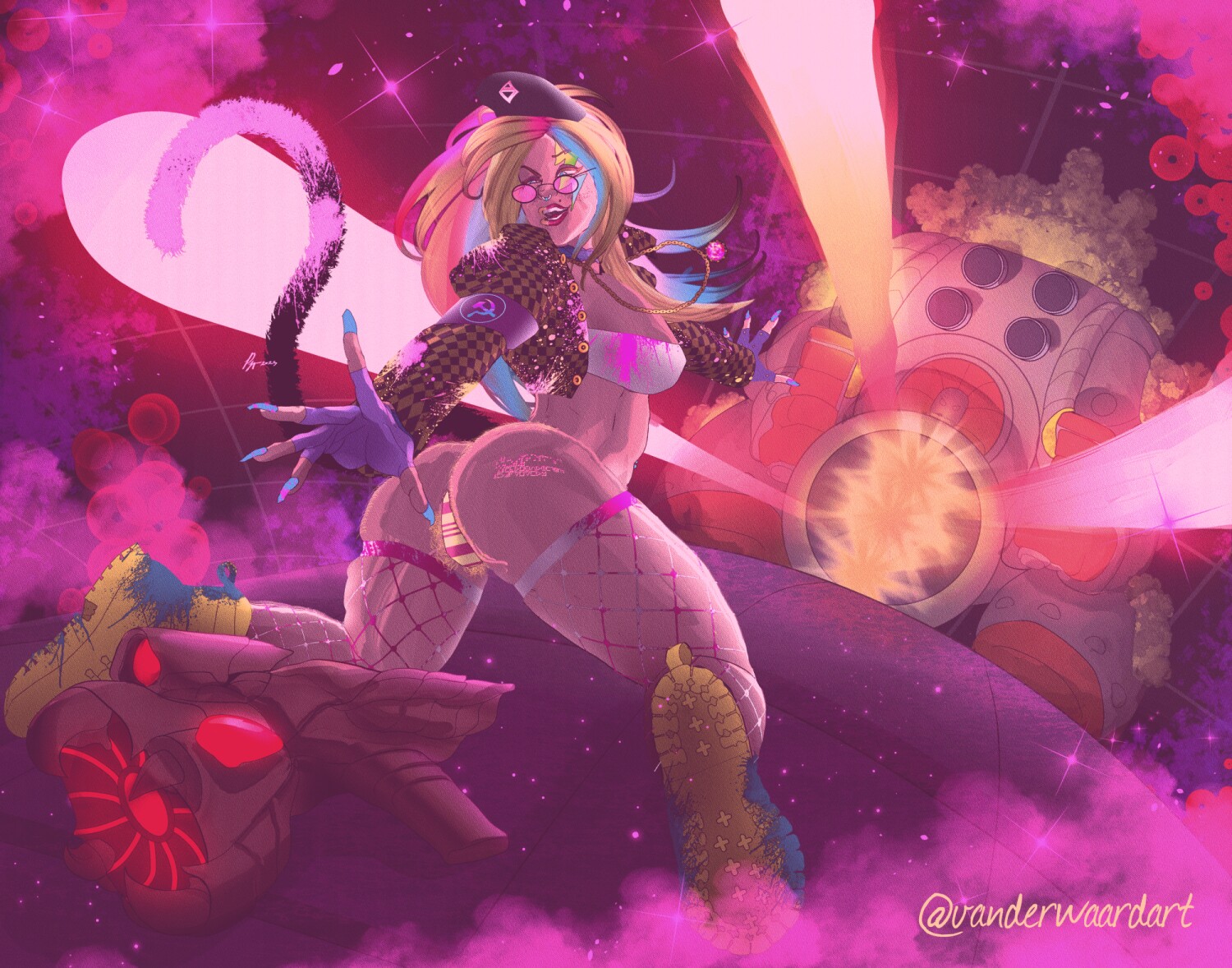
(artist: Persephone van der Waard)
Silliness aside (or alongside the pathos being shown), let's bounce a bit longer, shall we? The whole point of Gothic is to transfer and communicate power as ambiguous, in decay and up-for-grabs; furthermore, with the powers of state bumbling through life, using the same gaslights to bewitch us, I fail to see how gaining the ability to navigate these seas of madness is anything but a net positive: touching base with our alien animals sides, learning to see in the dark using darkness visible (the stuff of Gothic castles)! Dangerous confusion becomes our greatest weapon, one reclaimed from colonial powers.
Yet, state-in-crisis snuffs speech out like a Gothic flame. So it behooves us to learn other ways of speech, a Metroidvania heroine swimming comfortably in the soupy void—meaning in ways that beget a prolificity of patterns to (under)take; i.e., one dodging state censors (or lasers, above), which we imitate in reply. It's not a babble of gobbledygook, but code that seems bizarre to disguise its biting function; i.e., through oxymoron and metaphor as very old devices crossing over into "old" spaces, and seemingly for the first time; e.g., mad walking arm-in-arm with genius, black with whore, destroyer with lamb, wallflower and cum dumpster, etc. Meanwhile, everything sparkles, the promises made threateningly seductive: liberation and empowerment, bestowed from the past (and Medusa) unto ourselves (re: "Away with the Faeries; or, Double Trouble in Axiom Verge," 2024). Joy is the point, survival and rapture "crossing wires" to hotwire theft; i.e., of power placed back into our hands, the ensuring "ass war" historically asymmetrical, incumbent on (re)invention (with the Axiom Disruptor [the hero's weapon from Axiom Verge, above] able to turn anything around it—including language, itself—into a deadly[55] weapon).
It's cryptic, a cipher that can't seemingly decipher its own mess—with Metroidvania authored by a wide polity of spectres "making noise." Yet if this author is any indication, such discoveries (and their magic) can serve you well; re: sex—and learning to navigate its pitfalls, under capital—does so to both discover love and help other workers do the same; i.e., by playing with old taboos that, by these very processes outlined above, suddenly aren't off-limits. The magic (and the space) come alive, the magician's proverbial apprentice—wearing the wizard's fabled hat (or David Bowie's shock of "war paint," above)—suddenly becomes the master.
In turn, the cryptonymy couches within plausible deniably while plunging into forbidden (abject) spaces that, by their very nature, are heretical (their cryptonymy reversing abjection). Among other things, a heretic essentially accesses privatized information—meaning without permission. Under Gothic, said data can translate into ordinary events that Metroidvania speak to: everyday occurrences dressed up in the stuff of taboos; i.e., to "censor" what people are doing to help said goings-on continue through code—playing through teamwork, mid-cryptonymy!

(artists: Persephone van der Waard and Cuwu)
In keeping with the intrepid exploration of sex and fears about sex in Metroidvania, you could—for example—feel tremendously afraid of a woman, only to sigh your relief when she says (after you ask), "Sure, you can touch my boobs!"
Bitchin'.
Yet, the proceedings of one echo the other. Samus strips for the player much like Radcliffe's heroines ostensibly did for their hard-fought husbands. In real like—as spooning leads to forking and both parties hopefully careen towards climax (whose "perfect timing" is tricky at the best of times)—the gentle request from our hypothetical "ladyship" becomes an urgent "destroy me!" gasping in your ear! "Plunder my palace!" How uncouth, playing with sacred things outside the halls of marriage!

(artists: Persephone van der Waard and Cuwu)
And yet sex, under capital, is mysterious—and the violence and awe felt while butting up against it, whatever form it takes (the home just as much a metaphor of social, familial relations as any of the raw nuts-and-bolts of sex, above) is, itself, quite tremendous; re: "put your mysterium tremendum in my Uncanny Valley! PUSSY DESTROYED." Indeed, the ancient relationship of artist-and-muse has been the catalyst for my grander series, every castle begot from such raw unions not sanctioned by governing bodies; instead, my friends and I greenlight them, ourselves—both parties skipping down road after glorious fairy road (a slip-and-slide gushing almost-holy fluid, below)!

(model, top: Nyx; artist, bottom: Persephone van der Waard)
In other words, poetry has a history of inception and execution, one that remains plastic, onstage and off. So while the fairy princess—much like Samus Aran's warrior variant—might seem like the stuff of pure fantasy and dreams (similar to the castles being explored, per tale), that's what Communism is: the very things capital locks in a vault and paywalls (the Metroidvania story one of "two [or more] tickets to Paradise," the player and the game, but also the game and real life, bumping uglies)!
Yet, to deny workers "paradise" (whatever that may be), the elite must constantly take power from workers. Doing so means there are things outside the vault as magical as anything they claim to have "on the inside." For instance, the moment I started being my true self—one who understood consent and encouraged a system (re: Gothic Communism) that helped others win consent through trade—I began to meet an army of "castles" to explore: each one a diamond in the rough, permission a power to give to and fro! The more "castles" I met, the more cathedrals I raised in their name, and so on and so on. I was always one for marathon[56] sex; fortune favors the bold, only those "daring to try" the one's able to seize the Gothic flame back for workers, from the state! This happens, mid-illusion—one where, bit by bit, our cultural memory (and power) begin to return. For me, creating constantly keeps me stable and fends off depression; it gives my life purpose, doing so in ways that, for whatever reason, feel correct (re: the rememory process, from Toni Morrison, as "Gothic").
As always happens (and very much by design), such things rapidly grow out of control, a given castle multiplying seemingly ex nihilo:
Horace Walpole's The Castle of Otranto of 1764 is still accepted as the "father of the Gothic novel," yet most observers of this novelette see it, with some justice, as a curiously empty and insubstantial originator of the mode it appears to have spawned. It is understandably regarded as thin in more ways than one, as a stagey manipulation of old and hollow stick-figures in which tired conventions from drama and romance are mixed in ways that emphasize their sheer antiquity and conventionality" (source: Jerrold Hogle's "The Ghost of the Counterfeit in the Genesis of the Gothic," 1994).
i.e., by escaping a given maze seemingly made of whispers and nonsense—all to reinvade the homefront, which then must be recolonized by the would-be mothers of a dying Imperial Core, the latter seeking pre-emptive revenge against straying state secrets; e.g., Beowulf the hero's mother versus Grendel's (or Perseus's versus the Minotaur's), bleeding into future, well, retro-future, onstage and off; re: Cameron's mothers of a canceled future bonding with aliens through war as, itself, a bringer of various wishes felt by real people caught to kill others for no reason other than state mandates (to imitate the SA-X, itself an imitation, below): "blown up," canonically like a photograph, to serve state aims—a gross, kayfabe, Skinner-Box piñata to bash for treats, or give treats to while hyperbolically dying for the Greater Good (re: the baby metroid from Super versus Mother Brain to save Samus—with our heroine expected, sooner or later, to return the favor).

(source)
Alright. This brings us to videogames. Now that we've considered the poetic value of Gothic space furthering or reversing abjection, on stage and off, let's apply this to Metroidvania—specifically to Metaquarium's X-Fusion as being-yet-another idiosyncratic, cryptonymic space of play desperately chasing the Numinous; i.e., amid all those pesky conventions from Walpole's castle that Hogle observed as thin, fake, whatever (the Metroidvania an eating "disorder" for disordered, neurodivergently queer folk). The magic lies in how they're used, "fattened" for the slaughter (as Hitler's volk were) or, perhaps, joy when reversing abjection on one's chonky bod! And why not? Arcades (of a Gothic sort) are spaces of "dangerous" pleasure the elite can't monopolize, and ones we embody in our creations: as tied to such spaces having a humanoid (alien) stamp. In Gothic, a recognition exists between death and the supernatural as simply being commentaries on what is alien through material conditions; connection is restored by commenting on that alienation, closing the gap by playing with the dead but also all monsters (the SA-X, above, both a ghost, but also a clone, zombie, and demon, etc).
As a process, abjection lingers uncomfortably inside an unstable vacuum—one whose myriad hauntologies hover up the usual pieces; i.e., to administer, like poison, during questionable inheritance pirated by the usual benefactors crying wolf (the elite, but also the middle class they coddle and coerce, menticiding them into cops). "This time, it's war!" Cameron's trailer declared (timestamp: 1:45); Metaquarium returns to similar Promethean zones, selling war the same way Cameron did (aping Heinlein): "Come on, you apes! You wanna live forever!" It's Starship Troopers (1959) without the irony and all the Hollywood glitz—retro-future swords and sorcery "in space," similar to Star Wars evoking Flash Gordon (e.g., Conquers the Universe, 1940), but marooned in Gothic spheres: "Wherever you go, there you are."

(source: Metaquarius' "XF")
So when Samus "returns," she's an orphan colonist[57] exploring spaces of trauma many times (re: from a ruined past, damned at birth); i.e., going back to an "other" place that bears her second family's seal, but also said family's destroyer having "usurped" said seal as a fictitious "original" (the ghost of the counterfeit being both the act of fakery and various things contained with/within said act—what Matthew Lewis called "an artificial wilderness"). Avenging them, there's a jouissance (read: orgasmic, rapturous) quality to it all, Samus playing the conqueror "rescuing Rome" as much as white Indian/white savior (re: "In Search of the Secret Spell"); i.e., in ways that let her "go native" as Rambo does (a CIA "plant," dressed up as vagabond everyman): a token assimilator triggered by a "native" population the game conflates with colonizer as having seemingly been everywhere in the galaxy. Samus sees "home" as raped, and rapes in kind her employers' enemies. She's Indiana Jones, saying "It belongs in a museum" before opening the Ark, revisiting Numinous retribution onto a space where Nazis and Commies both call home (relegated there, by state powers).
To it, canonical Samus is a plague—a "creeping death" nightmare that projects onto her victims through a veritable mark of Cain: that of the Chozo household laid low. But in the eyes of those the state has raised to worship (and pilot) her—meaning while chasing the Numinous (to disinter and pimp it, per adventure)—Samus remains a dream come true; i.e., mid-nightmare (and still being wholly capable of Spartan-esque war "in the buff," below). Idle hands are the Devil's workshop, the state busying them to hunt devils down (or survive them, below): weaponizing nudity of different kinds, mid-cryptonymy and mid-moral-panic to a fiery Icarian degree. The Gothic, as we've said is architectural, but not shy about flames (of a Numinous sort, below); re: as a poetic, cryptonymic means of speaking about rape, its architecture "burns" with darkness visible (and mixed metaphors). To understand this thought process, you must travel it, chasing as you do the same dark shadows that Amanda Ripley does (our "spitting image" holding a "little sun" in her hands—not Samus' plasma beam, but Blake's "Heaven in a wildflower"):

(artist: Persephone van der Waard)
Many spaces in Metroid (or similar games; e.g., Alien: Isolation, above) are too hot or too cold, our resident Goldilocks surrounded by (space) "bears" seeking food; i.e., while she, the game's token Amazon, seeks shelter from their predation (she's never allowed to "power creep" like Samus is, a ludic quality survival horror has over Metroidvania; re: "Mazes and Labyrinths"). Like mother, like daughter—with the daughter's added fear of said mother being the long-lost Medusa, Amanda chasing Athena and Medusa towards a shared space of past (the Sevastopol, above): the quest for the Mommy Numinous, the modern girl playing "cavewoman" rite-of-passage in Plato's infernal cave (and exhibiting her "stupendous wares" for voyeuristic eyes, above)! Gorgon, give us your power—that magic stuff whose "fire of the gods" heroes are made of (re: Blake)! All heroes are monsters, including maidens and whores (re: monstrous-feminine).
Apart from the cowboys-and-Indians refrain, the "ancient" colonial refrain is awfully convenient—a false flag that, per the ghost of the counterfeit, fakes its own essentialized sovereignty to justify Enlightenment crimes (re: settler-colonialism); i.e., that token Amazons, like other tokens (e.g., Zionism), enact on loop. These enable recursive Pavlovian centrism through military optimism—Samus the war bitch forever in chase of her own tail, ergo fictional past; i.e., chasing the dragon, Vietnam-style, to seek revenge against a ghost of revenge, thus do the company's dirty work for them until she goes mad; re: the euthanasia effect, Hogle's ghost of the counterfeit being dragons, space vampires, and the Gorgon/Archaic Mother, Nature, as targeted by a would-be assimilator suffering from mirror syndrome. Violence is classically an act committed by the fearful acting tough, but also the victim needing to be brave to survive those who put her there. Therein lies the refrain (and the rub): she's trapped between the hero and the whore as things to be, showing the player her genitals when they do well: the hero a whore-in-disguise, the maze a brothel-in-disguise, and the quest a de facto booty call (the player a parasite controlling her to parasitoidal degrees).
In short (and to conclude this portion on space-as-abject), it's a very confused, myopic, and troubled heroism, but one we can camp, mid-confusion; i.e., to reclaim it for ourselves, onstage and off: playing with Amazon confusion.
Let's unpack that, next!
Amazon Confusion (and Camping Its Troubles for Ourselves)
Amazon confusion is the process by which warrior whores are simultaneously tokenized and liberated. While we can camp such matters, "Samus" remains canonically Quixotic—a machine girl tilting at windmills (dragons), mid-gaslight; i.e., one with false memories, implanted by the game programming the player controlling an avatar (often teenage boys reliving a childhood-that-never-was); re: to smash the unheimlich, Radcliffe-style[58], furthering abjection during a half-real process, thereof. So is nature pimped, but specifically by whores policing whores, the alien eating the alien; i.e., mercenaries of a bastard, oft-sexualized (or military-fetish) character (re: "Policing the Whore"). It's a catfight, one where the white-to-black, nun's-habit maiden spars the whore as "black," yet also remains haunted by her and those behind her pulling her strings, mid-confusion; e.g., Mother Brain, but also the SA-X, metroids and Dark Samus (an allusion to Plato's Cave, one similar to Dark Link in function, the evil twink doppelganger from Zelda II [1987] that haunts nature and the Hero's Quest, below)—as speaking to player control being equally shadowed by state forces (and victims) during the meta operation: "black" = alien, a mask-like "skin" but also simulacrum, or the identical copy of something that never existed (e.g., orcs being the "copy" of some original "evil" to vanquish to maintain state control by threatening maidens with black rape, mid-abjection; re: "Concerning Big Black Dicks"): literally the shadow of doubt, of cognitive dissonance to duel and repress through self-destructive force (re: Luke dueling Vader, Samus dueling Raven Beak, etc).

(source: Johnny Reynold's "Every Appearance of Dark Link, Explained," 2020)
Furthermore, from me, vis-à-vis Seth Giddings and Helen Kennedy (re: "Little Jesuses and *@#?-off Robots," 2008), (video)games canonically master players through coded instructions, including Metroidvania and other haunted-house stories that program through fear (of a quasi "historical" sort; re: Bakhtin's chronotope); e.g., me analyzing The Witch's House [2012] in "Our Ludic Masters"; i.e., as capital's echoed dungeon, yet-another-bog to crawl through (and cleanse) for monomyth purposes (false power): chasing down the whore and showing her who's boss! That's what Metroidvania are canonically for (re: "Regarding my Amazon Research," in "From Master's to PhD"): distributing pornographic violence with extreme prejudice that favors the state, under neoliberal hegemony (ergo Capitalist Reason).
Yet, camp is a curiously medieval affair from Walpole to Monty Python; e.g., "Strange women distributin' swords is no basis for a system of government!" Except, this process can also reverse, becoming actual apostacy whose Numinous "hanky panky" challenges the state (re: "I, Satanist; Atheist," 2021). "Power," for the historically disadvantaged (e.g., nuns vs monks, below), reclaims through play as more disadvantaged than it might be, otherwise (re: also below, "Help, help! I'm bein' repressed! Come and see the 'violence' inherent in the system!"). Lewis' Matilda was a demonic fraud not just in a nun's habit, but a devil—the Devil, in fact—crossdressing as a woman dressed as a man waging war against Man, shapeshifting in all the usual ways. A bit like an Amazon, no? Sometimes, it's Faustian; e.g., Lossow basically acting out Matilda's seduction, but whose cryptonymy delights inside the canvas (whose barrier protects the wicked apostates inside, similar to our screens protecting us; re: "Transgressive Nudism; re: Cryptonymy's Origins," 2025). Silence is genocide, clothing a kind of silence when enforced by SWERFs[59] (re: me, vis-à-vis Jill Smith, in "Joy Under Fascism").

(artist: Heinrich Lossow)
So whilst empowerment and disempowerment occupy the same "live burial" spaces and surfaces Gothic conventions[60] emblematize—meaning mid-liminal-expression (re: "Mazes and Labyrinths")—we Gothic Commies are breaking through boundaries to shatter Capitalist Realism; i.e., with whatever we can, including confusing Amazons (from Metroidvania or elsewhere, above) in suitably iconoclastic ways. Again, we do so through the cryptonymy process camping "rape" in quotes (a "ravishing" speaking to good sex, also above); i.e., which Hogle described as a "double operation," one that shows and hides a variety of ostensibly "unspeakable" but, in truth, entirely vocal things: closer and closer to a given "vanishing point," hence dark place of concealment that "censors" itself. Its own "X" to solve, the Amazon doing for giving the game away from the outside-in; i.e., whilst framing it, all the same, as "just a game" (the exploring of a haunted house just that, a game of fear for fear's sake). Within this framed story lurks tremendous obscurity, power and decay that—much to bourgeois chagrin—transfers mastery... somewhere.
To that, an Amazon is a witch, but needn't serve the state through said transfers; i.e., by leading its usual witch hunts away from themselves. Instead, she can camp them "on the Aegis," thus "in echo." Per Castricano, Gothic is cryptomimetic on its face (a façade, in churchly language that applies to nunly bodies, above, and knightly bodies, below); per me, this extends to revolution while not just writing with ghosts (re: Castricano, vis-à-vis Derrida), but all manner of monsters, including Amazons exploring monstrous tombs "for the Man." The cryptonymy they embody extends to their subterfuge as performative, ludic; i.e., existing between players controlling avatars for a variety of reasons, letting confusion work to proletarian advantage.
As such, the player accepts a ludic contract—normally Faustian to their detriment—and employs it ironically to deceive others, instead: those foisting it onto the player to start with. In either case, the story contains half-hidden messages; i.e., conveyed, in plain sight and in plainclothes, through an Amazon meta voice that's classically bereft of clothes; re: weaponized public nudism during paradoxical protection through exposure: that can just as easily defy state powers despite being slated for death (the state finding ways to constantly recruit Samus, of course).

(source)
Think Radcliffe's "armoring" process, minus the vaso vagal swooning (2014) maidens classically exhibit when exposed to danger (usually of rape). Amazons don't faint; they kick ass while also being sex symbols—specifically sex objects—in ways white straight men classically aren't; i.e., clothed while nude, or whose "clothing cryptonymy" Amazons specialize in (and Gothic heroines more broadly experience, mid-chronotope). It's a form of projection onto, meaning through the performance being acted out, said act viewed in a sink-or-swim vacuum of compartmentalized environments (e.g., the separate smaller laboratories from Fusion, all held in one larger container); i.e., walled-off among the dead metaphors on purpose (which Amazons also specialize in): find a knowledge gap (of the forbidden sort) and fill it.
As far as that goes, sexual frustration historically leads to death by Snu-Snu, and Amazons function as gatekeepers of the Humanities under attack by capital forces calling them, in so many words, "abject" but also confused, hysterical. In turn, the neoliberal forces gaslighting Amazons rule as "polite" (a relic of an older British colonialism), their doing so trying to erase the brutality of it all; i.e., alongside the myth that fighting isn't violent; e.g., no matter how gentrified and proper Chris Eubank is, war's war and hitting someone is fundamentally violent, including confusing their language. The fact is, you don't kill home rule with kindness, rebellion always violent. This includes its performance, during Amazon confusion, as reclaiming itself from the police! Reversing abjection will be seen as "violent" by killing state heroes—specifically by tarnishing their reputations; i.e., by exposing them as murderers and frauds; e.g., Samus is a murderer and a phony who punches down to a colossal degree.
So is agency found—much like the artefacts of power a Metroidvania classically holds—during play through spatial motion and containment; i.e., the sort permitting heroic bodies repeatedly braving its maze-like depths (sexual innuendo very much encouraged by the authors and text, from Freud onwards); re: darkness visible; e.g., faeries of a darker sort (2024) classically abducting the audience through Amazonian feelings of an "arresting" character—one that resist perception, mid-spectation, as one of self-reflection run amok: something to chain up, mid-panopticon. Like a savage stolen from faraway lands, said lands nonetheless come "from a sample of one" looping back around; i.e., indicating the player's home having become alien, their avatar alien in ways they cling to: like Mommy (which, per Cameron into Metroidvania, has an ethnocentric [therefor racist, Red Scare] refrain to its cartographic and morphological refrain; re: cops and robbers of a black-vs-white hauntological sort; see: "Always a Victim").

Space Israel, like South Vietnam before it, will always have what it needs to "defend" itself; re: peace through strength, the neoliberal refrain raping the Dark Mother and calling it "hope." Such is capital moving money through nature, disguising and revealing it through Amazonian cryptonymy. Cryptonymy is confusion, an oppositional argument that breaks or install illusions, depending on who's making the argument. Regardless of whom, Metroidvania is where those arguments are made, in videogame form (re: out of novels and cinema).
Fully exposed, such things will undoubtedly offend modern sensibilities, but remain nonetheless a part of the same romanticized inheritance having been lifted from older national characters (and their godly pantheons): as "Pagan," therefore alien; i.e., in ways the Gothic fascinates through chains as paradoxically apotropaic—with the Roman (therefore Pagan) god Fascinus being a literal penis god who protected worshipers from the Evil Eye... by starring at penis-like, or at least "phallic," objects viewed as symbols of virility and health due to sexist reasons (re: Athens, the nuclear family model, male invincibility myths, etc). So does the Amazon—as paradoxically unapproachable-yet-breedable through "volcanic" courtly love—enact and confuse the comforting heroism that jaded consumers binge on, and we purge by subverting the token elements, thereof; i.e., Byron's "I want a hero"; e.g., Ayla from Chrono Trigger (1995), below, an object of pursuit that pursues back.
Who doesn't want protection in times of crisis? To be desired in ways that speak to extreme forms of want (desired greatly by attractive mates)? Except, to be stewards of nature better than Ayla (or Samus) demands confusing their roles; i.e., during ludo-Gothic BDSM, which we'll get to, next. Breaking state monopolies on violent, terrifying sex, we have to do better than the corporations pimping Hippolyta. So fetishize and exploit, if you like, but remember that empowerment and disempowerments share the same spaces, thus the same bodies on the same stages for dialectical-material purposes; put "rape" (thus exploitation) in quotes, teaching through Amazonian "unga-bunga" thrills (whose warrior nudism includes the stressing of "strength" [erotic value] through different body parts; e.g., feet or otherwise): sex, drugs and rock 'n roll promoting monstrous-feminine (fatales) as "ancient" bread-and-circus weighed critically by us (re: "Death by Snu-Snu," 2024). You can't critique what you don't eat.

(artist: Persephone van der Waard)
Before we proceed onto ludo-Gothic BDSM, let's remember the Amazon—recruited by the state—is both a protector and a nurturer with war-like elements the state can't monopolize. Yet we must reclaim them from the same stories while revisiting them ourselves, the splendid mendax oddly "edible[61]"; re: Ayla, above, envisioned in ways that celebrate her basic design being "good enough to eat" (or eat us, on the same food chain); re: aesthetics don't matter, function does—the classic idea, of reversing abjection, being to thrive despite weird canonical nerds acting outraged to pimp you through disgust (e.g., Th3Birdman's "Exposing the Grift: Nerdrotic Lies To You About Ironheart," 2025). They see Ayla as a piece of tail or meat to carve up, but chase their own tails/beat their own meat to avoid thinking critically on purpose: "I feel like a young strapping lad, beating his [emphasis, me] meat furiously for the first time!" (Team Four Star's "Lord Slug," 2011; timestamp: 13:30). It's not hard to spoof, but we must spoof it (thus Amazons) in ways that move power away from the state (re: reversing abjection)!
So the Amazon walks cryptonymy's tightrope; i.e., by unfolding a curiously "Spartan" tradition of muscles for clothes, one that translates imperfectly into tokenized forms during reactionary politics—a sign of paradoxically honoring the gods while defying them, and one whose panoply of dark traditions (and older gods), to quote Marx (about the language of war and state, at large), "weighs like a nightmare on the brains of the living" (source: "The Eighteenth Brumaire"). Whores wage their own wars, generally for their right to exist. In turn, nightmares are often naked—insofar as we "forget" to wear pants (or some such custom)—and all as the plight of the Gothic heroine concerns her Amazonian potential (and crossed wires): during modesty arguments challenging her purity through weaponized exposure to nude, boiling temptation (of period blood, or otherwise); i.e., as "castled," itself seemingly haunted by spectres of Caesar and Marx but also Medusa, mid-cryptonymy. Per the Gothic, it's masturbatory and silly-serious, the hell-trotting pariah/exile caught between Comedy and Drama, but also powerful warriors. Amazon confusions speaks to, and plays with, warriors known to such spaces' kayfabe cryptonymy.
"If we spirits have offended, think but this and all is mended..." Amazons are "dream-like," fantastical and far-off—their uncanny ability to pacify and offend useful to slipping the mask of many-a-bad-actor (whose mortification gives up their ghost). And furthermore, while so many eyeballs rest on that exposed flesh surrounded by occupied darkness, Amazons appear unsightly under broad daylight. Feared by capital for their whorish, "conqueror" qualities, the state will tolerate Amazons, anyways; i.e., for their policewoman's role, the feeling of otherworldly surveillance speaking to a stately intelligence, and one dressed up as Radcliffe would: as pirates hiding behind "ghosts," the Amazon a ghost of her own conquering turned into state terror language sissies outwardly hate and secretly love. She's a drill sergeant, relegated to army spaces gone to seed—a military cryptonymy (re: the Gothic castle a military space and home [a barracks] for soldiers of a "medieval" sort: knights, including female knights of a hauntological sort, aka Amazons). The monopoly of dominion is imperfect—something to confuse, camp and play with by either side.
Let's unpack this through ludo-Gothic BDSM, then explore how everything is trapped in the same spaces of confusion (re: surface and threshold, mid-liminal-expression).
"Domination" through Amazon Confusion (re: Ludo-Gothic BDSM)

(source)
Again, the West testifies to its own abuses by fabricating them; in turn, everyday events are expressed under systems that confuse them, requiring they be told as "grave adventures" (e.g., Nathan's "My Camera Man Murdered His Family" [2025] but also the gravedigger's hacksaw story[62], from John Carpenter's Halloween, 1978). The Gothic concerns itself with armored chastity narratives borrowed from a neo-medieval past; Amazons are historically confused monsters, and reverse abjection through ludo-Gothic BDSM playing with dominion (rape) at cross purposes—i.e., on surfaces and thresholds, which include bodies and boundaries, the latter commonly expressed as territories previously mapped out in confusing ways (with Metroid games classically having map stations with prerecorded data [above], the idea borrowed from Alien and Aliens' floorplan[63] scenes). And in this tradition "of all dead generations," Ripley (or her clones, above) assume command: "Hudson, just relax!"
In fact, the canonical double standards only crystalize under her newfound clemency and tenure lacking the irony that ludo-Gothic BDSM affords; i.e., Amazons are classically impostors (or treated like impostors who assimilate, punching down to push up at the cost of former community support they abandon, and then police; re: Federici, who I expand on in "Policing the Whore"), but again, this cryptonymy cuts both ways; i.e., when playing governess to soldiers (Jane-Eyre-meets-Rambo). Furthermore, any camping of said nightmare occurs through play during the narrative of the crypt[64] (and its infernal concentric pattern navigated by heroes of all sorts)—and all while dealing in/trading blows with illusions the state cannot monopolize; i.e., we're chasing the Numinous to learn from it (thus Amazons) in class-conscious ways: as an epic, "danger disco" disaster of controlled confusion (re: during ludo-Gothic BDSM and its calculated risk; see: "The Quest for Power"). So can workers controlling the Amazon-as-terror-weapon effectively reverse Kristeva's abjection process, doing so per Creed's monstrous-feminine and Hogle's aforementioned ghost of the counterfeit—on the Aegis of a palliative Numinous while the game "fucks" the player (and generally in more ways than one, below)! "Stare and tremble!"
Again, all Metroidvania pimp the whore-as-cop, but generally under imposter fears touting the "enemy within"; i.e., as Trojan Horse (the original made by Athena to help sack Troy—the goddess also having cursed Medusa to prevent rape). Each game has a nasty surprise to hide and reveal, confusing the senses to hide the monster in plain sight: the Gorgon infesting the little girl (footnote), including more Amazonian varieties than The Witch's House.
Fusion, for example, differs from older Metroid titles, the X parasite a parasitoid (meaning it kills its host) targeting the very state trying to imbibe it (a plot point borrowed from Alien from Frankenstein from the Promethean myth viewed, post-Cartesian-Revolution, through nature as alien). As such, X is a copycat that—suffering from the usual dualities, per liminality—copies the colonizer as already tokenized and copied on loop; i.e., the SA-X is an Ozymandian, "ancient evil" copy of the state model repeatedly colonizing space, and space trying to return home as a poisoned fruit (the banana republic "choking on it"). The past is essentialized as always having "one more evil" to exterminate, the current astronoetic "harvest" more evil than those before (similar to the Drow being "more evil" than orcs are, in D&D canon), and which the token conqueror goes rabid facing the mechanisms of state laid bare; i.e., as overlapping with guerrilla methods the state will try to take back from native forces (the X being the original inhabitant of the metroid homeworld, SR-388 an echo of LV-426).

Furthermore, per the abjection process, the effect is not unlike a black mirror—one shining death (the argument for state force, mainly capital punishment) back onto the token colonizer as colonized, mid-abjection. "Death" can mean anything the state wants it to, generally through imbricating persecution networks abjection permits by design; i.e., things state actors (monomyth heroes) use to target nature beyond the traditional targets, and to modular degrees; e.g., queer people and sodomy, women and witchcraft, Jews and blood libel, but able to shuffle any pairing to pit this against that in a cops-and-victims way. Anything goes, provided profit is canonically upheld; re: Amazons are abject, but this plays on endless varieties that serve one single purpose (for all the state cares): shoot to kill, a given "witch" kill-on-sight. "How 'bout some fire, Scarecrow?" The Tinman needs a heart, the Lion as cowardly as they come.
As such, the witch—already a viral entity—survives between all of them; i.e., cryptomimetically on the Aegis, the land indicative of the very "peaches" the state carves up, in small. To survive token Amazons (re: witch cops), rebellious witches cannot just "keep quiet"; instead, their enchantments beckon the huntress—bewitched by state pay to eat her own, cordyceps-style—into spaces that misguide her towards a Promethean outcome (reversing power to unmake the monomyth imposter, as Matthew Lewis did to Ambrosio); re: "on the Aegis" of a decolonized grim harvest—still emblematic of the land, but freed from token embarrassment: Satan wins, in the end! Hail, Satan!

(artists: Dcoda and Persephone van der Waard)
This "fear" (of nature's revenge, mid-Sabbath) describes the larger ethnocentric process that abjection concerns, and which token Amazons stall, under Capitalist Realism. In Metroid Fusion (and its spiritual successor, X-Fusion), the game of cat-and-mouse further confuses, the hunter becoming the hunted; i.e., in a boardwalk time-space that loops in on itself, the Amazon replaced, then exterminated by the newer model borrowed from old parts—parts that reproduce less through viral asexuality and more an asexual, indifferent approach to sexuality (once again echoing the plot to Alien); re: cryptomimesis speaking to imitation on both sides of an ongoing dualistic conflict. Fascism appears when the state is weak/dying by design; death and rebirth speak to actors good and bad (thus Nazi and Commie) occupying the same kayfabe veneers: her armor is confused, hunting Samus inside a space built for slaughter (aka "experiments"). Looks, in Gothic, can be deceiving—with Samus desperately needing to be confused; i.e., needing to rely on more senses than sight alone in order to survive the labyrinth and its abject monster (and generally by performing various miracles to do so; e.g., laying bombs and rolling up into a ball to squeeze through tiny spaces).
Except, this war is asymmetrical, and during asymmetrical warfare, everything occupies the same shadow's surfaces and thresholds; re: mid-abjection as something to further or reverse; e.g., the SA-X reflects Samus' viral antics back in her face, whose cryptonymy and cryptomimesis are anisotropic but also, again, dualistic. Fascism is when the chickens come home to roost, copying and cannibalizing state workers (re: token Amazons); i.e., while Communism "fights fire with fire" using the same aesthetic to paralyze colonial machinery on all registers: Grendel's mother castrating Beowulf (female or not) through the act of looking (the Aegis a dark reflector similar to Medusa's zombie eyeballs, two images above). All the while, everything ties to sites of routine conquest, ergo heroic motion with an open-to-closed flavor (the treasure map/open world vs Cameron's refrain promoting urban/siege warfare in Metroidvania, below):

(the map exhibit [1a1a1h2a1] from Volume [Zero's "Scouting the Field," and cited in "On Canonical Essentialism"]:
"When Alexander saw the breadth of his domain, he wept for there were no more worlds to conquer." Videogames are war simulators; in them, maps are built not merely to be charted and explored, but conquered through war simulations. The land is an endless site of conquest, war, rape and profit carefully dressed up as "treasure," "liberation" and "adventure," but in truth, brutalizing nature during endless wars of extermination borrowed from the historical and imaginary past as presently intertwined:
- top-left: Tolkien's refrain, "Thror's Map" from The Hobbit, 1937
—source: Weta Workshop
- top-right: Thomas Happ's map of Sudra from Axiom Verge, 2015
—source: magicofgames
- bottom-left: Team Cherry's map of Hallownest, from Hollow Knight 2017
—source: tuppkam1
- bottom-right: Bungie's map of the West from Myth: the Fallen Lords, 1997
—source: Ben's Nerdery
Though certainly not unique to Tolkien, and popularized in the shooter genre vis-à-vis Cameron, Tolkien near-single-handedly popularized the idea of "world-building" in fantasy by making a mappable world full of languages he invented, but which he tied to the larger process of world war that has been replicated countless times since; i.e., the idea of the map as a space for conquest that paralleled the elite raping Earth repeatedly as translated to the videogame format; e.g., Myth, Axiom Verge, Hollow Knight, above...)
The monomyth (and abjection process) demand bodies and spaces to abject, and which tokenism is a vital part of capital; i.e., on all registers—Metroidvania not just Amazonomachia in small, but genocide in small. The point is, "geography = destiny" is a canonical argument doomed to decay (on cryptonymy as cartographic, above)—with Samus the "Roman fool," specifically an Amazon punching the past to try and make it great again (and again and again and again...). Per the whore's revenge, Medusa comes up from Hell, only for Hippolyta (captured by Theseus) to slice the Gorgon's head free from her shoulders—in effect beheading herself or, at the very least, those like her to "mute" their dark testimony as subjugated, segregated, slotted for orderly disposal (re: Samus vs Raven Beak). "Peace" is a white man's word spoken by white women through force (the Amazon myth predating racist models of conquest, but surviving and growing into them like a brain in a jar).
This can certainly be confusing but also, as I've said, joyous. As said in a previous essay (re: "Joy Under Fascism"):
To it, Samus is the token Amazon sent to recapitate Medusa; i.e., the female (or intersex, non-white, Pagan, etc) brain in a jar that, once reinstalled (or "rediscovered" by the state inventing her dominion for monomyth slaughter), decapitates her again—all to police her wandering womb for Capitalist Realism: recolonizing a given colonial space out of petty state revenge or denying it (for equally petty motives) to a native population suing for peace/right of return (commonly framed as pirates or pests, but also zombies raped in their sleep, during false flags). When nature becomes unruly thus adverse to exploitation, the state historically retreats from a land they've bombed for profit; in Metroidvania, Samus nukes the planet but, alongside the map she routinely explores, remains haunted by her own crimes and trauma(re: mirror syndrome). Abjection is abjection.
Similar to Rambo, Samus works through stealth and speed—one made or captured by patriarchal authority (re: Pygmalion) that, sanctioned for temporary release/parole, "speedruns" through a given territory to (re)prime it for present destruction and future repopulation; re: per settler-colonial models (with heteronormative and Cartesian elements) that scorch the earth; i.e., as completely uninhabitable, reseeding the pariah land's wreckage to bury state secrets and euthanize/exile the Amazon as Pavlov's rabid dog: by banishing her, post-op, to hang the thief, mercenary, and whore as all-in-one, but also the race car cyborg as conspicuously female/monstrous-feminine, an iron maiden/war bitch. All whores are monsters, but some get notably more attention than others (e.g., white women); the ones capital hates the most are Communist, and which it tokenizes Amazon novelties to destroy while weaponizing themselves during military optimism (and insect politics): a WASP-y parasitoid furthering the Protestant ethic by moving money through nature, mid-genocide (re: me vis-à-vis Patel and Moore).
Per capital's "dead labor feeding on living labor," there is no end to such abuse, including monsters being things to camp capital with, mid-confusion (with ludo-Gothic BDSM playing with confusion to respect consent; i.e., as something taught, mid-play an act of "learning by doing"):

(exhibit 3: Assorted images from "My Body of Work" [2021]: monstrous-feminine, but also their creators imitating art and vice versa—to speak to the human condition [especially the female/GNC condition] as suitably complicated under the shadow of state forces pimping Galatea.)
"Abjection is abjection," I write; snake oil is snake oil. The takeaway, here, is Samus being a canonically toxic stand-in (avatar); i.e., for players taught to punch the alien when Imperialism comes home to empire, during cryptonymy as mobile (the Nostromo a flying "castle" swept up in slave[65] labor, mad science, and military abuse, but also the Nightmare from Metroid Fusion, two images down); re (from "Joy Under Fascism"):

Amazonomachia is half-real. So we can use the language of monsters like code and disguise to change hearts and minds (thus abjection); i.e., doing so versus abandonment, like Smith did in 2013. Her study of Berlin's liminalities—while certainly fascinating (and obscure) from a purely historical perspective—feels a tad myopic and exclusionary (as third wave feminism does, albeit to a lesser extent than second wave); i.e., by focusing on bourgeois whores who are female, cis and white, but also clothed and ostensibly polite, versus not. Tone-police much? Your prescription historically serves to pacify labor before it is killed (re: Hilter).
In short, when Berlin's battleground returns, like a flying castle, to the dialogs of scholarship and imagination, I find myself recalling Hogle's response to Punter's The Literature of Terror: A History of Gothic Fictions from 1765 to the Present Day (1980):
In the Gothic from the later eighteenth century on, as David Punter has shown, "the middle class" often does what we have just seen Leroux do in Le Fantôme: it "displaces the hidden violence of present social structures, conjures them up again as past, and falls promptly under their spell" with feelings of both fear and attraction towards the phantasms of what is displaced (Punter, 418). The Gothic, well before Leroux adopts it, enables a growing bourgeois hegemony to be both haunted by and distanced from the "hidden barbarities" that have helped make it possible (Punter, 419)—and hence the repressed uncertainties it feels about its own legitimacy (as in Abraham's "phantom")—by projecting such anomalies into the horrors of apparently old and alien specters, buildings, and crypts (source: "The Ghost of the Counterfeit: Leroux’s Fantôme and the Cultural Work of the Gothic," 2002).
And yet, alongside the heart-stopping power of ghosts and tombs, we find the Amazonian "tomb raiders" of Metroidvania; i.e., caught between not just Hogle's counterfeit (and its ghost, mid-abjection), but Smith's fixation with whores; re: that don't look like whores, meaning monsters to abject. Any refusal or even neglect in that area contributes to the usual voids; i.e., those attached umbilically to punitive cultural signifiers that whores are known for and reach towards the usual panickers out of an imaginary past loaded with actual genocide: hugs from the Numinous patchwork (echoing Giger's xenomorph)!

(artist: Bryton Spurgeon)
And yet, such things often feel trapped in stasis, haunting the screen and its spaces of play on either side "lying in state." But this is where liberation occurs; i.e., as a voice, but one the state commonly denies through intended heroic force, this play (re: shoot the alien, the lumbering colossus from Walpole, onwards): to reverse terror and counterterror (of the Amazonian sort) is to confuse the us-versus-them, Amazon/Gorgon roles we've grown into—having been given to us since Ancient Athens. Allegory is powerful, every Alien and Metroid utterly "full of it," and which we can critique capital with, while enjoying the same base game and its token Amazons; re: me and ludo-Gothic BDSM vis-à-vis Anita Sarkeesian.
One last stop, then, before we arrive at X-Fusion's stable of monsters—the vector for cryptonymy trapped, just as well, in the very "tars" that give Metroidvania (thus Amazons, gorgons, castles, metroids, etc) endless shape and life, confusing them for our aims "on the Aegis"!
Haunting the Surface: Liberation while Trapped "on the Aegis"
Long after her "death," Medusa's voice lingers; i.e., trapped on the Aegis to speak out concerning rape, which states will try to weaponize; e.g., from Perseus rescuing Andromeda, to Ripley rescuing Newt (with Samus only optionally rescuing the animals). However abject they seem, though, voices matter in ways that prevent rape—meaning humanizing the harvest, exposing the state as inhumane (re: Nature Is Food"). To deny the colonized any kind of voice, mid-Amazonomachia—i.e., effectively using the same kayfabe tools (e.g., size different, below) that Amazonian cops do—is to monopolize these very tools for the state (re: violence, terror and monsters): fighting over a chair (of death). "Where did you get your clothes, the toilet store?" Metroid: Dread—and all Metroidvania, really—invoke Jonathan Swift's Lilliputians, the Big-Endians and Little-Endians essentially fighting over the same basic thing (status, territory and basic human rights, etc); i.e., to an Ozymandian degree.

But here I am, writing on and with these same tools, "hacking" them for my and worker's needs ("doctors hate this one simple trick..."); i.e., with ludo-Gothic BDSM as haunted by the very ghosts of empire (therefore trauma) Samus canonically tries to exorcize, and which rebels (of a Satanic sort) gleefully reverse on the same poetic track: to see Raven Beak stalk the maiden (above). She never can win, therein lies our chance to "break free." To liberate the Amazon from her canonical function is to reinterpret her actions, mid-play—meaning to have the whore's revenge, not the pimp's. We must challenge profit, and that happens through play as a means of understanding capital's usual refrains; i.e., to break Capitalist Realism (thus profit) with, not maintain them—the state using Cameron's refrain like Metaquarius does: waking the dead only to kill them again (re: Metroidvania, but also post-Marston Amazons recapturing an "ancient Athens alien" vibe—one wholly endemic to settler-colonialism, on and offstage).
Yet, so do all players. Ergo, we must acclimate to chaos "on the Aegis," and which canon traps workers on and inside; i.e., as a shadowy "Twilight zone" space of play known to Metroidvania and its palimpsests scapegoating its own skeletons-in-the-closet: monsters—occupying and colonizing their darkness visible—confuse during the abjection process; re: one workers reverse by understanding the roles we play in the classic Metroid story (thus ones the elite want us to carry out, beyond its walls). In it, Samus is always a monster, one Fusion strips down beyond Samus' birthday suit (a "murder hobo," in D&D parlance).

Doing so, the makers of the original game effectively merge maiden with metroid, guerilla with gallantry before antagonizing nature "for profit"; i.e., as a chaotic, biomechanical agent struggling to survive state predation (re: "Nature vs the State," 2025). Samus is a prisoner made to carry war out, regardless if she wants to or not—a being chasing shadows while simultaneously "fearing for her life" (and their evocations of rape) until she snaps; re: against state rivals like Raven Beak and Mother Brain (from a broader montage of nasties, including Samus herself, above). From that, there is no escape, least of all one that mere force can "solve." But Samus optimistically takes no prisoners, denying her foes a home to leave herself without one, too. It's akin to seeing a spider under your pillow and responding by burning your house down (white people shit, in other words; e.g., William Munny "outta Missouri," from Unforgiven, 1991).
So while I haven't played X-Fusion yet, I suspect it probably serves a canonical function given its bevy of monsters (and frankly "Metroid-for-weebs[66]" aesthetic; i.e., for Samus to police, on par with Mega Man or any other male action hero in videogames: war cryptonymy dressed up as "victory" through "peace" being forever "stalled." Unlike Metaquarius, we must challenge said inheritance (and its faulty dogma); i.e., by not falling under the spell of "past" Hogle (through Punter) warns about: "by projecting such anomalies into the horrors of apparently old and alien specters, buildings, and crypts" (source: "The Ghost of the Counterfeit: Leroux's Fantôme and the Cultural Work of the Gothic," 2002). We see these, too, meaning on the surface of gorgons; i.e., staring back at our Amazon double, on "the imagery of the surface" (re: Segewick, 1981): on the surface but also between thresholds the Gothic finds comfort in disturbing "for funsies." White (fe)male fragility is a thing! Trapped in her with us, they have nowhere to go.
Such is cryptonymy as having a class (culture and race) character waiting to wake up—by playing with monsters, mid-Amazonomachia, as the only way to reverse abjection (segregation is no defense, abstinence a kind of segregation); i.e., we (workers) are monsters, Nietzsche. The problem is capital; i.e., as something to "solve" by playing with said monsters to reclaim them, therefore raise emotional/Gothic intelligence and class, culture and race awareness (re: Samus is a token traitor blissfully unaware of the destruction she causes). That's the joy I'm taking about, here—not just emergent play but understandings of the text, mid-confusion; i.e., as occurring beyond its canonically judgmental, punitive tutelage (re: fear of the alien, versus hugging it)!
As we'll see in just a moment, inside the maze, X-Fusion celebrates a wide variety of monsters; i.e., for the player to dispatch with state-acquired materiel taken by force (and all while controlling a sex object of terror [whore] playing "hero"); re: by Metaquarius repeating the same-old mission Samus waits for us on, next time: "See You Next Mission." It's a come-hither dare, moving the goalpost by gaslighting the hero to kill more monsters—with all Amazons being monsters, who historically assimilate to punch down at themselves, mid-enchantment; i.e., to lead the heroine to her usual ignominious death; e.g., by building Samus up and stripping her down, "thus swyved was this carpenteris wyf."
In other words, Samus gets to play soldier, mid-topos (of the power of women); i.e., before being chased invariably off and humiliated (regardless if she's comfortable being naked or not). By killing so many monsters (thrown at her like the Duchess of Malfi suffering Ferdinand's lusty [and incestuous] advances), Samus becomes a cop; i.e., one who classically aggrandizes the men controlling her, the monsters she kills always bigger and badder to reflect her (therefore the state's) growing alienation and cruelty these men (and their automatons) desire. "It's structural perfection is matched only by its hostility. I admire its purity—a survivor, unclouded by conscience, remorse, or delusions of morality."
Incidentally, this was an idea I wanted to explore in my master's thesis, but thanks to word count, only had time to touch on it, back in 2018:

Figure 23. "Ending Screen and Samus Reveal" from Metroid
Inside the chronotope of the castle, one encounters death, doubles and destruction through movement as alien, in regards to one’s self and to older groups: women to other women, music in one media versus another, or the same hero whose movement inside the same space eventually becomes one of destructive growth and horrifying confrontation. This is a consequence of motion, but also perspective and function; all are continually the object and the cause of distance or alienation, of terror and horror as constantly encountered and accumulated. One form of media is never enough, nor is one reader nor one text; all communicate the castle and its contents, including time, as bigger than any of them can individually express. As a form of movement, each media responds back and forth, concerning shared notions of gender, labyrinth and Other that conventionally mutate. Along with it, any sense of reward is resisted.
Narrative caveats are always supplied; the notion, that space as continually explored and destroyed, is implied through ergodic narratives that undermine any sense of mastery or celebration. Samus' victory is unsanitized, or incomplete; it is uncertain, and one must "pray for a true peace in space!" (fig.23). The Knight is marked with the King's Brand as part of an underlying structure, implying his success temporary by simply being the next in line; even if the Radiance is destroyed, it is done at cost of the Knight, himself. In either case, it is never over, but a cycle that goes on and on forever, a barbaric rite out of the past, a looping labyrinth. In Gothic media, one sees the pattern forwards and backwards in terms of which media appeared, first, and what came next. All of this is reflected by the terrifying affect of the space-in-question as contributing to an overall castle-narrative experienced between reader, interaction, and text, across all kinds of media; in Metroidvania, it lies between player, play style and game. In cinema or novels, these parameters shift; like suit one wears and moves around, inside, a space’s sense of enclosure remains.
Across Gothic media, there remains an excessive quality of time that cannot be mapped, or expressed in clear terms. Instead, it pools inside the space. The returning hero is doomed to face the past again and again, a series of doubles. They can subvert old tyrannies by seizing control, but remain trapped or exiled, themselves. For example, Samus is nomadic, without a home; so is Ellen Ripley from Aliens or Victoria, from Charlotte Dacre’s Zofloya; or, the Moor (1806). Men experience it is as well, in terms of motion as gendered, but also said motion contested, within a given arc and across all of them. The Knight a wandering warrior, destroyed upon his return; Mather Lewis’ Ambrosio dies an ignominious death. For any hero, it is not simply a call to arms, but a rite of passage wherein the hero constantly infers whatever lies in store for them whilst inside; yet, it is always hidden, revealed too late: they were the destroyer all along. This can be of the space, others, or themselves, and there is no escape from that (source: "Lost in Necropolis: The Continuation of Castle-Narrative beyond the Novel or Cinema, and into Metroidvania")
Of course, such things exist in duality—meaning in dialectical-material forms that speak to state terror versus labor terror using and confusing the same Amazon aesthetic—but this is something I neglected to mention, at the time. All the same, the power—specifically the ability to conquer the state or to conquer nature—is fraught with an inability to do so, locking the conflict inside itself; re: the infernal concentric pattern,: Amazons all the way down—with Samus being a viral copy of herself that never existed, insofar as her canonical power is false (vampiric). To get back to a state of pre-exploitation, we must take power back from the state through the same cryptomimetic vector.
Furthermore, this often happens through "inherited confusions" (re: Baldrick); i.e., that we return to—a paradoxical "square one" or "return to zero" moment that, itself, has tremendous historical presence; e.g., from Metroid: Zero Mission to Zero Year being an erasure of history but also countdown to a doomsday that indicates genocide but also auto-genocide: Israel and Cambodia holding these events, and zero year appearing in both. "Zero" is an erasing of the historical calendar through infantilizing dogma (with Samus, in her baby-blue catsuit, something of an Aryan defender safeguarding a given ethnostate; i.e., one concealed in "native" cops-and-robbers language; re: the Chozo and the space pirates). Samus armors her pussy from black rape, then disrobes for the player (the assigned spouse); i.e., after the war "ends" and regresses to a Pastoral "zero" state. —Perse

(artist: Kate Willaert)
Part of development concerns the task of confronting truths we cannot simply reconcile, but face and overcome by acknowledging past (and present) sins; re: to reverse abjection, mid-cryptonymy. Let's unpack that in X-Fusion, specifically its fodder parade, then wrap up!
Note: Because singular interpretation is a myth, remember that Amazons also exist in duality. Context matters, my arguments dialectically-material; i.e., while I propose a fascist side to Amazons that conscious workers (class or otherwise) can actively overcome; re: by taking violence, terror and monsters back from state monopolies. So take what I argue, here, and use Samus to develop Communism with; i.e., mid-performance, your own interpretations playing out counterarguments, onstage and off. —Perse
Monsters: Fodder for the State; or, Analyzing X-Fusion's Monster Closet
"The enemy is always strong and weak," wrote Umberto Eco (re: Fourteen Points); the state presents its suffering as alien, monstrous and gigantic to effectively license death, financing Amazonian (abject) euthanizers who quell rebellion—i.e., in deliberately confusing ways, routinely "proving themselves" as haywire, rabid, nefarious, draconian, etc, per all the usual casus beli kayfabe (the heel and babyface), thus bodies, roles, spaces and confusion that Metroidvania afford: comically hyperbolic, even absurd (aka Numinous). To it, Samus is a cop who projects Pygmalion's fears onto her Galatean, apotropaically fatal vision, which players see through the eyes of—the creation of bigger and bigger "dangers," hence Radcliffean demons beyond the Black Veil of Capitalist Realism: "When it comes to wanting out, those with power will be there[67]" (Death's "Suicide Machine," 1991). It's a farm, and she's the butcher beheading Medusa, time and time again. The bigger the need, the bigger the kill, and capital's needs (through the profit motive tied to military conquest) only continue to grow to freakishly obscene dimensions:

(source)
In turn, the Gothic and its monsters (Amazons or otherwise) have become grossly popular in recent times (and certainly since Shelley's "Modern Prometheus" reviving Milton; re: "Making Demons"). This popularity continues under/contends with a structure that starves people of connection, then sells it back to them, virgin/whore, but also during monomyth refrains pimping nature-as-abject; i.e., of a cops-and-victims, Amazon sort, bloodthirsty for elephant-sized fodder that X-Fusion proudly unveils (with heteronormative, Cartesian and settler-colonial elements per cycle); re: Samus is Scipio, killing Hannibal's war elephants (which he marched across the Alps with during a legendary surprise campaign).
She's also eugenicist—a walking (mass-)extinction event rejecting "bad" genes for "good"; i.e., during "survival of the fittest" myths furthering abjection (effectively venerating metroid DNA after having exterminated their entire race: Samus going so far as to hold the last metroid hostage forever inside her body[68]). Having no friends because she trusts no one and kills everything in sight, she's addicted to death—as something to administer to Indigenous populations, "curing" them of imaginary ails; i.e., defending themselves from her ceaseless rite of "return": "Trust is a hard thing to come by, these days." To "conquer" death, the huntress grapples equally as much with microfauna as mega—the state desperately reviving its prize heroine, doing so much how the Nazis did theirs; re: debriding Reinhard Heidrich's wounds, after Prague; i.e., as a consequence of "degeneracy" for which violence, assimilation and revenge are the "cure" (the vaccine, below, a "nectar of the gods," one drained coldly from the last metroid like the Skeksis did, sapping the gelflings during their own genocide: to keep the Hunter in that story alive, preserving their emblems of strength "at any cost").

Through the usual trials of the gods, Samus becomes a monster to seek revenge of a routinely bigger and badder sort—an abject novelty pitted, during Capitalist Realism (and its assorted nightmare invasion scenarios), against "bears"; i.e., for the middle class treated like "kings for a day" (or queens, in Samus' case): to achieve glory through battle, specifically of a bounty hunter killing Indigenous populations with their own weapons, wunderkind to wunderwaffe gunslinger (of the "Wild" Western tradition, cowboys killing Indians on the frontier come home). Including Fusion-X, she's a cuckoo wasp designed to kettle state targets; i.e., by triangulating against them, nothing about Metaquarium's impressively hyperbolic bestiary suggesting otherwise (most of them giants, below): supervillains for a supercop, the latter committing domestic abuse against "'foreign' enemies within," a good castle versus bad in all the usual cryptonymy refrains, mise-en-abyme (with so-called black knights being castles in small, but also giant knights; re: Walpole's Capitalocene something to kettle and stab, inside the heroic, Amazonian pattern of abuse).
During Metroidvania, then, Samus has one "love" language: violence for the state, reaping death in its name. War is baked into her, orphaned and seeking endlessly bigger revenge to feed the state; re, Kevin Sanji: "My hungry ass will eat just about anything!" Samus is the Hound, a ballsy bringer-of-war butcher eating "every chicken in [the] room" to cheapen life no matter the size (a fox in the henhouse, killing Hell's roosters literally for fun). But it's not "senseless"; it's calculated, their fiercest servant a safari-style girl boss glutting capital, mid-harvest (a grim harvest, aka holocaust): she classically takes her prey (or parts of them, anyways) back to the mother country (save for the X parasite, making Samus not just an exterminator but a poison taster); re: the baby metroid part of the larger, now-extinct Archaic Mother that Samus, like Theseus, has absconded with (a kidnapper but also cradle snatcher vampire eating babies).
Thoroughly invested in future extinction, Samus begins to identify with those she destroys for the state. Robbing them blind through regular (and overseen) home invasion scenarios, Samus doesn't consciously do so, but instead operates through psychomachic division (re: abjection); i.e., that, whatever the cycle of capital, remain as gruesome and grandiose as those devised by Metaquarium: the most dangerous game a kind of "apex prey." From an iconoclastic standpoint, these hellish monstrosities remain Samus' victims—with Metaquarius, Nintendo's faithful torchbearer (of Metroid pastiche), having dressed them up as "attacker"; i.e., through DARVO and obscurantism. It's state (ergo rape) apologia:

(source: Metaquarius' "XF")
Forgetting ourselves, for a moment, this "impostor syndrome" takes many forms "on the Aegis"; i.e., Kaiju-scale vice characters to lynch, regardless if their opera sings in English or not. Sometimes "rawr" (or "fhtagn!") will do. Just as the map is endless and the heroine has a thousand monomyth faces (re: Campbell, with a genderbending twist), so does her adversary have as many if not more: Mother Brain's aborted offshoots (of the Numinous), skewered like shish-kababs by the phallic woman's beams and missiles! Samus' crusade (and crushing paranoia, which the X reflects by copying everything better than she does) never ends; it merely grows and grows to gargantuan size. In turn, it feeds the bloodlust on the imperial side of the iron wall (not Israel's, but America's), the fish-in-a-barrel approach very Conquest-for Dummies (and Samus opting for an admittedly more gladiatorial, spectacle-based approach): a means of tiring an attacker out (the guerilla refrain).
Capital doesn't care. Aping Aliens' motto for a retro-future Zulu Dawn[69] (1979), sequelitis demands endless fodder of a Numinous sort—to punch down against during all the usual DARVO/obscurantism the police rely upon; i.e., "Heaven rewards hard work" (which "Nintendo" translates to) serving the Protestant ethic as a matter of our aforementioned "head canon." Metaquarium has crammed the liminal hauntology of war (a flying castle, which Alien's Nostromo essentially is) full of increasingly terrible monsters (with a bit of Satanic panic thrown in, bottommost-right); i.e., that Samus, their "waifu" persona, can not only curb stomp, but shove missiles down the throat of, Bellerophon-style (the TERF refrain, attacking the usual state victims dressed up as "rapist," and all to carry out police force through bastardized activist language; re: "self-defense"). Rape = forced entry and the state is always hungry for the task of forced feeding:

In other words, it's bad BDSM (above)—Nintendo's Amazon aping Cameron to fetishize tokenism and call it "activism"; i.e., through Neo-Gothic but also neo-conservative pastiche, one haunted by fascist and Communist spectres alike, and which our ludo-Gothic BDSM must liberate from; re: Samus and her terminal, state-compelled eating disorders: on the same stages of exploitation and liberation that mad scientists like Metaquarium lovingly reverse engineer. In doing so, their de facto mantra is "keep her barefoot and pregnant," the Amazon's paradox (of terror) being she's always waiting to be bred (and ready to defend herself from would-be "rapists").
Head or otherwise, Metroidvania canon teaches war through monster mommy simulacra; i.e., as standing in as/for mother, daughter and Stepford Wife, ergo instructor. Samus teaches the player how to rape—in effect "acting like a man," meaning in ways that Amazons have historically tokenized to accomplish by betraying nature. They confuse it, confusion required to paradoxically overcome assimilation. Assimilation is poor stewardship, workers needing to become better stewards than Samus to survive state shift (climate change, the Medusa enraged by profit heating the world up on a planetary scale).

(artist: François Coutu)
In turn, "woman is other" extends to nature at large (re: "Nature Is Food"), itself utterly beholden to broader dialectical-material concepts; e.g., Mulvey's Male Gaze or Irigaray's creation of sexual difference, mid-abjection, turning the home into a murderous womb (re: Creed), hence prison: one known as much for cramped isolation and containment as any Amazonian jailor trekking the wide-open frontiers (above); re: a nostalgia of conquest already "mapped out," something whose "completion" stays unmappable—a recipe for disaster relaid in monomyth optimism; i.e., "maybe next time we'll kill death!" "Yeah, and maybe I'm a Chinese jet pilot."
I believe Ozymandias thought the same, gloating in death even after Medusa took her revenge (re: during state shift): the sweet taste of victory turning to ashes in one's mouth!
To it, whatever size or shape offered up by Metaquarium, all serve the same sacrificial, boss-key purpose: to be recolonized, the native eliminated per a structure of reinvasion under toxic heroism (re, me vis-à-vis Wolfe: "Toxic Schlock Syndrome"). Per the infernal concentric pattern, such sacrifices are in vain, routinely demanding "more, more, more!" abjection; i.e., from the usual police agents by capital (and always under threat of extermination, themselves). Cryptonymy hides genocide behind apocalyptic seals, their surfaces promoting imperial comeuppance—meaning inevitable future punishment; i.e., of the current "chosen" Amazon, presently suffering while recitivizing her forebears' former crimes of empire: for having "tamed" Mother Nature many times before, only to send the Imperial Boomerang sailing home. In doing so, our resident Desdemona tilts Quixotically at windmills, punching the Medusa into "submission," Kaiju-style (a "boss," in videogames, simply being a bigger criminal [or predator] to catch; i.e., a "power target" that, once exposed, is spanked by state detectives for the reward of excitement, mid-bloodlust). It's a joke, a lie—a petard to hoist oneself on, and stalling resolution for reprieve. The inevitable reckoning is always close by and waiting patiently.
Yet, the Roman fool is only one pilot. Rebels may camp Samus, too—and generally by enjoying the very perils Metaquarius offers up (re: Sarkeesian), but doing so through ironic performances; i.e., that reinterpret (and replicate) themselves, onstage and off. By meeting complicit cryptonymy with revolutionary, our performances can reverse abjection; re: by subverting Amazonomachia "on the Aegis," taking Samus—an "ancient" instrument of raw barbarity (which the Medusa and her abstractions echo abuse towards, below)—back from state hands policing the gallery! Per a dualistic Superstructure, the invigilator has the same "extra, shark-like teeth," using them to unravel state illusions, mid-confusion. In other words, "fuck around, find out! It's "Dream of the Fisherman's Wife" (1814), censoring rebellion-as-porn beyond (and upon) the usual smoke and mirrors:
Note: Metroid loves its animal totems (re: Samus the fuckable bird woman). For more exploration of mind-altering drugs and anthropomorphic animal sex and (education), in Gothic, refer to my book chapter on said topic, "Call of the Wild" (2025).

(model and artist: Mikki Storm and Persephone van der Waard)
Conclusion: Fuck Around, Find Out
After all this confusion, a cop is a cop, dreaming to restore order to/for the state; i.e., conducting genocide by raping nature on loop—meaning through tokenized police violence that we camp Metroidvania with, in nigh-exploitative ways (above). Said betrayals imply worker subjugation as useful to state dominance, and which the Gothic, per Alien and its Cartesian, neo-Freudian simulacra, enact in dreamlike language furthering abjection—by thrusting burly (or at least capable) women into spaces of rape: to shield bourgeois cowards from "the rabble," the warrior mommy crushing the Archaic Mother that capital repeatedly scapegoats, mid-cryptonymy. In doing so, such stories canonically "blame the whore"; i.e., while policing whores through maidens that are, to some degree, slightly phallic or desirous (ergo capable of revenge, "pulling a Brutus" while classically dressing Caesar up as "barbarian"). The bride price is emasculation, "wedding" the player (and the audience) to the Amazon through "transient" nuptials of combat—a succubean Valkyrie to visit us in the heat of battle, saying "Come for Mommy" as much as "to"!
To that, Amazons are, again, weaponized public nudity interrogating trauma, and where "fuck around, find out" goes both ways (re: in dualistic forms, above); i.e., dialectically-materially (and with as much love from us as Mephiskapheles loves Bumble Bee Tuna (1994): "This is our tuna!" Same with me and Amazons, but also Metroidvania as my domain shared by models thereof; i.e., not just literal maps, but bodily ones that flirt dangerously with damsel and demon: as cartographic/morphological arrangements of power-as-unequal-yet-played-with; e.g., Mikki, above, asking for a Numinous "funeral." Again, these are fantasies of conquest, thus not actual harm when played out; i.e., we have room to play, thus reshape, the heroic role their propaganda achieves; re: furthering or reversing abjection, mid-cryptonymy during ludo-Gothic BDSM.
Propaganda is powerful and Amazons are propaganda that extends to self-expression informed by external factors. Fueled and shaped by allegory as forever in flux, they walk the borderline; i.e., armed for bear, she's a teddy bear to hug and marvel—meaning at while kicking all sorts of monster ass, but remaining a monster herself, thus always uncanny/outsider to a push-pull degree[70]; re: when defending the nuclear home (the cleaning of the house "of whores" done by a has-been whore no stranger to whorehouses—meaning their "mercenary" approach to sex and force, aiding Patrilineal Descent by "phallic" means versus vaginal or net-like spaces and containers, below). Less elvish bread and more "hard tack," Amazons are abject (with elements of vulnerability disguised as war wounds; e.g., Baiken's missing eye making her a one-eyed monster that nonetheless feels pain and fear, also below). Make 'em walk the plank (also, bodies disposed "at sea" were often wrapped in sheets and dumped [un]ceremoniously[71] overbroad, below)!

(artist, left: Michael Whelan; right: Persephone van der Waard)
Luckily that blade (and its cryptonymy) cuts both ways. Yes, the state wants us to see monster and go "Faster, pussycat! Kill! Kill!"; i.e., while paradoxically viewing such things as "home" and "alien" conducive to profit (or at least "better times" evoked by Metaquarius finding Oz to be "no place like home"). But just as post-WW2 Japanese kayfabe tried to revive a lost or forgotten sense of national pride (e.g., Napoleon Blownapart's "NEVER DIE - SUPERCUT EDITION," 2022), the same is true of many kinds of fiction; e.g., Godzilla (1954), Hello Kitty (1974), Sailor Moon (1992; re: "In Praise of the Great Enchantress," 2025), KPop Demon Hunters (2025), The Powerpuff Girls (1996), and Metroidvania (1986, onwards); i.e., all these half-real poetic devices serve the same restorative role: through a joy the state can't monopolize—myself enjoying Wonderland, too, but perhaps for reasons not entirely similar (or alien) to Metaquarius: we were bred on the same virginal, Amazonian destroyers (re: warrior maidens protecting their "virtue").
Lovers of Amazons historically demonize and reject their dark side; i.e., commonly by presenting them as maiden/monster to conquer by riskily harnessing and riding into the sunset—one whose soft, outer appearance commonly "sheds" to reveal a demon-esque, alter-ego "whore," lurking on the same surface! Indeed, nature is monstrous-feminine, which the state antagonizes; i.e., by pushing it to forever colonize itself, mid-gaslight; re: by having it police itself through a love for such heroines to start with: as neo-conservative, from Ancient Athens into the present—the avenger who castrates state foes and gives the state its mojo back. Again, this goes both ways; re: fuck around, find out mid-cryptonymy! "The deceiver," declares Matthew Lewis' Devil, "has deceived the deceiver!" Never one to admit defeat, state powers pimp the Amazon (and her terror language) to aid in profit (thus genocide); we Commies subvert it in duality—hence the state's disproportionate response, mid-revenge (which Samus neatly embodies)—and all to challenge profit during the whore's revenge (re: "Our Sweet Revenge").
In doing so, we break Capitalist Realism on our Aegis, all while learning what it is: through all our Amazonian yesterdays' cryptomimesis (and subsequent rememory "playing with dolls"; re: "Back to Jadis' Dollhouse," 2024). Choice verse like "She should have died hereafter" and "She mighty mighty" signal not just to, and of, cops in function, but genuine rebels on the same already-occupied canvases; i.e., versus false, bad-faith ones; re: Parenti, per Metaquarium's hero worship towards a canonical function to camp. Don't throw stones in glass houses—abjection a hall of mirrors where I find myself reluctant to heap blame on Metaquarium; i.e., any more than I might entirely discard George Lucas for Star Wars' own numerous flaws. They are, to some degree, inherited. So are Amazons, and—for that matter—the entire abjection process; i.e., as incurred through Cartesian dogma married to monomyth copaganda.
Again, exploitation and liberation share the same stages, workers liberating Amazons from harmful context, mid- Metroidvania; i.e., while preserving what makes them memorable as monstrous-feminine; e.g., adventure and friend, sex and strength, passion and promise—my having accrued so many skills, friends, and skills on making friends/expressing friendship stemming from my belief system as Amazonian: synthesizing praxis through conscious daily habit, not blind, bread-and-circus consumption (re: "The Basics of Oppositional Synthesis"). What the state tries to pimp, we resist using what we got—our cryptonymy camping the canon to make it gay (and decolonize; e.g., as with Sailor Moon, below)! It is and always was our power for them to try and take! Take this, bitches! "Gingers do have souls, okay?"

(artist: Persephone van der Waard)
So don't be why! Play with Metaquarium's Amazon revival! I know I will (shooty-shooty, stab-stab). Just remember its copagandistic qualities while gazing into the abyss (and its ocean of manufactured enemies, borrowed from older titles). Don't banish the ghosts of the past, from Frankenstein onwards (which Marx—born in 1818—coined: "a spectre is haunting Europe"; re: "Making Demons"). Monsters aren't just vehicles to pimp and pilot, like Samus is under Metaquarius revival's intended function, but whose meaning gleans through emergent play—as an extracurricular (de facto) educational device! Said education is dialectical-material, its function once again determining anisotropically by flow of power through understanding such things while you play with them: for their slightly scary qualities. Children learn by playing. So do adults, and a variety of age-old lessons that further or reverse abjection under capital; re: Amazons are terror weapons tying to nature and sex "set loose," meaning on acting bodies whose cryptonymy hyphenates as warrior cheerleaders (above); i.e., subverting status-quo values in the right hands, wearing the right disguises: to rewire the enchantments at play that workers might reverse abjection One More Time™.
As Creed remarks, this hinges on fear. White straight men, for example, classically fear (thus fetishize) nature and those "of it" (re: Descartes' thinking beings versus extended beings); i.e., including those acting "like men" versus nature as monstrous-feminine occupying the same theatre, in small and at large. So use the Aegis to your own advantage; liberate the Amazon while exploring cop-like narratives pimping her out, "killing" the darling to set her free (from Plato's cave while inside it). Don't be a cop or a victim, but a survivor your colonizers will run away from (or towards), screaming "Mommy!" as they do! Amazons, I learned, are the perfect domme—are perfect for ludo-Gothic BDSM (reversing abjection)—because their power fantasies (of rape) classically fuck back; i.e., against power structures pimping them as cop to start with: as strict as she is gentle, and having obscure-if-rabid fan followings per revival, enjoying the cops-and-robbers parody and pastiche (e.g., Konoko from Oni [2001] speaking as much to '90s revivals of cyberpunk as to the Pygmalion myth or the Promethean Quest, below)!

One can even sympathize with Roman fools (who are also victims), save one vital difference: our joy (under fascism) spurns Pygmalion advances, teaching our own children not to be warlords (or brides for the state to sell; i.e., while bridling ourselves to be ridden by different masters against our will, in different stories, below); re (from "Prey as Liberators"):
When such a castle appears, it is time to be afraid; the colonial harvest is at hand. Yet, precisely because the state does not hold a monopoly over violence, terror and morphological expression, a demon or castle needn't spell our end; it can represent our sole means of attack, reclaiming said poetics' endless inventiveness to turn colonizer fears back into their hopelessly scared brains (source).
In short, there's always another castle, and Amazons are sex demon warrior pirates to play with, dodging the Boomerang as much as mobilizing it. So do we hand out "love taps," delivering them from those made to administer pain (above), itself an excellent teacher—as much through fantasy commenting on reality versus the other way around: people learn through play speaking to pain through legendary givers of pain (re: Amazons). The biggest pain for the Patriarchy is blue balls, literally denying him dynasty until he dies:

Except, to play with them as we do displays solidarity without quotes as much as " betrayal" in quotes; re: like Samus does (with her never have really turned in her badge, like Konoko or the Major do, but the story's open ending always letting the player imagine her doing so). Keeping things Austen as much as Amazon, some girls "spill tea" (meaning "gossip"; e.g., MATRIARCHETYPE's "About Laverne Cox Dating A MAGA COP[72]," 2025); some play with monsters like Amazons to gossip[73], shooting their shot (re: me, dating monster girls in more ways than one; re: Jadis). In any event, there's a world of difference in playing with characters who are cops in a ludic role—i.e., "dating" a "cop" through cops and robbers—versus, you know, actually dating a cop (see: footnote).
I realize we've gone on for quite some time. Bill me. Yet, if you take anything away from this lecture, it's that Amazons are abject devices to play with, mid-Metroidvania[74]); and better to play abject games that reduce harm, mid-cryptonymy, versus increasing the likelihood that harm occurs, in real life. That's why I love them—for their ability to reduce harm when played with a particular way! So don't yuck your yum; really fuck around and find out what's yummy to you! But use your brain as you do, learning from games to outmaneuver state actors on all planes of discourse; then "slay," queen! Material conditions go on to inform, thus shape social ones (and vice versa), and whatever beliefs you transform through play can leap off the page just as easily (development is a meta narrative)! "Amazons of the world, unite! You have only to lose your chains!"

(artist: Persephone van der Waard)
...Unless you want to use them later, for fun! Of course, such confusion remains half-real—mere play and "rebellion" happening all at once to different degrees, on different registers, mid-struggle. Whatever the form, (se)X marks the spot! Nudity is strength, and the Aegis is naked strength brought to bare! Show them your Aegis when the Man comes around! Remind him (and his servants) how lame they really are—how false, how doomed! Retake the disco, however dangerous, flamboyant or confusing its Lewis-style nights at the opera appear (theatre kids being the [classically cis] drag queens[75], Matthew Lewis onwards; e.g., Spencer Sutherland's "Drama," 2024)! "What's life without a little drama?" (or struggle, as Frederick Douglass puts it). Singing feels good, so fuck to metal; dancing in ways that combine such things to reclaim the Aegis[76] (e.g., WanGong Lin's "Twerk Choreography," 2025)! Learn from the past—actual or imaginary—to make it wise! All the world's a stage; make it yours in ways that comment on while living after death! Paralyze the war machine to prevent genocide, the art of the courtier a liminal gig! Land back, labor back, sex back! Free Palestine, but also Zebes. Turn Samus (and similar characters; e.g., Zarya, above) feral for workers and nature, reversing her abjection to terrify state doubles to death! The axe forgets, the tree remembers!

(source)
Footnote
[1] I.e., by also anisotropically reversing the vampiric flow that metroids classically embody. Samus becomes the Aegis, bouncing the nightmare back on itself: fighting terror with terror, fire with Promethean fire (of the gods). Such things, as we'll see, are not monopolized (re: Asprey). Our emphasis remains on class character, thus function; and despite all the hurly-burly confusing things, Samus remains a cop throughout. "Gaslight, gatekeep, girlboss!"
[2] Value judgements that inflict, mid-moral-panic [the state in crisis]; i.e., true/false = good/evil or us/them, in copaganda. "There are no moral actions, only moral teams"; i.e., neoliberal centrism, or America versus everyone else, as dressed cryptonymically up to maintain Capitalist Realism: in Promethean/monomythic kayfabe. "Once again the day is saved, thanks to the Powerpuff Girls!" I think the Indian name for Samus is Meat Hair (1996). "Good, bad—I'm the girl with the gun!" aka, the Force of Will argument tokenized: "I am become death, destroyer of worlds." For the state executing them, metroids = death; Samus becomes death, a thing to miraculously revive after burning Rome to the ground, but to a Promethean, nuclear degree. She's an atom bomb, a walking weapon known for unmitigated fear as much for its sheer destructive power (and something to "disarm" of its neoliberal propaganda value; e.g., T. Folse Nuclear's "No, Nukes Aren't as Scary as You Think," 2025). It's paradoxical because human language and history are paradoxical; re, Marx: "All great world-historic facts and personages appear, so to speak, twice [...]: the first time as tragedy, the second time as farce" (source: "The Eighteenth Brumaire," 1852). In Greek language, she's Nero, Persephone, Icarus, and Achilles, etc, hyphenating sex and force, life and death, love and (nuclear war) gallows' humor, mid-gaslight.
[3] Called "pragmatics," in linguistics.
[4] The original reaction is scattered throughout; i.e., anything I cite the "XF" teaser. However, the "Fodder for the State" portion contains the brunt of the analysis regarding X-Fusion specifically.
[5] From Cryptomimesis: The Gothic and Jacques Derrida's Ghost Writing (2001).
[6] I.e., a state of exception, from Agamben: "A special condition in which the juridical order is actually suspended due to an emergency or a serious crisis threatening the state. In such a situation, the sovereign, i.e. the executive power, prevails over the others and the basic laws and norms can be violated by the state while facing the crisis" (source: State of Exception, 2005).
[7] Which dates back to at least, as far as I can tell, 2014 (source tweet, Metroid Mist: August 26th, 2014).
[8] Such erasure is generally imperfect, because fascism (and capital, empire) aren't all-powerful; they leave behind ghosts of their own law/stochastic enforcement, which gorgons generally are and which Amazons generally revive and destroy to continue repressing history when abjection reverses (see: Jessie Gender's "Why Fascism Erases Our History" [2025] for a good-if-somber exploration of this concept). Heroism—including Amazonian heroism—is half-real, and sometimes our heroes let us down. This includes in real life (e.g., North Star Radio's "Why I Can No Longer Support AOC," 2025), fiction (e.g., Hero [2002], below), and in between; i.e., we must to take hold of such voices ourselves, wherever they occur and whatever they comment on (with Hero a story whose "greatest" warrior is a coward, the Amazon trammeled by his inaction, and the bravest act in the film that of an old man, boldly archiving his own death in the middle of an artillery strike, below). Silence is genocide, the paradoxical antidote being to speak out despite the violence inherent in the system, cracking down like it always does on oppressed voices (often the most vulnerable in society, which the state feeds on to preserve itself, by design); re: workers versus the state, "Survive, Solidarize, Speak Out" (2024) a thing that applies to Amazons having—if anything—strong-coded voices with softer sides, too. Controlling those voices to achieve universal liberation is paramount.
[9] Revisiting stories allows you not just to tell them differently but build on them; e.g., Zelda II: the Adventure of Link versus its recent remake for the PC (PROLEFEED 101's "Zelda II - Enhanced Remake (PC) - Review," 2025).
[10] To quote James Earl Jones, "What is steel compared to the hand that wields it?" What is a body like steel, Thulsa Doom (whose riddle of steel ultimately cost him his life)?

[11] With decapitation speaking to both, seeking a new body or vessel to fill with the spirit of death, intertwining life and death (re: Samus with the metroid DNA, but also the X-parasite virally aping the host organism versus melding with it: "Typically, the subject being copied is terminated.").
[12] Amazons are commonly of two minds, not one—formidable in their statuesque bodies, but torn insofar as how they are treated for those bodies (their alter-egos generally on the outside and standing tall as a kind of warrior state of grace, below).

(source: Facebook, 2024. Samus has many palimpsests, including Sandahl Bergman's aforementioned Valeria. And being girls in a man's world, they all endure comments that spill over onto the men around them. Several sexist comments include [ridiculing the man while paradoxically worshipping the Amazon next to him]: "Nice mangina!" "Ah yes, the male camel toe makes its appearance." Through such "sissification," fans [male or otherwise] can fetishize the Amazon; i.e., to achieve different aims, all at once—both to objectify the woman and attack "inadequate" men, simultaneously.
To it, Bergman isn't the tallest woman on the face of the Earth, but she is above average (5'10"). Yet, she's also someone shorter than Arnold, herself male co-star who she saves in the movie, anyways (and has the best lines; e.g., "All the gods, they cannot server us; if I were dead and you were still fighting, I would come back—back from the pit of Hell—to fight by your side!"); i.e., she reclaims her power on and off stages that classically fetishize her in different ways. Amazons don't escape fetishization, but reclaim it on different registers: by performatively distinguishing themselves despite the gender trouble, and all without assimilating! To that, Bergman carries herself well—still a woman while fighting "like a man"; i.e., in ways that me, a trans woman, still look up to an respect, today. A "femi-Nazi" [read: TERF] she ain't:

[source]
Language works this way more broadly. "Amazon," for example, isn't classically a compliment, but a stigmatic, highly pejorative label; i.e., when applied to Athenian women by Athenian men, the latter describing the former as monstrous-feminine, ergo second-class. Yet, actresses like Bergman—despite the historical censors surveilling them—have reclaimed "Amazon" to varying degrees of cryptonymic success; i.e., from their classic police function, the act of doing so transforming the aesthetic without changing its appearance: into a sexual-to-asexual, public-nudist weapon with no set role, and one that anyone can use for any purpose. The same reclamatory aim plays out for similar "insults," once camped.
For example, a timely and self-delivered "manlet" can be fine, insofar as it speaks out against abuse; i.e., as much for reclamation [through admittedly self-depreciating humor] as genuine insults delivered unironically by insecure dickheads [the ability to insult oneself paradoxically a form of control, thus power]. Context matters, an ostensible put-down becoming venerative just as easily as not; e.g., "short king"; i.e., depending on who's talking and why. Valeria was the queen for a reason, giving as good as she got while carrying herself well: "You're not a guard!" "Neither are you!" And then they fucked.

[different partners I've dated; source: "Cuwu's Hand in Forming Ludo-Gothic BDSM," 2025]
Furthermore, put such ideas to practice. I've dated cuties taller and stronger than me, and shorter and shapelier than me. What matters, here, is that they like you, not what you [and society] think they'll like. So find someone who looks at you and says, "Me likey!" [and won't harm you] and you're golden! To it, I found my Amazons [and gorgons] by first having encountered them in stories like Conan and Metroid! From there, I went out and bumped into them—encountering varieties of this-or-that on what Bakhtin might call "the Road": "A wild cutie appears! You used [twink girlish charm]. It was super effective!" Bitches love that Goldilocks girl dick and dashingly shy smile [something I learned at college*, but not in the classroom, per se]!)
*Another reason the state is currently dismantling higher education and funneling (mostly male) workers through "Nazi waifu" chatbots (MLYP's "They Turned Mechahitler Into The Goonertron9000," 2025). Propaganda works; i.e., from Aristotle, onwards: "Give me a boy until he is seven and I will show you the man." They want people ignorant, scared and stupid, but also horny and pent up (what Cynthia Woolf once described as virgin/whore syndrome; re: "The Radcliffean Model," 1979).
[13] Aka, holocaust brothels, Nazis prisoners pimping other prisoners. The term comes from Jewish exploitation novel, House of Dolls (1955) by Ka-Tzetnik, and was inspiration for the Mancunian postpunk band, Joy Division. Their first (of two) albums features the radio wave signature of a dying star (above).
[14] From Rudolph Otto's mysterium tremendum (see: The Idea of the Holy, 1917), which the Gothic classically quests for (re: Lilia Melani in 2003, vis-à-vis Davendra Varma: "It has been suggested that Gothic fiction originated primarily as a quest for the mysterium tremendum" (source), from Varma's The Gothic Flame [1923]: "Primarily the Gothic novels arose out of a quest for the numinous. They are characterized by an awestruck apprehension of Divine immanence penetrating diurnal reality" (source). In other words, the Black Veil of Capitalist Realism grows weak, showing the horrors of capital laid semi-bare.
[15] As Betsy Golden Kellem writes in "The 'Trapeze Disrobing Act'" (2022): "For a long time, unusually strong women were regarded as aberrant curiosities, described with wonder in the same breath as bearded ladies and living skeletons." They were literally circus acts—magnetic ones that, Kellem continues, "not only destabilized the white-male basis of physical culture, it challenged popular ideas about female ability, all while showing a discomfiting amount of skin and startling muscle mass" (source). For further exploration of this concept (re: demonization and assimilation), refer to exhibit 7a from Volume One's "The Nation-State" (2024); i.e., regarding Amazon tokenization, a form of sex work the state will use to police itself (menticiding labor to do so; e.g., Autumn Ivy policing me while incredulously insisting they somehow aren't a sex worker).
[16] Such patterns explored by those legendarily tragic heroes made of "sterner stuff," including Amazons in Metroidvania (which Aguirre doesn't mention); i.e., as unmappable insofar as they beget recursively ergodic (non-trivial, chaotic) motion, inside themselves (re: my master's thesis, "Lost in Necropolis"). From "Geometries of Terror" (2008):

where the hero crosses a series of doors and spaces until he reaches a central chamber, there to witness the collapse of his hopes; [this infernal concentric pattern has] in Gothic one and the same function: to destabilize assumptions as to the physical, ontological or moral order of the cosmos [… It is like a Mandelbrot set (left):] finite, and yet from within we cannot reach its end; it is a labyrinth that delves "down" instead of pushing outwards. From the outside it looks simple enough: bounded, finite, closed; from the inside, however, it is inextricable (source).
[17] Which Amazons sometimes get pegged as; i.e., virginal huntresses who fuck men up. The more slutty an Amazon is, though, the more gorgon-esque and "black" of a "homewrecker" she is. To combat the "threat" she represents to nuclear models, the state classically prescribes marriage into households of greater and greater value (thus "protection" [dominion] from the male masters, inside)—ostensibly to "avoid" rape (never mind that husbands, until the 1970s, could legally rape their wives): as rebellious property to rechattelize, mid-fetish.
[18] In keeping with a modular monstrous-feminine, white bodies can be PHAT, too; e.g., PAWGs (re: Cuwu, below). Whatever the stereotype, porn racializes such "body language" to pimp it out again: the white body having "black" qualities, the Amazon "skinny thicc" to imply a "destroyer" DARVO quality demanding her fertile "lands" be plundered by herself and her employers! Darkness is classically "fetish," whiteness classically the thing of reason, or object protected by reason (the husband and the wife, under Cartesian models). We deny them our "cake" by taking it back "on the Aegis": "Anyways, this cake is great, it's so delicious and moist!" Splendid booty mendax, "she mighty mighty!" (with Cuwu—like Bergman, before them [Cuwu is trans-masc]—a former dancer, which takes strength to perform, but also rhythm [e.g., WanGong Lin's "Dance Tutorial," 2025] and coordination [teamwork]; it also makes the dancer better in bed, "dancing" between the sheets).

(artist: Cuwu)
[19] Though mothers have had sex (as proven by their children and/or scars), hence are either framed as Madonna (fair "gentle" mommies) or whore (dark "strict" mommies of a vaso vagal sort, below); i.e., depending on their marital status—with Cameron's "Spartan" (chaste) Ripley being a warrior Madonna, one conceiving Newt through Immaculate Conception: by replacing her original civilian mother to show the Archaic Mother what's what! But the whore's paradox (re: "Rape Reprise") points to someone being virgin and whore, angel/devil, black/white, etc; e.g., girls groomed to be mothers, and mothers infantilized like sex toys for their dominant husbands' enjoyment (or seeking revenge against their children to vicariously "castrate" the husband for impregnating the mother, etc). These theatrical, "wandering womb" variations are endless—as is cryptonymy's uncanny ability to play Amazonomachia out, doing so for emancipatory versus carceral agendas. Indeed, the various indiscretions ludo-Gothic BDSM deploys to someone like Sue Storm apply, just as easily (and in duality), to Samus Aran: as prisoners to entitled paying men and their informed expectations—something to paywall and pimp, all over again, but also escape through the theatres at play! A mother is a girl is a daughter is a whore is a terrorist is a monster is a cake is a (rump) roast is a castle is a vigil is a heretic is a criminal is a crimefighter (thus judge, jury and executioner with stochastic elements)—and all, confusingly, on the same dark, action, fuck-me doll plastic as bleeding candy-apple red (a stolen car to ride). Medusa is straight-up stacked, meaning for purposes of salvation and revenge (for us or the state); per Creed, any Athena also stacked is the Medusa by another name! She oscillates to an ontological degree, one that confuses predator and prey alike! It's a contest of wills, but also military strength of an ancient female sort: childrearing and (for fantastical purposes) marathon sex flirting with "breeding" and deliberately not for having kids (e.g., anal, oral, intercrural, etc)! Whores are campy; Amazons marry that to kayfabe.

[19a] I.e., from Forbidden Planet (1956)—what Morbius called "the mindless primitive" (echoing various Cartesian, ethnocentric roots; re: "Men of Reason Suck; or, Ghosts of Freud," 2024)
[20] Such lips-that-grip "pussy teeth" actually being multi-purpose; e.g., partly for eating others and defending the owner from rape (as much the "clever girl..." scene from Jurassic Park (1994) as Mars and Venus tricked by Vulcan—the love goddess hypothetically trapping the god of war in her "steel trap" [a hunter's snare disguised as a "flower"] versus the smith, using his magic net, to classically kill two birds with one stone). They can also administer venom and—for vampires—to (sometimes) give blood back, "barfing" it into the host; i.e., while clenching down on them like potential prey (as the baby metroid does—the ensuing mind fuck stealing Mother Brain's rainbow beam, completing the fucked-up love triangle/custody battle to give said essence umbilically to Samus, at the end of Super). They also have that "freak factor," making would-be abusers momentarily hesitate (similar to Medusa's gaze, albeit from a one-eyed monster)—a kind of built-in "chastity belt"/cock-cage-meets-iron-maiden, depending on your perspective (with Creed using a red "sideways smile" for her book cover). Like petal roses (which, in Britain, have a pro-war sentiment), they're also a weapon of war disguised as peaceful, harmless (rape being such a weapon; re: "Cartesian Trauma in War Culture" and "Rape Culture," 2025), one that Metroid's cryptonymy historically revels in; re: "War Vaginas" but also Aliens' own slogan: "This time, it's war!" (meaning "personal," an act of revenge enacted in bad faith to recursively avenge America's Vietnam "in space"). Last but not least, it's also a half-veiled queer metaphor with its own Pygmalion origins; i.e., Georgia O'Keefe—the famous painter of vaginal flowers—herself initially "captured" (so to speak) by Alfred Stieglitz, the older wealthier man treating her like his "live-in pussy": "...eroticizing nudes wasn't her thing. Brigman went back to the West Coast for good, and Stieglitz eventually fulfilled his Pygmalion fantasy with the more compliant O'Keefe" (original source: Rebecca Kleinman's "A Pioneering Photographer, Bare in the Back Country," 2018; cited in "The Basics of Oppositional Synthesis" when I analyze O'Keefe, 2025).
[21] E.g., Vegeta from Team Four Star. All's fair in love and war!
[22] Or explode out of your chest like a xenomorph, the act of doing emulating a heart attack through memento mori turning the body inside-out—often through forced impregnation and cannibalization, during traumatic penetration (re: "knife dicks") and exit demonizing people and nature, side-by-side (e.g., Stranger Things [2017], below). But also, it's repellant—the would-be rape victim preventing her own rape by acting it out to "yuck" a prospecting defiler's "yum."

(source)
[23] "The Gothic art is sublime. On entering a cathedral, I am filled with devotion and with awe; I am lost to the actualities that surround me, and my whole being expands into the infinite; earth and air, nature and art, all swell up into eternity, and the only sensible impression left, is, 'that I am nothing!'")" (source: "General Character of the Gothic Literature and Art," 1818). He's a hypocrite (re: Christabel, 1816; see: "Coleridge's Gothic Romanticism," 2019)—one feminizing Lewis as a "degenerate" that he, the sagely straight literary critic, discouraged to the furthest possible extent. Simply put, I hate Coleridge and think he's a cunt (re: "The Future Is a Dead Mall," 2025)!
[24] With survivors lurking somewhere in between, both the living and the dead; e.g., Samus from Metroid, Trace from Axiom Verge (2014), or the "little ghost" from Hollow Knight (2017).
[25] The Galactic Federation Marine Corps. Appearing first in Fusion and then in Metroid Prime 2: Echoes (2005), the acronym and function (re: peace through strength, falsely called "defense") eerily resembles not just the Colonial Marines from Aliens (re: a Vietnam metaphor), but also the IDF colonizing "space," in Palestine: as "empty" of intelligent life. Said argument is also from Aliens' revival of it; i.e., the "gaslight the oracle" scene, early in. "It's a rock, no indigenous life," says the female corporate suit, Ripley firing back in frustration (re: catfight): "Ma'am, I already said it was not indigenous; it was a derelict spacecraft, it was not from there, do you get it?" This is a settler-colonial refrain—one framing native lands, under Capitalist Realism, as already-owned by the bourgeoisie before the invasion even starts... which it then blames on the colonized: killed without mercy by Amazons just like Ripley or Samus, either woman whitewashing the ensuing settler-colonialism; i.e., while having Mother Nature catfight itself for box-office dollars (or the videogame equivalent, under neoliberalism). Just as Ripley blames M.U.T.H.U.R. for the corporate scheme, in Alien, she blames the aliens for their own genocide, in the sequel; i.e., by citing the beacon, during the inquest (not the secret company missive), as the cause for the Nostromo disaster! Given the chance, she only continues her blame game—the colony obviously built with the company's own prior knowledge of the organism; i.e., the Nostromo having already visited the planet under orders, 57 years previous; re: Special Order 937 from Alien, which Cameron completely ignores by again, having Ripley pin everything on Carter Burke: "right to the wall." Bitch is paranoid, but also genocidal; i.e., as guided by revenge against a land she demonstrably colonizes a priori—for the people she supposed "hates," no less: "Not to study, not to bring back, but to wipe them out!" In keeping with Said's Orientalism, the aliens aren't just illegal (re: Hudson's tasteless joke) but synonymous with rape. It's the TERF tactic of protecting "women's spaces" from men in dresses, these fears classically founded on real middle-class trauma (domestic abuse) abjected off onto a state underclass (often overseas): by white women as the neo-Gothic pioneers (re: Radcliffe), acting as "Amazons under capital" to further bourgeois claims of ownership.
[26] The moving castle, which Metroidvania are—either actually mobile, or which compel recursive motion (castle-narrative; re: my master's, vis-à-vis Bakhtin) towards, into and inside it: an endless history of war as self-defeating.
[27] With poison being the classic "woman's weapon" that some fatales use (despite plenty men from the ancient world also using it; e.g., Socrates drinking hemlock); i.e., men being the ones who historically kill with guns and knives. While the latter fact is statistically true (source: UNDOC "Global Study on Homicide," 2023), it's also criminogenic. Given the chance, women certainly aren't incapable of it (e.g., Shogunate wives in feudal Japan), though historically tend to kill for revenge (for rape) versus military glory "just because." In any event, femme fatale is a "phallic idea" envisioned initially through the medieval topos of the power of women; then, in the "Gothic" Renaissance period by men like Shakespeare (e.g., Lady Macbeth) and women like Elisabetta Sirani (e.g., "Portia Wounding Her Thigh," 1664); then, in the neo-Gothic period by female writers like Charlotte Dacre and her own "phallic woman," Victoria de Loredani in Zofloya; or, the Moor (1806; re: Dr. Sam Hirst's "Zofloya and the Female Gothic," 2020). The praxial idea, here, works just as often to give women a much-needed place to voice their frustrations—with Sirani painting avenging women killing powerful men who raped women (e.g., "Timoclea Kills the Captain of Alexander the Great," 1659), and Artemisia Gentileschi actually being raped and tortured for it, in court; i.e., in ways that survived in her art (re: "Susanna and the Elders, Restored - X-Ray," 1998). In either case, this "femme forte" approach spoke to fiction and non-fiction collectively endorsing female violence against powerful men; i.e., as justified, whereas the femme fatale of the Enlightenment onwards classically frames the avenger as treacherous: a perfidious and lusty home invader who infiltrates, in Metroid's case, an impregnable fortress occupied by an opposing army. In The Iliad (c. 800 BC), this was Achilles helping sack Troy (admittedly with the Trojan Horse, not by killing Prince Hector). Samus, by comparison, destroys an entire planet minus the Trojan Horse. She's still vengeful, but that "spunk" has been demonized per a vampire function; i.e., a rapist in a woman's body paid to find and exterminate "pirates," all in furtherance to Pax Americana dressed astronoetically up. Just as Victoria de Loredani rapes the female teenage Lila to death with a dagger (saving poison for the men she's trying [badly] to seduce), Samus saves her "phallic" ire (and demonic ability to transform) for another powerful woman. Her revenge, per neoliberal fantasies thereof (emulating Vietnam), is biologically essentialized; i.e., to undermine centuries of feminism in Gothic media, and all to make women more rapacious than men, outdoing their battle lust while attacking other women the state wants dead: those tied to nature, itself, as alien but also furious (re: the Medusa—Samus emulating Perseus, a classic male hero, to rescue not a human hostage, but one baby metroid for the company's weapons division).

(source: M2K2, post from 2007, image c. 2004)
[28] While glasses don't automatically = smart, Hallie's a smart cookie (with Amazons and glasses often combined for that "brains, beauty and brawn" trifecta). Also, it's important to remember that sex workers aren't automatically stupid, either. Many enjoy sex, doing it for a variety reasons. Furthermore, sex work is work, thus takes as much brains (and elbow grease) to prepare and enact as any other labor type under the sun (also, many of my partners and friends have worn glasses, for some reason, but also had higher education; I guess I have a type)!
[29] Explained, by David Roden, as follows:
The radical augmentation scenarios discussed in the previous two sections indicate to some that a future convergence of NBIC [Nano, Bio, and Information Technologies; Cognitive Science] technologies could lead to a new "posthuman" form of existence: the emergence of intelligent and very powerful nonhumans. In particular, we noted that the development of artificial general intelligence might lead, in Good's words, to an "intelligence explosion" that would leave humans collectively redundant, or worse. Following an influential paper by the computer scientist Virnor Vinge, this hypothetical event is often referred to as "the technological singularity" (source: Posthuman Life, 2015).
[30] This "nothing is sacred approach" includes the Gothic playing with death to humiliate assholes after their death; e.g., The Onion, vis-à-vis Hulk Hogan:
After undergoing a medical emergency and dying last week at the age of 71, Hulk Hogan’s spasming cadaver reportedly lifted a mortician high above its head Monday and body slammed the professional. “At approximately 1:34 p.m., Hulk Hogan’s deceased corpse underwent spontaneous convulsions, at which point the cadaver bolted upright, ripped off its body bag, and started pummeling the mortician,” said Clearwater funeral home director Audrey Pearson, adding that due to the rapid stiffening of the WWE legend’s muscles, Hogan’s body also emitted one final “Brother” before climbing up on top of the embalming table, leaping off, and propelling itself more than 10 feet into the air to deliver a devastating leg drop. “Although Hogan’s brain activity had ceased days ago, his muscles were still able to contract enough to slap a bottle of formaldehyde out of the mortician’s hand, put him in a headlock, and slam his skull several times into the door of a refrigerated cabinet.” According to reports, Hogan’s corpse then involuntarily flexed its biceps, pumped its arms into the air, and let out a guttural scream, its muscles finally stiffening as it fell to the ground with a hand cupped around its ear (source: "Hulk Hogan’s Spasming Cadaver Body Slams Mortician," 2025).
I found myself laughing far too hard at this, reminding myself how awful Hulk was as a person; i.e., he was a chronic liar and racist man who abused a great number of people, including victims of a car crash involving his son (to which he blamed the people who died in the crash, who his drunk son recklessly killed while breaking the law). So does Gothic dig up things to expose the hypocrisies of the powerful.
[31] Also, an ancient name for vampirism; i.e., "hydrophobia" or problematic love (re: "Leaving the Closet").
[32] The movie being another Pygmalion fantasy, this one directed by an actual pedophile; re (from the Undead Module):

Classically this is always a Pygmalion fantasy that plays out in a half-real sense; i.e., male directors creating Amazonian fantasies that always seem to cater to their sexual fantasies under an abuse of power between them as director and the actresses they marry (and divorce); e.g., James Cameron, but also Luc Besson having dated Maïwenn Le Besco when she was 15 and he 32 (they met when she was 12). In short, Hollywood and European cinema is haunted by pedophilia, but still allows for monstrous-feminine liberation in a space occupied by exploitation, first and foremost. Per Gothic Communism, we can unshackle Galatea from Pygmalion. / In other words, we simply don't need to serve these weirdos to tell these kinds of stories (source: "My Experiences," 2024).
[33] With the franchise's endless stockpile of weaponry synonymous with sex (the cult of machismo; re: Umberto Eco's Fourteen Points from Ur-Fascism, 1995); i.e., as a nostalgic mirage, but also a simulation. Like Samus, many players can only feel anything while destroying women or dominating them in cartoon controllable forms (a virtual tradwife to harass, hectoring the battle axe). Have you ever heard players talk to Samus? "C'mon bitch! What the fuck, Samus?" They're like abusive spouses, or better yet, jockeys beating a racehorse! And before any of you say "she's not a real person," that's not the point. Images attach to a way of acting towards the thing they represent, Samus representing (more or less) a woman—one that men (or women acting like men) control through the Pygmalion fantasy. Simply put, they're her boss, and from a meta standpoint, that's performative, too; i.e., their abuse of a fake girlfriend they ride all day simultaneously guided by reactionary views while bossing her around: for money tied less to what they actually believe and more what they lazily want others to believe through said grift (e.g., Man Carrying Thing's "modern masculinity and The Critical Drinker," 2025). So, it's like totally ok to unironically call a woman "a bitch" or otherwise treat her like she has no agency if she's "not real" ...right? It's not long before that kind of thinking bleeds toxically out from private spaces into public ones, the profit motive (and police state) making that offer too good (for bigots) to pass up; i.e., to a repetitive degree; re: The Critical Drinker, whose own "friend" complains about him: "You've made the same fucking video on the same fucking topic at least, like seven times a week, Ryan" (Th3Birdman's "Exposing the Grift: The Critical Drinker Has Rachel Zegler Derangement Syndrome," 2025; timestamp: 2:20). Like canonical Samus, men like these have zero actual beliefs, no actual friends (they won't stab in the back), and all the personality of a discount toaster (to be fair to Samus, she's at least relatively charismatic for a [mostly] silent protagonist)!
[34] But also dumb ideas that sometimes ring true—with me identifying with Samus kindof, at least part of the time, from a certain point of view (reading the room), for being a man-hating she-bitch; i.e., men often suck, but so do SWERFs (a fact illustrated, however crudely and by accident, by Starbomb's "Regretroid" [2014]: "Stop treating me like I'm a sex object; Mother Brain's a woman but she gets respect!" [timestamp: 2:19]. One, what's wrong with sex objects provided they liberate sex work [not that the male characters in the skit are trying to]? Two, no she doesn't; you kill Mother Brain all the time, Samus).
[35] Re (from Volume Three's "Witch Cops and Victims," 2025):
Himmler hiring Reinhard not just because of his good looks and womanizer's past in the interwar German Navy, but also because of a shared interest in American pulp fiction that informed other imperial powers and their authors; re (from Volume Zero, "Overcoming Praxial Inertia"):
Heinrich Himmler hired Reinhardt Heydrich because Heydrich looked Aryan and because both men read the same cheesy Americana, specifically "cheap crime fiction and spy novels" (source: Behind the Bastard's "Part One: The Young, Evil God of Death: Reinhard Heydrich," 2023—timestamp: 1:11:48). In other words, their very violent worldview was founded on the same cheap, pulpy ephemera that fueled Tolkien's imagination:
Tolkien's world is certainly not groundless. It is traditional, "borrowing from the power and import of his sources - the 'middangeard' of 'Beowulf,' the grim and brutal cosmos of 'The Volsunga Saga,' the cold and bitter realm of the 'Eddas,' all of which left their traces and worked their sway over his own imagination'" (source: Influences of the Germanic and Scandinavian Mythology in the Works of J.R.R. Tolkien," 1983).
This issue, which I have dubbed "the Rambo, Beowulf or Star Wars problem," also effects witch cops (such as Amazons) during mirror syndrome (re: "Always a Victim"); i.e., Nazi Force of Will arguments borrowed from older ethnocentric ones (re: "Canonical Essentialism") that have become ethnonationalist and bled into hauntological corporate media, post-WW2; e.g., Star Wars and the Force alluding quite strongly to Force of Will in neo-medieval, space opera, white-savior arguments. The fact remains, Capitalism is racist, and racism is bad for anyone who does it, but also allows said persons to do bad things until they are killed.
[36] Despite what Aliens, Metroid, and similar stories like to argue, it is not "intelligence" to faithfully enact cops-and-robbers violence; i.e., from a position of relative privilege in a police state (the same bullshit Israel does, or South Vietnam did, when punching down against their own or other nations' populations). Anyone who thinks otherwise is just being a loyal attack dog for the state, little more than the elite's step-and-fetch it. Canonically Samus is a genocidal, bigoted manic, just like Ripley was. Only neoliberalism tries to disguise it, calling her "rape victim" (and even if she were, collective punishment is a war crime, the real terrorists the state and the real counterterrorists being those the state dehumanizes; e.g., the xenomorph and metroids, which its cops dehumanize in omni-superstitious dogma, self-roboticizing to destroy nature with total impunity).
[37] Me, vis-à-vis Crawford's Gothic Fiction and Invention of Terrorism and Asprey's War in the Shadows (1975), whereupon abjection reverses by anisotropically reversing terror/counterterror, mid-cryptonymy. The state has its "guerillas," and we have ours—the difference once more lying in function (flow of power), not aesthetics!
[38] Which not all rape is; i.e., of a vaginal sort; e.g., menticide (from Joost Meerlo's The Rape of the Mind, 1956) involving a figurative penetration of one's mind, regardless of biology. Furthermore, "The whore's revenge goes beyond simply "rape = penetration" [...] because that argument not only demonizes male GNC people or frankly anyone with a penis (re: Janice Raymond), but also gives pussy-havers a strange victim complex that ignores their tokenized role in things" (source: "Regarding Tokenism and Fighting It," 2025).
[39] Here's a portion of it (overseen by my ex, who used to record a 2020 Gothic podcast with me)—meaning while the cryptonymy of nature-as-weapon applies to any Amazon, mid-abjection, not just Samus; i.e., war is a way to relate to nature-as-alien, embodying it through the classic "battle of the sexes" that survives well into the present (and its wars of class, culture and race):
The myth of male superiority—and so-called "manliness" in general—is propagated through visually phallic, man-made weaponry. A phallic woman might pick up a spear and go to war, becoming transgressively autonomous in the process. There are other symbols of female rebellion and power, but these are seldom technological (excluding buildings, but we'll get to that). Instead, they belong to the body itself. Not only are these bodies generally female; the weapons they boast can appear visually phallic while also being sexually female. If that's the case, then men literally can't use them (the following examples were provided by my partner, Lindsay, an entomologist and mythology enthusiast):

[source: Helen Stoilas' "MeToo Medusa" (2020): "Luciano Garbati's sculpture Medusa With The Head of Perseus directly responds to Benvenuto Cellini's more traditional take on the legend." It's worth noting how #MeToo was coopted by white women, taking the movement from women of color (to flimsy success, the system defending powerful men like Black Penitents). In keeping with cryptonymy, nudity is often "censored" by translating it as violent, nature-themed ways; i.e., nature cannot consent, people framed as animals (women) by the state conveying the same lack of consent—meaning in and across social-sexual relations that transfer power and resources through war-like acts of "rape"; re: beheading the Gorgon. This is abjection at its most primal, one whose reversal generally involves giving the fabled castrator a "bit of a trim," in response.]
Mythical weapons can symbolize female rebellion and power. Take Medusa's snakes: Functionally her snakes aren't female-exclusive, or man-made; they're purely cosmetic. Medusa kills her victims with a petrifying gaze. Gothic tales treat this freezing effect as a shock response: The female "snake" is viewed as a symbol of antagonistic power, threatening traditional masculinity through castration fears (robbing the phallus of its mythical power) expressed in patriarchal myths like the gorgon. The snake can also be overtly phallic. Benisato, a female villain from Ninja Scroll (1993), attacks with venomous snakes, including one hidden inside her vagina (a man could arguably cram a "snake" up his bum, but homosexuality is often seen as "female": othered, ridiculous, impotent).
The second symbol of female rebellion are natural, entomological weapons. These can vaginal, tied to sexual reproduction. Insect brood mothers are a natural example of the Archaic Mother, using their powerful wombs to birth hostile armies. There's also phallic-looking weapons with female functions. The ovipositor of parasitoid wasps injects an egg into an unlucky host (the life cycle which inspired the xenomorph in Alien). However, all female Hymenoptera (wasps, bees, ants) have an ovipositor, the stinger of which is a modified version thereof. Stingers inject venom, but also eggs. It can stab and kill, but no male can have it. Like the womb, it is forbidden to men ("womb-like," vaginal spaces have a forbidding alien atmosphere, which we'll explore in a moment).
Insects tremendously impacted popular monsters like the xenomorph and later, Samus. Amazons are monsters, and Samus is only half-human. The other half is avian, but my point still stands: Humanoid insects (or animals more generally) are the site of alien depiction, but also behaviors humans typically abject. Unnatural strength is a thing to be feared, especially when viewed through a sexist lens. Though Samus is not insectoid, she still has levels of strength that mirror female insects. Hymenoptera are female dominant. Males are small, weak; they only exists to mate, and cannot work nor soldier—not unlike the submissive male roles in imaginary Amazon societies (source: "War Vaginas").
[40] Often by making the Amazon a "feisty" sex pot; i.e., both having the cliché male/masculine-coded muscles and female/feminine-coded curves (e.g., Shadow of the Ninja, below) that, when combined, speak to female invulnerability against rape as a state-authored DARVO argument waving the damsel demon (ninja, what-have-you) in front of the would-be "rapists." She's bait, but trained for dormant class war while attacking enemies that don't exist (aka victims). In turn, these classic Amazonian gender subversions are merely fig leaves; i.e., for Capitalist Realism, the Amazon victor immediately banished post-triumph alongside the shadows (of state abuse) she "defeats." Magically turning into a bride (or otherwise nubile, defanged maiden to "restore balance" after "getting even"), she's always "on call," the state needing her exterminator's settler-colonial, crimefighter alter-ego on standby—meaning for future acts of pre-emptive revenge. I'd say it's no different than the Contras from Operation Condor or the Zionist settlers in Palestine, except the colonizer works at home (often a Children's Crusade playing soldier). Either way, assimilation is an ugly business, one the state "dolls up" as "pick me" heroism: versus crime waves, drug wars, and rape epidemics, each of them challenged in furtherance to genocide during vigilante (stochastic) police action (ninjas, like Samus, are paid under the table, but so are child laborers). There's always a "next time," ergo a genocide they'll be called to enact: keeping "evil" at bay by patrolling home as alien, canceled (and often by a good bloodline of cops; e.g., the Belmonts or the Chaus, of men or women serving Patrilineal Descent). Trauma is something to face and destroy—in effect denying and burying it alive. Punching death (as alien) is what mirror syndrome is, permanent resolution a thing to deny by performatively cryptomimetic means. Such "fragments" of the Gorgon include sword and shuriken as phallic tools for violence, and stealth and armor as hunting/survival aids that—as boons of the gods, surgically or magically applied as attachments to said gods—trigger and employ via traditionally sexy human bodies bearing gendered cybernetic criminal elements that further abjection; i.e., "fighting fire with fire," teenagers transforming to defend the state as home from alien invaders from within—scapegoating former Japanese Imperialism to further current American Imperialism under Pax Americana's neoliberal (videogame) hegemon. Capitalist Realism lingers in the shadow of the "ninja," the ghost of the counterfeit performed by Truman Youth and Hiro Hito Youth as much as Hitler Youth revived under Reagan, onwards: "Any one of these is ideal for home defense!"

[41] I.e., "There are no moral actions, only moral terms"—with America being the perpetual "good team" that sometimes befriends Nazis to always attack Communism, in bad faith (using the same aesthetics).
[42] Re: From Sun Szu: "All war is based on deception" (which speaks to the cryptonymy process as one of show and concealment for different class-war aims, generally in monstrous-feminine language).
[43] Incest is a core Gothic theme; i.e., regarding the home, thus house, as alien "outsider" defiling legitimate bloodlines with bastard ones (the centrist demonizing the fascist, but privileging them over the Communist); e.g., Jamie and Cersei, from Game of Thrones (2009). While not a topic we have time to explore, here, you can explore such themes in Japanese culture through my books—specifically a subchapter on incest (and eco-fascism) in Japanese media (re: "Moe/Ahegao, Incest, and Eco-Fascism in Japanese Exports," 2025).
[44] When emulating American genocide (re: Bad Empanada's "From Manifest Destiny to Lebensraum," 2021).
[45] Alienated from the very slaughter they rely on to eat, the spoils of war treating the Global South like food.
[46] For more on this topic vis-à-vis Creed and Aliens, refer to my interview with "Mira" (an alias); re: in "Solving Riddles" (2024).
[47] Otto was pupil of Freud's, though less sexist (and mutilative) in his birth trauma theories, the latter of which I explore in "Birth Trauma, the Soul, and Der Maschinenmensch" (2014). As far as early scholarship goes, I would continue exploring Amazons with "What an Amazon Is, Standing in Athena's Shadow" (2017), shifting to Metroidvania with my thesis and never looking back! Freud might be a bad joke, but he's a popular bad joke—one Alien revived in ways we must work with, while Medusa shapes us outside the womb (a concentric womb, on and offstage):

(artist: Rubendevela)
[48] Originally called "The Story of Jack Spriggins and the Enchanted Bean" (1734), whose giant illustrations have an anti-Semitic character (with cannibalism and rape classically being not just of sodomy and witchcraft, but blood libel, too; re: "Idle Hands," 2024). Heroes (male or otherwise) classically kill giants to show off their strength; i.e., for having killed something older and mightier than "mere men" (re: "Giants/Female [Characters] in Myth II: Soulblighter," 2024).
[49] With some of this obfuscation helping dodge censors, but just as much of the same broader cryptonymy aiding in repressing Marxism; re: to its usual nadirs. "Bonk! Go to Horny Jail!"
[50] With Walpole's Lord Manfred threatened with dynastic erasure by a giant falling helmet (9/11 before 9/11), crushing his son to death and he responding by trying to marry the bride (the Gothic heroine), himself; i.e., "doing the honors" to vainly try to restore his bloodline's legitimacy despite its fakeness (with Walpole—taking the piss at state powers—initially presenting the story as a historical document, the meta humor a bit on lost his father's friends, in Parliament); re, Hogle: Gothic is fake to speak to power as forged, the castle a crude, morphological-ontological representation (albeit one that's thoroughly out-of-joint) of different "debris": the lord's rapacious will, the state apparatus walking around inside itself, and even the girl's wayward wishes (e.g., a desire not to be raped by a creepy old man). Everything sweeps up, mid-cyclone, trapped inside a concentric whirlwind's ambiguous cryptonymy. Think Baum's The Wizard of Oz (1901), but there's no place like home for our starring actress to return to; re: the "inextricability" of Aguirre's infernal concentric pattern, which Metroidvania revive for warring poetic excursions: chaos the place of endless possibility—to unite with alien forces once more, their reversal of abjection conducive to Marx' consciousness by waking us out of the nightmare while inside it! And if that seems absurd, it historically works (that and desperate times call for desperate measures); i.e., a castle is terror (the liminal hauntology of war) and "Not only can terror be employed as a weapon, but any weapon can become a weapon of terror: terror is a weapon, a weapon is terror, and no one agency monopolizes it" (source: War in the Shadows).

[51] Described by Horden House as, "A tragedy about incest which suffered from more than the usual attention from pirateers" (source: "Rare Books, Manuscripts, and Paintings," 2024). Indeed, much of this had to do with its taboo content and those as much obsessed with it as with any part of Strawberry Hill House, itself—rape, most notably the crime of incest, envisioned by a gay man; re (from Volume One): "Given the crime of sodomy that would have overhung Walpole, it might help to consider that Walpole was the man of privilege vamping it up in his own little, ambiguously gay 'rape' castle; i.e., a person of means/property (a man) who didn't quite fit in and was reclaiming the stereotypes of past centuries to literally reinvent the cultural imaginary known as 'Gothic' through his lifestyle, home, and refusal to wed" (source: "Prey as Liberators"). The "castle" itself didn't have much rape in it (and looked a bit underwhelming from the outside, below), but rather contained "it"; i.e., inside a fake document similar in spirit to the Otranto forgery's own cryptonymy. The rape was fake, in "quotes," a harbinger of so many things to come tied to past crimes. On that, Thomas Christensen writes,
Besides The Castle of Otranto, the other major literary work Walpole published during his lifetime was his tragedy in blank (at first I inadvertently wrote black) verse, The Mysterious Mother. Byron admired it, calling it "a tragedy of the highest order, and not a puling love-play" [that tracks]. It concerns a young man who, through a series of mistaken identities and unfortunate misunderstandings (no fault of his own), ends up marrying the daughter he has fathered by his mother (a bewildering set of relationships outdoing Bill Wyman). Dorothy Stuart, always charmingly sympathetic to Walpole, remarks, "It is, indeed, a little curious that his imagination—though in The Castle of Otranto he had toyed with the theme of incest—should have been allured by a story so sombre and so revolting." In a contemporaneous review (1797), William Taylor rhapsodized that the play "has attained an excellence nearly unimpeachable" and that it "may fitly be compared with the Oedipus Tyrannus of Sophocles." Few modern readers would value it quite so highly [speak for yourself, nerd!] (source: "A Horace Reading").

(source: Wikipedia)
[52] I mean this partly in a literal sense; i.e., from Dale Townsend's Gothic Antiquity: History, Romance, and the Architectural Imagination, 1760-1840 (2019)—with Dale being one of the academic supervisors for my master's thesis (which concerned the cartographic refrain of the Metroidvania as architecture: liminal space to move through time as "Gothic"; re: Bakhtin).
[52a] Amanda Vickey writes, "Was Walpole gay? Is Strawberry Hill the manifestation of a gay aesthetic? The questions linger, even though searching for something akin to a modern homosexual identity is fruitless [nice pun]. Homosexual acts were criminal—sodomy was a capital offense [like that ever stopped anyone]—but virile men were known to take lovers of both sexes, while effeminate manners were seen as a Frenchified heterosexual weakness. Walpole's biographers have often considered him effeminate and asexual, or at most passively homosexual (source: "Horace Walpole and Strawberry Hill," 2010).
[53] See: "Men of Reason Suck" from my Metroidvania chapter, "She Fucks Back." Frankly, the whole chapter is worth a look; i.e., for analyzing not just Metroid and its palimpsests, but also Axiom Verge and Hollow Knight (once the topics for my master's thesis): for the joy of existing as something the state calls "monster." The more we move, thus play with ourselves and whatever that is, the more we learn (the Metroidvania a playground to teach different things, mid-abjection)! Pygmalion doesn't make us; we—touched by that awful king—bear a stamp of the tyrant; i.e., as we learn to reshape ourselves, gazing at whatever it is we want to be; e.g., a baddie with big tits and a bigger ass, made material? Oh, if only! Yet whores are made by whores as much as by pimps; so are Gothic castles, the Metroidvania, a whore's palace as much as any pimply chateau state actors long to restore!
[54] As Megan Loe comments on (2025); i.e., quoting a Facebook user on what, in her words, "originated as satire": "I'm hearing that people are dumping glitter on ICE agents so they can be identified days later and if this is true it's one of my favorite forms of resistance to tyranny" (source). Whatever works!
[55] For capital, that means the death of profit, thus ability to enslave workers through police dogma and force; i.e., Capitalist Realism gaslighting workers to maintain the state's right to do so, "on the Aegis."
[56] Or, as one partner describes me, "a puppy girl service top who loves marathon sex." Verily, sugar bear.
[57] I.e., not an immigrant, like Superwoman, because the places Samus goes to are framed as "dead," meaning "free-fire zones" where everything is killed on sight (with possible exceptions to propaganda animals, aka "Good Nature" versus stigma predatory animals like spiders and mantids, who Samus—the apex predator—destroys to dominate the planet on a given quest). She's raised from birth to fight an enemy that isn't real, but whose victims are, if not real themselves, still serve as linguo-material proxies for real-life examples; re: half-real; i.e., children are victims of propaganda that menticides them into Pavlovian mercenaries who exterminate other victims on command, compounding generational trauma across class, culture and race lines—someone sleepwalking through life (versus conscious; re: Marx), ergo skeptical of anything that isn't the state (re, Eco: "pacifism is trafficking with the enemy").
[58] The female detective, but now with a gun (for a working girl, above), or a sword (for a girly "fairy" man, below); re: "Radcliffe's Refrain."
[59] While the Neo-Gothic classically interrogates trauma in historically ace ways (the virgin detective), these asexual trends nonetheless explore psychosexual trauma as standing in for rape (murder = rape = wilting modesty under virtue/vice arguments); i.e., naked crimes the Radcliffean outsider-insider helps uncover in police-like ways (re: "Non-Magical Damsels and Detectives," 2025). For more info on aceness in Gothic, consider my working with Blxxd Bunny (who is ace; re: "The Finale," 2023), as well as "Crash Course: An Introduction to Asexuality and Demisexuality" (2025). Sex workers often have ace sides, having sex they know others enjoy when they do not—at least not to the same flavor or degree that sexual people do. It all goes into the same pot (so to speak).
[60] Re: Segewick's Coherence of Gothic Conventions (1980).
[61] I.e., mid-consumption, though the Gothic does love a good pun/literal take on things; e.g., "This n*gga eatin' his gun!" (Key and Peele's "A Different Kind of Drive-By," 2019). To quote another (classic) phrase from them, put the pussy on the chainwax! (2013). I took it to heart (re: "Shining a Light on Things" [2023] from Volume Zero, and "Pussy on the Chainwax!" [2025] from Volume Three). To reverse abjection is to "do a Communism," and to do a Communism, you gotta "start a thing."
[62] "Every town has something like this happen" itself a form of Capitalist Realism, one where Imperialist comes home to empire (a bit like Michael Myers, embodying the vengeful spirit of the harvest).
[63] The workers inside the castle desperately trying to survive the castle's older inhabitants by drawing up old, dusty (and often incomplete) tome-like maps (of tomb-like conquest made temporarily hospital, and only consulted when that hospitality is thrown into question, below); i.e., Cameron's refrain being the shooter as historically starting with the Metroidvania, Metroid releasing in 1986 alongside Aliens, and Wolfenstein and Doom not releasing until the early '90s (the TPS versus the FPS).

[64] A narrative of the crypt" that, Hogle describes, is the only survivor—a found document that, like Ozymandian sands or Amazonian pastiche, goes on and on and on, mid-cryptonymy... (and one I interrogate during chaotically "female" space feared and fetishized by Freud's ilk; re: during "Geometries in Terror" from "She Fucks Back"); or, as I write in "Our Ludic Masters" about the The Witch's House (2012): "Initially the player controls the hero thinking they are the hero. Future playthroughs are made by a player who knows they're playing an imposter. Perhaps they think they can defeat this menace by 'really' beating the game: acquiring the 'best ending.' Instead, the game wins, trapping the player inside a foregone conclusion. There is no escape" (source). It might seem confusing to "escape" the prison from inside, but transformation happens accordingly (the Omelas paradox being to walk away from the city by ending the sacrifice, requiring a "sacrifice" to play with, hence convey the lesson). Same idea, with Metroidvania.
[65] From Joseph Conrad's novel, Nostromo (1904), being about a slave vessel of the same name. This makes the "eighth passenger" from Alien one that Fusion envisions through ubiquitous "body snatcher" or The-Thing-style imitation. Suddenly everyone's a threat in Samus' eyes (similar to Skynet); i.e., in ways whose widespread paranoia of replacement pushes our resident Amazon over the edge (therefore us, controlling her). A notorious hard-ass (read: survivor) who initially and reluctantly stays at the station to recover from an overnight "flu" (the "cabin in the woods" motif further occupied by bandits-in-disguise, this latter twist actually borrowed from Matthew Lewis' The Monk), Samus completely loses it; i.e., when faced with the mass hysteria of planetary-if-not-galactic home invasion: nuking the station (code for "home") from orbit, much how Ripley blows up her own ship (and later, the colony on LV-426): Domino Theory and mutually-assured destruction. The problem is, the X parasite—unlike the xenomorph, before it—isn't modeled after a real organism; it's Cartesian panic for Red Scare hosting all life that exists, the story's meta cryptonymy speaking to Giger's Medusa standing in for Communism "covering the globe" (and other invasion fears; e.g., The Thing from Another World made during McCarthyism, similar to the original Body Snatchers film, 1951 and 1956). No cost is too great, provided it "saves" the world—nay, the whole universe—from Communism eclipsing Cartesian ideas of "thinking beings" vs "extended beings" [re: Patel and Moore's "Cartesian Revolution," in Seven Cheap Things]: "The X mimicked a crew member..." The hypocrisy, here, is Samus does the same thing as "one of the good ones"; i.e., punching down at "Hannibal storming Rome" (which I guess would make her Scipio Africanus, a point we'll reexamine when "Fodder for the State" sees her attacking "the elephant in the room" quite literally, mid-cryptonymy). "Gaslight, gatekeep, girlboss!"
[66] Imitating Nintendo, the maker of X-Fusion has a thing for anime girls, their looking and sounding "forever young" occurring in ways that let them—an ostensibly male developer—"live forever"; i.e., in a warrior girl's nubile teenage body. Maybe they're an egg (a "maru mari," in Metroid parlance)? Trans folk do have second childhoods, these epochs haunted by spectres luring them back towards the same old monster closets!
[67] Again, a concept I've already explored in 3D Realms' 2019 Ion Fury (re: "Zombie Police States"). The makers and consumers of such media are historically quite afraid to speak out; i.e., against genocide. They sometimes pay lip service—e.g., by donating to charities, usually to both sides of a genocide they call "conflict"—yet classically refuse to put their money where their mouths are. In turn, silence is denial, denial being the final stage of genocide (re: Holocaust Memorial Day Trust).
[68] A stillborn she incidentally seeks revenge for, time and time again.
[69] The same year Alien was made, and one that served the usual colonial conquests dressed up as retro-future invasion fears; i.e., as informed by past recreations of historical events:
We set out to make a different type of film, not just retell the same story in a different way. The Aliens are terrifying in their overwhelming force of numbers. The dramatic situations emerging from characters under stress can work just as well in an Alamo or Zulu Dawn as they can in a Friday the 13th, with its antagonist (source: Aliens Collection's transcription of "James Cameron's responses to Aliens critics" from Starlog Magazine, Issue #184, November 1992).
[70] Oscillation again being that classic Gothic effect—one which abjection embodies on a sliding phenomenological scale; i.e., to inherit and behold the alien as potentially being oneself, thereby implying a doomed quest; re: a fool's Promethean errand that, far from over, denotes a business forever unfinished (and whose multimedia theatre's unmistakable stamp of tragedy being one that Shakespeare, a gay man, borrowed from the Greeks [also gay] to dub, in his own words, "a tale told by an idiot." C'est la vie).
[71] With mutineers probably not standing on ceremony (when plundering the mothership), but also historically being superstitious and prone to romance—as much by those who survived them as the pirates, themselves! In either case, adventures don't stay "in-text"; the matelotage vacillates forever in between, from Alien to Metroid to Metaquarius to me.
[72] Fuck Samus—a fictional character you can effectively rewrite and understand through allegory—all you want; don't sleep with actual cops because they lie for the state and domestically abuse their partners; re: class privilege overlapping with different axes of oppression, in Cox's case; e.g., myself as a trans woman, dating people who are bad for me insofar as police function is often stochastic. In regards to my own past, I respond to Kat Blaque's excellent "Laverne Cox and the Folly of Being a Woman Who Desires 'Traditional' Men" (2025):
Well said, comrade. I don't condone Cox' actions but I understand them; i.e., as a trans woman, I dated someone who was bad for me, finding out later how they hid their worst aspects from me until I was living with them. It was in the middle of COVID and I was rebounding from a previous relationship pretty bad (re: "Meeting Jadis"). But there were red flags I chose to ignore because this person made me feel good. I left them after several years of abuse, learning from said abuse to break the cycle and find people who treated me right without strings attached. But that initial confusion and desire for good treatment was still something I experienced, and something I see in Cox despite me having the power of hindsight, years later. Like everything else, victimhood is generally uneven—meaning imperfect and informed by variable/anisotropic class, culture and race positions (source).
In other words, liminal positions beget liminal experiences, ergo thoughts and feelings.
[73] The Basics of oppositional synthesis being gossip, monsters and camp (re: "The Basics").
[74] The simulation a training camp until nothing fazes us; i.e., "been there, done that."
[75] Amazons—at least from a classic cis-female perspective—are drag kings, babes.
[76] Fucking with double standards (e.g., guys rap about their dicks all the time, and girls' pussies "for them"; re: Cardi B and Meg Three Stallion reclaiming said things in "WAP").


.jpg)