This is a copy of my website's one-page promo; i.e., for my 2023 book series, Sex Positivity versus Sex Coercion, or Gothic Communism. It's essentially a copy-and-paste of the original and contains the same basic information (as of 3/24/2025), but to keep things SFW also contains placeholder images for the book covers/model images. If you want to access the original NSFW images, simply go to my website's (18+) original one-page promo for the series (which I update more often). It's not a commercial porn site; it's meant for education and critique, namely about sex worker rights pushing for universal liberation through Gothic poetics. Treat it accordingly!
Note: I sometimes forget to update this page. If a download link here doesn't work, I update the website version more often. —Perse, 4/24/2026
This is the promo page for my ongoing book series, Sex Positivity versus Sex Coercion, or Gothic Communism. Co-written and edited with my partner, Bay Ryan (below), and made in collaboration with numerous other sex workers, Sex Positivity is a non-profit, multi-volume* series on sex positivity and the Gothic . Feel free to scroll down and browse the rest of the page, where you can read the abstract and summaries per volume, view the cover illustrations, and learn about the project history and logo design (a separate page contains the acknowledgements for the entire project; i.e., thanking all the artists, models, and sex workers—over ninety who have participated, since its July 2022 inception[!]—as well as various other people who have generously provided support and inspiration before and after that point; e.g., old professors, exes, and creatives in different fields/industries).
*Currently six, though it orders from Volume Zero to Volume Five (and technically has eight books, three being modules for Volume Two: Monsters).

Sex Positivity is now complete/continues in small-form content (6/1/2025)! I wrote a final send-off to the series, which is now finished*; i.e., writing and illustrating a commemoration to the many models I worked with, commissioning a good number (roughly ten or so) to appear in a closing ceremony celebrating the making of Sex Positivity and what it stands for! However, Sex Positivity continues after its June 2025 finale in small-form content; e.g., essays on and interviews with other sex workers; i.e., I've worked with muses and models beyond those on my initial Acknowledgments page, whose featured models worked with me while I produced Sex Positivity. To it, I've now created a second Acknowledgments page (as of 12/16/2025)—one that credits future models and muses who appear in small-form content for my series after June 2025. To see everyone I've drawn before, during and after said series overall, refer to my Sex Work page.
*I've released several books since June 2025: Volumes Four and Five, or the Practice and Mirror Volumes (details deeper in).
Permissions: Any publicly available images are exhibited for purposes of education, transformation and critique, thus fall under Fair Use; private nude material and collabs with models are specifically shared with permission from the original owner(s). For more details about artist permissions, refer to the book disclaimer attached to each series of my blog-style book promotion; i.e., for my upcoming volumes; e.g., "Brace for Impact," "Searching for Secrets," and "Deal with the Devil." Or click here to read the disclaimer by itself.

(artist: Persephone van der Waard)
Click here to access the project's extended glossary of specialized terms.
Click here to access the project’s most vital Gothic paratextual documents; e.g., its main Gothic keywords, but also theories and central tenets, which aren’t contained in the full glossary. Click here to access the non-Gothic paratextual key terms, as well as information about the series’ intended audience and reading order.
Click here to access a list of the project's individual book promotions, promo posters, and model interview series. Each promotion presents a given volume/module in an online, segmented, and serialized blog-style format (versus downloading the PDF files in their entirety to read offline). The volumes also have paratextual materials; the unique paratextual materials for Volumes One, Two and Three—and for Volume Four—are contained in their own paratext compendiums: "Appetizers" and "Leftover Rice," respectively. The paratexts for Volume Five now have their own page as well, "Midnight Snack."

(a review from a loving fan/noted postcolonialist)
Learn about me! This page is dedicated to Sex Positivity. Click here to read about its author, including her academic contributions, specialization in Metroidvania and BDSM (specifically ludo-Gothic BDSM), Tolkien and Amazon scholarship, gender identity and politics, and personal portfolio when working solo/with other sex workers.
Check out my old blog! My book often cites my old blog, Persephone's Gothic Insights, which writes more casually about heavy metal, horror, videogames and sex (e.g., "Room for Both: Horror and Social Commentary in Three Japanese Classics," 2018); the blog also includes my old PhD research on Metroidvania, and numerous interview series, including on: FPS games, speedrunning the Doom franchise, speedrunning the Metroid franchise, and the indie Alien short film, "Alien: Ore," (2019). I also have an old YouTube channel that I still make videos on; e.g., "Monsters, BDSM, Politics and Fascism in and out of The Darkest Dungeon: An Interview with @ShuffleFM" (2025).

My booklet on anti-fascism in gaming is out (8/21/2025)! Ancillary to my work on Gothic poetics, I've just released "Hot Karl: Karl Jobst Still Racist (and Fash), in 2025; or, a Study of Fascism in the Gaming Community"! Click here to download the PDF (v1.1)! (to allow for easier accessibility using Adobe's bookmark system). Accessible on its original blogpost but also on this website on its own webpage.
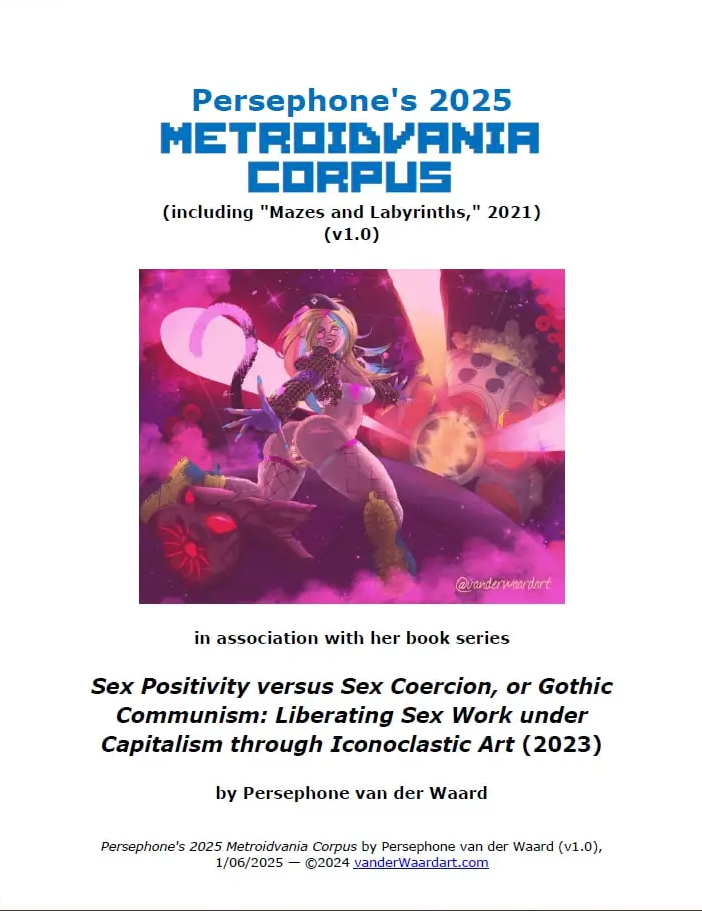
My 2025 Metroidvania Corpus is out (1/6/2025)! Ancillary to my work on Gothic poetics, I've just released Persephone's 2025 Metroidvania Corpus (webpage). Click here to download the PDF (v2.26)!

(artist: Maddie Minx [full uncensored covers on my 18+ promo page])
Volume Five is live (5/15/2026)! "We're in the pipe, five-by-five!" Click here to download the PDF (v1.05a)! It's a compilation of essays and videos I produced years ago; re: on their own compendiums that are already online, "My Older Body of Work (2014-2021)" and "YouTube Videos (Symposiums)." As for the volume, I released its introduction, "Interview with the Vampire" (2026), in advance. If you want to sample the module in smaller, bite-size pieces, consider its on-site promo series, "The Sphinx' Riddle" (2026).
Volume Four/the Practice Volume (essays and interviews) is out (4/23/2026)! Click here to download the PDF (v1.08a)! If you want to sample the module in smaller, bite-size pieces, consider its on-site promo series, "Pussy on the Chainwax" (2026).
Volume Three/the Praxis Volume is out (5/9/2025)! Click here to download the PDF (v1.3)! If you want to sample the module in smaller, bite-size pieces, consider its on-site promo series, "All the World," which divides most of the module into blog posts you can read one at a time.
Volume Two, part two (the Demon Module) is out (2/14/2025)! Click here to download the PDF (v1.4)! If you want to sample the module in smaller, bite-size pieces, consider its on-site promo series, "Deal with the Devil" (2024), which divides most of the module into blog posts you can read one at a time.
Volume Two, part two (the Undead Module) is out (9/6/2024)! I wrote an epilogue for the module along with its debut announcement. Give that a look; then, click here to download the PDF (v1.4)! If you want to sample the module in smaller, bite-size pieces, consider its on-site promo series, "Searching for Secrets" (2024), which divides most of the module into blog posts you can read one at a time.
Volume Two, part one (the Poetry Module) is out (5/1/2024)! I wrote a preface for the module along with its debut announcement. Give that a look; then, click here to download the PDF (v1.6)! The module discusses the dialectical-material process/application of Gothic poetics (making monsters as a critical-thinking process, in regards to the world around us as either for workers or for the state). If you want to sample the module in smaller, bite-size pieces, consider its on-site promo series, "Brace for Impact" (2024), which divides most of the module into blog posts you can read one at a time. The Poetry Module was inspired by my friend and muse, Harmony Corrupted! To say thank you, I wrote her a special dedication.
Volume One/my manifesto volume is out (2/14/2024)! Click here to download the PDF (v2.3)! Also, I recently gave Volume One its own book promotion, "Make It Real."
Volume Zero/my thesis volume is out (10/8/2023)! Click here to download the PDF (v2.3)! Also, I recently gave Volume Zero its own book promotion, "The Total Codex."
Promo Page Table of Contents
- Changelog
- Non-Profit and Funding (donations and commissions)
- Series Abstract
- Additional Promotional Material (posters and interviews)
- Book Series Table of Contents
- Volume Summaries/Download Links
- Paratextual Materials
- Volume Zero: Thesis
- Volume One: Manifesto and Instruction
- Volume Two: Monsters
- part one: the Poetry Module
- part two: the Undead
- part two: Demons
- Volume Three: Praxis
- part one
- Introduction
- Chapter One
- Chapter Two
- Chapter Three
- part two
- Chapter Four
- Chapter Five
- "Pussy on the Chainwax!"
- part one
- Volume Four: Practice and Preservation
- Foreplay: State Vampirism and Older Works
- Easing In: Essays
- Hard Dicking: Interviews
- Death and Aftercare: Martyrs, Anger and Dreams
- Volume Five: Reflection
- Foreplay (refrain): State Vampirism and Older Works
- Back to the Future (from the Past): Blogposts
- Full Circle: YouTube Videos
- But Wait, There's More: Taking Gothic Communism into the Future
- Gothic Communism: Logo Design (abridged)
- About the Author (abridged)
Changelog
Current updates:
- 5/15/2026 (v1.4/v1.0): Updated Volumes Zero through Four to match the paratexts in Volume Five. Removed Delilah Gallo's images. / (v1.4b): Volume Four and Five, v1.08a/v1.05a: Updated "State Vampirism" slightly (new collages feat. Scyllacibin, Blxxd Bunny, Ryder K, and Gorgeous George). Tweaked the volume summaries for Volume Five; updated Allie Reads' thank you. Also (for Volume Five), fixed some links with/paratextual information for "Interview with the Vampire" and "The Vampire's Reflection." Small addendums to Volume Five's volume summary and the openings for "Full Circle" and "But Wait, There's More" (whose listed contents will largely appear outside this volume; re: "The Vampire's Reflection."
I update the entire changelog whenever a new volume/volume edition goes live. Click here access the book's full changelog (v1.4b).
Non-Profit and Funding (donations and commissions)
Sex Positivity is non-profit/entirely funded through donations and commissions; i.e., I am unemployed, and any money I raise goes towards helping the people I work with. I take payment on PayPal, Patreon, and CashApp, etc; all links are available on my Linktr.ee.
You may also refer to any of the donation links attached to the individual model promotions; i.e., those found on the Sex Work page specifically or on the individual webpages built for my muses; e.g., Nyx' page and the various details it contains: an Aegis for where power is found, stored and expressed!

(artist: Nyx)
Concerning what these donations and commissions ultimately go towards, this entire project is the result. Sex Positivity seeks to raise awareness and engender activism towards and from all workers, but especially sex workers and the marginalized more broadly (many of whom turn towards sex work to survive); i.e., I do sex work, myself (see: "About the Author"), and the vast majority of sex workers I operate alongside are marginalized in some shape or form. To it, the overarching goal of my work is to humanize the dehumanized by reclaiming monstrous poetic tools of dehumanization; i.e., during informed mutual labor exchange, using the dialectical-material context (and social-sexual factors) of every exchange separately and together to vividly demonstrate protest: through artistic invigilation and expression, one whose holistic, intersectionally solidarized cooperation unfolds during a larger pedagogy of the oppressed (and its modular axes of privilege and oppression synthesizing praxis, mid-duality and -opposition). Those who walk away from Omelas, we seek to amplify and mobilize our cause using what we got—to unite and stand against the state, profit and capital's various traitors (cops, which pimps are, token or not) by reclaiming not just our bodies, sexualities and genders, but our labor and its holistic performative value: developing Gothic Communism through stochastic means and de facto education. The state from the beginning is a pimp, one that antagonizes nature as monstrous-feminine to put it (and those of it) cheaply to work; i.e., by pimping it genocidally through imbricating persecution networks guided by pre-emptive revenge labeling workers (and nature) as "terrorist," "black," "alien," "witch," and "other," etc; e.g., Amazons and the Medusa—with Athenian women tokenizing to attack themselves and the natural world they (and other workers) belong to. In turn, sex work is the oldest profession, hence the oldest form of labor exploitation through rape[1] (which is all that profit, hence wage and labor theft, is); the oldest form of worker revenge is the whore's against profit, which sex workers (and by extension all workers) attain through collective protest raising emotional/Gothic intelligence and class, culture and race awareness on all registers: reversing the terrorist/counterterrorist refrain (thus abjection process) through ludo-Gothic BDSM (see: footnote, above) cryptonymically playing with power as it is understood in society at large (re: Gothic poetics and the dialectic of the alien). We not only heal from rape as something to survive by playing with it; we seek systemic change and universal liberation by playfully putting "rape" in quotes, showing and hiding various things during the cryptonymy process, mid-paradox (refer to "Paratextual (Gothic) Documents" and "Audience, Art and Reading Order" for further summaries of these terms and arguments). To accomplish this, we must endure shameless tokenization, unchecked police brutality and widespread decay in the interim. Sex workers are offshoots of the Medusa, which the state has exploited since Antiquity into the present space and time; i.e., from Athens, Sparta and Rome into the First, Second and Third Reichs leading into Capitalism and Pax Americana as it currently exists. Labor has infinite value, and the elite only have what power we give them in that respect; i.e., monopolies are impossible, provided we fight back any way we can; re: by showcasing our humanity on the very fruit the elite want to harvest. On our Aegis, Medusa speaks through us, our peachy cakes and pies freezing capital Numinously in its tracks, breaking Capitalist Realism. "Stare and tremble," indeed!

(artist: Nyx)
If you wish to support the work that my friends and I do, please refer to the links above. Also check out some of the models promoted, below (the entirety involved can be accessed on the Acknowledgements page).
Series Abstract
My book, Sex Positivity versus Sex Coercion, or Gothic Communism: Liberating Sex Work under Capitalism through Iconoclastic Art, examines the various differences between sex positivity and sex coercion in sexualized media. Its "Gothic (gay-anarcho) Communism*" combines a wide variety of theories in order to critique capital and capital's sexualization of all workers: anarcho-Communism, Marxism and fourth wave intersectional feminism with the sharpness of Gothic academic theory, the immediacy of online political discourse, as well as postcolonial, posthuman and queer theory, ludology, sex education, antifascist (thus antiwar/anticapitalist) sentiment, poetry and a variety of ironic, xenophilic sex worker illustrations and negotiated labor exchanges' creative successes that illustrate mutual consent in Gothic BDSM language; i.e., what I call "ludo-Gothic BDSM" using various poetic devices to establish—among other things—rape play and the palliative Numinous during calculated risk to raise emotional/Gothic intelligence and class, culture and race awareness; e.g., Metroidvania and the monstrous-feminine having the whore's revenge against profit pimping nature (re: "Rape Reprise"). As such, Sex Positivity employs these theories (and their respective language/mode of expression) holistically and intersectionally to dialectically-materially examine and combat unironic xenophobic mental enslavement during the Internet Age: sex positivity (and universal liberation from profit and the state) versus sex coercion (and universal enslavement pursuant to profit).
*Re: "the deliberate, pointed critique of capital/Capitalism and the state using a unique marriage of Gothic/queer/game theory and semi-Marxist (an-Com) ideas synthesized by sex-positive workers during proletarian praxis: developing systemic catharsis, mid-liminal expression, with ludo-Gothic BDSM." Refer to "Paratextual Documents" for the full definition, as well as all of the core Gothic theories I use.
Specifically Sex Positivity tackles how neoliberal state-corporate proponents—i.e., official or stochastic cops, including TERFs (trans-exclusionary radical [fascist] feminists) and other standard-to-tokenized (crypto)fascists use canonical imagery created from coerced sex work to affect imagination as a socio-material process; i.e, using canon to generate complicated linguo-material arrangements that
- continuously exploit sexualized workers through widespread xenophobia under late-stage Capitalism; i.e., Capitalism sexualizes all workers to heteronormatively serve the profit motive, commonly through harmful Gothic poetics and BDSM theatrics.
- canonically exploit said arrangements to enshrine their abuse in abject, cryptonymic-hauntological crypts/chronotopes that "incarcerate," "lobotomize," "infantilize" and "incriminate" the public imagination; i.e., Mark Fischer's Capitalist Realism, or myopic inability to imagine a world beyond Capitalism even when Capitalism is in decay (whose maxim regarding Capitalist Realism reads: "It is easier to imagine the end of the world than the end of Capitalism"; source: Capitalist Realism, 2009).
- simultaneously pimp and condemn sex-positive artists who seek to liberate sexualized workers through their own iconoclastic, ironically xenophilic praxis; i.e., camping the canon to escape its brutal historical materialism through their own creative successes, achieving praxial catharsis regarding systemic abuse and generational trauma.
Sex Positivity illustrates, similar to how oscillation is a key component of the Gothic, that Gothic Communism is the oscillation between Capitalism and anarcho-Communism as dialectical-material forces felt in Gothic language by real people: oppositional praxis, or the practical application/synthesis of theory in dialectical-material opposition. To combat nation-states as the ultimate foe, Gothic Communism's chief aim is to be campier (thus sexier and funnier) than Marx; i.e., camping his ghost to develop a holistically intuitive anarcho-Communism begot through a widespread, collective and solidarized emotional and Gothic intelligence/awareness that recultivates the Superstructure and reclaims the Base through intersectional resistance and de facto (extracurricular) reeducation: the Wisdom of the Ancients, or cultural understanding of the imaginary past, endemic to this organizational process, and not one any particular group can monopolize (through violence, terror and monsters, etc).
Simply put, Gothic has that mood, that cool factor to do the trick; i.e., by subverting monstrous language, which normally dehumanizes workers and nature through popular stories furthering abjection (us versus them): to suitably humanize the harvest, which capital (and its Realism) can only pimp out when vengefully raping nature as monstrous-feminine whore. The whore's revenge against profit, then, is to fuck back on the same Aegis; i.e., when the Man comes around, show him your Aegis. When done correctly, its paradoxical, cryptonymic exposure will set you free (re: silence is genocide), but reversing abjection must happen together as one—per intersectional solidarity healing from rape through a shared pedagogy of the oppressed: walking away from Omelas and towards post-scarcity while becoming better stewards of nature than historically have ever existed (assimilation is poor stewardship)! Medusa demonstrates there is power in what they try to control; take it back by using it in ways they can't steal from you! Become the Gorgon!

(artist: Nyx)
Additional Promotional Material (posters and interviews)
Sex Positivity is a group effort and survives through collective labor action and advertisement. To it, the models below all agreed to take part in advertising Sex Positivity through promo posters; i.e., of a green-and-purple design that showcases their bodies (thus their work) and the project, simultaneously. Here is one of each model in the promo posters program (which doesn't contain all the models involved [as not all models agree to take part]. Models further divide into muses, non-muses and bad reviews; the entirety of them contain in my series and post-series acknowledgements pages):
[the posters are not shown here as they are NSFW; click here to see all of them on my NSFW website]
Poster models (from left to right, not shown here): Blxxd Bunny, Mercedes the Muse, Milking Marlo, Sinead, Mikki Storm, Roxie Rusalka, Mugiwara Art, Harmony Corrupted, and Ashley Yelhsa, Casper Clock, Ms. Reefer & Ayla, Romantic Rose, Nyx, Scoobsboobs, Ebbonny, Maybel & Jackie, Annabel Morningstar, Victoria Saix, Angel Witch, Crow, Tyler, Eldritch Babe, Cupid Kisses, Monster Lover, Bay, Rhyna Targaryen, Vera Dominus, Rae of Sunshine, Feyn Volans, Delilah Gallo, Kaycee Bee, Hallie Cross, Goddess Asterin, Puppy Bat, Gem McFlowers, Scylla Blair, Creepy Cryptid, Luna Rose, Yantastik, Rhxbynn and Valaroy, I-Nocturne, KJKay, Hannah Hussein, Vivian Strange, Goddess Brooklyn, Pupstar Darina, Alicia Axiom, Who Was Seren, Naughty Nar, Roelle the Rabbit, Iris Daydreams, Alliesha Bay & Nathan King Bunny, Cosmo Wanderlust, Julesss Next Door, Nerdy Nami, Frosted Teacup, Noir, Puppy Tyko (and Juicy Rabbit), Clown Sniffer, Jael, Gorgeous George, Pupbby Leo, Scyllacibi, Ryder K, Strawberry Skates, Maddie Minx, Allie Reads, Lilith Mae, Cuwu, Persephone van der Waard, and Cuspid.
I've also started a new Q&A series called "Hailing Hellions," which interviews models I've worked with. Click here to see the first entry, featuring Harmony Corrupted!
Further Reading by Persephone
Apart from her book series, Persephone does other research. Each section, below, gives a one-paragraph summary per area of research; each webpage contains a reading list with additional definitions, essays and books that Persephone has written on these different topics.
- Persephone's Metroidvania scholarship (available on its own page): A document that highlights Persephone's Metroidvania work in its entirety. Outlines the history of Metroidvania as researched by Persephone and other writers (e.g., Jeremy Parish), but also its historical exclusion by academics (e.g., Bernard Perron). Includes essays that connect Persephone's Metroidvania research to her book series.
- Persephone's BDSM Scholarship (available on its own page): Persephone coined ludo-Gothic BDSM while writing Sex Positivity (2023): the "combining of an older academic term, Laurie Taylor's 'ludic-Gothic' (Gothic videogames), with sex-positive BDSM theatrics as a potent means of camp" to challenge profit (re: the whore's revenge, "Rape Reprise"). Specifically, she introduced the concept in her first published volume, Volume Zero (her PhD, for all intents and purposes). At its simplest, ludo-Gothic BDSM combines Gothic poetics with ludology (the study of games) and BDSM power exchange; i.e., effectively using videogames as an apt comparison/metaphor while, at the same time, using the same ideas in daily life to develop Gothic Communism (re: Jesper Juul's "half-real" and Eric Zimmerman's "magic circle" taken to their logical conclusions).
- Persephone's Amazon Scholarship (available on its own page): While Persephone was introduced academically to the monstrous-feminine through Barbara Creed's 1993 book, she's consumed them all her life. Amazons/the Medusa are Persephone’s favorite monster type/style; i.e., as a kink (re: mommy dommes) and as a poetic vector to conceptualize arguments. They appear all over her book series—both through hundreds of separate, individual mentions and exhibits per book volume, but also as the dedicated subjects of numerous essays and book (sub)chapters; i.e., they embody her core arguments, ranging from her PhD thesis argument (re: "Capitalism sexualizes everything") to the whore’s revenge against profit versus nature as monstrous-feminine (re: "Rape Reprise"). To it, Amazons/the Medusa are both her academic and trans raison d’être; i.e., apart from her writing on them, her alter ego is an Amazon, as are various characters she has created in her original/fan art (with her website originally being dedicated to Amazons and femboys).
- Persephone's Tolkien Scholarship (available on its own page): While Tolkien isn't someone Persephone has written as much about, there's enough scholarship to merit its own section, and Tolkien still embodies an important aspect to Persephone's PhD; i.e., the High Fantasy treasure map and its vital role in gentrifying war (thus genocide) through neoliberal media, doing so through a cartographic refrain (re: "Canonical Essentialism"). Tolkien's refrain ties into Cameron's refrain (the shooter/Metroidvania), their combined racism (and other ethnocentric values) haunting American media from 1937 onwards (re: The Hobbit into LotR and Aliens, onwards).
- Persephone's Anti-Fascist Research (available on its own page): Namely her work on cryptofascist Karl Jobst and different Nazi apologia present within the gaming community (e.g., racism, transphobia, sexism, etc). Covers other fascists, as well.
- Persephone's Anti-Zionist Research (available on its own page): Various essays by Persephone on Zionism and challenging it, as well as racism/white supremacy.
- Persephone's Research on State Vampirism (available on its own page): Newer essays by Persephone (as of 2026) tied to state feeding mechanisms—mainly profit and productivity under capital/Marxist-Leninism; i.e., that prey on nature, mid-abjection, and which Gothic (gay-anarcho) Communism reverses.
Book Series Table of Contents
Sex Positivity is composed of four volumes: Volume Zero, One, Two and Three (arranged numerically as "volume [1, 2, 3, 4, 5 or 6] of 6, from 0 to 5" on their text-only title pages). Each has a proper title and ordinary noun(s) with which it is referred to; e.g., Volume One is also called "the manifesto," and Volume Two is also referred to as "the Humanities primer," etc.
Each volume only contains its table of contents and comes with a variety of paratextual materials.
Update, 8/21/2025: Added a Further Reading section, one that catalogs the entirety of Persephone's research this book series connects to (re: her work is holistic); and another section: "Other Books by Persephone." Changes following that (until further notice) are usually to the download links in the volume summaries section of the document.
Click here to access the PDF containing Sex Positivity's entire table of contents (v1.5a2).
approximate total book length (subject to change): ~2,926,900 words words/8249 pages and ~6,865 unique images
Volume Summaries/Download Links
Below are summaries for each volume of the book (download links will be provided as the volumes come out). Also included are the bookend sleeves for each volume (which features my partner, Bay, for the thesis volume; and various other models for Volumes One, Two and Three).
The paratextual materials concern the entire book, and come with each volume. The front of every volume will have: its front and rear cover images, its first disclaimer (legal information, citation facts, and trigger warnings, etc), the abstract, the inner cover image for the entire book, the text-only title page for the current volume, the volume/chapter summaries; an essay about "making Marx gay" and a small explanation on one of this book's oldest and chief aims, illustrating mutual consent; the second disclaimer (what I will and won't exhibit), an address to the audience, essential keywords, and (for Volumes One, Two and Three) a heads-up section with various reminders from Volume Zero, including reading comprehension pointers; and, of course, the table of contents per volume. For additional information, refer to " Frontload: Series Paratexts," below.
Click here to access the project's most vital Gothic paratextual documents; e.g., its main Gothic keywords, but also theories and central tenets, which aren’t contained in the full glossary. Click here to access the non-Gothic paratextual key terms, as well as information about the series’ intended audience and reading order.
approximate[1] length (not including the newer stuff from Volume Four): ~57,000-60,500 words/~204-220 pages[2] and ~17 unique images (including the front and rear covers)/~95-104 total images
[1] The length of the paratextual documents vary slightly per volume. All approximations are subject to change as the volumes are finalized.
[2] ~75-95 pages for the front of the volume, and ~128 for the rear.
"Frontload: Series Paratexts" is a section before every volume table of contents—one that contains a variety of paratexts. It reads as follows:
The table of contents for [each] volume doesn't appear until deeper in. [Click here] to skip ahead to the second (and main) table of contents, for the volume. / This initial table of contents, like the title says, holds a variety of series paratexts; i.e., that either appear in all the volumes
-
- "Series Abstract"
- "Volume Summaries"
- "Further Reading: Book Promotions/Model Interviews"
- "No AI Allowed; or, A Team Effort without Theft"
- "Making Marx Gay"
- "Illustrating Mutual Consent"
- "Defining Sexualized Media/Sex Work, and Regarding Hard Kinks: What I Will and Won't Exhibit"
- "A Note on Canonical Essentialism"
- "The Six Gothic-Marxist Tenets and Four Main Gothic Theories"
- "The State: Its Key Tools; re: the Monopolies, Trifectas and Qualities of Capital"
- "About the Logo (for Gothic [gay-anarcho] Communism)"
- "Concerning My Audience, My Art, Reading Order and the Glossary"
or repeatedly in some (usually newer stuff for newer volumes that older volumes don't have):
-
- "A 2025 Foreword: On Volume Zero's/One's New Edition Focusing on Ludo-Gothic BDSM"
- "Two Essential Halves: Dividing Volume Two in Two"
- "An Emphasis on Vampires (Dragons or Otherwise), Anti-Predation, and Weaponizing Rape Trauma"
- "Front to Back: Future Reflections on Old Things; or, Remembering that Little Dragon from My Past"
- "Of Wyrms, Witches and Wallflowers; or, Before/After I Hatched (and What to Do with It): Concerning Late-Bloomers (an Ode to Eggs)"
- "Abridged Manifesto Tree (of Oppositional Praxis)"
- "On Small Images"
- "Written Backwards: A Ship of Theseus, a Gothic Castle"
- "Into the Void: Losing the Training Wheels"
- "Heads-Up (a brief refresher)"
- "Concerning Monsters"
- "We Are Legion: So Many Monsters, So Little Time"
- "Regarding Tokenism and Fighting It (the opening to Volume Three)"
- "Turning Over a New Leaf: Into 2026 and Beyond; or, Introducing a New Volume"
- "Essay Paratexts: State Vampirism and the Whore's Revenge"
- "Fresh and Familiar Faces, Working in Secret to Burn Rome to the Ground (when reviving Medusa)"
- "Repeating Myself: On Formatting Hiccups"
- "The Price of Rice in China; or Capital in a Bird Cage (on Chinese Socialism)"
- "Buried Treasure; or, 'Sacking Rome' from Inside the House: Reviews of Several Models"
Click on them (or use Adobe's Bookmark system) to navigate the volume more easily.
—Persephone
P.S., Some of these paratexts have their own webpages; re: every volume contains "Paratextual (Gothic) Documents" and "Audience, Art, and Reading Order" (as well as the full series acknowledgements, glossary and disclaimer). Much of the unique paratextual materials for Volumes One, Two and Three—and for Volume Four—are contained in their own paratext compendiums: "Appetizers" and "Leftover Rice," respectively. The paratexts for Volume Five now have their own page, "Midnight Snack." —Perse, 5/13/2026
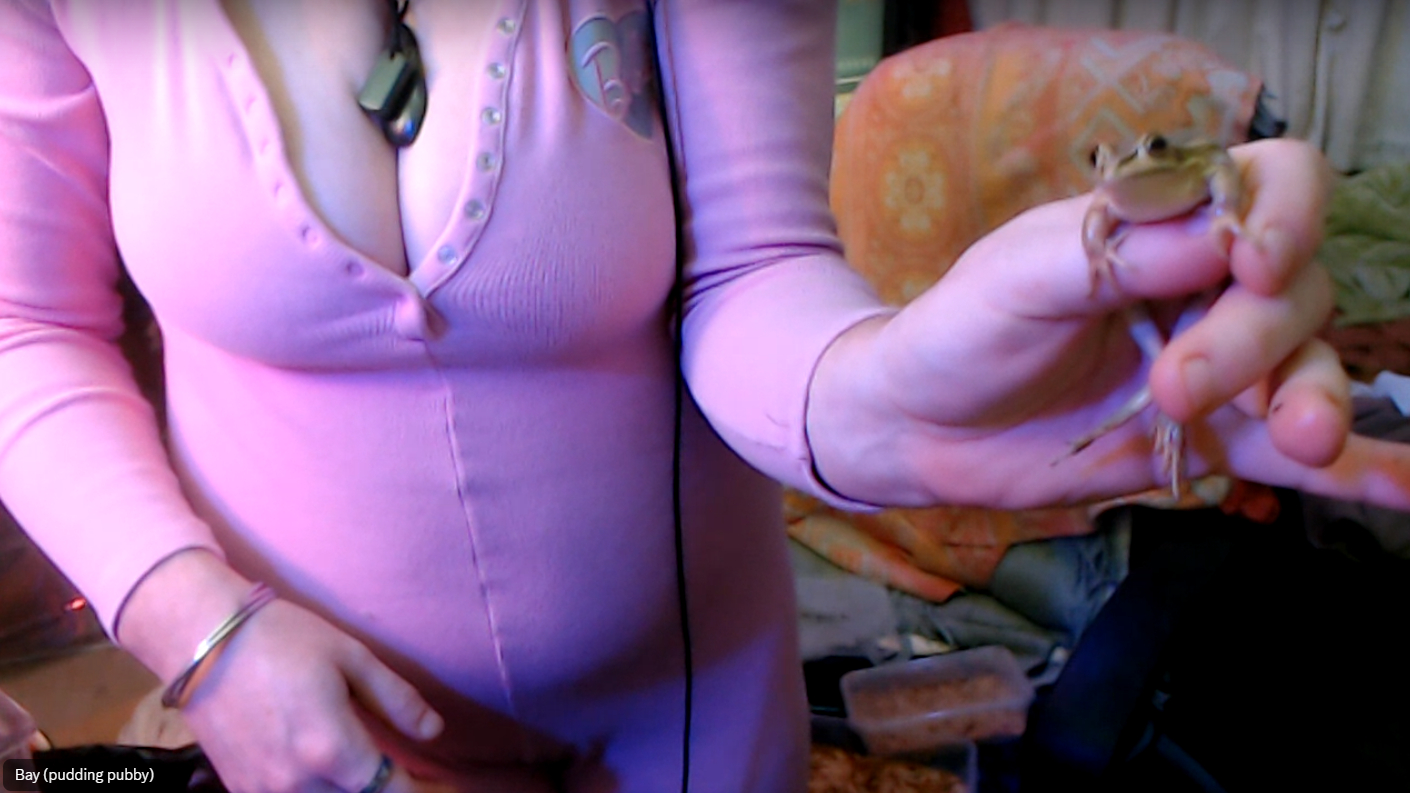
Cover model: Bay Ryan
Volume Zero: Thesis. The thesis volume (download link, v2.3) contains the complex theory of my book series; i.e., its various lists of interconnected theoretical devices, as well as the entirety of specialized keywords, all of which I unpack and explain in order. To that, it contains my author's foreword, a small essay on the performance and paradox of power ("Notes on Power"), as well as my book's manifesto tree (scaffold of oppositional praxis), thesis argument[1] on Gothic (gay-anarcho) Communism, "camp map" and symposium; it uses them to encompass, then articulate, the entirety of my book's theoretical content, using a variety of cited material and keywords (e.g., the Gothic, monstrous-feminine, and Amazonomachia) to delve into its broadest/most common arguments as deeply as possible. Written based on years of independent research—as well as older blogposts, essays, and my master's thesis—Volume Zero essentially operates as my PhD on Metroidvania and ludo-Gothic BDSM but also my total curriculum, which can be simplified as needed when being taught to others in more anecdotal, everyday forms.
approximate volume length (minus the paratextual documents): ~226,000 words/651 pages and ~474 unique images
[1] (a summary of the thesis paragraph from the thesis volume): "Capitalism dimorphically sexualizes everything under a heteronormative, settler-colonial scheme, one whose Cartesian myopia of Capitalist Realism must be escaped from; i.e., via a deliberate iconoclasm that liberates sex workers (or sexualized workers) under Capitalism through sex-positive art."
Click here to access the blog-style book promotion for Volume Zero, "The Total Codex."
The thesis argument is divided up into my thesis statement, "camp map" and thesis conclusion/symposium:
-
- The thesis statement: Contains my manifesto tree, Four Gs (four main Gothic theories), another small essay about where power is performed during the Gothic mode/inside the Gothic imagination ("Doubles, Dark Forces, and Paradox"), and my thesis paragraph, which the thesis body expands on using most of this book's keywords and manifesto terms.
- The "camp map": Assembles the manifesto pieces and explains (using the Four Gs) how to camp the canon of war as heteronormative by "making it gay" with ludo-Gothic BDSM; i.e., normally canonized through the quest for power in a Faustian bargain (told in the warlike language we're all accustomed to), which we then camp during our own Promethean Quests ("Oh, no! I'm totally being conquered right now!"). Told in four parts. Part one, explores camp as a counterterrorist activity in relation to state terrorism, and outlines various monster types featured in the exercises (e.g., femboys, catgirls, himbos, Amazons, etc); parts two explores the interrogation of power in relation to Gothic space (castles) but especially in videogames (shooters, high fantasy and Metroidvania); part three considers the making of monsters and goes over more monster types; part four puts all of these ideas to the test, executed by my friend Blxxd Bunny and I prototyping ludo-Gothic BDSM.
- The conclusion: Wraps everything up and segues into the symposium, which is a conversational follow-up/aftercare "sesh" dedicated to points I wanted to expand on but couldn't in the thesis proper due to word count/flow.

Cover model: Blxxd Bunny
Volume One: Manifesto and Instruction. The manifesto volume (download link, v2.3) contains the simplified theory of my book series; i.e., its Gothic-Communist manifesto outlines a teaching method for synthesizing praxis, meaning through an introduction to Gothic-Communist theory from my thesis volume that has been simplified.
Written before my thesis but updated in light of its construction, the manifesto takes a more conversational approach to my thesis argument; i.e., presenting said argument through my original preface, manifesto, sample essay and synthesis roadmap as a potent means of teaching others how to develop Communism through the Gothic mode. To this, Volume One merely begins exploring the application of my theories when trying to achieve development through praxial synthesis and catharsis; i.e., power and trauma as things to interrogate (and negotiate/play with) by writing about and illustrating them through Gothic poetics in the shared dialogs of contested spaces: ludo-Gothic BDSM serving as a flexible, campy and productive means of teaching empathy and class/culture consciousness through anecdotal evidence merged with dialectical-material scrutiny and analysis—where survival and healing from state abuse (and generational trauma) must be expressed through what we create ourselves as stemming from said abuse and its complicated spheres. While the reduction of pure theory to more comprehensible forms remains vital to achieving emotional/Gothic intelligence and class/cultural awareness, their instruction is nonetheless informed by workers living with trauma who inherently distrust the state: the oppressed. Heeding their pedagogy remains essential when synthesizing praxis in our own daily lives; i.e., through our personalized learned approaches to Gothic instruction being assisted by those with less privilege merging their poetics (and theatre) with ours.
approximate volume length ("): ~206,000 words/564 pages and ~394 unique images
Click here to access the blog-style book promotion for Volume One, "Make It Real."
Said volume contains my original preface, manifesto, synthesis roadmap and sample essay:
-
- The preface explains how Gothic (gay-anarcho) Communism differs from older Gothic and Marxist academia/praxis that I wish to modify and borrow from (Marxist-Leninism, postmodernism, psychoanalysis) in order to proceed beyond the myopia of Capitalist Realism using a unique synthesis of Gothic theories, Marxist concepts, and various other factors presented with commonplace language as freighted, liminal and already-colonized, but also potentially freeing when used by workers to open up their minds in dated, pulpy ways: the proletarian Gothic imagination.
- "Manifesto" simplifies the complex theory of our thesis volume by providing our manifesto in full; the manifesto gives our mission statement, as well as a variety of signposts and core ideas I've coined/retooled from older thinkers: the six Gothic-Marxist tenets of Gothic Communism (the Six Rs), four main Gothic academic theories (the Four Gs); its essays/essay groups ("The Nation-State," "An Uphill Battle," and "Monster Modes") also explore the topics of the Gothic mode we'll continue to cover through the rest of the book—its monsters, lairs/parallel space, Hermeneutic Gothic-Communist Quadfecta, and phobias—as well as the Six Doubles of Creative/Oppositional Praxis and their synthetic oppositional groupings through which to synthesize, thus interrogate state abuses using trauma writing and artwork.
- "Instruction" focuses on instructing theory once simplified by using trauma writing and artwork as a synthetic, educational means of Gothic poetic expression. The manifesto postscript tackles generational trauma and police abuse by seeing it in others through their pedagogy of the oppressed; the sample essay uses every key idea in my book to analyze a primary text at full speed; "Paid Labor" stresses the value of paying workers when synthesizing praxis; and the synthesis symposium covers how to use the synthetic oppositional groupings to synthesize our general terms and academic ideas, processing them (and our trauma) into idiosyncratic, emotionally and Gothically intelligent social-sexual habits within our own lives; it covers more at length what we illustrated during the camp map finale in Volume Zero, focusing on Cartesian trauma and how its profit motive unironically treats nature as food: (rape and war that harvest nature through monstrous-feminine dialogs).
(placeholder)
Volume Two: Monsters. The Humanities primer/monster volume divides into three modules, the Poetry Module (download link, v1.6), Undead Module (download link, v1.4) and Demon Module (download link, v1.4). They comprise a history of applied Gothic theory and poetics (simple and complex). Organizationally the volume divides in two larger parts, with three separate modules; re: the Poetry Module in part one, which explores the usage/application of Gothic poetics (with some historical elements); and Undead and Demon Modules in part two, which explore the history of Gothic poetics (with some applicative elements; re: ludo-Gothic BDSM). Due to their length, each module has actually been released as its own sub-volume; each has its own promo series, where you can read a given module, piece-by-piece, as individual blogposts; re: "Brace for Impact" (the Poetry Module), "Searching for Secrets" (the Undead Module), and "Deal with the Devil" (the Demon Module).
Furthermore, the sub-volumes collectively explore the complex-to-simple usage/application and history of Gothic poetics during oppositional praxis; i.e., its (un)ironic manifestation as xenophobic and/or xenophilic: creatively interpreting (and negotiating with) the Gothic past/Wisdom of the Ancients to better understand our own alien, fetishized world and the exploitation we face within it as dehumanized workers. We will demonstrate how to think like a Gothic poet/Renaissance person (through applied monstrous poetics), then examine two basic monster classes—the undead and demonic—and include anthropomorphic examples from the natural world as further hybridizing these already intersecting modules (furries, chimeras, composites); e.g., zombie-vampire werewolves, or undead fox demons, etc. We'll also reconsider Mark Fischer's notion of Capitalist Realism; i.e., inspecting how it fosters a plethora of cyberpunk and other dystopic/operatic "canceled futures," whose canonical, myopic hauntologies and cryptonomy must be challenged with iconoclastic monsters operating as a counterterror device: to help people radically imagine, and empathize with, a world beyond Capitalism (and state terror). Instead of simply viewing the current world as ending and labor to blame for it, we can learn why the state is ultimately to blame for a) its own decay and b) its scapegoating of said decay onto dehumanized monstrous-feminine workers of decreasing privilege/socio-material advantage. In turn we can portray the Medusa (nature-as-alien) as something to hug, fuck and love, not rape, kill or otherwise harm for profit vis-à-vis Cartesian thought.

Cover model: Harmony Corrupted
Poetry Module (download link, v1.6): Whereas the Monster Modules focus on the history of Gothic poetics—i.e., as something to learn from when poetically articulating our own pedagogy of the oppressed—the Poetry Module focuses on Gothic poetics as a historical-material process whose history we contribute towards . Its emphasis lies in teaching with Gothic poetic devices by applying them, the module explaining said devices while going over them, one-by-one; i.e., in a series of poetry-themed sections: "Time," "Teaching," "Medicine," and "the Medieval." Last but not least, the module includes a sizeable extension that goes over different ways to play with the imaginary past; i.e., per ludo-Gothic BDSM and rape play.
approximate length ("), part one (the Poetry Module): ~300,000 words/~795 pages, ~625 unique images
Click here to access the blog-style book promotion for the Poetry Module, "Brace for Impact."

Cover model: Harmony Corrupted
Undead Module (download link, v1.4): This module explores the poetic history of the undead; i.e., as creatures driven less by active intelligence and more by a desire to freeze and feed in the buried presence of trauma and harmful conditions. It explores how the state’s monopolies lead to a state of exception within its sites of settler-colonial violence, which in turn create a violent upheaval/silent scream among the oppressed and oppressors alike as the state takes from workers and nature; i.e., the voice of colonial trauma and the vengeful, desperate feeding on the living by the undead as the genocided dead, having come home to roost—zombies. However, the alienation and feeding also affect the ruler class, leading to vampirism as a canonical effect that must be personified in healthier forms of medieval nostalgia that, for their using logical motions, become ghost-like, copied and imperfect. Reclaiming these modules requires embodying and subverting the very traumas the state relies on to control us by keeping us hungry and braindead (a process I call “lobotomization”)—to, as the undead generally do, paralyze our prey and feed on their frozen bodies, albeit in ways that pointedly develop Gothic Communism: by taking back what's ours during ludo-Gothic BDSM (demons, by comparison, tend to give; e.g., dark desires, fatal knowledge or revenge fulfillment).
approximate length ("), part two (the Undead Module): ~430,580 words/~1,055 pages and ~832 unique images
Click here to access the blog-style book promotion for the Undead Module, "Searching for Secrets."

Cover model: Romantic Rose
Demon Module (download link, v1.4): This module explores the poetic history of demons (made/summoned/of nature); i.e., as actively cunning-yet-alien shapeshifters. Canonized as treacherous within transactional dialogs of forbidden, unequal exchange (of power, knowledge and darkness) and permanent transformation, demons frequently yield a repressed desire for radical change haunted by systemic abuse; i.e., of rape and revenge as things to canonize or camp through the Gothic mode: as untrustworthy beings made deceitful and torturous through the ghost of the counterfeit's process of abjection's Promethean Quest or Faustian bargain. As such, we'll consider the subversive, cryptonymic potential of demons; i.e., to reverse abjection through revolutionary cryptonymy's double operation (to conceal and reveal taboo subjects), all while dealing with state doubles (re: DARVO and obscurantism, including tokenized variants). Be those people, places or something in between (the chronotope and its castle narrative/mise-en-abyme), we'll do so through their classical function—as seductive, mendacious granters of dark wishes, including fulfilling the whore's revenge: of nature policed, thus pimped, as monstrous-feminine by the state for profit, which the demon (as a vengeful, monstrous-feminine whore) challenges said motive (and its raping of nature) in favor of something better.
To it, we'll explore the dark, hauntological creativity and endless morphological variety of demons, but especially how they manifest and behave; i.e., as a vengeful, nebulous, psychosexual matter of exchange, transformation and desire, onstage and off, during ludo-Gothic BDSM and liminal, half-real expression: composite bodies like cyborgs, golems and robots that are built with mad science (the Promethean Quest), occult beings that are summoned and dealt with (the Faustian Bargain), or overtly natural totems that are hunted down within nature-as-alien.
approximate length ("): ~534,396 words/~1,245 pages and ~1,169 unique images
Click here to access the blog-style book promotion for the Demon Module, "Deal with the Devil."

Cover model (for all Volume Three images): Harmony Corrupted
Volume Three: Praxis, parts one and two (download v1.3) combine Volume Zero's complex theory, Volume One's simplified theory/synthetic model, and Volume Two's monster history and application; i.e., as something to challenge the state by fostering our own creative successes of proletarian praxis, and whose mutual consent, informed consumption and informed consent, sex-positive de facto education, descriptive sexuality and cultural appreciation boil down to sex positivity (and liberation) versus sex coercion while developing Gothic Communism (with a huge focus on resisting tokenization; e.g., TERFs).
In other words, Volume Three covers the informed, intersectionally continuous application of successful proletarian praxis as we reinterpret the Gothic past pushing for universal liberation. Striking a careful, intuitive balance between pure theory and taught instruction, its introduction/summation takes Volume Zero's theoretical backbone, Volume One's simplified teaching approach and Volume Two's past lessons, then outlines the dialectical-material objectives through which to apply our central Gothic theories—i.e., in a dialectical-material way using updated, posthumanist models (expanded beyond Cartesian thought) in order to achieve Gothic Communism one step at a time. This includes the creative successes of proletarian praxis, which the volume explores in relation to state forces who resist their transformative power to keep things the same; i.e., the state vs workers, generally by pitting the latter against each other. A huge part of proletarian praxis, then, involves a gradual development of emotional/Gothic intelligence and class/cultural awareness during our updated teaching approach and labor negotiations when expressed during ludo-Gothic BDSM; i.e., to counterattack state forces in service to our larger goals—our six Gothic-Marxist tenets—thwarting Capitalist Realism.
approximate volume length ("): ~282,000 words/837 pages and ~586 unique
Click here to access the blog-style book promotion for Volume Three, "All the World."
The Praxis Volume divides in two halves:
Volume Three, part one lays out sex positivity and sex coercion—but also the liminal areas between them—in a two-part introduction, followed by three chapters:
-
- Chapter One focuses on sex positivity and the "creative successes" of proletarian praxis—how Gothic Communism, when correctly performed, cultivates empathy under Capitalism through mutual consent, informed consumption, de facto education and descriptive sexuality as things to materially imagine (often through ironic parody and "perspective" pastiche) through Gothic poetics.
-
- Chapter Two explores their dialectical foil, sex coercion, whereupon Capitalism "zombifies" consumers into "lobotomizing" themselves and others, resulting in abject, fetishizing witch-hunts, toxic love and criminal sexuality as historical-material outcomes; i.e., that seek to control sex and thoughts/cultural attitudes about sex, including the sexist, obfuscating ambivalence of Gothic canon's coercive BDSM, fetishes and kink.
-
- Chapter Three enters the "grey area" of cultural appreciation, examining: the culturally appreciative, sexually descriptive irony of Gothic counterculture's reverse abjection with sex-positive BDSM, kink and fetishization; as well as asexuality, queer-/homonormative gatekeeping and the ambiguities of trans, non-binary, intersex, and drag existence, but also their assorted discriminations begot from weird canonical nerds and the canonical media that turns them into harmful bigots.
Volume Three, part two concerns sex positivity versus sex coercion. It contains Chapters Four and Five plus the Conclusion, which concerns the creative successes of proletarian praxis versus state praxis. Time to fight!
-
- Chapter Four explores sexism and other bigotries within a gradient of canonical moderacy and reactionary politics in popular, sexualized media—TERF hauntologies, sublimated war pastiche, girl/war bosses, and queer tokenism at large.
-
-
- Chapter Five seeks to provide lasting solutions based on emotionally/Gothically intelligent activists who can detect, recognize and separate all of the above when creating their own cryptonymic material, all while enacting Gothic Communism, outing state proponents, and living in a brave new world of sexy "awakened" monsters: the liminally subversive/transgressive zombies, ghosts, vampires, witches, Amazons, etc.
- "Pussy on the Chainwax!" and "Kicks After Six" close out the book, giving the reader two basic choices: a) to serve the state and Capitalist Realism, bringing about the actual end of the world, or b) to face the perceived "end of the world" in order to stop of the Promethean cycle (and ultimate desolate conclusion) of Capitalism.
-

Cover model: Maddie Minx
Volume Four, or the Practice Volume (Practice and Preservation; download v1.08a), combines Volume Zero's complex theory, Volume One's simplified theory/synthetic model, Volume Two's monster history and application and Volume's Three's praxial outline; i.e., as something to achieve ourselves, making Marx gay (and hot) through the work we do every day.
In other words, if Volume Three covers the informed, intersectionally continuous application of successful proletarian praxis—meaning as we reinterpret the Gothic past pushing for universal liberation—then Volume Four puts that to practice, preserving our work (and public nudism) in practice. It does so through a variety of essays and interviews concerned with current events and workers on the ground + informed material exchanges illustrating mutual consent, but also research compendiums that "dial in" my research focus through practice; re: state vampirism, where cryptonymy and abjection work hand-in-hand for workers or the state, in praxial/dialectical-material opposition. Its chief aim is to archive and invigilate GNC and/or sex workers' collective efforts versus fascism and other state powers: to demonstrate a systemic devaluing of unpaid labor as a whole during state vampirism; i.e., prostituted by bad actors, whose predation on unpaid labor (and the latter's reversing abjection) the essays and interviews document and discuss (re: the whore's revenge, prostitution being the oldest profession and labor struggle tied to Medusa, one of the oldest monsters; see: "Rape Reprise," 2024). In cis binary terms, men (or warriors) are classically expendable, and women and women's work indispensable ("too important"). The non-binary reality is that class war is ass war—a holistic, dualistic, intersectional exchange demonstrating several adages of Sun Szu: that all war predicates on deception, and any army regardless of size must be well-fed (food being a form of payment but also fuel to motivation action with). Female or not, any monstrous-feminine is both the unglamorous side of revolution, and the undervalued-yet-essential—the creator and the destroyer as one-in-the-same, meaning the virgin and the whore/the angel of death and mercy in ways that show rebellion, seemingly shallow, as paradoxically quotidian/adventuresome; i.e., merely "doing the dishes" and, all the same, capable of slaying and becoming dragons (alter-egos) on a stage shared by our enemies (the state and its servants): the same half-real bodies and language, exploitation and liberation divided mise-en-abyme by dialectical-material context/the flow of power up or down, cryptonymy-and-abjection. The idea is to seek honesty in ways that expose our enemies hypocrisy—to not just "put the pussy on the chainwax" when camping the canon (re: "Shining a Light on Things," 2023), but to out our would-be colonizers as suitably full of shit (e.g., Key & Peele's "If Civil War Reenactments Were Honest," 2020).
To conclude, these essays and interviews synthesize praxis, making them a full-fledged demonstration of Gothic Communism's potential; i.e., while referencing and preserving everything else I've ever written, cataloging struggle: showing sex workers as human while humanizing them in reclaimed language (reversing abjection). Practice preserves praxis for future generations to study and learn from.
approximate volume length ("): ~529,000 words/1,706 pages[1] and ~1,558 unique images[2] (under construction, many images borrowed from older workers)
[1] Minus the original paratext material, not including new paratexts for Volume Four, specifically.
[2] With various repeating images for the essays and interviews (which self-reference).
Click here to access the blog-style book promotion for Volume Four, "Pussy on the Chainwax."
Volume Four divides in four main parts:
- Part one, "Foreplay," is the prior groundwork the essays cite and build on (re: "State Vampirism," but also "YouTube Videos (Symposiums)" and "Older Writing").
- Part two, "Easing In," will be the essays, themselves.
- Part three is the interviews.
- Part four closes things out—both by looking at real-life martyrs and giving the original series conclusion (that doesn't appear in Volume Three), before putting a bow on things with the rear bookend.
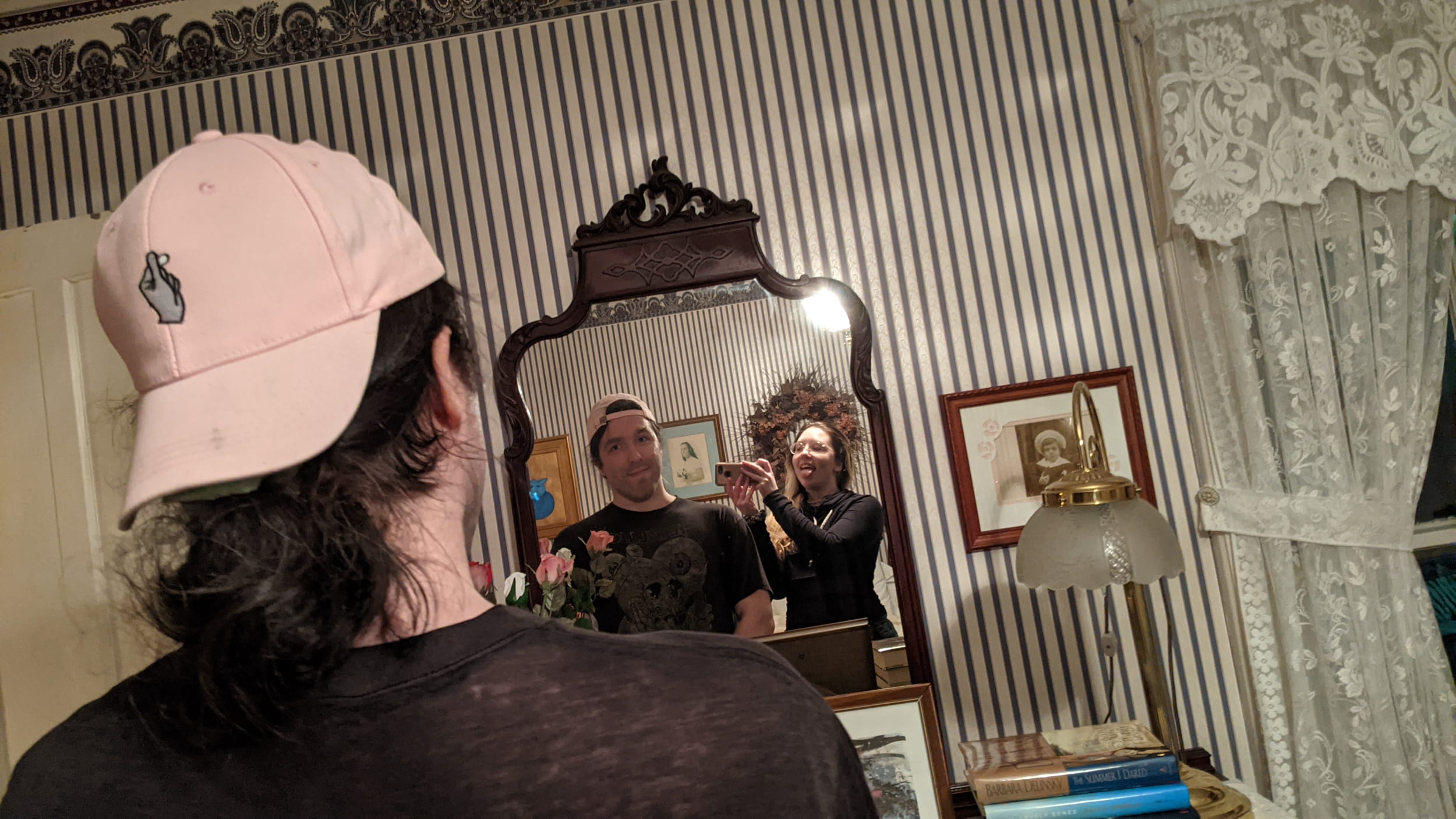
Cover models: Cuwu and Persephone van der Waard
Volume Five, or the Mirror Volume (download v1.05a): Considers reflections on my past work having lead up to my book series and its system of thought, Gothic Communism; i.e., said reflections, or holistic study returning to old things, happen after said series was written.
In other words, whereas Volume Three covers the informed, intersectionally continuous application of successful proletarian praxis (meaning as we reinterpret the Gothic past pushing for universal liberation) and Volume Four puts that to practice—preserving our work (and public nudism) in practice—then Volume Five is me reflecting on all that came before and how it helped shape what resulted (especially an emphasis on vampires*, dragons or otherwise). This includes Cuwu, the model and old flame sharing the outer covers with me (and something of a "little dragon" I've written extensively about in said series already, from Volumes Zero to Four); it dates back to 2014 when I was only just beginning to exit my shell, and which happened primarily by meeting cuties who radicalized my life heading into Gothic Communism (an ode to eggs).
To that, the notion of praxial synthesis through workers' social and love lives are a huge part of what Volume Five offers; i.e., from a reflective state, its paradoxical perspectives dwelling on the past (and its occupants brought poetically back to life in ghostly forms) to consider the vampiric (or otherwise monstrous-feminine) potency useful to us: when reversing state predation while furthering Gothic Communism vampirically among ourselves, love-is-a-battlefield. Dragons all the way down, babes!
*And rape prevention; for further information about that, go to the volume's book promotion.
First, the Mirror Volume divides in three; i.e., blogposts, YouTube videos, and future material (with some additional paratexts before/after these):
-
- Foreplay (refrain): State Vampirism and Older Works: Different paratextual bits from Volume Four, recycled in Five—namely the new introductions to "YouTube Videos (Symposiums)" and "Older Writing (2014-2021, refrain)."
- Back to the Future (from the Past): Blogposts; re: The blog posts, ranging from 2015 (where my blog begins) until July 2022 (when I started Sex Positivity in earnest).
- Full Circle: YouTube Videos; re: The YouTube videos, from 2014 to 2026 (with new summaries/reactions in "This Series (as It Unfolds)" of "Interview with the Vampire").
- But Wait, There's More: Taking Gothic Communism into the Future: Any interviews/essays after Volume Five (to be added after the initial release, not including "Interview with the Vampire"; re: "The Vampire's Reflection").
Note: This post only has the volume summary (and the synopsis to state vampirism and disclaimers, at the bottom of this page). Go to my website/the book promotion to see the rest of it (as everything else is very NSFW).
approximate volume length ("): ~430,500 words/~1218 pages[1] and ~1315 unique images
[1] Minus the original paratext material, not including new paratexts for Volume Five, specifically.
Click here to access the blog-style book promotion for Volume Five, "The Sphinx' Riddle."
Gothic Communism Logo Design (abridged)
Here is a history of the logo design for Gothic (gay-anarcho) Communism:
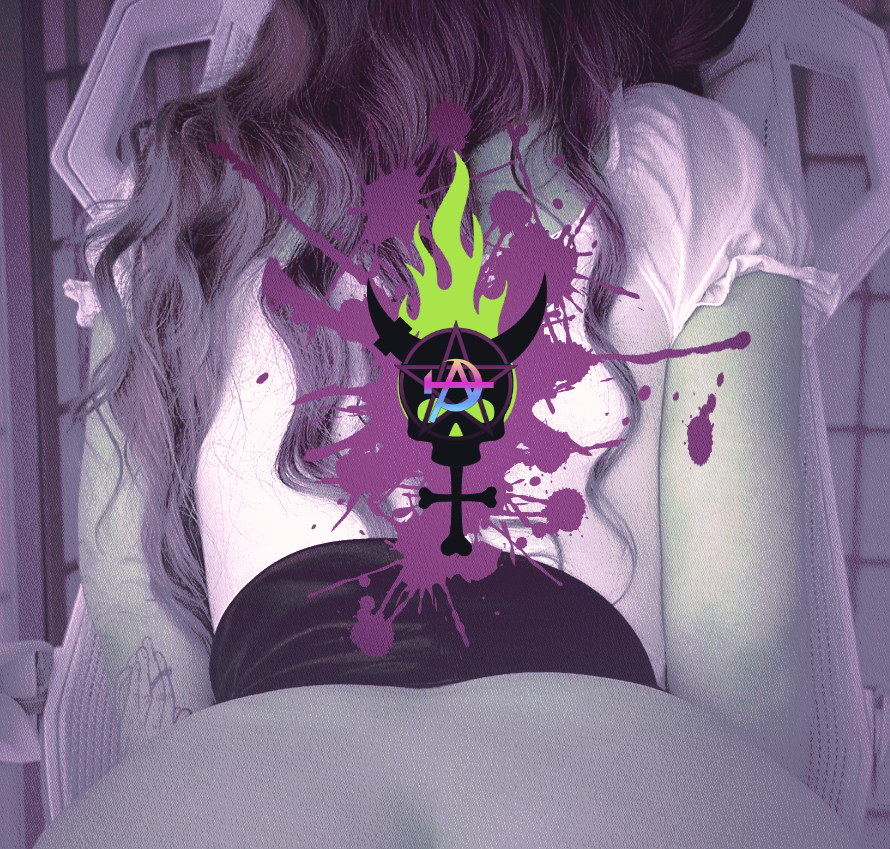
With the release date to my upcoming book, Sex Positivity vs Sex Coercion, or Gothic Communism, drawing near, I decided that I should finally design my own logo for Gothic (gay-Anarcho) Communism. Here is a brief history of its recent inception and cannibalized source materials (from my blogpost "My Logo for Gothic (gay-anarcho) Communism!" 2023, which has even more images):
For much of this book's construction, I was using the Laborwave hammer and sickle insignia over a red-and-yellow cover to represent the book's concept of Gothic (gay-anarcho) Communism. However, I decided on 8/26/2023 to design, thus give, the ideology its own symbol (the full PNGs for the Gothic [gay-anarcho] Communism logo by itself—with three different versions [full version w/flame and w/o flame, and the "skeleton key" simplified version] are included above, but also are available on my DA Stash). When crafting my own symbol, I wanted to progress further beyond the Vaporware aesthetic (which emerged in roughly in 2011) than Laborwave had, which, in 2016, combined Vaporwave's signature corporate mood/neoliberalism-in-decay with Marxist-Leninist icons divorced from their historical-material past. I wanted to not simply reflect on corporate/neoliberal fallibility and decay within dead/dystopian postpunk-tinged nostalgia, nor wax nostalgic on the undead pastiche of Marxist-Leninism, but inject a Gothic-queer presence to evoke an anarcho-Communist potential towards ending Capitalism Realism in the eternal drive towards developing Communism.
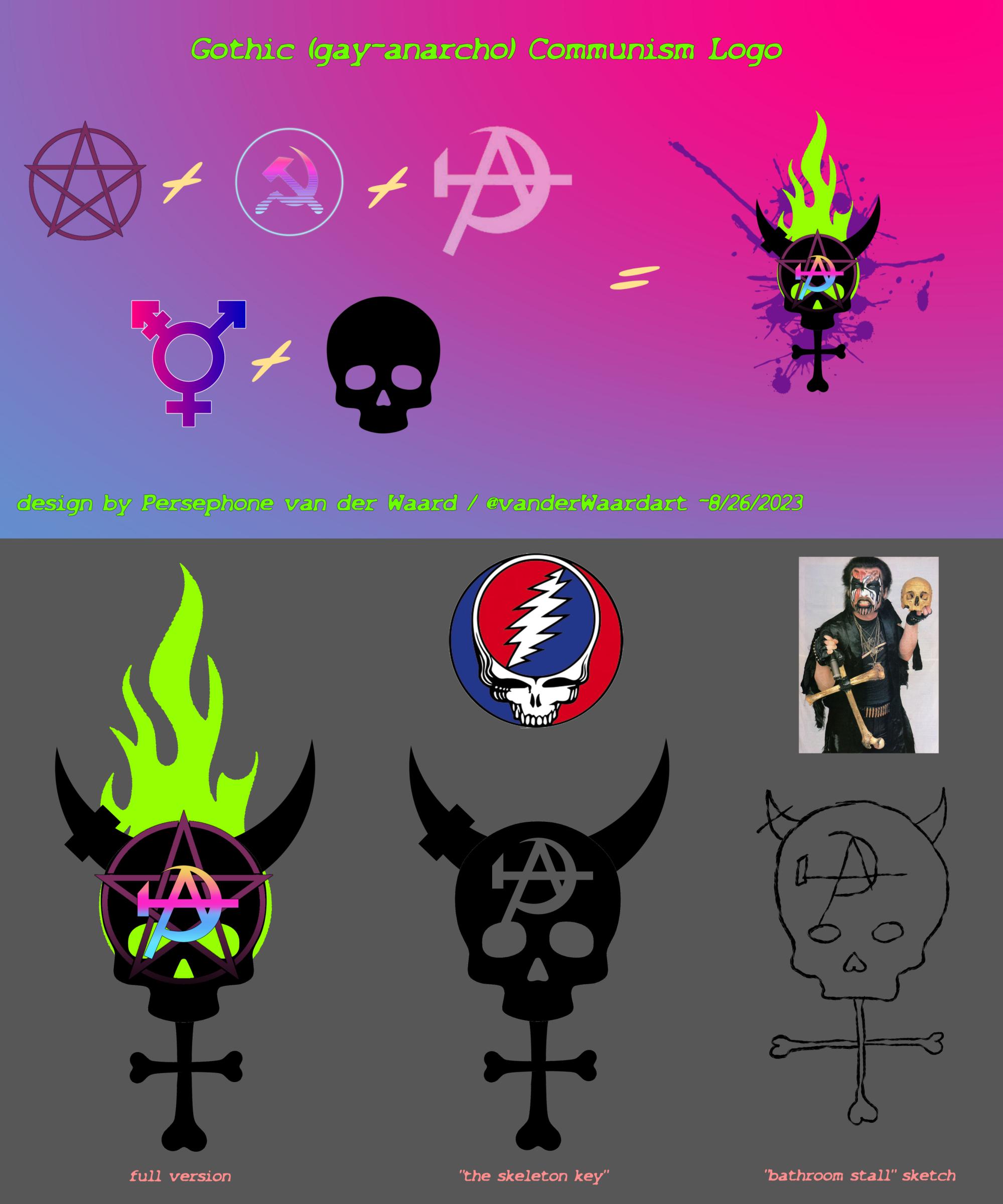
So I took the iconic hammer and sickle, found an anarcho-Communist variant with the same nostalgic/trans color scheme, and embossed a skull with it over a Wiccan pentacle; the skull I treated as the circle of the transgender symbol, fashioning it from black bones and horns (to symbolize the undead and demonic of Gothic poetics fused with the aesthetics of power and death; i.e., the green flames and purple slime as reclaimed colors of canonical stigma and persecution). If I was going to simply it, I'd thought I'd lose the flames and pentacle, turn everything black, and make the an-Com symbol negative space in the forehead. The thought process was, I wanted the embellished version for the book cover (like a monk's monasterial tomb) to give it a thoroughly medievalized flavor (the embossed codex). But as part of a logo guide, I included the simplified version of the symbol simply called "the skeleton key." I thought about using just the "A" in the forehead or the hammer and sickle, but that verges on too simple (the "A" being for Anarchism and the hammer and sickle being for Communism); so I went with the more complex an-Com symbol to preserve its meaning. That + the skull and crossbones + the horns + the trans icon = Gothic (gay-anarcho) Communism. It can be drawn all in black with a simple marker in a simplified "bathroom stall" form, but also has a fancier black logo that can be further embellished with ornaments and color if needed. Also, completely by accident, it kind of reminds me of Mercyful Fate's Melissa skull + the Grateful Dead logo, the latter being one of the most famous counterculture rock 'n roll bands of all time: sex, drugs and rock 'n roll all in one package!
Footnotes
[1] From "A Note about Rape/Rape Play; or, Facing the Great Destroyer" (2024):
I want to define [rape] as something broadened beyond its narrow definition, "penetrative sex meant to cause harm by removing consent from the equation." To that, there is a broad, generalized definition I devised in "Psychosexual Martyrdom" (2024), which will come in useful where we examine unironic forms of rape, but also "rape" as something put into quotes; i.e., during consent-non-consent as a vital means of camp during ludo-Gothic BDSM:
martyrs are generally raped by the state, which we have to convey mid-performance without actually getting raped if we can help it ("rape" meaning [for our purposes] "to disempower someone or somewhere—a person, culture, or place—in order to harm them," generally through fetishizing and alienizing acts or circumstances/socio-material conditions that target the mind, body and/or spirit) [emphasis, me]: finding power while disempowered (the plight of the monstrous-feminine).
Rape can be of the mind, spirit, body and/or culture—the land or things tied to it during genocide, etc; it can be individual and/or on a mass scale, either type committed by a Great Destroyer (a Gothic trope of abuse of the worse, unimaginable sort, rarefying as a person, onstage) of some kind or another as abstracting unspeakable abuse. It's a translation, which I now want to interrogate with the chapters ahead. So we must give examples that are anything but ironic before adding the irony afterward as a theatrical means of medicine; i.e., rape play challenging profit through the usual Gothic articulations in service to workers and nature at large.
Simply put, to be raped is to be deprived of agency facing something you cannot defeat through force alone (rape victims are often brutalized for trying to fight back)—capital and its enforcers, pointedly raping nature and things of nature-as-monstrous-feminine by harvesting them during us-versus-them arguments according to Cartesian thought; terror is a vital part of the counterterrorist reversal humanizing Medusa during activism as a psychosexual act of martyrdom. There is always damage, even if you survive, but there is a theatrical element that lets you show your scars; i.e., during consent-non-consent as an artistic, psychosexual form of protest through ludo-Gothic BDSM: having been on the receiving end of state abuse as something to demonstrate and play with for educational, activist purposes—generally with a fair degree of revolutionary cryptonymy (showing and hiding ourselves and our trauma).
By comparison the state uses masks, music (and other things) as a coercive, complicit means of cryptonymically threatening us with great illusions. These rape our minds without irony in service to profit. Such proponents are generally people in our own lives who don the mask/persona of the Great Destroyer to frighten us into submission; i.e., by threatening us with total annihilation as a force of unreality that feels shapeless and overwhelming yet humanoid. This is no laughing matter, nor is subverting it during rape play, both of which the rest of this volume (and Volume Three after that) will explore at length (source).
In short, to establish a grounds for humor and play during camp is to give workers control over things over things normally out of their control; i.e., putting "rape" in quotes during calculated risk, which ludo-Gothic BDSM essentially treats as activism when developing Gothic Communism to break Capitalist Realism; re (from the Demon Module):
try to understand how demonic desires are shadowy and repressed, given form by oppositional poetics in dialectical-material argument. So when I say "revenge" from here on out, I do so with concerns to the usual us-versus-them, cops-and-victims language that demons manifest as/relate to us with (and we them) while pinned between nation-states/corporations and nature growing increasingly turbulent; i.e., said revenge had by one against another pursuant to worker or bourgeois needs. Rebellion through demonic poetics happens through a particular thesis to counteract: nature is monstrous-feminine (re: Volume One)—a whore under state control, which the elite rape for profit, and for which both sides seek revenge before, during and after structural abuse. The exploitation is endless because profit and labor value (of nature) are endless!
(artist: PiMo)
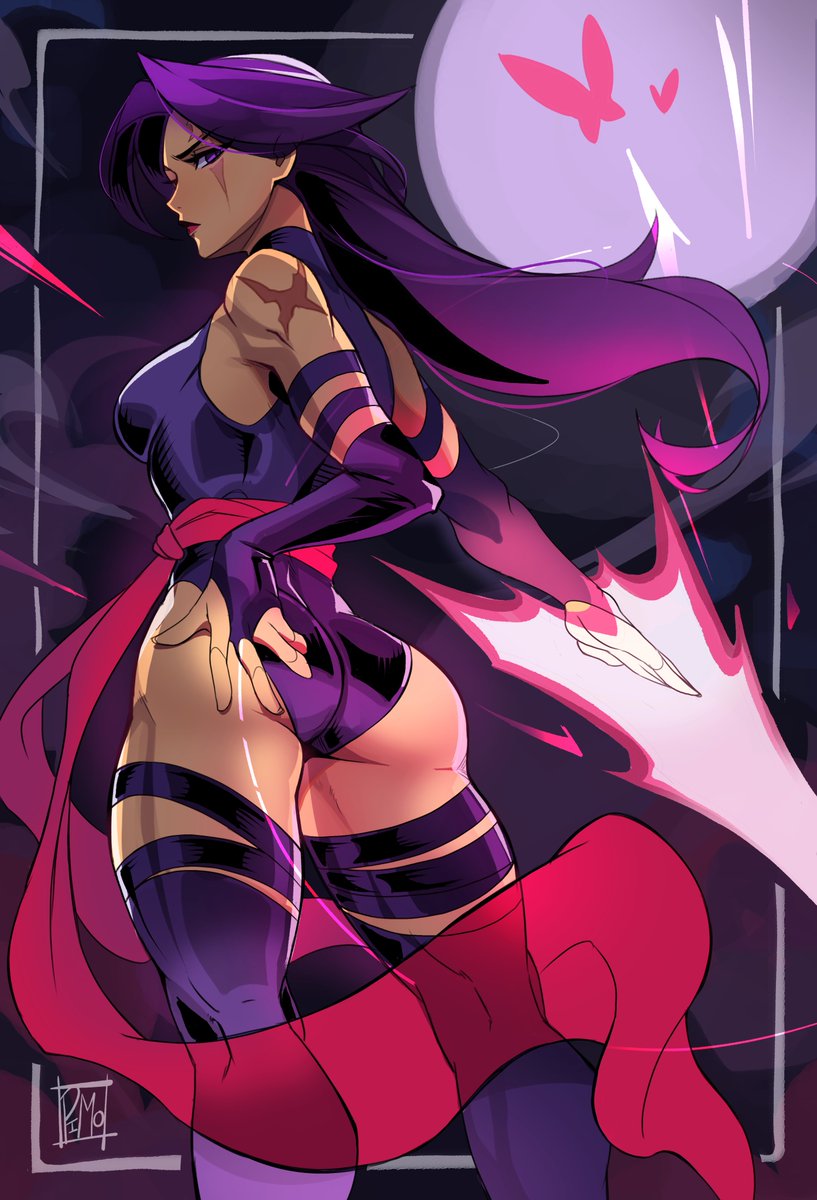
Demons, then, are whores under Western (Cartesian) dominion opposite virgins, but also are virgins depending on the circumstances; e.g., subjugated Amazons like Psylocke, left. This need for state control and dominion introduces a paradox from which a new thesis can arise during ludo-Gothic BDSM (for this chapter/module, indented for emphasis):
Ludo-Gothic BDSM has many theoretical definitions* and applications. In practice, though, I frequently utilize it through rape play that paradoxically achieves catharsis; i.e., by putting "rape" in quotes, thus healing from rape without quotes. Often by rape survivors, such people classically find power/agency through theatrical reenactments of unequal, unfair or otherwise rapacious treatment and conditions; i.e., by relying on a concept I'll heretofore call "the whore's paradox."
The paradox is simple: demons are maidens and maidens are demons, but both are virgins and whores, and each finds power (and knowledge) according to how the state forbids access, yet access happens anyways; i.e., (de)valued, mid-exchange, thus used to humanize or dehumanize the demonized through performance and play. Per Marx and myself, Capitalism alienates and sexualizes everything. Nature is monstrous-feminine as such, "empowerment" applying to any aspect of our life, bodies, violence and terror the state wishes to monopolize/control, and any trope, convention, cliché or fetish that might be used to degrade, humiliate, rape or otherwise demonize/dominate beings "of nature" per capital's qualities (re: settler-colonial, heteronormative and Cartesian); i.e., that we can reclaim during ludo-Gothic BDSM, hence through unequal power letting us "get a leg up," topping from a position of normal disadvantage to have our revenge: perceived disempowerment becoming a paradoxical, interchangeable means of escape, regarding universal worker liberation onstage and off (versus equality of convenience inside the text).
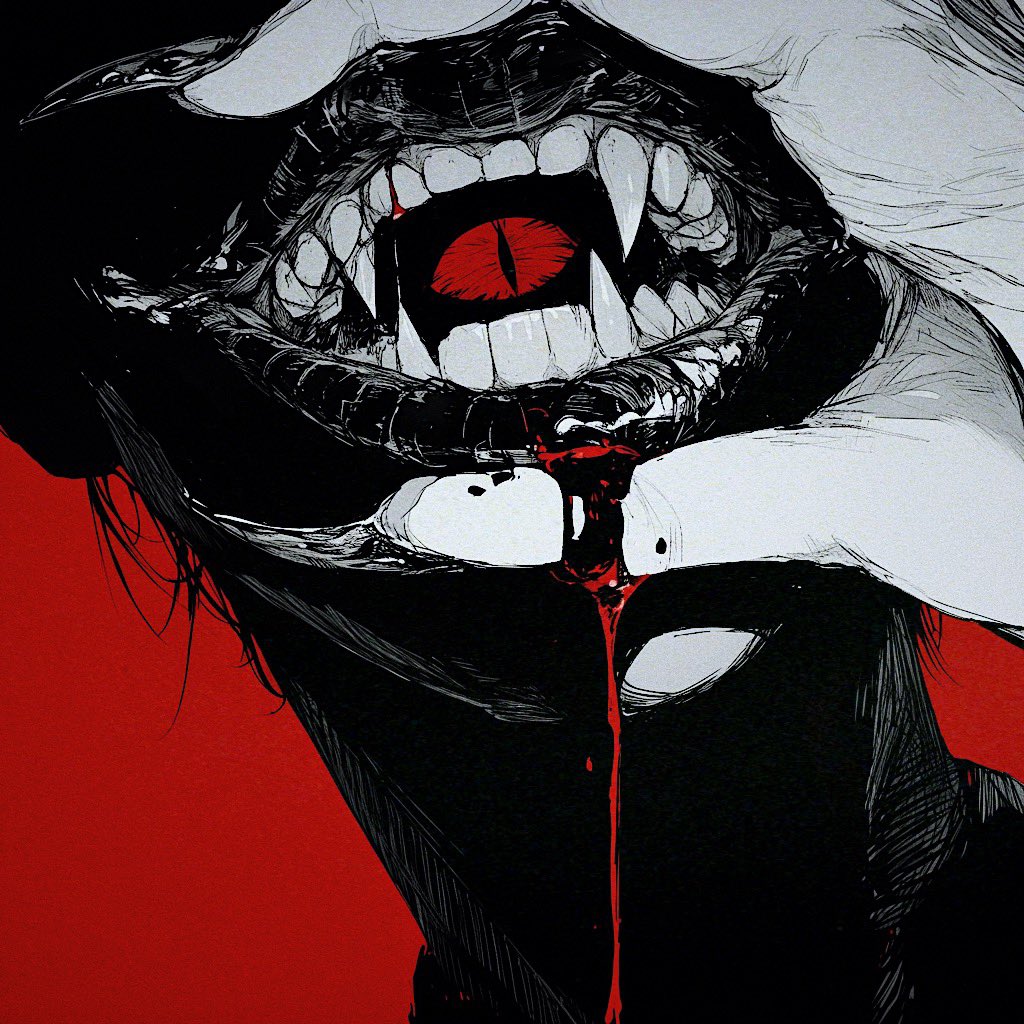
(artist: ALT3R4TI0N)
To do so is to break capital's hold on all things demons, darkness and nature they stole and monopolized, in turn smashing their own abjection against them and breaking Capitalist Realism with our Aegis—to deny capital's dead labor and language feeding on living labor and language according to what power and knowledge we exchange to and fro. The whore's revenge is to break the profit motive by making a world for which it (and rape) are no longer possible using these methods; i.e., by using the same demonic and slutty language capital does, but at cross purposes: to hug the alien—not demonize it to receive state violence—thereby (ex)changing how the world is seen to begin with. We aggregate power differently than state forms, outlasting and outperforming them to dismantle their harvesting mechanisms, social and material, foreign and domestic.
Nature, then, is always a whore who punches up against state pimps to end profit as an endless structure of genocide. History more broadly could be described as whores vs pimps, hence workers vs the state; i.e., something the seemingly cannot die, but whose aforementioned whores are as imperishable as Medusa despite being beheaded.
That's basically the gist of the whore's revenge during the whore's paradox (source: "A Rape Reprise," 2024).
*The word as I coined it has several definitions. One (from the Six Rs):
games occur along Gothic, liminal routes, wherein workers playfully articulate their natural rights in linguo-material ways between reality and fabrication that go beyond games as commodities but are nevertheless informed by them as something to rewrite; i.e., through play as a general exercise that involves a great many things: a reached agreement of power and play in Gothic terms, whose luck/odds are defined not through canon, but iconoclastic poiesis that can be expanded far beyond the restrictive, colonial binary and heteronormative ruleset of the elite's intended exploitation of workers to challenge the profit motive and all of its harmful effects in the bargain; e.g., genocide, heteronormativity and Max Box culture. The sum of these concepts in praxis could be called "ludo-Gothic BDSM."
Another (from the glossary, abridged):
My combining of an older academic term, "ludic-Gothic" (Gothic videogames), with sex-positive BDSM theatrics as a potent means of camp—specifically rape play by placing "rape" in quotes, mid-Gothic (where rape [and playing with it] is ubiquitous). The emphasis is less about "how can videogames be Gothic" and more how the playfulness in videogames is commonly used to allow players to camp canon in and out of videogames as a form of fairly negotiated power exchange established in playful, game-like forms
As I've moved through this series, though, the definition has narrowed, according to my focus on the term specifically to play with rape as I define it; re (from the Poetry Module's "A Note about Rape/Rape Play," 2024):
[...]
To that, rape is something that demons play with during the whore's paradox. By extension, ludo-Gothic BDSM is effectively rape play combined with Gothic themes and BDSM practices to avenge state wrongs against nature.
For further information specifically on ludo-Gothic BDSM, refer to my new webpage cataloging the subject and its history as coined and synthesized by me. —Perse

