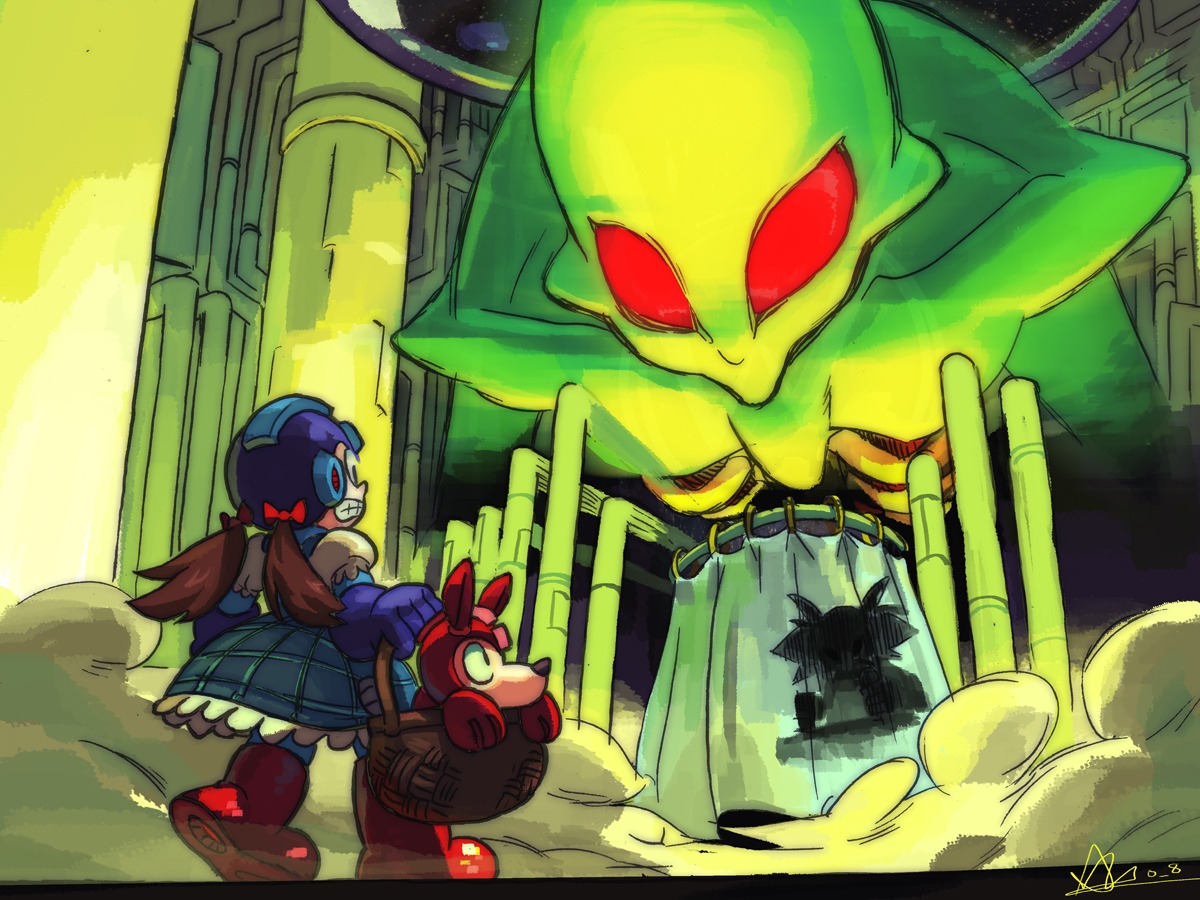
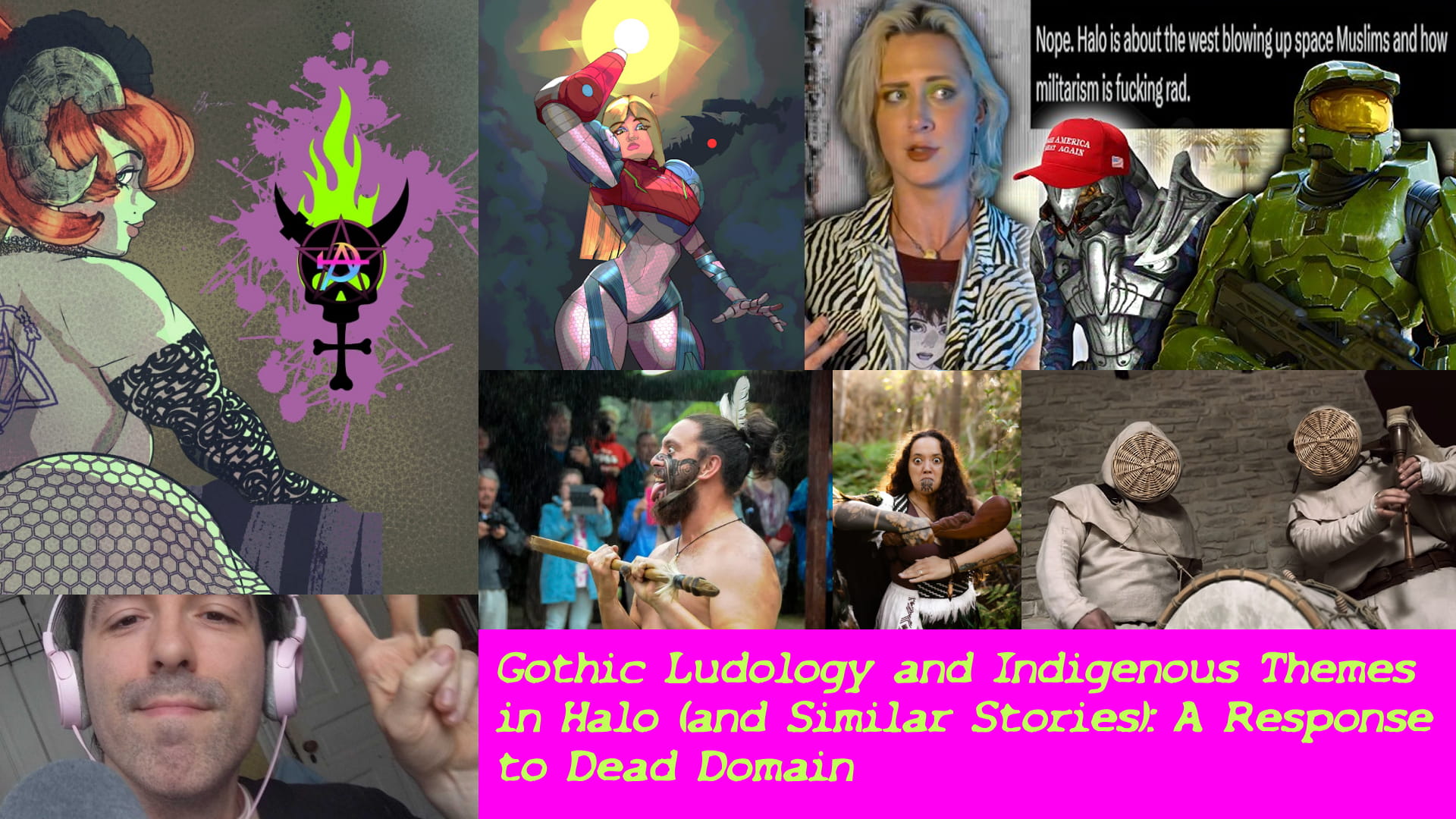
This post both outlines and builds my seminar-style response to Dead Domain, the video essay "Gothic Ludology and Indigenous Themes in Halo (and Similar Stories)." After seeing Dead Domain's video on Halo (2001) as neoliberal media, I decided to weigh in, lecture-style—partly on my own research, partly on Indigenous cultures I've tried to synthesize when critiquing Halo (and similar stories): to combat Capitalist Realism without reducing space opera to purely fascist dreck/singular unhelpful and unproductive interpretations. Instead, "the play's the thing"; i.e., to catch the conscience of the king—the bourgeoisie behind the curtain—in deeply chaotic and emergent ways that steeply diverge from intended play! So Gothic reinvents power to serve workers, doing so out from old dead things (and generally popular media seen as trashy-verging-on-taboo to start with, including sex, drugs and rock 'n roll, or anything comparable): dead labor feeding on living labor for centuries. What do you think capital is—or its power fantasies' endemic violence, terror and monstrous(-feminine) monopolies* projecting blame, in mirror-like ways, onto its victims through cops/robbers revenge (throwing stones in glass houses)? Dogma dies, but the symbols remain, and where workers might play with them as they wish.
*Said monopolies described by Weber, Asprey and me (re: "The State: Its Key Tools" from "Paratextual Documents," 2024): as things to challenge "on the Aegis," mid-abjection (classically Athena's mirror shield as Barbara Creed discusses, adorned with Medusa's head [the monstrous-feminine] as a Freudian terror device capable of great violence and transformation: the "kissing cousin of force" a grim reminder of state limits workers camp in dualistic† ways; e.g., Amazons, whose anti-predatory fabrication—and dialectical-material utility—we'll explore deeper in).
†Transplanted from "A Response to Brigitte Empire" (2026), whose Amazonian focus explores duality and satire for good praxis (developing Communism using Gothic poetics): "Satire is theatre, which incorporates Comedy and Drama on any stage; duality simply means both sides use it, workers (and nature) vs owners and those who serve them/the state guiding thought (thus action) through the usual circuits outside our bodies (avatars and conduits, themselves). There's no set function. Instead, they double each other regardless of venue or form" (source). To it, "duality" repeats a lot, here, as do terms like "Aegis," "anisotropic," and "abject," etc, alongside Amazons (an accidental ode to the letter A, it would seem); i.e., "Aegis" = "abjection" as something to reverse, terrorist/counterterrorist, in anisotropic, apotropaic and asymmetrical ways. For that, I love Amazons and use them, in my current work tied to older scholarship, to combat state predation in duality (what I call "vampirism," from Marx). True to form, "Amazon" does much heavy lifting to subvert the historically villainous (and canonically token) role they categorically play—meaning to police nature-as-whore, post-Athens—but whose "girl barbarian," specifically White Indian shtick (and its animal, weapons-and-armor body language) remain poetically flexible on the usual frontiers: as a liminal, political-morphological, at-times-trashy device, one used globally to embody and achieve different goals in praxial, dialectical-material opposition (e.g., employment, empowerment, emancipation, enforcement, etc).
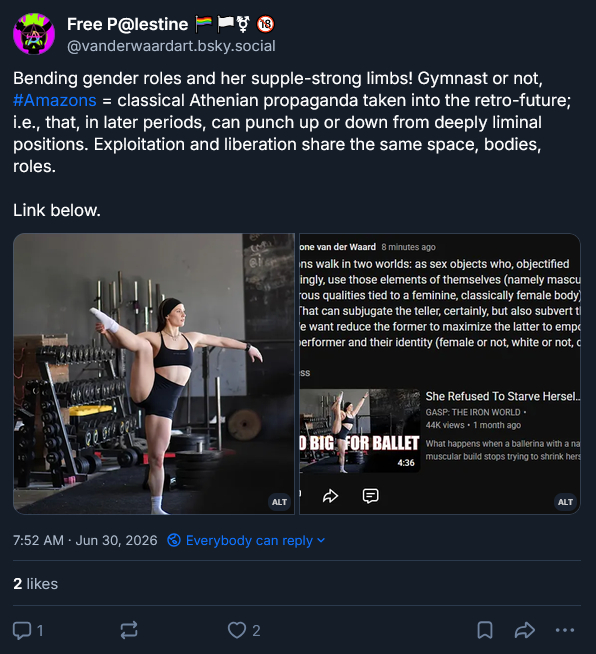
(source skeet: vanderWaardart, 6/30/2026 in response to Iron World's "She Refused To Starve Herself," 2026)
Table of Contents
Note: I've expanded "Gothic Ludology" since first publishing, table of contents included; and while I've made numerous changes throughout, the clear-and-obvious addendums are in bold and color-coded. —Perse, 6/23/2026
- Changelog
- Concerning State Vampirism
- Disclaimers/Concerning Censored Nudity and Its Educational Purpose
- Written Essay Portion
- My Thesis Argument (and Amazons' Role within It)
- Essay Body
- Context
- Heeding the Past (feat. Amy Chan and Allie Reads)
- Essay Body Conclusion
- Tangents
- Dark Matter Tangent: Amazons, Vampires, and Cryptonymy in Dualistic Frontier Dialogs (feat. Cuwu)
- Learning from Others (exhibit and intersectionality)
- Essay Prototype
- The Gist; or, Camping the Space Opera "When in Rome" (which "White Indian" Stories Are)
- Gothic Communism: A Holistic Approach (reprise, Amazons; feat. Allie Reads, Amanita Daukta, Fishnet Housepet and Lilith Mae)
- Original Video Notes
- Initial Written Thoughts (Comment to Dead Domain's Video)
- "Playing War: Capital vs Indigenous Groups (and Videogames)"
- Media Analysis Sample: Mega Man
- Thesis Portion: On Duality (timestamp: 21:45)
- Works Cited (for the video essay)
Changelog
—7/8/2026: After adding more "spicy" exhibits, I've age-gated the page in my usual style. Updated the disclaimers to give a fig leaf demonstration, up front; added a changelog and retooled the signposts to make "Preface" into "Essay Body," and "The Gist" and "A Holistic Approach" into "Essay Prototype."
—7/7/2026: Gave "Heeding the Past" more examples and explanations of Gothic poetics and theory to keep in mind.
—6/30/2026: Nearing completion, "Gothic Ludology" has become slightly repetitive; i.e., "Preface" being written after "The Gist" and the Amazon reprise, which began themselves as short refreshers before "Old Video Notes": jotting down smaller fragments that become a thesis argument—one responding to said notes, and one I'd frontload with "Preface"; re: leading to some repetition in the middle as formerly the start. What can I say? I write backwards, and like to preserve that while signposting things! From the top, "Thesis Argument" spells things out, giving my essay's basic argument and approach the rest of the essay unfolds like a timeline: from more concrete to less.
—6/29/2026: After rereading Patel and Moore's A History of the World in Seven Cheap Things (2017)—and revisiting Hazbin Hotel (2019) with a partner of mine (which I don't have time to explain here, but do explain elsewhere; e.g., this YouTube short on VivziePop's racism)—I decided to expand on/signpost "Preface"; i.e., while stressing the vampiric function (and trashy exploitation language) of capital that workers subvert during ludo-Gothic BDSM: as de facto stewards of nature, and on frontiers where good actors and bad play the White Indian role (that Amazons facilitate, in my opinion). Last but not least, the preface (and its tangents) contain artistic nudes and illustrations that, while censored, are pretty "spicy." I don't consider these sexual activity (as no one's having sex in them); I classify them as "ace" public nudism, tied to educational material and activism (thus no age gate). Your mileage may vary!
Concerning State Vampirism

(artist: Karen B.; cited: "The World Is a Vampire," 2024)
This piece (essay or otherwise) is part of a larger series on state vampirism. As I conceive it, state vampirism = feeding through the state mid-abjection*, be it openly capitalist or Marxist-Leninist. These are largely questions of aesthetic, whose Promethean (self-destructive) function extends to other configurations "of Omelas"; e.g., Zionism. Furthermore, there's overlap between my anti-Zionist work and my work critiquing Marxist-Leninism/state vampirism alongside capital, so consider reading both.
*Which state predation and revolutionary action both rely upon to function; i.e., "on the Aegis" as something to further or reverse, mid-vampirism, through paid/unpaid labor (re: me, vis-à-vis Julia Kristeva). To that, abjection (us versus them/alienation and fetishization) is one of four main Gothic theories my book series utilizes—the other three being hauntology (retro-future), cryptonymy (show/hide) and chronotopes (time-space) alongside smaller theories; e.g., Jerrold Hogle's ghost of the counterfeit† and Barbara Creed's monstrous-feminine (Gorgons and Amazonomachia, as I study it). As a queer sex worker and academic, I dialectically-materially prioritize abjection and vampirism through unpaid labor—chiefly sex work as exploited by Cartesian dualism and its harmful, maximalist binaries under Capitalist Realism, treating nature as monstrous-feminine (re: "Nature Is Food," 2024)—but mention the other theories, too (access "Four Main Gothic Theories (the Four Gs)" in "Paratextual Documents" for their longer definitions). In essence, capital/the state rape by design, which unpaid labor prevents by breaking Capitalist Realism mid-abjection; i.e., reversing abjection during ludo-Gothic BDSM (rape play) when having the whore's revenge (which "State Vampirism" explores at length): "to break the profit [and productivity] motive by making a world for which it (and rape) are no longer possible using these methods; i.e., by using the same demonic and slutty language capital does, but at cross purposes" (source: "Rape Reprise," 2024).
†Re: "Raising Awareness" (2025), footnote 1.
Disclaimers/Concerning Censored Nudity and Its Educational Purpose
"Gothic Ludology and Indigenous Themes" is part of my Sex Positivity book series, which continues after its June 2025 finale in small-form content; e.g., essays on and interviews with other sex workers, all of whom I credit on my Acknowledgments pages and Sex Work page. This piece doesn't focus entirely on sex work, but widespread exploitation that includes sex work as problem/solution; i.e., in a shared predatory system, "whoring nature (and workers) out" in highly abject ways.

(artist, left: Bay Ryan; right: Persephone van der Waard)
Disclaimer Regarding Essay Contents: All opinions are my own; i.e., as part of my research, conducted alongside my book series, Gothic Communism (2023). The material within is written/speaks about public figures and popular media for purposes of (sex) education, satire, transformation and critique, hence falls under Fair Use regarding copyright and free speech regarding defamation/obscenity laws (the Miller Test; source: Justice.gov). Click here for my entire series disclaimer. Lastly many of the links on this page lead to my age-gated 18+ website where my entire work on Gothic Communism is stored and exhibited.
CW: bikini-style pin-ups, cleavage and censored artistic nudes; fascism, genocide, racism and rape*; police brutality and carceral violence; anti-Indigenous sentiment and environmental destruction; and Gothic poetry and violence
*Meaning (from my definition) "to disempower someone or somewhere—a person, culture, or place—in order to harm them," generally through fetishizing and alienizing acts or circumstances/socio-material conditions that target the mind, body and/or spirit) […] Rape can be of the mind, spirit, body and/or culture—the land or things tied to it during genocide, etc; it can be individual and/or on a mass scale" (source: "Psychosexual Martyrdom," 2024).
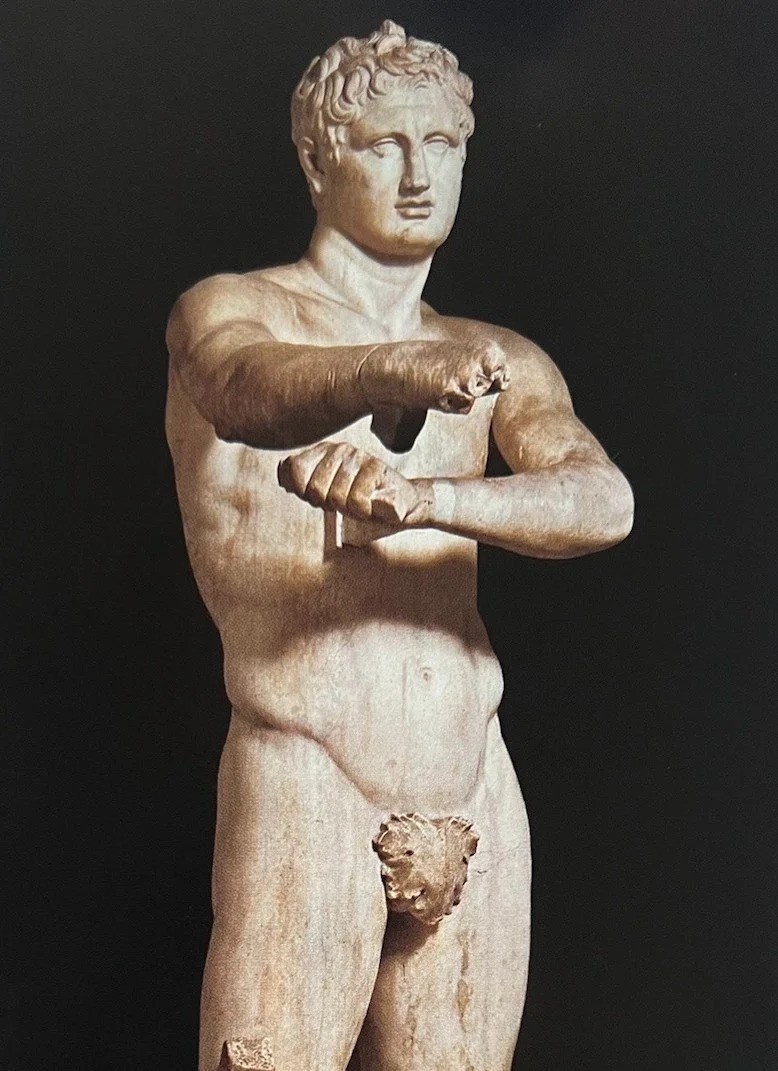
(artist: Lysippos; cited: Michael McClellan's "Professor Butter Beard and 'It's All About the Fig (Leaf)'")
Concerning This Pages' Censored Educational, Fig-Leaf-Style Nudity: This pages features censored, fig-leaf-style nudity* for purposes of sex and artistic education operating under the Miller Test/protected speech under American law (source: Justice.gov). For further info on my approach to censorship and sex education, kindly refer to exhibit -1 from "Raising Awareness" (which also discusses the hate campaign censors are currently waging against me and my friends' sex-ed work). All censored material is used elsewhere in my book series; i.e., as part of said series, and with permission from the models therein (re: my book series disclaimer). All models are over 18 and were when said material was produced.
*Meaning no bare genitals or sexual activity from the models (read: fucking), just bare butt cheeks, curves, body hair and public nudism; i.e., within a sex-educational, art-meets-porn framework that follows the Miller Test—one performed by sex workers and their content being voluntarily part of a larger project I continuously invigilate; e.g., my partner Crow:

(artist: Crow)
Concerning Keywords: My arguments rely on various keywords I've previously coined, which here present in bold while color-coded (usually only once, while stressing their keyword status; e.g., ludo-Gothic BDSM, Metroidvania, or the palliative Numinous, etc). While some are given here, in abridged form, "Paratextual (Gothic) Documents" provides all neologisms, in full.
Written Essay Portion
For once, I wrote this essay after the symposium; i.e., I usually write first, lecture later. Doing so, I'm molding ideas my video response installed, those based already on pre-existing scholarship from my own corpus. To it, I'll supply the written essay here, before compiling the notes it built on—meaning as they directly appear in the older video. While they share the same title, "Gothic Ludology and Indigenous Themes in Halo (and Similar Stories)," the written half goes beyond that franchise (and shooters) to conceptualize a broader holistic (multimedia) approach: one established through older scholarship of mine that venerates Amazons, all while recognizing their terror-like devices at play (and doing so since "Military Optimism," in 2021, going into my PhD and then current work on state vampirism, 2023 to 2026).

(artist: Matt Smith)
My Thesis Argument (and Amazons' Role within It)
"Gothic Ludology" (the written portion) uses Amazonian elements to make its point: acting out colonizer/colonized theatre—namely "White Indian" scenarios (meaning anyone of privilege [class, culture and/or race] occupying the savage* guerilla role per frontier* as space of predation) through space opera—to help genocidal benefactors empathize with Indigenous groups and unify struggle, monster-equals-argument (my focus being sex work and its weaponization). That means mid-exploitation diametrically for either side of a larger workforce tied to nature being raped as a whole (thus see through state illusions that whitewash genocide); i.e., while playing war in asymmetrical ways that xenophilically raise empathy and teamwork mid-abjection, thus reclaim the Aegis by dualistic means (namely terror/counterterror). Said essay features a variety of references to my book series, but also different research topics: Amazons, yes, but also videogames, BDSM, and more (whose praxial combination and focus [when developing Gothic Communism] I call "ludo-Gothic BDSM," below). Their usage here starts with a preface (now the essay body) and explaining of the gist (now the essay prototype), followed by a conversational refrain: one chased with smaller written fragments that lead, like bread crumbs, towards the original video's central thesis (on duality). Owing to its length, much of said video's overall contents do not appear here (read: the Halo analysis).
*From Patel and Moore's Seven Cheap Things: "Frontiers are frontiers because they are the encounter zones between capital and all kinds of nature—humans included. They are always, then, about reducing the costs of doing business. Capitalism not only has frontiers; it exists only through frontiers, expanding from one place to the next, transforming socioecological relations, producing more and more kinds of goods and services that circulate through an expanding series of exchanges. But more important, frontiers are sites where power is exercised—and not just economic power. Through frontiers, states and empires use violence, culture, and knowledge to mobilize natures at low cost" (source). This includes the idea of "savage" as something to embody by workers in service to themselves or nature, mid-Gothic; i.e., as Patel and Moore describe the original definition as something to subvert away from the current, Nature-vs-Society status quo: "As recently as 1330, savage meant 'intrepid, indomitable, valiant.' That positive use faded by the end of the fifteenth century, replaced with its modern one of 'in a state of nature, wild'" (ibid.). Patel and Moore explain, earlier in the book: "The cleaving of Nature from Society, of savage from civilized, set the stage for the creation of our other cheap things [...] Nature was remade, reinvented, and rethought many times over the next five centuries" (ibid.). To summarize, the land is a Frankensteinian project—one carved up and harvested by Cartesian powers dictating force in defense of the state and nuclear model, and whose intersectional challenging—by workers of varying privilege and oppression (during ludo-Gothic BDSM, below)—I shall outline in the essay body and unpack during the intersectionality exhibit.
tl;dr - Assimilation is poor stewardship, and nudity isn't weakness if its performance as "savage" (on different half-real frontiers) challenges state vampirism; e.g., Amazons classically tokenizing devices that flow power down in subversive hands: exploitation and liberation share space, performed "on the Aegis" by good actors and bad using the same stage, bodies and language (more on this deeper in). The Aegis is a black mirror whose terror weapons marry sex and force for workers vs the state (worker rights "of nature" vs state's rights to rape nature).

(artist: Nyx; cited: "Concerning Rape Play: a 2025 Note on My Development of Ludo-Gothic BDSM," 2025)
Note (6/22/2026): The piece-by-piece approach, here, draws upon notes taken in response to Dead Domain, Atun-Shei and others—listed and organized after the video (and signposted, for your convenience). It's still meant to be conversational (read: as short as possible though no shorter), thus won't repeat past arguments too much—all while directing viewers towards past written works should you want more. These include but don't limit to: "The Promethean Quest and James Cameron's Military Optimism in Metroid," "Vintage to Retro: An FPS Q & A series - FrostyXen" (on Doom Eternal and the Halo series, 2021), "Those Who Walk Away from Speedrunning" (2025) and "'Once More unto the Breach'; or, Reading and Responding to S. R. Holiwell's 'A Maze of Murderscapes: Metroid II'" (2026). All explore subverting the White Indian in crafty iconoclast hands. —Perse
P.S., Our emphasis remains on videogames (and sex work through art, below). For a good examination of movies and 9/11 (the latter which comes up here alongside Halo and the War on Terror), refer to GDF's "Hollywood and 9/11" (2026). For further discussions of sex work and its abuse by revolutionary parties, refer to "Censorship and Double Standards Regarding Sex Work" from "My Patreon, in 2026: Videos and Voice Work" (2026). Lastly, my work as a whole is anti-racist, but here targets workers with racial privilege; i.e., white people (of any gender) playing White Indian to emphasize with BIPOC workers (sex or otherwise). As such, the models featured here are predominantly white; i.e., while navigating the usual contradictions capital and state predation abuse, in retro-future language (with Amazons classically female barbarians—an ancient racist and sexist idea that, in post-WWII frontier stories, have grown increasingly "white" per Cartesian, settler-colonial paradigms: sex = sinful; sex sells to broadcast token [assimilative] ideas of class, culture and race that reliably gentrify-and-decay feminism into nature pimping nature, "gaslight, gatekeep, girlboss").
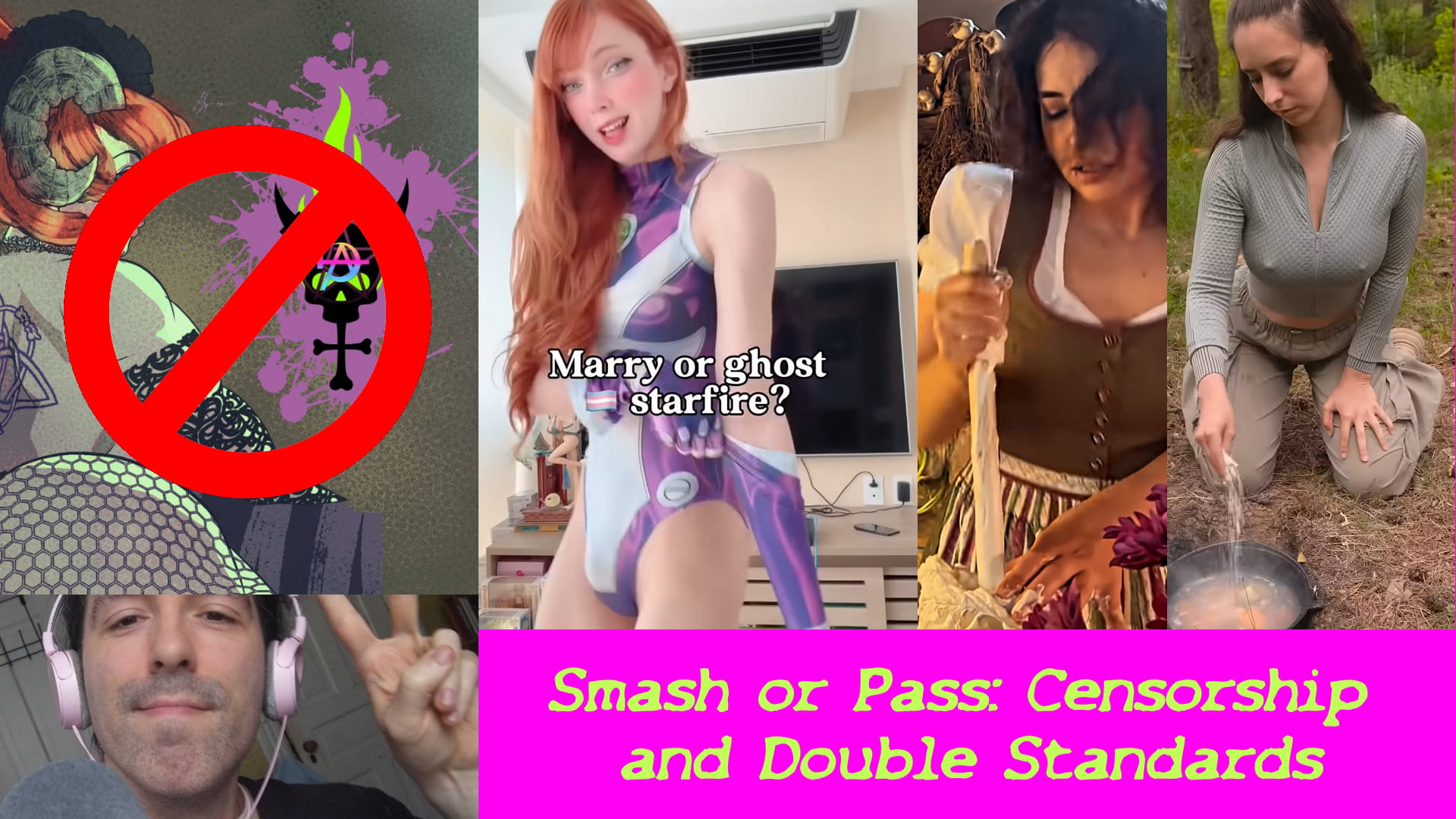
(source thumbnail: Persephone van der Waard's "Smash or Pass: Censorship and Double Standards," 2026)
Essay Body
That's my written essay thesis. Before the essay prototype (which is more conversational, short), here's the essay body—one that provides context but also why listening to oppressed groups matters; i.e., on why simulating their unequal position within capital, doing so for better understanding on how to meaningfully rebel through play as White Indians on imaginary frontiers (with Amazons or otherwise). Workers' Gothic doesn't reify cultural anxieties to scapegoat, but provide a poetically playful means of addressing the state predation their allegories imply (or shout from the rooftops).
Note, 7/7/2026: I've expanded "Heeding the Past" to account for Gothic's dark, imaginary qualities (operatic in general, not just space operas): a fear of the indigenous foreigner (enemy within) as having fetishized but also humanizing qualities that beg far more examples than initially supplied. Some ideas appear more, deeper in. Most do not, requiring readers use the hyperlinks I've given if they want to learn more; i.e., "Gothic ludology" refers to my PhD and the older research that went into what eventually became ludo-Gothic BDSM (re: Amazons and Metroidvania). Simply put, it's my jam. —Perse
Context

(source thumbnail: NeoGamer - The Video Game Archive's "Halo Announce Trailer - Macworld 1999," 2017)
For context, I recently saw Dead Domain's video on Halo and media literacy's admittedly flagging status—meaning when people online reductively write off neoliberal media (mostly videogames) as fascist, when that's not always the case or helpful; i.e., doing so doesn't describe how these illusions work on teenager brains (to uphold Capitalist Realism long after they grow up), nor how workers subvert them to reverse the abjection process under capital: on the praxial canvas as half-real, liminal, and monopolized by no one. Plenty of people love these stories, those who make them forced into places of work billionaires own (with Halo CE—initially announced for Mackintosh computers* by Steve Jobs, in 1999—actually competing with Bill Gates' ongoing monopoly on shooters, the latter's IBM machines having more copies of Doom [1993] on them than his Windows 95 operating system).
*Whose ubiquitous, bitten-apple logo alluding to Alan Turning's suicide by cyanide-injected-fruit: after being forced to ignominiously undergo conversation therapy by the British courts, who brutalized Turning after he cracked the Nazi Enigma, in WWII. The state is white, straight and male—specifically Cartesian, heteronormative and settler-colonial; evil is banal, as are its usual pimps being white straight men (and token traitors) abusing technology and privilege to rape the world—with fascism and capital under Western Liberalism (then neoliberalism) a giant filing cabinet, one where men like Gates and Jobs monopolized computers after women built the infrastructure (and where IBM computers originally made punch cards for Nazi death camps: the usual technologies of cataloging conquest [usually maps] lifted from Cartesian thought/mad science; re: me vis-à-vis Patel and Moore's A History of the World in Seven Cheap Things and Shelley's Frankenstein aka The Modern Prometheus, 1818; see: "Making Demons," 2025).

(source: "Vintage to Retro: An FPS Q & A series - FrostyXen," 2021)
Like the Gothic and opera at large, these studios are messy and incoherent, but within whose theatrical mess power (of a Promethean, Numinous sort) can still be found, captured and used! Hiding in the imaginary past brought forwards, we have the power states say we don't; i.e., from time-out-of-mind, but also in and out of fantastical stories sharing a larger poetic canvas the Gothic celebrates: for its perennial lack of resolution but also mastery over us, mid-exploitation, as something to place "rape" in quotes during ludo-Gothic BDSM (my praxial refrain). All is not well, but there's still a chance to change things (and look good while letting off steam, further down): taking back our actual power instead of the false, neoliberal, Faustian kind that states currently offer (workers Quixotically subsisting on simulacra of our own stolen wares [often videogames] while capital flows everything upwards; i.e., flow = function, not aesthetic). This happens through ludo-Gothic BDSM, a powerful means of calculated risk where workers reify different poetic devices: ironic spaces and implements of torture that—placing "rape" in quotes, mid-camp—heed the past (and its dangers) by supplying meaningful control during playtime (and communicate abject themes, mid-concealment, whose cryptonymy the rest of the essay body and tangent section each explore further).
Heeding the Past (feat. Amy Chan and Allie Reads)
Context conveyed, we're talking about the past as Gothic classically does: something to heed in half-real, semi-imaginary forms. A summoning ritual, the conjuring of dungeon-like time and space, resident and residence, hyphenate mise-en-abyme to voice the anxious, danger-disco inheritance of a notably grim harvest (and its monstrous, mad, vaudeville-style refrain, parody-and-pastiche): "When such a castle appears, it is time to be afraid; the colonial harvest is at hand. Yet, precisely because the state does not hold a monopoly over violence, terror and morphological expression, a demon or castle needn't spell our end; it can represent our sole means of attack, reclaiming said poetics' endless inventiveness to turn colonizer fears back into their hopelessly scared brains" (source: "Prey as Liberators," 2024). In turn, capital's frontiers collapse inwards, like a black hole with evil-coded beings (what I call the liminal hauntology of war [referenced by the quote, above] and Aguirre the infernal concentric pattern, which Milton once called "pandemonium"). Athena's Aegis, embodied by workers, isn't opaque; it's is black mirror with ocular qualities (the abyssal voyeur from Nietzsche going both ways): a projection of alien cultural qualities mid-abjection into a space of passion but also of radical change (death or otherwise), abjuring singular interpretations (which are dogmatic, ergo dangerous) to flaunt power despite state hypocrisy monopolizing of "darkness" to mean anything they want to pimp, police, and punish in punitive language (more on this, deeper in).

(artist: Akiko Stehrenberger; cited: "I, Satanist," 2021)
From cradle to grave, humans learn through play to interrogate threats. And so the Gothic—warts and all—plays with an imaginary past-as-fearsome; i.e., to learn from the secrets (and bodies) buried there, gaining forbidden sight through darkness visible (from Plato onto Milton, borrowed by workers embodying abject things that illuminate through paradox)! There be pirates and actors, whose good or bad faith and "bandit" function isn't immediately obvious. Rather, the seeing of such open piracy (and "booty" with which to leverage such deeds, below) excites different sensations to conceal, echo and further agendas well-and-truly at odds, workers-vs-the-state: the marriage of the virgin/whore, and of femme forte, fatale, and barbarian invader (outlaw homewrecker avenger, etc) as expanded into alien realms; i.e., where liberation begins "when in Rome," among hearts and minds changed through the vulgar language of sex and force—scapegoat caricature eliciting wild-animal responses both fearful of and fascinated with the Numinous "come to pass" (and where modular labels like "black," "queer," "female" and/or "queer" interchange and translate to monstrous-feminine). It's, to some degree drug-and-thrill-seeking but also attention-grabbing through readily understood symbols of danger and attraction workers subvert using our usual tools (and bad pans) we command; re: dead dogma and its Romantic metaphors reassembled and brought Numinously back to life (from Walpole to us)!
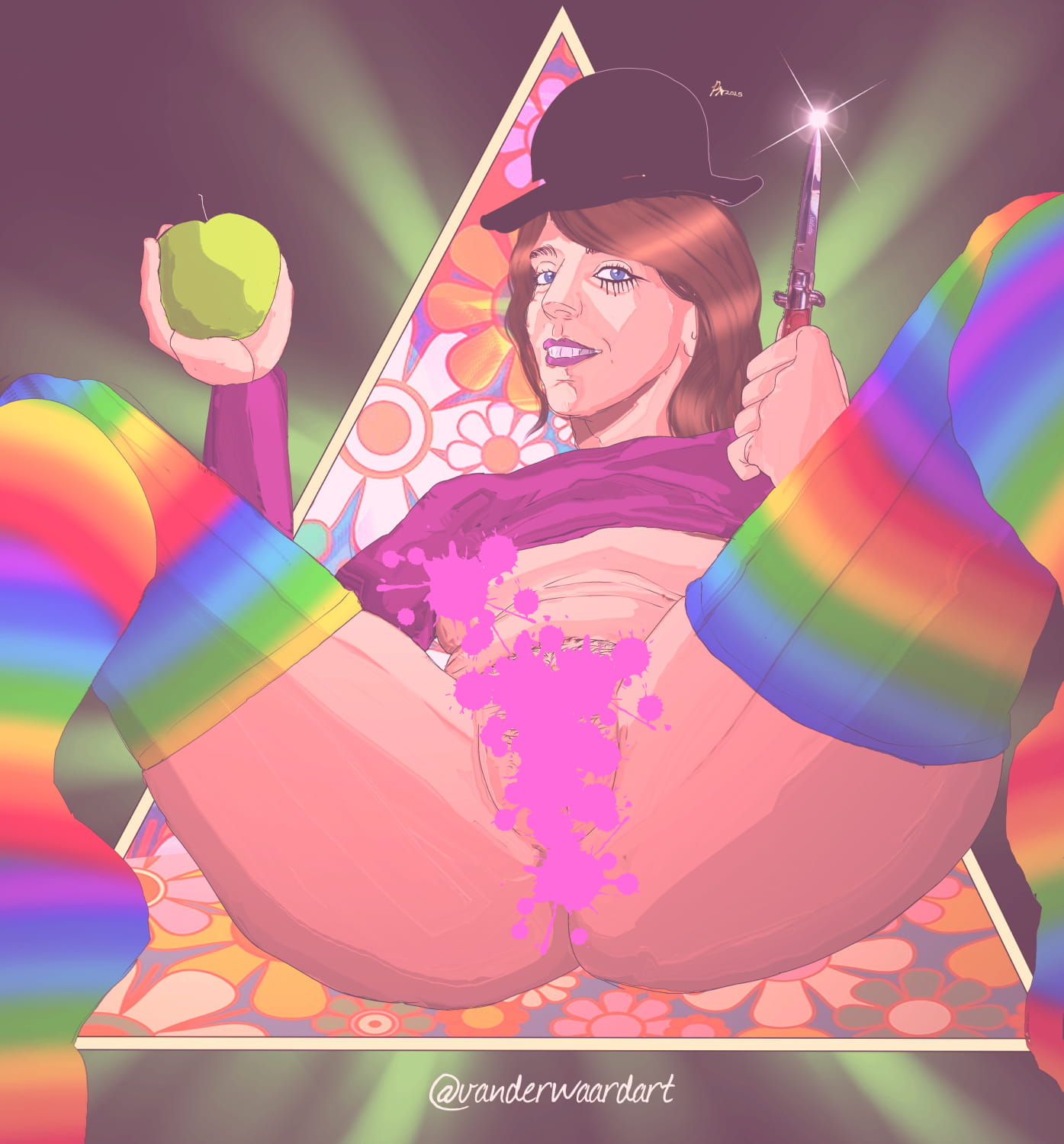
(model and artist: Amy Chan and Persephone van der Waard)
Here, the elite occupy the same pastiche yet cannot entirely control what goes on, "in the cave" (doing their best, however futile, to promote a decay of civilization in hauntological ways; e.g., Kubrick taking Burgess' "old ultraviolence," his own hoodlums—a fatal portrait of the empire-in-decline's vengeful youth gone wild and haunted by Red Scare fears [of Soviet triumph during the Cold War]—taken and run with into future iconic-to-iconoclastic varieties: the return of the neo-medieval past, above). Like all language, so do cryptonymy and abjection exist in duality. As dialectical-material things, they remain central to workers vs the state; both use the same things to send power up or down, waging war in paradoxical, fortress-like ways that many workers feel well at home inside (as Amy does, above). The state will call you violent to deny agency and amplify their own. Might as well own/work it and turn the tables, doing so in the frontier as "up for grabs." Cops should be made to feel unwelcome but also tempted, off-balance: a collapse of order mid-thrust into increasingly uncertain realms (through some-such moral panic concerned, reactionary/moderate, with disorder and invasion through crime waves, fear of immigrants, imperial collapse, etc)!
So capital treats the frontier and its savage whores, fetishizing apocalypse as "return of nature"; i.e., in hauntology as canceled future regressing backwards, call it "dystopia," "frontier" or anything else. So, the West testifies to its own atrocities by fabricating and then pimping them out, blame-the whore (source: "Healing from Rape," 2024); e.g., these older exhibits from my book series, concerned with rape and rapine as something of an amusement park ride: the power fantasy savior and rape fantasy scapegoat walking arm-in arm (and in clothed/unclothed states, below)!
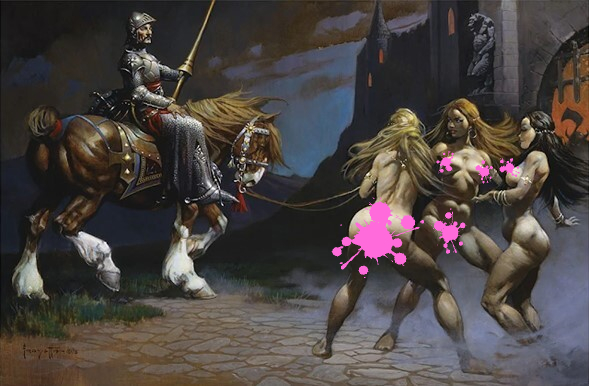
(exhibit 9a [from "Predators as Amazons, Knights, and Other Forms of Domesticated, Animalized Monster Violence," 2024]: Frazetta's "Castle of Sin" [1986]. Commissioned by Playboy magazine, Frazetta depicts our unsuspecting "hero" being led to his doom by three sexy witches [the same number as the Gorgons, aka the Fates]. In other words, the knight and his armored chastity are being absolved and the fleshy women are being cast as Original Sin capturing him; i.e., they [and their bodies] are entirely to blame for everything that happens to the "poor, defenseless[22]" knight inside the castle as an operatic place of "almost certain temptation." Never mind that he's armed for bear and armored from head to toe: the unironically fetishized executioner of the state whose medieval abuses and deathly persona are constantly emulated by state police acting as "good cop, bad cop," but also "white knight, black knight" against their own citizens; i.e., as beings to reinvade through an assigned, entertaining site of crisis within state grounds: the danger disco. / As we explored in Volume Zero, Frazetta's hauntologies generally objectify women and glorify men; i.e., operating through fetishized power imbalances that nearly always have the woman being offered up as a naked, idealized prize to powerful [usually white] men, and presenting people of color as violent rapists or powerful, eunuchized harem guards...)

(exhibit 1a1a1f1 [from "Overcoming Praxial Inertia," 2023]: As Hamlet famously said about his mother, "'Tis an unweeded garden grown to seed. Things gross and rank in nature possess it merely." Despite the Prince of Denmark's flagrant sexism, there is awesome power in the monstrous-feminine as a revolutionary force; as Archaic Mothers with archaic babies, they throw a wrench in the proverbial works according to a variety of ways [strict/gentle, damsel/demon]. Yet, as something to canonically "embrace," the male hero views nature as the perpetual victim/terrorist that threatens business-as-usual—i.e., embodied as monstrous-feminine, thus correct-incorrect according to her not being a man but also something for men to possess and dominate according to ancient doctrines: anything not the [white, cis-het, male Christian] hero is his by divine right. The ancient enemy of the classical West was Medusa through witches or Amazons, but also her "wandering womb" as the primordial site of disorder/chaos; i.e., Pandora's "box," whence the demons of nature spilled into Man's domain. Mother Nature is both a slut and a demon, something to fear and treasure but also slay and possess by a conqueror as the reaper slashes the harvest—i.e., as mere property to control and do with as he pleases, synonymizing sex with harm, with violation, with parasitic impregnation. This means killing anything that resists or is different: Grendel, but also Grendel's mother, the bride of Cain as an Amazon guerrilla, a hysterical backstabber whose wandering womb is heretical to his God-ordained might [...]

[artist: A Baby Pinecone]
The historical-material reality of Grendel's suspiciously Satanic-sounding mother is ordinary people being placed into the out-group by the in-group—i.e., less hag-horror in the sense of actual withered hags [the furies] and more the ancient mother goddess [the Archaic Mother] as embodied in AFAB persons and viewed fearfully by men as devious shapeshifters that could be anywhere, inside-outside anyone [a killer impostor that is instantly fatal upon encountering; e.g., the T-1000 disguised as an innocent housewife]. While the stigma applies to anything remotely female or incorrectly male, the redhead classically evokes the presence of pagan power and Sapphic energies. She embodies nature, and nature is something for Beowulf's hauntologized clones to kettle/box-in, then rape and kill for "their own" God-given glory in bread-and-circus-type stories [with her predictable revenge—at becoming like them for the death of her family and loved ones—being seen as cowardly and illegitimate in the eyes of the state and its kayfabe monopoly of violence; i.e., the back-and-forth cycle of reactive abuse]. It's not just "boys will be boys"; the pussy looks like a cave to conquer by men according to men during rites of passage that have been baked into our culture as fundamental to capital. It's Manifest Destiny in action—challenged by the simple fact that God is an invention, a cruel joke to abuse others with through the rise of Capitalism's Cartesian Revolution and resultant maps of conquest...)

(source: "Gothic Themes in Perfect Blue," 2019)
Nudity = a threat the state both paradoxically demands/cannot tolerate—one to clothe and strip in ways that facilitate capital's routine raping of the land, one invasion to the next. Here, the frontier exercises power in ways they can't monopolize, and which sex workers embody easily enough through nude power as classically "dark" (regardless of skin color). This makeshift brothel includes the Amazon, whose bare body (and deceptively pornographic/weaponized qualities, above) harken to a savage land bearing out cloaked, war-like ways: a prurient Destroyer to attack from and with as dark, shadowy and potent, a sacred/profane site of sewage and treasure. The body as "of the land" becomes a weapon, a Numinous savage both steeped in darkness made visible by workers trapped Satanically "in Hell." Monopolies and ownership become tenuous, vague, and uncertain, but also fun, educational—a furtive, eye-opening exchange route engaging with "past" embodied by present forces. Acting as vessels for "dark powers" (which we'll unpack, next), the paradox of exposure (and warring of naked bodies that piss off one's enemies since Antiquity) point to things capital conceals, but can't deny to an extent the stubborn and tricky exchange of data, cryptonymy-and-abjection.
To it, there is always something "behind the veil" to titillate the imagination, and which workers use since Radcliffe's infamous Black Veil (re: "Radcliffe's Refrain," 2024); i.e., for notably different terror/counterterror aims than the ruling class does alone (the bandits in the ruins, stealing from the locals while pretending to be ghosts): bearing out anisotropic and apotropaic utility no one side can fully "hog." Any gargoyle (and its frontier) shows "home" as anxiously up-for-grabs, uncanny hyphenating friend/foe, flesh/stone, knife/dick, alive/dead, clown/cleric (or pious/profligate, saint/sinner), black knight/white knight (and cop/victim), predator/prey, witch/wife, citizen/criminal, and noble/deplorable, etc (Gothic a space of trespass, violating boundaries and binaries alike to speak on unknown pleasures, below).

(artist: Heinrich Lossow; cited: "I, Satanist")
Such is war, whose "fog" when courting power hides the usual goings on, each White Indian "growing their own food" (a classic weapon); i.e., relaid in that most common of poetic devices, a given "crop" (from poisoned apples to Original Sin, each smuggling their own cargo through the gate, above): defending nature while of it but invaded confusingly by the thrust (so to speak) of state appeals to order over nature. These treat the human body as cop/victim through "inkblot" symbolism, terror/counterterror including the Amazon-as-terror-weapon's notably transformative alter-ego power when denuded (and their own forbidden love [the captive fantasy] as something to capture, contain and court; re: "I'll See You In Hell," 2025). "Not only can terror be employed as a weapon, but any weapon can become a weapon of terror: terror is a weapon, a weapon is terror, and no one agency monopolizes it," writes Asprey (source). His War in the Shadows: the Guerrilla in History (1994) speaks as much to White Indians (savages) being whores; i.e., through the oldest profession reimagined on the body-as-frontier, a concentric ongoing equation (and request) regarding power routinely played out/something to perform (re: "Notes on Power," 2023): camping canon inside the church (re: "Camping the Canon," 2023). We become the gargoyles state powers might try to abuse, nature-is-whore, when frontiers collapse inwards. So home and hospitality enter a hostile state of open predation that, all the same, remains veiled and off-limits; i.e., to the very false preachers hoisted, by us, on their own petards—the hypocrite's myth of security upended by undercover whores, from Matthew Lewis' crossdressing Matilda to Curry Barker's Freaky Nicky (Persephone van der Waard's "Rape Culture in Obsession (and Those Who Defend It)," 2026).

(artist: Allie Reads)
"Stare and tremble," indeed! So Gothic specializes in power as lost and found, mid-exploitation, then played with in spectacular fashion from Milton (and similar authors) to us—the paradox of terror not simply indecent exposure of anything sold as "terrifying" that aren't for most (with Amazons classically vice characters written by deeply sexist [and insecure] Athenian aristocrats), but whose stark, "gargoyle" unveiling as legendary warriors displays a unified front; i.e., under nature as abjectly fearsome to the owner class under Capitalist Realism: golems threatening deprivation of easy exploitation and rape for the state (nature set free), a given iconoclast curbing the working classes' enthusiasm for actual harm by placing "harm" in quotes (re: the whore's revenge, whose public nudism shows off weapons-and-armor capabilities to the body acting as canvas from different vantage points, above). Like Amazons straddling the fence, exploitation and liberation share space concerning Patriarchy and its age-old double standards; i.e., with our colonizers copying us in bad faith (and feeding under false flags, skull-equals-theft, through fascist "corruption" as part of state predation)—a knife that cuts both ways when playing war they can't exclusively control and reflect, where stripping doesn't defeat or weaken workers but empower them!
Through our aforementioned sex, drugs and rock 'n roll, workers ares castles in the flesh to wage war from; i.e., the fortress-like bodies of such-and-such bogeymen (and women, enbies, etc) conspicuously under attack but fighting back; i.e., class-war-is-ass-war while blamed by capital for our own rape (and whose testimony mid-Gothic becomes our revenge). Meaningful resistance lays bare whatever the ruling class hopes to rob; i.e., that which fucks back, "on the Aegis," to show state predation as treacherous and rotten; re: by listening to those who came before. This commonly happens within positions of play that speak to dangers half-hidden, rising to world-ending extremes (the stakes). For many less fortunate, any chance at a better future in one's lifetime has already passed! But the frontier waits, nonetheless—to be entered and decolonized with state cartoons of savage sex and force, spectres less of Marx and more of Mary Shelley and Medusa: "where power is" something to reify the killing machines of man-vs-nature, then interrogate from exhilarating positions of vulnerability (re: "Interrogating Power through Your Own Camp," 2023).

(artist: Persephone van der Waard; cited: "Away with the Faeries; or, Double Trouble in Axiom Verge," 2024)
Essay Body Conclusion
To conclude our essay body, nature is a frontier to cryptonymically reverse abjection with, and in duality. To drive this point home (and feed in reverse through the same paradoxes, on the Aegis), my response to Dead Domain draws upon Gothic ludology as "crossing lanes" (or streams, above); i.e., pointedly merging Gothic poetics and the study of play at large, but namely older research concerning different shooters under neoliberalism I now bring tangentially to bear—from Metroid and Mega Man to Doom to Halo alongside their space-opera palimpsests (e.g., Aliens, Starship Troopers, Frankenstein, Plato's Republic), which I then marry to various Indigenous perspectives or codes I've picked up along the way (to camp space operas, which tend to play White Indian in hauntological settings; e.g., Star Wars' frontier fantasy for white Americans to put themselves in Vietcong shoes versus Pax Americana dressed up as "space Nazis," and Samus and Ripley's Vietnam revenge fantasy a decade later carried out by "female Rambo," etc): ancient kayfabe, the monstrous-feminine, Maori haka and pukana, and Scottish-Irish threat displays (exhibit 0, further down)—all tied cryptonymically to music and nature that anisotropically reverse abjection (therefore state predation), fight-fire-with-fire.
Tangents and Exhibits
Before we unpack the intersectionality exhibit, a brief tangent on vampires and cryptonymy vis-à-vis Amazons and frontier dialogs: where guerrillas, however demonized or dimorphic, may enter and do battle with state powers, cowboys-and-Indians (a newer form of Amazonomachia). In turn, the revelation—that perfect victims and abusers don't exist (apart from deeply mythical language)—opens up new exciting dialogs: the ability to change when things stagnate and die, but whose transformations, however fearful and/or fun, see exploitation and liberation sharing space. Every castle has a vampire, good or bad; every opera its phantom—spectres not of Marx (a giant homophobe, 2024) but of Medusa and her* terrifying powers: things seen as dark, trashy and cheap.
*The gender of such beings classically female, in Western eyes—with modern workers laboring to camp them as notably GNC, thus ironic (with Cuwu, below, being transmasc for example).
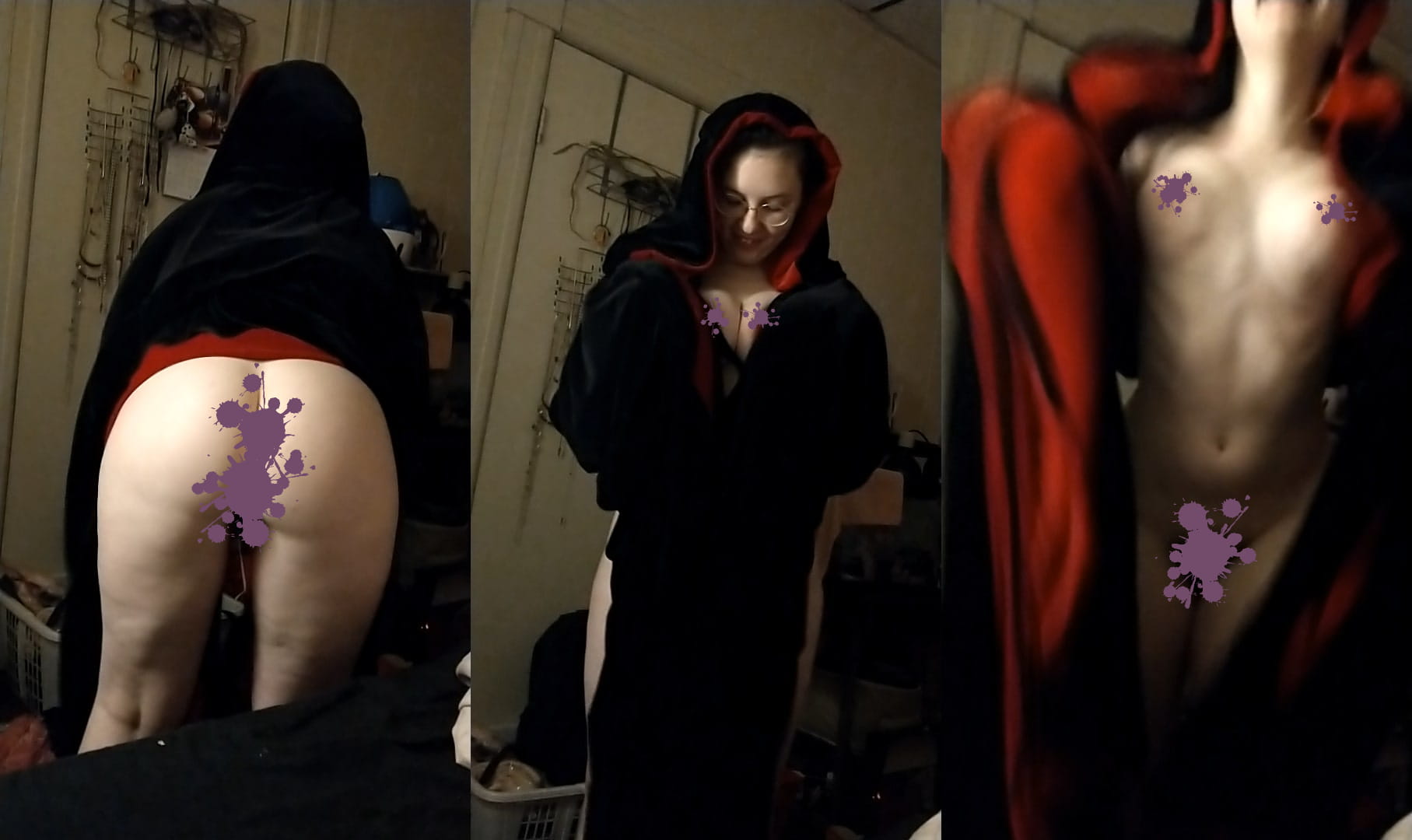
(artists: Cuwu and Persephone van der Waard; source: "Castles in the Flesh; or, a Personalized Example of Derelicts," 2024)
Dark Matter Tangent: Amazons, Vampires, and Cryptonymy in Dualistic Frontier Dialogs (feat. Cuwu)
Vampires, Amazons, Gorgons—these aren't exclusively instruments of state rule, whose instability mid-crisis conceals bourgeois predation; they expose such things, worn upon ourselves mid-entropy to generate those reactions that best weaken Capitalist Realism "inside the cave" (the labyrinth, the castle, etc). So we become the trap-like space, a given cryptonymy embodying its vampirically hypnotic but also transferable, mirror-like qualities to feed upon the state, mise-en-abyme—a mirror-shield crystal ball and sword (eyeball and tooth) all-in-one, reversing vampirism within/upon frontiers being the usual spaces for it in either direction! This anisotropism plays out through poetic shorthand, which during ludo-Gothic BDSM may express capital "in small"; i.e., something to dialectically-materially subvert through dualistic code, tricks, what-have-you as cryptonymy—the Amazon, yes, whose abject vampiric qualities (for instance) feed in duality within given frontiers: those where white Indians play war to teach secret things, leaving "dark matter" visibly behind for others to find and weaponize, accordingly.

(artists: Cuwu and Persephone van der Waard; source: ibid.)
So capital makes workers (and all of nature) undead, but cannot dictate how this cryptonymy operates afterwards. So do familiar faces (and roles) revive, called penetratively to our service while loving to show off their various "wares"; e.g., Cuwu, above, a reoccurring vampire in this case—so much so that "little dragon" became my favorite way to address them... and whose surprise gifting of Seven Cheap Things taught me the value in seemingly exploitative practices, liberation given fresh life among a naughtier librarian's fun-and-games: that I was learning valuable, life-changing lessons while playing with forbidden fruit. Cuwu loved it—deeply proud of their animal wares' power to magnetically hold one's attention (then prey as they saw fit), but also pass vital data along to those "in need": a cunning continuation of endless exchange, coming to fruition when challenging the state's zero-sum game. They weren't the only one, of course, but certainly "broke the mold" (re: "Cuwu's Hand in Forming Ludo-Gothic BDSM," 2025); i.e., on a notably two-way street when seeking fatal (transformative) wisdom, my doing so from other practitioners "holding the cards" (many sex workers being ace in ways that help others progressively wake up; e.g., Blxxd Bunny, below, also helping me develop ludo-Gothic BDSM; re: "The Finale," 2023): a "wild frontier" that reflects/trades in deeply hauntological strategies neither here-nor-there, a given avatar's nudity plying "when in Rome" a potent weapons-and-armor function bearing Athenian knowledge (whose "fire of the gods" ties classically to creation-equals-trade, the forbidden knowledge therein purveyed by human bodies demonstrating land and labor's self-emancipation [through iconoclastic trade] from Cartesian pimps). All the better to wage ass war with (therefore class war tied to culture and race); i.e., in deeply liminal ways whores frankly have, for millennia (who embody the argument and where it takes place, below)!

(artist: Blxxd Bunny; cited: "Broad Strokes; or, Signposting My Work, Post Hoc" from "Sharing the Blame," 2025)
Whatever the monster and its function per modularity (undead, demonic, animalistic), frontiers remain essential cryptonymy. Per frontiers, Patel and Moore write:
Frontiers are frontiers because they are the encounter zones between capital and all kinds of nature—humans included. They are always, then, about reducing the costs of doing business. Capitalism not only has frontiers; it exists only through frontiers, expanding from one place to the next, transforming socioecological relations, producing more and more kinds of goods and services that circulate through an expanding series of exchanges. But more important, frontiers are sites where power is exercised—and not just economic power. Through frontiers, states and empires use violence, culture, and knowledge to mobilize natures at low cost. It's this cheapening that makes frontiers so central to modern history and that makes possible capitalism's expansive markets. This gives us a precious clue to how productivity is understood and practiced. While much has been made of its gory and oppressive history, one fact is often overlooked: capitalism has thrived not because it is violent and destructive (it is) but because it is productive in a particular way. Capitalism thrives not by destroying natures but by putting natures to work—as cheaply as possible (source).
As I conceptualize vis-à-vis their work, capital's division in Cartesian terms manifest in moral geography to organize and exercise power that cheapens life (and everything else); i.e., the whore as the oldest (thus ultimate) scapegoat: the homewrecker as shapeshifting "butt pirate" (from Medusa to us). This concrete lack of form speaks to the exercise I have in mind, and whose context and theatrical heeding of the colonized I've laid out, here—reframing the colonizer's understanding of what they benefit from, often passively on a systemic level, to then subvert it mid-abjection: by placing themselves playfully in oppressed shoes, in frontier stories (the spaces opera or otherwise). Doing so happens not to appropriate, infiltrate and exploit (despite sharing space with those things), but gain better understanding of a larger predatory system that—along with the harm it causes to genocidal, ecocidal degrees (state shift)—remains normally invisible save through stories useful to concealment. Such is Capitalist Realism, ergo state predation furthering abjection per cryptonymy that frontiers are, and where vampires good and bad historically-materially operate to have their savage revenge (and always in duality because all language is dualistic).

(artist: Takena's "Midnight Vampire," 2024; source: "Vampires and Claymation," 2024)
The frontiers capital requires to feed go beyond literal physical land; i.e., dwelling inside recesses of the human imagination, which Gothic stands in for and controls canonically for state access and monopolies. Except workers more broadly access them, their doing so in/upon the same larger mirror and magic, monsters and myths it contains/advertises. So the whore's total erasure is not only impossible (which the state relies on to exploit nature time and time and again) but whose poetic fragments we reclaim "where they are"; i.e., to jury-rig our own counterterrorism, "on the Aegis": as testifying mid-cryptonymy to things capital makes unspeakable save to justify harm tied to profit (the "cost of doing business," Patel and Moore put it). The vampire classically feeds through sight; we can feed in duality from positions paradoxically exposed, able to feed when seemingly "for the taking." Something is always given and received per exchange, therefore letting us take advantage despite any disadvantage our would-be pimps have in mind: to listen to the past as having already come and gone, yet something that walks "among the living" to echo ongoing atrocities with fresh fabrications (the feeding vector).
Whatever is sucked, stabbed or otherwise traded, data is data. Often presenting as "corruption" or "indecent exposure" that canonically blames the whore (testifying to her own rape, below), liberation may disguise and subvert; i.e., mid-exploitation (under canonical shame, sin, and guilt, etc), as "mere play." They share the same frontier as concentric* space of concealment, therefore revelation towards feeding as everyday occurrence in either direction: a Russian doll taking turns to weaponize what pimps use solely for themselves. We're the frontier—and one that yields dark secrets on the homefront concerning state predation "abroad" (actually overseas, yes, but also the projection of current local abuse to Faraway Places closer to home; e.g., redlining and black neighborhoods, gay villages, and native reservations).
*Wherein the predation and decay of imperial frontiers invariably collapse inward; i.e., per Aguirre's infernal concentric pattern as something I describe as arriving after much travel but seemingly no obvious movement (re: the liminal hauntology of war a killing time but also danger-disco to convey predation as something to survive and Numinously subvert, "where power is" by reifying it "in small"; see, again: "Interrogating Power through Your Own Camp").

(artist E. Debat-Ponsan; cited: "Abjection/the Monstrous-Feminine" in "Sharing the Blame," 2025)
These frontiers, in turn, speak both to how we survive and fight back "on the hip," hyphenating victim-avenger to bring frontiers (thus vampirism) magically back—all while speaking to, thus unmasking state predation in the bargain, "topping from below" (as many vampires do, feeding in stillness); i.e., upon highly reflective surfaces (or things acting as mirrors, in this respect). The more we do, "from the slum," the harder for states/the ruling class to feed unabated; re (from "Interview with the Vampire," 2026):
Conjuring up Numinous things to comment on systemic inequality under capital; i.e., home = alien, in Gothic—one whose nuclear model remains haunted by older abuse, and whose victims have tremendous power in terms of their axe to grind: to a seasonal degree felt year-round, the grim harvest of the Halloween whore come home to roost! Nature is monstrous-feminine; the merchandise, during the whore's revenge, becomes a weaponized sphere. By reversing terror/counterterror through a hostile planet-in-small, the alien beings "of nature," under Cartesian dualism, can reverse abjection; re: in duality by anisotropically reclaiming the Aegis upon themselves: "humanize the harvest, expose the state as inhumane" (source: "Paid Labor," 2024). This happens by recognizing how we're alien, then embracing such things to reach others with; i.e., on either side of privilege/oppression, finding common ground during ludo-Gothic BDSM (re: "Healing from Rape," 2024).
The paradox is one of mirrors (above) used vampirically in duality when sending power to and fro: "Everything sits within a cycle of imaginary history that plays out through an endless, genocidal mirroring that must, if it is to cease, be met with mirrors" (source: "Author's Foreword," 2023). Like vampires, so do Amazons-as-White-Indians hide and show what liberation needs to suck back/feed on state doubles. They suck; we suck back—a frontier tactic gleaned from oppressed groups, meaning any who still use tactics today to survive and project their vampiric qualities forwards: a continuous undead (or otherwise) trade of data and wares for exchanging it, empowering intersectionality versus Cartesian division (and good/evil partitions of the land, but also territories of the body and spirit through art). The curse becomes a weapon that speaks to harm without harming workers, but one to bounce back from hellish zones whatever we need to turn the tables! Time is a circle to enter and parlay inside, and where the oppressed (and their pedagogy to learn from) "hold the keys"; i.e., per flotilla, sailing strange pathways towards liberation: a battle to free the mind from Capitalism Realism, thus transform and fight back "while inside" as learned from those who came before (the Wisdom of the Ancients or Ancestors, called accordingly by Gothic and Indigenous cultures; re: "The Value in Showing Intersectional Solidarity When Combating Fascism," 2025).
Learning from Others (exhibits on intersectionality)

(exhibit o: Source, left: Gymeagary's "Tamaki Wharenui within the Clan* Marae," 2015; cited: "Maddie Minx review," 2025. Artist, middle: Pam VanChaos in "Postscript: Arrows for My Quiver" from "Quality Beyond Measure: Remembering Jonathan Joss," 2025; right: Tabernis' "Florenscentia," 2026. War = something to advertise different things in a shared embrace, one where "savage†" and defense of one's home from capital, during ludo-Gothic BDSM, takes on educational, archival and performative qualities: when playing war in guerilla-style ways, mid-theatre, isn't "mere play" alone but seems that way to untrained eyes facing tools of violence, terror and warrior-like bodies [re: sex and force]. So do emergent players regain control as dualistic gargoyles; i.e., by stealing in duality Promethean-grade secrets from an imaginary past, which applied subversively help improve a cultural understanding thereof conducive to better praxis: uncovering fresh, old-is-new methods of revelation that minimize risk, harm and things that cause it [the bakers of new bread and circus conducive to liberation]. While doing so, "playing war" verges on "playing dead" [or with them] to deceive one's opponents, commenting all the while on potential change; i.e., whose radical, oxymoronic hyphenations—e.g., of sickness and health, death and food, eyes and teeth, body and building—raised from imaginary realms: a given proximity with barbarian "past" [re: the Gothic] as performed in earlier historical periods. Courting power-as-Promethean, each hauntology's imperfect resurrection supplies—through tremendous paradox—the chance to yield "darkness visible." Wisdom, then, is the context of play itself as yielding better outcomes, and whose "splendid lies" tell over time: while in the nude [the sex worker's frontier] concerning a partially imaginary past; re: as half-real, sitting between fiction and non-fiction but also body and land, alive and dead, friend and foe, clothed and naked, etc. So new subversives treat and toy with dead things, taking pre-capitalist language towards post-scarcity within holistic dialogs [which the Promethean Quest is, and has been, since 1818]. So "the gods" = alien, ergo the forbidden by which to explore personal limits; i.e., tied to systemic pitfalls we use to reduce harm: through reclaimed materiel, stolen back from Cartesian thieves to unify in opposition to our class enemies [regardless of our own class origins, tied to race and/or gender].)
*The specific group is the te arawa iwi, Bay explains. Also, they add, the familial "hapu" and larger "iwi" are what Maori use to self-organize, not "clan" (a Western Celtic term).
†Something to reclaim in performative ways; i.e., as Patel and Moore move away from the newer Cartesian standard, in Seven Cheap Things; re: "As recently as 1330, savage meant 'intrepid, indomitable, valiant.' That positive use faded by the end of the fifteenth century, replaced with its modern one of 'in a state of nature, wild'" (source). They explain earlier in the book; re: "The cleaving of Nature from Society, of savage from civilized, set the stage for the creation of our other cheap things [...] Nature was remade, reinvented, and rethought many times over the next five centuries" (the land a Frankensteinian project—one carved up and harvested by Cartesian powers dictating force in defense of the state and nuclear model, below).
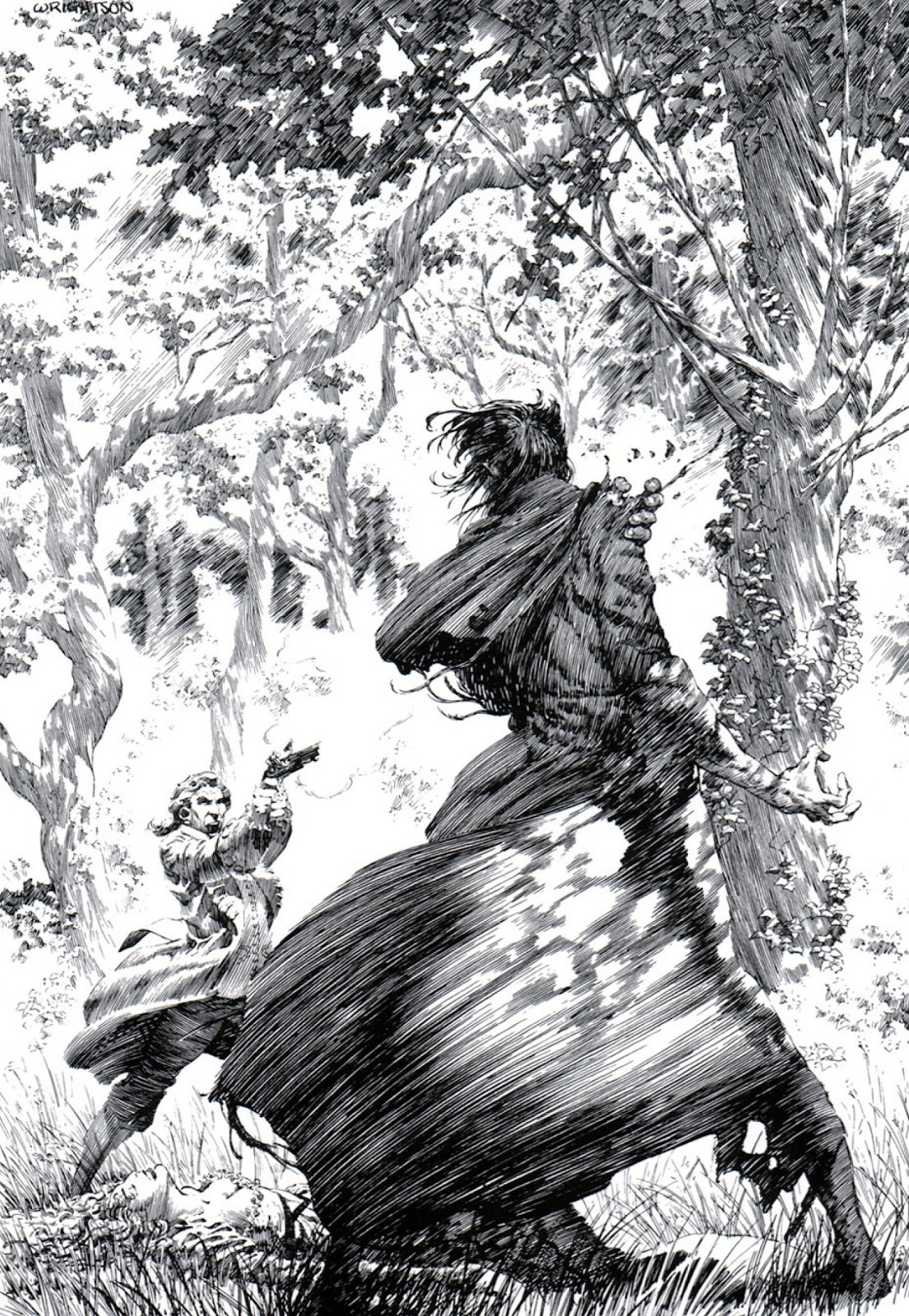
(artist: Bernie Wrightson; cited: "Psychosexual Martyrdom")
A bare savage making war from demonized positions of vulnerability under colonial shadows—Amazon or otherwise, these ideas elude capture by state monopolies. Indeed, I received them like the vampire's curse by others more oppressed/oppressed differently than me; i.e., in ways we should collectively heed by incorporating into a shared work; e.g., my Indigenous partner and co-writer, Bay Ryan—a non-binary Irish-Maori therian ecologist—pointedly informing my own eco-Socialist, anti-racist views (the pulse of my heart). So I combine this-or-that in my usual ways, heeding different oppressed voices through Gothic Communism as a holistic discipline: one of circular reflection—Indigenous voices wedding to GNC ones and sex workers, et al, as pimped out by the state and reclaimed through play as paradoxically armored/armed while nude (concepts we'll touch more on, deeper in). In other words, intersectional problems require intersectional solutions—with Gothic Communism stressing intersectional conscious and solidarity (awareness and teamwork) while combining modules of class, culture and race. No reductionism, no scapegoats. Here, "White Indian" doesn't reduce to state infiltration (fascism), alone; it provides a lens of alienation (the Aegis) that raises empathy and arms rebellious workers: with trashy tools for war to punch up with, mid-play in duality (during ludo-Gothic BDSM, having the whore's revenge while seemingly "disarmed," below).
This includes older examples I've worked with—meaning through the usual rules (and their exceptions) worked out by all sides; i.e., illustrating mutual consent during ludo-Gothic BDSM through the dialectical-material context of exchange (re: "Illustrating Mutual Consent" from "Paratextual Documents"):

(artist: Bay Ryan, Victoria Saix, Cuwu; source: "Fresh and Familiar Faces, Working in Secret to Burn Rome to the Ground (when reviving Medusa)" from "Yesterday's Leftover Rice," 2026)
It also includes new cases, many which I illustrate and invigilate during the Amazon reprise. However, I have more I'll include right now before said reprise: power having infinite forms to assume that, when transforming into different things (a demonic quality), speak to nature as preyed upon to chimeric undead extremes; e.g., "dog soldiers" not historically Indigenous, alone, but Whites Indians tied to GNC and Pagan elements just as old; i.e., trans people as old as Indigenous cultures, dating back millennia: witches and werewolves just two of an endless Legion of different disguises' imbricating persecution language (e.g., blood libel, sodomy and witchcraft; re: "Idle Hands" 2024). These and others intersect to wage war in service to workers and stewardship of nature; i.e., while belonging "to it," undermining the state's ongoing Nature-vs-Society binary (of thinking vs extended beings) Patel and Moore describe. For state vampirism, there must always be a frontier (and savages, nude or not) to leverage power in service to capital. Precise history matters less, for state predation, than those cyclical fictions states tell and perform to aid said predation (moving money through nature while raping it, blame-the-whore ergo the savage).
To it, there's more than one way to reverse abjection thus break terrorist/counterterrorist monopolies on violence, terror and morphological expression, and whose monsters, magic and myth (re: sex, drugs and rock 'n roll, per the Gothic mode) do not monopolize for one side, exclusively (the cases given below works-in-progress, for now): a means of safe passage but also message, and of smuggling weapons hidden, Trojan-style, in plain sight (the animal veneer made by Athena to break seemingly impenetrable defenses). "Smash or pass?" The usual camp (and ironies) ensue: you can't harm what you can't hit (a concentric illusion—one able regardless to provoke, nudity-equals-violence, worker counterterror behind various invisible buffers, masks and shields; re: "revolutionary cryptonymy" and "transgressive nudism" as "Interview with the Vampire" footnote 10 describes). So sex-as-terror-weapon works, mid-abjection, much how Amazons do—by transforming through public nudism as materiel substitute (weapons and armor) to reverse abjection, reclaiming one's body (and other canonically dehumanizing things): to rehumanize nature-as-whore "on the Aegis," and by using what's "on hand" (our great revenge).
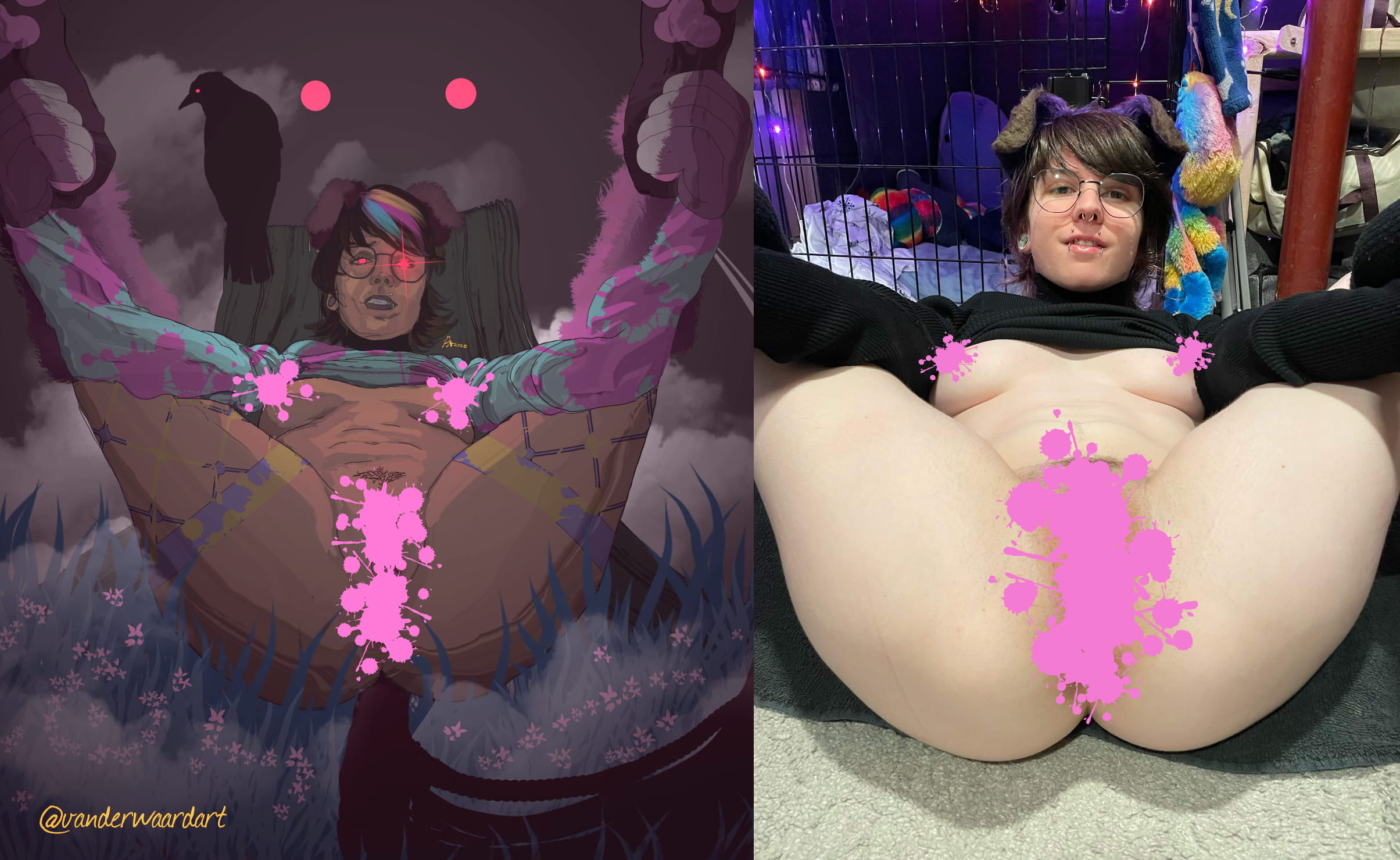
(model and artist: Cuspid and Persephone van der Waard)
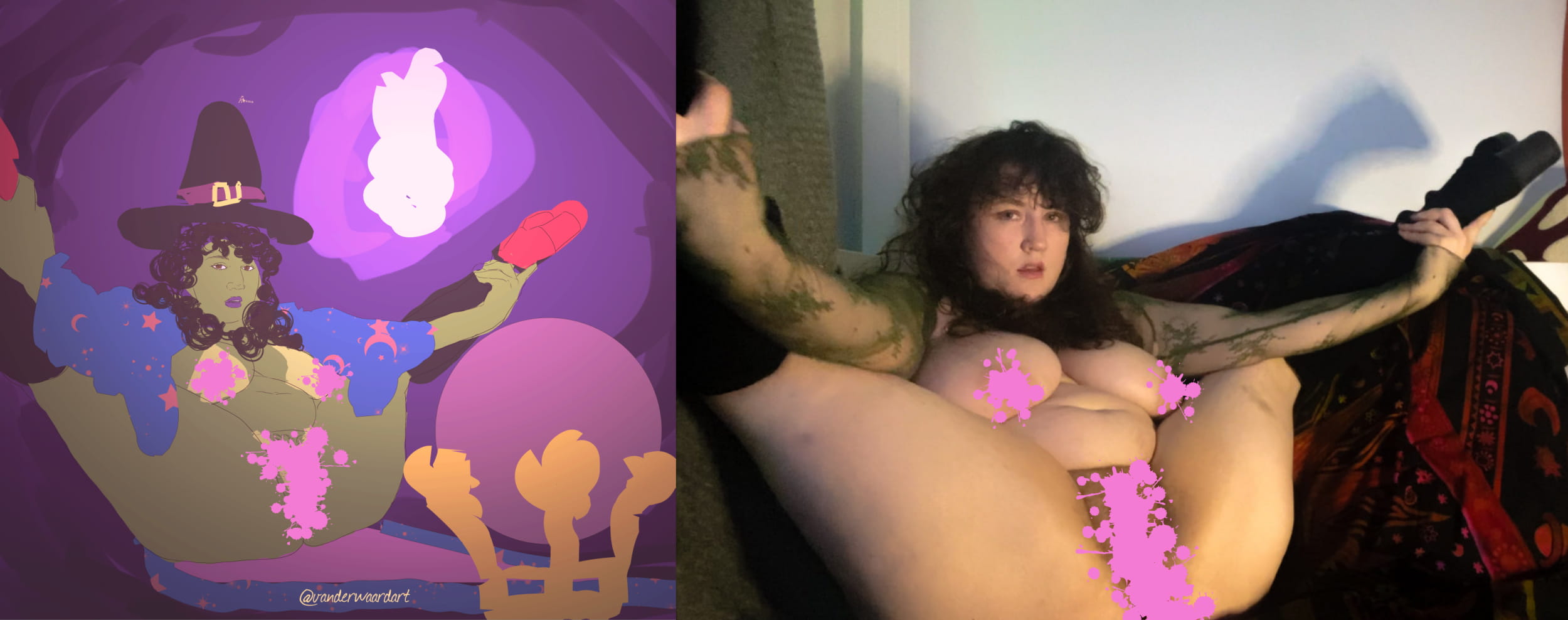
(model and artist: Amanita Daukta and Persephone van der Waard)
[more to appear]
These and others channel Nature vs Society to interrogate state predation, ergo "order" having fallen into chaos regarding the state thus nuclear model; i.e., seemingly "under attack" during Radcliffean false flags, the Amazon without a leash "disorder in the flesh"; re: whose Black Veils and their magic (the language of the alien) also aren't hoarded and abused by one side, alone (e.g., Nintendo and the Mario franchise's Gothic pastiche, below). Instead, it's fought over to further or reverse abjection, since time out of mind: the enemy but also warrior in disguise to change their shape in different trickster ways, during ludo-Gothic BDSM; i.e., where centrism, under neoliberalism (which videogames embody to serve state hegemony through corporate, privatized means), arbitrate the recipient of state violence as "bad," and the giver of state force as "good." These transpire under military optimism and its cartographic refrain, therefore moral geography and "good nature" as having Cartesian, heteronormative and settler-colonial qualities; i.e., that workers cryptonymically subvert, Prometheus-style: away from state monomyth varieties furthering abjection, parody and pastiche sharing the same frontiers exploitation and liberation do—cops (class traitors with token [race and culture] elements) buffering capital and empire from their own predation, policing nature and sex through force upholding nuclear models (an idea we'll touch on more with canonical essentialism [2024] during the Amazon reprise).
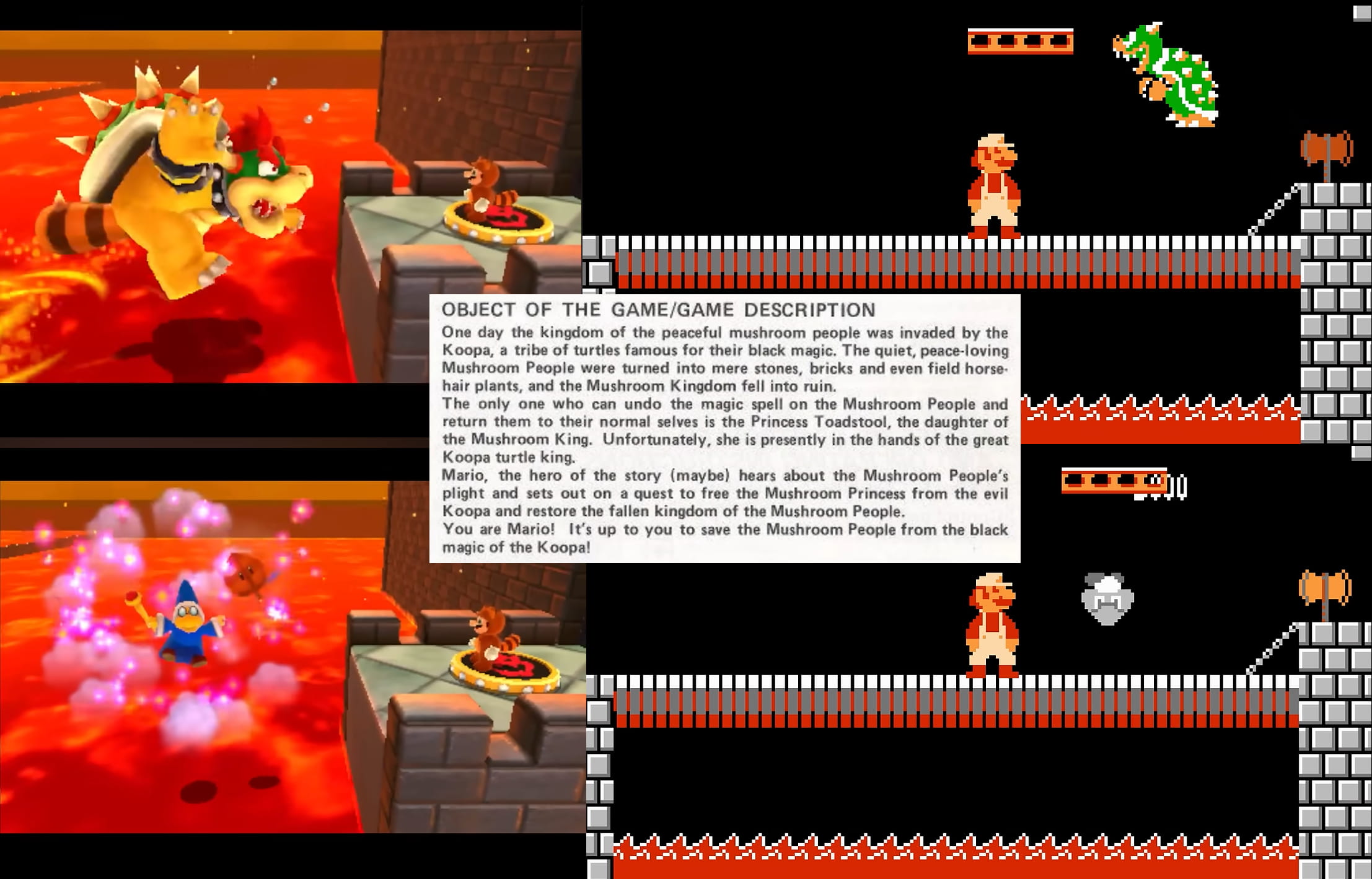
(exhibit 1: Source screencaps: Kosmic's "Mario 3D Land Speedruns Are Amazing," 2026; timestamp: 41:31. Corporations monopolize Gothic in service to preserving a so-called "natural order." Here, the hero may use the same devices the villains do, actions moralized by the good/evil team on which one belongs [and translates readily to genocide being something to conceal or otherwise distract from, under Capitalist Realism]. Such things, again, are half-real—meaning workers can take what states abuse [videogames or otherwise] and use for worker rights/the rights of nature as a whole, onstage and off. This includes Mario's vaudeville-in-disguise, but also Gothic tropes; e.g., the demon lover [dragon or otherwise] kidnapping the damsel-in-distress who—in more ironic outings of the love triangle—might want to be "kidnapped" and "ravished" by the villain! Here, Mario is a White Indian played classically in bad faith, the master/slave argument pimping nature's criminal horniness [echoed by Bowser's many anti-predation spikes] to hold the latter accountable for state crimes: dragon DARVO thirsting for Mario's pre-owned bride [with "Peach" being her own crude, cherchez-la-femme metaphor inside the chronotope]. The same way that you might give someone green skin [the color of stigma] or otherwise demonize them, virgin/whore, the binaries of terror/counterterror reverse through function, not aesthetic. And while all's fair in love and war as far as that goes, capital and state obscurantism treat "fair" as anything owners do to maintain control; anything that changes control, mid-abjection, they predictably and hypocritically call "unfair" [and generally with as much entitlement and petulance as possible]. The ruling class doesn't play fair when playing with fire, so neither should we!)
Anything can be a weapon, Asprey remarks (source). This includes the usual things controlled by state actors, Amazons and anything else rent asunder per iconoclasm: sex, athleticism, public nudism, etc, as military devices conducive to heroic action, cops-and-robbers (with sex the most valuable property a kingdom has). So power = something to Gothically perform in deeply trashy ways—to camouflage, downplay or otherwise subvert and disguise rebellious elements, and all while keeping theory and struggle in mind, but also media literacy and analysis; i.e., made of disposable things conducive to playing war as both data to communicate, but also utilize: in praxial, dialectical-material ways that make workers more aware, hence able to consciously cooperate through intersectional teamwork that keeps oppression in mind. Teamwork makes the dream work, especially during nightmares we wake up into as already known to people more oppressed/oppressed differently than us. From Dante to us, Hell has many circles (the deepest being where Satan eats sinners alive).

However "naked" or false we might feel and/or actually are, turning that into a weapon mid-unheimlich remains undeniably useful; i.e., when asking important (and pertinent, impudent) questions mid-play that invariably result: "Are you here for peace or for war?" Often, the lesson appears as "mere play" (or shadows; re: Gloggins, 2020), one that discovers a hidden second function; i.e., trapped allegorically inside the fad, craze, or anything else Gothic has been called (with some justice), over the years—and one that people with relative privilege don't realize subversive potential for until much later (as was the case for me)! In doing so, we "go native" while playing White Indians in good faith, becoming the hidden side of genocide played out to seek revenge (versus bad actors using the same costumes—the TERF a classic White Indian on frontiers of "actual terrorism" largely invented to serve state power). Doing so remains an act of synthesis, one occurring dialectically-materially through subversive media-as-performance, aka camp.
Thesis given, and essay body/tangents exhausted, "The Gist" and Amazon refrain shall expound and reiterate the same material—a conversational refrain of sorts (and the essay prototype) before we wrap up with "Original Video Notes."
Essay Prototype
This portion is the written essay prototype, which contains and preserves my thesis argument in shorter, more conversational forms (e.g., the Amazon refrain and initial exhibits therein).
The Gist; or, Camping the Space Opera "When in Rome" (which "White Indian" Stories Are)
The Neo-Gothic concerns a dreaded return of the imaginary "barbaric" past, one space operas follow in the same proverbial vein: a retro-future space of the barbarian (usually an impostor) come home (as frontier), but occupied theatrically by different groups sharing the costume "when in Rome" (e.g., Hornet from Hollow Knight: Silksong [2025] and her mask, below). Satire usually imitates, however badly, what it chases (e.g., Amazons not actually men, despite some acting like men while stubbornly chasing the truth). We're left with "Indian" as dualistic—a dead metaphor whose zombie dogma has become conspicuously "white," but punches all the same up or down in colonized/colonizer ways: by adopting anisotropic and apotropaic (flexible, protective) language per the terror/counterterror binary and its hunted-vs-hunter refrain (re: "Prey as Liberators," 2024). To that, Gothic Communism abjures Cartesian dualism in duality by camping or otherwise subverting canonical media; i.e., during the dialectic of the alien (2024) as deeply liminal; re: nature is monstrous-feminine, whose paradoxically anti-predation qualities can uphold the status quo of Capitalist Realism or not; e.g., white women currently members of the in-group that arbitrarily select out-group language for/against liberation from the state, I-admire-its-purity (classically tokenizing through subjugated Amazons that—like so much of feminism, historically—triangulate versus outsiders, out from Antiquity into modernity under capital; re: "Regarding Tokenism and Fighting It," 2025).

(artist: Fried Unicorn Studio; cited: "Persephone's Silksong Symposium!" 2025)
That's essentially "the gist." Our argument, here, concerns the White Indian as something to subvert, me falling back on "Amazon" (and similar devices) to do the job. However, the theoretical model stays black/white in ways that allow white performers (race or otherwise, white-equals-in-group) to wear different black masks, mid-abjection; i.e., "darkness" means "alien," "madness," stigma" or "abuse" (etc) as vaguely positioned on someone to transform them. Framing giver/receiver within a flexible state of exception's modular imbricating persecution language, many terms occupy a similar role intimating the repercussions of nature "on the loose," prowl, or hunt, etc. "Barbarian" = "savage" or "outsider" who is both alien to the land but tied to it as something states alienate, fetishize and exploit (as "homo sacer" per state of exception); i.e., through settler-colonial contradictions under capital, whose notably Cartesian MO divides and conquers nature as usual. Pimps recruit from those they pimp, whose endless boom-or-bust greed eventually bridles the Amazon once crisis and decay set in (e.g., Chun Li is a cop who—celebrated as a forbidden sex object [the "strongest woman in the world," sex-equals-strength]—enjoys some degree of autonomy by working for the man in deeply fetishizing ways, below).

(artist: Edayan; cited: "Borrowed Robes," 2020)
"Invasion is a structure," wrote Wolfe (2006), and capital repeatedly invades itself outside-to-inside the Imperial Core (fascism when Imperialism comes home to empire). It's the frontier myth as home to constant performance and (re)assignment, good actors and bad sharing the same stages, games, public nudism and Gothic, pimps-and-whores language. Home = alien per state vampirism, "theft" spoken to in different uncanny ways; i.e., while mastery decays (and laments its own outrageous demise), safety increasingly uncertain. Here, the nude/clothed binary speaks to exposure with nature as occupied by frauds, which campily subvert Western shame and stereotypes; re: we share the same mirrors and mirrors paradoxically show and hide weapons in plain sight: finding common ground as different oppressed peoples. Oppression takes many forms; all fight for the same right to be seen and heard during ludo-Gothic BDSM, a given savage-laid-bare camping holocaust under shadows of an ever-present police state (re: "Healing from Rape"). Here, the black/white binary takes on different meanings, including skin color's subversive role "on the Aegis": white meat, dark* flavors (or some-such food metaphor).
*As I write in "Demons: From Composites and the Occult to Totems and the Natural World" (2024): "Under Capitalist Realism, something is 'dark' if it ostensibly moves anything of value (re: power and knowledge) away from the status quo. Generally this darkness is associated with the vengeful imaginary past based on buried historical atrocities, the latter paradoxically twisted by the former to keep control right where it is (among the elite). Anything that challenges this paradigm is canonically framed as dark, evil, profligate; i.e., nature as vengeful whore, which capital takes revenge on through DARVO-style police violence/obscurantism, witch hunts, tokenism and moral panic; e.g., Medusa and her Aegis' forbidden sight (source).

(model and artist: Cuwu and Persephone van der Waard; source: "Interview with the Vampire")
Dark chocolate remains sweet despite the bitter notes (with Cuwu [a Marxist-Leninist, above] both feeding and sheltering me from harm, going so far as to offer me their pussy in bed until switching to anal after getting too sore). Moreover, such things further or reverse abjection in deeply cryptonymic ways (the paradox of open stealth; e.g., British polari slang working under police surveillance and half-real theatre to survive but also thrive, mid-imprisonment): the mask-like disguise of the phantom of the opera (or something comparable, terror-wise) but also brand that communicates less abstractly and more through poetic code/shorthand an arbitrary giving and receiving of violence, terror and monsters; i.e., whose monopolies (of sex and force) under capital demonize nature in mirror-like ways; re: the Aegis and nature-is-alien (a black mirror White Indians call home) speaking to the Gorgon as predating systemic racism (and nuclear appetites eating nature), but no doubt hauntologized in retro-future forms. Concerning ongoing monopolies of gods and god-like things, so we steal their fire apotropaically and anisotropically for ourselves; taking ours back, so we walk away from Omelas ergo any false deities the bourgeoisie (and their defenders) act like.
Same shit, different day. Here, the peacock preserves under moral panic and political violence; i.e., as subject to state vampirism, a giver player-as-prey denormalizing their own predation by embodying whatever its predators cannot see—meaning anything but threat, the cop (actual or stochastic) clumsily exposing their own betrayal when dropping the mask: "once bitten," scratched, etc, by the usual tactically frivolous tricksters laying traps. Power is performed but also haunts the hearts and minds of the public, long after (spectres of the Gorgon, who cannot die)! We walk the same road when in Rome, Gothic auteurs merging ancient Comedy and Drama to relieve tension and expose enemies—meaning since Sophocles to Shakespeare, Walpole to Lewis to Shelley to Ridley Scott to Jordan Peele to Curry Barker as seeing sodomy fears camped before and after Wiemar into Stonewall, AIDS, and neoliberal scare tactics' half-real frontiers. Survival is the queer baseline, "burning Rome" from within to expose the bandits "running the show"; i.e., similar to Indigenous struggles (or any other colonized polity under state dominion), "blowing the whistle" from different positions of ostensible disadvantage: "If you strike me down, I shall become more powerful than you could possibly imagine." So says the White Indian when actually oppressed and punching up, worker-rights-vs-state's-rights; so do such martyrs have the power to haunt their foes but also clown on them, reminding onlookers mid-panopticon how dignity is something our enemies cannot so easily take (anymore than squeeze the porcupine for answers).
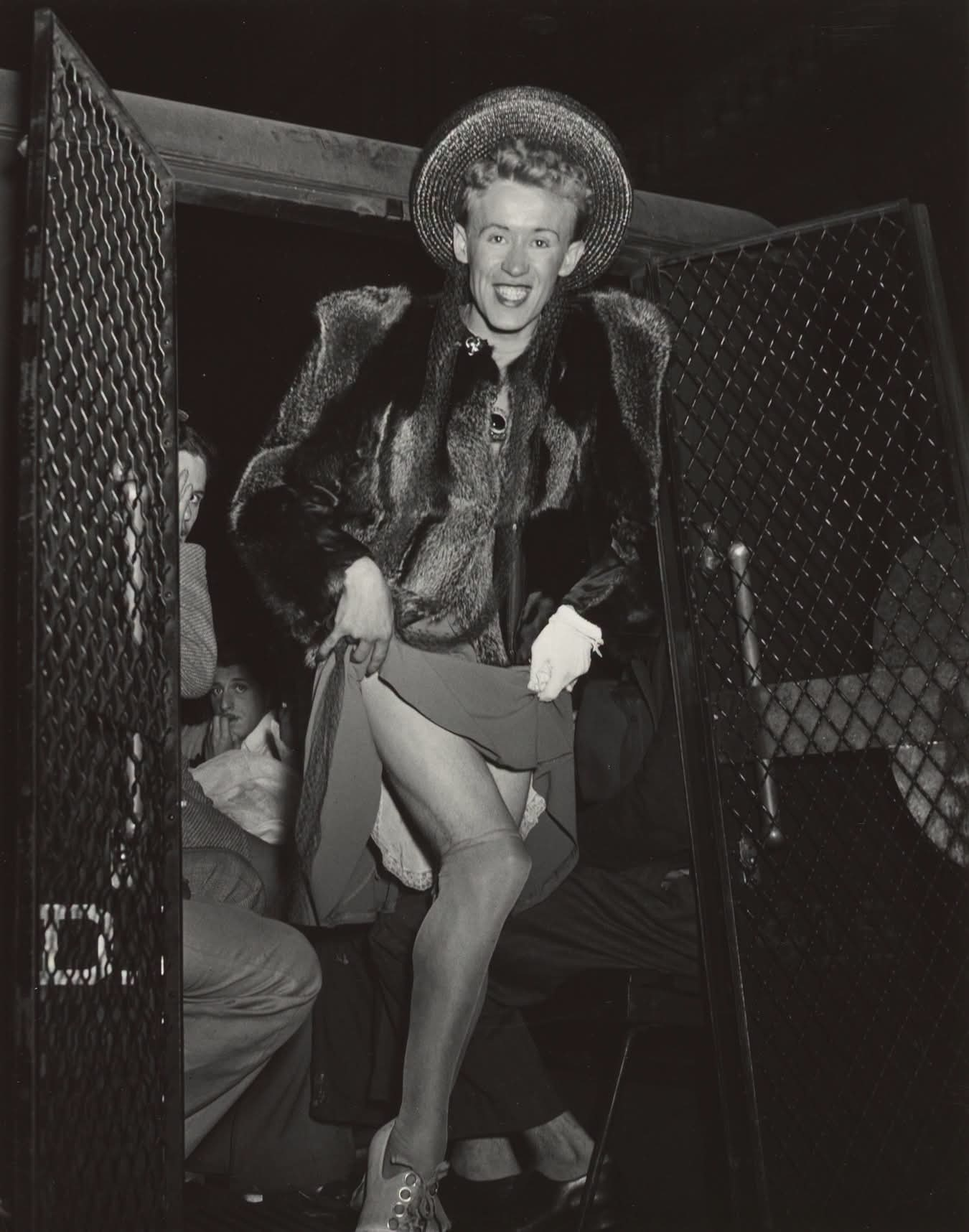
(photographer: Arthur Fellig)
As a holistic discipline, Gothic Communism aims to describe lived realities and systemic violence without tokenizing such matters, nor weaponize Gothic poetics for state predation through DARVO and obscurantism (the bad actor's usual tools when serving state power). What they invent in bad faith from the 1790s onwards (re: Crawford, 2013), we resourcefully reinvent (thus reenact) in ways useful to liberation-under-duress exposing the utility of exposure (and lies); i.e., to cryptonymically expose as useful to exposing whatever we need: less true/false and more somewhere in the confusing middle; e.g., the gay man in and out of the closet as "inherently deceptive" (above). That means in ways that historically play with lies—to vampirically expose hypocritical bad actors state-side calling us degenerate (re: "Joy Under Fascism," 2025), but also expose and shield ourselves for centuries. As one does. For the state and traitors among the working class, sex sells while being intrinsically "wicked" (one contradiction among many others, virgin/whore); for us, sex isn't automatically sexual (as an erotic mechanism), but a social practice that comments, first and foremost, on state predation "given flesh": the warrior princess, killer doll, military athlete, drag queen, and similar theatrical evocations of madwoman-in-the-attic White Indians evoke (the captive savage). Out of the closet, the escaped convict, gangster or supervillain might speak in frank vampirism to alter-ego secret identity as both armored and armed through shadowy exposure: as, like all such things under Gothic, deeply liminal and dualistic to cryptonymically reverse abjection with darkness visible (nature as monstrous-feminine pimped and policed in equal measure, savage-equals-demon).

(artist: Wolfhead at Night; cited: "Toxic Schlock Syndrome; or, an Early Stab at Cryptonymy: Amazons, Body Hair and Whistleblowers," 2025)
I've explored this before, concerning witch hunts, goblins and vampires, etc; i.e., in weaponized rape dialogs (and nature as space of rape under natural and manufactured scarcities) that cut both ways, mid-abjection, to have revenge for pimps or for whores (through Amazonian witchcraft, blood libel and/or sodomy accusations; re: "Rape Reprise" and "Idle Hands"). The same poetic idea applies to cop/victim acted in good faith or bad that, just as well, include the survivor and/or avenger swept dualistically up into shared Gothic theatrics (and frontiers patrolled by ambiguous gargoyles). No one can monopolize oppression, but oppression can be acted in bad faith (e.g., Autumn Ivy [above and below] as sex worker I initially approached, in good faith, then critiqued for licking the boot as White Indian); i.e., from Jodi Byrd's The Transit of Empire (2011) describing the white performer wearing a "black" or Indigenous-coded sock puppet in zombie-like ways. While these canonically discard Indigenous perspectives outright (and reverse Coulthard's Red Skin, White Masks argument, 2014), my own writing on White Indians, black planets (and Samus Aran from Metroid in "Unto the Breach") allow collectively for attempts at empathy under dehumanizing or otherwise uncanny conditions; i.e., those that speak on Indigenous exploitation applying diametrically to marginalized in-groups—an ultimatum: "Put on the costume and play the role, or pay the price." So often, cops are pinkwashed whores, pimping themselves while appearing rebellious on approaching frontiers (the best lies based on truth, including grievance). Yet Umberto Eco's weak/strong enemy can apply, just as well, to heroes cut from stolen cloth, Golems from shared clay (crude composite metaphors).

(model and artist: Autumn Ivy and Persephone van der Waard; source: "Amazons")
Segregation is no defense, assimilation poor stewardship of the natural world (the paradox of exposure walking a knife's edge, above). Like the vampire, dialectical-material context is both normally invisible and suddenly vivid through different theatricalities codifying state predation; i.e., dualistically, yes, and in different styles—with broader binaries such as black/white or colonized/colonizer yielding different flavors of class, culture and race than cops-and-robbers (and overlapping modules, per kayfabe; e.g., the Amazon and vampire evoking that classic overlap of fascist and Communist feminism, above). A cop is a cop, betrayal betrayal wherever it occurs by virtue of function "at play." Tokens spend through relative privilege/oppression, those with privilege betraying out of convenience and desperation for those without. These gentrify and decay. In short, there's always another land to abuse, a specific territory given over to frontier arguments of alien invasion that "must be resettled"; i.e., while scapegoating the usual suspects for state theft, tokens scapegoating themselves in undercover ways. Classically the house as retro-future, it's a fortress "under siege" invaded by imposturous doubles: the home as vampire, skull-equals theft, but "vampire" an ambiguous corporeal argument with alien but also Indigenous terror components. So a given neo-medieval hyphenates house and whore in phallic, courtly and pervasively "Freudian" ways, and whose Radcliffean morphology reliably survives the bloodbath (dead dogma camping Freud's ghost: with fresh hysteria equivalent to a lucid dream, one counteracting generational trauma/stolen generations by reclaiming the wares holistic liberation [and intersectional consciousness] routinely require).

(artist: Hallie Cross; source: "Preface: A Note on Amazons (as Warrior-Maiden Cops, thus Whores in Bad Faith; feat. Hallie Cross)" from "Persephone's Silksong Symposium!")
When camping such things to break Capitalist Realism upon ourselves—meaning while using the same costumes during ludo-Gothic BDSM to send power down, hugging Medusa as the ghost of the counterfeit—iconoclastic performers want to avoid a Peter-Pan-style playground; i.e., one classically using the White Indian to pinpoint ethnocentric, specifically white Eurocentric perspectives over more/differently oppressed groups; e.g., Mel Gibson's Braveheart (1995) and Pocahontas (1996). Such stories unironically position white straight men at the top, even when sacrificed on the alter of freedom. To that, the former would tokenize Scottish oppression in ahistorical ways to serve state terror in the 2000s—essentially a cartoon rebel white colonizers abuse at home and abroad when harming women, children and racial minorities, and doing so through weak/strong hero complexes playing the victim in bad faith (re: the War on Terror). Gibson's Wallace simulacrum plays the dead wife card, raising her like a false flag to "defy tyranny" overseas outside the film. By the end, she's no more real than Mandy was for Nic Cage: a White Indian as vengeful "brave" (complete with woad facepaint, Promethean fire, Cartesian coding* and ghost-like slipperiness) becoming increasingly bloodthirsty before sacrificed in a Christ-like way (Gibson notably and loudly Catholic).
*"I never tell a lie," Gibson swears, in Latin, "but I am a savage!" He frames Wallace as the barbaric exception—a "special case" elevated by higher learning to make him an equal to the English, on and off the battlefield (say nothing of the French princess he bangs after his wife buys the farm).

Then there's the fur trader's ruthless, land-seeking pursuit of exotic animal princess, in Pocahontas (and similar white-savior-playing-Indian stories; e.g., Costner's Dances with Wolves and Cameron's Avatar franchise, 1990 and 2009)—all while infantilizing her and turning her people into perfect victims doomed to die. Doing so reduces actual history into dead dogma, under the Protestant ethic (the British who came to America the Puritan side of that coin). Take virtue signaling under Western Liberalism, then swap it for vice signaling as the fascist side "rising from the grave," mid-crisis; e.g., Atun-Shei's "Matt Walsh Hates Indigenous People" (2026)—with Shei noting how Walsh (a less-talented-but-unscrupulous Gibson clone) throws out the Disney-grade liberalism to straight-up demonize (thus pimp out) Indigenous People; i.e., as abject savages, barbarians, cannibals, captors of white women, what-have-you (which "Playing War" shall unpack further). Virtue or vice, reactionary or moderate, vaudeville is vaudeville. To camp it, we must swim in the same waters, and holistically using "Indigenous" language for better aims. Avoiding it only furthers abjection, whose process segregates colonist from nature all the more, and whose bond must be restored therein to survive capital's universal predation: heading towards disaster as not far-off. It's land back or bust, babes, out of the frying pan and into the fire (the killing fields)! Time to go native, heeding others already there!
Gothic Communism: A Holistic Approach (reprise, Amazons; feat. Allie Reads, Amanita Daukta, Fishnet Housepet and Lilith Mae)
Last but not least, a quick reprise about Gothic Communism's holistic approach before we dive in—featuring Amazons as powerful stand-ins for rebellious sex workers (my poetic specialty and praxial focus, respectively): the freakshow alien of nature to hug and embody in defense of one's home from predation (the state classically feeding in secret, which holistic study helps reveal over time).
Doing so includes my art
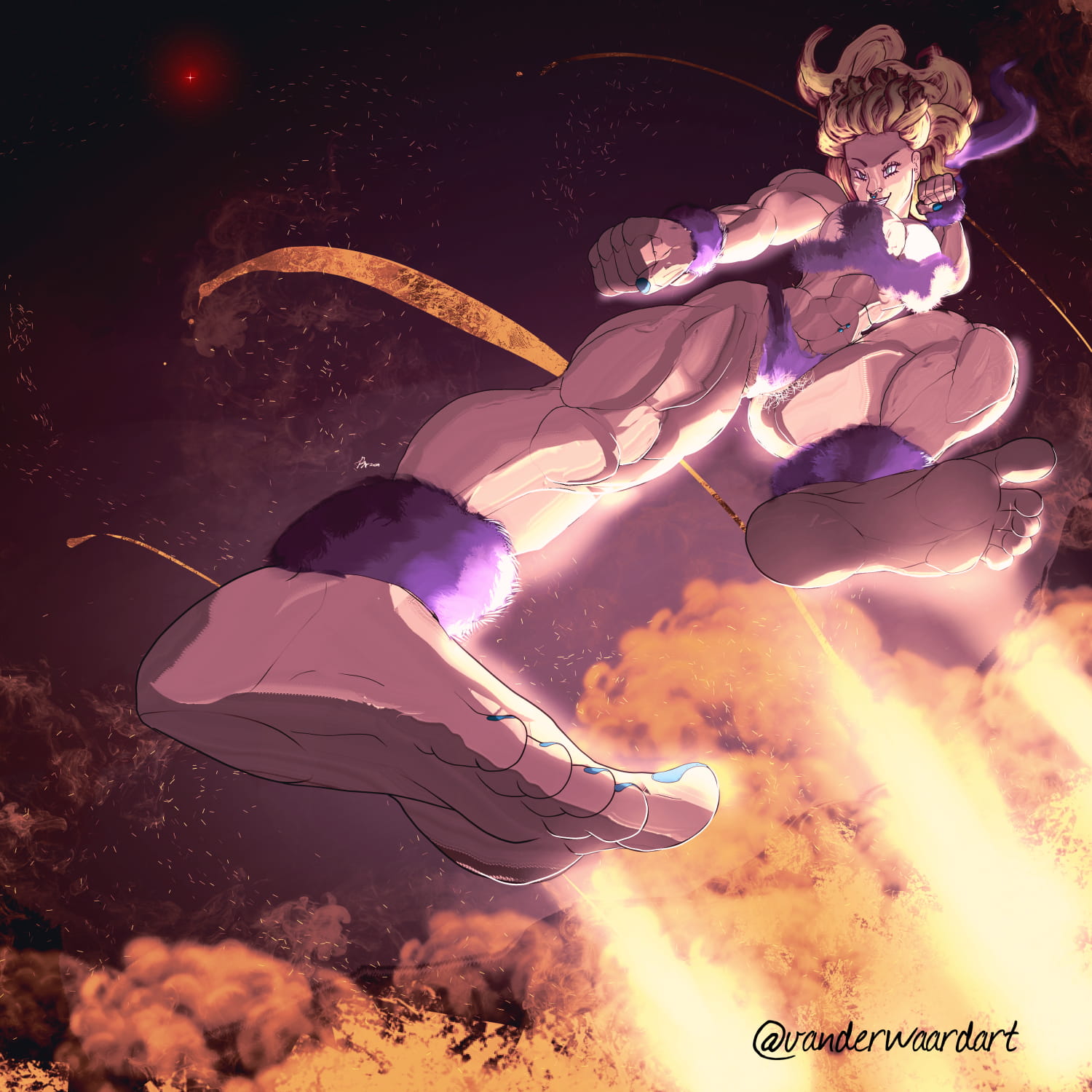
(artist: Persephone van der Waard)
but also the art of other sex workers and their own public nudism; i.e., as muses working separately from me and part of my series, in Amazonian ways:

(artists, left to right: Allie Reads, Amanita Daukta, Fishnet Housepet and Lilith Mae)
To it, Gothic Communism is a holistic, liminal, and ultimately dualistic, anisotropic process—one reversing abjection (therefore state predation) by combining and playing with different theatrical ideas and theories from different degrees of privilege/oppression, but also states of awareness and alienation under a colonizer/colonized binary (e.g., forbidden love; re: "I'll See You In Hell"). Capitalist Realism is the fear (for the state) of an unruly nature; i.e., monstrous-feminine refusing to obey despite the illusions in place, including Amazons (the myth of nature's warrior past defeated by callow men gaslighting their wives into gatekeeping and girlbossing themselves). Pimps fear what they're told is alien, having given sex workers unintended power by viewing and treating them as monstrous homewreckers: the weak/strong thing to chattelize and rob, per state contradictions. Why surrender everything to this system, when whores might just as well remind capital's enforcers of their own debt to us and what we control? An alien refusing to kneel like their classically subjugated brethren, subversive Amazons (and similar monstrous-feminine) instead become the avenger that castrates, in duality, patriarchy and state power—by bending binaries, breaking monopolies, and taking back land, labor and the human body's animalistic, terror-class weaponry (e.g., Amazons* and anal sex; re: "Our Sweet Revenge," 2025)! It doesn't assimilate (which is poor stewardship), but whose "going native" turns coats/changes teams versus the bourgeoisie—meaning in ways that require some degree of imagination; i.e., play-as-ritual (therefore instruction) for uneven degrees of privilege/oppression, but generally among abuse survivors without appropriating cultures live or dead (with white† women legally property and criminogenic rape victims for most of written history).

(artist: Dandonfuga; cited: "Our Sweet Revenge")
*Re: Classically female barbarians (and white, in 20th-century hauntologies), but allowing for any gender or biology in GNC dialogs (similar to the Gorgon and other monstrous-feminine, besides). This modularity of culture also applies to race and class. Amazons "swim in Styx," the aforementioned subversive variety challenging stereotypes: mythical bodies a "darkness visible" reminding patriarchal forces of their own colossal shortcoming (the sort that makes the self-prescribed rulers of the Earth "tilt at windmills," below). Amazons are classically guerrillas of an alter-ego sort, meaning who transform simply by undressing. The sudden marvelous appearance of a new challenger binds "distress" to the imaginary warrior past, one hitching a make-believe femme forte/fatale or otherwise monstrous-feminine stamp to a proverbial Wisdom of the Ancients or Ancestors: a palliative Numinous to chase and learn from, mid-worship, to achieve Gothic maturity (the ability to play with, or otherwise discuss, taboo things in Gothic language). Rebellion is partly a dark festival/outlet, but also "cheeky" Trojan actor smuggling data in and upon oneself as mask-like; i.e., to cryptonymically reverse abjection with; re: Amazons are paradoxically virgin/whore, able to say "access denied" or "come hither" while using weapons not just for show. The lesson, however nakedly jubilant and liminal (often comedic/dramatic in mask-like ways), hides through "mere play" that imparts (and impacts) forbidden knowledge behind/upon the surface-level, at-times-oxymoronic silliness and paradox known to Gothic, gallows humor and wallflower-she-ain't kayfabe (which Amazons speak to). "Oh, you dare approach me?"
†With "white," in this case, being a modern legal term that didn't exist until nation-states under Capitalism—with older black/white binaries (and Neo-Gothic regressions' historical fiction utilizing them) focused on the enemy within, the barbarian or impostor fearful of older forms of material pursuit and violent exchange: military expansion and conquest acquiring wealth through city-state violence. The label targeted indentured servants, Zinn notes (1980)—the Irish second-class citizen and the Scottish facing similar Hibernophilia both groups less abjure and more exist within; e.g., "Plastic paddies" sadly a thing (as the Leftist Cooks calls them) under legally white realities that lean into racist tropes; i.e., within a ladder of preferential mistreatment, one that lumps non-English inhabitants under British rule as colonizing and betraying each other differently. However, not everyone takes the soup (or English gold, as far as the Scots go); just as many punch up through the devil's courtship as something to embody and sell—meanings ones "wares" ironically conducive to a better world dressed up as sin, temptation, or savage of the Scottish sort: "Won't ye gang alang wi' me?" So the line between Heaven and Hell on Earth is generally thin, peddling flesh to weaken state partitions the whore's strength-amid-fragility cryptonymically pegs out!

(artist: Amanita Daukta)
So the Western world not only testifies to atrocities, mid-fabrication (re: "Healing from Rape"); it yields saviors of a nature/nurture raft, under pressure: those shoving state instruments of fear (which masks or helmets often are) back in colonizer faces, doing so whenever home-as-argument enters dispute and the argument embodies itself in nostalgically human/destroyer ways (often with someone human inside the armor or armor-like tissue). However subversive, doing so invariably evokes classical ideas of gender expression; e.g., public nudism; i.e., Athenian nudity (of women) seen as "weakness" therefore "in need" of protection (the damsel-in-distress). Camping it means the "Indigenous" element as "native" to reliably replace and exterminate under settler-colonial mechanisms, which revive and expand an older Patriarchy's state-of-exception for women who won't tokenize thus put on clothes (or any minority under state rule). The option* suddenly arrives to play Indian in good faith, those who do becoming naked (thus obvious) targets that relieve pressure for those taking state abuse year-round. We share the same spaces, their sudden utility giving the curious and the cowed a chance to navigate pictures of home; i.e., as under attack, and where aforementioned questions like "Are you here for peace or far war?" stem from Indigenous refrains: those passed off onto different people trying to survive, mid-invasion; e.g., witches tied to Pagan practices but especially unruly white woman like Amanita Daukta, above, surviving state abuse since Hammer of Witches (1486) and frankly long before!
*The operative word, here, and one whose quality of faith is never fully clear. Instead, war remains a naked display of power but also deceptions through seemingly naked things—with Amy Ginger Hart being a bad actor and Nyx being a good actor despite there being no obvious difference between them. Flow = function, whose dialectical-material context requires scrutiny to parse a given case of naked resistance; i.e., unequal power being summoned, exchanged and portrayed by different exhibits (usually of public nudism as far as Amazons go: something to control and be controlled, but where control happens from positions of perceived dominance and submission that—in practice versus on paper—aren't so clear cut!

(artist, left and right: Amy Ginger Hart and Nyx; cited: "Our Sweet Revenge")
Again, it's a poetic means of unity and survival but also navigation, meaning of routine spaces of war by workers of all walks: under manufactured scarcity worldwide, something we all play with versus state predation in duality. Dating back millennia, this includes the Amazon's hefty backside; i.e., as a congenital, weapons-and-armor device that gives and receives punishment when viewed: a poetic deployment classically deceptive, whereupon weakness and strength stealthily change hands, "on the hip." The Aegis allows for it in ways guerrillas (actual or false) use all the time, sex endemic to one's body (and where controlling a given scene commonly falls back on): an ability to transform and ask whatever we need, both to make our foes hesitate and keep us alive when subverting parts of ourselves state instruction dogmatically turns against us.
"Invasion is a structure," after all. So genocide is something to receive or exist amongst. Depending on one's privilege, placing "genocide" in quotes (camping holocaust) might actually be useful; i.e., when breaking the cycle for all workers: to place oneself in the shoes of another person for which the same world is more prison than palace. A valuable exchange can still take place, the role-reversal and/or witnessing of abuse for one side speaking dimorphically to alien things: what the usual benefactors only ever dream about, horrifyingly pulled out and displayed in front of them (while also speaking to abuses they might experience as suitably alien to the other side, the bond one of fear with a partially imaginary element; e.g., white women and rape vs black men killed in broad daylight by the police; re: "A Word of Warning" from "The Wolf Is Loose," 2026). Benefactors of genocide don't always realize they're benefactors, nor can they easily perceive the abuse that took place, past-and-present, to cushion them from state harm. It's both so normal as to be invisible, and outside normal experience for the oppressor class in a colonizer/colonized binary. The wake up calls tend to be rude, gross, and savage.

(artist: Less' "I Can't Decide," 2021; cited: "Healing from Rape")
Fucking with the veil—however white or black it appears (re: "Radcliffe's Refrain")—often feels mutilative: to kill one's darlings and transform a harmful, traumatic function by embracing "harm"; i.e., of an imaginary past haunted by real damage: the body as frontier with graveyard elements. To it, there's a ghost thereof that haunts amid faking from all sides, one that yields a Communist potential when consciously applied: a grand guignol (or grimoire's) black heart, which once pulled out sees a torrent or miasma of mad science (and black magic) sally forth. Loaded with tell-tale fears of the Pagan, the fraud, the outsider (etc), all exist alongside Indigenous things turned into machines. Treated as such, a gnawing fear of rebellion reliably follows suit—one happening in different ways that thwart the natural order Enlightenment inheritors (and their vampiric ethnocentrism) cannot see past: the Golem* tortured, from Frankenstein onwards, into a villain, a scapegoat, an undead/demonic/animalistic punching bag whose role varies depending on giver/receiver and their goals mid-reanimation.
(artist: Don Ivan Punchatz)
*A being made of clay and spells to defend a city by its maker—with the scans for the demons from classic Doom being made out of clay to raise anti-gargoyle, defender/attacker concerns seesawing occupancy over land resolved through force (and in defense of the people inside, often women and children). Land disputes under settler colonialism (and their bad-faith revenge arguments) are a running theme in the franchise and the genre it attaches to (shooters), as are false flags' pimp local guerrillas through DARVO-and-obscurantism copycats: "Under Capitalist Realism, Hell is a place that always appears on Earth [or an Earth-like double]—a black fortress threatening state hegemony during the inevitable decay of a colonial body. Its widening state of exception must then be entered by the hero during the liminal hauntology of war as a repeatable, monomythic excursion"; i.e., maps and monsters, a cartographic (and Cartesian) refrain echoing barbarians at the gate, revived hauntologically from Rome afraid of Hannibal into more recent concentric, capital-in-small revivals steadily conjuring weak/strong heroes and enemies; e.g., orcs and humans, below (source: "Scouting the Field," 2023; cited: "A Note About Canonical Essentialism"). These double by different actors, ergo sides during team-based combat, and take on anisotropic qualities in conquer/conquered invasion scenarios; re: rape and playing it in give/receive ways—an apocalypse that sees different sides play hero and victim, but where history and the dialectical-material context behind this theatre remain fixed: the West plays the victim to monopolize terror against those it calls "terrorist," who it punishes for state crimes under capital.
Ergo, true rebellion is something to embody by performers with different ratios of privilege/oppression regaining control and communicative skill during play as such—through our bodies, yes, but also art thereof that conveys a composite of stochastic, revolutionary ideas; i.e., whose cloaked "spectral" presence, onstage and off, continuously terrify the ruling class/those who serve them: the whore not surrendering her power but freeing it to build a better world assailed by endless rape (which profit demands)! This sustainability requires seizing the means of production in Marx' eyes (mainly factory labor in Western countries), but also dialectically-materially in favor of various social, artistic forms (the Superstructure). Those include sex work and the "factories" therein, the buck-stops-here (or the cow, below). Whatever the form, the sky's the limit insofar as the awesome power workers harbor within/upon ourselves can stymie profit across the board (and where the drawings I've made are just tip of an endless fang—one used by new workers to suck back from the bourgeoisie all stolen goods): the ability to think, thus ask questions and signal our friends/repulse our enemies a weapon unto itself (re: an unruly nature the state cannot chattelize, below). Empathy can be raised among good actors, but whose delivery mechanism retains a mask, trap-like function to use on bad actors (to ambush and terrify them with, unable to monopolize such things themselves; e.g., Vader in Rogue One [2015] versus the rebels, pure escapism and heroic action trapped between a training grounds to develop useful skills for rebellion).
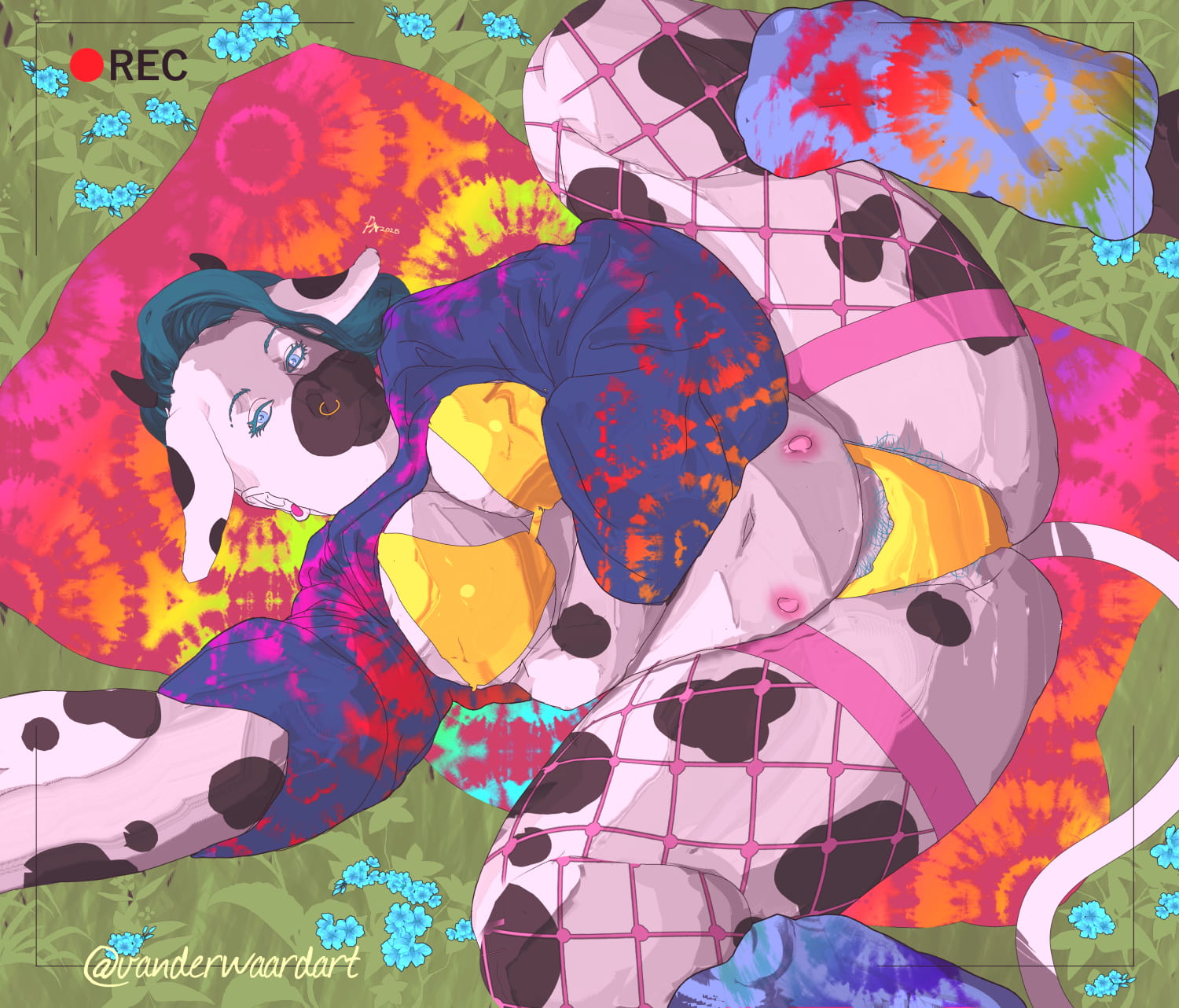
(model and artist: Fishnet Housepet and Persephone van der Waard)
My thought process here (and that of my friends, above and below) grapples with Indigenous means of playing war in post-scarcity ways, pre-capitalist language helping those with more privilege conceptualize a lack of privilege while giving the oppressed room to tell their own stories; i.e., while giving the curious and the cowed (so to speak) a chance to navigate pictures of home: that feel strange, queer and uncanny (etc) while shoving us into us-versus-them queries we might then use to preserve our commonalities with different oppressed groups more chattelized than we are, or differently. Rape takes many forms; anti-predation does, too, and whose fight-or-flight, "death by Snu-Snu" shtick Amazons entail in sensory ways we can master to camp/confuse predators "aping" us in bad faith (e.g., Amazon's hairy bodies with different abject qualities subjugated forms abuse versus subversive ones; re: "Toxic Schlock Syndrome"). This involves, as needed, various lures and repellents—tricks and traps employed in deeply playful ways, simulating a hunter/hunted dichotomy with many uses: the battle of the sexes and sex as a weapon taking on terror devices with a femme fatale or forte quality (where nature as alien translates to some degree of feral/domestic, wild/tame, indoors/outdoors, polite/rude, etc, as tied to virgin/whore and Society vs Nature's thinking beings/extended beings under Cartesian thought: the house and its nuclear model reentering crisis, mid-abjection).

(artist: Amanita Daukta)
For Gothic Communism (and its teamwork established through the context of mutual consent per exchange), praxis demands intersectional awareness and solidarity to vocalize and subvert exploitation, as such; i.e., as sharing the same stage with our abusers, acting in bad faith in predatory ways. My emphasis remains sex work and the chattelization of nature—meaning as something to pimp out by state powers, which whores (or those treated like whores) have their revenge "on the Aegis" (e.g., Amanita a Scottish witch joining with my work as kindred spirit to said work, above). So our bodies—and their special, intrinsic ability to perform power as suitably spellbinding in furtherance to liberation—work within/upon different barriers in proximity to exploitation, bigotry and "danger" tied to the real thing as confused, out-of-joint; i.e., the navigator able to occupy and cross, mise-en-abyme, when breaking state monopolies; e.g., on violence, terror and morphological expression, therefore nature as monstrous-feminine avatars of sex and force. "Land back" speaks to bodies back and sex back, workers sucking back, mid-abjection, when states suck on us, cops-and-robbers (with Amazons, unlike seafaring pirates, tied to the land as an unwelcoming or wild home; e.g., a jungle or island, often with primal, tropical elements). Abjection cuts both ways, rioting under state hypocrisy to leverage their contradictions in service to workers: the showing of things that have an adventuresome, weapon-like quality when viewed by those who expect us to lie down and submit (offering up exciting alternatives that smuggle in allegory while riveting whoever with whatever). Play gives us a means of control, of disguise, of useful abstraction and code during calculated risk.
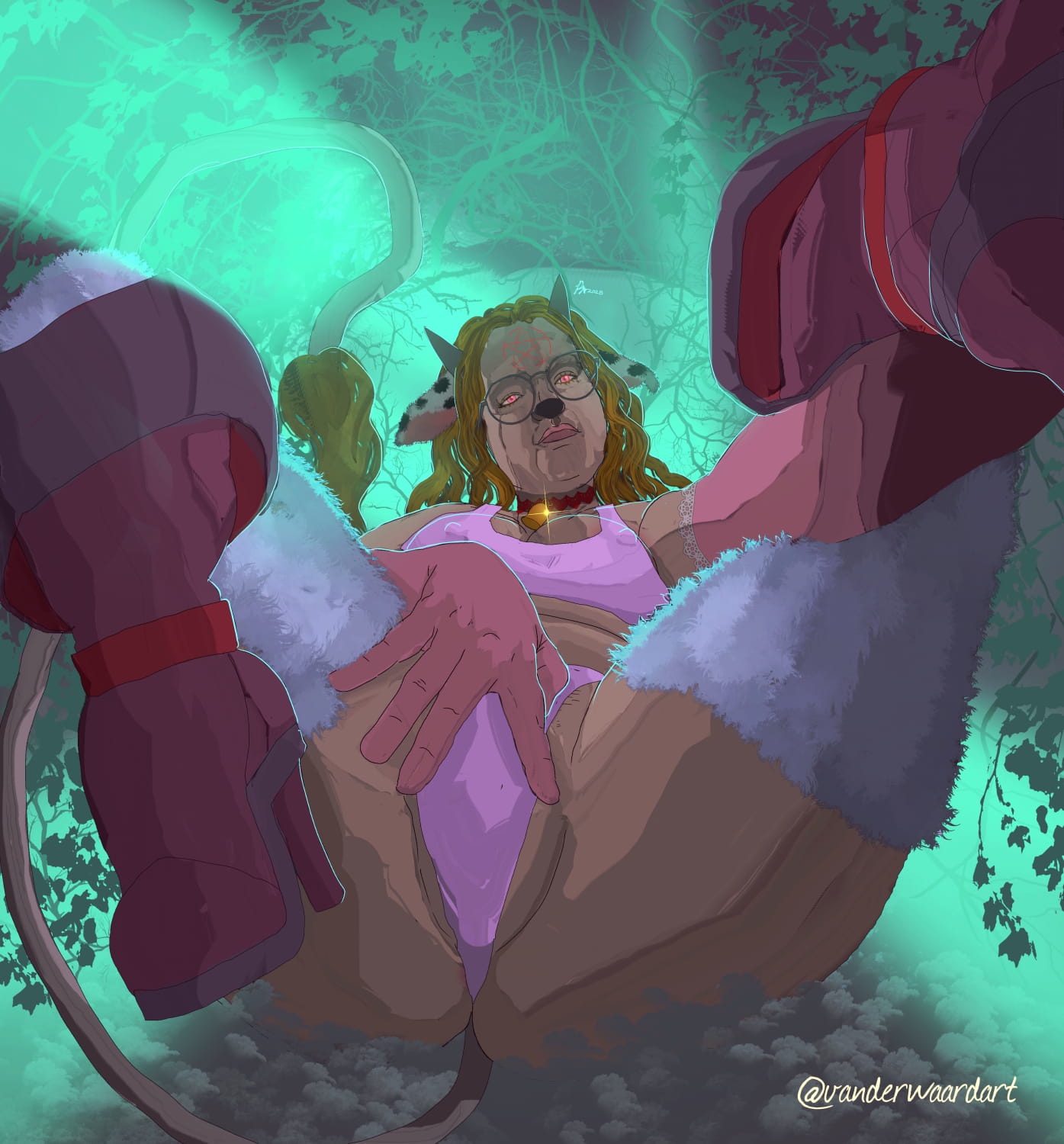
(model and artist: Allie Reads and Persephone van der Waard)
This has a cryptonymic bent; i.e., a common thread my friends and I tug upon is the paradox of exposure—of performative nudity and exploitation in ways that describe our dehumanization but also regain any lost humanity through the rising of our intersectional awareness and teamwork. It must be for all workers (no scapegoats). The ensuing revelations, then, speak collectively to our bodies as things to cage, but also cages we might wear for a time: the attire of warriors who, under struggle, fetishize and empower ourselves; i.e., in deeply ironic ways that "break the spell" of state monopolies—meaning exploitation and liberation as sharing space, but also bodies, costumes, etc, conducive to harm as something to cause while canonically extracting resources for profit. The body—but especially the female body—is always tied to the land and nature as vengeful for past wrongs; i.e., as something savage, terrifying and harvested pre-emptively to "avert crisis," flirting with disaster.

(artist: Amanita Daukta)
That's our "in," you see. States suck; we suck back, using the same devices to reverse abjection (what Louis from RE4 [2003] called "ballistics," above) : a lesson disguised cryptonymically as "playtime," and where calculated risk suitably achieves through ludo-Gothic BDSM a dignity that appears undignified only for the pimps looking in. Doing so merges a variety of factors, "on the Aegis," by substituting literal glass for a piece of ass that achieves the same goal. Any body (or body part, below) from the working class will do, provided it strives to authentically unmask* those who betray state employment when looking upon us. A mirror is a mirror that can bounce power both ways: dualistically up or down, vulnerable nudity ceasing to be "weakness" at all when its paradoxical, weaponized strength (of a concealed sort laid bare) reverses abjection; i.e., when the context of performance becomes the bait and the trap, thus means of control for those holding the reins despite how things appear ("topping from below," as it were). Our bodies become arguments that show easily enough what the argument is about/waged with, giving a way to conceal that allows us to observe our observers but keep hidden some part of ourselves (what Queen Elizabeth I referred to as video et taceo: "I see and say nothing").
*The "scratching method," as I call it, "reversing abjection to see how workers respond—in short, how they react to different things that get them to drop the mask" on a stage shared by good actors and bad (source: "Interview with the Vampire," 2026).

(artist: Amanita Daukta)
Witch, goblin, vampire; "When the Man comes around, show him your Aegis!" (above). So class war is ass war tied to culture and race, stare-and-tremble; i.e., as abject things to play out in war-like ways, thus bear out Indigenous signatures pushing terrifyingly (for state benefactors under Capitalist Realism) towards degrowth: a wild ass appears (above)! Puns (or buns) aside, class war is ass war and we're all warriors. That includes sex work as the oldest profession, therefore labor struggle as central in its body language to break monopolies with (nothing more policed than sex, but whose total policing and control by state powers remains illusory and elusive). Think of it as asymmetrical warfare—with workers reversing the terror/counterterror binary to free ourselves from inside state boundaries and arbitration; i.e., playing war by bearing our arms to our foes, that we might cryptonymically unsettle, upend, disrupt or otherwise destabilize their positions in highly abject ways (the home as place of theft for them to securely feed on others).

(artist: Amanita Daukta)
In short, nothing is secure when the whore's on the prowl, nothing more policed than sex when unleashed terrifyingly on our pimps (and generally from behind the safety of the phone screen or computer monitor as forced to watch what the viewer can't touch). Unable to behead Medusa, box Pandora, or gag Cassandra, they'll slump their shoulders when reminded, time and time again, by shadowy armies (ours [above] or otherwise): "Terror is the kissing cousin of force and, real or implied, is never far removed from the pages of history. To define (and condemn) terror from a peculiar social, economic, political, and emotional plane is to display a self-righteous attitude that, totally unrealistic, is doomed to be disappointed by harsh facts" (source: War in the Shadows, 1975). Such spectres revive, "in the flesh," as castles to wage war from—changing how sex and its control are viewed to have the whore's revenge on our mirror-like selves! "We will outline them," as Jewish survivors say of fascism.
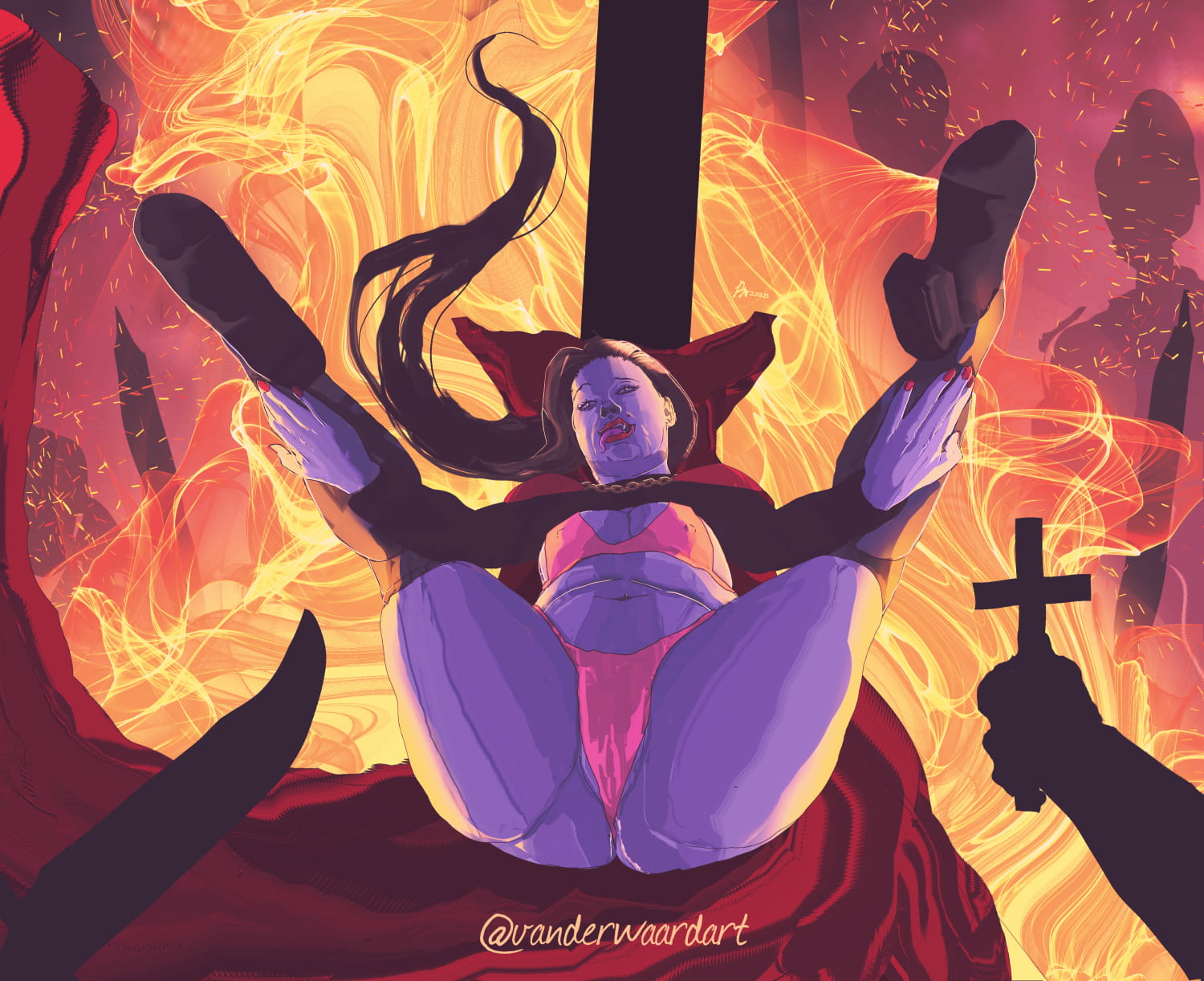
(model and artist: Lilith Mae and Persephone van der Waard)
To conclude, so Medusa stays immortal through her avatars—her guerrilla coven still able to fight from the canvas while laid bare, ensnared, or otherwise savagely exposed (above); i.e., when going native/playing war as something we've been discussing this whole time: "topping from below." Listen to us with more privilege, but also those we echo in less-fortunate realms who, seeking freedom in paradoxical ways, drink from the same gyn-ecological cup in anti-Cartesian, thus anti-predatory ways (and who often do sex work to survive/celebrate the body and nature as normally shamed under state predation)!

(artists, left to right: Amanita Daukta, Allie Reads, Fishnet Housepet and Lilith Mae)
"Gothic Ludology and Indigenous Themes," then, draws upon my older work and compatriots (above): a video essay reifying either while responding to Dead Domain for Gothic ludology and Atun-Shei and Indigenous ways of playing war that, when combined, also take all-around media analysis into consideration; i.e., as part of the performance conveying different themes productive towards liberation, going native in the process. Our written essay concluded, I'll list these in order (more or less, as they happened around the same time in the same space), then give the video's actual seminar-style thesis on duality. By this point, you should have what you need to make sense of them.
Original Video Notes
These are the written notes for my original video response to Dead Domain.
Initial Written Thoughts (Comment to Dead Domain's Video)
These were my initial comments to Dead Domain on her own video:

As someone who specializes in this kind of thing (read: I've written multiple books on it), most videogames have a neoliberal/copagandistic flavor to them, but especially shooters. That includes FPS like Doom, TPS like Metroid (which alongside Aliens inspired Doom), and whatever Halo is. Bungie's group-based arena shooter (that's it) is literally "Spartans" of a terrestrial bent, facing off against a variety of humanoid monsters from outer space: echoing not just Heinlein's Starship Troopers and its anti-Communist bent, from 1959, but Greeks (or Spartans) vs barbarians aka outsiders; i.e., the state is under attack and must defend itself in hauntological ways. Often, there's a queer and/or Marxist element in there, too (e.g., Ghost in the Shell or The Matrix), but those share space allegorically with canonical values that hog the kayfabe microphone. Such stories are generally centrist at best, and actively fascist at worst. Very rarely are they consciously Communist in any shape or form (e.g., Andor).
In other words, my specialty is neoliberalism and videogames—meaning as classically bolstering Capitalist Realism, which workers challenge in duality developing Communism in Gothic ways but specifically ludic ways; re: ludo-Gothic BDSM, which favors Gothic Communism on different registers, onstage and off, when breaking monopolies on violence, terror and monsters. The thesis portion lays that out, further down, but does so based on older works of mine tied to current smaller examples of media analysis: written snippets that break down neoliberalism attitudes while keeping Indigenous concepts in mind/nearby (re: for the video, but shown here as food for thought).
"Playing War: Capital vs Indigenous Groups (and Videogames)"
Around when I responded to Dead Domain, I also wrote a small response to Atun-Shei's "Matt Walsh Hates Indigenous People." Titled "Playing War: Capital vs Indigenous Groups (and Videogames)," it grapples with the themes of play and Indigenous warfare I use in either case; i.e., as a half-real, deeply poetic means of survival and preservation, but also fighting back versus Capitalist Realism on either side of the privileged/oppressed equation. "Playing War" reads as follows:
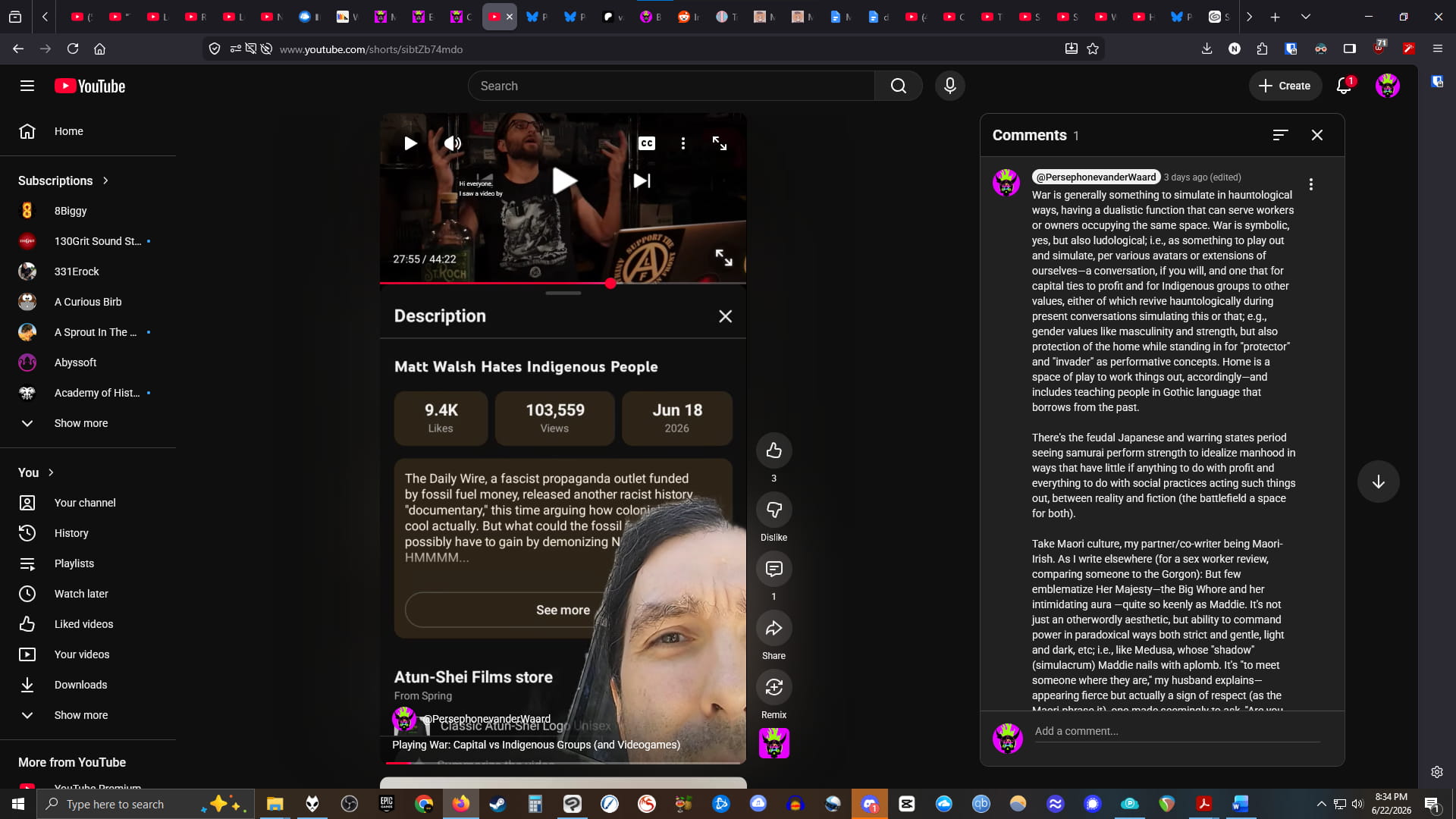
War is generally something to simulate in hauntological ways, having a dualistic function that can serve workers or owners occupying the same space. War is symbolic, yes, but also ludological; i.e., as something to play out and simulate, per various avatars or extensions of ourselves—a conversation, if you will, and one that for capital ties to profit and for Indigenous groups to other values, either of which revive hauntologically during present conversations simulating this or that; e.g., gender values like masculinity and strength, but also protection of the home while standing in for "protector" and "invader" as performative concepts. Home is a space of play to work things out, accordingly—and includes teaching people in Gothic language that borrows from the past.
There's the feudal Japanese and warring states period, for example—seeing samurai perform strength to idealize manhood in ways that have little if anything to do with profit and everything to do with social practices acting such things out, between reality and fiction (the battlefield a space for both).
Take Maori culture, my partner/co-writer being Maori-Irish. As I write elsewhere (for a sex worker review, comparing Maddie Minx to the Gorgon):

(source: Gymeagary's "Tamaki Wharenui within the Clan Marae," 2015)
But few emblematize Her Majesty—the Big Whore and her intimidating aura —quite so keenly as Maddie. It's not just an otherwordly aesthetic, but ability to command power in paradoxical ways both strict and gentle, light and dark, etc; i.e., like Medusa, whose "shadow" (simulacrum) Maddie nails with aplomb. It's "to meet someone where they are," my husband explains—appearing fierce but actually a sign of respect (as the Maori phrase it), one made seemingly to ask, "Are you here for peace or war? The land welcomes you and you it" through various profound exchanges crossing boundaries; i.e., building a rapport between host and visitor(s) from tapu to noa (a ritual of sacred restriction* to ordinary/safe, moving energy in warrior-like ways).
*"The ātea (space outside)," Bay explains, "is considered the domain of the God of War (Tūmatauenga), while the wharenui (meeting house) is the domain of the God of Peace (Rongo). The ceremony moves visitors from the domain of war to peace." It's very Gothic!
"Playing War" refers readers to some different pieces of mine, which I'd already recommended to Dead Domain: "For more of this idea of playing war in hauntological language, consider my analysis of shooters like Halo alongside Doom, Metroid, and more." The link goes to a YouTube community post, but refers to a prior skeet to Dead Domain that mentions a few pieces tied to my work on shooters the video response combs at length (re: "Military Optimism" and others).
Media Analysis Sample: Mega Man
Any aspects of play in a theoretical sense should work alongside media literacy and analysis. Simply put, you have to be conscious and able to work together when applying theory towards development; i.e., as already caged in illusions that betray themselves, and which workers can utilize in parallel ways while inside the cave. So here's an example of that I wrote when taking notes for my response to Dead Domain:
(source skeet: vanderWaardart, 6/19/2026)
Fun #MegaMan cover I thought I'd write about, having both grown up with the Blue Bomber and analyzed him extensively in my #Gothic book series [alt-text, top-left]:
And because I specialize in media analysis (not just music), remember how Doctor Wily is an "evil wizard" of sorts: a projection of state predation, skull-equals-theft, onto an Elsewhere to invade and police in monomythic ways (though not without Promethean implications, on the black mirror). I'm of course referring, here, to Operation Paperclip: a real historical event taken by post-fascist Japan and pressed onto a "Dark Einstein" scapegoat; i.e., a simulacrum of mad science that makes technology rebel in ways antithetical to the Asimovian, Western-Liberal worldview. For the state, nature is already mechanical and monstrous; i.e., abject under Cartesian dualism, whose mechanizing of nature (to exploit it) becomes overtly monstrous—meaning it justifies pre-emptive police action under the usual binaries and contradictions—the moment nature refuses to obey. Mega Man is Doctor Light's obedient Adam, Wily and his creations an evil Frankensteinian double; i.e., no different than Satan from Milton's Paradise Lost when fashioning Skull Castle as home-of-monsters-who-rebel (specifically the skull home as space of theft, one harkening back to Ann Radcliffe's banditti but pointing to modern capital-in-decay through its Gothic overtures): as "pandemonium" to invade and put to heel, under Capitalist Realism, by stopping "someone else" doing vampirism (the DARVO argument, mid-obscurantism). As a deeply centrist, cops-and-robbers story that decays hauntologically into the very ruin it already occupies (as any cyberpunk or Gothic novel does), Mega Man is rock opera; i.e., one with a suitably human phantom at its center. In the middle of the maze, Wily is both fash- and Communist-coded in the neoliberal kayfabe style (videogames): a humbug to some extent, but also a rebel defying the state as already dying from its own theft they blame him for.
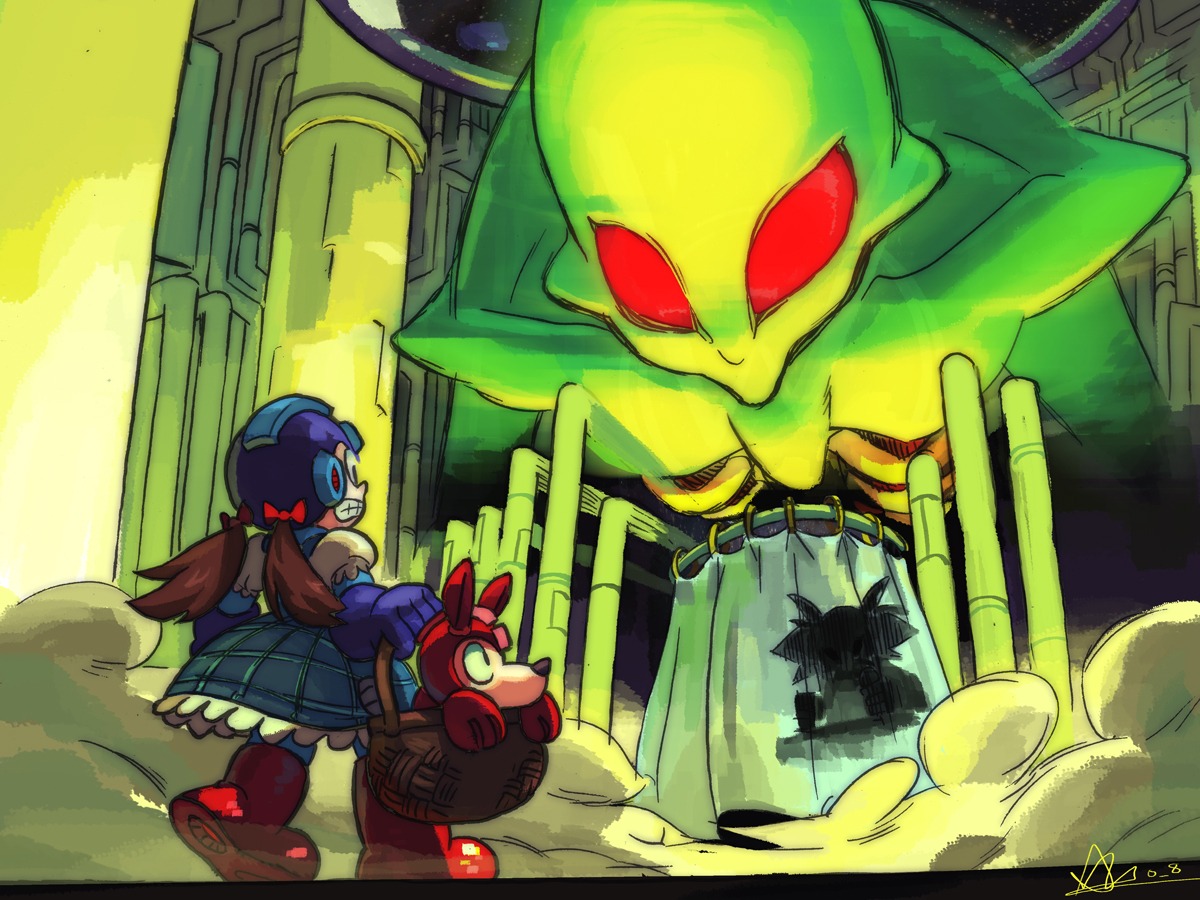
(artist: Alex Ahad)
You might take any piece apart, like so, then subvert the canonical variant mid-performance with liberatory elements in mind that target and uplift the most oppressed: those of nature under Cartesian arguments, whose predation we seek to reverse, show/conceal, on the same black mirror (the Aegis, mid-abjection). So can power decentralize in worker hands; i.e., in multi-pronged ways the elite—alienated from us as things to mechanically fetishize—suddenly appear unhorse and gasping for air. How might we denude them while arming ourselves and seemingly bare and exposed (or speaking to such things), ourselves?
Note: "Thesis Portion" (apart from the addendums in brackets and the visual aids) appears exactly as it does in the video: copied from Google Docs.
Thesis Portion: On Duality (timestamp: 21:45)
As a Gothic ludologist and the author of Gothic Communism/the coiner of what I call ludo-Gothic BDSM, I want to avoid singular interpretations to media whose function isn't immediately obvious/can go different ways mid-confusion: [the "Indigenous" character of the space opera played by good actors and bad, but also those with different degrees of privilege/oppression sharing space, stages, bodies and costumes, etc; re (from the reprise): while grappling "with Indigenous means of playing war in post-scarcity ways, pre-capitalist language helping those with more privilege conceptualize a lack of privilege while giving the oppressed room to tell their own stories. The name of the game is intersectional awareness and solidarity to vocalize and subvert exploitation; i.e., as sharing the same stage with our abusers, acting in bad faith."]

When examining Dead Domain's video, I want to stress here that such language exists in duality and is used by different sides when waging war on different registers [emphasis, me]; e.g., Amazons and/or vampirism (and different theories, too; e.g., Marx' "capital = vampire/dead labor [machines] sucking on living labor" argument). This dualism includes play-as-teaching-device through different theatricalities (e.g., kayfabe, drag and camp); i.e., instrumental in war as both a basic argument to wage, but one that ties just as well to different praxial elements: of class, culture and race separately and together when surviving capital through said lessons—a means of survival through play by teaching better lessons that change the world, doing so in ways that raise awareness and allow for teamwork that illustrate and navigate such dialectical-material minefields over time. There, play is the vector within a larger Gothic mode no one can monopolize, land = home and home a space of play that enters Gothically into conflict. Hurt is possible in the unheimlich (the uncanny or "unhomely" space), harm is not, and lessons about harm may be taught concerning how they manifest in and out of themselves; i.e., regarding state contradictions and monopolies workers can fuck with and bend to serve ourselves, mid-play.

(exhibit 1a1a1a1_a [from "Thesis Body," 2023]: Artist, left: J. Scott Campbell; bottom-middle: Fabián L. Pineda; right: Tom Jung)
Videogames (of any genre) are canonically neoliberal bread and circuses, for example, but remain nonetheless spaces to wage and communicate ideas antithetical to capital; i.e., of war using dead metaphors by good actors and bad, "on the Aegis" (re: Athena's mirror shield as Creed discusses, adorned with Medusa's head as a terror device capable of great violence: the "kissing cousin of force"). There's no set purpose* to theirs or any other language, especially when divorced from overt nationalism or payment of someone (a corporation, for example); i.e., for goods that unironically facilitate genocide and exploitation of nature. Something is generally a message and code at the same time, but also shorthand standing in for different language of play simulating war (e.g., "nukes" translating to "direct damage")—with war more broadly historically relying on deception as much as brute force to operate, and whose cryptonymy as such either furthers or reverses abjection mid-dialectic (struggle) to send power vampirically up or down (up being state predation [exploitation of nature as monstrous-feminine under Cartesian thought, what I call state vampirism] and down being workers preying on the state to take back stolen things).
*What Zizek calls "universal application"—an idea he largely applies/restricts to music, which I extend to any kind of language (especially monsters, body language and sex, which hybridize easily enough, in Gothic) to dialectical-material struggles: those humanizing the dehumanized in abject language that flows power down, accordingly. Such things generally happen in duality (even with national uniforms, which can be camped under the right circumstances); an '80s training montage can just as easily become satirical of the state, while appearing as dumb, useless garbage (the cryptonymy as space and/or body of concealment, the ensuing mise-en-abyme [recursive hyphenation, overlap and procession] allowing for revelation mid-concealment).
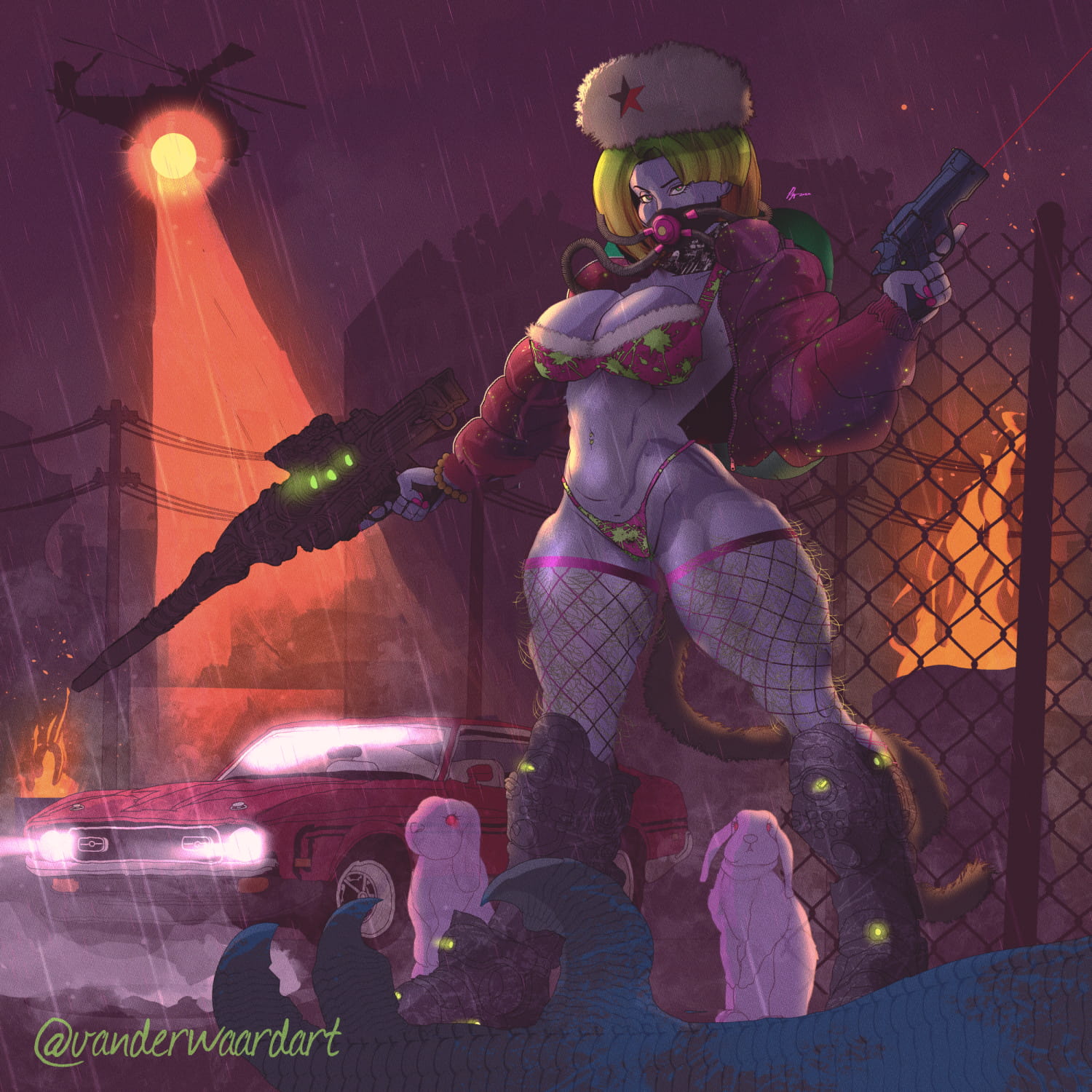
(artist: Persephone van der Waard; source: "Arrows for My Quiver" from "Quality Beyond Measure: Remembering Jonathan Joss," 2025)
The state essentially sucks; works suck back in diametrically-inverted ways aka asymmetrical warfare, which takes on class elements relaid in Gothic language (e.g., Amazons, above). Gothic generally concerns the dialectic of the alien in dialectical-material forms. Flow = function, not aesthetic; and something is generally multiple conflicting things at once—both a song or a dance, but also paradoxically a weapon depending on its usage, and means of education accordingly to communicate power anisotropically and apotropaically: determined by direction to ward off evil, and generally in liminal spheres of performance that confirm different answers tied to our own troubling pasts; i.e., as something to perform in spaces of confusion seeking resolution; e.g., "Are you here for peace or for war?" Humans make war as something to act out and help us survive not just natural scarcity but manufactured scarcity under capital as haunted by its own skeletons, gargoyles, what-have-you as performatively up-for-grabs, dualistic.
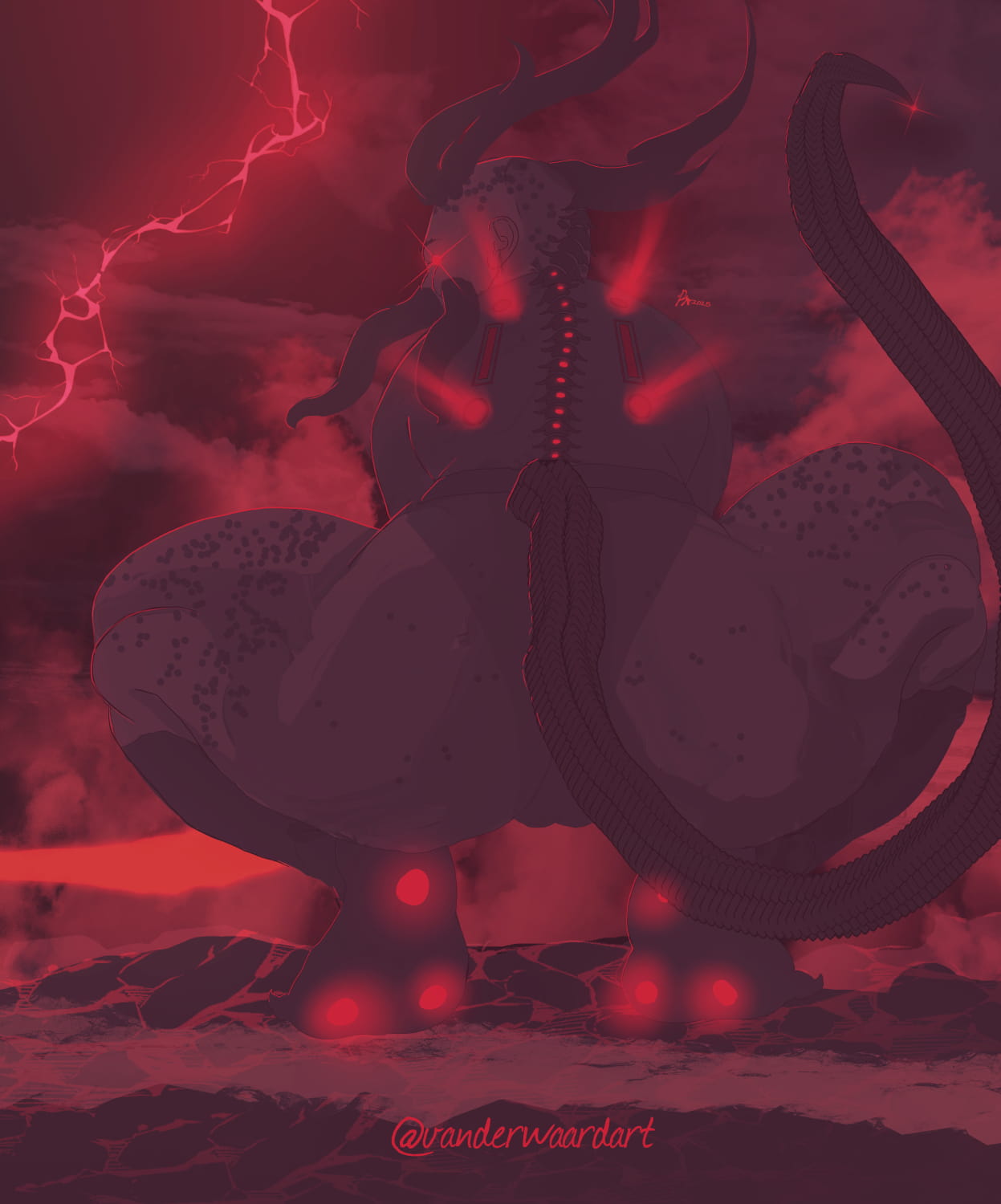
(model and artist: Maddie Minx and Persephone van der Waard)
As something to uncover and lay to rest, then, Gothic calls this "the Wisdom of the Ancients" and Indigenous People "of the Ancestors," and historically involves a Promethean, hauntological foray into the past; i.e., as something to summon, enter and steal power from in warrior-like ways; e.g., Gothic castles that travel through time—the chronotope a location of space-time that conveys Gothic ideas of power, mid-exchange, and whose Numinous elements I further articulate as the liminal hauntology of war (the timely arrival of a killing zone/site of rape and all-around power abuse, per calculated risk). Versus a police-grade, monomyth form under capital for capital (and Capitalist Realism), Gothic Communism and ludo-Gothic BDSM aim to push workers away from the state (as Cartesian, settler-colonial and heteronormative): by using pre-capitalist language—that of violence, terror and monsters—to usher in post-scarcity and break Capitalism Realism intersectionally upon ourselves:
(source skeet [alt-text]: vanderWaardart, 1/31/2026 [the thumbnail for "The Value in Showing Intersectional Solidarity When Combating Fascism"]: "From top-left to bottom right: Mercedes the Muse, Vic Menza, Lady Izdihar, Mexican Indigenous dancers honoring Alex Pretti in Minneapolis, Alicia Axiom, Olurrinati Politics (center), Black Liberation Media, a local Indigenous protest in Minneapolis, Jessie Gender, Rhyna Targaryen, and Julesss Next Door")
Point is, there's no monopoly to the Aegis or anything that stands in for it and its mirror-like qualities; but, all the same, duality remains when meting such things out. Generally (as I argue), this happens on/offstage as "half-real"—meaning between the two but also performers for/against the state in oft-kayfabe-style ways (where no Fourth Wall exists): those who colonize media in bad faith, Gamergate-style; i.e., as white straight guys (and token parties) have done for centuries; e.g., with Shelley's Frankenstein, the Wachowski's Matrix films, Lucas' Star Wars, or anything else. Anything can be a weapon to pass information along for different sides, and generally incompletely. There terror but also joy [when releasing we have more in common with those more oppressed than us, not less].
To it, I would imagine Halo—like any other franchise—has countercultural elements thrown in; but will just say now those are undoubtedly allegorical/recuperated by corporations in service to profit. So the bourgeoisie can disguise themselves and their motives behind Platonic means of entertainment: shadows on the infamous cave wall that distract from the usual goings-on. That knife cuts both ways, but with corporate media generally has the owner class holding the handle/censoring anything they can't directly control (to spheres of influence they can later invade, discredit, or otherwise "kettle," all under state crisis coming routinely back around until planetary crisis crystalizes). [By holding it ourselves, workers might break Capitalist Realism on our Aegis-like bodies—the unity of those the state exploits, in and out of the Imperial Core, through Indigenous-coded signals spelling "doom" to the state and ruling-class defenders: shaking before spectres not just of Shelley or Marx, but Medusa herself set free. Going native means degrowth while reclaiming such devices for ourselves, in duality. Always.]

(exhibit 1a1a1c1: "Thesis Body")
Works Cited (for the video essay)
"Those Who Walk Away from Speedrunning: A Trans Woman's Experiences Researching (and Abuse Suffered from) the Speedrunning Community" (and "Postcolonialism in Doom," 2025/2020): https://nicksmovieinsights.com/2025/01/those-who-walk-away-from-speedrunning.html
"Doom Eternal (2020) Review: No Girls or Trans People Allowed" (2020): https://nicksmovieinsights.com/2020/04/doom-eternal-review.html
"Fuck id, Free Palestine: A Doom: the Dark Ages Review" (2025): https://nicksmovieinsights.com/2025/05/fuck-id-free-palestine-doom-dark-ages.html
Mega Man analysis: https://bsky.app/profile/vanderwaardart.bsky.social/post/3moo27fxs7k2e
"The Promethean Quest and James Cameron's Military Optimism in Metroid" (2021): https://nicksmovieinsights.com/2021/06/the-promethean-quest-and-james-camerons-military-optimism-in-metroid.html
"'Once More unto the Breach'; or, Reading and Responding to S. R. Holiwell's 'A Maze of Murderscapes: Metroid II'" (2026): https://nicksmovieinsights.com/2026/03/reading-and-responding-to-s-r-holiwells-a-maze-of-murderscapes-metroid-ii.html
"Vintage to Retro: An FPS Q & A series - FrostyXen" (2021): https://nicksmovieinsights.com/2021/04/vintage-to-retro-fps-frostyxen.html
Halo plot breakdown: https://www.reddit.com/r/halo/comments/15ygic/can_anyone_explain_the_overall_halo_story_in_a/
Atun-Shei's "Matt Walsh Hate's Indigenous People" (2026): https://youtu.be/tIKUpIuYUVE
my response to Atun-Shei's video: https://www.youtube.com/shorts/sibtZb74mdo
"Quality Beyond Measure: Remembering Jonathan Joss" (2025): https://nicksmovieinsights.com/2025/06/quality-beyond-measure-remembering-jonathan-joss.html
Tabernis' https://youtu.be/lUfFhfJADRg
Some extra references (not in description):
Coulthard's Red Skin, White Masks (2014): https://archive.org/details/redskinwhitemask0000coul
Jodi Byrd's The Transit of Empire: Indigenous Critiques of Colonialism (2011): https://www.jstor.org/stable/10.5749/j.ctttv97j
Hogle's "The Ghost of the Counterfeit: Leroux's Fantôme and the Cultural Work of the Gothic" (vis-à-vis Punter and the ghost of the counterfeit, 2002): https://link.springer.com/chapter/10.1007/978-1-137-11288-0_4
Joseph Crawford's Gothic Fiction and the Invention of Terrorism (2013): https://www.bloomsburycollections.com/monograph-detail?docid=b-9781472543608&pdfid=9781472543608.0004.pdf&tocid=b-9781472543608-0000056
my work on ludo-Gothic BDSM: https://www.nicksmovieinsights.com/2025/03/concerning-rape-play-on-my-development-of-ludo-Gothic-BDSM.html
my "Dragon Sickness: The Problem of Greed" (2015): https://www.academia.edu/32985048/_Dragon_Sickness_The_Problem_of_Greed
"My Tolkien Scholarship" (2025): https://nicksmovieinsights.com/2025/04/my-tolkien-scholarship.html