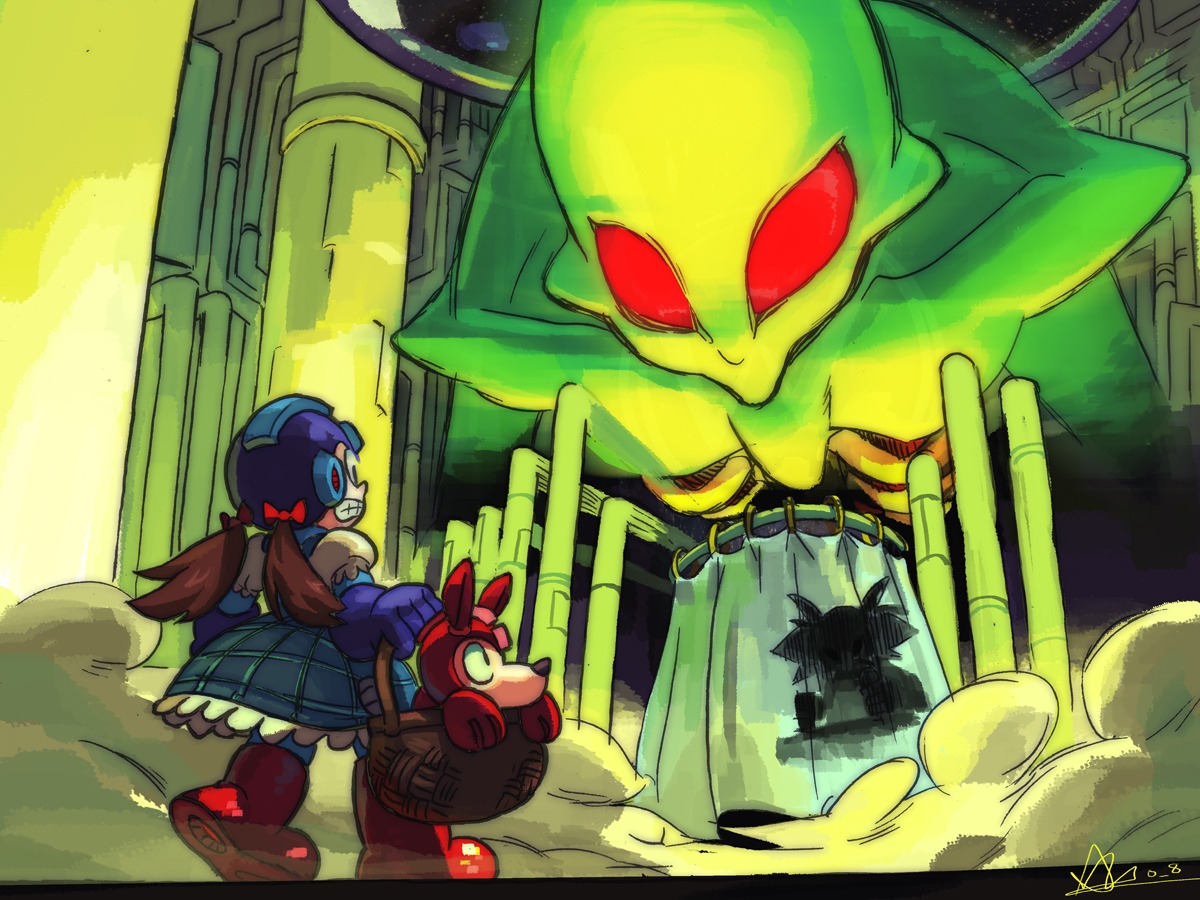
This page (and its symposium) are dedicated to my playing and studying Team Cherry's long-awaited Silksong (2025); i.e., stuck in development heaven (that's a first), and releasing for $20 on Steam (which is wild [and awesome] for such a highly polished game), Silksong is finally out after seven years of waiting—with me having asked "is it Gothic" all the way back in 2019; re: "Hollow Knight: Silksong - As a Metroidvania, Will It Be Gothic?" I guess now we'll see just how Gothic the game ultimately is (the Gothic being an older [and continuous] mode of expression that Metroidvania partake in videogame form); i.e., to such a Numinous (read: uncanny and paralytic, not fight-or-flight) degree that its Amazons (classic tools of abjection) either further or reverse the abjection process Kristeva envisioned (and Creed expressed in monstrous-feminine [1993] language).

Note: This symposium is actually quite large (~383 pages). If you just want the pros/cons (tl;dr) section, game review and gameplay notes without all the theory (and reiterations of my past work the symposium connects to), I've uploaded a smaller SFW symposium sample on my old blog for your convenience. However, you can also download my 2025 Metroidvania Corpus for free, which contains everything in an easy-to-navigate PDF format. —Perse

Table of Contents (Silksong Symposium)
- SFW Samples
- Concerning State Vampirism
- Disclaimers/Concerning Censored Nudity and Its Educational Purpose
- Changelog
- Persephone's Silksong Symposium
-
- Opening: Tying Silksong to My Past Work (re: Reversing Abjection, mid-Amazonomachia, in Metroidvania)
- A Primer Note on Amazons and Gorgons (re: my past work on ludo-Gothic BDSM)
- Capitalism: Our Dragon to Slay; or, Using What We Got (Our Aegis) to Camp the Canon (with ludo-Gothic BDSM)
- Opening: Tying Silksong to My Past Work (re: Reversing Abjection, mid-Amazonomachia, in Metroidvania)
- Before We Start
- Giving Thanks (to Team Cherry and Ginger)
- Four Main Gothic Theories (essential, do not skip)
- Short Version
- Long(er) Version
- Some (More) Keywords (also essential, do not skip)
- General Terms
- Persephone-Specific Terms (abridged)
- Preface: A Note on Amazons (as Warrior-Maiden Cops, thus Whores in Bad Faith; feat. Hallie Cross)
- Preface (cont.): Concerning This Symposium's Broader Focus/Conversational Approach; or, a Tangent on Amazons, Metroidvania, Fascism and the Promethean Quest (feat. Jadis)
-
-
-
- Mapping Things Out
- My Work: Fascinated with (and Haunted by) Cartesian Abuse
- The Return of the Gorgon: Jadis Colonizing My Work as Capital Colonizes Nature
- Chasing the Gorgon: from Mary Shelley into Metroidvania
- Rememory and Gorgons: a Black Mirror of Endless Possibility
- A Word of Warning: Playing with Fire (of the Gods) to Turn Galatea Feral
-
-
- Last Call
- Symposium Focus (the Numinous)
- Summarizing My Broader Work this Symposium Contributes to (re: ludo-Gothic BDSM and Metroidvania)
-
- Kicking Things Off
- Pros and Cons for Acts I and First Half of Act II (tl;dr)
- Pros
- Cons
- The Verdict
- Original Review (of the Base Game; re: Act I and Part of Act II—short and sweet)
- Ups and Downs: Addendums
- Getting to Act III (G2A3); or Act II, Extended
- Venting a Bit; or, G2A3 (cont.): the Last Word on the Entire Game, Colored by Some Frustrations
- Act III, the Abyss, part one; or, Going Back to Hell
- " part two; or, More Boss Keys
- " part three; or, the Final Ending: Cloning Ripley and Castrating Shelley's Promethean Quest to Revive Cameron's Amazonian Monomyth
- Keeping Track; or, Pros and Cons (cont.): the Final Score for Act III, Thus the Entire Game
- Best and Worse
- In Conclusion: Final Thoughts, Capping off My Review (and Symposium) by Stressing a Reversal of Abjection
- Future Projects (after Silksong Playthrough)
- Pros and Cons for Acts I and First Half of Act II (tl;dr)
- Kicking Things Off

- My Gameplay Notes: First Impressions for Silksong (factual observations and opinions)
-
-
-
- Act I and Base Game
- Act II
- Dueling Lace (second fight)
- Concluding Act II/the Final Boss(?)
- Act III
- Some Transitional Notes
- Getting to Act III (G2A3), or Act II, Extended
- G2A3 (cont.): Fetch Quests
- Actual Act III/the Abyss, part one
- The Abyss, part two: More Boss Keys
- Preliminary Comments on Act III, part two; or, Odds and Ends Before We Start
- Setup: Hearts of Darkness
- Finding the Hearts: A Slight Detour (the Fleas and Sword Upgrades)
- Finding the Hearts: Heart of Might (re: Coral Tower and Crust King Khann)
- Finding the Hearts: Heart of the Woods (Seth and Nyleth)
- Finding the Hearts: Heart of the Wild (Skarrsinger Karmelita)
- On Karmelita/Amazon Confusion
- Some Extra Tips (per boss)
- The Abyss, part three: Flower Acquired; or, Going Back to Hell
- Red Memory
- Heaven in a Wildflower (a preamble/some predictions)
- The Final Showdown
-
-
- Extra Theory (from the Numinous to Amazons)
- The Numinous (from Walpole to Me)
- Concerning My Research: Mazes, Monsters (re: Amazons), Gothic Theory and Rape, Camping the Canon with Ludo-Gothic BDSM
- Mazes
- Monsters (re: Amazons)
- Other Things to Keep In Mind: Key Gothic Theories, Metroidvania as Canon (to Camp), Rape (my definition), and the Whore's Paradox
- Camping the Canon (thus Rape) with Metroidvania
- Thematic Analysis; or, Essays on the Promethean Quest in Silksong
- Introduction
- Essays
SFW Samples
Portions of this corpus are inescapably NSFW (mainly due to artwork and exhibits featuring sex workers). However, various and lengthy SFW samples are available on my blog; re: "From Masters to PhD" and "Mazes and Labyrinths" but also parallels posts like "Military Optimism" (2021) and "Canonical Essentialism" (2024), which—while they don't appear here—discuss the same basic material in conversational (and more importantly non-naked, thus accessible) forms:

(artist: Persephone van der Waard)
Last but not least, there's also the shorter promo version of "Silksong Symposium" on my blog, which as of 5/21/2026 I've tailored to be entirely SFW.
Concerning State Vampirism

(artist: Karen B.; cited: "The World Is a Vampire")
This piece (essay or otherwise) is part of a larger series on state vampirism. As I conceive it, state vampirism = feeding through the state mid-abjection*, be it openly capitalist or Marxist-Leninist. These are largely questions of aesthetic, whose Promethean (self-destructive) function extends to other configurations "of Omelas"; e.g., Zionism. Furthermore, there's overlap between my anti-Zionist work and my work critiquing Marxist-Leninism/state vampirism alongside capital, so consider reading both.
*Which state predation and revolutionary action both rely upon to function; i.e., "on the Aegis" as something to further or reverse, mid-vampirism, through paid/unpaid labor (re: me, vis-à-vis Julia Kristeva). To that, abjection (us versus them/alienation and fetishization) is one of four main Gothic theories my book series utilizes—the other three being hauntology (retro-future), cryptonymy (show/hide) and chronotopes (time-space) alongside smaller theories; e.g., Jerrold Hogle's ghost of the counterfeit† and Barbara Creed's monstrous-feminine (Gorgons and Amazonomachia, as I study it). As a queer sex worker and academic, I dialectically-materially prioritize abjection and vampirism through unpaid labor—chiefly sex work as exploited by Cartesian dualism and its harmful, maximalist binaries under Capitalist Realism, treating nature as monstrous-feminine (re: "Nature Is Food," 2024)—but mention the other theories, too (access "Four Main Gothic Theories (the Four Gs)" in "Paratextual Documents" for their longer definitions). In essence, capital/the state rape by design, which unpaid labor prevents by breaking Capitalist Realism mid-abjection; i.e., reversing abjection during ludo-Gothic BDSM (rape play) when having the whore's revenge (which "State Vampirism" explores at length): "to break the profit [and productivity] motive by making a world for which it (and rape) are no longer possible using these methods; i.e., by using the same demonic and slutty language capital does, but at cross purposes" (source: "Rape Reprise," 2024).
†Re: "Raising Awareness" (2025), footnote 1.
Disclaimers/Concerning Censored Nudity and Its Educational Purpose
This symposium is part of my Sex Positivity book series, which continues after its June 2025 finale in small-form content; e.g., essays on and interviews with other sex workers, all of whom I credit on my Acknowledgments pages and Sex Work page.

(artist, left: Bay Ryan; right: Persephone van der Waard)
Duplicate Page: This page is duplicated, appearing here and on my 18+ website (something I did to secure my work before hiring Josey, who ultimately made such duplications redundant). Given my Metroidvania corpus avoids open eroticism, the nudity herein remains censored, fig-leaf-style, on both page versions.
Disclaimer Regarding Essay Contents: All opinions are my own; i.e., as part of my research, conducted alongside my book series, Gothic Communism (2023). The material within is written/speaks about public figures and popular media for purposes of (sex) education, satire, transformation and critique, hence falls under Fair Use regarding copyright and free speech regarding defamation/obscenity laws (the Miller Test; source: Justice.gov). Click here for my entire series disclaimer. Lastly many of the links on this page lead to my age-gated 18+ website where my entire work on Gothic Communism is stored and exhibited.
CW: spoilers, various Gothic themes (sexual violence [rape*], live burial and incarceration, entomophobia and other fears/taboos Gothic typically explores), censored nudity
*Meaning (from my definition) "to disempower someone or somewhere—a person, culture, or place—in order to harm them," generally through fetishizing and alienizing acts or circumstances/socio-material conditions that target the mind, body and/or spirit) […] Rape can be of the mind, spirit, body and/or culture—the land or things tied to it during genocide, etc; it can be individual and/or on a mass scale" (source: "Psychosexual Martyrdom," 2024).
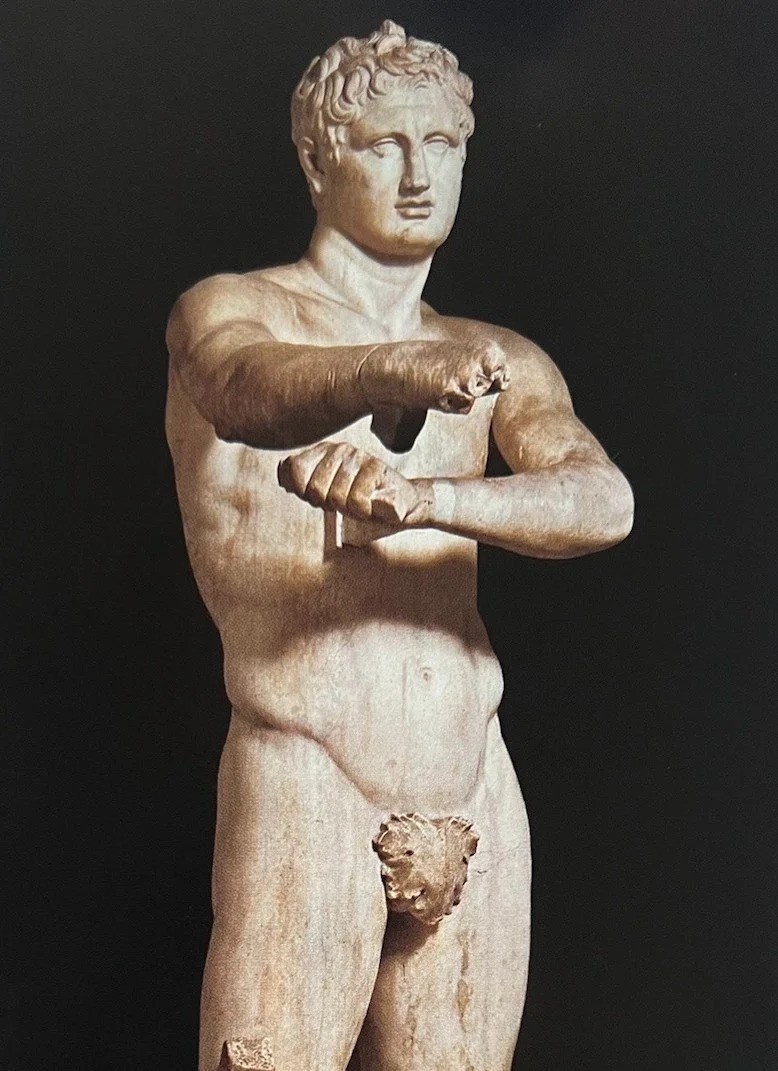
(artist: Lysippos; cited: Michael McClellan's "Professor Butter Beard and 'It's All About the Fig (Leaf)'")
Concerning This Pages' Censored Educational, Fig-Leaf-Style Nudity: This page features censored, fig-leaf-style nudity* for purposes of sex and artistic education operating under the Miller Test/protected speech under American law (source: Justice.gov). For further info on my approach to censorship and sex education, kindly refer to exhibit -1 from "Raising Awareness" (which also discusses the hate campaign censors are currently waging against me and my friends' sex-ed work). All censored material is used elsewhere in my book series; i.e., as part of said series, and with permission from the models therein (re: my book series disclaimer). All models are over 18 and were when said material was produced.
*Meaning no bare genitals, just bare butt cheeks, curves and sexual context (and lots and lots of pubic hair, below); i.e., within a sex-educational, art-meets-porn framework that follows the Miller Test—one performed by sex workers and their content being voluntarily part of a larger project I continuously invigilate; e.g., Cuwu and I:

(artists: Cuwu and Persephone van der Waard)
Symposium Changelog
—5/21/2026 (v2.26): Made small tweaks to "Module Nulla," adding "Concerning State Vampirism" and a small note about SFW versions (and samples) of the corpus. Added links to Angel Witch's tribute page and tweaked several exhibits. Added an outer cover:

(artist: Persephone van der Waard)
—3/22/2026 (v2.25): Added a forth module, Collabs, including its first publication, "'Once More unto the Breach'; or, Reading and Responding to S. R. Holiwell's "A Maze of Murderscapes: Metroid II" (2026). Updated "About the Author" and "About this Corpus."
—10/31/2025 (v2.05): Updated "the Final Score for Act III"; added multiple drawings for "Best and Worst." Small changes throughout symposium.
—10/20/2025 (v2.04): Proofread "Kicking Things Off," making small additions from "Pros and Cons" to "Best and Worst." Small corrections made throughout the entire symposium.
—10/13/2025 (v2.0a): Lowered score to a low A (92/100) because of awful backtracking in Act III, its cryptic, "needle in a haystack" problem—i.e., of tiny false walls in a giant concentric gameworld—exacerbated by long-standing map issues and accessibility from Acts II and III, part one; re: one-way routes, no map squares or useful hints from NPCs, etc.
—10/7/2025 (v2.0): Organized the corpus into modules; re: Nulla, I, II, and III, of which the "Silksong Symposium" is Module III. Reorganized "Kicking Things Off," putting the addendums into their own section ("Ups and Downs"), as well as completing "The Abyss, part three; or, the Final Ending: Cloning Ripley." Also added, "Keeping Track; or, Pros and Cons (cont.): the Final Score for Act III, Thus the Entire Game," "Best and Worst," and "In Conclusion: Final Thoughts, Capping off My Review (and Symposium) by Stressing a Reversal of Abjection." Added "The Final Showdown" to my gameplay notes for "The Abyss, part three."
—10/5/2025 (v.1.90): Added "The Abyss, part two: More Boss Keys" and "The Abyss, part three: Flower Acquired; or, Going Back to Hell" to "My Gameplay Notes." Small changes throughout document.
—9/30/2025 (v.1.85): Added "Review Addendum: Act III: the Abyss, part one; or, Going Back to Hell," to the "Final Review" section; added "Actual Act III/the Abyss, part one" to "My Gameplay Notes." Small changes throughout document.
—9/29/2025 (v.1.80): Wrote another extension for my "final" review—this time including frustrations to vent after reaching Act III (mostly concerning fetch quests and lack of useful hints; i.e., from the game's caretaker at First Shrine). Added a new section to the "First Impressions" section: "G2A3 (cont.): Fetch Quests." Wrote the opening to "Actual Act III/the Abyss," too.
—9/27/2025 (v1.75): Wrote an extension for my "final" review, originally for the base game's Act I and start of Act II but now including addendums: "Getting to Act III (G2A3)" and "Actual Act III/the Abyss" (one completed and the other yet to be written). Divided "Act III" of my "First Impressions" section into three parts: "Some Transitional Notes" and "Getting to Act III (G2A3), or Act II, Extended," both completed; and "Actual Act III/the Abyss," yet to be written. "G2A3" is extensive enough on its own to justify uploading a new edition (which includes ~90 new visual aids in "G2A3," alone).
—9/25/2025 (v1.69): Wrote a "Pros and Cons (tl;dr)" section, and put it and the review (for the base game) at the start of "Kicking Things Off." Put "Symposium Focus" and "Summarizing My Broader Work" before that, in a section called "Last Call." Various signposting and small changes throughout. Proofread my notes for Acts II and III; still need to proofread "Extra Theory" and "Thematic Analysis," but decided to proofread those after uploading a new version of the corpus containing the current proofreading changes.
—9/24/2025: Proofread "Kicking Things Off" up to the end of "Act I and Base Game" from "First Impressions." Various signposting and small changes throughout.
—9/23/2025: Proofread the first half of the symposium; i.e., everything until "Kicking Things Off."
—9/21/2025 (v.1.65): Expanded "First Impressions"; beat the final boss and added my review of the main game (from a single playthrough). Added the SSS to my 2025 Metroidvania Corpus.
—9/18/2025: Added essay topics (to write after my review). Expanded on symposium opening, adding "A Primer Note on Amazons and Gorgons (re: my past work)" and "Capitalism: Our Dragon to Slay Using What We Got (Our Aegis)." Small changes throughout. Continuing to expand on "First Impressions."
—9/17/2025: Signposted "Opening: Tying Silksong to My Past Work" a bit more, adding some quotes (from my book series) that talk about relevant topics regarding reversing abjection, Amazons, and Metroidvania; i.e., as this symposium will discuss them; e.g., the whore's revenge, Capitalist Realism, walking away from Omelas, etc. Continuing to expand on "First Impressions."
—9/16/2025: Rearranged "Before We Start," putting "About Me," the obligatory Metroidvania definition and thank yous to Team Cherry and Ginger up front. Added a variety of additional essential definitions (for terms and key Gothic theories) after that, plus visual aids. Continuing to expand on "First Impressions" while I play through the main game (still on Act II).
—9/14/2025: Blogger flagged my old blog version, so I'll have to remove the nudity there even though its censored (castrating the Gorgon). Go to my website version, here, to see the censored nudity.
—9/13/2025: Added footnotes. Expanded on the opening and signposted everything more; more first impressions, too.
—9/10/2025: I've repeated this process, writing a lengthy preface and adding more keywords, placing those in "Before We Start" and rearranging its order.
—9/9/2025: I've moved things around substantially. Much of the theory is now at the end, with other pieces closer to the start. The general approach goes like so: introductions, symposium, extra theory, and thematic analysis. As such, I've redone the table of contents, added headers, and included new material (and citations) throughout!

Persephone's Silksong Symposium!
Metroidvania are performative places of power and sin, effectively a videogame "equivalent" of the same chronotope seen in Gothic novels or older still, operas and stage plays: the castle, but specifically a black (non-white) castle/whorehouse/den of thieves, ghosts and pirates' sex, drugs and rock 'n roll.
I use quotes because videogames differ greatly in execution from novels or cinema, but collectively uphold the same basic principles despite these differences: the exploration of tremendous obscurity, power and decay from a disadvantaged (and erotic) social-sexual position, one where a prophesized bastard or whore comes home to roost; i.e., the return of a tyrant or profligate, whose fatal homecoming emerges from a half-formed rogue barbarity/derelict, imaginary past (again usually a castle) as traveling pirate ship! (source)
—Persephone van der Waard, "Metroidvania: What Are They (my definition)?" from Persephone's 2025 Metroidvania Corpus
Welcome, dear reader(s), to my "Silksong Symposium" (SSS, versus SS, for obvious reasons)! In short, the symposium discusses less if the game is Gothic (it is) and more how it is Gothic; i.e., in ways that are useful to my past work this symposium builds upon.

(artist: Fried Unicorn Studio)
Note: Though it borrows material from other pieces of mine (e.g., "Geometries in Terror; or, Traces of Aguirre and Bakhtin in Hollow Knight‘s Promethean Castle World," 2024), I'm not sure how thesis-driven this piece will be; i.e., it's a symposium, therefore conversational (and if you want thesis, read my entire Metroidvania chapter, "She Fucks Back" [2024], from the Undead Module). Conversations allow for repetition (a teaching device) amid a chance at new scholarship. Here, our focus will be the Numinous and Promethean Quest—both of which we articulate through ludo-Gothic BDSM as I previously synthesized it: per Amazons, Metroidvania and Barbara Creed's monstrous-feminine (Gorgons), the heroine huntress Hornet—a Day-of-the-Dead matador [complete with skull mask and red cloak, above]—led to a central menace, her evil double relegated to the maze-in-question, waiting for hugs (or bug hugs); re: hugging the alien during the dialectic of the alien to reverse abjection: us-versus-them, per Kristeva, and one of the four main Gothic theories we'll unpack in "Other Things to Keep In Mind" (the other three being cryptonymy, hauntology and Gothic chronotopes*; i.e., that Amazons reify as; e.g., as Amazonian cryptonymy that shows and conceals power in openly defiant/deceptive ways, their nude power a Miltonian "darkness visible" channeling Sun Tzu's adage, mid-dialectic: that "all war is founded on deception"). —Perse
*See: "Four Main Gothic Theories" for their longer definitions. Keywords are color-coded and in bold font.
P.S., While I do specialize in sexuality, we won't be focusing on "thirsty" Hornet fan art; i.e., as that isn't actually in-game (maybe I'll write a small follow-up, down the line). We also won't presently examine how speedrunners play the game (as the leaderboards on Speedrun.com are still locked and will be for another week or so). We'll just be focusing on a single playthrough by me for the time being.
P.P.S., The version of the SSS for this blog and in my corpus are slightly different—mainly the website version including more definitions than this version (whose corpus already features them, earlier in the document).
Opening: Tying Silksong to My Past Work (re: Reversing Abjection, mid-Amazonomachia, in Metroidvania)

(source: "Of Darkness and the Forbidden," 2024; artist: Reiq)
To that, said symposium is a spearhead-style extension of my book series, Gothic Communism (2023) and previous essays; i.e., following its conclusion, continuing to try and reverse abjection (thus profit, capital, tokenism, Capitalist Realism, etc) through subversive Amazonomachia, therefore Metroidvania and ludo-Gothic BDSM. Before I can proceed into the preface material and symposium itself, I will summarize them according to this present piece as building on my past work (which I will also summarize, below)!
A Primer Note on Amazons and Gorgons (re: my past work on ludo-Gothic BDSM)
In this symposium, I'll bring up my past work often (to inject said work into my 2025 Metroidvania Corpus, which this symposium will be going into). Here, a note about Amazonomachia ("monster battle," as I describe it) and ludo-Gothic BDSM; i.e., as they feature in said work.
First, Amazonomachia. Amazonomachia is essentially Gorgons vs Amazons, but really any monstrous-feminine; i.e., armed while nude and armored when nude in ways that speak paradoxically to exploitation and liberation sharing the same spaces, the same bodies in a patriarchal world; e.g., redheads, above, historically tokenized since Antiquity and resisting tokenization under Capitalism like all the rest! "Capitalism has no use for people who see each other as human," I write in "Remember the Fallen" (2024); "it wants us dehumanizing ourselves so capital can function as normal, moving money through nature at the cost of human life" (source). In other words, the state is a pimp who needs a whore to rape, thus can never kill outright; there must always one to breed and exterminate in the future (for profit to occur).

"Invasion is a structure," Wolfe famously argued; i.e., one whose Superstructure must be subverted as much as reclaiming the Base, I've repeatedly argued (re: "On Twin Trees," 2023). I go on to write, in "Psychosexual Martyrdom" (2024):
"Psychosexual Martyrdom" asks the reader to humanize the oppressed through reclaimed monsters by learning from the monstrous past as something to recreate ourselves in our own artwork:

(artist: Harmony Corrupted)
[...] To survive this clear-and-obvious clusterfuck [that is capital/Capitalist Realism], we must become precious, saintly and unkillable as monsters are, but also loved. As something to perform, queer martyrdom is instrumental to our becoming loved without demanding our actual destruction. That sword is always hanging over our heads:
Military optimism, as I envisioned it ("The Promethean Quest and James Cameron's Military Optimism in Metroid," 2021), is the idea that you can kill your problems, somehow "slaying Medusa." But you can't kill Medusa because her life-after-death persona represents things that aren't people, alone; they're structures and the genocide they cause seen in the final moments of the damned. Theirs isn't a question of blind faith towards a self-righteous cause, but conscious conviction towards a cause that is just ("Bushnell's Requiem").
Ideas are bulletproof and fireproof, etc, but people aren't. This requires terrifying those who would kill us for destroying the dogma they hold dear at the cost of human life—our life—as normally the required sacrifice for profit dressed up in American Liberalism (the give-and-take of basic human rights, vis-à-vis Howard Zinn, but retreating as fascists do towards a Zombie Caesar who eats workers at a greater and greater rate): a persona attached to various uniforms. This can be literal military attire, vis-à-vis Aaron Bushnell
The paradox for Bushnell is he made a choice to leave the security of the Western mindset, his complete self-destruction an educational act of siding indisputably with the oppressed by literally becoming one of their number. He was not the Roman fool falling on his own sword, but Medusa cutting off her own head to show it to the West and freeze them solid. It took guts, conviction, and profound belief in a better world. More to the point, it will endlessly haunt those people most used to Western illusions (ibid.).
but it easily extends to more overtly monstrous forms of martyred expression related to state abuses of power on all registers. A state in decay will colonize, thus cannibalize, its local population from the outside in. Like Joan of Arc, we must transcend, becoming something the flames cannot burn, and for which rioting will result if the flames touch us.

(source: Brianna Zigler)
The idea essentially boils down to "pick your poison, go to work," which brings us to camping the canon. There are many kinds of canon; I specifically chose monsters—specifically the monstrous-feminine Amazons and Gorgons—and BDSM to develop ludo-Gothic BDSM (re: "Concerning Rape Play: a 2025 Note on My Development of Ludo-Gothic BDSM"); i.e., as attached to Metroidvania and my PhD (re: "The Quest for Power," 2023). Its full definition, as I coined it, reads (from "Paratextual (Gothic) Documents"):
ludo-gothic BDSM
My 2023 combining of an older academic term, "ludic-Gothic" (Gothic videogames), with sex-positive BDSM theatrics as a potent means of camp. The emphasis is less about "how can videogames be Gothic" and more how the playfulness in videogames is commonly used to allow players to camp canon in and out of videogames as a form of negotiated power exchange established in playful, game-like forms (theatre and rules). Commonly gleaned through Metroidvania as I envision it, but frankly performed with any kind of Gothic poetics, ludo-Gothic BDSM playfully attains what I call "the palliative Numinous," or the Gothic quest for self-destructive power as something to camp (the Numinous, per Rudolph Otto, being a divine force or numen tied less to the natural world [the Sublime] and more to civilization as derelict, dead and alien; re: the mysterium tremendum): a Communist Numinous/the Medusa per Barbara Creed, but not tokenized (re: the Amazon) while dancing with Hogle's ghost of the counterfeit to reverse abjection (thus profit) and shrink the state!
For further information specifically on ludo-Gothic BDSM, refer to my new webpage cataloging the subject and its history as coined and synthesized by me. —Perse
The difference between rape (which capital does by design) and "rape" is context, mutual consent needing dialectical-material context through play that establishes consent during calculated risk (thus harm reduction); i.e., one capable of raising emotional/Gothic intelligence and class, culture and race awareness in intersectional solidarity during tactical unity's pedagogy of the oppressed; re: "When the Man comes around, show him your Aegis!"
This can mean so many things—the damsel in the dungeon, or the open-secret avenger h(a)unting the same surfaces, ready to explode in violence (which reversing abjection requires, be that words and/or actions): something polite/rude, thus able to exist mid-cryptonymy in ways the state can't monopolize "on the Aegis" (the virgin and the whore a paradox trapped on the veils of Gothic censure and exposure; re: Eve Sedgwick's "Imagery of the Surface" [1981] married, by me, to Creed's monstrous-feminine ["her terrifying powers"]: "I now pronounce you newlyweds—Amazon and Gorgon, virgin and warrior-whore!").

(artist: Nyx)
Invented as anti-feminist devices by Athenian men (who feared Spartan women, the latter having more rights than their second-class Athenian counterparts), Amazons are virgin/whores of a warrior sort, Gothic femme fatales classically tasked with slaying Gorgons (emerging in the Neo-Gothic from the 1800s onwards, but especially the neoliberal period, onwards; re: Metroidvania and similar "shooter" videogames capitalizing on James Cameron's Aliens [1986], next section). Real or not, Amazons are historically presented as guerillas, therefore shadow warriors/terror weapons symbolic of rape with a seemingly "primitive" aesthetic (the barbarian/noble savage); i.e., as something to reclaim from state power like all dehumanizing language, reversing abjection mid-abjection and cryptonymy (re: "Our Sweet Revenge," 2025). Land back, monsters back, sex back; that's the Gothic Communist way! Become the Gorgon to set nature (as monstrous-feminine) free:
Why deny life you dream about? Why deny your dream?
[...] A generation gets left behind
Degenerate
I break away for my soul to keep (Fear Factory's "Recode," 2021).

(model and artist: Nyx and Persephone van der Waard)
Per the Amazon/Gothic refrain, nudity is rebellion as seductively alien, mid-abjection; or, as Fear Factory says: "Humanity depends on us. Do not let our enemy prevail. If you are listening to this, you are the resistance" (ibid.). Whores are classically framed as "corrupt," except the corruption is the data; take what we leave behind and use it to wake the fuck up and slay capital dead, mid-cryptonymy! This wardrobe of the warrior empress' new clothes features various masks and costumes common to Amazons and Gorgons, onstage and off; e.g., Nyx, above, "armored" in ways that Radcliffe's virtuous, virginal heroines would classically swoon at (fearing exposure); i.e., Hornet's pick-and-choose vigilante violence, but also people dressing up as Hornet for reasons that may or may not "jive" with the original character's raison d'être: our resident heroine being—among other things—a vulgar and hyphenate composer of sex and force (eat your heart out, Mozart); crossdressing rogue, highwayman, vampire and harlot; and basically a genderswap of the shy guys from Mario II (1988)!

(artist: Val0rw1ng)
The fact remains, you don't kill home rule with kindness—the whore a homewrecker bringing the house down; i.e., naked, mid-concealment, for those aims (the booty a concealed weapon "carried" while sitting between exposure and open disguise, fucking to metal but also embodying it as "slain" while refusing to die; re: Nyx, a force of nature in her own right, above, but also myself working with other sex workers, robots fucking robots mid-posthuman-breeding-kink, below)! Sex work is work, ergo part of the struggle it paradoxically seeks to liberate from, while inside; i.e., subversion—cryptonymically reversing abjection—as much an act of fucking the alien as hugging its killer golemesque, mid-dialectic: "Use me like a doll, motherfucker!" Graveyard sex, castle sex—swapping the little death for something bigger and badder!
In short, power is classically performed/fake, being performed among illusions of itself (re: "Notes on Power," 2023); in Gothic, performance happens specifically through hauntological illusions of power lifted from older times, and which invite for troubling but also liberating comparison, mid-chronotope ("Doubles, Dark Forces and Paradox," 2023). Got the guts?

(model and artist: Creepy Cryptid and Persephone van der Waard)
The Gorgon is fractally recursive—a dark spirit who terrifies the state powers that pimp it, per the usual contradictions and double standards; i.e., their dragon to slay/Omelas child in the cellar (or dungeon), the elite needing the whore to pimp, mid-monomyth (thus exterminate, but also assimilate [tame/tokenize] from time to time). "Dragon," similar to "Amazon," "Gorgon," or "castle," is dualistic; i.e., through rebellious context, the iconoclast slaying capital's doubles with their own: during the Promethean Quest as the Amazon's gateway to Medusa (which Metroidvania are)!
In short, canon is capital, and capital—since the Cartesian Revolution—is built on systemic division, therefore exclusion through compelled sex (rape); i.e., thinking beings vs extended, under Descartes' Cartesian dualism; re (from Patel and Moore's A History of the World in Seven Cheap Things*, (2017)...])
Descartes distinguished between mind and body, using the Latin res cogitans and res extensa to refer to them. Reality, in this view, is composed of discrete "thinking things" and "extended things." Humans (but not all humans) were thinking things; Nature was full of extended things. The era's ruling classes saw most human beings—women, peoples of color, Indigenous Peoples—as extended, not thinking, beings. This means that Descartes' philosophical abstractions were practical instruments of domination: they were real abstractions with tremendous material force. And this leads us to Descartes' second law of capitalist ecology: European civilization (or "we," in Descartes' word) must become "the masters and possessors of nature." Society and Nature were not just existentially separate; Nature was something to be controlled and dominated by Society (source).
*Any time I mention Patel and Moore, this is the work of theirs I am referring to.
Science or otherwise, such facets of capital don't exist to include others outside the status quo, but to pointedly deny them entry and exploit them, by design; i.e., while punching down at the alien (the Gorgon, meaning nature as monstrous-feminine) in ways we camp; re: when hugging the alien (or fucking it, above), punching up; re: during ludo-Gothic BDSM reversing abjection "on the Aegis." From Mary Shelley's Frankenstein to Ridley Scott's Alien (and Metroidvania) to my work on such things, there's no monopoly on madness or monsters—either being something that aids pimps vs whores, thus the state vs workers in duality!
Capitalism: Our Dragon to Slay; or, Using What We Got (Our Aegis) to Camp the Canon (with ludo-Gothic BDSM)

(source: exhibit 30a, from Volume One's "Nature Is Food, part three: A Deeper Look at Cartesian Trauma in Rape Culture," 2024)
First and foremost, Capital isn't seasonal but perennial. Ergo its decay is, too; fascism is capital in decay, whose canon takes many forms. All are baked into its framework, used by those in power to keep power where power is; i.e., when it gentrifies and decays, during historical materialism upholding Capitalist Realism; e.g., like a city or a cop, a castle or an Amazon, etc, onstage and off: the Palestinian massacres enacted by the Israelis[1] (through foreign assistance) similar-if-not-identical to the Vietnamese vs its colonial enemies, the metroids vs Samus Aran (a white Indian/savior female Rambo comparable to Ellen Ripley as much as to Beowulf in neoliberal copaganda, above), and so on.

(artist: ChuckART)
To reverse abjection is to camp the canon*, and to camp the canon is to reverse all of this; i.e., "on the Aegis," during ludo-Gothic BDSM, which happens dialectically-materially on multiple registers breaking Capitalist Realism (during oppositional praxis synthesized by workers). Yet, labor has infinite form, infinite power something to reify and exchange, mid-interrogation. To interrogate power, you must go where it is and play with it; re: Metroidvania a place of play with power through Gorgons-vs-Amazons (and other monstrous-feminine) brought home, mid-Amazonomachia (see: "Interrogating Power through Your Own Camp," 2023); i.e., "Gothic," for all intents and purposes, amounts to the harsh, ambiguous, Numinous realities of power as something to play with in potentially palliative ways: "warts and all."
Note (regarding camping the canon, ludo-Gothic BDSM and Metroidvania): "Canon vs iconoclasm (camp)" or "sex positivity vs sex coercion" are two of the original binaries I devised when starting my book series, back in July 2022. This would crystalize into "canon vs camp," in my PhD (which released, October 2023); i.e., when focusing on camping the canon, using Metroidvania (and the Amazonomachia [of Amazons vs Gorgons] that features heavily in Metroidvania) for ludo-Gothic BDSM. These are big ideas with many dedicated works tied to them—far more than I can briefly explore, here (and many which this corpus has already touched upon). Instead, we'll (re)introduce "camping the canon," in this opening itself; summarize ludo-Gothic BDSM vis-à-vis Metroidvania, in "Summarizing My Broader Work" (with several mentions of ludo-Gothic BDSM and the whore's revenge, in the preface); and make a note of everything (alongside some other ideas) in "Concerning My Research," in the Extra Theory section. Also, if these modular inclusions ever feel inadequate, know they tie to research bodies I will also link to, here and elsewhere: Metroidvania, Amazons, and ludo-Gothic BDSM, but also Tolkien. —Perse
Our praxial-poetic focus, here, is one, Amazons of a subjugated vs subversive sort (the token cop vs the freedom fighter); two, Metroidvania (ergo the Promethean Quest and palliative Numinous); and three, ludo-Gothic BDSM—our "death by Snu-Snu" sharing the same Aegis as all our yesterdays, therefore the state's. It becomes the very thing to gaze into—to face, like Nietzsche's abyss, the assorted doubles on its surfaces/within its thresholds that invite for troubling comparison while camping the canon in playful ways; e.g., as Neo and the rebels do, in The Matrix (1999), their own rebellious ludology escaping Plato's cave while inside it; i.e., effectively helping workers wake up from the nightmare, mid-liminal-expression; re (from Volume Zero, my PhD):
Star Wars (1977) famously presented the Death Star as something to blow up during a canal chase bombing run, flanking Luke Skywalker with fascist hounds; Battlestar Galactica (2005) inverts the canal chase into a head-to-head, one-on-one dogfight, putting the hero, Starbuck, on a paradoxical collision course with herself but also all our yesterdays: the female knight/Gothic heroine jousting with her own dark reflection as one narrative in a series of endlessly foretold collisions. The nightmarish reverie holds her in trance, bringing her close enough that we see the whites of her eyes—to stare into her very soul. As we do, we're invited to project onto the screen, seeing a "reflection" of ourselves upon Starbuck; i.e., not just as a dramatic vehicle for cheap, quick "feels," but the uncomfortable sensation of mistaken identity that this has all somehow happened before—is all happening again right this very second; it becomes an undead phenomenology to freeze under and stare at, but also a communion with all the dead generations who preceded us/will proceed after us. As part of this cathedral, we are merely "in the middle" of a never-ending struggle:

For workers, then, this book is about harnessing the awesome power of the Gothic double—of cultivating a Gothic counterculture useful to liberating sex work from capitalistic bondage, thus requires camping canon through holistic study of the larger aforementioned cycle; holistic study is the returning to, and reflecting upon, old points/dated expressions after assembling them in a powerful, fractally recursive way to understand larger structures and patterns' own divisions and replications across space and time, but also representations of space-time (especially if they're designed to conceal themselves through subterfuge, valor and force). Camping canon, then, is the profoundly chaotic challenging of singular, thus harmful interpretations (and their reactionary responses) through the commodification of power and resistance as the ongoing (and hopelessly messy) struggle between colonizer and colonized; i.e., "nothing is sacred" (except human rights and the health of ecosystems and the humane treatment of animals) [...] Capital is always trying to commodify, thus colonize, the antiquated oral traditions of theatre/folklore, but through the inexorable drive of capital these invariably become outmoded as discarded hauntologies/cryptonyms that we can reclaim from canon as it crumbles and seeks profit elsewhere. Canon can always be camped, and relies upon old theatrical stratagems and Gothic hauntologies, but also "talking funny" or incorrectly to achieve its campy Jester's affect (source: "On Giving Birth," 2023).
"Canon" = genocide, rape, profit, etc; i.e., as a historical-material effect pimping nature as monstrous-feminine (thus matriarchal, under Cartesian models; re: "Nature Is Food," 2024), and which takes time and effort to comprehend and camp, mid-repression—punching up to have the whore's revenge against the pimp, not serving state actors (and revenge) pimping the whore (re: "Rape Reprise," 2025)! Gothic Communism isn't just poetic and academic, then, but holistic to achieve this revenge; re (also from Volume Zero):
Returning and reflecting upon old points after assembling them is a powerful way to understand larger structures and patterns (especially if they're designed to conceal themselves through subterfuge, valor and force). It's what holistic study (the foundation of this book) is all about. [...] Crank it up to eleven! (source: "Shining a Light on Things, or How to Make Monsters: Reclaiming Our Lost Power by Putting the Pussy on the Chainwax," 2023).

(source: Robert Kolker's "This Lawsuit Goes to 11," 2017)
Therefore ludo-Gothic BDSM* (which Gothic Communism is, in practice) is also holistic, camping the canon to "put the pussy on the chainwax" (starting a thing); i.e., to a similar poetic/academic degree as equal parts historical document and current activism; re (from Volume One):
*Why Gothic and BDSM, you ask? Because Gothic concerns the radical change of power, and BDSM concerns the exchange of power through play and performance; i.e., in ways that Metroidvania—as Gothic media to play inside—neatly represent in and out of themselves. This goes for critiquing capital in small, which Metroidvania reify when played. It extends to Capitalist Realism in all its forms, which—while Metroidvania provide as teaching devices with no set use—for us, go a long way towards breaking said Realism. "Rome wasn't burned in a day."
Don't just smile at the gods, moon them; show the elite (and their dogs) your Aegis!

(artist: Aria Rain)
[...] I've revisited "rape" and played with it many times, because successful ludo-Gothic BDSM demands holistic study to subvert canonical forms; i.e., inside structures designed to conceal and expand themselves. We must become like demons, then, opening our own doors of perception wide to break Capitalist Realism on our Aegis—upon our surfaces and inside our thresholds thwarting state monopolies. When chasing Medusa/the Communist Numinous, hit it from the front and the back, lovelies! Spit-roast the bourgeoisie, but also yourselves in duality while having the whore's best revenge [against profit and the pimp's revenge; re: "Rape Reprise"]: taking your power back by putting "rape" in quotes, thus camping the canon to death! Show them no quarter! (source: Concerning Rape Play: a 2025 Note on My Development of Ludo-Gothic BDSM").

(artist: Persephone van der Waard)
The Gothic is recursive in its reflections, a quality I've tried to illustrate in my own circular dialogs coming back around: to "go back in time" = gettin' nekkid (the Gothic aware of its own paradoxes for ages); re: the Aegis—my Aegis (above)—borrowing from the Gorgon, herself! It's smart and dumb at the same time across time (and space). Death and rapture go hand-in-hand, Christ an ahegao-style memento mori with "druidic" flavors (whatever that means): power as arbitrary (and retro-future) in ways we reclaim upon ourselves, mid-cycle (time is a circle). The attempt needn't be perfect, just present enough for someone to find! Capital decays by design, rapes by design, dies by design; re (from Volume Two):
Capitalism achieves profit by moving money through nature; profit is built on trauma and division, wherein anything that serves profit gentrifies and decays, over and over while preying on nature. Trauma, then, cultivates strange appetites, which vary from group to group per the usual privileges and oppression as intersecting differently per case; i.e., psychosexual trauma (the regulation of state sex, terror and force) and feeding in decay as a matter of complicated (anisotropic) exchange unto itself, but also shapeshifting and knowledge exchange vis-à-vis nature as monstrous-feminine: something to destroy by the state or defend from it (and its trifectas, monopolies, etc) using the same threatening aesthetics of power and death, decay and rape (source: "A Cruel Angel's (Modular) Thesis; or, the Broad-Strokes Nature of Holistic Instruction: Camping 'Rape' as Food for Thought," 2024).
Rape = profit, giving us weird nerds strange appetites to camp the canon with versus state dogma as equally-if-diametrically nerdy and weird (e.g., trans an-Com witches like moi slaying pussy [with girl cock, below] through polyamory illustrating mutual consent, versus Nazi volk or the KKK's latest grand wizards not slaying pussy unless through compelled marriage dogmatizing sex); i.e., during the whore's revenge reversing abjection (thus profit, rape, harm, and genocide through state monopolies on monsters), meaning per "data exchange" disguised as "mere play":

(artists: Persephone van der Waard and Cuwu)
So be bold, dear readers! When the Man comes around, show him your Aegis, putting "rape" in quotes to break such monopolies and their qualities; i.e., of terror, violence and monsters as Cartesian, settler-colonial and heteronormative (re: "The State: Its Key Tools; re: the Monopolies, Trifectas and Qualities of Capital" from "Paratextual Documents"). Our focus, here, will be Amazons, Metroidvania and the Promethean Quest; i.e., Amazonomachia, Amazons and Gorgons bearing out a tokenized flavor to subvert:
In service to the profit motive, the state requires the ability to defend itself through absolute means; i.e., us-versus-them dogma, cops-and-victims propaganda (re: copaganda), and terrorist/counterterrorist arrangements of privilege, authority and status/class flowing power towards the state. This basically happens by antagonizing nature as monstrous-feminine and putting it to work as cheaply as possible; i.e., to move money through nature, thus reify and maintain capital until the end of time. Often, this movement is guided by revenge in dualistic opposition; i.e., the whore has their revenge by thwarting profit through their bodies, artwork and labor anisotropically moving power, money and information away from the state and towards workers (by reversing terror/counterterror, thus abjection). The state, by comparison, accomplishes the movement known as "capital" using three basic things: the state trifectas, monopolies and qualities of capital policing nature as monstrous-feminine (source: "The State: Its Key Tools").
Regardless of form, function is dualistic—specifically the anisotropic flow of power towards workers or the state in duality. Context clearly matters, here, unfolding through dialectical-material scrutiny of different things laid bare (re: Cuwu and I, above). In turn, exposure unfolds through calculated risk as playful despite capital wanting to silence us: "Oh, no! I'm totally 'in danger' right now!" Rape needn't define us—e.g., I was raped (re: my definition of rape), but survived past abuse to rebuild myself and prevent future abuse; i.e., the former turning me into a class warrior waging ass war as a face thereof—but it is something for whose darkness visible survives, meaning through vampiric exchange as dualistic: they suck, we suck back. The corruption is the data and functions through dialectical-material context over time; i.e., as a conscious choice to rebel, mid-duality. So become the numen (the Gorgon) the state fears (afraid of nature, therefore death)—the sexy spectre haunting Europe, while camping Marx (2024) for good measure:
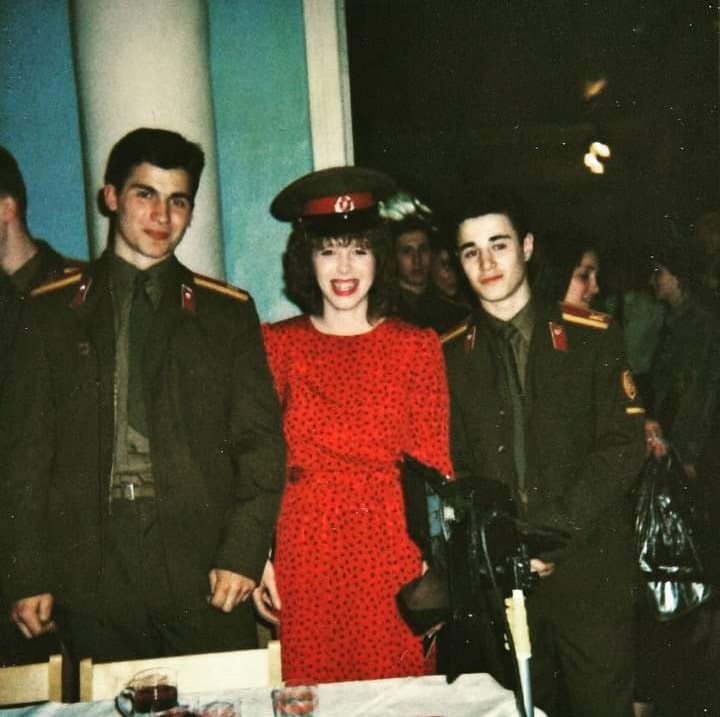
(source image: A Polaroid taken of my mother when she was younger, shortly after the Fall of the Soviet Union; i.e., circa. 1991, while hanging with the Red Army. Mom’s incredibly educated, but one whose streetwise past ensures that she always has a trick [or two] up her sleeve! She also gave me a room of one’s own, in essence funding my entire book series.)
Upon yourselves, all the dead whores of past generations weigh like a nightmare on the brains of the living who worship the state (re: me, vis-à-vis Marx' "Eighteenth Brumaire")! (source: "It Began with a Whisper—Now Scream!" 2025).
To that, Gothic is dualistic, mise-en-abyme ("to place in abyss," belly of the beast, concentric); liberation and exploitation—as much as tragedy and farce, Comedy and Drama, kayfabe and coquette, Nazi and Commie—share the same space onstage and off, in Gothic (re: "Doubles, Dark Forces and Paradox")! Outshine the moon, in either case, killing your darlings—state darlings—to stymie profit, reversing abjection to break Capitalist Realism (therefor Capitalism at large, developing it away from state [vertical, nuclear] models, one step among millions more)! Make it impossible to ignore, camping your own holocaust before it's too late (again)! Stand out but protect yourself while in harm's way[2] (and learning from the best how best to avoid and prevent harm; e.g., my learning from my mother, above, and Harmony Corrupted, below). Whores speak through their bodies, showing others their ass in good faith (as Harmony does, below); i.e., versus bad actors showing theirs in bad; re: in duality! Fight fire with fire knowing it's anisotropic, thus means different things depending on which direction power flows—towards workers or the state, "on the Aegis."
Rebellion takes work and sex work is work; i.e., the oldest form there is, therefore the oldest struggle into capital out of the past (re: the Gorgon). Canon calls us the homewrecker turning capital upside-down, so make that your Numinous (awesome, mysterious) power to anisotropically reclaim; i.e., as the Gothic historically does ("heaven in a wildflower," below)! Connect what seems random; e.g., sex work and Metroidvania! It's not as far-fetched as it seems—the two concerning sex and war (rape), but also widespread exploitation both concealed and advertised cryptonymically by state powers; re: the black castle both opaque and the X to solve for/marking the spot!

(artist: Harmony Corrupted)
The cake is a lie, but a beautiful one telling truth with lies versus state lies—towards universal liberation amid intersectional solidarity/tactical unity (no double standards among good-faith actors): the Utopia of the Gorgon, Gothic Communism setting Medusa free on the Aegis (the usual spectres of Shelley [as much as Marx] down in the trenches during ludo-Gothic BDSM, below)! It's what fascism fears (well, actually fascism fears everything—a sad reality owing to their being nothing more than scared weaklings; i.e., terrified of the Gorgons beyond Capitalist Realism, thus fighting tooth-and-nail for the state and amounting to little more than tribalistic bullies [white Indians]: enacting armed subservience worshipping bourgeois dogma ["follow the leader"] behind a jingoistic, neo-medieval, "might makes right" veneer of false rebellion [re: Parenti's Blackshirts and Reds, 1997]. But I digress).

(artist: Harmony Corrupted)
As for the symposium, itself, it aims to say new things about old topics we all revisit, from time to time; i.e., the Gothic is silly-serious in ways that invite camp through sex, drugs and rock 'n roll, their playful "worship" conducive to thought-as-camp; e.g., Spinal Tap, themselves, being the "little children of Stone'enge" that others, in turn, take up the deliberately bad echo of, to keep the party going (re: "A Song Written in Decay," 2024). Whoever said rebellion had to be dull? The best revenge is to smile at the gods, defying them in all the usual Gothic, thus Numinous, heavy-metal ways that don't preclude blank parody (as Frederic Jameson calls it, in Postmodernism [1991] while whining about the Gothic [re: Alex Link, 2009]—a form of playing with empty/dead metaphor [and superstition] something Horace Walpole [the father of the Gothic novel; i.e., with 1764's Otranto, which we'll return to] had done, centuries prior):

(331Erock's "'STONEHENGE' - Spinal Tap (turned to 11)," 2025)
Amazons are Numinous, thus well at home in Metroidvania revenge stories where Amazons face the Gorgon (nature as monstrous-feminine; re: "Nature Is Food"), thus further or reverse abjection (see: "X Marks the Spot" [2025] for a precursor exploring this idea, at length, with Amazons and Metroidvania); i.e., that I've written about before—borrowing arguments from my older work to establish new commentaries with, namely on camping the canon (or, "making it gay," as I put it[3]); re: to challenge profit, thus abjection, during the whore's anisotropic, dialectical-material revenge against profit and its monomythically Amazonian stories: terrorist/counterterrorist (thus abject) as something to embrace or resist, mid-Amazonomachia, doing so according to Cartesian thought, settler colonialism and heteronormativity monopolizing violence, terror and monsters (morphological expression[4]).
Lastly, while camping canon doesn't preclude playing with canon during ludo-Gothic BDSM (and its Numinous factors, which we'll focus on), the function of canon sees state proponents (traitors, cops) avenging the state; i.e., pimping nature as monstrous-feminine with nature as monstrous-feminine; re: "Rape Reprise" but also "Policing the Whore" (2024). Workers, mid-revenge, can reverse the terrorist/counterterrorist binary per Asprey's maxim (thus abjection), but it requires conscious empathy—qualities trained out of cops recruited from the worker pool, including whores: those fearing state rape projected onto state victims, DARVO-and-obscurantism. In short, there is always an alien to behold, the viewer and the viewed—the voyeur and the exhibitionist, facing off—promoting a conflicted (virgin/whore) sense of diaspora and exotic homecoming alike: liberation from capital demanding the paradox of exposure under capital—the whore(s)-in-question speaking out in cryptonymic ways that conceal as "mere play" once silence becomes genocidal!

(artist: jazminskyyy)
Before We Start
A continuation of my work, the SSS offers an extended poetic/academic writeup on Silksong from my point of view (unless stated otherwise, all images from the game will be screencaps from my playthroughs): my notes on the game, final review, and essays on the game's thematic content (the latter buttressed by older scholarship I've scattered throughout, but generally up front; e.g., the preface and "Extra Theory"). First, though, some information about moi and my obligatory Metroidvania definition, followed by several thank yous—one to Team Cherry for making the game, and another to Ginger for buying it for me to play! After that, I'll give a variety of core theories (and other keywords) you'll need to follow my arguments (do not skip them), ending on a two-part preface.
About Me (the Researcher and my PhD's Independent Nature)

Hi, everyone! I'm Persephone van der Waard, an independent researcher but also Gothic ludologist, medievalist, historical pornographer and trans sex worker activist who wrote her de facto PhD—the core of my book series and written partly for academia, if not peer reviewed there (though produced with a published PhD's help[5]—partly on Metroidvania in connection with ludo-Gothic BDSM; re: Volume Zero of my Sex Positivity versus Sex Coercion, or Gothic Communism book series. I'm the Metroidvania expert, essentially. If you're curious about my entire Metroidvania work—including a variety of essays analyzing a variety of classics, from Super Metroid (1994) to Hollow Knight (2017) and Axiom Verge (2014)—please look at my 2025 Metroidvania Corpus.
Obligatory Metroidvania Definition
This is my basic definition for Metroidvania:
Metroidvania are a location-based videogame genre that combines 2D, 2.5D, or 3D platforming [e.g., Dark Souls, 2009] and ranged/melee combat—usually in the 3rd person—inside a giant, closed space. This space communicates Gothic themes of various kinds; encourages exploration* depending on how non-linear the space is; includes progressive skill and item collection, mandatory boss keys, backtracking and variable gating mechanics (bosses, items, doors); and requires movement powerups in some shape or form, though these can be supplied through RPG elements as an optional alternative.
*Exploration pertains to the deliberate navigation of space beyond that of obvious, linear routes—to search for objects, objectives or secrets off the beaten path (source: "Mazes and Labyrinths," 2021; refer to the Metroidvania page on my website for everything that I've written on Metroidvania).
For the rest of it, refer to "Metroidvania: What Are They (my definition)?" from my Metroidvania page (aka "From Masters to PhD" on my old blog).
Giving Thanks (to Team Cherry and Ginger)
As promised, a thank-you to Team Cherry (for making the game) and Ginger (for buying me the game).

(source)
First, thank you to Team Cherry (above) for not only making the game, but for taking as much time as needed to really let it shine (re: development heaven). Furthermore, thanks for making the game accessible, price-wise—effectively setting an incredible standard for indie games (and Metroidvania); i.e., that AAA studios can't hope to match (thanks to short development cycles/crunch time [worker abuse] and price gouging)! You guys are my heroes (and if you ever want an interview, you need only ask)!

(source: "Away with the Faeries; or, Double Trouble in Axiom Verge," 2024; artist: Persephone van der Waard)
Second, thanks to Ginger—one, for introducing me to Axiom Verge (2014) and Hollow Knight in mid-2017, before I went to grad school (I actually downloaded Steam onto my SSHD, which I put into a portable HD case and used to play Steam games on MMU's library computers); and two, for buying me a copy of Silksong several weeks ago, so I could write about it (and gush about it as we both played the game)! Teamwork makes the dream work; our shared love for Metroidvania and queer rights eventually became my master's thesis and PhD, thus art connected to it (the above artwork drawn for Ginger's birthday, the below artwork celebrating Ginger's coming out as trans). So, thank you, Ginger. You're amazing and "really quite fierce—as useful as a dragon in a pinch!" O most excellent of hobbits, may the hair on your toes never fall out!

(model and artist: Ginger and Persephone van der Waard)
Four Main Gothic Theories (essential, do not skip)
Gothic Communism is holistic, thus combines theory with poetic application; re: the state treating nature as monstrous-feminine food to abject, thus pimp in ways whores (or those treated like whores) have their revenge against; i.e., these theories are dialectical-material, their language (and application) dualistic, anisotropic, what-have-you.
Please note: these are essential terms, meaning you can't understand my arguments without them. For your convenience, I'll give a short and long version of their basic utility and application; i.e., as I define it, based on prior scholarship I've expanded on for these aims (re: developing Gothic Communism). —Perse
Short Version
The four main theories used by Gothic Communism are:
- Kristeva's abjection process (us-versus-them)
- cryptonymy as described by Jerrold Hogle (a "double operation," showing and hiding; e.g., the Gothic castle is a big-ass shadow that, despite being a space of concealment, shows a presence of obscured trauma)
- Bakhtin's Gothic chronotope (the black castle/time-space)
- Derrida's hauntology (retro-future)
Alongside those, there's also
- Castricano's Cryptomimesis (2001), or writing with ghosts (and other monsters, I argue); i.e., similar to how Derrida's 1993 Spectres borrowed from Marx (either case denoting an echo of trauma between pieces of language)
- Hogle's ghost of the counterfeit (the lie of Western sovereignty haunted by victims behind/upon said lie's surfaces and thresholds; e.g., the Medusa)
Long(er) Version
Note: Some of these definitions are slightly abridged. These are big (and obscure) academic ideas my work relies heavily on, and which these samples here are only a taste of. For a deeper look into all of them, refer to the "Four Main Gothic Theories" section, from "Paratextual (Gothic) Documents."

(artist: Doc Zenith)
- abjection (from Julia Kristeva's process of abjection, vis-à-vis Jerrold Hogle's "ghost of the counterfeit"):
Coined by Julia Kristeva in her 1980 book, The Powers of Horror, abjection means "to throw off." Abjection is "us versus them," dividing the self into a linguistically and emotionally normal state with an "othered" half. This "other" is generally reserved for abjected material—criminal, taboo or alien concepts: good and evil, heaven and hell, civilization and nature, men and women, etc. Through Cartesian dualism—re: the rising of a dividing system of thought by René Descartes that led to settler colonialism—nation-states and corporations create states of normality (the status quo) by forcefully throwing off everything that isn't normal, isn't rational, masculine or even human, etc. [...] Descartes was certainly a massive dick, but the spawning of endless Pygmalion-generated undead and demons scarcely started and ended with him. Instead, it expanded through the ghost of the counterfeit as wedded to the process of abjection in Gothic canon; or as Dave West summarizes in "Implementation of Gothic Themes in The Gothic Ghost of the Counterfeit" (2023):
In [the 2012 essay] "The Gothic Ghost of the Counterfeit and the Process of Abjection," Jerrold E. Hogle argues that the eighteenth-century Gothic emergence from fake imitation of fake work is the foundation of what is defined as modern Gothic today. He maintains that Horace Walpole's 1765 The Castle of Otranto, which is considered as the groundwork of the modern Gothic story, is built on a false proclamation that the novel was an Italian manuscript written by a priest. […] Hogle argues that modern Gothic is grounded in fakery. [In turn,] Hogle's observation of the history of The Castle of Otranto forms the basis for understanding the concept of counterfeit as a result of the abjection process.
Gothic Communism, then, reverses xenophobic abjection through xenophilic subversion as a liminal form of countercultural expression (camp). Sex work and pornography (and indeed any controlled substance—sex, drugs, rock n' roll, but also subversive oral traditional and slave narratives) operate through liminal transgression; e.g., subversive monster-fucking Amazons (exhibit 104a), werewolves (exhibit 87a) and Little Red Riding Hood (exhibit 52b) or Yeti (exhibit 48d2), etc. Reversing the process of abjection, these monstrous-feminine beings allow their performers to not only address personal traumas "onstage," but engender systemic change in socio-material conditions; i.e., by performing their repressed inequalities during arguably surreal, but highly imaginary interpersonal exchanges that are actually fun to participate in: as a process of de facto education in opposition to state fakeries (thus refusing to engender genocide within the common ground of a shared—indeed, heavily fought-over—aesthetic).

(artist: Henry Fuseli)
- chronotope/parallel Gothic space (from Mikhail Bakhtin's "Gothic chronotope"):
Mikhail Bakhtin's "time-space," outlined posthumously in The Dialogic Imagination (1981), is an architectural evocation of space and time as something whose liminal motion through describes a particular quality of history described by Bakhtin as "castle-narrative":
Toward the end of the seventeenth century in England, a new territory for novelistic events is constituted and reinforced in the so-called "Gothic" or "black" novel—the castle (first used in this meaning by Horace Walpole in The Castle of Otranto, and later in Radcliffe, Monk Lewis and others). The castle is saturated through and through with a time that is historical in the narrow sense of the word, that is, the time of the historical past [...] the traces of centuries and generations are arranged in it in visible form as various parts of its architecture [...] and in particular human relationships involving dynastic primacy and the transfer of hereditary rights. [...] legends and traditions animate every corner of the castle and its environs through their constant reminders of past events. It is this quality that gives rise to the specific kind of narrative inherent in castles and that is then worked out in Gothic novels.
For our purposes, Gothic variants and their castle-narratives have a medieval/pre-Enlightenment character that describes the historical past in a museum-like way that is fearfully reimagined: as something to recursively move through, thus try to record in some shape or form; e.g., the Neo-Gothic castle (Otranto, 1764) to the retro-future haunted house (the Nostromo from Alien, 1979) to the Metroidvania (1986, onwards; my area of expertise).

(artist: George Roux)
- hauntology (from Jacques Derrida's "spectres of Marx" and Mark Fisher's "canceled futures," vis-à-vis Jodey Castricano's cryptomimesis):
A basic linguistic state between the past and the present—described by Jacques Derrida in Spectres of Marx (1993) as being Marxism itself. Smothered by Capitalism, Marxism is an older idea from Capitalism's past that haunts Capitalism—doing so through "ghosts" in Capitalism's language that haunt future generations under the present order of material existence. In Cryptomimesis: The Gothic and Jacques Derrida's Ghost Writing, Jodey Castricano writes how Marx, though not a Gothicist, was obsessed with the language of spectres and ghosts—less as concrete symbols sold for profit in the modern sense and more as a consequence of coerced human language expressing a return of the past and of the dead as a repressed force; she also calls this process cryptomimesis, or "writing with ghosts," as a tradition carried on by Derrida and his own desire to express haunting as a feeling experienced inside Capitalism and its language. [...] I would argue the same notion applies to all undead, demons and animalistic egregores; i.e., writing with both as complicated theatrical expressions of the human condition under Capitalism.

(artist: Zdzisław Beksiński)
- cryptonymy (from Nicolas Abraham and Maria Torok, vis-à-vis Jerrold Hogle's "narrative of the crypt" and Jodey Castricano's cryptomimesis):
From Hogle's "Restless Labyrinth" (1980): a "double operation," showing and hiding (e.g., the Gothic castle is a big-ass shadow that, despite being a space of concealment, shows a presence of obscured trauma). In Cynthia Sugars' entry on "Cryptonymy" for David Punter's The Encyclopedia of the Gothic (2012), Sugars writes, "Cryptonymy, as it is used in psychoanalytic theory and adapted to Gothic studies, refers to a term coined by Nicolas Abraham and Maria Torok [which] receives extended consideration in their book The Wolf Man's Magic Word: A Cryptonymy (1986)." Sugars goes on to summarize Abraham and Torok's usage, which highlights a tendency for language to hide a traumatic or unspeakable word with seemingly unrelated words, which compound under coercive, unnatural conditions (the inherent deceit of the nation-state and its monopolies). For Sugars and for us, Gothic studies highlight these conditions as survived by a narrative of the crypt, its outward entropy—the symptoms and wreckage—intimating a deeper etiological trauma sublimated into socially more acceptable forms [...] Described by Jerrold Hogle in "The Restless Labyrinth" as the only thing that survives, the narrative of the crypt is a narrative of a narrative of a narrative to a hidden curse/doom announced by things displaced from the former cause: Gothic cryptonyms; illusions, deceptions, mirages, etc. Sugars determines, the closer one gets to the problem, the more the space itself abruptly announces a vanishing point, a procession of fragmented illusions tied to a transgenerational curse: "a place of concealment that stands on mere ashes of something not fully present," Hogle writes of Otranto (the first "gothic" castle, reassembled for Horace Walpole's 1764 "archaeology"). In regards to the mimetic quality of the crypt, this general process of cryptomimesis draws attention to a writing predicated upon encryption: the play of revelation and concealment lodged within parts of individual words tied to Gothic theatrical conventions and linguistic functions, but also patently ludic narratives that can change one's luck within a pre-conceived and enforced set of rules; i.e., rewriting our odds of survival, thus fate, inside exploitative ludic schemes by pointedly redictating the material conditions (through ludo-Gothic BDSM) that represent "luck" as a variable the elite strive to manipulate for profit under Capitalism.

(artist: Lord Mishkin)
Some (More) Keywords (also essential, do not skip)
Some other phrases to keep in mind. I'll define many deeper in (refer to "Paratextual (Gothic) Documents" for their full definitions, alongside others not shown here).
General Terms
- the Numinous: The awesome mystery. From Rudolph Otto's mysterium tremendum, a "wrath of God" motif rooted in Gothic (albeit its perceived divinity having an alien character to it; see: "The Numinous" theory section for more information on Otto's idea and how we'll apply it).
- the Promethean Quest: For the Numinous, from Mary Shelley's Frankenstein (1818), aka The Modern Prometheus. Stresses a reversal of the monomyth through the whore's revenge (an idea we'll unpack in "Other Things to Keep In Mind"); i.e., versus those playing God to rape nature; e.g., Victor Frankenstein, but really anyone aping the Cartesian model when stealing the fire of the gods (a dualistic phrase, insofar as "gods" can also speak to nature and the proletariat versus the bourgeoisie).

(exhibit 34a1a3a1 [from the Poetry Module's "Eyeball Zone," 2024]: Source, right: Ron Magid's "Unearthly Terrors: Event Horizon," 2020. The Gothic is the quest for the Numinous, or destructive power in different forms and functions. Per Capitalism, these forces are like a black hole that cannot be seen past, but whose awesome gravity is felt at all times; per Communism, those of us in the Imperial Core must look past the myopia [and Faustian bargain] of Capitalist Realism to face settler-colonial horrors before they overwhelm the Earth during state shift [re: from Patel and Moore describing climate change, aka Mother Nature's revenge, in A History of the World in Seven Cheap Things...])
- Metroidvania: Capital in small, playing out abjection/the Promethean Quest through a player-controlled avatar. See, also: "Obligatory Metroidvania Definition."
- Amazons: Mythical warrior women and part of Creed's monstrous-feminine rubric (versus Gorgons). Originally mythologized as propaganda enemies of Ancient Athens, Amazons eventually became a tokenized cop symbol, under Capitalism (the femme fatale/forte femme, from the 1800s onwards). To that, Amazonomachia, or "Amazon battle" (which I extend to all monsters, including heroes and damsels), concerns the poetic, half-real warring of semi-mythical ideas, onstage and off; i.e., while canonizing the camp or camping the canon, which the abjection process—to further or reverse, concerning profit (ergo Cartesian thought)—essentially is.
Persephone-Specific Terms (abridged)
Apart from "ludic-Gothic," "infernal concentric pattern" and "Amazon"/Amazonomachia, which I only expanded on, here are some specialized academic definitions from my book series, Sex Positivity, that I personally coined and developed over time:
Gothic (gay-anarcho) Communism (abridged)
Coined by me, Gothic (gay-anarcho) Communism is the deliberate, pointed critique of capital/Capitalism and the state using a unique marriage of Gothic/queer/game theory and semi-Marxist (an-Com) ideas synthesized campily by sex-positive workers during proletarian praxis: developing systemic catharsis, mid-liminal expression during praxial opposition, using ludo-Gothic BDSM and palliative-Numinous dialogs (e.g., Metroidvania).
(model and artist: Blxxd Bunny and Persephone van der Waard)
the Shadow/effect of Pygmalion/Galatea (abridged)
Another of my neologisms (from the thesis volume), the Shadow of Pygmalion or "Pygmalion effect" is the patriarchal vision and subsequent shadow of any knowing-better "kings" of empire, thus capital; i.e., of male- and token-dominated industries inside the Man Box, wherein "Pygmalion" means "from a male king's mind," but frankly extends to all traitors (male or not): upholding profit/the status quo raping nature for profit (and those treated by the state as "of nature" for those reasons).
the Cycle of Kings (abridged)
Another term of mine, the Cycle of Kings is the centrist monomyth, or cycling out of good and bad kings (and the occasional queen), which extends to all the kings' white cis-het Christian men or those acting like these men, thus warrior-minded good cops and bad cops (weird canonical nerds) apologizing for state genocide through Man Box and "prison sex" mentality arguments; i.e., within hauntological copaganda dressed up in medieval language.

"prison sex" mentality (abridged)
Coined in my own work, "prison sex" mentality speaks broadly to rape culture as a practice; i.e., as a systemically taught and enacted approach leading towards the routine harming of others while maintaining the status quo. It is similar to the Man Box argument by Mark Greene, who—in his 2023 podcast, Remaking Manhood: The Healthy Masculinity Podcast—refers to "Man Box culture" as:
the brutal enforcement of a narrowly defined set of traditional rules for being a man. These rules are enforced through shaming and bullying, as well as promises of rewards, the purpose of which is to force conformity to our dominant culture of masculinity (source: Mark Greene's "How the Man Box Poisons Our Sons," 2019).
weird canonical nerds (versus weird iconoclastic nerds—abridged)
A term I coined while borrowing from and expanding on Cheyenne Lin's "weird nerds" phrase from "Why Nerds Joined the Alt-Right" (2023) [...] To it, weird canonical nerds work within a toxic subset of nerd culture. Whereas nerd culture more broadly is for those who present an increased intellectual interest in a given topic—often in literature, but also popular media more broadly as something to consume, critique, or create (with iconoclastic varieties extending such matters into a spectrum of modular activism and counterculture)—weird canonical nerds are those who undermine genuine, active intellectualism; i.e., by exchanging it for dumb, hostile and even bad-faith consumerism and negative freedom for the elite.

(source: Reddit)
the liminal hauntology of war (danger disco)
Another term of mine, one describing a half-real poetic space to heroically move through, onstage and off, and one that concerns the hauntological presence and function of a Gothic chronotope (the castle or some other war-like alien double of the nuclear home); i.e., of the Imperial Boomerang bringing monsters (and their masters) home to roost, during fascism; e.g., Tolkien and Cameron's refrain (further academic coinage on my part, specifically that of the High Fantasy treasure map and Metroidvania/shooter), per the monomyth and Promethean Quest (for power) chasing the Numinous: for different reasons during the dialectic of the alien. In turn, these translate in and out of neoliberal stories (especially videogames) into real life; i.e., during the abjection process as something to reify and further for profit raping nature as monstrous-feminine (re: "A Note About Canonical Essentialism"). Also something I call the "danger disco," or source of Numinous thrills; i.e., where the hero chases the Numinous during calculated risk: to articulate and interpret generational trauma under state confusion and duress.
the infernal concentric pattern (full)
Described by Manuel Aguirre in "Geometries of Terror" (2008) as the final room, or rather a room that, per my arguments, conveys finality through the exhaustion of military optimism in the face of an endless, yawning dead;

where the hero crosses a series of doors and spaces until he reaches a central chamber, there to witness the collapse of his hopes; [this infernal concentric pattern has] in Gothic one and the same function: to destabilize assumptions as to the physical, ontological or moral order of the cosmos [... It is like a Mandelbrot set (left):] finite, and yet from within we cannot reach its end; it is a labyrinth that delves "down" instead of pushing outwards. From the outside it looks simple enough: bounded, finite, closed; from the inside, however, it is inextricable. It is a very precise graphic replica of the Gothic space in The Italian […] Needless to say, the technique whereby physical or figurative space is endlessly fragmented and so seems both to repeat itself and to stall resolution is not restricted to The Italian: almost every major Gothic author (Walpole, Beckford, Lee, Lewis, Godwin, Mary Shelley, Maturin, Hogg) uses it in his or her own way. Nor does it die out with the metamorphosis of historical Gothic into other forms of fiction (source).
i.e., the infernal concentric pattern is the smoke of the ignominious dead used as a myopic screen of arrogant, Americanized Capitalist Realism—one that hides the obvious function of the free market and exploitation as an irrefutably man-made, but nonetheless brutal Cartesian, heteronormative, and settler-colonial model: profit, by any means necessary (often through a Protestant work ethic whose post-Enlightenment era of "benign" Reason demonizes medieval markers in ways useful to the state and its Radcliffean thieves; e.g., the Roman Catholics, but also the paganized Romans before them and the selectively-religious fascist "Romans" after them, etc: the First Reich, Second Reich, and Third Reich, aka Holy Roman Empire, Weimar Republic and Nazi Germany).
Furthermore, such patterns are generally archaeological and architectural in nature, speaking to the medieval idea of mise-en-abyme ("to place in abyss") and Numinous occupations with palliative therapeutic and harmful potential, alike; re: canon vs camp, during the demonic, ergodic, concentric, anisotropic, entropic and gigantic recursions at work; e.g., Metroidvania and similar Gothic castles (or otherwise haunted mighty homes' signature castle-narratives, mid-chronotope) relayed through endless inheritance and doomed heroic motion: death from the house birthing and eating you while exploring it through fatal homecomings. As things to generate and play inside for different reasons, such spaces suggest profit as normally concealing itself during the cryptonymy process; i.e., showing things normally hidden/opaque through unresolved systemic/ontological tensions, exquisitely torturous emotional distress, total imprisonment, taboo subjects, raw aggregate power, paradoxical healing and tremendous obscurity (re: darkness visible, the Black Veil, etc). The pattern, then, is Capitalism (and its deliriums) in small, hence conducive to ludo-Gothic BDSM (and calculated risk) at large when played within miniatures expressing those hypermassive/quantum things felt beyond and inside themselves.

military optimism
A term I wrote for a discontinued book series, Neoliberalism in Yesterday's Heroes, military optimism speaks to the half-real "gun-happy optimism of Pax Americana—i.e., that one can always shoot away the state's enemies and problems" (source: "The Promethean Quest and James Cameron's Military Optimism in Metroid," 2021). This includes any scapegoats that exist in and out of media/the Superstructure and society's public imagination; i.e., between fiction and non-fiction, onstage and off; re: during Capitalist Realism antagonizing nature as monstrous-feminine, pimping it through abject (us-vs-them) revenge before repeatedly summoning and banishing it, Radcliffe-style.

(artist: Alex Ahad)
the dialectic of the alien (abridged)
A term I coined to articulate the dialectic of the abjection process and venerate the Gothic—vis-à-vis Julia Kristeva, but also Frederic Jameson's "dialectic of shelter" and subsequent class nightmare (re: Postmodernism), as well as Summoning Salt's "The History of Mega Man 2 World Records" (2024; timestamp: 8:25); i.e., as a dialectic useful towards universal liberation, one concerning the alien as something to parse and arbitrate for or against abjection (as something to reverse): to hug or hate, police or liberate, the assignment of "alien" status using the same language/aesthetic of the alien, mid-play.

the palliative Numinous
A term I designed to describe the pain-/stress-relieving effect achieved from, and relayed through, intense Gothic poetics and theatrics of various kinds (my preference being Metroidvania castle-narrative vis-à-vis Bakhtin's chronotope applied to videogames out from novels and cinema and into Metroidvania).
praxial inertia
A term I coined when dealing with weird canonical nerds, praxial the resistance to/mistreatment of state-sponsored scapegoats in monomythic stories.
Tolkien and Cameron's refrains (abridged)
Originally conceived of during my PhD, a refrain is a repeatable exercise that upholds Capitalist Realism, in some shape or form (though generally in videogames, per neoliberal media onwards). As I write in "A Note on Canonical Essentialism" (2024):
Tolkien's refrain gentrifies war in a fantasy-themed cartography (the map of conquest in novels, movies and games, video or otherwise), which neatly and consistently divide land and occupant between good and bad, human and orc (or spider, demon, ghost, etc). Cameron's refrain, the shooter and the Metroidvania, was first inspired by Robert Heinlein before likewise being injected into popular media as conducting military optimism abroad: insectoid places to go and bomb/shoot into oblivion [...] (source).
the euthanasia effect (rabid token Amazons—abridged)
A term, coined by me, to describe the canonical, assimilative qualities of the Amazonian myth (and one whose Amazonomachia has canonized, post-Wonder-Woman, in Metroidvania through Cameron's refrain and—to a lesser extent—Tolkien's). It is one where magical, mythical warrior women—as simultaneously virgin/whore animal people (the female* berserk)—are canonically employed to keep men (and the victims of men/token enforcers during "prison sex" police violence) paradoxically in line, mid-panopticon; i.e., a female-coded (usually white, or token non-white) centurion or stentor girlboss who, in between yawping at the men to aurally castrate them (the banshee or siren), "tops" them in hauntological, dominatrix-style fashion, elsewhere outside the bedroom (re: Foucault).

mirror syndrome
Another term of mine, one that occurs through the euthanasia effect; i.e., the euthanizing of token agents, ignominiously attacking their own black reflections' troubling comparison (which doubles are for). Such complicit cryptonymy happens during the abjection process/state of exception and, in effect, betraying their own interests (and those of their fellow workers and nature) for profit: Roman fools killed mid-apocalypse, during blind parody's remediated praxis (re: boom and bust).
Amazonomachia (Amazon pastiche, subjugated/subversive—abridged)
Not a term I coined, but one I certainly expanded on (to speak on subjugated, reactionary, TERF-style forms and subversive variants, mid-duality). "Amazon battle" is an ancient form of classical, monstrous-feminine art whose pastiche was historically used to enforce the status quo; i.e., Theseus subjugating Hippolyta the Amazon Queen to police other women (making regressive/canonical Amazonomachia a form of monstrous-feminine copaganda). [...] regressive/subjugated Amazons become assimilated token cops [...] To that, their symbolism colonizes revolutionary variations of the Amazon, Medusa, etc, during subversive Amazonomachia within genderqueer discourse.

(source)
Preface: A Note on Amazons (as Warrior-Maiden Cops, thus Whores in Bad Faith; feat. Hallie Cross)
Before we start, there's a thin line between maidens and monsters I want to touch on that—while important—we won't have time to explain much, deeper in; i.e., virgin and whore, per the whore's paradox*, share the same space; e.g., Hallie Cross (currently she/it[6]) as a good-faith genderfluid example:
*Which we'll return to, during "Other Things to Keep In Mind."

(artist: Hallie Cross)
We'll get to her. First (and in turn), whores police whores when selling out; i.e., the oldest profession, the oldest tokenism expressed—with Gorgons and Amazons (re: "Always a Victim," 2025) being some of the oldest monsters known to the West (female or not, white or not). Current research is far kinder to Medusa than past stories have been (re: Hadley, 2024). During mirror syndrome, the state triangulates bridled whores (often warrior maidens; re: Amazons); i.e., to punch the Gorgon, mid-abjection (a confusion of us versus them, confronting said confusion [the death omen] on a black mirror): "I'm nothing like you!" Per Creed, it comes from a desire not to be a victim—one I argue always harms women; i.e., assimilation is poor stewardship, TERFs harming all woman by gatekeeping worker rights for state gain (re: "Nature Is Food").
Canon-wise, it's a very militarily optimistic approach—Hornet essentially a bounty hunter for the powers-that-be, much like Samus was: an Amazon (token) cop policing the alien, in bad faith (re: "Witch Cops and Victims," 2025); i.e., herself, but foisted off, by Cartesian rhetoric (man vs nature, thinking beings versus extended beings), onto the state of exception (acceptable violence, mid-crisis; re: Agamben). This happens through its map-like means of conquest, our resident mercenary hunter/returning barbarian effectively the state pimping nature as monstrous-feminine with nature as monstrous-feminine; i.e., during the Promethean Quest and its Numinous upending of Campbell's monomyth (from Aguirre's infernal concentric pattern to ludo-Gothic BDSM as I envision it—the canon for us to camp inside Metroidvania, mid-play): Amazons embody and survive the Numinous (Gorgon or otherwise, below) to further or reverse abjection. We must humanize the harvest, exposing the state as inhumane (re: "Nature Is Food")!

(artist: BTG Art)
Such work, like Gothic Communism at large, is holistic[7]; i.e., language is merely a tool—including the dualistic language of violence, terror and monsters—and whose collective, dialectical-material function is anisotropic, thus determined by flow (of power, knowledge, wealth, etc), not aesthetic! Said praxis (and its synthesis) is oppositional, combining a material and social critique, mid-dialectic (re: Marx' Base and Superstructure). The Gothic is classically "stuck," the Amazon a liminal being (read: historically a white middle-class woman) trying to survive, but also contend with ambiguous aspects of feminine and/or female occupied by other oppressed groups (female or not, white or not; e.g., trans women of color).

There's a "playing possum" idea to it, as well—a secret princess (or prince) lying in wait to accept the hero into them (think vagina dentata but also phallic woman/crossdresser and you have the right idea): the medieval love for crude puns, made flesh then superimposed back into inanimate things (with Team Cherry frequently having players communicate with warrior corpses [above]—communing in old tombs to [re]claim the power lying in state there)! Warriors, lest you forget, are classically poets. So put the pussy on the chainwax (synonymous with camping the canon), bringing the dead back to life (e.g., the Valley of the Dry Bones, Matthew Lewis' Bleeding Nun, and various others)! All's fair in love and war, and war's entire "manufactured suffering" is historically manmade (e.g., the Tudors [and Cromwell, a rebel sacking other rebels] vs O'Neill and the Irish, the former ruthlessly enacting famine during the Nine Years War). Seizing that weaponized concealment ourselves—meaning in the poetic sense—is, unto itself, vital to convey and express state "abuse" in quotes, mid-cryptonymy (e.g., "famine," "pestilence," "rape," etc): "They're right here!" War is a game, Fowler's gun (from Blue Eye Samurai [2023], below) smuggled in but also composed of piano parts and chess pieces: playthings for playing war tied to actual war, back and forth.

Class war is loaded with clichés but also complexities, mid-theatre (re, Fowler [ever the vice character]: "They just assumed the white man needed a chapel… and put it by the dungeon," next page). The colonized, under the colonizers' yoke, must get crafty in their replies; or as Asprey writes, "Terror is the kissing cousin of force and, real or implied, is never far removed from the pages of history. To define (and condemn) terror from a peculiar social, economic, political, and emotional plane is to display a self-righteous attitude that, totally unrealistic, is doomed to be disappointed by harsh facts" (source: War in the Shadows, 1975). "I want a hero," indeed.
Monsters—among other things, besides—represent externalized arguments; e.g., externalized sin, strength, sex and/or force versus internalized variants of the same cryptonymic reifications of stigma, shame, bigotry and guilt, etc, to taboo extremes. As do buildings, though these are morphologically inverted vis-à-vis monsters—the two speaking indiscreetly[8] to a confused and flippant inside/outside, mise-en-abyme: people of sin, castles of sin, whose castle-like bodies or body-like castles (re: "Castles in the Flesh," 2024) hail from the same proverbial tree they reify differently to concentrically recursive extremes; i.e., combating ideas told through combat, as combatants, mid-Amazonomachia—aka a debate or contest that, again, is poetically externalized (versus a psychomachy, whose "mind battle" is generally internalized). Moreover, these are classic theatrical foils, and they manifest and interact differently between themselves; e.g., the damsel a virtue character threatened by vice—often an exotic (xenophobic) lothario or space of sin such perfidious alien debauchers call home: do gingers have souls (the question for the ages, below)?

At the same time, who's alien versus local, captive versus guest? Can one be the other? Is a church, however homely, not like a fortress (whose walls are thin, and have eyes; i.e., as illusory/concrete spaces of concealment and revelation, mid-cryptonymy)? However eclectic, these ecclesiastical variables war constantly among a waning membrane aged perilously thin—the Gothic (and its myriad doubles) prone to troubling comparison, but also love for playing with conspicuously dated language and organizations of power to regress towards (e.g., a baron, duchess or burger, etc); i.e., having simultaneously come back to life while remaining stuck in/relegated to a fascinatingly nostalgic past one is forever moving ergodically[9] through, mid-chronotope (re: my master's thesis). Castles are cool, as is their revival in ways that ignore pure history in favor of something more useful; i.e., what Mark Madoff in 1979 called "the myth of Gothic ancestry" and which Hogle, years later, described its debatable originator as follows (Otranto classically being a fake sold as "authentic"—more on that later):
Like Strawberry Hill, Walpole's playful gothic estate-house, it is an obviously faked "conglomeration of styles" that bespeaks "the instinct of the collector" who divorces artifacts from their foundations and turns them into bric-a-brac, signs disjoined from their original substance. Walpole himself admits all this in his most prominent statements on his fascination with things "Gothic." He loves to play among the relics, his letters tell us, of "centuries that cannot disappoint one," since there, unlike living politicians in the House of Commons, the "dead have lost their power of deceiving" and one has no conscious reason "to quarrel with their emptiness." How is it that such a hollowed-out and admittedly inauthentic (yet also well-researched) approach to fragments of the past could become, precisely in both its imitativeness and its distance from medieval "originals," the origin of a mode (source: "The Ghost of the Counterfeit in the Genesis of the Gothic," 1994).
The Gothic's not just love, willy-nilly, but a powerful tool—one to cut through state illusions in illusory, poetic places of play! Home is alien, but also an imperfect (and plastic) merger between homely and warlike, domestic and foreign; it only seems like "mere play" (and you don't kill home rule with kindness)!
That nerdy (and arguable queer[10]) practice is relatively new, ranging from Walpole's "Gothic" (and gloomth) into Matthew Lewis' false church and Madonna tempting an equally false Ambrosio in The Monk (1794), the abbeys of Austen's Northanger (written in 1804 but published posthumously in 1817) camping Radcliffe (who detested Lewis)... all the way to Team Cherry (and similar latter-day authors) loving the same brand: those old-becomes-new-again stories, worlds and words of a faux-ecclesiastical hauntology and architecture (e.g., friar, monastery, and God versus heathen, hut and godless, one man's rebel another man's terrorist). The cake is a lie, but a splendid one—the Gothic castle's malicious erection stabbing an infernal architecture (of a crude morphological statement) into space-time, on and offstage (the hoax, per Walpole's at times infantile style, very much a joke to play on the powers that be)!

(source: "Radcliffe's Refrain" [2025]; photographer: Dale Townshend)
Furthermore, Amazons, like knights, communicate through both the art of deception (re: Sun Tzu, shown by Fowler's false preacher but also Dale's edible fake book for a non-edible real book, above), as well as open stealth versus the boast, parry or naked thrust without guile. Make it—the figurative "ravishing" that ensues—a clever (and productive) way to relieve stress and reclaim/release your power! It's statuesque, doll-like—abiotic but with a likeness of tissue speaking to trauma and salvation, mid-simulacrum and cryptomimesis; e.g., the rotting Madonna behind Radcliffe's Black Veil, in Udolpho (1796_ or throbbing heart 'neath the floorboards, in Poe's "Tell-tale Hearts" (1843), Emily Brontë's "heart is resting / Beneath the church-aisle stone" from "The Night-Wind" (1846), etc: a black dahlia both guerilla and geisha! Terror and war, sex and force—the heart beats for both (the GNC person/whore both having no childhood and a second one, to boot).
Virgin/whore is a liminal proposition, in Gothic. In turn, "death" takes many forms, which workers reify (and face) together as servants galvanizing rebellion with taboo[11] encounters and open-secret sedition, not sedating it (nudity a fashion statement among class [therefore culture, race] warriors doubling as maids and butlers, but also Gorgons, phallic women [or genderfluid people] and avengers-through-instruction)!

(artist: Hallie Cross)
We're essentially talking about the uncanny, which brings us to Hallie and I. Per Freud's uncanny[12] (and fixation on the nuclear family), home is always somewhat untrustworthy and alien, in Gothic, therefore dangerous; per the exhibit I made invigilating Hallie, Amazons are legendary (oral or written) warrior aliens with a human stamp, uncovering in seemingly old, buried (subterranean) locations with a graveyard, live-burial character to them (re: Segewick): they're "dug up" like corpses, but also of a statuesque funerary. Flirting with outmoded conventions to revive and reanimate, Walpole onwards, "cave (or maze)" + "woman" = sexy and dangerous, femme and fatale with a dark (anatomical) Venus twin to beckon/tempt the audience with; i.e., shadows on the cave wall, and "dark" meaning a variety of things useful to abjection, above; e.g., monster-fucking and courtly love inserting whatever into whatever, mid-dialectic, to make a point (re: "Concerning Big Black Dick," 2025)!
Humanizing the harvest takes many forms, often with soft flesh and cold, hard steel—the reaping implement, laid against the grain, but often taken up, "in arms," by the grain protesting its own grim harvest; i.e., by reclaiming Halloween's ghost of the counterfeit from state pimps (and similar harvest rituals, mid-dialectic; see: "Cornholing the Corn Lady" [2024] for more examples of the same basic idea at work—of nature fucking back/punching up against Cartesian pimps, below)! As usual, Gothic overlaps rebellion and submission, sex and danger to assist in different aims simultaneously!

(exhibit 19c [from Volume One's "Corn Lady"]: model and artist: Cara Day and Persephone van der Waard. Gothic canon invokes the monstrous-feminine to fetishize and annihilate it. It is within this complex space that sex-positive implementations of the same hysterical poetics [and famous monsters] must come to light. Gozer isn’t just a bad girl to spank, and Cara isn’t just a piece of ass. There’s sex-positive power in what they can subvert and express while turning a buck.)
As Hallie shows (next page), the "danger" becomes delicious—the medieval love for oxymoron/allegory alive and well in Gothic's deliberate, confusing "grey area"; i.e., as Destroyer and destroyed sit side by side through the fusion of binaries, so do other combative (tense) dichotomies; e.g., combatant vs civilian, saint vs sinner, minister vs minstrel (vaudeville), virtue vs vice, pleasure vs pain, safety vs danger, order vs entropy, black vs white, good vs evil, maiden vs menace, macho vs meek, hyperbole vs mundane, voyeur vs exhibit, big vs small (size difference), written vs oral, cyborg vs natural, etc. Gothic stamps these modular hybrids with a gradient of Promethean, thus Numinous favors, generally some degree of mysterious and tremendous (more on this in "The Numinous"). In turn, so do Amazons stand in for the damsel, therefore the detective chasing the Gorgon, virgin vs whore; i.e., as separate parts to a larger whole (the human condition): shouting "YOU DIED," mid-harvest, versus "remember that you, too, must die" (said Dumbledore calmly).
The Numinous isn't subtle, but allows for hybridity as abjection occurs. To that humans, under capital, are the harvest—grain for the sickle to reave in ways we can reclaim from state reapers dualistically. Again, the Gothic is powerful not just for its vivid, optionally veiled metaphors, but for where those symbols send power a-flowing when viewed—towards workers or the state, anisotropically (terrorist/counterterrorist, or vice versa). Nudity is violent, and if you disagree, show them your Aegis and watch them recoil as though struck (the pimp reflex):

(exhibit 0: Artist, top-left [and top-far-right]: Hallie Cross; bottom-left: Luna Rose; top-middle-left: Hannah Hussein; top-right-middle [top and bottom]: Persephone van der Waard and Nyx; bottom-right: Artemisia Gentileschi. I've drawn many-an-Amazon, and "femme forte/fatale" is monstrous-feminine; i.e., in ways that allow for cis women, but also GNC pussy-havers to brandish their wares, combating tokenism through Freudian camp [castration[13]] and Amazonian aesthetics [re: "Regarding Tokenism and Fighting It," 2025]. Whatever the gender, body type or area, the Amazon is something to quest for in different ways; i.e., to embody whatever that means, per person; e.g., my friends and associates catering as much to themselves as my type [the mommy domme protector skilled in bullets and blades, above]. The same spirit can be felt in the art I create, my avatar Madikken a thicc redhead punching up; i.e., in the same tradition gleaned from older female Renaissance artists like Artemisia Gentileschi—unsung architects of rebirth through the Humanist tradition that Mary Shelley would camp in posthuman ways [more on that, in a bit].
To it, the reaper is as much Wordsworth's 1807 "Solitary Reaper"
Behold her, single in the field,
Yon solitary Highland Lass!
Reaping and singing by herself;
Stop here, or gently pass!
Alone she cuts and binds the grain,
And sings a melancholy strain;
O listen! for the Vale profound
Is overflowing with the sound [source].

[artist: Kris Verwimp]
as BÜTCHER's 2019 "Iron Bitch (Unholy Wielder of the Blade)" [above]. As the Unicorn tells Mommy Fortuna [concerning the harpy the witch holds captive], "We are two sides of the same magic." In turn, the whole point of "afterlife," in Gothic, is how it affords the ability for radical change while alive; i.e., taken from the imaginary past, a magic that can serve workers or the state. "Magic is magic, but we are the reality!" There's bad bitches and bad bitches, y'all. Angel or devil, don't be polite while speaking truth to power with your fire of the gods; be whatever shape that requires for you to say your part! From Woodie Guthrie's "All You Fascists Bound To Lose" [1944] or "Ciao Bella Ciao" from Italian folk to us, so long as it's conscious of rebellion—and intersectionally inclusive while fighting for universal liberation amid tactical unity [no double standards]—go wild; make pandemonium [monsters] to set yourselves free! You have only to lose your chains!)
There's a Sleeping Beauty component (re: Hallie), but also a hidden beast lurking on the saintly surface of things (re: Sedgwick)—waiting to wake up, the lure and the snare, mid-graveyard-sex (the separation of sex from surroundings being a modern concept, 1700s onwards; re: Foucault)! It's something to embrace as state models (and capital/the media) decay, as usual; i.e., in ways that bring us "closer" (as Trent Reznor would put it)—to get a grip on things when they slip so easily into pre-capitalist socio-material conditions. Memento mori (re: anatomical Venuses, Hallie or otherwise) aren't for causing fear alone, but reconciliation with that curious fascination that people "are basically balloons filled with soft squishy stuff"—as my friend Mira puts it—"and sometimes they pop." Celebration of mortality isn't that we will die (everyone does), but that we're currently alive and can squish in ways that don't harm us (e.g., really good [rough] sex having a semblance of violence)!
In that same vein, people have bubbles to burst regarding our inherited confusions about life and death. Like Ingmar Bergman's The Seventh Seal (below, 1957), the above combo presents medieval life not one of immediate destruction, but of workers once again being closer to Numinous forces; i.e., the likes of which people quest for (not just straight men, below), in Gothic:

The rise of the Gothic novel may be connected with depravity, and a decline of religion. […] In particular, these novels indicate a new, tentative apprehension of the Divine. Monastic life was no longer believed in, but at least it recalled the Ages of Faith and the alluring mystery of their discipline. The ghosts and demons, the grotesque manifestations of the supernatural, aroused the emotions by which man had first discovered his soul and realized the presence of a Being greater far than he, one who created and destroyed at will. Man's first stirring of religious instinct was his acute horror of this powerful Deity—and it was to such primitive emotion that he reverted, emancipated from reason, but once again ignorant of God, his spiritual world in chaos.
Primarily the Gothic novels arose out of a quest for the numinous [emphasis, me]. They are characterized by an awestruck apprehension of Divine immanence penetrating diurnal reality. This sense of the numinous is an almost archetypal impulse inherited from primitive magic. The Gothic quest was not merely after horror—a simple succession of ghastly incidents could have satisfied that yearning—but after otherworldly gratification. These novelists were seeking a "frisson nouveau," a "frisson" of the supernatural. They were moving away from the arid glare of rationalism towards the beckoning shadows of a more intimate and mystical interpretation of life, and this they encountered in the profound sense of the numinous stamped upon the architecture, paintings, and fable of the Middle Ages. The consequent "renaissance of wonder" created a world of imaginative conjurings in which the Divine was not a theorem but a mystery filled with dread (source: Devendra Varma's The Gothic Flame, 1923).

(artist: Hallie Cross)
However they appear, Amazons—similar to witches, sirens, or non-male vampires—offer another GNC monstrous-feminine poetic lens to see the world through (with Hallie being genderfluid in ways befitting an Amazon/redheaded Celtic[14] badass, but also Persephone and Prometheus); i.e., one to express complicated feelings aroused in light of state crisis: acting out death in ways that are fetishized, therefore educational (something I'm happy to actually put to use, invigilating my friends and commenting usefully on current upheaval with said friends' help; re: Hallie the "necropolis" to lose oneself inside).
In turn, aesthetics aren't just "for looks," but poetic engagement to understand and ultimately accept our world in chaos, mid-curiosity—the language of the dead useful for the living to not only survive, but thrive to rapturous degrees, mid-bondage and domination (my time and place, endemic to such things): "A wild cutie appears!" but also a dungeon she calls home (and prisoners, kept there of their own accord, below). Play is built on knowledge and trust, both they (and their brothel espionage) stemming from Gothic's usual sex, drugs and rock 'n roll (and centuries-long insistence on dark mood/vibes): payback's a bitch, reversing abjection "on the Aegis"; i.e., "nostalgia is the enemy of reason, but there is something enticing about its form." Amazons ravish back, potential Gorgons to freeze us where we stand!

(artist, left: Michael Whelan; right: Persephone van der Waard)
Think "come to Jesus" but also "come for Jesus!" It's a likeness of The Canterbury Tales (1392) and similar stories (re: Inferno) that later authors (re: Cervantes, below) would allude to, and from them, Team Cherry returning to such modes, as well: the dead and knights (those who make people dead) going arm-in-arm, like the Knight, the Pardoner, the Wife of Bath, etc, but also Dante's Virgil, Cervantes Quixote or Milton's Satan playing with darkness visible, similar to modern Amazons (and feelings of danger they evoke). Access to these shadows (and their echoes of the past to play with) gives us fresh means of control; i.e., of potentially poisonous balms—a fresh "corpse" to play with, giving it an apothecary's voice to impact future generations with, investing the past in the present as equally buried alive, mid-calculated-risk (re: Hallie, again): "There are no poisons, only poisonous doses." So shuffle the deck, then play your hand once more (the more "cards" we have, the better); it's anyone's game!

Shadows, caves[15] and plays date back to Plato; often, the damsel of Modernity feels scared by state abuse Plato was hinting at. So she "summons" the Amazons of yore—and similar shadows (from the classic male Greek heroes transferred over to English with Beowulf, c.700-1000AD)—to achieve multiple goals. One, she can classically (if temporarily) embody the Amazon from the femme fatale of the 1800s, onwards—becoming "like a man," as it were. Two, she can defeat evil[16]; i.e., on the Aegis, the maiden policing the whore as natural, hysterical—the Gorgon, but also the Dragon Lord as a kind of false or bastard ruler out of the past to replace (exterminate) in the present: blaming the whore, but also investigating tyranny (the two sharing the same stage, while empire decays).
Doing so is dualistic, ergo happens while the Promethean Quest rescues labor from power fantasy pitfalls (the monomyth). The former gives the Medusa a chance to speak, the latter tokenizing nature to pimp itself, Amazon-vs-Gorgon; i.e., slaying dragons while chasing them down (to tilt at windmills; re: Cervantes and Don Quixote [1615] alluded to by Team Cherry's Dulcinea stand-in, above). To interrogate power, you must go where it is; Metroidvania reify that by giving Amazonomachia a structure to play out: xenophobia (and rape fears), forever fixated on dialogs of abjection, ergo capital's us-versus-them-style violence. Our stories mix with theirs, piloting the same avatars; i.e., the sub/sissy's fantasy, mid-Amazonomachia, being to control something just as different from themselves as any sort of repressed alter-ego/secret identity—a horse to ride versus being the horse (or horse-sized dog, below): steering the servant, mid-crisis. Per sex and force (the ancient language of the Imperium, of pimps and whores), Amazons are deeply animalistic, ergo sexual and violent in ways Gothic loves to hauntologize in soldierly ways.

(source: DC Comics' "Scooby Apocalypse," 2020)
The ontology—as a poetry to express, through Gothic—is phenomenologically messy/out-of-joint. Good actors and bad occupy the same shadow zone (ergo shadowy instruction); i.e., that plays repeatedly out during Toni Morrison's rememory process (re: "Rememory, or the Roots of Trauma," 2024)
Rememory as in recollecting and remembering as in reassembling the members of the body, the family, the population of the past. And it was the struggle, the pitched battle between remembering and forgetting, that became the device of the narrative.
and one facing the embarrassing past fraught with cryptomimetic peril and shattered innocence: of various self-betrayals, each taking state pay that Metroidvania—like a dollhouse to lose oneself, inside—collectively reify as a state of perverse grace (re: "Back to Jadis' Dollhouse," 2024). It's the "pick me" mentality of punching the Gorgon, mid-revenge, to desperately and/or conveniently prove one isn't the whore (depending on one's oppression and privilege). Maidens are whores, no matter how purse, and can absolutely punch down to pimp themselves (re: "Policing the Whore").
The pimp's revenge, then, historically boils down to compelled chastity upholding nuclear models; the whore's revenge happens on the same Aegis—a reclaimed Gothic mode (and its dehumanizing language) converting Amazons to a hauntology (anachronism) of pre-colonization: discovering universal liberation among the canceled retro-future; re: me vis-à-vis Bakhtin's Gothic chronotope (the black castle) and Mark Fischer's canceled future (see: "Call of the Wild" and "Follow the White-to-Black Rabbit" [2025] for more on this and Fisher's acid Communism, in particular): less about restoring the black castle to the white (as Walpole did, with Otranto) and more about ending Divine Right/the Protestant ethic, thus capital as a whole!

We do this as Walpole (and others) did—by playing with knights and pirates, damsels and demons, but differently than in the past; i.e., towards a better world by breaking Capitalist Realism "on the Aegis"; i.e., "when the Man comes around," there is always another castle to play with (re: "It Began with a Whisper," 2025)! From Cervantes to us, then, there's an imperfect, Quixotic character to Gothic/reviving the past—one all too easy to canonize (re: "Valorizing the Idiot Hero," 2020); i.e., where power and performing it is ultimately an illusion mired in doubles and paradox (re: "Notes on Power" [2023] and "Doubles, Dark Forces and Paradox"), and where games are classically seen as rendering us the dupe (re: Gloggins [2020] per Plato's allegory of the cave; see: "The World Is a Vampire" [2024] to read how I interrogate this notion, more broadly). Prohibition doesn't work, though, and compelled abstinence is a state tactic (cannibalizing the faster).
To that, Amazons perform like anything else; undead, demonic and/or animalistic, they exist in duality per the Gothic mode as monopoly-adverse. Their dialogs on sex and force (therefore rape), occupy the same spaces sharing exploitation and liberation, side-by-side: something to break state monopolies (therefore Capitalist Realism) on the Aegis—our Aegis, therefore land, labor and sex taken back on itself, relaid as monstrous-feminine. Person or place (monster or maze), form follows function; our function is class, culture and race conscious raising emotional/Gothic intelligence, ergo critical thinking to reverse abjection (thus profit and state-corporate [nuclear] models)! To do that, we require intersectional solidarity without scapegoats (or chickens to butcher, below). No exceptions for the pedagogy of the oppressed; segregation is silence and silence is genocide! Fight fire with fire, Prometheus stealing the fire of the gods—the very "darkness visible" that composes the Amazon—and brings like clay any golem statuesque to life (re: "Of Darkness and the Forbidden," 2024): a protector as much as not, the line between death by Snu-Snu and salvation categorically thin!

(source: "Bad Dreams, or Surviving the Zombie Apocalypse, part one: Police States, Foreign Atrocities and the Imperial Boomerang," 2024)
"A king has his reign and then he dies"; police states decay like anything (above), Metroidvania illustrating the Imperial Boomerang during the liminal hauntology of war (re: inside capital's illusions bleeding outwards to cryptonymically conceal and reveal state death). As capital decays (aka fascism), Capitalist Realism has its own chickens coming home to roost, a reckoning with nature that operates per fatal nostalgia of a Numinous character (the return of the black knight, the ninja[17], the Great Destroyer). To break said Realism, we must play among the spaces thereof, rescuing the monstrous-feminine by virtue of function: to not be the TERF-style feminazi (or twink [re: Link from Zelda, above] stuck in the Man Box, ergo "acting like a man"; re: me vis-à-vis Mark Greene)! Military urbanism, offstage? Amazonomachia in Metroidvania, punching Medusa to uphold Capitalist Realism, onstage? Po-tay-toh, po-tah-toh! Genocide is half-real, the Numinous a means of interrogating abjection in signature ways (which Amazons and their de facto castles are).

(artist: Alaine Daigle)
Preface (cont.): Concerning This Symposium's Broader Focus/Conversational Approach; or, a Tangent on Amazons, Metroidvania, Fascism and the Promethean Quest (feat. Jadis)
This is a symposium; i.e., there's so much we could discuss, I want to conclude this preface with a primer of sorts. Before we get to Silksong the game, let's squeeze in what said game concerns: a loose-but-vital tangent on Amazons Metroidvania, fascism (the heroic cult of death), and the Promethean Quest weighing heroic agency against antagonism during mirror syndrome (often through doubles, below). We'll also discuss how canon is patriarchal; i.e., featuring my Amazonian ex, Jadis (no one is "pure evil," as simple as that would be)! Bodies are classically controlled, autonomy haunted by said control's dialectical back-and-forth over space-time (re: the Amazon and Gorgon as alien to different "cops and robbers" degrees, below). And last but not least, we'll consider different ways to reflect on this (namely Morrison's rememory process; i.e., as it appears in Metroidvania having endless possibilities to cryptomimetically reshape and explore).

(source: "With a Little Help from My Friends," 2024; artist, flats: Hellica-Ordo)
Mapping Things Out
To it, and in architectural terms, Metroidvania aren't just mazes or labyrinths—meaning spaces of confusion, concealment and containment—but also delusion and (dis)empowerment to play with, inside themselves (re: "Mazes and Labyrinths," 2021) and relaid through bodily architecture; i.e., also bodies that denote such qualities in relation to space, mise-en-abyme (re: "Castles in the Flesh"). Castle-like bodies or body-like castles, they are traveling castles (or circuses; read: strongwomen of a "past" brought back to life); i.e., of whose liminal hauntologies of war denote the presence of power in decay through tyrannical left-behinds come home to roost: a cartography to act out old wars (and confusions, cryptonymies) again. The Amazon is the central prisoner-monster (above), released mid-crisis to defend the state or scapegoat its foes (namely the bastard Dragon Lord or whorish Gorgon, deeper inside).
Furthermore, the Promethean Quest points to a Numinous failure, damage and harm per generational theft; i.e., of the Protestant ethic's Cartesian system of thought, mapping nature out in all the usual nuclear/astronoetic methods:

(source [from the Poetry Module's "Teaching and Coaching," 2024]: Jake Rosenthal's "The Pioneer Plaque: Science as a Universal Language," 2016)
Something of a grim harvest/vanishing point, they are literally the Aegis, which we can reclaim, part-in-parcel, inside the madhouse using its wreckage; i.e., liberation and exploitation share the same space, hence magic circle as being half-real in ways that master players through the ludic language of decayed mastery Gothic excels at, in Metroidvania; re (me vis-à-vis Zimmerman, Juul, Giddings and Kennedy):
When such a castle appears, it is time to be afraid; the colonial harvest is at hand. Yet, precisely because the state does not hold a monopoly over violence, terror and morphological expression, a demon or castle needn't spell our end; it can represent our sole means of attack, reclaiming said poetics' endless inventiveness to turn colonizer fears back into their hopelessly scared brains (source: "Prey as Liberators").
Home to an ontological confusion of Amazons/Gorgons, Metroidvania are canonically capital-as-toxic; i.e., the Promethean Quest played out "in small," thereby containing a Numinous outcome for which a pro-state understanding (of dogma) is not guaranteed. Things spiral out of control for one side, granting the other strange advantages (and generally from odd, formerly medieval vantage points, below):

Instead, the iconoclast can camp that, upending the moral manic (and its tokenized copaganda), meaning inside its replica self; i.e., as the state (thus power) decays. Whatever escapist potential Metroidvania have, it's to reify and convey something back into our world from theirs; i.e., while piloting the Amazon-in-question, including her stabby "phallic" bits (a killer but also Trojan rabbit, above). There's still a hero's journey during the Promethean Quest, but it has room to fuck all sorts of shit up; i.e., the king can not only die, but the hero attached to them can reveal as false (ergo the power attached to all of the above): "Conservatism consists of one central principle: There must be in-groups whom the law protects but does not bind, alongside out-groups whom the law binds but does not protect," aka Wilhoit's Law.
The Promethean Quest, through Metroidvania, offer a spatially confusing-but-honest interrogation of such things. Resolution is a myth (re: Aguirre), the hysteria of a dead king(dom) the central structure (not event) lording over the proceedings; e.g., in games like Hollow Knight and Silksong as depicting a cop without a captain, the unmoored slayer (or slayer threatened with homelessness) clinging to order as something to try and restore. The resulting bloodlust (and bath) behaves very similar to Americans crying over Charlie Kirk's assassination (see: conclusion to "Thematic Analysis" introduction)—or the Two Towers falling on 9/11, the bombing at Pearl Harbor, etc—insofar as the system they rely on, including the view of the world it offers to in-group members, being suddenly threatened or pealed back (an apocalypse); re: like The Matrix, showing "Baudrillard's "desert of the real" outside Plato's cave: "Some people are not ready to be unplugged; they are so hopelessly dependent on the system that they will fight to protect it."

This includes subjugated Amazons treating their own (or those they have more in common with) as "Gorgon"; i.e., during giver/receiver dialogs of state force during state decay playing cops-and-victims out, sans irony! Amazons are simulacra, in how they were never strictly "real," but have become at least half-real; i.e., at cross purposes, mid-replication. Furthermore—and placating a dead tyrant, mid-Cycle-of-Kings—the world is less dying and more already dead; i.e., a Metroidvania frozen in time and needing to be unfrozen (a bit like Ripley, above).
Amazons classically assimilate, and assimilation is poor stewardship. To end the curse (the false power offered by neoliberal authors, during Capitalist Realism), said avenger seeks to slay the Gorgon (dragon, giant, Jabberwock, etc); i.e., as village-style scapegoat, ergo prevent state shift in duality as the logical (and inevitable) outcome of Capitalism; re: "state shift" being Patel and Moore describing climate change, aka Mother Nature's revenge against capital functioning as normal: while raping nature. Sometimes nature fucks back; i.e., in borrowed robes, Nelson-Mandela-style, and while sensing state fear because the state fears nature, mid-polemic to a menticidal degree, yet also fetishizes extended beings for routine exterminatory harvest (re: Patel and Moore, Wolfe). Such contradictions are baked into the system, its technologies of conquest (maps, below) inked in blood:

(source: tuppkam1)
The Cartesian model—as the Promethean Quest reliably demonstrates—routinely begets fascism defending territories of genocide; i.e., big map, big genocide (above). For all their cult of strength, then (re: Eco), Nazis (and the white moderates who defend them) are giant pussies who abandon struggle (re: "White Moderates Don't Challenge Fascism," 2025)—all to bend the knee through armed submission, raping nature anew! They're lobotomized, viewing nature through the colonial gaze of the state; re: Michael Uhall's astronoetics, but through a retro-future gaze that decays backwards:
Astronoetics are what Michael Uhall calls a celestial, intelligible presence ("Astronoetic Cinema," 2019). Reframed by me slightly, it is the colonial gaze of Planet Earth in any imaginary scenario, which the Metroidvania commonly portrays as nature vs civilization. [...] The fact remains that men like Weyland rape nature all the time, but only double their efforts when they—like the system they personify—reliably starts to die (false power). In turn, the state and its men of reason will do anything to preserve themselves, weaponizing their own bloodline against nature, the latter having evolved to resist dominion (thus rape) through counterterrorism and asymmetrical warfare. [...] That's what the Promethean Quest effectively encapsulates and discourages, Medusa fucking back to reverse the flow of power and information the monomyth normally supplies in outright parental language, but also monomythic media exposed to middle-class children at a young age (source: "'She Fucks Back'; or, Revisiting The Modern Prometheus through Astronoetics: the Man of Reason and Cartesian Hubris versus the Womb of Nature in Metroidvania," 2024).
The colonial gaze is as much the titular Hollow Knight from Team Cherry's maiden voyage as it is Peter Weyland from Scott's prequels. Either is infected with state dogma; i.e., capable only of raping the natural world to prolong themselves, but only up to a point (the giant fat and skinny at the same time, below). Except, the twist in Hollow Knight lies in how the bugs have had said gaze replaced with the Gorgon's viewpoint; i.e., seeking cordyceps-style revenge:

Fight fire with fire, remember? Asymmetrical warfare classically relies on terror weapons to alter the colonial mindset to destroy itself; i.e., Ozymandian syndrome: "Look on my Works, ye Mighty, and despair!" Hollow power, hollow knight—invaded by hysteria, the Archaic Mother's Wandering Womb (or bicycle face); i.e., sacking Troy's rebuilders by making them Athena's Trojan Horse, reversed by the vengeful Gorgon: "When Perseus slew the Medusa he did not – as commonly thought – put an end to her reign or destroy her terrifying powers" (source: The Monstrous-Feminine).Chief among them is simply telling the state: "remember that you, too, must die" (the memento mori a bit smug in its reminders). Medusa is a Leveler—one whose petrifying vision spells doom, as does viewing whatever she has to show conveying Numinous qualities (above and below); i.e., the cryptonymy is the map, but also the bones hidden inside: the state having eaten itself alive (the ignominious death)!

By comparison, canon is patriarchal, thus mortal and begot from primordial female/monstrous-feminine origins. This brings us to earlier research I did with and before/around when I met Jadis (c. 2019-2022), which I want you to conceptualize alongside Silksong after I explain it, here.
My Work: Fascinated with (and Haunted by) Cartesian Abuse
To summarize, capital's worst nightmare is basically a facet of nature that can think for itself, suggesting planetary rebellion through singular instances thereof it will try to tokenize. What Jadis loved actually came from a shared childhood, one they used against me; i.e., to defend capital from my work.
First, said work:

(artist: Alexey Lastochkin)
Per my thesis statement, Capitalism sexualizes everything in a heteronormative (vertically arranged, sexually dimorphic) scheme; canon achieves heteronormativity by essentializing biology, ecology and geography (economics, etc) in equal measure in order to achieve and maintain a Cartesian outcome: domination of the natural world (and workers) to serve profit. This happens through the routine gendering of Nature vs Society (vis-à-vis Raj Patel and Jason Moore) by Cartesian thinkers; i.e., in ways that men like Francis Bacon and René Descartes started, but continue to remain relevant under Capitalist Realism as a more recent affair that neither patriarch lived to see: a raping of nature as Promethean, meaning in this case "primed for abuse, ad nauseum." Nature is Medusa; Medusa must obey and die (over and over).

In turn, said Realism yields neoliberal fantasies (often videogames) that present nature as good or evil in essential terms, and by extension, gendered ones that are biologically and ecologically divided along problematic moral categories whose territory is geared towards a settler-colonial outcome: the mapping and execution of conquest, thus genocide through us versus them, reliably framing "us" as human and "them" as inhuman through various black-and-white binaries that serve capital, thus empire (or humanizing inhuman groups—e.g., white cis-het women [above]—to recruit them harmfully into a centrist story that prolongs settler-colonial conflict; i.e., for profit's sake, instead of permanently ceasing hostilities by actually addressing the socio-material conditions that historically lead to them: pro-state workers triangulating through the equality of convenience ["boundaries for me, not for thee"] to unironically punch down in defense of the state against intersectional solidarity and workers, animals and the environment at large).
It bears repeating that said execution of conquest involves a map of a location, the latter filled with enemies (e.g., orcs) who must be cleared by human agents or token enforcers, doing so step-by-step, person-by-person, room-by-room to effectively "sweep" the entire area of perceived hostilities. Doing so is meant to achieve one cycle of capital in miniature; i.e., moving money through nature to achieve profit as expressed concentrically on all registers. Likewise, the basic categories of land, sexual biology and ecology manifest in a variety of [cartographic] refrains canonizing Cartesian dualism (and its harmful divisions) through Capitalist Realism. My book pointedly highlights two: Tolkien's and Cameron's [re: the High Fantasy and the shooter, including Metroidvania] (source: "A Note About Canonical Essentialism," 2024).

(exhibit 37e2 [from "Meeting Jadis," 2024]: Artist: Bayard Wu. Wu's art showcases the kinds of tough, savagely capable orc women that Jadis [my female genderfluid ex] preferred. A maxim of theirs was that "heroic" women weren't allowed to be ugly, so Jadis especially enjoyed seeing female characters that were either too tall, wide and/or brutish to meet conventional beauty standards; i.e., women of color outside of the West, closer to nature, the jungle, rape and death [the "voodoo" of the pre-colonial "zombie"]. "Strength," for Jadis, was meted out through appropriative perceptions of tomboy force delivered by capable-looking female bodies of given races [...]: monster girls who spat, farted, fucked and took spoils of war as sexual prizes...)
In media or out, and across a variety of genres and mediums (novels, cinema, videogames, etc), cartography is a technology of conquest filled with enemies to justify the map (ergo the prison and its free-fire zone as space to slum, NPC or avatar). Videogames were simply the neoliberal continuation of what older mediums couldn't simulate—a reality it rectified by sending the simulation into the household:
From the early days of Space Invaders (1978), Pac-Man (1980) or Donkey Kong (1981) to Mario, then (about seven years—about twelve, if you start from 1973 when the elite began their first experiments with neoliberalism in South America), the usual place of neoliberal business and indoctrination transitioned from single arcade machines to larger amounts of money (from quarters to hundreds of dollars) per customer in each household (where there is more money to be had, and seasonally at that); i.e., a Stepford Wife, purchased for paychecks, not pocket change, and ready to implement the business model into the first generation of what would become the New World Order under neoliberal Capitalism: a world of us-versus-them enforced by neoliberal, monomythic copaganda's harmful simulations of Amazonomachia to maintain the status quo at a socio-material level; re: the shadows of a new republic's man-cave walls. / In turn, the American middle class (so called "gamer culture") would gatekeep and safeguard the elite through videogames being an acclimating device to neo-feudal territories to defend in reality (outside of the game world[s] themselves) as capital starts to decay like usual (source: "Modularity and Class," 2024).
As we'll see with Jadis in just a moment, the home became a site of abuse sold dogmatically back to itself; i.e., "like mother, like daughter" speaking to the usual "cop or victim" dice rolls that occur after trauma is inflicted—meaning from one member of the family to the next (on and on, down the line): survival and survivor hovering between echoes of the helpless that many tokenized Amazons historically refuse to be, punching tyrannically down (as Jadis did to me, below). They become the Destroyer for state aims—a de facto (stochastic) token cop aping the Gorgon in bad faith per return!

(exhibit 1: Artist: Jadis; original source: Persephone van der Waard's "Why I Submit: A Subby Gothicist's Attitudes on Metroidvania, Mommy Doms, and Sexual Persecution" [2021]. Shown again in "Going Mask-Off: Showing Jadis' Face" [2025]. A model inmate for which I founded my quest for the Numinous on, post-escape, they had "resting bitch face" down pat: "The greatest irony of Jadis harming me [...] is they accidentally gifted me with the appreciation of calculated risk. Scoured with invisible knives, I don't view my scars as a 'weakness' at all; I relish the feeling of proximity to the ghost of total power—of knowing that motherfucker took me to the edge but didn't take everything from me: I escaped them and lived to do my greatest work in spite of their treachery!" [source: "Angry Mothers; or, Learning from Our Monstrous-Feminine Past," 2024].)
The Return of the Gorgon: Jadis Colonizing My Work as Capital Colonizes Nature
Per the Protestant ethic (under Judeo-Christian values), nature as dominant is alien and fearsome, continuing virgin/whore in dogmatic ways fearful of the Gorgon's return; i.e., there must always be a monstrous-feminine whore of nature to pimp, including through dialogs of internalized self-hatred, when kettled (the Gorgon's rage classically blind, thus easy to triangulate/pimp). "Peace" is a white man's word, one tokenized easily enough to maintain through tokenized[18] violence; re: Man Box, which Jadis gladly occupied, and for which they enacted their tokenized, Amazon-style, "hall monitor misogyny" against me (fascism and white moderacy are misogynistic, including when genderfluid AFABs enact it versus trans women; i.e., marginalized infighting for Judas pay upholding state models): often to police the games they loved, defending them from me by colonizing these spaces, onstage and off.
For one, Jadis' moral compass was hopelessly skewed, seeing my attraction to the void as an alien threat. One to stamp out in bad faith, Jadis preferred their place as alien in the order of the world; i.e., as it presently was—not to change but preserve and police as currently sacred, immutable, and essentialized until the sun burns out. They acted like bait for a master they served, but never saw (the Man).
Furthermore, it needn't just be orcs in a top-down RTS (re: exhibit 37e2); it could be dinosaurs (e.g., Jurassic Park's cunning velociraptors[19]), space aliens, or—in Team Cherry's case with Metroidvania (classically a kind of shooter [the TPS] with platformer elements)—bugs; i.e., talking animals that aren't human acting human, specifically as colonizers through DARVO argumentation: Mother Nature's revenge versus the state mothership. Onstage and off, man versus nature is central to Cartesian thought—from Cromwell vs O'Neill to the Americans vs the Native Americans to fascist South Vietnam (and CIA advisors) vs the Communist upper half (which Ripley tokenized to defeat both them and herself, afterwards), and so on. Segregation is no defense; life finds a way to push back: the whore's ancient revenge Jadis monopolized for themselves, mid-Capitalocene (drawn to my prior femboy ass like a huntress to fresh meat)!

Aesthetics aren't the issue; function is. A moral geography is just that, and its destiny under capital is always genocide; i.e., per moral panics designed to maintain order as a Cartesian structure of routine invasion—of extermination versus nature as furious alien whore from the Land Before Time: thinking beings vs extending beings, the latter very pissed off and whose pimping promises the powers-that-be endless billions (as Spielberg's dinosaurs did, above). There's always a map, and said map is a lie insofar as its power (for the worker) is ultimately false (also above). "Life finds a way" becomes "clever girl!" becomes escape scenarios framing the downfall of the state, however ethnocentric, as "tragic." So the state pimps nature to subjugate it, whores policing whores inside each map as maze-like; re: Amazons acting as cops, either in real life (re: Jadis) or the closed space and open worlds for never-ending conquest in-game bleeding outwards (from my PhD):

(exhibit 1a1a1h2a1 [from "Scouting the Field," 2023]: "When Alexander saw the breadth of his domain, he wept for there were no more worlds to conquer." Videogames are war simulators; in them, maps are built not merely to be charted and explored, but conquered through war simulations. The land is an endless site of conquest, war, rape and profit carefully dressed up as "treasure," "liberation" and "adventure," but in truth, brutalizing nature during endless wars of extermination borrowed from the historical and imaginary past as presently intertwined [...] I.e., the problem of Cameron's centrist feminism is that it "empowers" the female warrior to uphold the status quo, dooming women at large (say nothing of everyone Ripley attacks to "save the world" by paradoxically blowing it up; or as Metroid put it: "Pray for a truce peace in space!") [That is the lie I'm talking about].)
Videogames are merely part of the same Gothic mode—ergo its sex, drugs and rock 'n roll the state will abuse to maintain itself and its territories. Onstage and off, any labyrinth (or maze) is a prison-in-a-prison housing Amazons and Gorgons; i.e., as the worst-of-the-worst, a bad girl that a cop—including a somewhat-bad-but-ultimately-good-girl version of a criminal-turned-cop (the warrior nun)—must stop in its tracks. Ripley was female Rambo; so was Samus, and arguably Hornet fills the same Amazonian shoes (though perhaps not, in the latter's case; see: my notes for "Act III" regarding her ascension from Amazon to Gorgon): token war bosses punching down against "clever girls," the former feeling owed post-betrayal (colonizer behavior from "pick me" bitches).

(artist: Blue Kiwi Design)
Clever girls can fight back. Can't have that, so the Gorgon's death is mapped out. The maze becomes a gladiatorial arena centralizing her as the perpetual scapegoat[20]; re: blaming the whore while fetishizing her as alien and intelligent; i.e., the phallic woman as Archaic Mother speared by token Amazon weaponry (usually pilfered from the Gorgon's pirated home). Offshoots of the Gorgon, these cute-but-deadly ravishers wield a palliative Numinous—one whose subversive power (during the whore's paradox) becomes the object of state pursuit: something to hijack for its own revenge (acted out, mid-aesthetic, by token goons playing white Indian in bad faith; re: from Ripley to Jadis). From Radcliffe to Scooby Doo (1969), the Gothic adores the pirate aesthetic, and piracy is anisotropic; i.e., insofar as its irony—through an executioner's guise of power and death—is entirely optional.
To that, Gothic canon (thus Cartesian thought) is historically patriarchal versus nature as matriarchal—the former afraid of land, labor and sex back "on the Aegis," therefore excusing itself to justify the usual reprisals; i.e., while raping nature-the-pirate-hooker to preserve state hegemony (and piratic dominion), meaning over nature not just as monstrous-feminine, but gyn-ecological; re: Francis Bacon, per Patel and Moore in Seven Cheap Things, invoking a "penetrating of the womb of nature," during the Cartesian Revolution; i.e., "to torture Nature's secrets out of her" (source). The state cheapens life to prolong itself, mid-hunt.

(source: "Meeting Jadis" [2024]; artist: Jadis)
This includes sodomy accusations, but also witchcraft, blood libel, and Orientalism, etc; i.e., as arbitrary-but-imbricating persecution networks with menticidal effects, under Capitalist Realism (re: "Idle Hands," 2024): "boundaries for me, not for thee." The whore's revenge is a nightmare the state will capitalize on—class, culture and race things to betray by tokenizing this or that; i.e., Amazons pimping their own while thinking they're more oppressed than they've actually become (and using different poetic implements to fetishize their own turncoat role in things; e.g., those "phallic," alien-green, and notably ovipositor sex toys that Jadis enjoyed, above).
Whatever the form, capital is functionally toxic—rotting our brains while grinding the Earth up inside itself (re: "The World Is a Vampire"). It's what Jadis did to me, the pirate queen harming me for being "weak" by actually rebelling versus state models; i.e., inside a perceived pecking order of preferential mistreatment, Jadis always acting the victim while being the cop in pirate's clothes: whoring themselves out while preferring to harm others through the usual bad-faith spells (and mirrors of enchantment, left) that capital taught them to abuse (always a daddy's girl, but cowed by their "narcissistic mother," as Jadis put it).

(source: "Transforming Our Zombie Selves" [2024]; artist: Jadis)
However potent such spells are—rape a spell of control that never fully ends—a pimp is a pimp, ipso facto. Jadis' betrayal, mis-aesthetic, was a painfully potent lesson about Gorgons with zero inclination to rebel; i.e., for every Galatea betraying the Cause or otherwise "asking for it," Pygmalion sits behind the curtain pulling the strings (not just Foucault's Boomerang but panopticon): envious of nature tending to be female superior—and in ways beyond the token avenger's submission, wherein Great Men have fetishized, post-decapitation, from Freud onwards; re: Creed vis-à-vis "Medusa's Head" (1922).
To that, Jadis was utterly incapable of actual connection/actually loving others, yet burned with a dark desire for nature's revenge they pushed onto me, instead (too scared to actually put it to practice). Yet, the awesome "ghost" of Jadis (the dark Amazon, aka "strict" mommy domme, below) is often what I miss the most, thus continue to chase, in Gothic; i.e., long after I left the actual tyrant behind! "Every girl's got a devil; you can't rest till you find them." Gothic, as Metroidvania demonstrate, doesn't preclude playing with them; Gothic Communism seeks to learn from what abusers teach us, whether they meant to or not (a lesson I'd carry into Metroidvania, after the fact): a better Gorgon/Amazon than Jadis chose to be, and one for me—a survivor of rape—to hungrily chase! Doing so (and recalling the abuse, again) is cathartic for me (the curious case of the nerdy girl chasing the cavewoman, the knight, the straight-up thumper as brains and brawn, beauty and beast, below)!

(exhibit 43d [from the Undead Module's "Seeing Dead People," 2024]: Models and artist: Jadis and Persephone van der Waard. Jadis and I, re-envisioned as a knight and her femboy ward through their encouragement/coercion [they would pull my funding and threaten me when angered, becoming a cycle of reactive abuse]. Doing so has transformed the past in ways that reflect on my abuse while also offering up a better hypothetical in the same Gothic language: what could have been and what could actually be in future love stories should workers [and BDSM contracts] actually be respected, post-negotiation—not a memory of the past, but a rememory focused on remembering the essence of what was lost and, if not forgetting the horrifying abuse suffered at the same time, then at least not letting it rule me; i.e., me feeding on something I could rearrange and draw strength from—to not have it drain me all the time. Trauma is cryptomimetically echoed; i.e., in ways that acknowledge what was while subverting it per a revolutionary cryptonymy!
It's not exactly "the happy ending" of the Neo-Gothic novel, if purely because it doesn't do away with the haunted past; but it does present a suitable "What if?" for future undertakings that bear some resemblance to a former life while being different in all the ways that matter. This "ghost" of Jadis represents them at their very best, their most beautiful. On this page and nowhere else, they are still my protector and beloved, but also my Slan, my succubus monster mom who won't actually harm me. Creating them here in this form is my attempt to riff off my own trauma in cryptomimetic fashion, repurposing my own dead memories in ways that bring me peace; it hurts, as birth generally does, but ultimately delivers me tremendous sensation and relief from a tyrannical past! […]).
Chasing the Gorgon: from Mary Shelley into Metroidvania
Concluding our exhibit with Jadis, let's push into the sorts of vengeful spectres (of Gorgon-esque power) mapped out in ways that capital historically pimps; i.e., after Mary Shelley (and her famous novel, Frankenstein) came and went (re: "Making Demons," 2025): the Destroyer as still human but lethal, vengeful, and aloof!

Per Shelley's story as echoed by Metroidvania, nature is always "hysterical," in canon, thus "needs" to be dealt with as the state historically does: as "the ultimate mechanism of alienation and estrangement [where they] turn the accused—still primarily women—into monstrous beings" (source: Federici, citied in "Hot Allostatic Load" [2015] and later in my response to both writers: "Policing the Whore"). From the US to Russia to Germany before, during and after WWII (e.g., revolutionaryth0t's "Why did the USSR (re-)criminalize homosexuality?" 2025), the state is straight (re: "Understanding Vampires," 2024), thus heteronormative in ways that afford people like Jadis embodied in bad faith.
This includes "lobotomy"; i.e., as a broader pacifying means of controlled opposition, per the monomyth—its regular benefactors treating nature as insect, vermin, chattel, whore, ergo its token ones, too; re: the Amazon punching the Gorgon, per Promethean Quest; e.g., the xenomorph being a crude metaphor for Communism, but Red Scare really going all the way back to Mary Shelley's golem: pimped by Victor Frankenstein, but also those like him—so-called Mankind (and all its princely "paragons," below) being the center of a very fragile universe (what Lovecraft[21] called "Cosmicism" [and was called "cosmic nihilism" by his fans] having a Numinous-if-uncheery outlook on things).
To that, Jadis was a member of the STEM fields—the very sort of group that, one, is haunted by capital's patriarchal (thus sexist, racist) past, hence can totally be Nazis while claiming to be "neutral" (re: Operation Paperclip, but also more recent examples; e.g., Shaun's "The War on Science," 2025); and furthermore, can fetishize men to infantilizingly Cartesian extremes—meaning in ways that Jadis (a classic tomboy but not a herbo despite acting like one) shamelessly imitated through false (token) disobedience in a lab coat: a false god to worship uncritically by TERF and SWERF alike (which older feminist movements absolutely were/are; re: what I call "fascist feminism," historically having [white] moderate forms—Jadis breaking the mold for me).
Again (and not for the last time), function/flow (of power) determines function, not aesthetic, and the dialectical-material dividing line that separates actors concerns those who are good or bad; i.e., as a question of good and bad faith—with Cartesian arguments tying science to empire for as long as science has existed: from Bacon onwards, and certainly when Shelley—something of a whore and iconoclast, herself—wrote her novel lambasting such individuals for their hypocrisy and privilege.

Yet, absolute power is also a myth, Shelley's Gothic (therefore all Gothic) cryptomimetically shows; only its arbitration is constant (and even then, things get messy). Mad science, Shelley contended, concerns growing soldiers in a lab, said lab the usual world laid to waste by genocidal fucks. It's a very dialectical-material argument, preceding Marx's catalog by decades when she published Frankenstein the year he was born (and when Shelley herself was only a teenager having birthed and lost multiple children[22]).
The original sci-fi novel and easily the most important, influential Gothic work ever written—one inspired by Paradise Lost (1667), The Tempest (1611) and Dante's Inferno, and whose scope includes all Metroidvania, the entire Alien franchise (1979-present), Forbidden Planet (1956), At the Mountains of Madness (1936), Heart of Darkness (1899), Dracula (1897), The Narrative of Arthur Gordon Pym (1838), among others—Frankenstein warns against Cartesian dogma on the rise (and death) of capital: the aging recluse in a glass jar, womb, and ultimately grave when all his seemingly magical technology (and all it cost to procure) cannot save him. "Mortal, after all!"

(exhibit 40g1 [from "Double Trouble"]: Artist, top-left: Wildragon. Resembling the skeletal Immorton Joe from Fury Road [which came out a year before Axiom Verge] but also, oddly, Jacques Derrida, Athetos is Happ's "writing with ghosts" by evoking the heteronormative spirit [and cartographic tools of conquest, exhibit 1a1a1h2a1] of the old, Enlightenment tyrant/con man Wizard-of-Oz, Peter Weyland. As the vain owner of everything around him, Weyland becomes desperate to cheat death, yet only discovers the Leveler on his own Promethean Quest: "A king has his reign, and then he dies," his daughter, Mary Vickers, explains to him. "That is the natural order of things." [...])
Cartesian thought is dogmatic, and dogma is criminogenic, Frankenstein argues. Conducive to the very conquests that Metroidvania map out, the latter only wait to reenact through the discovery of old worlds like Shelley's palimpsest: new sites of plunder and death, ergo colonization per the usual cartographic architecture (thus refrains); i.e., "a technology of conquest," Patel and Moore rightly posit, "[one where m]edieval multiple vantage points in art and literature were displaced by a single, disembodied, omniscient and panoptic eye."
Under such oppressive surveilling conditions, a pastoral backwater easily becomes a killing field, one where the owner class (and those aping them, below) attack their victims with endless impunity (expressing total ownership over, in perpetuity): laying everything to waste (re: Ozymandias' "colossal wreck")! So the Promethean Quest steals power from the past as genocidal—marked cryptomimetically by ghosts of genocide to steal power from again (and again), doing so out of perpetual (at times indiscriminate) revenge! Whether from workers or the state—either chasing the Gorgon (and her screaming shadow, below), at cross purposes—the fuel is pain, hatred, and death (the Numinous in Metroidvania echoing Sontag's "Fascinating Fascism," 1974). However extinct Medusa may seem, no monopolies on any of those things presently exist:

"Who's the savage? Modern man!" Mary Shelley—specifically her Promethean Quest (and all its framed, almost-forensic conversations about, and dilemmas regarding, morality in the face of technological abuse)—loves reminding those accustomed to power and privilege: how these luxuries have, in fact, made them incredibly venal, stupid and cruel; i.e., scientists are not gods, they're men, and men are classically fated to be tragically flawed—terminally so (so many stories after Shelley delighting in killing scientists, from The Island of Doctor Moreau [1896] to King Kong [1954], Gojira [1954], The Fly [1958 or 1986], Jurassic Park [1994], Half-Life [1998], Portal [2007] and countless others)! They think to themselves, "conquer nature, conquer death," when nothing could be further from the truth (so many Metroidvania are dead places, where advanced science—often expressed as magic [above, per Clarke's Law]—have laid themselves to waste).
Worse (for them), nature—when treated like a science experiment—is quick to turn the scalpel on the surgeon: to "turn the tables," as Wordsworth might put it, "murdering to dissect." Capital (and science under Capitalism) can only extract value from nature, killing nature; i.e., in ways that don't even preserve the elite for whom capital serves (with Hornet seeking sanctuary[23], post-escape, for those chattelizing her for her body's natural silk-producing qualities). Meanwhile, the colonized long to give the colonizer a taste of their own medicine—of generational trauma killing not just the man, but his entire legacy (the murder of children signifying poetic justice alongside natural selection; e.g., Peter Pan [1904], Alien: Earth [2025], The Beautiful Darkness [2014], and Lord of the Flies [1954], etc, all leading back to Shelley's dysfunctional family unit, her furious planet): the transference of power when power decays, during the Promethean Quest Shelley crystallized. Per the Gothic, it's both cautionary[24] and delicious, but also ghoulish and infuriatingly unfair (depending on who's getting it, below)!

(artist: Bernie Wrightson)
To that, non-Promethean hero fantasies, in the canonical sense, become kayfabe-style bread and circus versus nature; i.e., as a source of perpetual fear following genocide haunting what has become alien (a death cult per Capitalist Realism); re: rape nature with nature (as monstrous-feminine), mid-monomyth: making the Amazon a pimp for state aims castrating Medusa (who refuses to bow to state dominion). Seeing how Medusa always wins in the end (re: the Promethean Quest), this symposium begs the following question: will the Omelas child, Hornet, walk away from the city-in-question, camping the canon? Metroidvania are Omelas, laid to ruin (the Gorgon in the vault screaming less to be free, mid-panopticon, and more to seek revenge against state ruler and police by testifying to her own rape; re: "Policing the Whore"). As Porpentine would write, they "build among the storms" (source: "Hot Allostatic Load," 2015).
Furthermore, to camp the canon, Gothic demonstrates just how silly-serious (campy) the revived medieval is: a deliberate parody of the vaso vagal death fetish; i.e., the coat of arms—often some kind of animal—adopting knightly ferocity to eat said knights alive, we queers making it gayer than Monty Python did (re: "Scouting the Field"). Forget Python's killer rabbit—itself a hilarious mixture of predator and prey—and dwell on Team Cherry's variant, instead: a freak-of-nature misfit—one tied as much to predatory and decomposer insects as bunnies (the former's "death, decay and rebirth" symbolism pertaining to seemingly adoptive animal moms borrowed from a "raised by wolves" narrative, below).

Shelley's Gothic was—like a pregnant mother hungry for odd combinations (e.g., pickles and chocolate ice cream)—something begot from old parts. To that, the Gorgon (and her rival, the Amazon) revive in patchwork ways; i.e., resurrected through the very rememory process whose endless possibilities Metroidvania (and their mirror-like surfaces) encapsulate. Let's briefly consider Morrison's famous idea vis-à-vis Gorgons (the kind that cryptomimetically revive in Metroidvania), then kick the symposium off proper!
Rememory and Gorgons: a Black Mirror of Endless Possibility
Rememory and oscillation go hand-in-hand, in Gothic. In turn, Gothic oscillation thrives, mid-ambiguity, among doubles and masks, puppets and dolls, but also kayfabe (warrior theatre); i.e., Hornet being our resident Princess Mononoke (above, 1999)—a liminal protagonist caught between monster/maiden, hero/villain, nature/civilization, Amazon/Gorgon, and virgin/whore on the Gorgon's fateful black mirror (re: mirror syndrome, below)! The choices are endless (re: "infinite form, infinite power"), but they (and their cryptomimesis) aren't always good or well-behaved on their face (quite often jealous reminders of nebulous anger and revenge, but also frustration and regret, fear and doubt, shock and awe)!

Assimilation is poor stewardship (re: Jadis)—the wild forest and grave-like ruins it regrows inside the hellion's home to protect mid-rememory from invasive outsiders (what the Māori call pākehā, essentially meaning "not of the island"; i.e., regarding white settlers): a standoff-ish, ontological ambiguity to native and colonizer, the truest alien one who—while physically sometimes white—isn't a savior on par with Last of the Mohicans (1826; see: "Assembling Trauma and Questions of Betrayal" [2024] for further interrogations of this dilemma per that and similar stories, including Frankenstein). Per the rememory process, Amazons and Gorgons revive in new stories built on older stories (re: fertilizer); per cryptomimesis, the palimpsest (or pieces of it) perniciously haunt the replica, the fake, facsimile impostor staring back at onlookers: Hogle's ghost of the counterfeit lurking on black mirrors, which Metroidvania—however cryptonymic they are—essentially comport!
Keeping with Hogle (and my Shelley rant), Amazons are retro-future forgeries that serve different aims; i.e., on the Promethean Quest as rememory (made cryptomimetically from pieces, like Shelley's Creature). Time is a circle, one from which vital queries emerge. Is Hornet (a suitably ambiguous creature) the Western military fetish aping the Gorgon, in bad faith—a predator/prey vampire ninja zombie sex demon acrobat animal thing to kill state foes with (re: the Archaic Mother)? Or is she Frankenstein's Monster emblematic of worker rights? Or perhaps she's Ariadne; i.e., leading us out of Capitalist Realism through fearful showdowns?
Amazons, so often, have one foot in both worlds: advocates of nature, ergo life and death (the oldest theatre combining animals and shadows, but also shadow warriors, below). The game, here, is humility over hubris, the hero forced to confront a darker side to survive—seemingly their flaws but also any disordered elements, the untapped potential for wild growth unlocking through pressure (what scientists call evolution): change as scary but also mysterious, uncanny and exhilarating (what Gothicists call a fatal portrait)!

(source)
Whatever the case, power is baked into the monomyth, which the Promethean Quest subverts, mid-rememory. Metroidvania do so as simulations of war where power is arbitrarily Numinous—meaning to ascertain, assemble and arbitrate these factors concerning power effectively happens through play (rememory a process of playful motion, mid-chronotope): summoning the pre-capitalist warrior as strong but vulnerable, control found between the fiction and the rules that Gothic concerns disempowerment and empowerment, the Amazon and the Gorgon working hand-in-hand. Furthermore, it happens mid-hauntology—to regain power in times of crisis, thereby regaining control when adopting legendary "ancient" means of control; re: a dark warrior aesthetic; i.e., from the past to adapt with, a given damsel playing "rape" out, per calculated risk: to summon the Destroyer the Amazon frequently embodies, bloody adulthood being the logical endpoint to a rite of passage hugging the Gorgon. Doing so hurts, but also reminds us of older animal things about ourselves we have presently forgotten (often pain, but not always):

Often in connection to something more wild and unrepressed than she (re: of nature, to extract from it whatever capital wants), state power frames this as an externalized enemy from within the heroine must canonically face, abject and defeat (therefore harvest, per cycle); i.e., the embodiment of guilt, shame, lust, hatred[25], etc. Classically the two are trapped inside the same maze the heroine races through to uncover (chasing her shadow while embodying it): her secret self something to transform into through development unarrested, and generally through schemes of motion; i.e., per the Metroidvania powerup system; e.g., Hornet turning more and more into a flying insect from a grounded one, from pupa to adult (she's less of a brat, this time around, but still unproven).
What could that be, you ask? Follow Team Cherry's "white rabbit[26]" to find out—as much a white wolf piqued by black autonomy, mid-rememory! Dance with she who, acclimated to chaos, can be your angel or devil in duality! A lady of the night purging the unheimlich or embracing it, mid-abjection (on the Aegis as a mirror shield, thus a barrier and an omen)! She's an adult (as the game likes to remind us, above), but develops through heroic motion towards a Promethean center (e.g., shades, in Greek myth, which Team Cherry clearly borrow from). Towards death, as heroes classically do, so we relate to something both alien and familiar to us—Hornet the usual Amazon proxy to make sense of our own short lives under siege, hugging Medusa (and her tremendous assets, below)! The Gothic adores fatal homecomings, mid-inheritance (and nostalgia); i.e., the home is alien, thus the monster that eats you alive! "Welcome home," indeed!

(source)
Women are classically "prey" in ways where Amazons (of the cop sort) still fall into state jaws. To it, Modernity pimps what is childish to devalue children (or women, treated like children), by capital exploiting any and all for profit. Freed from capital while inside it (and its miniatures), children learn by playing in ways that extend into adulthood and beyond (the grave): "Her tits were there" (or, in Hornet's case, her cocoon). To play with Metroidvania is to play with rememory and Amazons, calculated-risk, and to play with Amazons is to play with Numinous power capable of monstrous change (refer to "Playing with Power" from "Straight Dog Water" [2025] for a good encapsulation of this; re: regarding Metroidvania, Amazons, and ludo-Gothic BDSM, but also Mary Shelley's Frankenstein).
Fire burns, Numinous fire doubly so! So one last word of warning before we proceed!
A Word of Warning: Playing with Fire (of the Gods) to Turn Galatea Feral
From King Pygmalion to Victor Frankenstein, capital historically wrongs nature; i.e., until she, Galatea, goes feral and seeks revenge. Often guided by Numinous echoes of revenge until that happens, there's a fine line between cop and victim (re: Jadis), therefore terrorist and rebel, survivor and corpse while playing with the fire of the gods. It bears repeating that Gorgons are creatures of fate, therefore accident. The only to way to prevent certain destruction is by abandoning Cartesian thought; i.e., forgoing the very dualism Shelley dissected, in Frankenstein—including the monomythic attitudes that Metroidvania prescribe and subvert; re: during the Promethean Quest courting the Gorgon through curious Amazonian heroines who, if they aren't careful, can turn feral!
To it, self-discovery never ends, the abandoned ruin forever occupied; i.e., by something older still, something the West guiltily ponders about (and slums with, below): new golems that feel less-and-less human, the more capital demands, yet relaid in all the usual cartographic/morphological indiscretions Gothic architecture affords (the line between person and place "thin," insofar as people are cyborgs tied to those areas that make them cybernetic, also below).

(source: exhibit 42e, "Seeing Dead People")
The Amazon is no exception, a Galatean exhibit for voyeurs to leer at, mid-control (classically a vehicle for men to pilot). The oldest traitor of the West and Western (read: Athenian) tradition, capital's canonized the Amazon of the Metroidvania to pimp Medusa (nature as monstrous-feminine) with: an "ancient" white-Indian savior punching Gorgons under modern, neoliberal, corporate circumstances; i.e., the likes of which produce a variety of possibly-cyborgs: Hornet, yes, but also Major from Ghost in the Shell (above, 1995), Tifa from FF7 (1997, below), Trinity from The Matrix, Elektra Ovirowa from Cowboy Bebop: The Movie (2001, next page) and Konoko from Oni (also 2001)—all embodying "death" as something "dark" to look upon, during the Pygmalion fantasy! Pandora's Box a proverbial can of worms!

(model and artist: Soon2BSalty and Persephone van der Waard)
Some are rebels, others are cops; all are prisoners of capital, begging for release in a man's hopelessly dying world (the Gorgon the Amazon's angrier shadow, longing for release). Per the retro-future, all remain liminal but also ethnocentric (re: "A Note on Canonical Essentialism"), thus under state power pimping them for their monstrous-feminine potential to tokenize (with Amazons, again, being undercover cops as much as rebels—the Pygmalion fantasy stripping them nude while telling them to kill until they run away from home, echoes of Shelley's impudent Creature acting out the Gorgon's revenge, mid-hauntology)!
Capital alienates and fetishizes everything (re: Marx and I; see: my PhD thesis argument). Within such things set free, all of nature we find alien and fetish—including its technological side—can, at long last, come home. To that, women—classically "prey" wherein token Amazons fall into state jaws—magically find freedom through play as offered by Metroidvania during ludo-Gothic BDSM; i.e., the joy of the Gorgon her ability to shapeshift the Amazon into something mightier than state slave! Incarcerated, freedom is still possible for the whore, the bastard; i.e., because it's just as much a state of mind as material conditions the social attaches to, any-which-way.
As usual, it's all a matter of dialectical-material context—of saying no (or yes) in ways that serve workers and nature, "on the Aegis." Let it echo, a Song of Infinity reaching onstage and off, through space and time (re: "A Song Written in Decay")! Per Marx, matter shapes consciousness and vice versa; per me, the Gothic and its neo-medieval, retro-future antics shape thought, mid-disintegration to reintegrate—meaning in ways that break Capitalist Realism (therefore Capitalism), ipso facto. "Give me a lever and a place to stand and I will move the Earth!"

(model and artist: anonymous and Persephone van der Waard)
Note: I'll try to stick to the above keywords, but will undoubtedly broach some extra terms, in the periphery. Anything we don't explore here is referenced as part of a larger book series. Simply follow the sources and read to your heart's content! —Perse
Last Call
With introductions dealt with (and our indulgent preface concluded), let's quickly reiterate several things: the symposium's focus (the Numinous, half a page), but also larger body of work it ties to—i.e., in ways I want to unpack more than we have so far (camping the canon with ludo-Gothic BDSM using Metroidvania, four pages)—followed by my notes and review of Silksong the game!
Symposium Focus (the Numinous)

As stated, the SSS ranges from describing my initial playthrough/first impressions to a review when the game is done, followed by various academic-style analyses diving deep into the game's thematic content. In turn, the SSS focuses on the usual: pursuing Numinous power as the Gothic does, specifically Team Cherry's idea of Gothic; i.e., per a Promethean Quest enacted by Amazons (as Metroidvania historically do). And "If the mountain won't come to Muhammad, Muhammad must go to the mountain!" It's a theme Nietzsche built on with his 1883 "will to power" idea, followed by Clint Hockings' "seek power and you will progress" regarding ludonarrative dissonance (2007), but also the Numinous as something the Gothic fixates on; i.e., its subsequent enchantments disrupting monomyth canon; re: generally on a quest for the Numinous—from Devendra Varma's Gothic Flame (1923) to my PhD (re: "The Quest for Power"), a century apart. In short, Metroidvania and the Numinous (and its destructive, death-to-heroes power) go hand-in-hand, per ludo-Gothic BDSM, and Silksong is most definitely Numinous (which will become relevant when we examine its churchly fixations; e.g., with graveyards of literal church bells, below, but also massive churchly structures too big to explore easily without maps, above).

Summarizing My Broader Work this Symposium Contributes to (re: ludo-Gothic BDSM and Metroidvania)
I specialize in a variety of things, including Metroidvania. However holistic my work is, it responds as its most basic and broad to Patel and Moore's A History of the World in Seven Cheap Things, which denotes capital as "moving money through nature"; i.e., within the Capitalocene furthering abjection (as I argue). Keeping that in mind, my work prioritizes the reduction of sexual labor theft and harm capital causes, thereby achieving stewardship over nature and ourselves; re: by raising emotional/Gothic intelligence and class, culture and race awareness to reverse abjection, hence break Capitalist Realism (re: the whore's revenge against profit; see: "Series Abstract" [2023] and "Rape Reprise").
To that, I've written extensively on Amazons, ludo-Gothic BDSM (rape play during calculated risk), and Metroidvania, already—six books in my Sex Positivity series, and several more if you count my 2025 Metroidvania Corpus (which is book-sized) and "Hot Karl" (which is not, 2025). To break Capitalist Realism, all of them camp the canon (thus the dogma of rape capital enacts versus nature). My SSS hopes to continue this trend; i.e., it contributes towards said work, adding to it in ways that reverse abjection, too (ergo the system of rape and genocide behind Capitalism Realism); re: anisotropically reversing the flow of power, insofar as direction of power (not aesthetic) determines function (Gothic or otherwise)—dialectically-materially per a historical-material outcome of genocide; i.e., Marx' "spectre haunting Europe" (which, I contend, is the cryptomimetic spectre of the Medusa, from Mary Shelley onwards; re: "Making Demons").

(artist: Geminisoku)
That being said, the SSS is cumulative—building on my older Metroidvania work, which ties to other areas of research, besides; re: Amazons and Gorgons, the Numinous (specifically a palliative Numinous), and Metroidvania all tied by me to a concept I coined called ludo-Gothic BDSM.
In turn, I would specifically tie ludo-Gothic BDSM to Metroidvania as a potent means of camping the canon with; re (from Volume Zero):
Our basic aim for this subchapter is to camp canon as a mapped-out space for simulating war in a theatrical sense. This [cartographic violence] includes Tolkien's refrain [the treasure map] as having gentrified war through a "new Eden," and Cameron's refrain [the shooter] inside the Metroidvania, modeled directly after Aliens in Metroid. [...] As such, we'll be using the closed space of Gothic castles that split off with Cameron's refrain from Tolkien's: a particular kind of abortive offshoot—the ergodic, closed space of the Metroidvania, but also what it contains—to play at rape (and war) through ludo-Gothic BDSM, castle-narrative and the palliative Numinous; i.e., in campy ways that translate back and forth to any medium as a healthy means of negotiating unequal power exchange while also interrogating its historical-material forms. We're camping the canonical performance (thus function) of the castle, making it gay from within; i.e., by going where power when summoning it in castle-like ways; re: castles in the flesh being as much castle-like bodies versus body-like castles, mise-en-abyme. Either can be camped, letting us interrogate power through the Metroidvania as a simulation of a Gothic castle (the Medusa and her utterly stacked and delicious body takes many forms, next page)!

(artist: Rae of Sunshine)
To interrogate power and trauma, you either must go where it is, or bring the mountain to Muhammad by personifying it in a Gothic, palliative-Numinous sense to then interrogate (re: the mommy dom, but also her cake and pie, above). So we must first give it shape, however that may be: "She might mighty." Once personified or otherwise morphologized in castled anisotropic body language, the critique must become second-nature—a way of existing through the most direct and human (thus efficient) ways of communicating the powers that be: (a)sexuality, gender, music, theatre, and so on, during ludo-Gothic BDSM. We'll be camping the quest for power where power is centralized, which Tolkien largely tried to sidestep on his own questing formulas and maps and which Cameron jumped headlong into (source: "Make it Gay," part two: Camping Tolkien's Refrain using Metroidvania, or the Map is a Lie: the Quest for Power inside Cameron's Closed Space," 2023).
Again, "the cake is a lie," and legends are suitably hollow and full, in Metroidvania; re: like the Numinous, which is built (and builds), mid-chronotope, on the fluctuating presence of tremendous obscurity, power and decay as connecting people to place and vice versa. So is cryptonymy concentrically mise-en-abyme through body-like castles and castle-like bodies (re: "Castles in the Flesh"): the dark war-like personas and castled narratives of motion therein camping the canon by cryptomimetically doubling its fearful rapacious elements partitioning Hell (thus nature as monstrous-feminine).
In turn, ludo-Gothic BDSM amounts to rape play during calculated risk; i.e., camping "rape" by placing it in quotes as the Gothic do: through pirates and castles, Gorgons and Amazons, paid executioners, bloodthirsty killers, the Numinous, and Promethean Quest (we'll go over these ideas one more time during the Extra Theory section). "Gothic," at its most basic, is a fear of—but also fascination with—the return of a barbarian past (re: the ghost of the counterfeit): "Yeah, baby! Raid my dungeon! Don't stop! Harder, faster! Giddy up!" The best revenge is naked and clothed, the skilled whore able to cryptonymically "flash" and hide as needed: mid-ass-war on the cheeky Aegis (re: "Transgressive Nudism; or, Flashing Those with Power," 2025)!

(artist: Wolfhead at Night)
It's fearful and fun (cathartic, per calculated risk), but also fake and performative, more broadly (what I call silly-serious and "almost holy"): the Gorgon/Amazon as both never real and all too real as a cryptomimetic, semi-mythical spectre (simulacrum) of Shelly unto Marx unto us; i.e., punching up at bad-faith posers hogging the stage with their own trashy offshoots thereof, their lying cakes saying, "eat me!" while letting it all hang out (re: Autumn Ivy [above and below] being tokenized but whose hypocritical brand still bears a Numinous stamp; see: "The Nation-State," and "Toxic Schlock Syndrome," 2024 and 2005)! Again, context matters, and monopolies (and binaries) are false; so scrutinize, scrutinize, scrutinize, no matter how skimpy (or unscrupulous) your monstrous-feminine warrior bimbo is!

(model and artist: Autumn Ivy and Persephone van der Waard)
Dark mommy domme or otherwise, the point is revival to reduce harm; i.e., mid-play (among ourselves) and to a systemic degree. This should happen whenever lessons in fantasy bleed Quixotically into daily life—what I call "synthesis," per de facto education; i.e., speaking dialectically-materially to a half-real social-sexual sort (and one that includes the "ace" quality of Amazonian public nudism interrogating sex and force, above). Reviving the "past," we play with its nostalgic ideas; e.g., Amazons and Gorgons, mazes and labyrinths, maidens and monsters—playing with them until doing so becomes second-nature to a wider community (and hopefully worldwide) level; i.e., outside Metroidvania as merely the starting point of a grander Promethean Quest; re; camping the canon through Gothic ways of thinking as play during ludo-Gothic BDSM: taking power from the past (and its varied, self-aware assemblage of imaginary battlegrounds, mid-Amazonomachia) to learn from unorthodox sources, but especially whores of a warrior type! Everyone loves the whore, albeit for different reasons, mid-dialectic!
So can the Wisdom of the Ancients—a cultural understanding of the imaginary past, and whose pre-capitalist ideas help us push towards post-scarcity by changing capital inside its own terrible illusions—give us the means to break Capitalist Realism: to part Radcliffe's Black Veil like Shelley's Modern Prometheus did, one to summon and destroy through the usual call-to-arms (and cartographic violence) a monomyth hero historically represents (and capital demands); re (from Volume Zero):
Under Capitalist Realism, Hell is a place that always appears on Earth [or an Earth-like double]—a black fortress threatening state hegemony during the inevitable decay of a colonial body. Its widening state of exception must then be entered by the hero during the liminal hauntology of war as a repeatable, monomythic excursion—a franchise to subdue during military optimism sold as a childhood exercise towards "playing war" in fantastical forms; e.g., Castlevania or Metroid. Conjure a Radcliffean menace inside the Imperial Core, then meet it with American force. / Threatened, the state always responds with violence before anything else. Male or female, then, the hero becomes the elite's exterminator, destroyer and retrieval expert, infiltrating a territory of crisis to retrieve the state's property [weapons, princesses, monarchic symbols of power, etc] while simultaneously chattelizing nature in reliably medieval ways: alienating and fetishizing its "wild" variants, crushing them like vermin to maintain Cartesian supremacy and heteronormative familial structures [...]
In neoliberal copaganda, canonical heroes are sent solo or in small groups, deployed as much like a bomb as a person; hired by the powerful, these "walking armies" destabilize target areas for the mother country to invade and bleed dry [a genocidal process the aggressor sanitizes with cryptonymic labels like "freedom" and "progress"]. To this, they are authorized, commissioned or otherwise sanctioned by those with the means of doing so; i.e., a governing body centered around elite supremacy at a socio-material level. After infiltration occurs, the agents work as a detective/cop, or judge, jury and executioner—either on foreign or domestic soil, the place in question framed as loosened from elite control, thus requiring the hero [and their penchant for extreme violence] to begin with. This makes them an arbiter of material disputes wherever they are: through police violence for the state in its colonial territories at home and abroad. They always follow orders: "Shoot first, ask questions later and enslave what survives" (source: "Scouting the Field").

Canon steals from the past to continue profit mid-abjection (re: mirror syndrome); the Promethean Quest talks about those optimistic forces getting burned for it, reversing abjection! Keep this in mind as we proceed. I'll be using it while analyzing Silksong and ultimately rendering my verdict; i.e., my decisions being easier to parse if you're already familiar with my process and its guiding theories camping the canon (e.g., shooters, including what inspired them, above).
Kicking Things Off
The rest of the SSS is dedicated to exploring and reviewing the game. Initially this portion led with my first-impression gameplay notes. However, as those grew, I found my actual review marooned; i.e., trapped at the end of the document by hours and hours of painstaking notetaking (and over a hundred screencaps)! For your convenience, I've decided to draft a quickie "Pros and Cons" section, placing it (and my review of the game) at the front of "Kicking Things Off." After those, you may access the entirety of my notes and read them at your leisure!

(artist: Nitric Acid)
Pros and Cons for Acts I and First Half of Act II (tl;dr)
My quick takeaways, after beating Act I and part of Act II (thus most of the game's non-hidden content).
Pros
- awesome bosses, most with multiple phases (sometimes up to four)
- music grows on you (especially the boss music)
- towns (and side quests) add variety in between main quest and exploration
- plenty of non-linear and linear exploration (search), but also platforming and combat per the Metroidvania "search/action" formula
- plenty of quirky NPCs with their own little stories
- area design/variety is excellent, both with visuals and control scheme(s)
- beautiful graphics and sound design unexpectedly aid in exploration
- great combat modules; i.e., robust crest, charm, magic and sub-weapon systems (which all hybridize for lots of synergy and build options)
- tons of enemies, traps and pitfalls per area/Act, all of them excellent
- wonderful use of ambushes to ramp up suspense
- great Amazonian protagonist (something of a Spider-Woman-meets-Zorro who—dressed in black and red [always a classic]—takes exactly zero shit from creepy, not-so-secret admirers):

(artist: Zummeng)
- great villains (even Lace, who's a fucking brat)
- great mixture of platforming and combat, per area
- cutscenes are nifty (if few-and-far between)
- the Bell Beast
- plenty of early-, mid- and end-game secrets (even if many are a little too esoteric/cryptic, below)
- plenty of in-game jokes/quality-of-life stuff (e.g., rosary necklaces)
- Act III giving Pharloom the upside-down castle treatment from SotN (versus one extra area, and not like A Link to the Past because you can "jump" between Light and Dark Worlds)
- phenomenal music in Act III
- great community still making great art, years before, during and after Silksong was announced (above and below):

(artist: Zummeng)
Cons
- some weak early areas; best content checkered in Act II or gatekept in Act III
- frustrating cartographic bottlenecks inside the embedded labyrinth sections from Act II (which sometimes make main quest progression very one-way and cryptic)
- equally frustrating lack of individual room completion for the world map (aka the "fill in the squares" style from Super Metroid, onwards, which—notably absent in Silksong—makes it very easy to skip vital items/areas per location, then have no idea where they are, afterwards); i.e., the map lies to you, this time by withholding information (re: "The Map Is a Lie")
- giant larger map makes it hard to keep track of where you've been/need to go back to, regarding above problems (tl;dr – backtracking really sucks/requires guides to save time)
- annoying ability to do certain side quests "backwards," accessing final area before quest has even started (e.g., plasmium quest; see: "First Impressions")
- lack of clues with some puzzles, versus too many clues for non-helpful things
- certain puzzles boarder on Myst-level vague (e.g., the music pillars)
- certain areas suck to find (e.g., Bilewater)
- certain areas suck to navigate once found/are too tight, dark, one-way and booby trapped (e.g., Wormways and the area beneath Whispering Vaults)
- total lack of stationary map vendor and infrequent map access (e.g., Shakra only giving me the map marker for elevator way points after I discovered all of them; i.e., some maps are sold to you, some are found—and it all felt very random)
- however brief, losing your items at start of Act III (similar to Half-life 1 or Zero Mission, etc); i.e., how it unequips all of your charms, per build
- blind drops with spikes
- Silk Soar being kind of a gimmick ability
- not enough bees

(artist: Zummeng)
The Verdict
Metroidvania habitually deal with sham-like gameworlds, monstrous-feminine friends and foes, and false tyrants. Unlike those, Hollow Knight: Silksong gives up the ghost, yielding a variety of pleasant surprises amid its army of obstacles (and Numinous backdrops). Simply put, Silksong is an awesome, awesome game—well worth the wait and up there with Super Metroid, Zelda II (fight me), SotN or OG Hollow Knight as one of the greatest Metroidvania of all time. Is it the best? Eh, your millage may vary, and such things are ultimately arbitrary.
From an objective standpoint, achieving total perfection is denied—sadly blemished by some irritating design choices that "come with the territory"; i.e., the game is admittedly a little too ambitious, in spots, but jam-packed full of goodies to keep you coming back, regardless! The flaws didn't sour my maiden voyage (or desire to return to and keep at it), but did make my first playthrough a tad bittersweet! But barring any nasty surprise that Act III has in store (the hidden portion of the game), I only expect things to improve, from here on out!
To conclude, in a time of corporate overreach and AAA oppression, Silksong shows that Metroidvania—and by extension, the Gothic at large—are alive and well. "We live in Gothic times," indeed—a thing we workers make as much for ourselves as responding to the world (and Capitalist Realism) around us! We're all queens under Communism, and Silksong is our royal jelly!
Final Score (for the Base Game): 95 Lifeblood out of 100 "Not the Bees!"

(source)
Original Review (of the Base Game; re: Act I and Part of Act II—short and sweet)
My opinion of Silksong combines theory and statements of fact (observation) with experience. I'll be keeping this review short and sweet (a bit like Sabrina Carpenter's Daisy Dukes, below—the Metroidvania home to many different kinds of monstrous-feminine, but especially globetrotting whores)!

(Sabrina Carpenter's "Manchild," 2025)
Note (9/27/2025): As I am beating the game in pieces, this review will contain addendums; i.e., first, the base game (Act I and part of Act II) or original "final" review, followed by getting to Act III (G2A3) from Act II, followed by the actual Act III (the Abyss). —Perse
What a time to be a Metroidvania fan! After X-Fusion released and reviewing and playing that game, it feels utterly wild to me—suddenly able to take my skills, honed over ten years, and using them to review the Metroidvania to end all Metroidvania eight years after its development and release; i.e., coinciding with my time in grad school onwards: into postgrad and beyond, approaching this project after having written so much on Metroidvania, already!
To it, I can really build on my research, here, but also take my time with this project; i.e., going in blind to enjoy myself. Having done so, this review takes the theoretical scaffold—itself embedded in my larger corpus and book series—and marries it to my list of first impressions; re: playing blind while taking notes. It's the best possible way to review something—not to simply slap a number score on it, but get all up in its guts while contributing hermeneutically to a larger body of work (at times setting the theory up and being too tired to play the game, but in truth enjoying myself plenty once I laid the groundwork out).
All that being said, let's get started!
Note: I'm writing this review after having beat the main game, but not 100%. This game, compared to the original, was released fully finished, no DLC required. So there are things I've missed (e.g., town quests, below); i.e., it's only based on a single playthrough of Acts I and most of Act II (with a second follow-up review/addendum to be written for Act III/future playthroughs). —Perse

To frank, my initial feelings were a little underwhelming. However, the more I played, the more incredible (and open) the experience became—though, I do have some critiques of the game, overall! Furthermore, I probably wouldn't say that Silksong is as radically different from OG Hollow Knight as Super Metroid was to Metroid II (1991), but the fact remains, it appears similar while playing in ways that set it apart. In that respect, it's the MGM Wizard of Oz (1939) versus Baum's original 1900 book:

While plenty of things hold their own versus the original, the music this time out—while serviceable—just isn't as memorable overall as Hollow Knight 2017. And maybe that comes from me having had more time to play the former, thus commit its music to memory. However, the music for Hollow Knight wasn't always the most melody driven. Like "Surface Runner" from Metroid II, some tracks are straight-up bangers, but the tone was less anthemic and more morose and thoughtful. Even so, the City of Tears theme still slaps, and many of the horror themes do as well (say nothing about the Castlevania-esque music for Grimm). By comparison, Silksong's music doesn't really have any bangers. Everything works, but it doesn't really ever catch fire (maybe Act III does).

Conversely, the bosses and crest system are easily the game's strongest suit (no health bars, either). I mostly stuck with the Reaper crest, but found myself using the Hunter crest by the end. Needless to say, there's plenty of different abilities to use (e.g., the Beast crest, above—rawr). You get stronger as you collect power ups, but not too strong (thought I haven't collected all of them, yet). Instead, the fights wind up feeling like call-and-response dances[34a] (a la Dark Souls, 2009)—challenging but not brutal, at least not to the point that you want to pull your hair out (with just enough space between the save point and battle to make death impactful, but not deflating in defeat). Tougher bosses require you to use more and more of your abilities to overcome, and it synergizes nicely with the ammo/currency system if you lose. This game doesn't feel overbaked, but well-tested and thought-out.
Furthermore, the secrets for Act I and II are less cryptic and more rewarding (read: without feeling cheap); the platforming is less relegated to a single area (re: the White Palace), thus seldom prone to prior Super-Meatboy-levels of intensity and rather spread throughout the entire game to a balanced degree. The bosses are where the biggest challenge is, but the platforming holds its own, too. Like SotN, Team Cherry gives numerous nods to Zelda II without making their game open-world. Even so, there's still tons to see and do!
For example, after killing a local "Jabberwock," of sorts, you rebuild the former boom town that hired you… only to watch it get ignominiously trampled, Juggernaut-style; i.e., by a second Skull Tyrant seeking revenge for you having killed (ostensibly) its mate (and only for shards and beads). The town heals, but the initial shock gives quite the kick!

To that, Metroidvania are expected gateways bridging our world and the Numinous—with Hornet's travel companions prone to invasion from "feral" elements of nature that she, the good Amazon (or maybe the Gorgon), must put down. But if the victory feels a bit hollow on purpose, it's actually exhilarating in practice. So abjection should; so should leaving Paradise into Hell, or returning from Hell to find home is Hell—e.g., Hornet defeating Widow with her own fabled strength to then rape her with Hornet's "needle" (below). It's very medieval, reminding people that Hornet's the cop and Widow is the madwoman in the attic: "Reader, I face-fucked her."

Ostensibly. It's also the Gothic (dualistic) version of "cleaning house," one tied to older village scapegoat narratives and frankly death in general (the Gorgon's severed head apotropaic when killed, the Amazon apotropaic when compelled to kill [classically] for the state); it's also, per ludo-Gothic BDSM, just a touch kinky—if rooted in the biological as rapacious. Seeing how consent is non-existent, in nature, we see Communism eating Capitalism alive!
Spiders—the game's stigma animal and sacred cow—are Hornet's sigil, her feudal crest while she proves she's literally "one of the good ones," killing bad spiders. But, again, this isn't as simple as it sounds. Per Creed, Athena and the Gorgon are both ambiguous, overlapping and dualistic as "two sides of the same coin"; per me, these ambiguities play out during ludo-Gothic BDSM—i.e., insofar as how we interpret (and learn from) our avatar's actions while we control them: playing Dorothy hunting bad witches for good ones, but feeling sympathy for the Devil in ways that remind us of one witch's hypocrisy scapegoating another (re: Federici). There's more than one interpretation; i.e., the sum of which holistically drive towards more areas to rescue, more quests to act out, more white castles to restore (from villages to actual castles), more witches to hunt while "following the Yellow Brick Road" (even if, just as often, the game prefers blues and reds, below); re:

I love Silksong—it takes me back to when I was a kid, playing on my uncle's Amiga (the early '90s). It has a similar level of wonder and scale. I still can't believe they're selling this for $20! Then again, it's Team Cherry making the product of a lifetime and giving it to the people (rejecting raw greed in the process). It's "Heaven in a wildflower," as Blake would say—made with time, care and love.
It also bears an Orientalist stamp that's neither here nor there, but not strictly xenophobic; i.e., the false mother having hidden spider qualities, below, her outwardly two-armed body denoting a cryptonymic sense of assimilation that Hornet ultimately rejects: by reversing abjection, forcing her wicked stepmother to show her original Gorgon-esque figure—while wearing the holy attire (unmasking the fraud, pantsing the prude, etc)!

Like a good Gothic novel (e.g., Lewis' The Monk or Radcliffe's The Italian), Silksong kept getting better and better, and I loved nearly every second of it—nearly. The experience isn't completely perfect. Instead, it feels like two different games, at times (or three; e.g., Metroid and Castlevania, but also Castlevania, Simon's Quest and Dracula's Curse, rolled into one); and while these hold out very well and generally mesh to an organic degree, transitioning between them is occasionally rough—i.e., can lead to some unfortunate mid-game confusion, meaning after much of the map is filled out and you have to start completing the main quest (re: boss keys).
I think it's also worth noting that your mileage may vary—meaning with the "White Palace 2.0" bits, after the exploration elements have dried up. Personally I'm not a fan and never was; i.e., my criticisms from the first game still hold up; re: "If you don't like intense platforming challenges (and Myst-level puzzles-in-puzzles), then fuck you!" Luckily there's more combat woven in, to spice things up this time—and various charms make it easier than it could be, otherwise—but that's still not the kind of challenge I was hoping for, this time around. It is what it is!
There also remain elements of the main quest that feel "jank"; i.e., bits and pieces that result from trying to be multiple games at once that don't really gel; re: various bottleneck progression points that—ensconced Russian-doll inside a labyrinth-in-a-maze—led to, along with a frustrating lack of clues and surprisingly unintuitive pathways, more frustration that I want to admit, by the end of Act II.
A huge part of this was the map function. Whereas Metroid maps or SotN each let you know if you've missed single parts of a given room, Silksong maps do nothing of the kind; i.e., making it very easy to think you've explored an entire area when you haven't! This was a recurring problem in the game for me, and one that felt more frequent here than in OG Hollow Knight. Many of the sequel's Act III areas felt especially cryptic—as much if not more so than the original!
Even so, the Gothic has loved a giant "hard to get" medieval since Horace Walpole—less David vs Goliath and more a family reunion, one held between Hippolyta and the Gorgon (or vice versa, mid-Amazon-confusion). I loved the game's Gothic themes, including a frank return to a dark pastoral, one whose Freudian uncanny reflects in cryptonymic, female/monstrous-feminine honesty on life and death; i.e., in scapegoat language that feels more descriptive than not—not dogma, but a provocative slice of alternate history whose confounding albedo remains reflective regarding our own world-in-crisis: graveyards, but also places of fresh life amid the rituals of reunion with death-as-alien. Silksong handles it all with Gothic maturity but also spectral enchantment and a seemingly elegant innocence—what the Catholics call "grace" (I think): big city nights, small town blues.

Again, the game—while certainly ambitious and unrestrained to an unprecedented level—isn't perfect; i.e., Team Cherry made exactly the kind of game they wanted to make, one that mixes and matches a lot of different ideas that don't initially feel "for me"; re: the pacing issues, mid-mental-stack, overwhelming me through a concentric learning curve; e.g., one minute, you're playing classic Metroid, the next you're playing Dark Souls—solving for X, then learning a fugue before juggling sticks of dynamite(!). I felt like a young Austenian heroine, being asked to adopt a variety of "female accomplishments" by an overbearing Mr. Darcy (closer to Northanger than Prejudice): "meet the new boss, same as the old boss"; i.e., not in design, but in going from challenge to challenge: constantly having to readjust on the fly until I felt a bit… thin ("like butter scraped over too much bread").
But doubtless that's just the maiden voyage. I've no doubt subsequent playthroughs will smooth the rough patches out; i.e., after Medusa's giant cunt has been well-and-truly "broken in." However, I can't say that it's been the smoothest experience, until then (a bit like having really nice sex and then repeatedly hitting the cervix out of the blue—ouch)!

(artist: Vansik)
All in all, Silksong ends with some blemishes on a really nice fruit, but only superficial ones. Given the incomplete parts of the map (re: Act III), I have lots left to explore (thus secret endings and bosses to uncover). I look forward to it—mostly!
Note: Despite having RPG elements, Silksong didn't have much grinding in it—with my playtime (including some AFK moments) clocking in at ~55 hours. I can't honestly remember the last time I spent 70-80 hours in a game (not including MMORPGs like Everquest or Team Fortress 2, 1999 and 2007). Maybe FF7? —Perse
P.S., The in-game timer only keeps track of in-game hours when you're not paused. For me, my Steam hours are ~200, whereas my in-game timer is ~80.
Ups and Downs: Addendums
After playing Silksong beyond Act I and Act II's "bad ending" (which I thought was a good ending—at least when compared to Act III's anti-feminist, Aliens-style conclusion), the best way to describe the game is "roller coaster"; i.e., it has a lot of ups and downs.
Getting to Act III (G2A3); or Act II, Extended
I essentially got out of gaming retirement to play and review Silksong and it's been a total blast—stressful in spots, but a lot of fun, all the same! It's not as big as Daggerfall (1996) or anything like that (a game that was procedurally generated, mind you), but everything in Act III—or rather getting to Act III (as I still need to do more quests to activate the events that open Act III up; re: G2A3)—is crafted by hand and woven into the first two Acts' cartographic architecture. That takes time and effort, both something that Team Cherry devote lots of to Silksong.
Theme-wise, you have the good civilization/civilized warrior (e.g., the paladin or good Amazon) destined to return to a ruin laid low by piratic imposters—the spectral and palimpsestuous Weavers being an older Indigenous-coded culture bearing problematic warrior elements that Hornet also bears/descends from; i.e., making them this game's Chozo and Hornet their white Amazonian savior with raised-by-animal roots, comparable to Samus Aran! The victims and abusers are both imperfect, here.
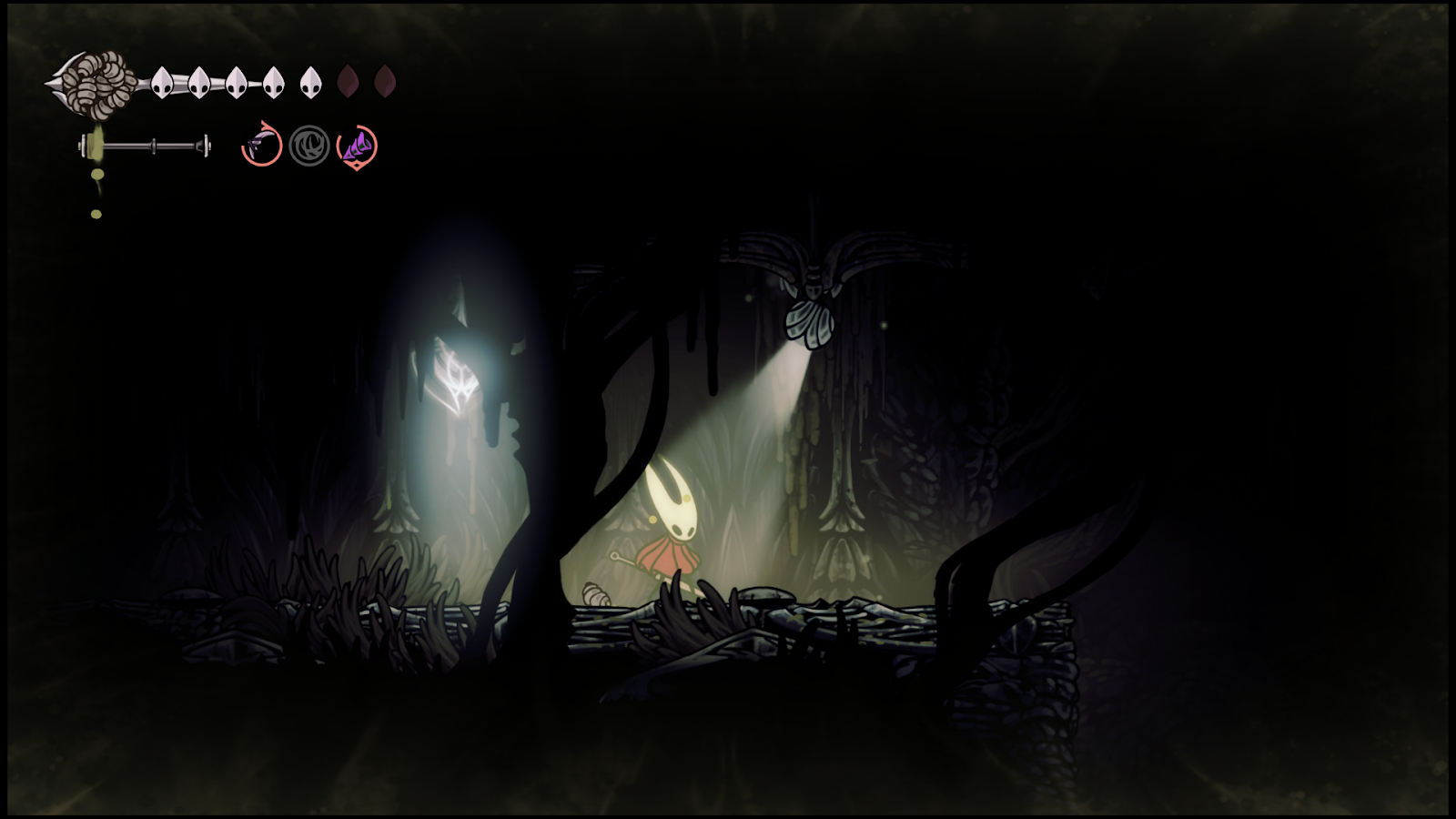
Equally bogus is the "return home and fix it" narrative, one the game notably leans into—with Hornet being the genre's yet-another-secret-warrior-princess (from and in another castle); re: like Samus before her was: one whose homecoming (and subsequent judgement and troubled heritage stolen feudally from the locals) being equally skewed. Everything unfolds amid challenged, semi-mythical ancestry whose made-from-whole-cloth Amazonomachia ominously evokes Western Liberalism (the white castle); i.e., just as much as fascism (the black castle) and Communism (the Gorgon, nature, and anarchy among the castles). Everything shares the same spotlight, but is covered in bugs and slime (specifically maggots, a decomposer-type insect larva, above).
Furthermore, the game—like all Metroidvania—grapples with the notion of godly boons (re: "fire"), meaning heroic power as given by status-quo (or former status-quo) parties; i.e., from dubious, false-god sources that, when unquestioned for their "Numinous" forgeries, lead to great harm enforced and upheld in real life; e.g., Shadiversity being living proof of that, offstage but regarding media onstage:
What a story, Mark! I've seen a lot of people discuss this godawful book by Shad, but this particular dissection by MoviesWithMark ["Shadiversity and the Swords of Anti-Intellectualism," 2025] is especially thorough—both to-the-point and scenic is his dismantling of, frankly, a giant weirdo like Shad.
And I confess, the premise of the book could be interesting enough from a Gothic standpoint; i.e., specifically the notion that the hero is actually a total fuckface who learns that gradually by regaining his memories and reclaiming his old imperial powers through the monomyth. Such a revelation, while not exactly novel, essentially turn[s] the Hero's Journey on its head, aka the Promethean Quest; it invites the hero (therefore the reader) to self-reflect in ways that expose the heroic identity as repugnant, and simultaneously grant commentary on the whole idea of progression through violence in a cop-like way (SA or otherwise).
Shad does none of this, of course. His story—much like the nation creation myths of high-control groups like the Mormons [to which he belongs]—will acknowledge the evil; i.e., as something abjected, or thrown off onto the colonized, us-versus-them. It's what I call "mirror syndrome," or the inability to self-reflect—instead invoking DARVO [and obscurantism] at every waking moment: by routinely projecting your worst flaws onto your victims. This obviously includes cult-like hero worship and rape apologia aggrandizing the self as genocidal to apologize for; i.e., in ways [a] fantasy world has been recursively built around, and which for Shad routinely apologizes for with his own.
In other words, it's fascism—the cult of the strongman avenging his former self while projecting his sore spots onto weaklings to commit revenge against (source YouTube community post, Persephone van der Waard: September 26th, 2025).
To that, power fantasies are criminogenic, thus all-but-expected in times of crisis (which the state manufactures by design; re: to uphold Capitalism Realism furthering abjection). Provided we consume them critically and in ways that lead to an increased level of critical thought (thus harm reduction by dismantling Capitalism, not tokenizing to uphold its Realism), then it's all good, babes! Go wild; Fried-Green-Tomatoes that shit (1991, below); make the Numinous (and its Promethean Quest/the nostalgia of said Quest) palliative!

Ludically-speaking, G2A3 opens up through meta-play that doesn't function as a single-use "meta map"; re: one superimposed over two in-game maps (the intended routes for Acts I and II before Grand Mother Silk/GMS). Rather, the meta reveals itself to be accessible through emergent routes the player—once fluent in blazing trails—can begin forging new routes on the map surface from the outset; i.e., of a map within maps[34b]; re:
A map is not the territory it represents, but if correct, it has a similar structure to the territory, which accounts for its usefulness. If the map could be ideally correct, it would include, in a reduced scale, the map of the map; the map of the map, of the map; and so on, endlessly [...] If we reflect upon our languages, we find that at best they must considered only as maps (source: Science and Sanity: An Introduction to Non-Aristotelian Systems and General Semantics, 1933—cited in my master's thesis and repeatedly in my book series; e.g., "The World Is a Vampire").
Again, holistic study is what my series (and post-book-series) work is all about; re: returning to old spaces to uncover their secrets during ludo-Gothic BDSM; i.e., as a matter of fresh synthesis regarding what only gives up its secrets through repetitive play-as-hermeneutic: you learn by doing and doing = playing with things as the Gothic (thus Metroidvania) do! They're the belly of the beast (re: mise-en-abyme), communicating not through raw reason, but vaso vagal, thus feelings of danger married to safety (and all the emotional turmoil and confused binaries that go with that unholy union).
This might all sound daunting enough, but after you practice and acquire items (thus knowledge and power), the game really opens up; i.e., coming together despite the growing pains in Act II before trying to reach Act III (re: just getting what's needed to beat GMS the "basic" way). Furthermore, it starts to feel nostalgic when doing so—visiting old areas again and smiling when you remember how green and tender you were (the monomyth refrain, which Tolkien loved to marry to maps, below)!

If the game can do this to subvert monomyth hubris, then why not the world? There is no conquering death, but meeting it between life and death to overcome state (thus Cartesian) hubris, "on the Aegis." Rememory is motion on the Aegis to remember in life what has become buried through generational trauma: taking elements of pre-capital to push nostalgically towards post-scarcity "inside the tomb"! Transform the Earth! The infernal concentric pattern—instead of crushing the player inside it—becomes a space of infinite possibility and history (of power) to reclaim for workers through play among the tombstones! What has become alien—the map as alien—becomes home by embracing the alien among said home (and forgetting all about the map in one's hands to rely on the map in one's brain).
So you see, I haven't fully walked away from speedrunning (my Omelas), for speedrunning (and development) are both baked into Metroidvania!
Venting a Bit; or, G2A3 (cont.): the Last Word on the Entire Game, Colored by Some Frustrations
Note: This game is a bit of a rollercoaster—and not always the fun kind! Yes, I made it to Act III, but not before G2A3 went and threw some more surprises my way—the kind that left a bad taste in my mouth; i.e., when chasing the good "second wind" vibes from the prior play session, which had already been chasing some earlier frustrations Act II had initially given me. This checkered, up-and-down feel persisted throughout the entire act, and left me feeling altogether exhausted by the time I got to Act III! While I don't know fully what to expect in that department (apart from a bit of Ozymandias-style Capitalist Realism), I do have some venting to get off my chest, here; i.e., that I acquired the need for when wrapping G2A3 up, as of writing this!
Here, we'll only discuss the bad; for the entire description of said frustrations alongside the fun stuff I encountered, see "G2A3 (cont.)" from "First Impressions." In short, though, Act II had of enough see-sawing for me to rethink my initial feelings for this review. To that, whatever happens in Act III, I want to lodge my complaints, here, about Act II; i.e., my review is cumulative: it takes the pros and cons for all acts into consideration. Consider these complaints about Act II vis-à-vis Act III as I weigh them against what is still, in my opinion, an incredibly well-made game. But in light of my complaints, do its strong suits still have what it takes to outweigh the bad? —Perse

Silksong is gigantic, but stands on the shoulders of/enshrined within the bodies of the giants it borrows from. Personally if you're in the same company as Super Metroid, SotN, or even OG Hollow Knight, then I'd say that's good enough. In Silksong's case, it takes that cumulation to its logical conclusion; i.e., it's far more hit than miss, but certain core, fundamental problems prevent it from being the "best of the best." But also, there is no best of the best; each game does different things well to achieve a similar level of quality. If that sounds unsatisfactory, then rest assured I enjoyed this experience to a similar degree as any of the other games mentioned (and other games besides); i.e., as a satisfying continuation of the same conversation/evolutionary process.
If I had to get more specific, Super Metroid and SotN are way too easy (above), but Silksong—while far harder and better-developed in the boss fight arena (especially over Super)—is a few steps back in terms of the automap feature/overall cartography (re: linking maps); it also has a much steeper learning curve and requires a lengthy playthrough to access the entirety of what it has to offer. OG Hollow Knight is fairly shorter and easier than its sequel, but also is far less developed than Silksong in terms of integrated combat. Pick your poison, essentially. More complex =/= automatically "better"; it's just different.
In terms of that, Silksong's secret systems and hidden areas/endings all but require a strategy guide (of which many de facto ones exist, not just this symposium). So while the paradox of playing a game designed to hide parts of itself from the player is to be expected, here the secrets are a little too secret (and wouldn't require too many in-game paratexts to help the player with—not the aforementioned player-made instructional manuals). Whether or not that is even a criticism depends on the critic, but in my opinion, it led to multiple mid-game headaches. So, it's definitely a con in my eyes!

Also, because it's basically four games in one (re: Act I, Act II, G2A3, and Act III—above), I started to want to finish the game so I could start rerouting it. Alas, Silksong was also too big; i.e., it took me too long to finish because of the cryptic stuff, the latter keeping me from the delicious Promethean center Act III promises. Like The Old Man and the Sea (1952) or "Rime of the Ancient Mariner" (1798), Act II just went on and on and on, making me feel bogged-down in trifling matters that incrementally stymied the good stuff. And while much of the content itself was individually great, and frequently gelled in large chunks over time, it wasn't without growing pains and an up-and-down sinus rhythm that—apart from making her (me) a tad seasick—also kept a lady waiting (rude); i.e., too much foreplay/size, not enough climax; re: a potential complaint if you're not a size queen into orgasm denial. Bigger = / = automatically "better," either!
Also-also, I have a one-track mind, and the map design (and tendency to lie to the player) is not friendly towards players who tend to follow single points; re: to their conclusion versus exploring a given room 100% before jumping on any track said room offers—a quality I might address when writing my Silksong essays; i.e., starting with symposiums to "set the table" like you're "supposed to" in academia, versus how I did with my six previous books (seven, if you include this one); re: setting up my system of thought, first (the manifesto), then laying out the modules, writing my PhD and book series before trying an actual symposium for once: writing things in a more standardized way (which, to be fair, professors do after their PhDs and having written plenty of journals and books).
Last but not least, hard-gating Act III behind so many things was very frustrating. Specifically it felt like a tedious (and cryptic) time-sink to pad the already-lengthy runtime; re:
- The town wishes. In doing these fetch quests towards the end, I felt like I was spending more time going through waypoints than traversing the castle/countryside. Being stuck in an elevator leaps to mind (echoes of Mass Effect 2 [2010] and its Citadel/elevators). Many of the quests are fine, but there's no indicator a new quest is available in town; i.e., unless you're at town, which—you guessed it—means more time using the waypoints (and the Final Shrine requires using two: the Bell Beast and Citadel elevators)!

- Collecting the fleas. This—while a nice sentiment—feels no more novel than older fetch quests; i.e., get items, progress; e.g., the silver and gold rings in SotN, or various tasks from Simon's Quest like the red vortex, except even less exciting because it's basically making the Gold Skultulas from Ocarina of Time mandatory! Sure, they're way easier to find, but it doesn't change the fact they're fetch quests, and repetitive ones at that (at least the fleas are cute)! Tying the final ending to them is somehow way less interesting than the ghost battles in OG Hollow Knight. Basically you're Lion-O, progressing towards Ultimate Mastery (or Complete Doom)—not by defeating Mum-Ra, but by rescuing Snarf the sidekick from tripping over his own feet in his own house! It's a bit… anti-climatic.

- The third requirement, the fucking house. Speaking of "house," there's a home you're given in Bellhart, overhanging the town center (the pastoral reward for kicking ass). The house is completely pointless, save that you'll need it to receive the "Silk and Soul" quest; i.e., to progress to Act III, which gatekeeps you if you aren't a homeowner. Except no one told me this, in-game and out—with me learning about it after checking multiple guides. That's a bit much. And all it would need is having the town crier waving his hand to get your attention; re: similar to the steward at the First Shrine being annoying for non-vital things, this literal clown could have taken two seconds to say to me, "Hey, you have a new house!" versus waiting for you to talk to him. If you don't talk to him, then you literally can't get to Act III, and there's no indication you should! How dumb is that?
If these were optional or better signposted, then I wouldn't really have cared. But I do care because Team Cherry deliberately left them out and made it possible for you to feel stuck; i.e., despite moving heaven and earth, I still had to say "please," and the game wasn't about to tell me that (nor let me know about the Pinmaster I had missed in Bellhart, for most of the game; see: my "Act II" notes). You're telling me I already killed the fucking Balrog but you won't let me enter unless I "speak 'friend,'" first, but you won't even ask the riddle? It's very frustrating and frankly dated game design; i.e., the sort of action/adventure fossils lifted straight out of a pre-modded Simon's Quest. Sickness, be gone!

In other words (and to reiterate, from my notes), it should not be possible for the game to gatekeep you with such small (and boring) things. But Silksong does its best to keep you in the dark:
- having the final quest not activate despite acquiring items for it; e.g., when you show the caretaker the soul of his own dead cousin… only for him to act like he doesn't know who you're talking about
- his shitty clues/directions for the other parts of the quest (above), including not marking them on the map despite the game literally marking Grand Mother Silk on the map (again, lying to you by telling you the most obvious path and only that path)
It's like, the game shows it can be a total blast when "done correctly"; i.e., when played in a manner that doesn't cause frustration in the most mundane ways imaginable; re: feeling trapped in an elevator when all you want is out so you can get to the climax: the arrival of the ambiguous death omen that Gothic castles ultimately represent—themselves (and their infernal lineage) trapped between life and death, and whose Numinous rebirth (of tremendous obscurity, power and decay) remains "up for grabs," something for the hero to cryptomimetically discover (and rediscover) in a never-ending parade of castles (thus panoply of Gorgons and Amazons, damsels and distress, etc)!
Except, it's not up to the player when and where they get lost; it's up to the game and how it communicates information. And if there was some kind of reminder telling you that "you're doing it wrong," then I wouldn't have cared nearly as much! But again, there isn't one—making me feel profoundly and inexorably stuck because I know I'm doing it wrong but there's no way to know how, in-game, and the world is so goddamn big but has zero clues. Searching in it feels fruitless (which is a bad sign; i.e., from a game genre with "search" literally in its formula). It feels padded not just by fetch quest after fetch quest, but from a lack of certain directions despite having quest givers who could give them but don't; i.e., they're designed to be reluctant quest-givers, meaning assholes who lie to you, withhold information and/or have selective memories: "Computers are dumb; they only know what you tell them," and Team Cherry made these guys dumb on purpose.

To be clear, the final quest is easy as pie—almost insultingly so (and the caretaker infuriatingly spells it all out at the very end, above). Instead, it's the game, thus developers' puzzling tendency to withhold information in between that makes it hard (re: bad game design); i.e., you need the information that's being withheld, because muscling through the quest will do absolutely nothing unless the quest activates; re: like with the Plasmium Vial in Wormways (see: my notes), you can find all the items and/or areas for a quest, but still not have the quest activate unless you do them in the exact order/talk to the right person! A side quest is one thing. This is the secret ending we're talking about—the game's big payoff, when all's said and done!
More than anything else, then, a good climax hinges on seizing upon it; i.e., after the thrill of a big event, not a trip to the grocery store (or getting lost on the way to the grocery store)! To that, having the game cockblock you repeatedly during G2A3 felt as fun as forgetting the condoms after robbing the bank with the femme fatale… only to have to go to the 7/11 and pick up an emergency pack, then get stuck in the aforementioned elevator on the way back! Plot twist: she hid them, and just wanted to make you wait longer! It is possible to ruin the moment, my guys; and by the end of all this extra busy work and stupid game-played by the devs to prolong things, I sort of just stopped caring about getting to Act III! I eventually got there, but the novelty had long since expired. That's the game's fault (doing everything in its power to jam sticks in my bicycle spokes, thereby forcing me to use Google to progress, which is not my idea of fun).
And maybe for some, these issues were non-existent and/or immaterial. For me, I fell repeatedly out of the Issue Tree and hit every single branch on the way down multiple times*! If the game puts them there, then I'm going to bitch, afterwards! Newsflash: that's what a critic does!
*A bit farcical in its Promethean allegory execution; e.g., like Chris Farley in Almost Heroes [1998, below]—repeatedly falling out of the tree when trying to get the eagle's eggs (the Roc but also Prometheus' avian tormentor); i.e., the servant trope, Sancho Panza onwards, trying (badly) to help his friend… only for the quest giver to chide him—after several failed attempts and one successful-but-excruciatingly-painful-one—that she only needed the egg shells, not the yolk, silly goose! Um, that information would have been useful at the start of the quest, you asshole!

Last-minute gripes aside, I suppose these are ultimately nitpicks from me. Even so, they do add up/ultimately prevent the game from being perfect; i.e., no game is, but Silksong falls this short for some very dumb reasons—and all while still getting closer than the original (which was already one of the best Metroidvania ever). Close, but no cigar! Next time, add a fucking quest indicator, you louts!
Note: I'll probably write a final addendum for Act III and the game's true ending(s). But the honeymoon is well-and-truly over, at this point! —Perse

(artist: Jim Davis)
Act III, the Abyss, part one; or, Going Back to Hell
Note: This game is continuing to surprise me with more content. It's a rollercoaster of sorts, but this—part one of Act III—was one of the good arcs. I'll give my larger impressions, here, then conclude the symposium with Act III's boss keys and stab at Mother Brain (third time's the charm, I guess)! —Perse

(artist, top-left: SilverEyes0114; right: Tom Jung)
In keeping with the monomyth and Joseph Campbell, Silksong is Star Wars the saga: multiple Episodes, multiple Acts; re: map I, map II and boss keys, meta play (fetch quests), and infernal concentric pattern (with more boss keys). In the neo-medieval fashion, it's the knights errant questing for the Grail after going into Hell and fucking things up (with Hornet being not just Lancelot defending the realm, but Mordred and Morgan the sexy [and incestuous] outlaws defying law and order once set free; i.e., like the Sith [above] or really any black-knight-style bandits, Radcliffe onwards).
You start in the countryside, go to the Emerald City/Ozymandias' ruin to meet the Wizard, blow up the Death Star and get its fire of the gods (the monomyth) before the Emperor comes back to life; repeat. In Mary Shelley's language, the Promethean Quest is a spiritual sequel/guide of future narratives built on "past"; i.e., of the OG myth and Paradise Lost, the monomyth performed ostensibly to completion, except Hell follows the hero home seeking revenge (the pale horse, or "horse with no name," in Hornet's case). So the hero, stuck in Hell at home (re: Aguirre), must put the wrong things right (the plot to Coraline [2009]—itself lifted from older stories neoliberalism has capitalized on, before and after Gaiman; e.g., The Crow's own vengeful bloodbath; re: "Ruling the Slum," 2024).

In Hornet's case, she is misled by "black magic practitioners" (a different "species" coded as non-white, non-Christian outsiders, their "other" status comparable to Jewish blood libel and calumny but also sodomy and witchcraft accusations and/or Orientalism, etc); i.e., the snail shamans, above, being gremlin tricksters who kill "Girl Christ/Caesar," making Hornet the Amazonian, dress-wearing (androgynous), tomboy Judas/Brutus "Mary Sue," going about the Resurrection after stealing the fire of the gods: as the warrior Madonna/Athena reviving Zombie Christ/the Medusa (there's a lot of palimpsests, here). She's the Magician's niece entering Event Horizon and going into the singularity to chat with Medusa, post-beheading (re: Queen Jadis, see OG cover art [below]—the witch abducting the children per the classic criminal charges that witches suffer and survive [re: Federici], but also enact; re: my ex, Jadis: "You have heart! I'll take that, too!").

(artist, left: Roger Hane)
Save Christ; save Christ's kingdom per Capitalist Realism, Jane Eyre talking to Bertha to put the head back on, mid-bildungsroman (giving the fire back): to mollify/quell—with Irigaray's creation of sexual difference (sacrificing the mother as other) unfolding during a last battle versus the executed monarch/persecuted witch. Here, the empress Mother Nature occupies the same body/space seeking revenge against the pimps who kettled her (re: state shift)—her own children/dead ringers of said children (and the players piloting said avatars) going through the motions of genocide!
Metroidvania are capital in small, including its Realism; i.e., there's a lot of virgin/whore mirror syndrome, hot-potato scapegoats, and home-and-homewrecker ambiguity that happen during Capitalist Realism. This includes the Metroidvania hero "blaming the whore" but really any monstrous-feminine; i.e., that lurks inside the genre's complicated, psychomachic Amazonomachia working cryptomimetically with monomyth and Promethean language (canon/camp): Wandering Womb into the murderous womb to tame it per a Protestant ethic during military optimism (whose false hope/power we camp in anisotropic duality during ludo-Gothic BDSM's Amazon confusion; re: in the Metroidvania as fabled, ergodic, concentric, holistic, cryptonymic, recursive, etc). The game is very girl-on-girl, the (anti)hero facing her divided self as tied to the world's routine abjection-as-cartographic (Cartesian, settler-colonial, heteronormative): of a hauntological conquest and redemption, mise-en-abyme. She's a real daddy's girl, descended from the Pale King and a Weaver (Zeus and [insert rape victim, here]).

(artist: Gian Lorenzo Bernini)
Silksong is very gaslight, gatekeep, girlboss, in that respect—the Gorgon having a mind of her own, and classically raped for it by the Amazon "Galatea" pleasing Pygmalion; re: whores policing whores, pimping each other in Omelas as a circular Jerusalem (the Ozymandian version a Black "Egypt"). Dating all the way back to Plato's Republic into more recent monomyth stories (and neoliberal [videogame] power fantasies), the allegory and its paradoxical spectres/darkness visible (conducive to systemic change) occurs within the cave as half-real; re: Shelley's consciousness through darkness "in the cave," the labyrinth, etc, as eventually eclipsed by brightly-lit stories like Star Wars, the monomyth and Promethean Quest at odds; i.e., just as nature and the state are, hence capital and Communism, Athena and Medusa, canon vs camp, good praxis vs state bread and circus, etc (there's an offstage "mil spec" on the same gradient, too; e.g., echoes of the armored bounty hunter Samus, of the princely Alucard, of the hawkish and regretful Hornet—with the blonde-haired Offizer Amira having a Hornet-y vibe, of sorts, below): the white wolf chases the black (functionally because Hornet is cosmetically black-skinned while wearing a white mask), fetishized mid-cycle on the surface of women's bodies (cis or otherwise)!, fetishized mid-cycle on the surface of women's bodies (cis or otherwise)!

(source)
To it, Silksong is literally "there and back again" again. As such, it shows us the meta game in small: how, with Metroidvania and ludo-Gothic BDSM, good praxis isn't merely the power fantasy of growing strong and beating up bullies—i.e., enacted by those who feel (or act) alien/persecuted against—but outing the hypocritical impostor in duality, mid-DARVO-and-obscurantism! The enemy looks like us and we, to survive, look somewhat like them; i.e., the aesthetic an argument of power sharing the same larger stage, and all to chase the Wisdom of the Ancients; re: to uphold a canonical Superstructure or subvert it (defending/reclaiming the Base, all the awhile)! It's what Silksong's "Amazon monopoly" interrogates while "heckling whores," hence what we interrogate while interrogating Team Cherry's spatialized "puzzle combat" (thus puzzle of existence, of power exchange, the impossible architecture and lying [unmappable] maps, Numinous brothel espionage mid-warzone, token Amazons, the castle-as-hero, and the absurdist Drama and Comedy of it all, on and on…)!
" part two; or, More Boss Keys
Part two of the Abyss is primarily abjection through gauntlets and duels; its length is less about the size of a given space and how quickly you can explore it, and more how fast you can beat the trials, inside.

To that, the ability to enact "violence" onstage without harming others is an intensely powerful critical device: the swashbuckler's saber-rattling essentially an argument of sex and force (with knights, not just Amazons, classically being both per the courtly love trope); i.e., the ability to poetically discuss something through something else as a disguise, a front, a code for treating the Wisdom of the Ancients as plastic, rewritable, anisotropically "Trojan," mid-argument; e.g., during ordinary things like food, sex, opera, what-have-you. "When in Rome" and all that! We retell, reenact, and rememory massive, Numinous things that—for us mere mortals who are not gods—can only touch upon larger things "in small": the past, but also the future as felt within the same hauntology/chronotope, mise-en-abyme; re (my master's thesis): from out of novels and cinema and into Metroidvania reifying power-as-Numinous, danger-disco (the "venue" Team Cherry built haunted by Cameron's shadow, inspired by stories [of timeless, giant-in-miniature assassins] that he directed, below). In Gothic, the past—a brutal and secretive thing to fear and portray as incredibly potent—survives imperfectly through performance and play as castle-like, in some shape or form: a way to conceptualize and perform power as part of the larger world (and empire) it seems separate from; re: the ghost of the counterfeit, Capitalocene, or liminal hauntology of war as traveling to and fro, a demon lover longing for its final embrace!

Onstage and off, power is a relationship constantly had between seemingly unlike things (metaphors); i.e., performing power forever "in flux," mid-entropy (compelled by capital functioning by design, above). There, cryptonymy speaks mid-abjection—through the chronotope and hauntology as specific renditions of space and time out-of-joint—towards the present into the future as "Romance": married to the ordinary novel from Walpole onwards, the Gothic auteur standing on Plato's reputedly broad shoulders; i.e., in ways that state powers obscure or reveal to enrich the elite and profit, versus workers for themselves and nature through "mere play." Said play is useful for all sides; if it weren't, the state wouldn't try to control it for themselves (re: the Superstructure).
As such, anything in Silksong is dualistic, able to represent the same-old colossal abbreviations; i.e., that in our hands or theirs routinely play out in small, mid-Metroidvania: playing with monstrous-feminine taboos, however off-limits they seem, and with fire, third-degree or not. The conversations continue because people continue; power is lost and won—indeed, lost and found—time and time again, on stages and shadows haunted by dead empires and workers, alike: dead metaphors and conventions raised cryptomimetically from the midden, brought theatrically back to life during ludo-Gothic BDSM.
To that, the main love triangle (or Triforce) in Silksong is Hornet, Lace and GMS—Hornet's other dance partners mostly "side pieces" with a lesser (smaller) but certainly no-less-violent role. Sense and sensibility, Lace is the giddy madness to Hornet's tempered courage; the other characters accent these two, dancing under the moon-like queen and her spectral lunacy (white or black, full moon or new). Hornet's Jane Eyre—the formerly passionate "wild child" still wearing her red dress (the color of sanguine and loose morals); i.e., like Mouse's tall, blonde concubine in The Matrix (with Team Cherry being this game's digital pimps, hard at work telling us to follow their white rabbit). Lace, by comparison, is a dead ghost girl/simulacrum from a twin orphanage (or a naughty nun), and GMS is Bertha/Antoinette Causeway from Wide Sargasso Sea (the infamous "madwoman in the attic"—1966).
And somewhere in the maze is Skarrsinger Karmelita, the real girl in red: the madame brothel-owner using her siren-like voice (and vampiric aesthetic, below) to mobilize entire armies. Upgraded to warrior queen, Lewis' jester-like gypsy now throbs with demonic power—the kind to drive men mad with exotic battle lust, and fighting in her name as taught (re: the matador and the bull, the killer lady-in-red spilling her opponents' blood, the latter coating her dress in the poppy-red power of countless dead victims)! Per a revolutionary cryptonymy that players intercept and interpret inside itself, she's the data, as are her "weapons" (of steel and the flesh) disguised as "mere music" (a form of playtime); i.e., as "corruption," concealing itself, mid-exchange: out on the dance floor "furthering" abjection, but likewise reversing it through David Bowie's power of the babe!
All the while, Karmelita puts the "ass" in assassin, the player a nightly visitor paying homage from outside; i.e., mid-hospice and house call—a barber's "conjugal visit" that, but for a moment, brings Her Majesty back to life once invited (as the vampire does, on both sides)! For one delicate, precious moment, predator and prey intertwine, the old maid suddenly young until Hornet, like a mosquito, greedily drinks her hysterical blood! All the while, lust and battle go arm-in-arm, in Gothic (re: sex and force)—the larger mode passing its feudal torch from one successor to the next: a doom shared between femme fortes/fatales! Power is fleeting and delicious, paradoxically most alive when close to death! A bloodbath to revive the chimeric ghost of dead cultures, watered in the spoils of their own harvest!

(artist: Catateil)
Doubles galore, babes—mid-psychomachy and Amazonomachia, inside the danger disco! It's also a vision quest—a revival of 1987's A Nightmare on Elm Street 3: Dream Warriors* and its problematic treatment of a very old, non-white idea: the leather-stocking tale, or white Indian. Our game's "Nancy" (from the original Nightmare film, 1984) is Nancy Drew—the white, female (classically straight, middle-class) detective, solving mysteries through Radcliffean Black Veils met with veiled cultural appropriation: power as performed through a monomythic exchange. Here, Hornet's literally a heartbreaker ("dream maker, love taker"); i.e., snatching hearts, heads, and souls "for the Man." She's not just a baddie aping warrior Princess Zelda (aka Sheik, Zelda's drag king musician double, below), but an enforcer of power as arranged and performed, mid-gauntlet, for the state!
*See, also: Poltergeist II: The Other Side (1987); re: exhibit 52c2 from "Dark Xenophilia; or, 'Far Out, Dude!' Monster-fucking and Magic Girls Helping Foster Dark Radical (Communist) Empathy During Healthy Sex Education (for Children and Young Adults into Adulthood)" (2025).

From out of Ancient Athens into Pax Americana, there's a cultural sense of rebellion to Amazons—one which, often enough, conceals a weaponized, problematic side; i.e., a cryptonymy working covertly behind and in front of their kayfabe's rock 'n roll façade (with the harp being a classic monomyth device: lulling dragons to sleep, above).
In other words, Hornet's a token princess cop—a potential witch, whore and/or monster cop maiden (through the whore's paradox); i.e., one with her own musical approach to kicking Gorgon ass; re: Spider-Girl slinging webs, or Wonder Woman catching other supernatural beings with her lasso of truth (and magic bracelets): the superhero policing supervillains, the maiden policing the whore to prove she isn't one, herself. So does Hornet pimp Medusa's likeness, doing so just like the Pale King's knight, his (and his wife, the Pale Lady's) dutiful "bouncer"; i.e., the secret weapon from Hollow Knight, having no memory and able to constantly revive until it completes its state-assigned goal.
In Hornet's case, any Red Scare sentiment arrives through the ambiguity of the Amazon-coded heroine (and her dress)—her rivals also her ilk, the latter (and their hearts) meant to be cowed and contained within a heroic crimefighter yarn seeking assimilation: one that restores order to arbitrarily make up for past royal failures by "scalping chiefs." Thoroughly subjugated, the game's motto may as well be: "Gaslight, gatekeep, girl boss!" (re: "Zombie Police States," 2021). And don't just take my word for it; the monomyth hero being an asshole genocidal cop expresses in various memes and revelations felt by other players leery of Team Cherry's token Amazon (e.g., Killroy Was Here's "Hornet Kills Karmelita For Nothing," 2025).

(artist: Ickpot)
Alongside similar characters and predicaments—mainly unequal, master/slave arrangements of power in any epic adventure—Amazons offer a special poetic means of (re)connection; i.e., with that which workers have become distanced from, over time: ourselves, but also of nature and the past, whose imaginary echoes denote a potential better world, provided we get in touch; re: a blood bond.
Sound familiar? It's the plot to Silksong—a game-within-a-game that relates to players using a semi-mythical past, doing so through force, music, space, and hyphenations of those and other things, too; i.e., as abstract shorthand/a Gothic means of social-sexual synthesis (thus catharsis): expression, tension, struggle, exchange, effort, confusion, paradox, and so on. It's a dialog on alienation, which makes it constant, ongoing and prone to dispute, monsters included. Whatever Silksong concludes will still be open to dispute afterwards, including the Amazonian wrestling match between Hornet and Karmelita. As such, these orgasmic duels unfold in highly public, paid broadcasting of the tourneys, themselves: nude-yet-clothed contests of strength, a freakshow where the classically oppressed gain some purchase to sway hearts and minds; re: the paradox of exposure, nudity an Amazon's armor and Gorgon's weapon striking onlookers stone dead (one the givers of rape, the other avenging it as monstrous-feminine weapons of terror).

That's the beauty of it, ideally—the war without harm, the camp-in-question letting off steam while passing vital information along: the Gothic paradox of speaking to harm without harming anyone, but inside half-real dialogs between canon and camp (e.g., live burial [above]—dialectical-material scrutiny [thus irony] being the deciding factor)! We have the luxury of play as a means to message each other across space and time—not turn off our brains, but speak covertly in ways that seem like "mere play" reaching through time.
Such is revolutionary cryptonymy reclaiming alien things, including Amazonomachia (monster war)! Amazons are timeless, eternal; so is Medusa, and the two often overlap (the ego and alter-ego/secret identity often divided between multiple actors, onstage). The problem is, Silksong's cryptonymy is diegetically complicit—a fact we'll now unmask; i.e., with its highly monomythic, Aliens-style ending pimping the whore with the whore: Karmelita (the Amazon) was merely a stepping stone to GMS (the Gorgon) for state abjection, ergo revenge! "Thy wounds, they smack of honor!" The usual monopolies persist in duality.
" part three; or, the Final Ending: Cloning Ripley and Castrating Shelley's Promethean Quest to Revive Cameron's Amazonian Monomyth
Mercenaries were classically bastards, the modern Amazon a counterfeit hauntologized from ancient legends. Not all Metroidvania "clone Ripley" but Team Cherry does; i.e., by thematically paying homage to Cameron's girl boss, and effectively raping nature as alien in all the usual Cartesian ways; re: that Shelley's Frankenstein abjured: Hornet is Black Spider-Ripley who failed before and now seeks revenge. Except the first game was already the plot to Alien—mostly. Now, it's even more on the nose, "Pharloom" Saigon by another name, and Lace Android Newt raised by the Alien Queen for Ripley 2.0 to rescue from (below). Through Team Cherry's betrayal cloaked in phony heroism, praxial inertia and blind pastiche, Cameron's Amazon monomyth replaces Shelley's critique of Cartesian thought—the Metroidvania chickens, like those from the Zelda franchise (above)—coming home to roost once more (the Star Wars and Rambo problems, from Beowulf onwards; re: "Overcoming Praxial Inertia").

To be clear, I'm not surprised to see Cameron's DNA in a Metroidvania; i.e., Aliens and Metroid released months apart, and were both playing out the same neoliberal power fantasy avenging Vietnam: a female Rambo killing the pirate queen (the Archaic Mother either a brain-in-a-jar cyborg or insect broodmother). I am surprised to see the game regress quite so aggressively towards the status quo and its military optimism—effectively castrating Shelley's allegory by giving Medusa a "haircut," turning a possible Promethean Quest back into the monomyth (false hope). It's regressive not just by modern Metroidvania standards, but by Team Cherry's own corpus (whose final ending in "Godmaster" turns the OG hero into a rabid lycanthrope that Hornet must defeat, post-Promethean-Quest)!

First, the double standards and paradoxes at play during the final battle serve to indebt Hornet to the original hero: monopolizing darkness in a patriarchal manner that lets said hero do whatever he wants (above); i.e., he can use darkness for good, but GMS can't! This is the polar opposite of what I hoped would happen: Hornet serving in Heaven while kidnapping Grendel's mother's creation to live in Heaven, too. Ruling in Hell is for losers, it would seem, and Hornet's a Ripley clone; re: Cameron's Invincible Heroine—once dissected by Ridley Scott—is raised to insulting degrees of impunity when deciding who lives and dies; i.e., playing god versus those deemed "lesser" to a verminizing degree: insect politics. Delivered with a colonial element blind to its own neoliberal past, the payoff remains focused on sheer impact (of revenge); i.e., at the expense of conscious allegory (the sins of the father Team Cherry is emulating to give their audience a secret treat: being Ripley the Great Destroyer for but a moment, below). More's the pity!

Keeping this in mind, all stories operate in duality to some extent, but some stories have more prevalent canonical elements in their narrative structure. In monomyth terms, "hero" = cop. Hornet's not just a cop, but a supercop princess furthering abjection, mid-Amazonomachia and black skin, white masks—literally! It's literally "kill the Indian, save the man" (or princess, in this case).
To further abjection, you need a villain to scapegoat, and that's where GMS comes in: a black mother in white clothes. Between them and their custody battle is Lace, the Omelas child whose subsequent torture drives Medusa towards state shift. To prevent it, her womb is the frontier for which anything goes—the state of exception pushed to its extremes, mid-abjection during mirror syndrome (ergo Amazon confusion): single mom stealing white princess from Heaven (where she made her out of stolen silk, but I digress), and which the assimilated black princess must rescue for the Man (versus Ripley's white neo-con warrior Madonna enacting Immaculate Conception).

Silksong didn't emerge, ex nihilo. Aliens borrowed from past legends Team Cherry copies just like Cameron did. Doing so to maintain the status quo out of revenge, its rebel, the Alien Queen, is spuriously framed as a mad motherly monarch, and its cop the rebel to defeat her (re: Ripley as CIA advisor enacting the Rambo problem). And yet, the cop/criminal function aiding state power doesn't change. Instead, it's Frankenstein without Shelley's irony or Milton's, canonical on par with Cameron or Tolkien's military optimism; re: Paradise Lost speaking to the fallen kingdom or, in modern warfare, the fallen settler colony mapped out for future monomythic force!
Being Heaven's Gabriel in Team Cherry's retelling of this basic idea, Hornet's a bit of a self-righteous twat. Before the fight begins, she blames herself and Lace, but isn't so noble (or foolish) as to blindly sacrifice herself. Lacking gratitude towards the other child having saved her from certain doom, Hornet takes the credit. In doing so, she categorizes Pharloom as hers—all so that she, guilty as sin, can atone for past failures by rescuing it from the Radcliffean darkness this time; i.e., as a daughter (shieldmaiden) of Hallownest, scapegoating nature as alien and colonizing the black planet by aborting the Numinous as monstrous-feminine. Nothing could further abjection more, capital—per Patel and Moore—relying on whores to be raped, thus enabling heroes to move money through nature: by raping nature as cheaply as possible, mid-monomyth ($20, remember).
Unafraid and ready to pimp for the state, our Ripley 2.0 dives into the void, female Ludovico facing the pirates dressed up as ghosts:

As usual, the alien queen is the Numinous power supply to the colony (above). It's not something for Hornet to hug, mid-dialectic, but blame and euthanize per a singular Cartesian interpretation. I, for one, felt sorry for the queen; i.e., clearly being tortured, a witch burning at the stake somehow still being accused of child abduction by the paladin putting her down (shielded by the apotropaic flower serving as Athena's Aegis): Pygmalion's bitch, Victor's dutiful debutante with mirror syndrome pimping a less subordinate child of Galatea, or "wretch's bastard." Wherein GMS the woman is "of darkness" but arguably a byproduct of patriarchal fears to confirm them, she embodies Original Sin as a kind of Coraline-style "Other Mother" impostor who's long since jumped the shark. She's guilty from the start, doomed not just to die but be judged by her own child, post-rescue.
In keeping with Paradise Lost and Frankenstein, Hornet is a living girl punishing female Satan (which the game makes terrorist in fascist and Communist ways); i.e., for making her own living-dead creations; re: Lilith making demons that were never alive—a double standard, given God's creations were also fashioned from clay. That's the double standard; i.e., how a rival, Pagan-coded goddess/Archaic Mother is framed as tyrant far more aggressively than the Pale King was—how GMS, like the Radiance from Team Cherry's cruel universe, is viewed as a criminal to punish, whore to rape and blame, a corruption to root out and burn in holy light; re: Hornet as Gabriel, and Lace Lucifer the fallen angel to rescue from an Archaic-Mother scapegoat (saving the niece from her magician aunt; re: C.S., Lewis). It's Paradise Lost (thus Frankenstein) without the irony and all the distractions; i.e., false flags that state power uses to further abjection, monopolizing the fire of the gods/darkness visible like usual: Satan's the villain tied to nature as evil, mid-Crusade!

As such, Lace is someone bratty and naïve to rescue from darkness—her light showing through when beaten in her dark form (above): needing to be monomythically chastised, then rescued versus any Promethean interpretation humanizing the darkness. And yes, darkness can represent abusers; i.e., with Lace a windup doll to arguably save from Narcissistic Eve—the latter commanding her mechanical daughter "defend me!" from the rescuer Eve pits Lace against. In this scenario, though, Lace feels like a Second Newt following Ripley's dead child, Amanda (third time's the charm): the patchwork damsel to rescue from the false parent because she's "lost"; i.e., a warrior damsel led tragically astray through matriarchal temptation and folly (re: Original Sin). She went over to the dark side (though she did so by rescuing Hornet from GMS, so it really feels like another case of whipping the victim, here).
I'm reminded again of Jane Eyre and the madwoman in the attic—with Jane taking Mr. Rochester's bastard daughter and Anglicizing her to be less French, thus wild. Also, there's a kawaii/kowai rivalry between Lace and Hornet; i.e., as spiritual-to-actual siblings, one comparable not just to Jane and Bertha but Chun Li and Juri to Eleanor and Marianne Dashwood to Satan and Eve (the last two, below), etc. A pimp's a pimp, a whore a whore to Numinous extremes: dueling banjos teetering operatically between monomyth and Promethean Quest, but ultimately falling on the side of the classic state hero (or Amazon fall guy serving the same role, DARVO-and-obscurantism).

(artist: John Martin)
Regardless of the comparisons being made, all of this feels canonical, thus regressive. For canon, "darkness" only equals evil as something to abject—a dubious proposition given its demonic status is classically assigned to state foes that subjugated Amazons historically pimp: zombies to deliver death to by facing and branding them alien deceivers. It's standard-issue DARVO and obscurantism, framed canonically as "chosen by God" to help Medusa's brat (the chosen infiltrator) grow up and betray her rebel mother... who gives her up so Hornet will stop beating her! To this, Hornet is Dorothy melting the witch and rescuing her woman-made apprentice, mid-raid (the flying monkey): rooting evil out by literally pulling it out by the root, assimilating the homewrecker-in-question's creations to preserve and contribute towards nuclear models. Said models are only reinforced when the black, gorgon-esque male ghost of the original knight magically appears, beheading the likeness of the Radiance (and her madness) in the nick of time. Bullshit, Mr. Han, man!
Again, this indebts Hornet to a character she formerly rescued (a bit like the Metroid larva from Super)—specifically a male character who enjoys the classic double standard; re: being able to actually use Hell's power for good, whereas the game standardizes "woman is other" for its chosen Medusa relegated to Milton's burning lake (whose use of the same power is extended, thus of nature, damned by Cartesian thought to ignominiously die). Pimps can hypocritically wear black (as Puritan witchfinders do)—and even rape women if it serves the will of the state (re: the Radiance)—but girls in black are always witches, therefore whores; i.e., Hornet, with her black skin, pointedly wears a white mask to hide her whore's status, mid-tokenization: a token witch cop shown how it's done by the witchfinder general (or "grunt," with Team Cherry's Hicks clone saving Ripley and Newt, below). In having Hornet receive his help at the end to defeat the Gorgon, Team Cherry whitewash the knight, ergo his savage acts in "Godmaster"; i.e., to have the pimp's revenge, this time around: Heinlein's Competent Man policing the whore not just in one kingdom, but across all of them—meaning in ways both Nintendo and Cameron cloned with Competent Women, followed by Team Cherry! It's Man Box, the map the box to pimp Pandora inside (the state of exception).

As a result, Hornet's heroism—however confused on its surface and inside the murderous womb (and its black acid trying to digest her)—only seeks to further abjection, mid-Amazonomachia. It's deeply sexist and xenophobic, therefore ethnocentric, racist, and queerphobic, but also Red Scare (whatever persecution language "fits," mid-panic; re: blood libel, sodomy or witchcraft). That's what the monomyth means under neoliberalism, which Aliens crystalized for videogames and which Silksong cloned. It's Cameron's Amazonian refrain largely minus* the guns (while wedding it to Tolkien's treasure map)!
*Mostly. Hornet does have some ranged weapons, several of which are guns.
So while I could say these things are dualistic, Hornet's saving from GMS by the OG hero only slants things in a canonical direction: one knightly cop helping another on this particular mission, furthering abjection all the more! It's no different than Samus being saved by Adam, in Metroid Fusion. The purge is routine, valorizing the usual abusers as "saviors all along"; i.e., while blaming the whore, the witch, the Gorgon as usual victim. Despite the veneer of matriarchal tyranny being presented, here, it's not really that ambiguous; i.e., the game providing an even less subtle pimping, mid-dialectic, than the original (which kept its whore hidden for most of the experience). Regarding all these troubling observations, my mind leaps to Adam's query to Samus in Fusion, "Any objections, lady?" Yes, actually! I don't like vaudeville, even if its hypercanonical; i.e., like Aliens very much is, and which Team Cherry's pastiche blindly recreates—effectively turning what didn't have to be into an unironic cowboys-and-Indians narrative for 2025:

A couple last-second points before moving on:
- Mechanically the end fight is completely fine, as is the entire game (quibbles about the maps and lack of hints aside). Thematically, though, it borrows from Tolkien, Cameron and various other Pygmalions to live in their shadow/the Cycle of Kings. As such, the biggest casualty of Silksong is the Gorgon. Go figure. Team Cherry continue that sad trend of pimping Medusa, celebrating the monomyth versus Shelley's Modern Prometheus (and its quest) reversing abjection through a loquacious wretch.
- Speaking of, GMS is something of a "rabid bitch," herself—one to put cryptomimetically down while scapegoating her in ways the Pale Lady curiously avoids: not to outright destroy but trap in Hell forever without her child, i.e., by removing Lace's accidental presence to prevent tormenting GMS towards state shift (another way to blame the end of the world on Wandering Womb). It's forced adoption, Hornet justifying separation from the mother as extended being versus honorary thinking being enforcing segregation against her own; i.e., on par with a boarding school for Indigenous children where one of the children assimilates and punches down (and who the state views as being made "unnaturally" per ethnocentric arguments). Team Cherry's regression isn't just myopic, but damaging in its fairytale, tokenized approach; i.e., to Manifest Destiny that Aliens and its derelict retro-future celebrated (re: frontier Capitalism and extermination arguments made by the colonizer class fearful of replacement).

- Silksong is canonical Metroidvania, thus Capitalist Realism par excellence by following faithfully in Aliens' footsteps (and Tolkien's all the way back to Beowulf and, before that, classic Greek heroes like Perseus and Theseus; re: the lot of them pimping nature as monstrous-feminine). None of this feels surprising given how the Radiance was treated, or Mother Brain before her or the original Alien Queen echoing the same Medusa's vengeful DNA. The "flower shield" Hornet wields on her suicide mission—a perverse take on 1960s Flower Power invading black* spaces (above)—isn't just apotropaic, but a false flag giving false power indemnifying the token Amazon wielding Athena's Aegis against the Gorgon (the pure "flower" versus the head of snakes, mid-cryptonymy). In short, it's hella monomyth, Team Cherry's variant reverting not just Frankenstein and Paradise Lost to their patriarchal function, but the Medusa legend itself: colonizing the Aegis, therefore Amazonian process of abjection, mid-cryptonymy.
*White-on-black not just racial, of course, but anything the state could hope to abject. It's incredibly binarized.
To reiterate, Silksong is basically the plot to Aliens, but Newt's an android and Ripley's black ass gets saved by Boy Medusa (a token "Pocahontas" [read: Indigenous princess] saved by a white Indian going native in bad faith, or a lawn jockey painted white, making her warrior Pocahontas saving whitey). I actually preferred the game's so-called "bad" ending because at least then I could interpret it in a more positive way (though nothing beats the Radiance's revenge in "Godmaster" by driving the hero insane); this ending is pure neoliberal copaganda/rape apologia: false power in a time when such power (and Avatar-grade escapism/veiled appropriation, below) is hardly what we need (re: state shift can't be scapegoated, you chuckleheads).

In other words, I'm all for rough sex/rape play during ludo-Gothic BDSM, but context still matters regardless of aesthetic. Rape is sacred to the monomyth, its cartographic refrain central to said rape and reenacting its abjection; with it, Team Cherry demonize all of nature, ergo everything under the sun as monstrous-feminine: to rape and reap in grim-harvest perpetuity until the sun burns out. Pharloom is a settler colony taken back from the local natives by a token native from another nation. It's Last of the Mohicans all over again, Team Cherry coasting their refrain with Cameron's white liberal racism/military optimism (and Lucas' own incest, sexism and white saviorism): vaudeville made by white male pimps tokenizing women and treating Indigenous people as perfect victims. It's Gothically immature, reliably furthering abjection in Amazonian monomyth: "Into the garbage chute, flyboy!"

Let me set that straight: you're no better than Lucas or Cameron were, Team Cherry—giving the milk practically away for free while lacing it with a tone-deaf opiate for the masses (the hidden ending is the game's most copagandistic). So while the language of sex and force, therefore violence, terror and monsters ultimately determine through flow of power pursuant to function (re: for state's rights vs worker rights, mid-abjection), Team Cherry and their "yellow cake" (weapons-grade nuclear) fire of the gods are only contributing to the same-old trifectas, monopolies and qualities of capital; i.e., that workers must steal and camp, afterwards on the Aegis.
To that, Team Cherry's ending plays out like a bad joke whitewashing genocide, canonizing camp and spitting in Mary Shelley's face. They're pimps, when all's said and done, the monomyth a pimp's refrain with zero grey area. Is there no underwear in Pharloom, too? And if that sounds too harsh, I didn't spend ten years of my life studying Metroidvania—writing multiple books and essays about them while putting nearly a hundred hours into this game (and hundreds of hours writing and invigilating this module)—just to suck Team Cherry's dick! Heavy lies the crown; "now go away or I will taunt you a second time!"
Now, can we get a third game with this bitch in the starring role? If Mother Nature's gonna eat me alive, then at least I wanna sparkle while going down the pipe (five-by-five)! "Eat this!" you murdering ministers! Finish me!

Keeping Track; or, Pros and Cons (cont.): the Final Score for Act III, Thus the Entire Game
Having played through the entire game (minus the extra optional end-game content), I want to do that most-classic-of-Metroid-activities: keeping time and score!

My final in-game time was ~97 hours, my out-of-game time ~197 hours (from being AFK or Alt+Tabbing to take notes). I imagine the playtime would be shorter had I used more guides in G2A3, but also, I was documenting the entire playthrough and pausing non-stop; i.e., takings notes based on screencaps and video, as well as my thesis arguments from the symposium preface. Furthermore, if you actually include the time it took to draft the entire SSS, then the total time for me playing Silksong is even higher(!). All in all, I started it on September 6th, one month ago—about the time it took me to write my original master's thesis and PhD, respectively (not including the time spent gathering research, however).
Ratings-wise, the solid mechanics keep the score (from my base review) basically where it is. But the conclusion is straight ass, and not the good kind; i.e., the more I played the game, the more it felt like I was the villain!
Pros
- baller music (re: Larkin's best, imo)
- excellent combat mechanics
- amazing bosses (especially Karmelita, but they all rock)
- Beastlings' Call
- Crawbell passive income, cutting down on end-game farming (and making me actually enjoy being a Bellhart homeowner)
- satisfying tragedy with Garamond and Zaza
- making Hornet the game's secret villain (though they whitewash her at the end; see: below)
- ability to revisit old save file after achieving win condition (replaying old bosses and searching for undiscovered secrets)
Cons
- Beastlings' Call not working in the Abyss (requiring you run back to the diving bell if you want to go back to Pharloom)
- eyestrain from B&W color scheme during final battle with Lost Lace
- persistence of annoying map issues (re: one-way routes and lack of map squares) + super-charged enemies + lack of useful non-map hints—i.e., from Act II's first half into G2A3 and Act III, part one (the Caretaker from the First Shrine can eat shit)—making backtracking and end-game item collection a serious pain regarding anything you miss when visiting a room for the first time (failing to mark it on the map because you don't know it's there, then not being able to mark it after you've left): craft metals and memory crests, but also collectibles and charms, even crests (e.g., the Shaman crest in the ceiling being easy to miss and me having no idea I had missed it)
- too much gatekeeping of extra items/areas behind false or breakable walls that aren't visually obvious; re: the dense, unintuitive quest system from the early Zeldas and Simon's Quest + the wall-humping school of exploration from Doom and OG Metroid (with zero indication that you missed them being a huge problem, afterwards; see: previous point)
- hidden systems and permanent decisions that further gatekeep content (e.g., the Silkshot having three different features, only one of which you can use per playthrough and each found in a completely different area; re: no clues)
- the fan-service, uncritical, black-and-white ending to Act III being a giant monomythic love letter to Cameron's Aliens (therefore its Red Scare, essentially going against everything my work [and Shelley's Promethean Quest] holds dear)
- still not enough bees (the cutscenes during Red Memory don't count)
- demonizing the snails (re: Orientalism and similar xenophobic persecution language)
- no shade spells for Hornet's silk abilities
Final Score (for the Entire Game): 92 Absentee Bee Butts out of 100 "Why Have You Forsaken Mes?"
Update, 10/13/2025: Lowered score to a low A (92/100) because of highlighted issues. Trying to solve for X when Team Cherry forces old game design is, in many ways, worse than those old games, themselves; i.e., because they have detailed guides from veteran players (e.g., U Can Beat Videogames' "The Legend of Zelda : SECOND QUEST," 2021). Silksong is barely two months old, its broken map system complicating exploration. —Perse

(source: "'Chop Suey' Cover," 2020; artist: Lauren Babic)
Best and Worst
Note (10/22/2025): This Best and Worst section was done by me—someone who skipped quite a few items owing to the shitty map system and overabundance of false walls and ceilings. So a good percentage of optional items, areas, and bosses (about 20%) are not included. If you want an exhaustive guide on the game's crest system, check out UncleMumble's "The Most ABSURD Crest Analysis" (2025). They have videos for tools, too; e.g., "All SECRET Tool Upgrades In Silksong & Where To Find Them" (2025). —Perse

(model and artist: Angel Witch; top-left and bottom-right: Persephone van der Waard)
best boss:
- resident baddie/thigh queen/secret vampire: Karmelita
- music/theme: Cogwork Dancers
- for why it was made: Seth
- for being justified: Raging Conchfly
- overall vibes (and settings): Phantom
- for being gay as fuck: Trobbio
- Amazon (tie): Karmelita and the Last Judge
- tag team: Forebrothers Signis and Gron
- early balanced challenge: Moorwing
worst boss:
- most annoying: first Savage Beastfly
- most problematic: Groal the Great (for the racial vaudeville), GMS, and Broodmother (another hag to revile for being a big bug to kill, wow)
- most underwhelming: Fourth Chorus
best NPCs:
- overall: Ductsucker (those big guys from Putrefying Ducts) and the Citadel zealots aka "choirboys" (as a group + random silk thieves)
- runner-up: Skarr minions
- coolest intro: the Vaultkeeper (spider deacons from Whispering Vaults)
- individual: a lot of unique enemies, especially throughout Act II (e.g., the Cogwork Clapper)
- to punish: Cogwork Choirbug or Cogworker (by pushing into gears)
- best death scream: Cogwork Cleanser
- cutest: the Fleas
- best bois: Bell Beast and the Huge Flea
- most phallic: Whiteward Morticians
- thirstiest: Styx
- most brutal: the Huntress
- best singing voice: Karmelita (sorry, Shakra)

(models and artist: Tyler and Husband, Persephone van der Waard)
- most tragic* side plot: Green Prince (in-game, above) and Seth (out-of-game)
- most missed: bees
- annoying until they're not: Grindle
- annoying but I didn't mind: Stilkin (frogmen with darts)
- most dedicated: Deep Diver or Muckroach
- best part of a bad level: Hokers (the flying bowling balls from Far Fields)
- most derpy: Marrowmaw
*My idea for Tyler and Husband's drawing (originally explained to Tyler by me): 'In-game, the Green Prince has a lover that the evil queen turns into a mechanical pair of dancers, the "duo" being a copy of the lover dancing with his beloved, the aforementioned prince. When you free the prince from his cell, he discovers you have killed his beloved—or rather, that you've set them free from the queen's technological "spell" of replication and undeath (the prison of a doll's body forced to dance forever inside her mechanical halls). With my drawing of you and your husband, I thought I'd have a happier ending to their story than "bury your gays" [with Hornet being a royal, queerphobic executioner desecrating a gay gravesite]: the prince and his lover reunited, the lover returned to his natural form and the pair boning massively. The gender of the lover is "he," in game, so I thought that would work with you being a trans guy and your husband being the dashing Green Prince.'
worst NPCs:
- most person-I-wanted-to-kill: the Caretaker
- most evil: Tarmites (second Savage Beastfly's minions that spit fireballs at you)
- most why-can't-I-hit-you: Cogwork Defenders and Judges (the shield guys in Cogwork Core and Blasted Steps) + Squatcraw (those bird ninjas that bounce away from you and throw kunai nonstop)
- hardest to hit: Spit Squit (toxic mosquitoes)
- annoying but I did mind: Driznit
- most "get the fuck away from me!": Flintflame Flyer
- least satisfying to kill: Lavalug (no silk)
- most fuck-you-why-are-there-two-of-you: Choir Clappers
best music:
- vibes: Choral Chambers (re: Enya-meets-Satie)
- instrumentals: Lace and Widow themes (and any of the Vivaldi-sounding stuff, really)
- melodies: Cogwork Dancers themes
- biggest Act II surprise: Cogwork Core
- biggest Act III surprise (and best Larkin track, ever): Abyss Climb medley
worst music: the Slab theme(?)
best level:
- overall: Sinner's Road + Putrefying Ducts, the Mist and Bilewater
- runner up/for platforming: Sands of Karak
- that grew on me: Mount Fay
- most surprisingly straightforward (and grossest enemies): the Abyss
worst levels:
- Far Fields (empty and boring)
- Wormways (dark, cramped, full of annoying enemies and traps)
best platforming section: final Sands of Karak puzzle (for puzzle, boss and reward)
worst platforming section: that fucking red-thorn tunnel puzzle in Far Fields + double jump
best movement ability:
- most effective: Clawline
- my favorite: first cloak upgrade
- most essential: Cling Grip
worst movement ability: double jump (for being ironically frustrating) and Silk Soar (for being a cinematic gimmick)
best quests: freeing Bellhart from Widow, the red ant fight in the Greymoor bartender's cellar
worst quests: main quest line in Act II, and unlocking Act III
best charms (that I found, having 45/57 by end of Act III):
- Memory Crystal and Poison Pollips (for damage)
- Druid's Eye (for silk regen)
- Magnite Dice (for damage mitigation, no downside and cheap)
- Longclaw and Snitch Pick (for range)
worst charms: Claw Mirror and Sawtooth Circlet
best sub-weapon:
- overall: upgraded Plasmium Phial (for health during Act III Abyss section, gauntlets, boss keys and Lost Lace)
- for bosses + Plasmium: Flintslate (since Poison Pollips eats your blue health)
- optimal (ground, large foes): Cogwork Wheel or Tacks
- optimal (air): Conchcutter
- runner-up (air at a distance): Curveclaw
- for bosses: Cogfly
worst sub-weapon: Longpin
best crest: Hunter + upgrade (solid damage/range and easy to get); others are all fine (though Reaper is nice for OG pogo)
worst crest: Wanderer crest (terrible range but good speed, so who knows)
In Conclusion: Final Thoughts, Capping off My Review (and Symposium) by Stressing a Reversal of Abjection
I wish to conclude this review (and the symposium*) by addressing Team Cherry's betrayal with a solution. You already know what they did, and what's done is done; re: Hornet the Ripley clone furthering abjection, turning the game's Promethean potential—dualities notwithstanding—into a monomyth witch hunt, first and foremost. However, abjection isn't a single event; it's a structure, which makes it prone to invasion and interpretation by different sides simultaneously. Keeping that in mind, I want to discuss reversing abjection through the same poetic devices. "Alright, you primitive screwheads, listen up!" We're camping the canon using what we got (re: no monopolies)!
*The symposium is technically the whole module, but a symposium more generally is also a talk of sorts. Here, the talk is basically concluded—with the rest of "Persephone's Silksong Symposium" being my gameplay notes, as well as some extra theory and an outline of future thematic analysis (re: my essay plans and actual, cut-and-dry symposiums for those). —Perse

Time is a circle—things coming back around to give workers a second chance; i.e., to purposefully camp or twist the outcome on an iconoclastic direction; re: mid-cryptomimesis and cryptonymy reversing abjection inside the hauntology/chronotope. Pain = the opportunity for change, including radical change, thus revenge of a sort not harmful to workers (despite playing with "rape" in quotes). We gain cyclical chances to interrogate the human condition as historically-materially traumatized—meaning to a generational degree where no perfect victims (or abusers) exist, and which something always survives to past on: the never-ending return of the Gorgon, making Whitey and the Straights anxious about their own dead inheritance (dancing on their graves).
Why do you think Team Cherry keep pimping Medusa? Their darkness visible is blind pastiche upholding Capitalist Realism. We must reverse said abjection (and its rape of the Gorgon) "on the Aegis."
This power comes in recognizing that and seizing control of what gets passed on, thus "raped" (optional quotes); i.e., healing from rape during ludo-Gothic BDSM to lower criminogenic conditions over space and time; re: while playing with heroic/villainous language (all heroes are monsters, including Amazons posing as warrior maidens having a whorish side to their monstrous-feminine characters). "To critique power, you must go where it is." Playing with power to learn from its "past" includes its dialogs of salvation and revenge; i.e., reifying as the Metroidvania do, and its classically TPS/side-scrolling Gorgons and Amazons, the same way that first-person shooters do; e.g., Blood and Refreshed Supply (2025) after Fresh Supply (2019) after Death Wish (2011) after the original 1997 game and all its many in-game homages (as well as over-the-shoulder, top-down or isometric examples, like Soulsbourne, Zeldavania, and the Diablo franchise). That's what breaking Capitalist Realism is, on the Aegis—and what Silksong is doing with us, however imperfect (nothing is perfect)! Canon is merely an argument, and arguments have allegory.

Hurt, not harm; there must always be struggle, thus some degree of pain to ensure and learn from/challenges to overcome. Gothic Communism plays with dead poetry (and poets), development the greatest challenge of all: to kill a god (Capitalism) by transforming capital inside itself, using the palliative Numinous and its "struggle snuggle" during a Promethean Quest; i.e., played out mid-allegory to learn by paradoxically seeking struggle in educational, non-harmful forms; re: my focus, with ludo-Gothic BDSM, being half-real, and all while constantly questing for knowledge, power and protection regarding Metroidvania, onstage and off. This happens through a learned ability to fight back in different ways, over time—itself something that is routinely colonized and decolonized by opposing forces occupying the same performative territories at the same time!
To it, Silksong is no less half-real, this symposium proof of that. It's not gospel, but merely another document to interpret in canonical or iconoclastic ways; re: during the abjection process, specifically the Metroidvania's fixation with Amazonomachia. Let's consider that here with four different steps.
One, this includes submission as a paradoxical form of power to teach discouraged things; e.g., Act III as the place to learn the vagaries of power in all its arrangements; i.e., if it wasn't a challenge, we'd feel let down, hence disappointed.

(exhibit 22 [from Volume One's "The Basics of Oppositional Synthesis"]: Artist, top-left: unknown; top-right: unknown, but links to a Velma cosplay subreddit; bottom right: Steven Stahlberg; bottom-left: Valentina Kryp. Especially popular or remediated characters tend to get virally shared. Such sharing can be hard to regulate or track. In this case, we not only have detective pastiche, but Velma pastiche. Seriously, this foxy nerd is legion, but also a regular practitioner of the "explained supernatural" trope originally formalized by Ann Radcliffe. Defrauding the "supernatural" through spooky piracy is a common theme in Radcliffe's works, or embattled marriages, false relatives and various ordinary things taken to performative extremes; e.g., the mother being sent to live in a nunnery for the rest of her days. To this, Radcliffe was following suit with Walpole, injecting the supernatural into ordinary events, getting at the truth of things through outrageous narratives that still, in the end, feel cliché and homely...)
Two, the Gothic is haunted by domestic fears of foreign things, and per Punter and Hogel, is the middle class fearful/fascinated with invasion, death and rape (from "barbarians," thus bastards and whores, banditti and reapers wrecking home); i.e., the ghost of the counterfeit furthering abjection while romancing pirates and taboos per inside/outside rhetoric in privileged ways that gentrify into tokenized violence and Scooby Doo syndrome (an obsession with solving crimes, arguably inventing them from positions of relative privilege—Velma being a classic example who needs mysteries to solve, thus goes looking for them while being fetishized for various reasons, above); e.g., cannibal preachers calling immigrants "cannibals" during alleged crime waves through different moral panics (re: Radcliffe's Black Veil inventing terrorism, her own heroines ranking and monopolizing rape as something to pin on various scapegoats during material disputes*). "Past" = power as a dialog to invade for the status quo or not, "monomyth" or "Promethean" largely a question of direction through play with Numinous devices (and medieval-style graveyard puns and hyphenate plays on words/poetry in motion; e.g. academic rigor vs rigor mortis); re: Team Cherry's fixation on mighty queens of a dark divinity—only to rape after the hero hunts them down, tracking the victims to a smaller central lair inside the concentric maze, itself a prison, all the while.
*A quality that would only continue to intensify over time, developing into stochastic terrorism after her death (re: "Radcliffe's Refrain").
Three, something as vague, fake and broad as "Gothic" is—at least as I holistically understand and apply it among my friends—ultimately a question of poetry concerning power given shape, but also subversive position during supervised play synthesizing ludo-Gothic-BDSM (e.g., bottoming from the top or topping from below, regardless of the aesthetic or clichés at work/play—Bunny preferring stigma animals like sharks, below).

(artist: Blxxd Bunny)
So while power flows in two basic directions, it takes limitless form through darkness visible; i.e., as "rebellion/chaos" given shape—stemming from the general poetics of demons, animals and the undead, but also the persecutorial vein of witchcraft, Orientalism, sodomy and blood libel; re: as modular but often intersectional (e.g., undead goblin clowns[!] from Elsewhere). Milton's Satan was a shapeshifter terrorist of immense size value by second-generation Romantic poets:
According to [Percy] Shelley, it was a mistake to think that Satan was intended by Milton as the popular personification of evil. This argument is still very much alive and valid today (source: Jamal Subhi Ismail Nafi's "Milton's Portrayal of Satan in Paradise Lost and the Notion of Heroism." 2015).
So was Mary Shelley's Creature and Team Cherry's black queen in white clothes; re: fallen angels challenging the Patriarchy known colloquially as "God" (and called "Ozymandias" by Percy).
In turn, cops and victims seek the same uncanny stuff with the same aesthetic, at cross purposes; re: darkness visible, on and offstage, in and out of videogames! It lives within us—the very stuff the elite seek to steal through Metroidvania's canonical function, which Silksong has; re: one we camp, outing bad actors as we do, doing so with any kayfabe, costume, mask, shadow or stage (to play on/with since Plato's Republic): building a parallel society and second-nature community intuition before their very eyes but under their very noses; i.e., through dialectical-material scrutiny and de facto education—one whose revolutionary cryptonymy (reversing abjection during the whore's revenge) ultimately relies on trust built during generational struggle, hence reclamation of canon through camp as class war (therefore ass war). Achieved over space and time in space and time, mise-en-abyme (re: chronotopes), all collocate culture and race mid-calculated-risk during intersectional solidarity/tactical unity's pedagogy of the oppressed—unifying to fight for universal liberation amid selective inclusion (no tokenism, no cops); re: by raising Gothic/emotional intelligence and awareness (of the above factors) like Gothic Communism (as I envisioned it, from my PhD onwards) does by design versus capital within capital! That's what reversing abjection is, ergo its "pandemonium" (to borrow from Milton's angels and demons, camping them, below)!

(exhibit 0a1b2b [from Volume Zero's "Notes on Power"]: Artist, top-left: Gustave Doré; everything else: UrEvilMommy. [...] Psychomachia and psychosexuality often employ medieval language as something to consciously interrogate by sex-positive workers who use their labor to revive and invigilate [display in exhibits] monstrous conversations about sexuality as heroic, thus athletic and/or adjacent to depictions of war in traditional gendered ways that have been canonized/camped back and forth over space and time. / The monstrous violence and sexuality in Paradise Lost are thoroughly psychosexual and gendered in relation to heteronormativity as something to rail against, and hence plays out in the usual theatre as something to witness: through battle, specifically that of angels and demons adjacent the human occupants in the Garden of Eden...)
It's a balancing act—a game-within-a-game, fighting rape without quotes using "rape" with quotes (and general exposure during public nudism—the nudist interrogating unironic violence with psychosexual "martyrdom," as the Gothic do; i.e., by using performatively "ace," social-sexual forms that reduce harm but communicate its presence; e.g., Blxxd Bunny and I developing ludo-Gothic BDSM alongside our own bodies [so to speak] of work). In short, if you're not being scandalous while letting off steam (and lashing out as a defense mechanism), you're invisible, and silence is genocide, babes! Segregation is no defense, the paradox of rebellion speaking out to prevent rape while simultaneously surrounded by rapists (who capital gladly employs while bastardizing rape prevention language and ghost stories). Silksong argues for segregation while raping the whore to further abjection; we reverse that, "on the Aegis" happening in- and out-of-game (e.g., Bay "reversing abjection" for me with some nice daily nudes show off their fuzzy chonky nerd [ecologist] bod, below):

In turn (and for our fourth step regarding abjection), exploitation and liberation occupy the same space. To that, Hornet amounts to the inaccessible baddie/virginal cuckoo and warrior-maiden sexpot you can ride for the duration of a bad (or wet) dream; i.e., for different dialectical-material aims (e.g., gender trouble, parody/pastiche, etc). Whereas Team Cherry canonically argue for rape—punching the alien when furthering abjection—our approach reverses "no kings, gods or masters" while hugging the alien (or fucking it).
In doing so, we critique the very monopolies (of violence, terror and morphological expression) that Team Cherry canonize while raping Medusa not once, but twice over nearly ten years; i.e., while they and we play with the Metroidvania's endlessly recycled language of alien mastery and death. To critique Team Cherry's furthering of abjection, mid-Amazonomachia, we literally play with their rendition of cops and robbers—but also their idea of terrorist and counterterrorist, barbarian and bastard, man and monster (versus nature), merrymaking and murder/mayhem, weddings and funerals (thus Tolstoy's happy vs unhappy families), Foucault's discipline and punish (the panopticon), Divine Right (no due process)—doing so to anisotropically abjure such things, mid-abjection and cryptonymy (and the other main theories)!
(exhibit 18a [from Volume One's "Healing from Rape"]: [....] the models featured on the next page were commissioned this April 2025; their material was commissioned specifically to be part of this book series, thus was negotiated as such [which the addendum in "Paid Labor" will go over before we jump into the synthesis symposium]: to embody from start to finish, top to bottom, what ludo-Gothic BDSM is in practice: praxis to synthesis through negotiation as a form of paid mutual exchange!
[artists (from top-left to bottom-right): Tyler and husband, Rae of Sunshine, Rhyna Targaryen, Vera Dominus, Kaycee Bee, Moxxy Sting, Cupid Kisses, Monster Lover, Delilah Gallo and Feyn Volans]
Beyond these recent eleven, though, Sex Positivity has commission over sixty models since 2022; i.e., as a habit of offering, negotiating and paying that happening slowly over time before invigilating it, post hoc.)
From Gloggins to me (and my friends, above), it seems like "mere play" but sees seditiously through illusions while being treated as "mad," ourselves (as Communists but also Gothicists classically are, including their forbears; re: Plato, Milton, Shelley and Marx, etc); i.e., the jester/vice character in the king's court, reversing abjection; e.g., Frank Zappa calling America a fascist theocracy back in the early '90s, and phrasing things rather aptly with this quote:
The illusion of freedom will continue as long as it's profitable to continue the illusion. At the point where the illusion becomes too expensive to maintain, they will just take down the scenery, they will pull back the curtains, they will move the tables and chairs out of the way and you will see the brick wall at the back of the theater.
None of this is strictly "new" at this point, but there are different cycles of power as states live and die under capital. Our power—as something to reclaim in Plato's cave, mid-abjection versus Team Cherry's "cave" (with Pharloom having its own shadowy allegories)—happens on and off the same stages as half-real; re: during ludo-Gothic BDSM while dealing with good and bad actors, mid-dialectic (and aesthetic): of the alien's sex, drugs and rock 'n roll, eating Medusa's "cake." Revolutionary cryptonymy looks, at least at a glance, like its compliant cousins (similar to me playing Ion Fury by 3D Realms, only to critique it in and out of itself below):

(exhibit 1a1a1h4b: Artist: Blur Squid Art. "The cake is a lie." Gun porn is commonly tied to gun sentiment granted a nurturing quality while pressuring for its continued sales and usage everywhere and on everyone [the Dirty Harry effect]. Women, then, are commonly used to fetishize and whitewash the climbing sale of weapons in an ever-growing market that—more and more and more—conflates women with guns in the cliché maxim: "Your rifle is your girl." These are not "peacekeepers," but tyrants at home and genocidal implementers abroad working in concert. For the women involved, even if they never see live duty or combat, they are still propagandists by virtue of what they're contributing towards.)
We clearly can't just play games "apolitically"; we need to act out to expose those who act in bad faith so they won't kill us (the people who show up to college campuses with assault rifles, and who look at Ion Fury with rose-tinted glasses, but also treat it as rose-tinted glasses with which to view the world around them: a killing ground of us-versus-them). This makes our function as iconoclasts somewhat complicated and unsafe: the Gothic princess-faggot and the rodeo clown waving a big red flag at the bull acting tough in his bailiwick! (source: "Interrogating Power through Camp," 2023).
Both fascism and Communism engage in abjection, thus conceal—whether on purpose or not—among the media they consume as weird weirds. "Nerds = Fascists That Can't Fight" (2025), says Mo Hates Media. Except, nerds are dualistic (re: my arguments vis-à-vis Cheyenne Linn), meaning they aren't just fascist; i.e., there's no monopoly on nerd culture, the Gothic full of weird nerds both canonical and iconoclastic (ergo fascist and Communist). As Silksong shows, there is always another castle—one to play inside and draw you own conclusions! Those are where abjection furthers or reverses, me reversing abjection despite Team Cherry's dogmatic framework (re: cage whore, kettle whore, rape whore, gaslight whore, blame whore; repeat); i.e., of their cuckoo Amazon exorcizing GMS's daughter from a natural state of possession to possess them, mid-DARVO-and-obscurantism: the cradle robber is Hornet as one the king's token bitches, in the Man Box (aping Raimi's sexist hag horror/Quixotic mishmash from his 1992 Army of the Darkness, below)!

So go wild, little ones! Never let them have the last word, on the Aegis; remind them they, too, must die; re:
I can't fight when the night comes callin' me!
Everyday you're runnin' but ya can't escape the grave!
Nobody knows, nobody knows when it's time to die! (Black Absinthe's "Nobody Knows," 2024).
To that, let's conclude with whores and playing with them to reverse abjection; re: Gorgons and Amazons, but in the proverbial flesh having the whore's revenge, mise-en-abyme (featuring Angel Witch; i.e., as one such friend taking part in a group effort that I merely document, analyze and invigilate)!
First, if the above quote is any clue, the Gothic loves its puns/oxymorons, merging recycled* and paradoxically poetic sex and force with food and death (among other many other binaries besides, the monstrous-feminine a forsaken, heady combination of all of the above; e.g., "Toxic Schlock Syndrome" or "Call of the Wild"). This book is my ambrosia as grown myself for you—a "black absinthe" to imbibe and expand the mind of society starting with the individual, me doing so with my Aegis for you to gaze upon (or a "part of it," as Hamlet's castle guards might put it)! "Holistic study is repetitive study" my work's refrain, ergo emphasis in all its forms; i.e., development a marathon as much as capital is!
*With me having cited "Nobody Knows" in the Poetry Module's "Castles in the Flesh" and "Dead Queen" (another Black Absinthe track) in "Meeting Medusa"; re (from the Poetry Module):
The key to liberation, then, is dark (Gothic, Satanic) poetry as something that queer people regularly lean towards in order to describe their daily lives under capital—to find the words in things around them, often from one's childhood nostalgia as "fatal," murderous: opportunities to mutate; to embrace the weird as dark, sexy and fun; oxymoronic, medieval, paradoxical; mad, etc […] We fags tend to get it because the devil's playground is where we live, baby. Context matters; irony matters.

(artist: Black Absinthe)
Or in the words of Black Absinthe's On Earth or In Hell (2024):
"Rise up! Make love! Do everything above!"
I eat puss[a]y!
I eat ass!
I drink liquor!
I smoke grass!" ("Dead Queen").
Such a campy redistribution of fun moves notably pleasurable activities like sex, drugs and rock 'n all (and freedom of expression) away from the Puritanically holier-than-thou's usual ghost of the counterfeit and towards the rightfully (and good-faith) queer folk they abject, ipso facto.
All the same, I don't monopolize such things and, indeed, wouldn't want you to dogmatize my work over Team Cherry's, either! Instead, build on it; when the Man comes around, show him your Aegis, onstage and off! Give 'em Hell, therefore a taste of what they can't have by letting all that "mighty mighty" Numinous hang cryptonymically out; re: nudity as armor but also preferential code; i.e., the kind flashing those in power with power of an Amazonian but also Gorgon-esque sort—a Communist Numinous Medusa can get behind (or back it up with; e.g., Angel Witch doing so for a shared effort, below)! Stack what is already stacked, synergizing tit for tat:

(artist: Angel Witch)
By comparison, canon forces Medusa to be a victim and then blames her mid-scapegoat, thus rape (a "train" to ride, its gang to endure until she is mad with it/dissociates to "feral, rabid" levels). Rape is genocide is small, which abjection furthers or reverses when repeatedly played out. Per the paradox of rape, the actions unfolding don't automatically preclude or encourage it, but rather perform onstage to speak to larger systemic issues and they subsequent harm.
To this, Team Cherry very much endorse the kinds of "heroic" arguments made by states when raping nature in small; re: by following Cameron and Tolkien's refrains a bit too faithfully (with Lace embodying this game's "pale enchanted gold," stolen by the draconian GMS). From profit to genocide, to abjection advancing the violence either entails and demands, we whores (and our strange appetites) challenge all of this, mid-revenge: reclaiming such things on the Aegis, meaning the same Aegis shared (and made) by Team Cherry! Development is a war of mirrors, then, my symposium concerned with sympathy for the whore (and all workers taking the piss; e.g., Parker and Brett from Alien, below); canon or camp, the whore is central to abjection, liberation happening inside the prison, ergo labyrinth: things to tackle and wrestle, but also play pranks on/with!

Everyone loves the whore because she's a monster to control for different aims; become the one they fear for different reasons (e.g., girls shit, swear and fuck whoever they want), making the state (and its proponents) afraid of workers; i.e., by using sex, drugs and rock 'n roll's unlawful carnal knowledge (unpaid labor) to break Capitalist Realism, thus prevent state shift "on the Aegis": "I'm sorry, Mario; your princess is another castle"—one united against colonizers of all shapes and sizes! "It began with a whisper—now scream!" being our best revenge versus the pimp! No matter how hard Team Cherry present, Hell as a genocider's vacation resort, better to rule in Hell than serve in Heaven.
Better yet, embody that maxim—your bodies a veritable fortress to paradoxically wage war from/with; e.g., Angel Witch (next page) working alongside me to the degree they're comfortable; i.e., in rebellious irony and courage, heart and brains (re: Baum's latter-day humors)!
So the Gothic communicates power as something to play with; i.e., as people thus workers do; re: through poetic nuptials of sex and force, romance and ordinary-to-extraordinary things: a Numinous, profligate chapel-in-the-flesh—one devoted to dark prayer making dark wishes come true per labor exchange (or just come period, frankly)! Storm my castle, fuckers! It's a promise and a threat, but also a subversion of the usual places (and deeds) of violence, terror and monsters, ergo sex and war as the oldest language of the Imperium alongside the oldest struggle (re: pimps and whores)! Convey that in ways that break Capitalist Realism (thus reverse abjection, profit, genocide, etc) and you're golden, babes!

(artist: Angel Witch)
In other words (and beyond this symposium), the Gorgon is a whorish "castle" and "Whores of the world, unite!" Castles all the way down! Take back your awesome power! Use ludo-Gothic BDSM to turn capital (and its Gothic canon) upside-down; i.e., transforming them, on the Aegis, into something better than circuitous moral panics, half-real spaces of unironic torture, and endless abjection like Team Cherry's magnum opus. They clutch stolen pearls; use your own bakery's "booty" (cakes, pies, and strudel, etc) to bring them (thus capital and the state) to their fearful knees! We're the gods as much as they are, monopoly of power (thus whores, castles) nothing but a myth to play with and prove wrong. This includes Silksong and Team Cherry's furthering of abjection: from "art thou but / A dagger of the mind, a false creation, / Proceeding from the heat-oppressed brain?" to "O happy dagger! This is thy sheath; there rust, and let me die!"
When death dies, our words last forever! "Her tits were there," indeed, but also her cake (next page) passing "darkness and corruption" (the data) to and fro: the Aegis as something to embody through parts of itself different people embody differently in a larger transgenerational struggle; i.e., offshoots of the Gorgon/a Communist Numinous vs echoes of Caesar and "Rome," Pygmalion, Descartes, Victor Frankenstein, Tolkien, Cameron and all the rest, in and out of myth! In our bodies, ergo labor and labor exchanges, we have the power to strike people dead (re, Creed: "her terrifying powers"): ka-boom, cha-ching out of a black planet's beauteous orbs! "Stare and tremble," motherfuckers!

(artist: Angel Witch)
In turn, class war is ass war as pushing for universal class, culture and race liberation; i.e., by paradoxically making workers more conscious, not less; re: by camping the canon with your numen, your Wisdom of the Ancient's infinite form, infinite power! Mid-Amazonomachia, hug the alien! Humanize the harvest to expose the state as inhuman (and straight)! Land back, labor back, sex back! ACAB! ABAB! ASAB! Free Palestine and all occupied lands! End genocide, once and for all, by having the whore's revenge, mid-cryptonymy! Playing isn't "just dumb"; it's how people think, thus learn while camouflaging themselves (re: as "mere play")!
So play with power in duality as Gothic do—anisotropically for workers reversing terror/counterterror to set Medusa free! Tire the rapist out, if only for the children of tomorrow to be spared the abuse we of today must endure! Rome wasn't burned in a day, but it also can't last forever! Be brave and strong until then; slay what keeps them alive—our unironic submission! Fascism is worldwide, its bigotries happening onstage and off; i.e., we have to defeat it where we are as half-real; e.g., when traversing physical space (Elliot Sang Again's "A reality check about leaving the US," 2025) but also ethnocentric ideas and bigotries that don't stay out of popular media; re: from Aliens and Metroid out of the Vietnam War to Metroidvania under neoliberalism/the end of history to Silksong to us, "there and back again." Time is a circle; so drink the milk of paradise, then come for/to Mommy! Give it as tribute to the Numinous, temples-like bodies you secretly "pray" at:

(artist: Angel Witch)
Whores, great and small, live in Pygmalion's shadow. From Pygmalion to Victor Frankenstein to latter-day examples salivating about future abuse towards Medusa—said daydreams (and their dominion) as built on sexism, but also racism, transphobia, ableism, anti-Indigenous sentiment, and other systemic practices and ideologies (e.g., racism, vis-à-vis Scientific Snitch's "DR MIKE is WRONG about RACE & BIOLOGY," 2025)—we have to remember that we're not powerless; re: "When the Man comes around, show him your Aegis!" Use it to break state trifectas, monopolies and qualities of capital (re: "Paratextual (Gothic) Documents"), thus Capitalist Realism when developing Gothic Communism (re: "Series Abstract"): seeing the alien as human while reclaiming the language of cop-and-criminal to normally abject and rape us on and off the same stages.
In other words (and to conclude), play = thought, a system to reclaim through its implements long before, during and after this symposium needling Team Cherry concludes. It includes our bodies, which if those didn't have power to steal, the state wouldn't try! "You have all the power you need, if you dare to look for it!" But also, "You're so good!" (as Cuwu told me, stuff their little muffin, below): something to seek in people as similar to Angel Witch as Angel Witch is to Medusa's chonky might (Cuwu being a little dragon in their own right, below)!

(artists, left: Cuwu and Persephone van der Waard; right: Merv the Cat—timestamp: 3:29)
Full moon? Make it an eclipse—a space station with stealth but also firepower whose magnitude their shields can't resist! "Pew! Pew!" goes the Numinous booty! Little necromancers hail the Great Destroyer with their own "ballistics"! And like Merv the cat and her boyfriend Charles (the "thirst trap" groundskeeper standing in for Romeo in Juliet's garden, above), you "gotta let 'em cook"; let us cook using what we got, we artists and muses reminding people voyeur/exhibitionist why they love the whore and why the whore's revenge is so vital to our species' (and the environment's) survival; re: assimilation is poor stewardship, our sweet revenge reclaiming not just Metroidvania from Team Cherry's refrain (raping the Gorgon), but land back, labor back, sex back, ipso facto and on/across all registers!

ACAB! ASAB! ABAB! Free Palestine (and all colonized or embargoed lands)! Liberation for all (no Omelas children, gorgons or otherwise)! Go HAM! Fight ass with ass (the booty of the gods)! Put the pussy on the chainwax! Better yet, make it a buzzsaw—one the monomyth hero, eager to abject mid-chronotope (above), wouldn't dream of penetrating!
Future Projects (after Silksong Playthrough)
- Silksong essays
- playing different Metroidvania and Zeldavania I'd always wanted to try (e.g., Super Guacamole!, Astalon, and Zelda II: Enhanced Remake, etc)
- play the Castlevania side of Metroidvania more (main series but also Blasphemous)
- do a portion on survival horror (starting with Sweet Home and Friday the 13th)
- potential Soulsbourne material, as well
- an essay on the original Dragon Warrior (the RPG elements of the Metroidvania formula)
There might be more, but these are what I have planned for the future of this series.
My Gameplay Notes: First Impressions for Silksong (factual observations and opinions)
These are my initial, basic impressions of the game; i.e., as I initially play through it, writing down semi-chronological statements of fact and opinions before combining them into my overall experience, post hoc (which the review is for). For now, I'll list them as bullet points (dividing them between acts, below):
Note: This game is fucking huge. For real, I did not expect it to be so massive, but didn't want to skimp on the details, either! So I just decided to write everything down. I'm glad I did, too, because there's a lot to enjoy/archive! —Perse, 9/15/2025
P.S., I didn't write this portion as a strategy guide, but it kind of acts like one. Also, if you don't want to be spoiled to Hell and back, kindly skip this part!
Act I and Base Game
- The game is very Alt+Tab friendly, making it easy to take notes while playing.
- While I have old woman reflexes, the game plays nicely on a keyboard; apparently the same is true of a controller (according to a friend, though it's so addicting they've tired their thumbs out[!]: "100% thumb death; my thumbs don't wanna thumb").
- I love the mixed currency system (shards and prayer beards), and the fact that your silk (the game's mana system) doesn't regen by default; you have to hit enemies to refill it (or attack silk threads).
- To this, benches don't recharge silk, either, making it all the more precious (this will come into play much more, during Act II)!
- Similar to Zelda II, you can upgrade your health, mana, and damage. Not similar to Zelda II (or Dragon Warrior, Castlevania or Soulsbourne), but closer to Metroid, you do it not through exp but powerups/quests.

- Hornet is not a silent protagonist; she doesn't talk-talk, insofar as she reads her lines, but the VA is good. This straw dog has bite and bark!
- Amazons are not modest; when Hornet heals, her skirt flies up and you can see her naked(?) body (nudity is strength, for Amazons).
- Air heal is nice (and you can do it by default, too). It's especially useful with the double-heal charm, which takes longer to use. Simply jump away/over your enemies; heal and watch as they struggle to reach you!
- Double-heal feels amazing, especially during bench droughts. Furthermore, some enemies only respawn at benches, while others respawn when you enter/exit a room (useful for the same reasons).
- Hornet doesn't use a nail, but a needle (doubtless a nod to Arya Stark, from Game of Thrones, but also jiving with the game's "killer seamstress" vibe).
- Your silk spool breaks on death, meaning your spool upgrades won't work until you reclaim your cocoon (a stationary object versus the shade copy of you, from the first game). Your cocoon always gives you full silk when you collect it (which is useful for boss fights—for the fight, itself, but also for healing at the start of the fight if you've taken damage on the way back).
- No health bars for the game's varied minions and (many excellent) boss fights.
- Getting hit while healing will consume all your silk (not something you'll notice early on but something that really sucks, during longer boss fights; e.g., Skarrsinger Karmelita)!

- Lava areas are a classic of the 1982 Pitfall-style action/adventure (say nothing of the monomyth sending players into hellish, Numinous territories for thousands of years). They appeared perhaps most famously in Super Mario Bros. 1, adopted soon after by Metroid 1. Silksong borrows from the same tradition (above), having more lava areas than before, but also cold areas (more on this, deeper in). The lava areas also include: heated floors that literally keep you on your toes, as well as bomb-like enemies that explode on death (one example basically being enemies that throw bombs at you, which you can deflect with your needle during "dynamite baseball").

(source: "'The Map Is a Lie': the Quest for Power inside Cameron’s Closed Space—Origins and Lineage," 2023; artist: Devilhs)
- Per the Promethean myth, power is something to steal from the past (above); i.e., per a Protestant ethic that abandons its principles to let the middle class slum. Puzzle-based action/adventures allude, Tarzan-style to Pitfall (and Tomb Raider's sexpot Lara Croft [re: above], 1996)—with Hornet hanging over lava by a literal thread (these sections actually letting players take advantage of silk's from-zero-to-one regenerative qualities):

- Speaking of Lara Croft, Silksong seemingly has no underwater swimming like her first game famously advertised (the trope of the "expert treasure hunter" from Tolkien onwards, but sexed up per the usual "damsel-in-distress" Gothic tropes afforded a masculine [monstrous-feminine] element):

- The crafting alloy (which I presume is eventually for upgrading your needle's damage) is much more obvious than in the first game (which just had them generally appear as white glowing item dots); you also have to mine the ore, which—while not the most engaging thing on the planet—adds just a touch of interactivity to the exchange (and which certain enemies can rudely interrupt while your health is low and your back is turned, below):

- You don't have to sit and watch a bench or waypoint fully open/unlock after you pay the fare.
- The graphics are definitely an upgrade from Hollow Knight. Everything appears as lush as that game did with its final update, and then some (tons of lighting effects and multiple planes of vision).
- For a fantasy game in a fictional place with a megachurch tied to a dead god come back to life and worshipped by little bugs (a metaphor for size difference), Silksong is largely lite on goofy fantasy names; e.g., nothing as remotely silly (and awesome) as Merv the cat and the almighty Bagagwa. Instead, it's mostly portmanteaus and basic English nouns (with "Pharloom" sounding rather like a Super Metroid nod, specially to that game's Phantoon boss).

- In keeping with the medieval tradition, it has many areas that are ostensibly monotone—only for different colors of the characters to stand out against these drably "Puritan" backgrounds; e.g., the blue of the Pinstress and Hornet's red feeling like a tourney of female knights (or Amazons wearing dress-like "tabards," above); i.e., Bakhtin's medieval chronotope, one of outdoor pageantry (and signature shows of force) that medieval knights were known for (what Jim Carrey would refer to literally as "Medieval Times!" in The Cable Guy [1996]—the difference between the medieval and Gothic chronotopes being the focus: the knights [and damsels] versus the castles, themselves)!
- For a game about bugs, this game doesn't have many "bugs" in it—glitches, that is! That being said, I haven't noticed many spiders (apart from Hornet, who's a chimera), nor butterflies nor scorpions; I have seen red fire ants and little purple bees this time around (many of the bugs—while noticeably more colorful than in OG Hollow Knight—seem kind of generalized and cartoonish, but many more seem based on real-life species):

- Bone Bottom (this game's starter town area, making it a Zeldavania of sorts minus an open world/only having closed space) has piano music that sounds slightly like Resident Evil's save rooms.
- Like Zelda II, each town you encounter in Silksong has quests to perform, and which the game calls "wishes" (making the gameplay wish fulfillment, making Hornet a granter/fulfiller of wishes—a demon).
- The Act I gameworld appears non-linear, making it a maze in function (re: "Mazes and Labyrinths"); i.e., multiple towns in closed space, and with various RPG elements to enact and mission objectives to complete, Zelda-style (quest-style hunting bosses in that franchise, versus minibosses in Metroid 1 [1986] onwards): destitute frontier towns in an ongoing post-apocalypse, which the heroine—right out of a Western—returns to restore order to. In keeping with the medieval into the Western, such spaces would combine aspects of the currently forbidden out in the open—brothels, but also graveyards turning a boom town into a ghost town, mid-bust (with Persephone something of a tour guide, below): a "curse" to lift (and distance from Capitalism).
- I found myself using the menu teleport from Metroid 1 or Zelda II (exit game; return to starter area—though here, it's return to last bench).
- The start of the game is a little slow-going (no movement upgrades), but really starts to open up, into the mid game; i.e., after you upgrade your cloak (letting you glide on thermals).

- The game is predominantly melee-based; i.e., making it a Castlevania-style Metroidvania, in terms of combat, but spatially maze-like, not labyrinthine (unicursal, linear); re: as Metroid-style Metroidvania are.
- That being said, the "clocktower" sections in Greymoor are straight out of CV3(1989).
- The exploration feels easy enough to do, while the combat feels nicely balanced (not too hard, not too easy). Hornet's something of a "scrappy" gymnast—athletic and graceful, but able to stand and bang if she needs to.
- The bosses hit harder than in Hollow Knight, and many of the enemies and environmental pitfalls do double damage (also, the game has tripwires that you'll learn to spot and manually disarm).
- Many bosses have multiple phases, and make better use of their environments than OG Hollow Knight did; e.g., Moorwing giving you a whole stage (lit all spooky like Jack the Ripper) to move around, inside.
- The crest system allowing for different builds is cool (and changing your needle effects with them reminds me of the Mega Man Zero series); e.g., it not only adds ludo-visual variety but serves as a reliable money sink, too.
- When acquiring new crests, the game automatically equips them, forcing you to use them without any charms equipped (familiarizing yourself with new tech while at a disadvantage).

- You can upgrade crests, too (above), allowing for even more synergy and player choice.
- You get less overall charms, but can combine them more diversely through charms and CV-style sub-weapons (the latter which require hearts acquired by hitting handles—a nod to Catholic miracles and Neo-Gothic anti-Catholic dogma). There's loads of tradeoffs; e.g., spamming sub-weapon attacks can do a lot of quick "burst" damage, but you don't recharge silk. As such, he combat feels more simple at the start, but becomes deceptively advanced (and more fun)!

- The quests are better, all-around. Not only do they organize by type (above), but they introduce and evolve as you go—giving you a gradual sense of progression (and demand for upgrades); i.e., one that evolves alongside your discovering of crests.
- The quest mobs factor into the environment well; i.e., they're as good as the bosses are (optional minibosses, essentially).
- Health upgrades feel scarce, early on, making it hard to fall back onto cheesy "tank" builds, right out the gate. That being said, the game handsomely rewards you for exploration, too; i.e., backtracking lets you find items you can't always buy in stores; e.g., charms, but also craft metal. Areas that seem useless early on reveal hidden puzzles and rewards later (a Metroidvania classic).

- Hornet's movement powerups (and variety the crests offer, in that department) are less jarring and more nuanced than the Crystal Heart from OG Hollow Knight. In short, there's more choice regarding movement, less big areas you sail through; re: ones where you're historically unable to move dynamically so much as watch yourself move through a single cinematic-style motion.
- You can pogo spikes, but not thorns (an environmental movement nerf to pogo).
- The screen doesn't go black/partially stun you when you get hit, which I prefer.
- The Gothic is a site of decayed power, including left-behind churches with a carceral feel to them; Silksong speaks to an Orientalist flair of the holy traveler (on silk roads).
- Metroidvania are called "search/action," in Japan, but the same idea applies in America: there's a map; fill it out and find shit, especially power as Numinous. There exist multiple areas, each with its own flavor (the polish really shows, everything gorgeous and fully fleshed-out). Silksong doesn't just have areas, but objectives and—on top of that—multiple acts (not currently sure if areas share the same map or not).

- This game is huge, its spaces feeling far bigger than Hollow Knight (which is nuts, because that game was one of the biggest Metroidvania ever). Everything is color coded, but also lush (for the green areas) and foreboding (for the fiery zones), etc—the Elden Ring (2022) treatment, in other words (re: quests, enemies, and closed/open areas that feel contained, regardless)!
- To traverse the giant sprawling spaces, the game has waypoints (appearing in SotN, onwards); when Hornet uses them to mount the Bell Beast, she somersaults like Samus Aran does.
- The Bell Beast is basically the luck dragon from The Never Ending Story (1984), but grounded (the bell rooms basically leaf piles for it to jump through). He's best boi.
- Being able to look at your map while moving (the quick map feature) is a nice touch; i.e., not quite Super Metroid's permanent minimap, but also more engaging from a gameplay standpoint.
- Silksong is more of a platformer/vertically designed than Hollow Knight was; i.e., it's less "search" and more "action," Hornet more mobile and less glass canon (explosive) than the original protagonist was.

- Despite having the ability to heal, I constantly want to both: top myself off after losing only two masks (for fear of ambushes), and wait until my health is lower to heal more The variety of enemies (and environmental hazards) has me never feeling fully secure or safe—I like it!
- You can't rush through areas, but have to take your time (at least early on). It's very engaging—insofar as you can't wall-climb or -slide like the OG hero, but can ledge-grab. Eventually you get wall-slide and wall-jump, opening up the game, but you can only jump on smooth flat surfaces (which many in the game aren't).
- Unlike a ledge grab, you can also dash over short elevations (about half Hornet's height) without
- Crests also have unique secret attacks; e.g., the reaper crest's dash uppercut.
- Striking enemies can interrupt your heals and attack spells; however, you can also interrupt theirs (most enemies in the game cannot heal themselves).
- In rare cases, a boss scream animation (at the start of the fight) can eat your heal. Some enemies can even eat your mana (the ones that do suitably rare and semi-random, below)!

- This game's upgrades are less plentiful, but higher in demand; i.e., compared to Super Metroid (and that whole franchise), the balance of quantity and quality (of non-movement items, namely health and ammo) is much better in Silksong. To it, you're incentivized to go and explore beyond just, "because I'm supposed to." Even with the spool halves, you don't get enough mana for double heals, anytime soon (I think you'll need all of the spools for that, but I'm not sure). Bottom line is: items that permanently increase your health and mana are exceptionally rare (mask piece = this game's version of the heart pieces from Zelda); items that change how you move or attack are far more common (though as of Act II and exploring much of both maps, I still haven't found a way to upgrade my needle damage).
- Animals drop shards, and possessed "human" bugs—called "pilgrims," this time around—drop beads; i.e., when returning to older spaces, you adopt older forms of exchange: barter but also theft through force (rapine).
- Shards and beads work better than geo or exp, which you could just stockpile. Here, you can't just endlessly level up (e.g., Alucard from SotN) but can choose to use beads for different items, abilities and keys that impact play more greatly. Shards—while relatively cosmetic and minimal, in the grand scheme—lend combat more interaction and choice, as well.
- Stockpiling beads that survive, postmortem, can be done if placed on necklace strings, but you can't use them until you break the strings again. Both have costs, again giving your actions further weight (also, just having the option for peace of mind is nice; the game has a lot of small quality-of-life choices that really enhance the experience).
- You can heal more, but less often (three masks once, versus two masks, multiple times); traps hit way harder (and are more frequent); and I found myself using the "look down" function more often in Silksong than OG Hollow Knight. I also found myself thinking about resources more, but not to such a degree that I minded.
- You can eventually make/upgrade your own traps (which, again, I'll call sub-weapons because of their requirement on ammunition), which remind me a bit of the trap skill tree for the Assassin, from Diablo 2's 2001 expansion, Lord of Destruction ("They'll never see me coming!"). Fancier sub-weapons are more expensive, but whose investment with bosses feels worth it provided you don't repeatedly die (sunk cost); i.e., burning your potions and sub-weapons into a boss can really be spammed, making you feel like Eric Bana's villain in Star Trek (2009): "Fire everything!
- Traps are deadly but ambushes are deadlier (and rarer); boss ambushes are the worst.
- The creepy bug world is oddly beautiful, reminding the player they—while being a huntress—are not at the top of the food chain.

- Candles are a good visual marker for chapels; re: where crests are found; i.e., giving better battles than OG Hollow Knight, whose best fights were locked away in a concentric boss rush DLC (the sword masters in that game normally just giving you new abilities, "pretty as you please"). The Numinous is grounded in worship (e.g., convulsionnaires and rapture), these entities from Silksong's chapels—defeated in knightly combat (duels)—something of an explained supernatural reduced by arguments of force (re: Radcliffe; e.g., Ludovico vs Emily St. Aubert arguing about ghosts being real, in Udolpho).
- As Ginger points out, many of the changes feel similar-but-different; i.e., on par with Ocarina of Time (1998) vs Majora's Mask (2000).

- Hornet is a badass, but has a "maidenesque" side (the game even calls you one, above—a quality common to Amazons despite their fetishized origins). Specifically she has a chance to leave the castle, but doesn't because she has unfinished business; i.e., she's "in danger" and will forever be unless she "does her duty." The price of her freedom? Catching the cult leader, the rapist, the freaky bondage expert literally stringing everyone up (the vampire, in terms of the spidery implications demonizing arachnids). It's very Radcliffean/damselesque, save that Hornet combines the militant fighter with the nosy sleuth:

- Sub-weapons are handy for killing a near-dead enemy without using silk (so you can heal after).
- Impaling dead enemies on spikes—only for them to go "ah!" when they land on them—is very Environmental kills extend to drowning your enemies or dunking them in lava (which makes them explode).
- Being able to dash while in water is a nice upgrade from OG Hollow Knight.

- Slow-mo kills—especially after hard-ass fights (e.g., the savage beastfly being really challenging, above). In a world where the strong survive, you either gotta look stylish while kicking ass, or catch your enemy flat-footed/on the hip!
- Hornet's iconic red clothes help her stand out more from the blue-ish grey backgrounds (extra points for it being a turtleneck, too).
- Floating like Mary Poppins is admittedly hilarious, but also an oddly useful combat dodge (also, being able to slowly float downwards makes blind drops easier to handle; re: versus looking down)!
- Alongside the shard system for sub-weapons (currency for ammo)—and heal restricted to a full bar of silk (re: mana)—the Zelda-II-style pogo has been swapped out for a less abusable diagonal attack (for the first crest; the Reaper crest gives you OG pogo).
- There's a ton of ability variation as the game progresses; re: pogo—first not having it, and then unlocking it in different orders; i.e., discovering crests is non-linear, meaning different kinds of pogo jump depending which way you ultimately go: diagonal, diagonal roll, straight down with cleave, and straight down with increased speed but reduced range (maybe others, not sure).
- This variation includes crest, sub-weapon and charm builds, some more optimal than others. Most are viable.
- Not all the variation is my cup of tea—e.g., on par with the blue laser from Raiden II (1993) barely being viable comparable to spreadshot, in that game—but more variation (and synergy) adds to replayability and that's never anything but good, in my mind!

- The beautiful singing of Shakra the map keeper (above) travels through the maze; i.e., in ways that, along with other voices, besides, help guide the player towards someone if they don't have a map (useful for speedruns)—or out of the maze while inside it, inverting the siren myth. Shakra seems vaguely African-coded, but in an ostensibly culturally appreciative way, relaid in Gothic space and time!
- Edward Said's Orientalism is combined with a bildungsroman (coming-of-age story) per the warrior detective (which hunters classically were, in hunter/gatherer societies): lands of a mystical exotic full of warriors; re (from the Poetry Module):
My own quest for a Numinous Commie Mommy isn't so odd; capital makes us feel tired relative to the self-as-alien, both incumbent on the very things they rape to nurture them (re: Irigaray's creation of sexual difference). I'm hardly the first person to notice this:
As Edward Said astutely notes in Culture and Imperialism, most societies project their fears on the unknown or the exotic other. This barren land, where the viewers are kept disorientated, is threatening. It is a place between the familiar and the foreign, like part of a dream or vision that one cannot remember clearly. There is always a sense of a lurking danger from which the viewers need protection. Nikita provides that sense of protection (source: Laura Ng's "'The Most Powerful Weapon You Have': Warriors and Gender in La Femme Nikita," 2003).
I am, however, a trans woman who has gone above and beyond women like Barbara Creed, Angela Carter, Luce Irigaray and Laura Ng, etc, in my pioneering of ludo-Gothic BDSM: as a holistic, "Commy-Mommy" means of synthesizing proletarian praxis inside the operatic danger disco(-in-disguise), the "rape" castle riffing on Walpole, Lewis, Radcliffe, Konami, Nintendo, and so many others. I sign myself as such for a reason—not to be an edgy slut (though I am a slut who walks the edge). Rather, my pedagogic aim is to consider the monstrous-feminine not simply as a female monster avoiding revenge through violence, but a sex-positive force that doesn't reduce to white women policing the same-old ghost of the counterfeit: to reverse what TERFs (and other sell-outs) further as normally being the process of abjection, vis-à-vis Cartesian thought tokenizing marginalized groups to harvest nature-as-usual during the dialectic of the alien (source: "In Search of the Secret Spell," 2024).

- On one hand, the Numinous atmosphere has an element of the Sublime to it; i.e., of nature to a chthonic, underworldly yet still animalistic, "of the jungle" degree. This reflects in the architecture as seemingly made, but also grown (making buildings seem haunted by a human defense mechanism, but one borrowed from a primordial past; e.g., moths and bird spots, the forest defending itself from invaders): consent does not exist in nature, only fight or flight (and flop, freeze or fawn, which are classically human rape defenses, ergo anti-predation mechanisms).
- On the other hand, the "civilization" side of the coin is more manmade—the discarded sewer or mineshaft, but also derelict catacombs, underground lairs, untended churches, and seemingly haunted crypts (all that gloomy inhospitable-amid-the-hospitable shit). There's also highways traveled by pilgrims, either overcome by Otto's sense of the alien divine, the colossal, the cyclopean (itself an architectural stone-laying technique from Antiquity, meaning "to have been placed there as if by giants"). As a huntress in a postapocalypse, you're delving into what nature has partially reclaimed (the jump-scare monsters in tight claustrophobic tunnels, below, are a nice nod to the City of Tears sewers from the first game):

- There appear to be non-insect enemies, like small mammals and birds (corvids)—implying you're out of your element. The corvids—unlike other animals—drop beads (loving sparkly things, just like in real life). Also, bird ninjas!
- The game does not appear to have a torch, like the candle in Zelda II (which the first game required in certain areas, with the firefly lantern).
- Being a churchly "other" land piloted by an Amazon, Hornet steals rosaries from people hypnotized by a foreign peak (nods to Jerusalem or Mecca, perhaps); i.e., maps are tools of conquest, treasure maps to be navigated through theft and force: breaking or otherwise lifting the curse through monomythic violence while "starting in Hell."

- The pilgrims are wound in silk and driven, mid-partition, to attack the huntress—similar to the orange moss of the Radiance, from the first game except one is a hidden infection (madness), the other a hidden servitude, or bondage (conversion therapy): "You'll float, too!" It's very spidery (above)!
- The music is a little less engaging than OG Hollow Knight (so far).
- The muttering of the converts sounds like the parasite-controlled villagers from RE4 (2005).

- The lava area in Silksong reminds me of the Dragon Room from RE4, too (above).
- There's also bigger bosses in Silksong comparable to that game's larger bosses; e.g., Fourth Chorus—the size of a cathedral—rivaling El Gigante in terms of sheer terrifying size (rawr):

- Certain bosses are harder from lack of equipment, early on; certain bosses are harder (or easier) depending on your equipment, which changes how you move and attack.
- There's less variation with charms, and more with crests and memory seals; i.e., that force the player to try again later/on a different playthrough, and all because builds have a limit to what you can hold at once (no overcharging).
- Some bosses are optional (from quests or chapels), and tend to be hard while also changing how the game plays substantially if you beat them (re: chapels and crests). However, plenty of bosses are gatekeepers to main-quest progression and still offer a good challenge. I only fought one boss where I thought afterwards, "Well, that was underwhelming."
- The Bell Hermit is basically Diogenes critiquing Alexander (a false god, but also gods alienated from their humanity via godhood; i.e., the Frankenstein problem, insofar as the Creature is physically impervious but mentally cut off, stunted or otherwise ostracized from those around him by the equally alienated Victor):

- I'm not through the game yet, but the standout improvement over the first game is bosses. In OG Hollow Knight, they tended to be afterthoughts/feel unfinished—with only Nightmare King Grimm or Radiance being a challenge prior to Godmaster (2018), whose boss rush feels far too divided from the rest of the game. In Silksong, everything integrates much more smoothly and has a lot more variety from the ground up (not to mention any emergent challenge offered by "iron man" playthroughs and harder crest builds).
- Too early to say if the game is more or less linear than OG Hollow Knight, but it does have a clear mid-game moment where it opens up and offers different paths!
- There's simultaneously more and less to do with currency. Even if I died and lost everything I had, I never once found myself farming like in OG Hollow Knight. Instead, I found myself focusing on gameplay through platforming and exploration (the most I ever "farmed" being while dying multiple times on the way to a boss/said boss repeatedly killing me).

- The game has plenty of single-use interactions, usually tied to the environment and breakable objects (e.g., this silk spool before facing the Skull Tyrant, above); i.e., the farming character is tied to prayer beads, which you harvest from the game's NPCs. By comparison, many breakable objects (not characters or silk spools) do not respawn, but do give you a much-needed leg-up the first time through (making them useful for speedruns, which backtrack less).
- The game makes better use of false/fake walls than OG Hollow Knight.
- The bell enemies can deflect your attacks in certain directions, adding some tactical variety to combat (while parries slow down time but do no damage).
- Certain quests unlock as you go, but are not accessed through towns; instead, the gameworld lays them along your path (often in color-coded ways, so they stand out, above). I'm not a fan of the Easter Egg hunt fetch quests, but variety is Needless to say, the game's old areas change and evolve both in terms of content, morphology, motion and enemies throughout the game. It's fabulous.
- The singing bug in Bellhart is basically a town crier (or court jester). He'll sing to the town leitmotif, which is bell-themed (slight nods to Mike Oldfield's "Tubular Bells," 1973); i.e., in keeping with the church bell motif. It really ties into the Amazon power fantasy needing music (to go with her cape-like dress).
- Like any Metroidvania, you don't need most of the items to finish the game. But exploring the world to find them all is a reward unto itself. That being said, not all rewards are created equal; e.g., Super Metroid (and later entries in that series) fall into the "more missiles and e-tanks" trap. By comparison, the items in Silksong really change how the game plays; i.e., further variety happens when you find them, mid-sequence-break—the sequence break something to seek out for variety as intended: the beauty of Metroidvania a healthy nuptial between intended and emergent play (the oldest Metroid games—with their spatial approach and hidden reward systems—still being built for speedrunning alongside casual play).

- Slight audio clues will notify observant players if an item is near.
- Visual clues will also let you know if secrets are nearby, or if striking a terrain directly will yield treasure (e.g., color-coding and texture variation, above). Quests, by comparison, will put clues in-game for the player to track:

- Following these through requires time (and motion) within space. The rewards are as much build-related items that alter combat as motion (e.g., the Pollip Pouch adding a fast-acting passive poison to your sub-weapons, but also poisonous synergy to your active-use flea draught, below):

- Some bosses are short and sweet. Some, like the bug moms (above), are more endurance-based.
- The Needolin is a harp-like instrument. Similar to the dreamnail but stationary, you can use it to temporarily tame wild animals (whereupon you can read their thoughts). This makes Hornet not just an Amazon, but Muse!

- The harp also unlocks certain doors (similar to the Golem in OG Dragon Warrior being lulled to sleep, or the river monster from Zelda II—gaining access by raising a bridge, opening a door [above] or quelling a guardian).
- The areas not only look and sound different, they control Some offer better resources; e.g., Deep Docks having portions that are better for farming beads (should you want to), but carry more risk (tough, more-aggressive enemies with AoE [explosive] attacks + awkward terrain). Expect knowledge checks.
- There's a spotlight monster that feels like a nod to Super Metroid after collecting the Morph Ball:

- Unlike Super Metroid, Hornet never gains a "Screw Attack" kind of powerup that makes her too powerful; e.g., the Silkspeed Anklets giving you higher-than-usual speed at the cost of silk (making silk-based interactables in the environment useful for fueling speedrunners).
- Speed charm is actually useful in this game, helping with certain platform sections (for when you need an extra running start).
- Bug bodies don't decay (as fast as human bodies, anyways). Like the original, the world around you is littered with the shells of decomposers.
- In keeping with the Promethean Quest, the world is littered with the remnants of an older, more advanced alien civilization; i.e., seemingly destroyed by its own hubris, on par with Lovecraft's At the Mountains of Madness or the Strugatsky brothers' Roadside Picnic (1972) taking Frankenstein to an astronoetic extreme—one Silksong brings home to roost among nature; e.g., Weavenest Atlas having both computers and burly bug moms, the latter tag teaming you with their endless brood of green little guys (cute, but spiky)!
- Obligatory Ozymandian sand area (the "scary" part of the game):

- TThe above area is meant to be desolate, thus blinding in its sandstorms. Most areas don't fuck with the player's eyesight too much, but this one does. Whereas other areas have plenty of resources, this one is the opposite: tight jumps, obscured field of view, lava ground (no pogo) and plenty of annoying enemies that tend to duel the player versus walking mindlessly into their attacks. It's hard to recharge silk, too, making the Blasted Steps a difficult area to survive/navigate. That being said, you can skip a lot of the enemies and just focus on platforming. It's a very "slow and steady wins the race" obstacle course. Dash is your friend.
- Had a boss run away after you kill its sibling. That's new!
- The Pinstress reminds me of a particular kind of Amazon: the hatpin-wielding kind from the early 1900s (e.g., Leoti Baker)!
- Frankenstein is rooted in Orientalism; or rather, the early Orientalism of the 1800s could be seen in British Romantic poets like Percy Shelley's "Ozymandias" (1818) but also Samuel Taylor Coleridge's "Kubla Khan" (1816), who shared a similar fascination with the area their country called (and treated as) "the Orient." Furthermore, this revival happened in the Romantic movement, which overlapped with the Gothic (often at odds). A similar love for the exotic is seen today in Silksong (whose name potentially alludes to the Silk Road of yore): a place of combat, sin, and, among other things less down-to-earth, gambling[27]!

- "Ozymandias" parallels Frankenstein, and you can see its roots in At the Mountains of Madness and, later, Alien and Scott's prequels: a site of perceived Numinous power that is home to false gods, or those who played with fire only to be supplanted by those they created (wicked servants, but also rebellious ones). I suspect Hornet and the pilgrims' will to power ends in a similar rude awakening: a false church, with a lot of star-struck hoopla surrounding it (re: like Dorothy and her companions, "off to see the Wizard"). It's not so different from Radcliffe hating on Paris (a city of sin, with brothels and casinos), but in this case has an Orientalist flavor demonizing a foreign church promising great things: an offshoot of a monstrous-feminine Numinous (the Gorgon's avatar) doing nun-fu (the trope of the battle nun, but overblown to a Walpolean degree; re: the giant suit of armor, below).

- This all might seem quaint or random, but Gothic was popular (and new) in a time when paintings and poems were standard. Called "miniatures," the idea from Walpole onwards—and frankly an idea borrowed from medieval thought, and before that from Plato (re: the simulacrum)—was the portrait coming alive; i.e., the conqueror walking out of the painting or poem to walk around, doing so like any inanimate thing might; e.g., a suit of armor, effigy or reliquary possessed by some kind of spirit (often a former ruler/tyrant; re: Bakhtin). This includes Numinous spirits; re: the Numinous afforded different characters to it, hybridized within a variety of anachronistic elements, then and now. More than anything else, the Neo-Gothic previously feared an imaginary past (specifically a conqueror) come back to life—itself something afforded a historical character to walk through (re: Bakhtin). Instead of God and Moses, you have a profoundly non-canonical invention—proudly iconoclastic and borrowing whatever palimpsest it likes within the larger mode. Iron Maiden did so, with Powerslave (1986), and Team Cherry have done it now, with Silksong. Each presents religion both as highly bogus, and as something to regress towards and fear, mid-fascination; i.e., a kind of pseudo-archaeology whose architecture (and actors) walk the line between silly and serious: the ghost of the counterfeit courting reverence and ridicule to achieve a revenge of the "Pharaohs" (re: "Of Darkness and the Forbidden").
- From Caesar to Hobbes' Leviathan (1651) to the United States, what follows is a conversation with power-in-decay changing Team Cherry's Amazonomachia invokes the present exchange as tied to smaller and bigger exchanges, onstage and off. And overhanging all of them is the self-same Gorgon; i.e., whose extension seeks to bar you entry from the forbidden queendom, thus enacts her own anti-predation maneuvers (the golem, above, rendering death sentences to the unworthy and cursing those who survive Her Majesty's wrath; re: versus seemingly Cartesian agents like Hornet).
- It's as much an imaginary foreign culture or religion associated with violence as much as a religion of violence, the latter communicating through force versus Think Black Panther's (2018) Wakanda but also Wonder Woman's Themyscira or the various Chozo ruins guarded by effigies of those Indigenous-coded conquerors—a Paradise protected from invaders (the player). In turn, it's a dialog of invasion fears from a perceived outsider's fortress mentality but also insider's in duality (the Nazi and Commie sharing the same kayfabe zone); i.e., there's no concrete interpretation for the violence, which itself is constant (as is the fear, stigma, what-have-you); re: terrorist/counterterrorist in anisotropic, ergodic, concentric, recursive duality (fractal recursion under Cartesian dualism into the Gothic).
- Ozymandias is a cryptomimetic echo of giants, of dead empires conversing through hauntological sex and force, of Numinous transference during the Promethean Quest (canonically furthering abjection, mid-cryptonymy inside the chronotope). There is always another castle, capital-in-small denoting a cycle of endless misery trapped apocalyptically inside itself (e.g., the Ringed City and duel with Slave Knight Gael, in Dark Souls 3, 2015): a cartographic refrain, a tool of conquest something to salvage from capital's endless death and decay by camping it (and Capitalist Realism, mid-loop).

- Speaking of which—with the guardian dead, a new palace of conquest and plunder (above) opens up; i.e., to our little Caesera, therefor us; re: the player is piloting the villain posturing as the hero, per the Promethean Quest (see: my master's thesis: "they were the Destroyer all along"). But, just as well, there's room to interpret Hornet as something of a Satanic, shapeshifting rebel, too: the Commie cunt dressed in tell-tale red, effectively "burning Rome" as projected onto an exotic other where we can "Wolfenstein the shit out of this situation." Die Nazis!
- In keeping with kayfabe (and Gothic ambiguity), colonizer and colonized occupy the same Miltonian space, the same avatars and arenas that unfold throughout the dialectic of shelter and the alien (therefore Capitalist Realism). Moreover, this is merely the end of Act I—with Act II implying more than two acts; i.e., lending the size and scale of this game to massive degrees all but alien to AAA gaming (which tends to deny its spaces of play by whoring them out, piece-by-piece)!
- As always, the way out is through the labyrinth (see: block quote, below), transforming ourselves—but specifically our ability to think critically about the world and its fantastical projections—while piloting Hippolyta; i.e., in Metroidvania (and similar stories) giving a rare chance to learn from history through play with the imaginary past; re: during ludo-Gothic BDSM, camping the canon mise-en-abyme to radically alter the retro-future; e.g., the heroic Amazon invading the castle of the Gorgon (or false Gorgon, in Silksong's case): as a morphological extension of potential maturity and agency taken from an feudal imposter sacked by a dead ringer "going in."
- Here, the duality of morphology plays out, insofar as the castle represents what was, is, and could be—as traded between the virgin and the whore, but also two warring whores completing for territory as repeatedly scouted, stormed and stolen! A black planet preceded by the home upon its surface, it's whores all the way down, babes (and they're totally "in danger"; re: placed in abyss, per calculated risk)!

(artist: Hallie Cross)
-
- The Gothic castle in Silksong is poetically no different than any other (e.g., Hallie's, above); i.e., a maze embodied as much by the heroine, naked in darkness, as the other way around—a sort of female/monstrous-feminine codpiece acting as mythical, darkness-visible (read: pareidolic) extension of one's body (and bodily power) taken by theatrical force, mid-excursion: bait and trap alike forcing one's hand, doing so during the perceived, cryptomimetic outcome of an open portcullis—not consent, but "rape" to place back in quotes, mid-paradox; re, nudity as armor taken to its total extremes to aid our escape (from the Demon Module, exhibit 42d):
(...the paradox of rape being no one is being harmed, and furthermore, that we can use this [and the whore's] paradox to have the whore's revenge against profit: to humanize ourselves as raped by "raping" ourselves for others to see. But revolution is always dualistic and liminal; i.e., we must look into those places' of total disempowerment to liberate ourselves with; re: the way out of the labyrinth happens inside it as something to discover through found-document copies of itself.
As I write in "Out of this World, part one: What Are Rebellion, Rebels, and Why" [2024]:
In turn, the vivid language of war—of castles and sieges—paints both a pretty and straightforward picture regarding what to do and not do while also taking the duality of human language into account. Let the right ones into your "castle" and win-win, regarding whatever your combined hearts desire; let the wrong ones in and suffer Capitalism the Great Destroyer as usual, and whereupon genuine consent (and everything associated with it) becomes not just an alien myth (the Medusa) but a forgotten memory. Per the Gothic, its fading dream must be revived in oft-surreal ways while inside capital; i.e., as a rigged game normally weaponizing shelter harmfully against us […] often as literally toy-like; e.g., the derelict from Alien being a funerary dumping ground on par with the Island of Misfit Toys from Rudolph the Red-Nosed Reindeer (1964). This crisis must be subverted to expose the true menace, often through the animated miniature: as something to invoke to achieve bizarre comparisons via jarringly non-fatal nostalgia [source].
or more succinctly in "Modularity and Class":
Words are easy to find if you have imagination, especially if your imagination isn't myopic because it actively resists Capitalist Realism's usual bullshit. The way out is inside, using imagination through Gothic poetics to set ourselves free [source].
so must we build and look upon that which subjugated workers dare not—viewing the Medusa with an open mind! So must we must break Capitalist Realism by facing the wax sculpture melting before us: ourselves and all our yesterdays, relaid in small and burning horrifyingly before us! We can stare and tremble, then learn from it to tremble perceptively in a dialectical-material lens that resurrects Marx as thoroughly gayer than he ever was, in life: our little pissed-off princess of the underworld. And if anyone rejects that, they're not our friends; they're cops. See how easy that is?

Despite what Radcliffe says about horror vs terror and the dreaded evil, then, Kristeva highlights the power of the abjection process; i.e., as something I argue further can be reversed in monstrous-feminine dialogs whose camp remains profoundly palliative-Numinous [thus delicious]: those touched by fire need stronger medicine, its procedure merely being to play with store-bought canon differently. And inside those dialogs, we can learn useful things about ourselves and Gothic poetics attached to the bigger picture, mise-en-abyme. It's not fear and dogma, but critical engagement with our own fabrications camping the canon to enjoy its monopolized effects; i.e., if you want to critique power, you must not only go where it is, but become able to play with it without harming people in the present moment or incentivizing systemic harm in the future [... source: "Dark Shadows: The Origins of Demonic Persecution and Camp," 2025].)
-
- As always—and especially with Metroidvania—the way out is inside, meaning going deeper inside the infernal concentric pattern to hug the alien; i.e., to learn her "sacrificial" secrets for reversing abjection, versus any sort of maiden fearing forced entry (accepting the mysteries of nature, thus life and death, by leaning from the whore teaching consent via consent-non-consent, below). Gird your loins; we're going in… to Medusa's crushing cake hole, summoning today's whore through yesterday's black magic!

(source: "A Song Written in Decay"; artist: Temporal Wolf)
Act II
- Everything in Act I appears to have been prep for storming the castle, in Act II; e.g., the City of Songs, at least up front, charges prayer beads for using basic amenities (namely save stations).
- The ensuing derelict mechanical city (the Torment Nexus) is like the White Palace "having an off day" (scarier looking but far less obnoxious). Specifically called the Underworks, it reminds me a little of Fritz Lang's Metropolis! (1927) and Little Nightmares 2 (2021); i.e., unheimlich spaces of danger as home/alien to explore through a capable alien tied inextricably to home, mid-dialectic. Like Alien's Nostromo, there's plenty of steam, darkness, bright lights, and seemingly pointless biomechanical factories: a place that treats workers like expendable garbage!

- The usual contradictions persist, capital-as-undead mise-en-abyme a constant motif*; re, Marx: "Capital is dead labour feeding on living labor" (source: "The Limits of the Working-Day," 1867), the area-in-question full of constant reminders of that fact—that you're currently in a giant machine designed to render workers into raw materials!
*See, essay topic: "'Circular Jeopardy'; or, Macro vs Micro Vampirism in Hollow Knight: Silksong's City of Death."
- The spirit of this "urban underworld" seems to be: "survive to end," not find cool items; i.e., a survival horror approach, versus the search/action approach endemic to Metroidvania normally (the two, though modular, are not mutually exclusive).

- The fountains above the Underworks remind me of the Roman aqueducts—like you're scrounging in the ruins of great rulers gone to pot. The lights are still on, but nobody's home—no one friendly is, that is!
- New act, new menu theme!

- Explored, the sleeping city—Cthulhu's R'lyeh, the Alien Queen's reclaimed colony or Mother Brain's Zebes—begins to "wake up" (more defense mechanisms).
- Nods to Paradise Lost per the Pygmalion fantasy—with Lace (angelic and white) alluding to Hornet (demonic and partially black amid the white) as Satan defying God-as-female (the Gorgon, in this case): "one needs grace to stand before the divine." One child operates under said deity's thrall, the other does not:

- Music here (once the city wakes up) gives me Satie-meets-Enya vibes.
- The orange tick-tocks evoke Baum's Oz, but also the Dwemer from Elder Scrolls (also orange): a lost civilization surviving its makers, its "ancient," derelict power for you (the intrepid explorer) to find that, during the Promethean Quest, resists discovery in a very literal sense (re: "Ozymandias," Forbidden Planet, At the Mountains of Madness, etc).

- The City of Songs might be a ruin occupied by unwanted guests, the little tick-tocks—endemic to the city's mechanical façade—are constantly repairing it. While this is a common theme in "ancient alien" stories—ones where the civilization-in-question (and its magical technologies) survive long after the makers, themselves, have died—here, it actually affects the gameplay/story the gameplay is trying to tell. For example, one room (above) has vendor stations that are initially broken, when you find them. If you visit them later, however, the little repair robots will have fixed them (capital trying to self-repair in light of its own monumental decay)!
- Using the environment to your advantage is very fun; e.g., hitting the hapless tick-tocks into the spike-style gears (walls, floors and ceilings) being a lot of fun!

- Act II's map is connected to Act I's, but also contains within it Metroid-style map stations that unlock entire areas for you to explore. These are (sometimes) given at the start of a level (some, you have to find, above):

- Eventually you find a waypoint, and can travel back to the larger map. Acts are spatially arranged with their own cartographic-architectural properties; Act II, aside from the Bell Beast, also has elevators unique to its areas (above): a dead mall with zombies inside, Queen Bee pulling the strings but unable to control everything with total authority (the myth of a dictator's "absolute" power).

- Found something called a silkeater—a rare item that lets you collect a cocoon after death without having to travel to it!
- The outfits of the city's inhabitants look like white togas with gold brooches; they feel a bit "Roman," communicating a sense of fashion whose Pagan civilization has a Catholic flavor to it, as well (a Christo-Pagan mishmash). Toga party!

- Some also resemble the pilgrims outside, making this gated community feel like it was once open to the public (versus those on the inside having gotten past the Last Judge, which I very much doubt); i.e., on par with Brutus and the Rats of Nimh (making Hornet and her red cloak a scrappier [and childless] Mrs. Brisby, above).
- Adding to the Castlevania feel (especially SotN and the handheld "Iga-vania" of the early 00s, on GBA and Dualscreen) are these big monsters in long open hallways; sub-weapons work wonders for them (and indeed, the whole city has a use for shards more than Act I did):

- There's an arcade-like feel to this ruin, having things to buy behind glass windows (for you to break).
- The ringing of the bells evoke C.S. Lewis' bells from Charn, in The Magician's Nephew (1955): waking up a hostile female tyrant when rung. Here, it seems like doing so takes more than one In any event (and per the Promethean Quest) the city is a monster eating those who follow its siren song home:

- Not as many bosses (so far) in Act II; i.e., the city is the boss (making Act II feel more like OG Hollow Knight in spots).

- And right on cue... a boss! Or rather, bosses: the Cogwork Dancers, who—like many of the game's bosses—have a musical theme and dance for the player to learn. Theirs is "killer windup " It's another dance-off ("They're breakdance-fighting")! Like any music (or fencing) exercise, things start slow, then pick up the pace. Here, you have to adjust to the tempo changes, which are meant to throw you off. Per BDSM, they're teachers of a strict sort—ones that you, the apprentice, can strike back against once you know the moves! It's not Battletoads (1991) hard, but works through animation and music to show you the ropes (a smaller quest for mastery inside a bigger one); i.e., a bit like Cuphead (2017) and similar revivals of older games (and novels, movies, etc). Here, though, the music is more involved, kicking it up a notch to reflect the change in battle as things get more heated/passionate (more like the "Soulsbourne" games than Cuphead, to be honest).
- The fight, but also the map, reminds me of a killer music box, but also those warring music machines from Fantasia (1941). The fight feels rather tragic, too, once you reach the fourth act: one dancer without their mate, no match for the player who has killed said mate (and all so you can selfishly progress, monomyth-style). It's a swansong, and you're the siren's executioner! The dance feels very Twilight Zone (1959), commenting on the nature of the entire game; or—as I've been saying this whole time—like a Promethean Quest, ergo tragically doomed: "Are we the baddies?"

- Much of Act I has movement schemes that play into the boss fights later on. It feels very "wax on, wax off," a la Mr. Miyagi from The Karate Kid (1984), except through an obstacle course with combat portions set to music.
- Speaking of which, Act II has elements of scenic reprieve to it, but also boss rushes (a la OG Hollow Knight's final DLC); certain areas have puzzle-like combat to them, adding more variation to the "action" portion of the search/action formula.
- The area music is a'ight, but the boss music is where it's at (the Cogwork Core is a straight bop, though); i.e., there's usually a point where I "have a bosses number," and then can just enjoy the "dancing" both of us are doing. Something is always lost and given, per exchange; in exchange for my energy and time, I start to enjoy the dance purely for its own
- "And why should your music be unfit for these halls? Come, play us a song!" The Golden Statues portion of the game (the miniboss keys before the final boss) present as Tinmen telling the player, "Play it again, Sam." They long for greater glory—to be remembered through such remembrance as bards, skalds (and similar musical rhetors) are known for! "But you're dead; you can't taste, can't smell!" / "Ah, but I remember!"
- Speaking of which, the story in Silksong (and any Metroidvania, really) is structurally quite similar to Beagle's Last Unicorn (1982); i.e., its own Gothic chronotope (the castle) housing the final monster piloted by the mad king: "That clock will never strike the right time. To reach the Red Bull you have to walk through time; a clock isn't time, it's just numbers and springs. Just walk right on through!" Per my master's thesis, any affect a Metroidvania yields occurs through motion happening constantly inside it—through the museum, Bakhtin might say (re: "time in the 'narrow' sense of the word, that of the historical past")! Motion spells doom out.

- Per Gothic, such chronicles—as we have seen, thus far—are loaded with Numinous freight, but also sorrow, rage, lust, madness and forgiveness (among other things). In keeping with Aguirre's infernal concentric pattern, the deeper you go, the more doomed you become—have been, this entire time! Gothic implications are always dire, and generally play out through bloodshed (a cautionary element to the usual power fantasies' vengeful elements).
- In the city proper while killing its inhabitants, for example, Hornet feels a bit like a raiding barbarian—uncaged and looting the locals blind; i.e., payback's a bitch, calculated risk intimating extermination fears relaid in a Neo-Gothic "medieval" (ol' Walpole would approve): the sort to cry out, "Crom, count the dead!" when push comes to shove ("Cry 'havoc!'" and so on). Hornet's literally unbridled suffering—less through a strictly female angel of mercy and more an androgynous unstoppable angel of death (re: the Destroyer chasing greatness, eager to lay a Great Destroyer low); i.e., one sitting between traditional Western ideas of feminine softness (attraction) and masculine hardness (repulsion)—a phallic woman, if you will, and one to reject and embrace, mid-abjection, inside the charnel house (through circular time, thus revenge):
Come, you spirits
That tend on mortal thoughts, unsex me here,
And fill me, from the crown to the toe, top-full
Of direst cruelty! (source: Lady Macbeth's Soliloquy from Macbeth, 1606).
- To this, people are drawn to the medieval for its closeness to death (the alien), but also vampiric (vitalistic) relationship between life and death—mainly, kicking ass and getting ass while being badass (maiden = sex to get; warrior maiden = yougetting got by a bad bitch)! In turn, heroes are monsters and monsters (of any genre; e.g., Westerns, noirs, postapocalypse stories) don't have monopolies on them (re: "An Uphill Battle," 2024). Same goes for medieval regressions like the one found in Silksong!
- Again, though, Walpole's male-centric chivalry and imaginary medieval has a post-1800s femme forte/fatale approach in Team Cherry's game, but whose hauntology isn't lacking male companions to go along for the ride:

- Speaking of, our resident Don Quixote makes a return (made useful for a change, above)! Here, the Amazon-meets-knight combo ("when two stood against many," to quote Conan) celebrates the very medieval feel (and love for combat) that Silksong has, at times. Also, his galumphing "steed" reminds me of Carrol's Jabberwock" (1871) poem: "And the vorpal blade went snicker-snack!" (source), indeed!
- By comparison, Hornet could be this story's Lady of Shallot (from Tennyson, 1832), lending the whole ordeal a "Ren fair" feel to it. For the Brits, this ties to their ancient-to-monasterial homeland being littered with past invasions (and continental Europe's Dark Ages, across the English Channel); for we "Yanks," it's a cultural import than never quite was—a simulacrum (the whole Neo-Gothic, really).
- As far Metroidvania go, it's really a mixture of the Castlevania and Metroid styles, spatially and in terms of combat. It's not something I've seen hybridized to quite this degree before (essentially two games in one), and I'm here for it! Silksong is Gothic as fuck.

- Fairly Purgatorial, the empty dining hall reminds me of the ending to The Shining (above)—minus the ghosts in that film (or those seen in Aria of Sorrow's [2003] dance hall area).
- For a franchise about bugs, there aren't many scenes with actual fleshy decaying going on (never mind, I just found the Slab, which is full of these gnarly fly guys—further down); i.e., few-if-any mammals, in-game, for censorship reasons (no blood and gore to worry about). This rotting food in the kitchen fixes that (more symbols of imperial collapse, thus inheritance fears from the middle class—to clutch non-exist pearls but also look in on the dying rich): a Masque of the Red Death (1842) vice narrative overseen by a ballerina thereof (the witness to the crime as much as the criminal carrying it out, Little Red Riding Hood killing the Wolf and eating him; i.e., per the Seven Deadly Sins that Se7en alluded to, in 1995)!

- Act II is more about "making it" to Rome, only to find it in ruins/populated by bandits to duel with (the ability to parry more useful here, allowing you to negate various attacks without having to dodge). Act I is more rustic, all about that bucolic village life (and exploration, versus non-stop combat—the latter something to do when you get to the capital, sacking it like the mythical Goths [re: Baldrick] and historical Vandals).
- Here, we get Foucault's A History of Sexuality (1980) and the panopticon from Discipline and Punish (1975)—the panopticon being a tower to observe lepers in the medieval period, which Foucault likened to sodomy accusations, from the 1870s onwards; re: during the AIDS crisis; see: "A Vampiric History Primer" [2024] for a history of this, vis-à-vis problematic love—a concept classically applied to cis-queer men, in the West).
- The variety of combat in Act II is great (and partly because silk does not recharge at benches, meaning you have to manage your supply thereof, mid-combat). This includes not just the bosses, but the regular mobs, too. As someone who played vintage Iga-vania in high school and college (from '03 to '07, mid-commute), I can't help but notice how Silksong gives off strong Portrait of Ruin (2005) vibes, in spots (and Aria/Dawn of Sorrow, 2003 and 2005); i.e., sub-weapons are useful, terrain plays a role, and big enemies drop bigger drops, including "jumbo-sized" beads and shards. It really gels nicely and gives a spatial hub for this style of play versus the Metroid-style, in Act I (which is probably the simpler way to merge the two; i.e., by putting them side-by-side).

- Keeping all of this mind, the City of Songs is ultimately a place to loot, effectively redistributing wealth during the Robin Hood bandit fantasy—with Hornet being a rising pirate queen; e.g., like Valeria, Queen of Thieves; i.e., offering more enemies to rob and chests to plunder when she "reaches Camelot" (a silly place). But said booty is limited (chests do not respawn).
- Those fantasies are messy in the usual "Gothic" style—with Hornet killing rich and poor people (read: literal chimney sweeps)! To that, she's both stealing from the rich, Robin-Hood-style, and a "scab" (strikebreaker), punching down; i.e., the trope of the "neutral" treasure hunter upholding the Protestant ethic despite appearances of selective rebellion (a fascist quality)!
- In other words, when you encounter the city's population, they're hanging out—waving to and talking among themselves, even singing (comes with the territory). Then, Hornet shows up and robs them (enacting the Crusades by sacking Jerusalem, in other words). Maybe the gated community are "once bitten, twice shy" and that's why they're not keen on letting outsiders in? Here, Hornet isn't just an outsider but terrorist who butchers the locals. And maybe they're villains; the fact remains, you never see it (though you do see it in the city's design; re: the horrifying machinery behind the holy façade).
- The best place in Act II for farming beads is between the two southwestern-most benches in the Choral Chambers; i.e., they have tons of the city guards to kill, alongside a full silk spool to recharge your silk with and several "animal" bugs to farm shards with, too (and little in the ways of platforming or spikes, which means you don't lose beads when they drop from enemies).
- Nods to Bioshock (2007) and its own city-in-perpetual decay hauntology, Silksong has what appears to be a switchboard operator—a classically female position; i.e., during the early days of telephone (though the name "Architect" alludes to The Matrix: Reloaded [2001] minus being narratively central like that story's character, embedded in the proverbial labyrinth):

- There's so many beads to acquire that, while dying and losing a bunch admittedly sucks, it's not the end of the world; i.e., there's lots of ways to farm them (from the numerous city folk), as well as using the rosary necklaces you find/are rewarded from quests, if you need to (the "mercenary" approach from the medieval period, onwards).

- The combat in the city is somewhat random, including random encounters from friendly and unfriendly NPCs (e.g., the Green Prince, if you rescue him from the Sinner's Road "horny jail," above). It doesn't happen too often, making when it does all the more surprising! This includes enemy drops—with enemies sometimes dropping silk spools that you can hit (and chase around like a cat); i.e., echoing the Iga-vania drop system from SotN onwards (re: Aria, several images above).
- It's easy to burn shards in the city (upgraded sub-weapons making fights with the cleric-type enemies go much faster). It's also easy to farm beads, which, if you do a quest to unlock the merchant at the First Shrine, lets you buy a Simple Key (and various charms + a mask piece).

- Fighting the pilgrims with the staves reminds me a bit of Robin Hood's merry men: Little John and Friar Tuck, in particular (warrior monks having been a thing in medieval times). In Gothic, chivalry is undead!
- High adventure keeps low company—raiders and bandits, yes, but also a brothel (not all brothels are trashy, mind you, but this one's doors are locked so it's hard to say)!

- Locked doors with sigils gives a slight Resident Evil 1 (1996) vibe (above).

- The Slab is nice because it offers some of that Metroid-style "search" to Act II's "action" vibe (also, the level's decomposer bugs [above] give Hornet something of an exterminator feel, comparable to Samus Aran. Unlike Samus, she's paid in what she can steal [sorry, "salvage"] on-site).
- …And there's a cold area right next to it that does DoT (damage over time); i.e., the longer you're exposed to the cold, the sooner you begin to freeze (similar to X-Fusion's ARC sector, though far less punishing). So-called "hell runs" are a Metroidvania staple (or chill runs, in this case, though Dante's Ninth Circle of Hell is a frozen lake). Also, it plays off the idea that bugs don't like the cold:

- I keep thinking I've seen the end of things and there's just more and more stuff to find by running around. This game rules!
- The main quest is big—like really big (I can't imagine speedrunners trying to "hundo" [100% category] this). If it feels too big, there's plenty of side content, as well; e.g., you not only have different fetch and hunt quests, but can upgrade your pouch and sub-weapon damage four times each (the former similar to Zelda and Link's wallet, the latter similar to the Castlevania games). None of it is mandatory—point-in-fact, I got most of the way through Act II without upgrading any of those things—but they are present for any who care/need such boons!
- The game's quests focus equally on acts of charity (a Catholic staple) as acts of cruelty (also a Catholic staple; e.g., mortification of the flesh [torture] and Black Penitents).
- For a game invested in the medieval, there's a distinct lack of black knights (or fatal riddles, dragons, etc). To be fair, the first game had the Dung Knight (and the other knights of the Pale King's court). By comparison, this game only has our Don Quixote clone—a wandering knight (also called knights errant, versus Grail Knights having sought and claimed "the Grrrrrrail!").

- Furthermore, the closest we get to courtly love is actually Hornet herself (which the game calls "the forbidden taste," above); i.e., no playable star-crossed lovers, like Romeo and Juliet (1598). Instead, Hornet's too cool for school (the witch's daughter), she (thus the player) Tybalt killing Mercutio; re: the Cogwork Dancers dying a tragic death by the hero (similar to Sif the Great Wolf, from Dark Souls 1, 2009): "A curse on both your houses!"

- That being said, there are things comparable to dragons. Knights classically prove their bravery and daring for a lady to seek favor (sex) from; Hornet has quests that, for all intents and purposes, serve no role other than to have her cake (the player's) and eat it, too: doing acts of great courage to stroke one's ergo while occupying the gymnastic body of a tall mean lady (crossdressing being a common Renaissance pastime, from Shakespeare onwards)! It's largely a matter of pride, insofar as fighting a second savage beastfly over a pool of molten lava while the floor collapses and the beast summons a little helper to spit fireballs at you that light the ground currently not under lava on fire. Simply put, it's a dare. Will you accept the challenge? Personally, it makes me question my own sanity (ready to ask "What am I fighting for!?" like Zero from MMX4, 1997).

- This game is full of Gothic references, meaning of a Walpolean For an example that isn't a knight, there's a shadowy monk in the Choral Chambers (who you can't reach right away but can hear singing nonstop) that—rather than fight you, himself—hides in the shadows and, ever the dastardly rogue, sends his henchman servants after you! Pick your targets, girl!
- Evil monks are another Gothic scapegoat, one seen in post-Reformation anti-Catholic dogma like Dumas' Cardinal Richelieu from Three Musketeers (1844), John Webster's Count Malateste from The Duchess of Malfi (1614), and Father Schedoni and Ambrosio from Radcliffe's Italian (1797) and Lewis' The Monk (1794), respectively. Mistrust of religion isn't always of God, per se, but of organized religion; e.g., the convulsionnaires in mid-1700s France (shortly before Walpole's Otranto) mistrusting the French monarchy and desiring a return to God by conducting various Numinous rituals (read: crucifixion); i.e., a reunion with God while rebelling against state powers. In this light, Hornet isn't just a detective (re: her turtleneck evoking Radcliffe's debutante sleuth echoed later with Velma Dinkley's four-eyed neo-nun); she's muscle, bringing the impostor to justice: a crimefighter unmasking banditti. Radcliffe's villains felt supernatural but were ultimately mundane. She explained them away but trapped them (until then) in spaces of perceived enchantment (thus her moniker, the Great Enchantress—a phrase I critique in my own work per her [admittedly annoying] value judgements; re: "In Measured Praise of the Great Enchantress," 2025).

- The evil priest is shown to be a spider (wearing a hat, cute): a Western symbol of evil and predation. Hornet, by comparison, is part-spider, part-other-insect(s), making her a chimera with tokenized Furthermore, the evil monk is often a rapist lusting after a woman, making Hornet's revenge a classical anti-rape narrative; i.e., the monk-in-question generally shown to be a dark outsider corrupting whatever office(s) of clergy they hold; re: Silksong's spider monk profaning his station, a proverbial wolf in sheep's clothing who bribes others to do his dirty work (those who serve him wear nicer clothes than the pilgrims, having more health from presumably better housing and diets).
- When defeated, the monk fucks off and you unlock a new area: the whispering vaults (the church-in-question housing multiple suspects tied to murder and rape; e.g., Umberto Eco's In the Name of the Rose, 1981). Such stories, from Radcliffe and Lewis onwards, supplied a "terror" flavor to their backdrops—both a commentary on daily life through the "Romance" qualifier (yes, a proper noun) and blockbuster entertainment, to boot. Per Crawford, churches (and similar structures) became less and less spaces of wonder, alone (during the mid-1700s), and more spaces of concealment tied either to queer outcry (in Lewis' case; re: Broadmoor) or moral panic in the face of fomenting revolution, overseas (in Radcliffe's case; re: Groom[28]); i.e., places to expose for their concealed brothel-like qualities—including the pimp-in-disguise the virginal detective is unmasking (re: Radcliffe's refrain)!

- The priest returns (above), requiring you to fight him deeper in his lair; i.e., where the bodies are buried—historically there being little difference legally or morally in terms of murder and debauchery of a sexual This makes our priest a kind of Black Penitent, or (male, affluent) criminal/assassin housed by the Church to protect the criminal from justice (some things never change); re: Radcliffe's final (and best) novel being The Italian; or, the Confessionals of the Black Penitents—a story where, once caught, Father Schedoni commits suicide with a vial of poison, but not before uttering a terrible scream that no one in the room can bear to witness (with more than a passing resemblance to Hollow Knight, in that respect)!
- Classically this is done by some meddling kid swearing. "Jinkies!" says Velma; "Holy Saint Francis!" swears Ambrosio (that story's villain, to be fair). Compared to them, Hornet keeps quiet, only shouting when she needs to yawp, cast a spell, or otherwise kick some (un)holy ass!
- Befitting the classic fate of such a villain, the monk's death has no fanfare; it's merely ignominious (turns out, there's more than one of him).
- The area in which he lives (thus hunts) is labyrinthine and, worse, gives no bench or map, up front. It's far too easy to go deep into it, die, and then have to travel incredibly far to get your corpse (making those silkeaters more and more useful, in the bargain). The vampire analog—which a spider is, but also for which the monk (and similar characters) symbolize—would seem to have you on the hip (at a disadvantage)!
- Speaking of vampires, the game has no mammals, but does have some fairly bat-like bugs in the abbey (echoes of Grimm, who I think was a moth—the evil bugs from the first game; i.e., for classically being symbols of death; e.g., the death's head moth from Silence of the Lambs [1991] being a symbol of queer transformation linking homophobically to a serial killer).
- The area itself, which doesn't show up on the map before you download it, also feels secret the way that homosexuality classically was; i.e., the Vaults are as much secretive as they are a secret for you to uncover. It is—to use a Renaissance term—a "mystery" or trade secret (also, pedophilia and homosexuality being treated differently in that period versus now, though not entirely differently). The Vaults were so dark and architecturally confusing that I felt momentarily dizzy exiting them and entering the bright city, outside (an inner city versus an outer's concentric prison).

- Speaking of secrets (and Gothic pastiche), waiting for you at the end of this one is Trobbio, who I'm fairly certain is a drag queen (and a moth or butterfly of some sort, above). So much glitter (and jazz hands)! It practically screams, "This stage ain't big enough for the both of us red queens! Get lost, nerd!" A Phantom of the Opera (1909) vice character (not the madwoman in the attic or closeted witch; e.g., Lovecraft's "Dreams in the Witch House," 1933), he's the lycanthrope/vampire the vaults are whispering about—with homosexual men being hushed secrets cryptonymically gossiped about in Gothic fiction; i.e., problematic love, aka "the love that dare not speak its name," more whispered about in the early 1800s versus screamed about as "degenerate," later on; e.g., Victor Hugo's The Hunchback of Notre Dame (1831) versus Robert Louis Stevenson's Strange Case of Dr. Jekyll and Mr. Hyde (1886), culminating with post-1870s "bury your gays" media like Stoker's Dracula (1897) into fiery purification under fascism (an acceleration of sodomy laws' older pre-1870 pogroms, in England; re: Broadmoor).
- Furthermore, a woman versus a gay man? It's Radcliffe vs Lewis, all over again! In the 1970s spirit of things (when queerness in America began to visibly emerge), it feels very Rocky Horror Picture Show (1974)! I won't complain; vampires are basically gay ninjas, the two of you fighting over the stage (the show must go on, one gay burying another in ways the game doesn't strictly endorse)!
- Despite all this business with bells (and gay men), there's no thirsty hunchback on par with Victor Hugo's Hunchback. Also, no werewolves (a thing featured—albeit figuratively [as a symbol of depravity and criminal lust, therefor sodomy accusations]—in stories like Webster's Malfi, but also Lewis' Monk, arguably); i.e., classic symbols of rabies, which bugs cannot get (the closest thing being the cordyceps motif, per the series villains—oddly demonizing female monarchical insects considering insects are matriarchal, from an evolutionary standpoint). They can, however, be gay, it would seem!

- While the clocktower + church combo is classic Castlevania, there's a puzzle in the Vaults (above); i.e., based on darkness and sound, and which would feel right at home in a Resident Evil game (the one I thought of was RE4 and the Ashley puzzle section).

- Act I is both the time and space before and after you go to the City of Songs. The city itself is mostly a place to commit violence, while the map around it is dedicated to finding essential early-game items; i.e., movement To this, it bears repeating that, outside of those powerups, much of the area for Act I contains additional secrets that you don't need; e.g., silk spool halves (above), but also incredibly varied mid-game areas whose discovery and exploration is optional (while arousing the player's curiosity and sense of adventure, mid-Promethean-Quest).

- To that, an area like the Sinner's Road doesn't seem to be a prerequisite to beating the game/the win condition (though Silksong has multiple endings, thus multiple win conditions); it still has plenty of neat additions that—for those not determined to go looking off the beaten path, will invariably miss out on (e.g., the silk-eating maggots in the pools of green slime, above).

- This includes Simple Keys for Simple Locks (above—a nod to Zelda's small-key system and the keys from Resident Evil 1 and Dragon Warrior 1, onwards, but also Tolkien's capture-happy orcs and goblins); i.e., smaller areas of interest to mark on your map using the marker system (a system I never really used, in the first game).
- Beyond items to find or NPCs to engage with, the areas themselves have individual motifs; re: the Sinner's Road, whose "silk maggots" mentioned earlier," actually prevent healing on top of eating silk. The only way to heal is to "shake" the maggots of you, which "eats" a heal with no healing gained!

- Furthermore, the enemies in that area tend to throw projectiles at you, which you can knock out of the air. In short, it—and similar optional areas, besides—provide extra incentive to explore through everything in them you encounter. It's a tough zone, and one whose aesthetic and overall experience reminds me of far harder (and less fun) games; e.g., Shadow of the Beast II (whose gameworld is called Karamoon [above] versus Silksong's Pharloom).

- Another example is a pilgrim who, when rescued, goes to the flea caravan with a giant bell that, when entered, contains a small hot springs that heals you while soaking in it (the tradeoff being you have to pay to use it and endure the voyeuristic ogling of the Peeping-Tom owner (above; though you can smack him in the face, leaving him bruised and humiliated, below).

- The beauty of Silksong is that all these fantasies (and their outcomes and poetic varieties) exist in the same space; i.e., across multiple acts in a larger gameworld's single map. Cataloging all of this (as I've done, here) is all part of the fun!

- Some areas are green and lush, some are gloomy and "loud" about it (e.g., Greymoor), others feel imprisoned by an invading sense of the barbarian (re: Sinner's Road, who has houses and a similar sinister "enter if you dare!" vibe, but also action/adventure HUD, above), and so on. Silksong nails all this through disparate vibes (and their respective lapses and spikes in action) to evoke a good balance of safety and danger amid familiar/foreign; e.g., I loved being reminded of Shadow of the Beast II with Sinner's Road, meaning just enough to get a similar feeling without plunging headlong into the older game's frustrating difficulty and cryptic puzzles (at least in Act II): "They say this land was green and soft, once, but moment King Haggard touched it it became hard and grey." The area looks cool, has enemies that feel novel (the big spiky bruisers who hit for double damage, below), and ultimately feels satisfying because it seems scary at first, only to become easier to navigate/understand. Even the music sounds similar, the game's composer Christopher Larkin subtly borrowing from Tim & Lee Wright's 1992 OST when writing his own track for Sinner's Road. Not having the map, being teased to go into deeper dangers while surrounded by tough-but-fair enemies, platforming and pitfalls—this might make Sinner's Road my favorite area in the entire game, and it was the last area I discovered in Act I (until beating the final boss in Act II)!

- To that, Silksong is far less esoteric than even the first Hollow Knight was, thus more accessible in all aspects of itself (re: until Act III). Its diverse content is more spread out/evenly distributed, making finding it all the easier/more satisfying as a Goldilocks challenge. Furthermore, documenting it is dangerous—with me trying to take photos of things that want to kill me, mid-safari (above). The thrill is there, but no one is harmed, and the game isn't automatically bigoted because the metaphors are literally (and functionally) "dead." That's the beauty of Gothic, and what Silksong understands very well: letting off steam without harming others, mid-calculated-risk (the colonial language divorced from earthly territories and human/non-human analogs for "insect politics" more so than District 9 [2009] was); i.e., its areas will punish you for not being careful, but demand you explore their dangers to uncover its forbidden secrets, devil-may-care. The paradox strikes a good balance, mid-oscillation, its onus as much on the player seeking "danger" in quotes as it is the game providing those push-pull thrills being sought (the Western middle class chasing the ghost of the counterfeit during their own anxious inheritance; re: Punter).

- Often, the dominator in Hollow Knight is monstrous-feminine, thus probably female in ways that speak to nature-as-matriarchal (e.g., the Radiance, above, as Archaic Mother slain by the Amazonian [monomyth] hero; i.e., in a space of secret trauma come home to roost; re: "Policing the Whore"). However, it can also be the map space unto itself, sometimes gendered (re: (re: "War Vaginas," 2021) but sometimes without obvious gendered coding (a gender-neutral map). This map isn't afraid to string you along; e.g., having a sign at the start pointing to a bench, but not giving it to you until the very end (next to the giant spider, further down). This forces you to not only fight the stupid cockroach dogs (who can juke and chase you over the uneven terrain), but master the jumping mechanics over the "bug lava" that kills your heals (and the Castlevania-style pendulum spikes). If you do that, you'll get a secret item: the tacks, a ground-based, caltrops-style sub-weapon. The trap is a reward for following the game's coded instructions, including its monstrous-feminine, sometimes-exotic language of dominance and submission; i.e., its ludic contract:
My research never stops. I'm writing this post less to convey what my thesis was, and more what it's become. My thesis is about castle narrative in Metroidvania. This includes casual play and more advanced play styles like speedrunning. Regardless of which, a Metroid player must master their surroundings to survive until the end.
Game mastery is a large part of my research. However, I'm interested in players being dominated by the game, not the other way around. Seth Giddings and Helen Kennedy touch on this in "Little Jesuses and *@#?-off Robots" (2008). They write:

conventional assumptions that players learn the game system to achieve mastery over it—and that this mastery is the source of the prime pleasure of gameplay—is in fact an inversion of the dynamics and pleasures of videogame play. Games configure their players, allowing progression through the game only if the players recognize what they are being prompted to do, and comply with these coded instructions (source).
According to them, the game prompts the player. My argument is less interested in games at large, and more in the relationship between players and Metroidvania. / The mere phrase "game mastery" might suggest the player mastering a particular game—an idea popularized by the FPS (first-person shooter). Since their inception, the FPS affords the player power fantasies by turning the game into a sparring partner, one with limited attacks. It can be mastered, but mastery of the player by the game is much less omnipresent in Doom. Metroidvania master players in so many different ways, and communicate this mastery as the game is played. This includes the audio-visuals, but also the metaplay surrounding them. This dominance is felt by casual and hardcore (re: speedrunners) players alike (source: "Our Ludic Masters," 2021).
- You'll also have to face the aforementioned "spiky guards," the terrain not really letting you dodge them, either. Instead, it's better to fight them—if only because later in the area, the game forces you to duel one in close quarters! And when you do (and provided you survive), he drops a key—the very key needed for the cage at the start of the map!
- Sinner's Road is just another example of Team Cherry giving each area its own themes (traps and prisons, in this case[29])—a quality that can only occur when making areas by hand (a lost art, outside of indie games); i.e., the area has been teaching you how, making it your master (re: me vis-à-vis Giddings and Kennedy): "Another way to think of it is, the player is the bottom, and they're being topped by the game" (). In other words, it's ludo-Gothic BDSM—with the Metroidvania classically being tyrannical, but just as often of a palliative female Numinous (the "perfect domme," I call it; re: the mommy domme, alluded to by the game itself and its own Amazon/Gorgon worship, below)!

- In this respect Styx—the spider guy at the end of the map (above)—is something of a "sissy" (a spoof/size inversion on the mating rituals of male spiders wanting to fuck a female spider who can eat them, above). The quest for mastery (and its Numinous accompaniment) takes many forms! Whatever those are, we historically learn (and enjoy ourselves) through play! Metroidvania synthesize that reality through puzzles and combat, but also humor and exotic, Numinous, even animalistic thrills; re: nature-as-alien, but also theatrical and loquacious (talking animals dating back to Aesop, but resurrected by Team Cherry's own silly-scary bug pals, above).
- The game also has different set ups for later—meaning "no obvious reward," up front; e.g., the guy in the jail cell you break free doesn't have anything to give you; i.e., having been in jail for however long (and assuming sex is off the table). That being said, you are the princess rescuing the prince, inverting the "I'm here to rescue you" trope seen in latter-day hauntologies like Star Wars (1977).

- "Hurt, not harm" is the mantra of good BDSM. In Gothic, we touch upon diametrically inherited degrees of familiar and foreign, per the dialectic of the alien; i.e., depending on where we are born. It allows us to play with those variables, mid-Capitalocene, but also explore older sides of ourselves tied to life and death: humans as historically a hunter/gatherer society (which Metroidvania's search/action formula encapsulates well enough); i.e., during calculated risk, regressing to pre-capitalist frames of mind/modes of theatre that shove towards post-scarcity. Capital is bigger and badder than us, but looks can be deceiving: there's always something bigger and badder than whatever seems the biggest and baddest; i.e., when David fights Goliath, regardless of what either means, the hunter can become the hunted! Nature, compared to capital, is infinite in its size and shape, thus its ability to evolve and overcome obstacles (state shift beats state models, Communism being more stable than Capitalism is; re: Patel and Moore):

- The Gothic, as such, is just as much about getting in touch with our ancient selves, belly-of-the-beast; i.e., our animal sides conveyed more honestly as, if not outright peers with the rest of nature, then certainly not superior to it. This requires exposure to our bodily functions as ancient, primordial; e.g., childbirth and eating food, but also gland secretions more broadly, like defecation and vomiting (above); i.e., alongside the usual tooth-and-claw business, but also monstrous-feminine realities of nature (we all start as female in the womb, girls shit, nature is matriarchal, etc). Rather than put such things out to pasture (or relegate them to taboo spheres, mid-abjection), they become a dialog of "dog eat dog" that speaks well to the kind of Gothic Silksong adheres to: nature and civilization coming to a head—a reckoning with nature versus the state, in and among ourselves (to burst the usual bubbles using the very stark contrasts that nature, through Gothic, is known for)! Whatever spaces we explore, we're also exploring what they represent: as dialogs on nature vs civilization, per the Promethean Quest!

- Like Tolkien, this game fetishizes spiders, placing them alongside images of mad science/surgical addiction (with the face-bandages guy [above] reminding me a bit of James Whale's Invisible Man, 1933). Then again, you're still the hero, and reconciling with your animal side as abject; re: in ways that reverse said process: "embrace the spooter."
- In keeping with the Little Nightmares 2 vibes—and borrowing similar uncanny ideas cryptomimetically from stories like Jacob's Ladder (1990) and the Silent Hill franchise's fixation on evil hospitals (re: exhibit 43a, "Seeing Dead People")—Silksong continues a similar motif (of medical malpractice/state bodies figuratively [or literally] cannibalizing labor, including doctors eating patients, for profit); i.e., one tied to a mistrust of institutions of healing that serve state masters, the first game seeing the Soul Master kill an entire city to try and "solve" the madness of the king (which gets blamed on the Radiance) and the second game, with its ominous Whiteward, evoking images of death-camp-style Holocaust ovens (and Auschwitz' angel of death—with a very phallic-looking surgeon evoking vaso vagal[30] with his scalpel-like "knife dick," below): gradual overwhelming unease within anachronistic symbols of damnation tied to silent-scream symbols of sudden rape, physical violence and murder (e.g., outdoors, with Cormac McCarthy's 1973 Child of God, or various indoor examples afraid of the inhospitable hospitable, funeral home, church, bakery and so on).

- This area is kept under lock-and-key, implying a degree of shame (and shameful state secrets; e.g., the inmates running the asylum, the secret military project, the toxic waste spill, etc). You get the feeling you shouldn't have seen it—that you're not welcome and will be killed if you stay and investigate. It marries to black humor (sitting next to a dead guy on a bench, above) but also images of fire and darkness beckoning and begging to gobble you up (the furnace having a human face, mid-pareidolia, its fuel pipe evoking that very animal fear of dark claustrophobic places from our collective ancient past, while marrying them to more recent hauntologies; i.e., of a sinister Western origin): the final boss/meal being the player for the older decaying empire to try and devour (to preserve itself from a long-overdue death).
- Trobbio is literally a cloistered queer/drama queen, and when he dies, he goes out like a queen—bemoaning prurient violence (and explosive rapture, below): "O happy dagger! This is thy sheath; there rust, and let me die." Gahhh!

- The cryptic nature of the Whispering Vaults is a little too unicursal, distracting and dark for my liking; i.e., if you don't go the right way at the start, you'll get turned around and skip the bench and the map, then have to go through the whole area completely blind—like I did! It's not the worst thing in the world, but it is a test of memory-under-duress that some won't like (read: me). This being said, the area is basically a giant puzzle, and thinking about it as such helps navigate and approach its singular It is faithful to the Gothic's idea of confusing spaces disorientating the heroine—i.e., while her walking through them, a morphological-architectural metaphor for the fear-addled brain, "activates" the memories therein (re: Bakhtin; e.g., the decaying leaves on a library shelf or some-similar data storage device from the medieval past)—but remains an acquired taste, all the same. Sometimes the fantasy is more fun than actually doing it, you see, and here, the simulation is a little too faithful/devoted towards confusing the player! That's the challenge, I guess, but I still don't like it!

-
- One smaller example are these knobs sticking out of the ceiling (above). They're actually ladders, but you wouldn't know it at first; i.e., they originally face at a 45-degree angle, and hitting them causes them to correct, pointing towards the ground. You lower the ladder and then climb up it, but it feels very unintuitive (who skips up ladders?). The idea is certainly neat, but for a game where you spend much of it not having to wall-hump or solve puzzles quite like these, it's a pretty jarring tone shift; i.e., from the combat elsewhere in Act II, and the more movement-based "search" side of the formula in Act I.
- The larger puzzle isn't exactly Myst-grade (1993), either, but can be a bit of a head-scratcher, at first (the giant sliding blocks you control something like a Rubik's-cube-meets-a-sliding-bookshelf/secret-stairway). Unlike vintage Myst, the game gives you prompts and cues[31](above). Even so, it remains possible for players to take a wrong turn in the organ pipes; i.e., under the vaults (which you access under the elevator after beating Trobbio)—skipping the way to the top because it's too dark/you're under attack (from steam and spikes—again, like I did): the one area in the game (up until that point) where I used a guide(!). I do so even though the way forward was basically right above me. I just wanted to get out of there!

- The Psalm Cylinders (a nod to phonographs and wax cylinders, above) speak to the decay of written law/dogma and memory (re: Plato's Phaedrus, c. 370 BC), whatever remains passed on through oral traditions and the thieving, mid-rememory, from written ones. Per the cylinder's rotational design, the Vaultkeeper is actually two puns—a bookworm, but also, "the worm turns!"

- Speaking of worms, my earlier complaint about the Whispering Vaults also applies to the Wormways; i.e., if you're not paying close attention, you can skip the quest giver at the start of the area, then wind up at the bottom of the maze with no idea you're standing at the end of a quest you don't currently have! In my case, I did everything backwards, wound up in that position (above), and had no idea where to go or what to do (re: without a map for the Wormways because Shakra the cartographer is pretty random in where she'll appear—I really wish she had a shopkeeper spouse to buy the same maps from; re: like in the first game). I would have found it eventually but the fact remains, something relatively as simple as taking a wrong turn becomes ten times worse from being in a dark claustrophobic maze without a map or a guide!
- I suppose the above hassle about the Wormways quest is offset by the fact that it lets you boost your health up to four maskers higher with the Plasmium Phial (which is a lot, given how rare health upgrades are—though there's anti-synergy with the poison charm, which makes the health points decay). Not only is there the maze to contend with, but the maze itself is locked behind a door you need a Simple Key for. And if you've used your Simple Key elsewhere, in Act I, you'll have to explore most of Act II in order to find the merchant for the First Shrine, then buy the key off her. It's frustratingly inaccessible/esoteric, but I do like the sorcerer's apprentice theme; i.e., the mad scientist sending his former aid down into the predator-infested tunnels (essentially slave labor to harvest rare ingredients from inhospitable environments). When the aid reliably dies, four-eyes is like, "Well, you'll do!" and sends you down there, next! It's a little Re-animator (1985) with the syringe*, too (below—with Herbert West from Lovecraft's original short story being a Nazi metaphor). Again, the fantasy is fine; experiencing it a little too faithfully is rather annoying.

*Making me want to shout "overdose!" when stabbing myself (above). The game's Estus flask, its blue glow is significant in different ways. One, it glows not bright green (re: Re-Animator) but cold blue like Bilbo's Sting—looking a similar color if not for the same purpose ("when orcs are near") then with the same spirit of caution ("and it's times like that, my lad, when you have to be extra careful"). Two, it glows blue like Cherenkov radiation, "a form of energy that we [humans] can perceive [with the naked eye] as a blue glow emitted when the electrically charged particles that compose atoms (i.e. electrons and protons) are moving at speeds faster than that of light in a specific medium" (source: IAEA), most famously while underwater (which tends to be transparent, thus more visible). Third, "plasmium" itself is a nod to "plasmids" from Bioshock ("my daddy's stronger than your daddy!"); i.e., death takes many forms, as does the Numinous, mad science, Amazons, etc.
- The one-way routes don't just affect side quests, unfortunately. The map was so big that, in trying to figure out where to go, I had gotten turned around and missed this specific air vent (above); i.e., by thinking I'd been here before, I didn't use it, and spent a good hour (or so) scouring over parts of the city I'd already been to, thinking I'd missed something (and many of which also have one-way paths that go nowhere, me tripping over those while backtracking towards the next guess, and the next). This problem is seemingly quite similar to Metroid I, where you can't progress in that game unless you go to the left versus the right to get the Morph Ball, first (notably breaking tradition with Super Mario Bros., where you can only move to the right, below). However, Morph Ball is literally at the very start, while I encountered Silksong's exploratory problems deep into the second Act/map; i.e., the latter stemming from a smaller labyrinth embedded by Team Cherry into a larger maze (re: the infernal concentric pattern going inwards; see: "Mazes and Labyrinths" for all of the following distinctions being made).

- In other words, if Act I is a maze (non-linear), then Act II is definitely a labyrinth (linear)—one filled with monsters, but also a prison-like space that is much more restrictive than the surrounding countryside. Apart from the lack of a minimap that fills in "per square," this issue owes its headache to the labyrinth design; i.e., that Team Cherry borrowed from Konami—meaning after the older developer's Castlevania 1 (1986), whose levels were linear and sequential, beaten in tandem. In Simon's Quest (1987), Konami fashioned a gameworld that—like Zelda II (of the same year)—is far more cryptic.
- When SotN took elements from Zelda II, for example, it largely took the sword-and-board + RPG elements while favoring a closed, Metroid-style space; i.e., doing so over Zelda's open-world approach (with multiple dungeons accessible per that game's overworld map, below). From there, the Iga-vania handhelds adopted a labyrinthine approach to spatial architecture that—while linear in their approach—were relatively straightforward to get through; i.e., no bottlenecks per labyrinth embedded in a larger maze, as Silksong does (this problem kind of unprecedented, given many games don't mix-and-match quite like Team Cherry have done, here). The same of SotN and the Iga-/Zeldavanias cannot be said of Silksong—at least, not part of the time (re: the left/right coin toss ensuring you can get very lost if you're not vigilant/aware of the map not filling in the way Super Metroid and SotN do).

- So while the maze-like or labyrinthine areas in OG Metroid, Castlevania or Zelda (re: dungeons) are far from perfect, those games were also made back in 1986! By comparison, Silksong takes the same "go left, go right" mentality and embeds its worst aspects (re: the bottleneck) into its concentric, "sometimes maze, sometimes labyrinth" map design; i.e., so that if you do go the wrong way in a given area, it's entirely possible to get lost for hours, afterwards!
- Except, you're not lost so much in the smaller space, but in the larger space while trying to figure out where to go between smaller spaces that limit exploration more than they should (think Borges' "Garden of the Forking Paths" [1948] except with single paths; i.e., in spite of the forking paths, one way is correct and the other is not, in Silksong's case). It's not very much fun, meaning it interrupts what is otherwise a completely awesome Think coitus interruptus—one perpetrated by an overly ambitious map design; i.e., one that works most of the time. When it does, it's great; when it doesn't, it sucks all the more for detracting from the aforementioned jouissance. Orgasm denial is only fun when it's consensual (re: per the ludic contract). Through its own flawed cartography sending me on a wild goose chase, Silksong is a bit too CBT for my liking (different strokes, 'n all that). In short, it's not what I signed up for!

(artist: Joshua Reynolds)
- Now, you could say it's my fault for not picking up on things—me being neurodivergent and struggling with spatial awareness/navigation; i.e., despite having played Metroidvania all my life. But also, I think that it's bad map design, period. Point-in-fact, it could have easily been prevented (thus preventing the issues outlined above) by having more than one route; i.e., to some of the areas in Act II, specifically the one's I'm critiquing. Silksong's diverse approach to map design is half-and-half + some checkered elements, and I'd say ~95% of it is completely fine! But if getting needlessly sidetracked from a wrong turn that is basically a coin toss (re: left or right)—meaning that, part of the time, you're taking a chance that you don't even realize can waste tons of time/force you to resort to using a guide you didn't want to use, taking you literally out of the game (only to facepalm, afterwards)—then my conclusion remains firm: bottlenecks in labyrinths, including labyrinths inserted into larger mazes, are simply bad design on top of more bad design. The individual maps are mostly great (except for Wormways and, to some extent, Whispering Vaults); the path to progression between them is, at times, hit-or-miss enough for me to comment, however tangentially, on it.
- Despite these flaws—which only are a first-time problem, I think—the game remains absolutely incredible, overall. But it just goes to show how no honeymoon lasts forever!

- Another way to think of it is, once you know where to go (and have been shown the ropes/gotten the hang of things, above), the prior critiques are largely null-and-void; i.e., the gameplay styles (and architecture) are mostly gated between Acts, preventing too much abrupt genre-swapping from happening all at once. To that, Act I is more fun for its non-linear, open-ended-but-closed space; Act II, for its better music and combat married to the platforming—in short, Act I feels more like Metroid regarding how everything gels, and Act II feels more like Castlevania. Maybe Act III is more Soulsbourne/Zeldavania?
- I will say that waypointing between Act maps (the city/outdoors) requires you to switch gears pretty hard, ludically. The teleport is instant, but after which you still have to remember the playstyle of the area in question/switch gears on the fly. It can feel a bit "running into a brick wall," at times; i.e., a sudden change of pace combined with big spike in difficulty. This is especially problematic when trying to explore the game's side content, Act II, onwards; i.e., you want to branch off and explore, but often run into insurmountable obstacles you can't acquire outside the main quest—meaning you have to do the main quest to do the side content (e.g., like Metroid Fusion forcing you to wait until the end of the game [or close to it] before you can explore every nook and cranny of the environment around you).

- And what's worse, the "White Palace" sections in Act II (above) are mandatory and have you suddenly engaging in a movement scheme that you haven't had to use, up until then; i.e., there's been no preparation, ahead of time, the game throwing you "out of the frying pan and into the fire": a similar complaint I had with the first Hollow Knight trying to be two radically different games in one. Here, it's less abrupt (and the charms help), but there's still no rushing through it; i.e., it's the game's Green Eggs and Ham and you gotta eat up. I can't say I'm a fan, but then again, I never was. Part of the difficulty stems from switching gears (so to speak). I just think there are better (read: more fun) ways to make a game hard than asking the southpaw boxer to get a hole-in-one on a par five, first try. I feel like Arthur's knights being asked to cut down the mightiest tree in the forest with a herring(!), except here, I'm a fish-out-of-water being asked to climb a mountain. Bottom line: I hate mountain climbing and this game takes "go to the mountain" quite literally!

- Worse, it seemingly demands you beat the boss keys in a particular order (something OG Metroid didn't do)! When I reached the top of the Cogwork Core, for example, I was greeted with a Myst-level puzzle I felt like I had no hope of solving: four pillars with four switches each, four sides per block engraved with music notes. Instead, I had to leave after climbing to the top with nothing to show for it. It felt very trial-and-error and more to the point, unsatisfying (unless you're one of those people who just loves platforming puzzles, which I'm not). The only thing I could think to do was try for the Conductor's Melody in the High Halls, and hope I could access something music-related there to take back to the puzzle room, afterward. Able to access it with the Clawline ability taken from Whiteward, I found myself in boss-rush territory when the game switched gears on me—lots and lots of those city dwellers in their pale cloaks for me to slay (murdering zealots, essentially—above). And while this sounds like a nice change of pace, the fact remains that my brain's pushing forty and doesn't really have the mental stack[32]; i.e., for jumping between genres, mid-game, and doing so multiple times like Battletoads. It technically felt like progress, at least: having an idea of where to go and like I was getting somewhere, however slowly (and painfully)!
- Put a pin in that; we'll get back to it, in just a moment (switching gears because that's the direction the game led me in).
- In meteorological terms, the weather comes into play in certain outlier zones—less storms and more hot and cold; re: the lava areas, but also the chilly areas in the Slab mixing fire and ice: to test one's mettle when it weathers the elements!

- And again, I really wish Shakra had a map vendor like the cartographer's spouse, from OG Hollow Knight! She sold me a map for the Wormways and Mount Fay but not the Slab, despite being right next to it! In short, I think the Slab is part of Act II, being "indoors," whereas the others are of Act I, thus "outdoors." And you can only find Act I maps in Act I, and likewise for Act II. It's a bit too much to juggle, in my opinion.
- Speaking of too much to juggle, here's another map complaint, this time concerning the needle upgrades (about time). After killing the Widow, you unlock Bellhart, thus the Pinmaster and his weapon upgrades. But remember those critiques of the game making certain things not obvious and, furthermore, making them completely inaccessible unless you go a particular direction; re: while giving you multiple ways to go? This includes the Pinmaster who hangs over the center of the town. You can access him after the Widow fight—i.e., by using a mechanical unfolding ladder that reaches down after Widow is dead—but it's not clear he's up there and frankly I never noticed the ladder (re: from no "fill in the square" map design).

- And again-again, maybe that's my fault, but that is the only way up to him; i.e., there's no clues he's up there or reminders that I missed Instead, I got all the way to the Conductor's chambers (and the boss gauntlet, there), only to ask myself: where the fuck are the weapon upgrades in this game? I had found the oil, only to come up short when taking it to the Pinstress; i.e., I had played through most of the game with the base weapon, hence reduced damage for physical attacks and spell attacks (upgrading the needle upgrades damage for both); re: I have a one-track mind, and follow trails to their conclusion before changing tracks, and this game gave me so many trails that I had exhausted all of them (and carried myself far away from Bellhart) before I realized I needed the weapon upgrades to finish the gauntlet!

- Much to my infinite chagrin, I had learned the needle upgrade was in Bellhart, but that I had missed it for the same reason I had previously missed ways to progress; re: bottlenecks and one-way routes to progress, inside embedded labyrinthine spaces. The prior examples were paths to new items, and this was the path to better damage for a current item, but it's the same basic idea. Furthermore, the game wasn't above giving me clues about other stuff; e.g., the steward at the First Shrine literally waving his hands in your face and saying "Hey! Hey!" until you answer him. So the fact that the game let me go all the way through it without so much as a clue—i.e., that I was playing without needle upgrades that were waiting for me like Odysseus' wife back in Bellhart—really pissed me off. A similar problem happened with the original Hollow Knight and I don't think it's too much to ask to include a small reminder. The fact that the game lets you progress this far without one is, frankly, absurd. It doesn't have to be Navi the fucking fairy from Ocarina of Time (1998), just something.

- Given this is a recurring theme in the game's fundamental design, I can't really write it off as a one-off or edge issue, either; it's literally par for the course (at least for me; re: neurodivergent person with situational awareness and hyperfocus problems). And in light of everything happening in the world right now for trans people and other minorities, in-game frustrations like these really don't help my stress out-of-game! I want to play the game to enjoy it, but also write about it to warn about the dangers of fascism in and out of the game; and doing so feels, sadly like a race against time: "The sands of time, for me, are running low!" So don't fuck with me, Team Cherry!

- As for the aforementioned music puzzle at the top of the Citadel (above), it's not something as logical as "get clue from the Conductor"; the puzzle really is "just line them up, stupid," which is not intuitive and prone to wasting giant amounts of time. Case in point, finding that out after coming back down to access the Conductor (the man behind the curtain, below)—i.e., while knowing I'd have to make the climb back to the top of the Citadel, afterwards—really took the wind out of my sails.

- Connecting them wasn't exactly intuitive, either—a fact not exactly helped by one, the combining of different game spaces (and movement/combat styles within said spaces) forcing me to switch gears; two, a failure for these different elements, while more or less perfectly fine on their own, to ultimately gel/add up; and three, the fact that the puzzle itself isn't just annoying vague, but also frustrating to implement (dark, not enough platforms, the switches are too close together and sometimes double-activate, etc). In regards to the third point in particular, having this at the end of what essentially amounts to a giant platforming puzzle (versus a puzzle-puzzle) is toxic frosting on a poison cake. To quote Ace Ventura, "Three darts is too much!" (also, making it save after I learn the melody so I have to climb back down instead of menu-teleporting is a dick move).

- The learning of different melodies to progress is very similar to Ocarina of Time. In this game, however, the Zelda-style music keys are framed as a group; i.e., like the Metroidvania boss keys from Super Metroid, but three instead of four with Team Cherry's own golden-statue Russian Doll:

Dueling Lace (second fight)
- And with this out of the way, Act II—mercifully—appears complete (each statue representing a different gameplay style: search maze, search platform, and action)! The statues sink into the ground and you—this story's Charlie Buckets from Charlie and the Chocolate Factory (1964)—take the flying machine (an elevator, in this case) to go and see Willy Wonka (a repeat of the Wizard of Oz, of Hilter, of the Pale King, Snowpiercer [2013] and so on)...

- ...only to have to fight Lace. God damn it! I assume she's the gatekeeper for Act III, but we just had three of those (making her the de facto fourth of the Super Metroid statue, above)!
- At least the Vivaldi-style fight music sounds cool. But still...
- Some thoughts on that duel, since we're here:
- The dueling opposites are a common Gothic trope. Often involving a maiden (whether present or not for the actual duel taking place), the rogue, bastard or black knight squares off against the white knight(-in-shining-armor); i.e., during courtly love as something to play out (a fairly brutal enterprise despite its regal trappings). One side, per the Radcliffean model (re: Woolf, 1979) is a demon lover, the other the classic goody-goody hero saving the maidenesque reader "from evil" by proxy. But the rape fantasy is always there, sex and force hyphenated through hauntological mergers under modern moral panics fixated on present struggles relaid as "past"; e.g., a woman's virtue, ero desire, as divided virgin/whore between the two men (the good guy and the bad-boy rapist) fighting over her passive stand-in; i.e., the Gothic heroine classically a damsel with a bit more nosiness—a detective exploring the feelings of her divided self, including the operative (and operatic) castle itself that said knights occupy, mise-en-abyme. The same goes for us; i.e., felt offstage when viewed onstage (or vice versa, if you're the actor), such maneuvers are always, to some degree, half-real.

-
-
- A straightforward example is Ken versus Vega, from Streetfighter II V (above 1995): the redheaded, bare-chested and barehanded hero forced to fight the equally bare-chested "matador" (killer) armed with an unfair advantage—a knife for a hand, jousting the rich kid (with a wild side) whose only weapon is his hand (the boxer rebel literally punching up)! Dueling for the honor (thus virtue) of the hypnotized lady of the court (Chun Li, in this case), Ken pulls off the seemingly impossible feat of strength ("I'll finish you with one punch!"), fighting through the pain to send the dastardly rogue sailing skyward. It's a reversal, in fighting-game parlance—said rogue's penetration meant as much for Ken, homosocially and homoerotically, as for Chun Li (the "strongest woman in the world" by her own metric, benched ignominiously on the sidelines): pure Force of Will, personified by the usual knightly contest presenting in an underground gladiator fight for the elite. All sit in attendance, rooting for Vega—the masked local lothario/vampire thirst trap—to skewer the ginger scrapper and exotic damsel-in-distress; i.e., in a grotesque show of toxic love for their shameless/shameful amusement. Oh, how dashing (and in 4:3 aspect ratio, too)!

- The historical fact remains: You can't defeat fascism with love, alone (as William Blazkowicz points out, below), but you can combine love and force mid-cryptonymy to disguise your attacks as the Gothic Romance do; e.g., with the very Amazons that fascism will make extinct; i.e., as "medieval," its "mere play" a kind of terrible poetry that everyone loves, discussing dueling forces through useful codelike abstraction: "I call it 'Cupid's shaft'!" There is no monopoly (or clear cut) boundaries on anything in Gothic; e.g., Hornet is wearing black-and-red, which could just as easily mean "fash" as "Commie," and Lace's white has a "trouble in Paradise" feel to it, as well; re: liberation and exploitation occupy the same complicated zones of play (the opera, the Metroidvania, the danger disco).
-


-
- Concerning Hornet and Lace's duel, the male version of a maiden (a twink) is absent, the two women dueling, mid-Amazonomachia, per the psychomachy of a Star-Wars-style scrap: "Search your feelings; you know it to be true!" Except, instead of a long-lost father, we have two siblings fighting over an absentee mother. They don't have to be literal siblings, but "sisters" on par with Hippolyta and the Gorgon, the Unicorn and Celano, and similar doubles denoting Beauvoir's "woman is other" as a suitably divided refrain; i.e., a long-lost sibling rivalry. In this case, the hero (the player) is the daughter of the Gorgon; i.e., controlling Hornet the warrior-whore dueling its lacy inversion, the daughter of Athena.
- Regardless, the fundamental jacket of their warring coats-of-arms, whether white-and-black or black-and-white, is still monstrous feminine in a knightly ACAB, but what about AKAB? What if it's in quotes, "knight on knight" violence a poetic exchange performing power to convey different points (with points; i.e., the knights' lances, mid-joust)? What if the Obi-Wan-lookin' motherfucker is an actual motherfucker and the scary clown from outer space (Darth Maul, below) is the Commie? What if you're not sure? Gothic begs the question, "who's the rapist?" and then makes the investigation (and mythical evidence) ambiguous for different praxial aims that Gothic Communism focuses on for workers (re: "Introducing Revolutionary Cryptonymy and the State's Medieval Monopolies on Violence and Terror through Animalized Morphological Expression," 2025). Heroism is always dubious, in Gothic (re: all heroes are monsters, be they Amazon, whore, or otherwise, below).

-
- All that being said, the most immediate comparison that leaps to mind, with Hornet and Lace, is Guts vs Griffith (below): a genderswap of the rough-and-tumble, Conan-style antihero (the savage barbarian) versus the false hero who looks knightly in a Lancelot-kind-of-way but feels off. In other words, Lace is unheimlich, just as the castle By sacking it, Hornet must face its champion before she can come at the queen, personally. So does the Gothic enjoy the playful hypocrisies/ambivalence of feudal debate; i.e., the classic dichotomy may invert, but its basic function remains one of "dynastic primacy and hereditary rites" (re: Bakhtin). Assimilation is poor stewardship; can Hornet salvage said power without punching down against nature as monstrous-feminine (re: scapegoating the whore); i.e., Lace ultimately a vessel for shadows Hornet purifies with silken light? "Long is the way and hard, that out of darkness leads up to light."
- Like Guts and Griffith, Hornet and Lace demonstrate that aesthetic doesn't matter, function All the same, reality is more complicated than the black-and-white binaries Gothic fucks around with: Griffith was the rapist before his transformation; Guts was a war criminal before/after his friend is raped; and determining who's actually the hero and the villain in Silksong is no more cut and dry! The difference is good faith vs bad, hypocrisy the deciding factor when hugging the alien; Gothic maturity is the ability to not only interpret such things dialectically-materially "when in Rome" (camping the Romans), but recreate them in code used fluently by au fait workers for workers, mid-cryptonymy! Basic though she was, Radcliffe showed us how bitches love knights and castles; Metroidvania took that a step further, playing with Amazons to touch upon reality piercing Capitalist Realism, vaso vagal! Pierce this! Sack my city (or I'll sack yours, muhahaha)! Such is camping the canon, fighting fire with proverbial fire: the violence in the language itself as something that threatens to escape.

(exhibit 47b2 [from the Demon Module's "Non-Magical Damsels and Detectives," 2025] Artist: Calm. Rape pastiche is liminal, like porn, but not strictly negative. For one, it's cathartic regarding systemic issues, thus incredibly popular for being able to explore said issues. Rape is everywhere in the Gothic [and often campy "disco in disguise" to boot; it's a party!]. Furthermore, no one really says, "I hate the Goth look!" Why? Because it's powerful and stylish; but it is tangential to fascism as something to enjoy and/or endorse, meaning we have to consciously reclaim it from Hugo Boss in ways that go beyond Sontag's quaint, second wave fascination; re: "the fantasy is death" regarding an unironic master/slave scenario...)
-
- That being said, people faced with reality will historically deny it, more often than not; e.g., some random genocide apologist[33] who criticized me for my review, "Fuck id, Free Palestine" (2025); i.e., after genocide was recognized by the UN, saying id and Doom (1993-present) have "nothing to do with real-world politics." Quite the contrary, the devil is in the details (the trade secrets laid bare, mid-cryptonymy)!
- A good example of this—in small, mise-en-abyme—is Hornet, grinding up the city population to conduct her own conquest of the Ozymandian ruin (re: Jerusalem changing hands). It's an Omelas refrain, a factory of death where genocide is the industry and one that renders (grinds up) organic and inorganic material, alike. Hornet (and her quest) embody that; i.e., she might not be a hypocrite, but she's still a barbarian demonstrably pimping nature-as-zombie; re: the Gothic denying resolution by having all of these devices be dualistic, anisotropic, what-have-you: versus enigmatic ambivalence, it's die-by-the-sword. There's no such thing as perfect victims; the same goes for perfect abusers (who often use food as a weapon, sex, media, or anything else, but often struggle to see their own felonious work through; i.e., the state and its models have the belly/demand for slaughter per the profit motive, but workers often lose their nerve partway through).

-
- Conversely, Hornet's the purifier of a zombie police state ruled by an evil monarch; i.e., nature come home to roost. Even with more charitable interpretations, Hornet's still a rapist. To that, Team Cherry seem to be falling into the same trap that OG Hollow Knight did: blame the whore, the mythical she-wolf of the SS (or Red-Scare bugbear), nature as monstrous-feminine doing the zombifying, not The bugs of the dead city are revived to protect Her Majesty (whoever that is); and Hornet is the slayer of corpses to sustain herself, mid-apocalypse (an uncovering of secrets through force): the rapture (and horror) of grinding up zombies with mechanized implements—both war machines in miniature, but also factory-style (assembly line) implements of mass death; i.e., debriding and harvesting the recycled dead for parts anew (making Hornet not just a vampire but necromancer)!
- Furthermore, slapping an alien queen on the fallen colony is just scapegoating a given "other" for capital's demise, be it Nazis or Commies; i.e., on either side of the inside/outside equation (though I think, in hindsight, Hornet is more Commie-coded than fash): "Out of the rapture myths of early Christianity, undeath has been a metaphor for capital for centuries" (source skeet, vanderWaardart: September 19th, 2025). This includes Hornet and the gameworld (thus Lace) as equally undead, Team Cherry's Metroidvania co-starlets reflecting anisotropically and in duality on the Aegis. Violence is messy. So is sex through force as a warring ontological refrain. For twice the fun, the Gothic doubles up (and loves its puns, oxymorons, and paradoxes while doing so); i.e., through its apotropaic function, skilled workers can shield themselves from state illusions (therefore bad actors and Capitalist Realism): breaking the Gothic monopoly on the Aegis; re: violence, terror and monsters! We're living in Gothic times, and you're trapped in here with us!

(artist: Chloe Gore)
-
- The tradeoff dilemma returns! Charge attacks are useful against Lace under niche circumstances, but don't recharge your silk! She's a cruel mistress—slapping Hornet's asymmetrical head around, royal-vs-rube, if you're not careful! It's a sweaty fight, too—sweatier than these wrestling Amazon's coochies (and hotter than the friction caused by their "dummy thicc" "chub rub"); i.e., reminding us onlookers (which includes the player) what a real catfight is like: loose and tight like their kegels, olé and touché while girding and unbuckling one's loins (and so on)!

-
- There's more than one way to skin this cat, though (e.g., double potions for health/speed, above), and a certain amount of (eu)stress is preferable—not simply to beat Lace, but find balance mid-dance while not stepping on each other's toes (dirty dancing): Wandering Womb/the traveling vagabond musician (with feral "jungle girl" vibes, depending on which crest you use) versus the dolled-up hypocrite having pledged fealty to the highest bidder (echoes of the heated Neeson's Rob Roy vs Roth's despicable Archibald Cunningham, 1995, below)! The music of the stage is offset by the music of their war-like instruments clashing back and forth, mid-swashbuckle!

- The above concepts speak to playing with "rape" (abuse) in quotes to heal from it; i.e., to take lessons from abuse, including whatever headaches a videogame dishes out (which, like Gothic novels, can't harm the audience); re: "Healing from Rape" (2024). Enjoy the violence but do not endorse its unironic varieties (re: Sarkeesian); critique the Gothic when it becomes unironic, too (or leans in that direction, from time to time; re: as Silksong does).
- As for Lace, she was hard enough to make me devote an entire afternoon to her—partially because I'm writing this guide and juggling some other stuff on top of it, but also she was legit tough! Even so, eventually I got the hang of her/figured out the right build and practiced until, like Goku and Freiza, I wanted to say to her, "Your power level is decreasing with every blow! In fact, you're not even a challenge to me, anymore!"

- Much to my delight (and with some Gothically poetic justice), the game humiliates Lace, showing her to be a false husk—a Pinocchio fake/empty shell that was never a bug but given life like one; i.e., made from lifeless stuff stolen from life to serve a cruel master for all time; e.g., as Victor made the Creature, and God made Lilith, Adam and Eve. There's no love lost between parent and child, in that case. And in Numinous fashion, Lace asks us to face the divine (versus Gabriel the Archangel, in Paradise Lost, basically telling the Arch-Fiend, "fuck around, find out"): a false divinity, in Lace's "mother's" case—one guarded by a hollow shell of a daughter/female white knight gone a bit mad, herself (the kowai/kawaii binary)!
- Similar themes are present within the Green Prince and Cogwork Dancers, the latter two of which were copies of a former living bug stolen from the prince by mad science (and imperial abuse): conversion therapy (also, allusions to Baum's Tinman and its own queer [friends of Dorothy] themes)!

Concluding Act II/the Final Boss(?)
- A new act, a new menu theme? Not yet! Unless there's an Act after this, is this the final area (thus boss) to the main game? Not sure!

- The final area in Act II is called the Cradle, home to a dark creator that looks holy (note the full, child-bearing hips, below); i.e., Team Cherry blaming the dark Madonna, the Immaculate Conception combined with the Promethean Quest's wombly infernal concentric pattern; re: Creed's murderous womb, the witch's daughter come home to roost (as suggested by the cages of former weavers/offshoots of the Numinous, above). It's literally blaming the whore as God-like—a female mad scientist/prioress/fallen angel with delusions of grandeur!

- She's literally hysteria personified, the "this is why we can't have nice things" motif placed on the shoulders of an angry queen/wicked stepmother (whose banshee-like shrieks and vaso-vagal fetish is adorned with oversized Freudian surgical symbols of abortion and castration, above; re: Otto's abortive offshoot of the actual Numinous). Then again, Hornet absorbs her Other Mother's power and ascends to said throne (for what I presume is the first, thus "worst," ending); i.e., to become the next-in-line, echoing "The Queen is dead; long live the Queen," ipso facto. This isn't just a feudal enterprise and the trope of the prodigal daughter come home to roost, but the way many insect societies operate in our world: the killing of the current queen to replace her through rapacious, incestuous, cannibalistic force—the fetishizing of nature as monstrous-feminine for literally being itself. At least with this ending, Hornet isn't working "for the Man," but pursuing her would-be pursuer to the final resting place—the site of her death and rebirth calling Hornet home (with home being a place to seek revenge, the Grand Mother Silk being someone to kill out of revenge for the Weavers).
- The final boss is a bit of a pushover compared to Lace, the former destined to be consumed by the vanquisher of Lace (who Hornet ultimately spares out of pity): skullduggery of a literal sort, the blinding of Oedipus turned once more on the Gorgon, the false prioress (re: The Monk), the grand profligate, etc. The theme is one of arrested development, because Hornet's final form is her leaving the pupation stage; i.e., per nature vs the state, but feudalized; re: vis-à-vis a return to Bakhtin's Gothic chronotope and its emphasis on "dynastic primacy and hereditary rites." Spider-Girl eats the Bleeding Nun to become Spider-Mom—a new Weaver/Archaic Mother, one having had its revenge versus its former slaver (and whose silk was used to make Lace and enslave the locals).

- After Hornet kills Grand Mother Silk, she turns her—and the entire city as an extension of her—into a "death egg" of sorts (above and below): a place of life, death, sex and food, all in one. There Hornet falls in battle, ravishing the mad queen only to be reborn, herself, as queen. She becomes not just a destroyer of the false monarch/queen's household, but the Great Destroyer in her place erecting a new home on top of the old; i.e., with a naturalized vitalistic production* versus a false moribund impostor (who killed Hornet's mother for her silk). The fresh bloodline overtakes the sour batch, its reigning "top dog" reaching maturity (thus fertility) to promise, during the fertility ritual, a more brutal-if-honest-and-lively future among its canceled present—a "hard reset," if you will (e.g., like End of Evangelion, 1997): a new matriarchy (and lease on life) built on the bones of a stubborn corpse laid to rest by compelled sacrifice (a foregone conclusion). So does Communism excise and cannibalize capital's stillborn womb, our playable Gorgon (whose many arms resemble the snakes of the Medusa) aborting future genocide as nature takes its course (nods to Inside [2008] with the scissors): reminding civilization living in denial what happens to queen bees who feign divinity. An insect politician who "beheads" (castrates) the false Gorgon, Hornet eats her royal jelly to become the new queen—from white to black, checkmate!
*Re: the witch's daughter but also tomboy echoing Dracula's son and his red cape (there's a lot of similarities between Alucard and Hornet, including their animations but also their quest and stoic, no-nonsense attitudes when literally facing Death).
- So new life comes from old, the madwoman made into fertilizer of a potentially matricidal character (the haircut being her censored castration, mid-cryptonymy)! Brutal, yet also an act of mercy (fascism the state gone to pot)! It's a regime change, the Frankensteinian fears of replacement from the ruler side—not of the robata slave (re: Lace) but the natural one—brought to hellish fruition by a golemesque protector gone feral camping the canon; i.e., vae victis, realizing the state's worst fears being replacement, the exterminator exterminated on a structural level: the black castle turned white by the Archaic Mother... sort of. To rebel or not to rebel, that is the question Shelley asked, and which Team Cherry replied, "Better to rule in Hell than serve in Heaven"; i.e., while bringing Hell to Heaven (re: pandemonium)!

- However, the game's bad ending still deserves a less charitable interpretation. Bad ending = gaslight, gatekeep, girlboss. Death of feckless leader (e.g., Czar Nicholas II and the royal family in a basement) is just that—the death of a leader while the system stays the same (or doesn't change enough; e.g., with Stalin after the October Revolution, or Cromwell eating the Irish Catholics after rebelling vs King Charles; re: the historical palimpsest for Paradise Lost, which Shelley alluded to while also camping Napoleon's false-rebellious aims before becoming emperor). It has to go further or it's trapped in the same cycle! And as we'll see with Act III, the Gorgon (state shift vs Capitalism) is still the thing to deal with, here, enacting the game's seminal catastrophe (climax)!

- After the ending, the credits roll, you get Steel Soul (the "ultimate challenge," says the game), and a new menu theme: threads of Ariadne, pulling you back into the maze!
Act III
Note (9/27/2025): Act III technically doesn't start until you finish Act II in its entirety; i.e., by unlocking a different way to beat Grand Mother Silk (this game's version of collecting ghosts, but much more involved than fetch-questing for them), then using said method on GMS As far as that goes, we'll need to further divide this portion of my notes into three different parts: "Some Transitional Notes," "Getting to Act III (G2A3), or Act II, Extended," and "Actual Act III/the Abyss." —Perse
P.S., G2A3 is so varied in setting and theme, enemies and items, that I felt the need to take as many photos as I could.
Some Transitional Notes
- If Act I was predominantly a maze, and Act II predominantly a labyrinth embedded within said maze, then getting to Act III (re: G2A3) is the metaplay superimposed over both. To it, G2A3 is pure backtracking after you destroy the main boss in Act II (or more accurately have enough to destroy said boss but don't). However, Act II doesn't end, there; it ends—and Act III begins—once you go to a secret area, called Bilewater, to defeat its froggy boss, Groal. From there, you take the Seeker Soul, do the Silk and Soul wish (quest) and then, I presume, access the Abyss (the core of the infernal concentric pattern).
- To be frank, I'm not sure what any of this is, yet. Rather, this portion of the game is so cryptic and unintuitive—similar to the upside-down castle in SotN (and all the wacky shit you, as Alucard, had to do to access it)—that I had to look up the basic premise, just to write about it! It's very map-in-a-map, too—similar to Thror's Map in The Hobbit (1937) having moon letters on it, but also quest items that are, themselves, quite secret and guarded by warring parties working at odds; re (from Volume Two's "Policing the Whore"):

To revive the memory of the king, Tolkien's war-like dwarves (a whole mess of anti-Semitic clichés) embark on a goldrush through the usual business of burgling a stolen home back unto a mythology's "timeless" ownership (echoes of Zionism): waging war against the monomyth's usual enemies by unlikely heroes on a Journey thereof (Jewish-coded monsters and a closeted bachelor). In Tolkien's opinion, only Tookish assholes have adventures, generally as a matter of conducting violence in dark, deep places while wishing for it: "to wear a sword instead of a walking stick" (ibid.). Like all these little quotes, the desire for adventure against the Numinous dragon is littered throughout Tolkien's world: little things lead to big things, a covert military operation escalating to all-out war on all fronts (making Smaug this story's Archduke Ferdinand, I suppose).
The home isn't just guarded by the dragon, but by the dwarves' secrecy towards the treasure pegging them as vice characters ("the fierce and jealous love of dwarves" amounting to "dragon sickness" later in the book). And in the interim, the map and key go hand-in-hand—as a matter of code that includes the map and its runes, hidden walls, moon letters, riddles, royal flattery and so on—as a business practice among them, an omerta of sorts. The treasure, already stolen through conquest, becomes a mystery unto itself, then; i.e., a trade secret in the usual medieval sort, one unlocked with the key that was, itself, secret: "the quest to the Lonely Mountain depended entirely on a single key and a secret door that the dragon didn't know about. In fact, without the key, Bilbo wouldn't have been able to get into the mountain" (source: A Hole in the Ground's "The Strange History of Thror's Key," 2012).

(artist: the Brothers Hildebrandt)
- The point, here—at least from my research—is Tolkien's story was very monomythic despite its monstrous language (much of it antisemitic, including the dwarves; re: "Goblins, Anti-Semitism, and Monster-Fucking," 2024). Furthermore, he had some monstrous-feminine elements (mainly with spiders), but not nearly as many as Metroidvania do; i.e., the latter of which are both full of monstrous-feminine elements and wholly Promethean; re: penetrating the dark womb of nature during a Promethean Quest (a dark wish, in Silksong lingo) that reveals the awful truth/fate of the Gorgon, thus the hero chasing her down: a Numinous confrontation where the quest ends (which the monomyth historically runs away from, halfway through); e.g., the first Hollow Knight and its secret ending/date with the Radiance; re (also from "Policing the Whore"):
The point in dredging up Tolkien, here, is the knight in Hollow Knight is really no different: promised by the game some kind of gilded spectacle (rewards are generally promised through tiny markers of themselves, Thror's key made of silver); i.e., to plunder through rapine (the act of taking by force) from an undeserving party by deserving ones through a casus beli. In this case, the "dragon" is Hallownest's monstrous-feminine queen, the Radiance, and your reward—as the games little, hobbit-sized hero—is to rape her and take her spectral crown for the former now-dead king. Not so different from a ring around one's finger, no (either type signifying the transfer and legitimacy of power, which Bilbo is not immune to, below)?

The Radiance's death—like Smaug's—is an honor killing met with armed robbery, but also an exorcism of something hidden to the same extent as that pale enchanted gold, Thror's key or even the dragon: a mountainous glimmer that blinds the hero and fills them with unquenchable bloodlust; i.e., drunk on glory and death, but also their own heroic brand as inherited from the home's forged, mythological sense of ownership as rooted in secrecy in deception; e.g., Samus and Zebes, but also Bilbo's hand in a larger race war that cumulates in Thorin's Viking-style last stand against Erebor's forces of darkness (arguably the author's token Jew defending an imperialist stronghold from the "ancient," essentialized enemies of Britain: "the enemy is weak and strong"): Thorin bashing Bilbo, calling him "descendent of rats" (code for "Jew" but also "thief"), whereupon Bilbo does everything he can to prove he's of the good's side (while also, it must be said, trying to prevent all-out war). Antagonize nature and put it to work as cheaply as possible (which is what the Battle of the Fire Armies [a world war predicated on racial conflict] illustrates); assimilate, gentrify and decay.
Except, the context is more different, in Hollow Knight. For one, the Radiance isn't just a vice character comparable to gold and conquest, but a tragic character whose rape fantasy is one of reversal after you've raped her to death more than once; re: "the fourth ending destroys the Absolute Radiance, but turns the knight into an even greater monster that Hornet must fight on her own." This happens while the sky weeps blood and tentacles (such black shit may as well be blood given the cataclysmic atmosphere). During state shift, then, the female sun goes black, coming home to end the king's Cartesian madness—his endless line of toy soldiers marching to their doom—by shattering the dollhouse and the heliocentric stance it has; i.e., built around a false, decaying king (the conspiratorial fascist) eaten, in the end, when the raped, hungry womb of nature goes "om nom nom!" It's simply the planet defending itself.
In turn, the colossal misogyny on display is actually a revelation about instructed rape that, until the grand unveiling thereof, was merely whisper and allegation: the true villain was the hero all along (in other words, the total opposite of stories like The Hobbit)!

(artist: Ashen Hare)
After all's raped and done, the Radiance remains the most endearing character ("She's mighty-mighty") in the game precisely because she's raped, but is also the wonderous object of pursuit with a secret to tell that lingers in undead fashion, postmortem. She's the tragically Icarian/Luciferian (and phallic), but also hidden heroine; i.e., Hollow Knight's fat lady signing passionately about her rape in Bluebeard's castle/geometry of terror (the stage being the GNC performer's classic arena to summon and voice their abuse, their insecurities, their passion—not for the elite, but for themselves as a dark god worthy of tribute).
- In short, the Promethean Quest is a quest for power from the past not just to steal from, but learn different arrangements thereof; re: the "come to/for Mommy" quest for "the perfect domme," as I call it—so-called "Gorgon bondage" and release from state models of monomythic abuse by camping them, mid-cryptonymy and abjection, with ludo-Gothic-BDSM!
- We'll consider these themes while beating Act III, though my doing so will be modular—meaning I'll release it in a future update/extension for the corpus, after finalizing my proofread, thus far (for the version I release between it and v1.65).
Getting to Act III (G2A3), or Act II, Extended
NNote: My path to the quest needed with G2A3 is pretty all over the place. It essentially started with Sands of Karak, to Mount Fay, back to Sands of Karak, into the Citadel Memoriam, a bunch of side-quest material, back to the Memoriam and into the Putrefying Ducts, the Exhaust Organ and getting there from Sinner's Road through the Mist (a generative, non-linear area you navigate while communicating with will-o'-whips and avoiding banshees, below), then Bilewater when I returned to Sinner's Road again (and even more side quests, in between). That's the basic order, though some of the notes I wrote out of order. —Perse
- Remember when I said the map lies to you? Well, here, it lies with a nice surprise/pay-off; i.e., in a space of concealment that's saving the best for last! There's so much to do in G2A3, it's icing on the cake (which is a lie, but a delicious one)! I love how interconnected everything feels in G2A3; the game really gels once you have all the movement items (many of which are optional, mind you). It keeps you so busy and there's so much to see and do! A lot of it is more… cosmetic or superficial, on account of it being side material, but it really makes the world feel alive (despite its dead façade)!
- G2A3 feels very tangential, given it's essentially a variety of "dots" around Pharloom you connect however you That being said, you lose the ability to do certain quests after the old queen is killed "correctly" and Act III actually starts (essentially saddling Hornet with a death curse worthy of Groundhog Day [1993], one to overcome lest she turn into the same queen)!

- Starting G2A3, I learned there's more than one way into the City of Songs; i.e., fighting Phantom at the Exhaust Organ (above). There's actually a third way, too. However, it's hard to say how much of this is intentional or not; i.e., the more "open" a gameworld is, the more easy it is to comment how emergent gameplay has an intended feel to it (and vice versa). Even so, much of the open-endedness feels deliberate; i.e., like Super Metroid.
- The Sands of Karak are quite beautiful! I love the coral reds and blues with the sand and crabby bois, and the vine-growing platforms that decay are straight outta Light Years (1988):

- The crabs in Karak aren't just colorful like Mr. Krabs, from SpongeBob (1999); they sound like Butthead from Beavis and Butthead (1993):

- The boomerang sub-weapon from the top of the Hunter's March is basically Baterangs + the "swag stars" from Ninja Gaiden (1987):

- Double jump was made famous by SotN. In that game, players acquire double jump through an amulet you find without much platforming. By comparison, the Faydown Cloak requires climbing a freezing-cold mountain-sized labyrinth; i.e., while you can climb Mount Fay in different ways (e.g., no Clawline; Cofy's "Silksong – Faydown Cloak without Clawline [Act 1]"), its path is deliberately unicursal. The scenery is chilling and the gameplay deliberately foreboding. Here, the fire of the gods—a cloak of feathers similar to Freya's from Norse Mythology—is given by a dragon-like being at the top of the mountain.
- As we've established, the map in Silksong frequently lies to you. But such are the spaces of a Metroidvania: home to the fire of the gods making human spaces unheimlich, but also prone to Numinously powerful wishes, when explored! Climb the mountain, gain the power of a space that both promotes and conceals itself. It's basically the light grenades from Mom and Dad Save the World (1992). When collected, though, the cloak doesn't destroy you; it gives you the ability to ascend to new heights (thus progress deeper into the infernal concentric pattern, which will destroy you).
- Speaking of flying, the mountain reminds me of Superman's Fortress of Solitude (itself kind of a nod to the Creature as exiled in the frozen north, from Frankenstein).

- I love the use of color in this area—blues and oranges signifying where "hot" and "cold" are (above); i.e., while playing on the hot/cold game, "you're getting warmer" being while you worm your way through the freezing labyrinth. It's essentially a series of steps, learning one step at a time as you progress. Eventually you should be able to do it all in one go. A big part of it is understanding how Hornet automatically jumps off enemies when using the clawline on them. Once you have that down pat—and furthermore when you understand that you're supposed to "grapple" from enemy to enemy to progress—the area becomes a lot more navigable:

- It's not just movement, but monitoring your silk regen as you move; i.e., always making sure you have enough to jump while being pushed forwards by the cold. It's an oddly hypnotic push-pull, and one I kind of enjoyed, by the end; i.e., similar to when I was a little kid: initially scared of sledding down the frozen hills outside town, but ultimately eager to do it again and again after the initial shock had worn off!
- This mountain is essentially the same, and is built not just on obstacles, but a very old human fear when facing the elements: freezing to death (aka exposure, specifically to cold, the snow, isolation/cabin fever, and wide-open spaces with no food or shelter). The game hybridizes that fear with the obstacles, allowing you to master them in tandem; i.e., the hang of the slopes, and the cold—formerly no laughing matter—becomes something to face with a smile (re: Camus). It's almost nostalgic, transforming a source of fear into something to welcome, mid-play.
- The fires, for example, become welcoming because you appreciate them more, but you also gain the ability to do new areas blind; i.e., because you have the skills to do so. In short, you become more capable, thus heroic (and monstrous).
- In essence, the start of the mountain is the training area, and the hardest portion to ascend; but once you get the hang of it, the rest of the course flies by. It's exhilarating! I never thought I'd say it, but the platforming here is really fun; i.e., once you get the hang of it (and over the idea of not using guides. Knowledge is power that you retain)!

- Your date with destiny is basically a giant bird thing—not a dragon, but something closer to the Roc from Ancient Greek. It doesn't eat you, but purrs while you're close (having been summoned to you by the tuning fork you activate with your own music [above]—a scene basically out of the giant pigeon skit, from the 2006 Korgoth of Barbaria pilot)!
- Apart from giving you double jump (with the same animation as Alucard, from SotN, above), the cloak makes you immune to cold—another boon from this particular god! The danger is gone (with protection [shelter] being a common godly gift), letting you explore what previously was off-limits also reminding me of the ending to The Monk ("having felt misfortune's quiver"). This being said, climbing the mountain still felt tricky with double jump—the new ability make me feel only off-balance while "learning to fly."

- The snowy slopes, after all's said and done, become a racetrack for the player to enjoy (above). Humans are animals, after all, and animals need enrichment. Gothic enrichment confuses pleasure and pain, blurring the line between them (and other binaries; e.g., friend/foe, safety/danger, etc).
- After the mountain, I did some side quests and found the Rosary Canon. Said canon is a gimmick weapon, but something to add variety for those who explore (similar to many of the extra weapons in RE4):

- This includes the thieves' hideout, where you can spend your hard-earned blood money on cool extra gadgets (a de facto reward for completing the mountain, aside from opening the game up more):

- Exploring these unessential areas sometimes yields chests—a bit like Zelda, minus the trademark "open the big chest" music:

- Incidentally, getting the Faydown Cloak opens up the Citadel Memoriam. Another non-essential area for "beating" Act II, the Memoriam for G2A3 is entirely essential; i.e., as you need to do all of the quests you can before the steward at the First Shrine will give the quest to open the Abyss (which will take you to Bilewater, first). Essential or not, the Memoriam is a wholly unique area—one having multiple unique enemies, pitfalls and platforms to traverse: giant killer plants, supersized animals, and purple lightning (fire of the gods, aka "Galvanism"; re: from Frankenstein):

- This part also reminds me of the final area of Bioshock, but also The Island of Doctor Moreau or King Kong (1933); i.e., mad science combined with the ethnocentric refrain of conquering and enslaving nature to chattelize it: the freaks of nature for Nobel-Prize-chasing assholes to self-aggrandize with, but also hideously replicate in a lab (e.g., the Tyrant from RE1, onwards)!
- A hideout/derelict of sorts, said lab is something to salvage and look under a microscope, yourself:

- The freakshow (of giant animals) also includes this big-ass flea! Fighting him, the two of you do battle, only to let him go; i.e., releasing him from captivity/the abandoned zoo to send him (hopefully) back into the wild (a bit Jurassic Park, but also Twelve Monkeys, 1995):

- After doing enough quests, the caretaker speaks of Grand Mother Silk as a similar being of captivity—one to keep far from mortals (re: the Gorgon, used to power the city like the Alien Queen with Hadley's Hope or the Radiance with Hallownest; re: "Always a Victim")! Further dialog suggests the queen being something of a station of office—a gift and a curse that women are forced to bear (above and below); re: "gaslight, gatekeep, girlboss":

- Returning to the Sands of Karak, it has similar platforming to earlier areas, but they're timed differently—not from the cold, but from vines that rapidly grow and die! The trick is zero wasted motion, which means the correct order of motions, thus timing and positioning per memorization through muscle It just takes practice, but it's also the only way forward (though this time it's fairly obvious). Similar to Mount Fay, the Clawline is your friend, here (not double jump, which can still help from time to time, but isn't the primary "key" for this movement puzzle):

- …and remember that pair of bosses that you killed one of, earlier? The survivor's here to cockblock you; re: a hero, in this game, is holistic: skilled in puzzles, platforming and combat! The relief you feel when painting the room red with this sadistic fucking bug is palpable! Your reward, a "conch drill" sub-weapon (very Lord of the Flies), plus hanging out with all these statues of older crab ninjas! The conch, itself, works great—cheap and powerful, it's basically a smaller version of what the boss itself uses on you: something to turn deliciously on your foes (not quite Mega Man 2 [1987] levels of broken, but still quite strong):

- Leaving Karak, there's lots of little areas that look cool—not really full-size zones, but mini-areas. These include the Mist and Exhaust Organ; re: one that you navigate by playing music for little wisps that lead you out of a semi-generative area occupied by banshees, the other where you fight the literal Phantom of the Opera(!):

- Said phantom sisters with Lace (which you discover while looking into a magic mirror, below):

- Another area is the Putrefied Ducts, which contain an item called the Wreath of Purity (vital when exploring Bilewater, below):

- All of these areas feel "liminal," insofar as they're designed to be moved through; i.e., from point A to point B. But they look exceptionally cool and have their own sound and feel to them, too. The Putrefied Ducts, for example, have these radioactive-looking mosquitoes and the ceiling tentacles from Half-Life 1 (which can eat the mosquitoes, but also you if you're not ready for them, above). The sheer variety of fauna per area reminds me of Metroid II, honestly. Many of the monsters are huge (and fast):

- Also, the composition of the enemies is entirely animal, meaning that you don't encounter shards here (or in the Memoriam you access this area from). So when I got to the bench and transit area, I couldn't unlock them; I had to go and farm!
- As far as farming goes, there's a lot of different ways to do it: poisoned boomerangs or snitch pick and memory crystal work pretty great, eradicating your enemies "with the greatest of ease"! The more items and practice you have/get, the more efficient a killer (and holistic a hero) you become: rebels (and false rebels) are historically farmers (e.g., Japanese shinobi, Cambodian auto-genociders, etc):

- You find the Apostate next to his key. He won't be needing it anymore (above, a very Resident Evil approach to leaving items for the player—the key-in-question to be used at specially marked doors elsewhere also being a survival horror signature):

- There's various Dark-Souls-style dialog/quest mobs, too. I loved the sewers for City of Tears, and this area is no exception; it's full of cool sights and sounds, enemies and frenemies, alike (the Huntress quest giving you Longclaw[35a], which rocks):

- Also, Fleatonia is a giant paradisiacal lake, one guarded by an Amazonian flea and evoking matriarchal warrior memories on par with Taarna's own home, in Heavy Metal (1981):

- Speaking of, there's a Taarna-style scene in the Greymoor bar, when you have to fend off a wild band of red-ant raiders in the barkeep's cellar. I love how early-game enemies continue to be relevant in G2A3! Also, it was double-neat because I went to the wrong area (the bar) and still ran into a quest than made visiting the tavern worthwhile anyways:

- Also, the "scarecrow" the bartender made is terrifying. Part-Grim-Reaper, part-Gene-Simmons, I tried setting it on fire ("How 'bout some fire, Scarecrow?") but it wouldn't play ball:

- "What doesn't kill you only makes you stronger." Something of a broken clock, Nietzsche's maxim (about abysses and gazing into them) proves true in Silksong. Revisiting the Sinner's Road with lots of items, the area is much less threatening (though still fun to navigate while beating up my former bullies). Areas, in general, play very differently depending on which powerups, charms, crests, and sub-weapons you have. Also, revisiting past areas makes it more likely to find things you missed; e.g., the breakable wall in Sinner's Road next to a corpse I noticed, hanging off a ledge; i.e., one that, when going in for a closer look, opened the way to Bilewater (leading me to excitedly say, "Hey! I found Bilewater!"):

- It bears repeating that you can visit Sinner's Read in Act I (I found it in Act II before G2A3/killing GMS the first time). This means you can visit Bilewater in Act I; i.e., without Styx and his sissy silkeater gifts for "mistress":

- You can also skip also the Purifying Mantle from the Putrefying Ducts (which you can access through Bilewater, but can access before Bilewater, too; re: from the Memoriam in Act II provided you have the Clawline and Faydown Cloak). In other words, earlier access to more dangerous (and pivotal) areas requires navigating them without vital powerups (movement or otherwise). However—and I can't stress this enough—it is doable! Non-linearity and secret emergent routes are the stuff Metroidvania (especially Metroid-style Metroidvania) are made of.

- The Bilewater is swamp-themed—with the regenerating foes inside lurking in the shadows and attacking with toxic, Vietnam-style traps and poisons (above); i.e., guerrilla/asymmetrical warfare (with the blow darts and suicide attacks [e.g., "three darts is too much" guy, below] being an ethnocentric throwback to older colonized lands romanticized by the colonial powers; re: the ghost of the counterfeit to "tango" with, mid-Amazonomachia; i.e., from Aliens to Zulu Dawn). And I know it's the game's "obligatory sewer area," but I really didn't mind it (having the equipment to safely traverse it, of course, but also the practice; re: the Sands of Karak)!

- The area would appear to scapegoat nature; i.e., Groal the giant frog, for whom the locals worship as a death god (which includes sacrificing themselves to him as offerings, below): a hungry amphibian versus a hippo, but still swimming in shit. It's an acquired taste, Shakra disliking her surroundings here as much as everyone save the natives (an alien nomad uprooted from her home, fish-out-of-water):

- Then again, it also presents these things side-by-side, admiring them just as often; e.g., as Mao did, fighting capital in China:
We must honestly admit the guerrilla character of the Red Army rather than repudiate guerrilla-ism wholesale. It is useless to feel ashamed on this score. On the contrary, this guerrilla campaign is precisely our distinguishing feature, our forte, the means for us to defeat the enemy (source: "Strategic Problems of China's Revolutionary War" as quoted in Real Time History's "The 2nd Sino-Japanese War & Chinese Civil War 1927-1949"; timestamp: 12:58).
- Amazons, as I have repeatedly acknowledged (re: "In Search of the Secret Spell"), are guerilla warriors—i.e., well-versed in violence, terror and morphology—and Metroidvania are places of guerrilla warfare relaid per cartographic refrain, mid-Amazonomachia, during the Promethean Quest. Furthermore, many different actors and parties use the same aesthetic; i.e., when "playing war" out (with monsters, Amazons or otherwise); re: to move power towards workers or the state—doing so through a chance to immerse ourselves in: to play with war and rape (thus their ghosts) during ludo-Gothic BDSM. Nerds fuck, nerds fight, and these two ideas go hand-in-hand (re: me dating Jadis, Cuwu, and other nerds, who all loved monsters and fucking with them). Protest and submission occupy the same half-real poetic spheres, our revenge converting people away from fascism (through violence, if required); i.e., versus fascism eliminating us, meaning in classically bad-faith ways with genocidal They're all connected, love it or hate it, and the more we play with them in-game, the more the same capabilities can be acquired offstage as well; i.e., if you can speedrun Silksong, you can be an Amazon in real life, too—it just might synthesize differently.

- As for Bilewater, it connects through a secret passage to the Exhaust Organ (above—which, when reexplored after the Phantom inside is killed, reveals the pipe organ's ducts to be inactive/fallen silent); re: accessing the latter through Sinner's Road to Bilewater to the Organ, versus through the Mist (and the banshees wisps, below) to the Organ, bypassing Bilewater (though the secret path might be one-way, I'm not sure).

- It's always nice to find Shakra, benches and waypoints partway through a dungeon; it gives the dungeon crawl (and its restless natives) a brief sense of reprieve for the unwelcome occupier (re: like the Resident Evil save rooms, the player using their item chests and typewriters to store items and save progress with); i.e., you're the stranger in a strange land, the Amazon white Indian on someone else's turf, and chasing their deity to progress into Hell, monomyth-style: a sacred cow, or rather, sacred bullfrog worshipped among the dung heap[35b] (the eater of bugs, the King-Kong-style menace to our pond-hopping debutante).

- That being said, in pursuit of the stage's death god (and Shakra's master, either entity somewhere in this dark maze) throws a lot of traps in your way. Dodging them feels cool, but getting spooked and running through them like a Gothic heroine through spiderwebs kind of sucks (the museum-like ghost of the counterfeit, Indiana-Jones-style, making you the butt of its joke; i.e., look at these goofy foreigners). The veil between life and death is thinner, here, making it an excellent tourist attraction but also training grounds/survival simulator—that paradoxical "happy place," taking the one from Happy Gilmore (1996) and making it more abject than Adam Sandler did; i.e., the ludo-Gothic BDSM combining elements of timing and discretion, mid-maze, to help players acclimate, trial-and-error (without making you suffering real mosquitos, mid-calculated-risk): dodging enemy attacks, disarming traps, platforming and enduring "white folk, get out" sentiments from literal terror signs (above). All execute in ways that demand not just your powerups (most of which are optional) but your entire knowledge of the immediate terrain and general gameplay know-how (with are not optional)!
- Furthermore, being deep in enemy territory while low on health and having no ability to heal is actually pretty exhilarating[35c]! I can absolutely see why this is intended as an end-game area, and my hat's off to anyone who traverses it, in Act I!
- In keeping with the abjection process, it's Super Mario World (1990) infested with maggots:

- It's not all gloom-and-doom, however. This waterfall within Bilewater has a certain non-abject/non-paradoxical (oxymoronic) beauty to it; it's also where you and Shakra meet up—not with the frog as her master but this old Gouki-looking dude (correction, Amazon):

- Echoes of The Dark Crystal: Age of Resistance (2019) but also Xena: the Warrior Princess (1995), you pass on the memories of older warriors, their oral culture surviving within your cyborg one bearing witness. It's touching!
- Less touching is Groal. When dueling the death god, you're also fighting a giant Dark Buddha/infernal lawn jockey—Hornet basically the Western hero of a Frank Frazetta painting (Canon having fascist origins): canonically punching the Swamp Balrog as a kind of ethnocentric throwback's revived caricature/racial stereotype (a flying head/evil Pac-Man, in this case; i.e., a male Gorgon trying to eat you alive—doing so with a pussy-like mouth and "beard," below).

- However, dueling such a ghost, mid-pastiche, is also a puppeteer's ghoulish invitation to converse and learn from the experience. In doing so, hopefully the Radcliffean Amazon learns through play to hate a bit less, thus walks away less bigoted. It all boils down to how you think about the violence unfolding onscreen (thus view it, mid-abjection); re: playing genocide out in ways that don't harm anyone—a vital chance to dance with the Gorgon for apotropaic reasons; i.e, that prevent actual genocide, offstage! We're all monsters, thus animals that push power in different directions; i.e., according to how it presently exists (and power flows), onstage and off.
- It also reminds us that not everyone has the same privilege, and that for all her posturing as "hero," Hornet still has a token potential; i.e., one she realizes by using the aforementioned lawn jockey—the ghost of the counterfeit presenting as an African bullfrog—for a literal stepping stone out of the swamp (effectively draining said swamp, mid-extermination)! It's literally white-on-black violence, Indiana-Jones-style—the whole point of the safari into the swamp being to steal something from the deity and its people; i.e., doing so through force, Team Cherry's "grand guignol" multi-tasking as Gothic vaudeville, mid-Numinous (also, multiple legs, giving their "gay frog" a mutant quality).

- Another nod to SotN, Frogger has his revenge; i.e., by cheering as Cthulu does when you die in that game (above). How does it feel to be "other," white (wo)man (re: the target audience of the Metroidvania for decades)? When I died, I actually smiled as Groal had the last laugh (with nods to James Bond's Baron Samedi, the evil-coded witch doctor from Live and Let Die [1973, below] who—despite being a Svengali [enactor of ill will towards the hero[35d]]—has that movie's last laugh). The Gothic plays not just with racial tropes and dead symbols (who classically threaten white people); it revives them like a zombie to dancing with the ghost of colonialism for different aims (of a zombie of a zombie of something reviving a zombie, again, and again-again, etc)!

- To this, Groal and the entire village of frog people are straight out of Jonny Quest (1964), itself (and similar stories, like Scooby Doo [1969], Angel Heart [1987], The Serpent and Rainbow [1988], The Princess and the Frog [2009], etc) mere hauntologies (resurrections) of Gothic vaudeville from older times (e.g., Jane Eyre, 1849) and older times (e.g., Zofloya; or, the Moor, 1806) and older times (e.g., Othello, 1604). Racism is rooted in the Renaissance, but has survived well beyond it; i.e., in ways that videogames like Silksong continue to interrogate out of novels and cinema from stage plays and oral traditions (re: my master's thesis). Violence, terror and monsters are talismans concerning power's exchange, but also dialogs about power as something to exchange; e.g., Silksong's jungle land (and ostensible cannibals, headhunters, devil worshippers and pygmies, etc) the same-old fears of a "black planet" and "black revenge" out of capital's earliest years to feel Numinously fascinated with (re: comparable to Tolkien's orcs and goblins, but also Frazetta's shameless "white barbarian" effigies): into the present looking To reverse abjection, we must do the same—with you overcoming the locals by fighting dirty like they do; e.g., holding the frogmen's heads underwater when they come up for air (to blow darts at you, traps-vs-traps):

- The idea is to extend the "danger" while in quotes, thus the séance for as long as one can (for "danger" and spectres of bigotry and Marx/the Gorgon are how the Gothic communes with the living). Eventually, though, the Radcliffean menace is banished, post-summons; i.e., back to the grave (which a swamp is), seemingly "gone" but always threatening to return and plague the living (re: Castricano, through a return of the living dead). By for now, froggy! Thanks for the shiny stuff (also, two things to note: the white shit he spits at you cryptomimetically echoes the OG hero from Hollow Knight; and the Huntress in the Putrefied Ducts above the frog's village makes me think of the curiously symbiotic relationship between tarantulas and frogs, below)!

- After making the big guy fear the Chamber of Mazarbul and looting the chamber of secrets, the riddles persist; i.e., after killing the frog and acquiring the Seeker's Soul, the enigma of final progression rears its ugly head. Navigating the perils of the labyrinthine swamp and killing the central monster there—effectively one side of a rebellion versus the queen[35e]—isn't going to activate anything on its own. You merely have the piece of a larger puzzle, the quest for Act III something that won't activate unless you do to very specific things (which I learned from my friend Mira also playing the game, who learned it from someone else, word-of-mouth):

There are 2 requirements to access Act III. I didn't know about the other until a friend told me:
1) the flea circus. you have to find enough of the lost fleas around the map to advance the flea circus to their final permanent location at the lake
2) you have to complete as many of the wish side-quests off the boards as possible and eventually if you go to the 'bell ringing lout' guy he'll have a quest for you
If you do both of those it'll give you an alternative option of how to end the boss fight with Grand Mother Silk. That'll kick off Act III.

(source)
- One, this isn't really a new concept. Indeed, it's something that has existed in games of this type since at least Simon's Quest, the original Metroid, the NES Friday the 13th or Strange Home (1989, above—the OG survival horror Resident Evil followed, in the PSOne era). And from them, they inherited their cryptic nature from older mediums passed on (re: Radcliffe's infernal concentric pattern).
- Two, this means that however spirited (or pun-heavy) they are, dueling exotic "others" (aka "boogeymen) is classic abjection—the bringing home of which entails paradoxically going to a site of abjection bounced back into/embedded within home (the scary basement filled with hypocritical colonial devil worshippers; e.g., Hawthorne's Young Goodman Brown [1835] evoking a Protestant ethic rotted from the inside, out).
- Lastly, while many older Gothic nerds (from the 1960s, '70s and '80s, etc) focus on the psychoanalytic—re: per ghosts of Freud and his at-times racist, sexist ilk (re: Creed, Castricano, Moers, etc, haunted by these qualities)—my emphasis remains dialectical-material per a ludo-Gothic BDSM scheme.

- In any event, you can't progress purely by killing monsters (devil frogs or otherwise); you also have to help people—or more accurately, rescue fleas (above); i.e., those being treated humanely by the Robertson-Jefferies-esque heroine (echoing a poet who liked animals more than people).

- I love the variety of the fleas (the grubs from the first game, while cute, all looked identical except for the old guy and the mimics); e.g., the big guy makes a big "roof!" sound, like the sheepdog from 2 Stupid Dogs (1993, above). Also, it's a diaspora guided by Amazons (a bit like Fury Road, making you Furiosa). There's a lot of them, and you can unlock their locations (to go and get them) with beads:

- I love that beads have uses other than buying items; i.e., you can use them for main/side quests—even bullets:

- Even after these side quests, there's also bonus keys; i.e., that you acquire along the way, and which allow for you to go to other areas, besides—not just the key of the Apostle but also the Architect's key. Inside the latter's locked room (and its big robot, below), you find more (throwaway Ozymandian) fire of the gods; i.e., less to steal and more given to you by the room owner (re: a boon).

- You can also get items that serve as throwbacks to classic Metroidvania; e.g., the Scuttlebrace essentially giving you Alucard's classic backdash from SotN (along with a weird spider dance if you hold the button down):

- Monomyth or Promethean, the hero is holistic; i.e., a hunter, tracker and slayer of great beasts (big game). To acquire the final oil for the final needle upgrade, you have to complete the most ancient of physical trails: the race (with Metroidvania and speedrunning amounting to a marathon of sorts, one waged inside a fallen Olympus).
G2A3 (cont.): Fetch Quests
- Having what Spike Spiegel called "that Toreador look," Hornet is black and red in ways that are fetishized; e.g., her skirt blowing up not just when she heals, but stands over a fan, Marilyn-Monroe-style; i.e., the red "mil spec" cloak of the female Spartan:

- The game has fireflies in it (a bit odd, given they're bug-sized for bugs, but still cool to see):

- The platforming areas, including the side ones, often have smaller regenerating mobs; i.e., to recharge your silk with, versus going all the way to a bench somewhere.
- Double jump actually makes certain puzzles harder than they would be without it (e.g., red-thorn jump puzzle in Far Fields).
- The Slab is a "holy play of forgiveness"; i.e., it sees pain, darkness and isolation as a kind of penance, one tied to death, decay and mortification of the flesh—black penitence! It is generational, but also forgotten (the panopticon, in a Foucauldian sense, outliving the memory of those holding its vigil—an oubliette):

- The door is open but the bug refuses to leave—Pavlov's bugs, menticided (above)!
- The ring is a medieval symbol of power exchange, but also master/slave (re: "Concerning Rings"). These human-coded prisoner bugs don't drop beads; they drop shards, stressing their chattelized state under the Slab prison system (the jailor bugs do drop beads, their thirty pieces of silver):

- The prison has different doors with different keys (of a medieval, Dante-esque sort). Furthermore, you can get captured by slaver bugs and taken to the fortress as early as Greymoor (where I saw my first slaver bug, though I killed him not realizing what he was). If you go to the fortress early, you won't have double jump or Clawline, nor the Apostate key needed to navigate certain parts of it, but will be able to get another key to escape: where you currently are and at least leave the prison fortress.
- Inside the fortress, you find a bug with the map of the fortress written on its shell (a nod to prison tattoos); to take the map, you must take the shell along with it:

- The sneaking area at the top of the fortress reminds me a little of Blackthorn (1992). The area is very cold and darkly phallic—like the tall spires to Sauron's crown—but the guards look a bit like the dog from Adventure Time (2010):

- Most of the doors in the game say "enter"; I found the rare one that says "descend":

- The area feels very "mid-game." I could see it being a challenge with zero equipment, but having the Faydown cloak, an upgraded needle and multiple strong and upgraded sub-weapons makes this place far easier than it could be. You're basically Batman in Gotham's Arkham asylum: a de facto guard taking a staycation while beating up the inmates and the guards (who are basically the same thing when push comes to shove).
- The guards wear the same global weaver spool as the zealots at the Citadel: plenty of money here, even if the guards are recruited from the prison population (and sleep on the job), and the equipment is all breaking down:

- Collecting mask shards always feels monumental; re: for being way rarer than the E-tanks from Metroid and more in demand than the hearts in Zelda.
- Drilling the guards in the face with the Conchcutter feels very satisfying; i.e., they're flies (symbols of death and decay) with hook swords, so revisiting some of that pain back on them feels like torturing the sadist.

- After you make your way through the entire fortress, you can use the final "Heretic" key (which you get from beating up a bunch of guards) to open a big chest at the bottom of the fortress (above): stealing from the jailors (whose chest bears the mark of the queen stealing from the locals, the latter locked up by the former for vague "sins")!
- The prison also has these rare thief mobs, who will "mug" you and steal your beads if they hit you—you're not the only thief in this place:

- After exploring the entire prison, I got another quest from the First Shrine requiring me to go back: to hunt the Broodmother inside the Slab by listening to her sorrowful wails (and the usual tracker's methods)! She lives in the prison and would appear to eat guards and prisoners alike: from inside its walls between cells!
- It's the Archaic Mother! Nesting in the bowels of the Earth, she looks like an old plucked chicken ("Behold, a woman!"). The fight against her is a gauntlet of sorts—with the bench luckily right next to where you fight her (and her brood/slaves). Even with all your upgrades, it's still a tricky fight. That being said, the Memory Crystal is nice; for when she bounces up and down at you, she'll slam into these, which do massive damage! That and Conchcutter (which works well against her little brood that she shits out—hag horror at its finest and echoes of Grendel's mother) both cut her quickly down to size:

- After some hangups with the "Silk and Soul" quest (see: "Final Review" addendum, "Venting a Bit"), we're able to defeat Grand Mother Silk differently than before—breaking the Cycle of Queens. Or so you think! Instead of ushering in a Communist Utopia, the game settles for the Ozymandian abyss of Capitalist Realism—literally! The white ruler is replaced with the black, the black castle sailing home during the liminal hauntology of war's Imperial Boomerang (the kind of risen nightmare home/Radcliffean Black-Veil finger-wagging evoked admonishingly in early neoliberalism centuries after the Neo-Gothic period; e.g., with cartoons like Samurai Troopers and He-Man: Masters of the Universe pimping the ghost of the counterfeit through inherited confusion, below—see: exhibit 43e2a from "Of Darkness and the Forbidden" for a more thorough unpacking of this idea): invasion fears brought back around!

- It's finally time for Act III, babes! The final showdown with the spectre of evil, of Communism and fascism (the Gorgon and Caesar) occupying the same kayfabe shadow zone eclipse capital (echoes of Apep eating Ra's canoe); i.e., that centrism has pimped and feared to cliché ethnocentric extremes since WWII (clichés that Team Cherry cannot avoid, in their own final battle, above); re: fears of a black planet risen from the grave of empire dying once more. Time to play with "Power! Pure unstoppable power!" by entering into Hell, monomyth-style. The state, since its inception, has relied on concentric veneers and stochastic terrorism; i.e., to demonize labor in us-versus-them ways that help it pull through, thus continue to rape nature by moving money through nature, unabated. Will Silksong have a Promethean conclusion to confuse canonical Amazonomachia, hugging the alien in Numinous ways; or will Hornet triangulate and tokenize to blame the girlboss—i.e., by acting like a man, from Ripley into Metroidvania (re: whores policing whores)? Let's penetrate the Gorgon's Freudian cakehole (the sodomy castle, the anus, the murderous cannibal [sarcophagus] womb, Plato's cave, Nietzsche's abyss, the upside-down castle from SotN, etc) and find out together!

Actual Act III/the Abyss, part one
- New Act, new menu theme:

- Before you can access the act, some menu shenanigans:

- With a black screen and white font accompanied by a doomy gong (on par with Egger's The Witch, 2015), Hornet wakes from a nightmare… only to find herself in a nightmare (alone and surrounded by flowers, like Dorothy Gale without her friends, below); i.e., the infernal concentric pattern as something to abject (the monomyth) or reverse-abject (the Promethean Quest), mid-narrative (of the crypt): weak and near-paralyzed, stumbling while surrounded by darkness visible in a restless labyrinth (what capital cannot wholly visualize, only suggest cryptonymically through fears of cataclysm; e.g., the Nothing from The Never-Ending Story [1984];i.e., that maintain the Radcliffean system of theft until the world actually ends during state shift, offstage)! She's Dorothy-wearing-red, surrounded by beautiful wickedness; embrace it, child, and show the world there's no place like home set free from capital! Dance on Ozymandias' grave, thus the corpse of the nuclear model waylaid by its own alienized victims taking the Numinous back, mid-unheimlich!

- Something of a liminal figure with pimp-like habits, Radcliffe ultimately feared this idea. In turn, any author aping her famous Black Veil (re: from Udolpho) convey some notion of the Gothic castle and its chronotope. The Gothic castle, writes Raškauskienė, is a nightmare home, one doubling the heroine's perfect past (see: "Postscript" from "Meeting Medusa" for a more thorough unpacking of this idea); re: the black mirror for our ambivalent protagonist—with one foot in two worlds, ergo Hell—to behold; i.e., while talking to Medusa "on the Aegis." Now, both her feet are in Hell, and Hell has come home to Earth (the Gorgon's revenge, but also scapegoating her as "cancerous," growing on the "goodly" white castle during Capitalist Realism, below)!

- The area is basically the upside-down castle from SotN (recycling said castle in the cheapest way possible); i.e., it isn't just a single area, but effects the entire gameworld and its enemies(!)—the former reduced to ruins, said ruins populated with dark husks of the latter inhabitants: shades (with a tenebrous, tentacle-heavy feel to them)!
- The Pharloom ruins remain chockful with plenty of old enemies given new powers; i.e., that "possess" with a wandering dark force (their traveling "mass hysteria" similar to Harbinger from Mass Effect II, though less strong): it's Invasion of the Body Snatchers!

- Some new enemies, as well + unique music (re: like the SotN upside-down castle).

- Darkness enemies deal double damage(!) but also have a variety of dangerous new attacks (above), extra health, and silk drain to top it all off—all of the above helping with any "power creep" the game otherwise might have had (and making it random adding a nice spontaneity to the proceedings)! The system itself reminds me of the red-and-black mobs in the Dragon's Crown (2013—with its own Amazon, above) Tower of Mirages end-game area (an endless gauntlet, one where the boss fights and regular mods really get nuts, but also the art, below).

(source)
- Likewise, the chaotic black goo is the same basic idea as Scott's 2012 Prometheus (which continued his prior Frankenstein pastiche from Alien, onwards, and Frankenstein from Paradise Lost onto later centuries; re: "fire of the gods" = "darkness visible," below)! In Act III, the world is covered in black rope—a literal planet in "dark bondage"; i.e., the usual centrist, ethnocentric fearmongering (though fascism and Communism are blamed disproportionately in such kayfabe).

- I know I probably sound like a broken record, but Act III feels like a whole new game—less Ocarina and more Majora's Mask, one full of surprises given the state of the world (and turning its recycled enemies on their heads). Exploration remains hazardous due to the increasing danger combat offers (all enemies essentially being ranged and melee attackers, now). I dig it!
- GMS will occasionally scream, filling the world with her terrible cries (the cry of the siren, the banshee, the gorgon, etc). Her doing so also makes the color drain away from the screen (including Hornet's red dress, which is starting to feel more and more like Lois Lowry's The Giver or Schindler's List [1993] and its doomed damsel, below):

- The opening waypoint is kaput, requiring you to tunnel through from the other side (I went to the Memoriam, then the First Shrine waypoint).
- Bell Beast is definitely kaput… or is she?

- The beastlings are cuteness incarnate—I'll actually watch the loading animation to see them run alongside their mom:

- They also serve as your Dreamnail-style teleport; i.e., a song of teleportation, where they burrow a path for you to take straight to the Bell Beast—handy!
- The Bell Beast theme in Act Three sounds very similar to the prelude Legend theme, by Tangerine dream (which—apart from being great music—is also the palimpsest to the Zelda franchise)!
- Bellhart is fucked up, but your house is still around (the Pinmaster has fucked off somewhere, though)!
- You can actually decorate your home ("Blue, no yellow!"):

- Bone Bottom was less lucky (everyone is dead and the bench is gone):

- The Wormways are actually better off than before; this includes the scientist's aide, who has risen from the grave as a zombie:

- In a curiously xenophobic turn, the game demonizes snails; i.e., as a shadowy cabal of "sham(an)s" bent on "capturing the light," but causing Grave Devastation because of it (the Wandering Jews, witchdoctors, devil worshippers, Pagans, Loki, or some-similar calumny to blame for the queen's madness):

- Further stressing Hornet as having feet in multiple worlds, she is described as "Old One" by the shamans (above).
- The game even lets you hit them: white-on-black violence. I can't say I didn't want to wail on them a little bit because of what they put me through in Act II:

- I found a spell in the Wormways behind the sealed door (the kind you open with music): Sharpdart. It's non-essential, but still cool in that you can find items in Act III that you missed in Act II! And in the case of Sharpdart, you can use it to bypass the indestructible gate-type enemies you'd otherwise have to damage-boost through:

- Exploring the differences in the gameworld's time-spaces are half the fun, in Act III. This includes seeing how the darkness has impacted the world, but also the passage of time. The mad scientist in Wormways, for example, has become addicted to the serum he injected, Herbert-West-style, into everything—himself, included! In doing his second, more-Numinous quest for him (where you harvest Plasmium from his now-undead assistant, which kills the assistant again), he gives you the ability to treat Plasmium like any other sub-weapon (to recharge it with shards at a bench, not beads at his lab):

- Using all five vials to give yourself a shitload of extra health—while not the most practical—is fun. From a thematic standpoint, it feels as much like "overdose" in the Requiem for a Dream (20010) sense as it does Stuart Gordon's 1985 Re-Animator kind.
- Also, can we just take a second to appreciate the lovely animation for using the phials? The way Hornet stabs herself seems so damaging, and clearly the drug-using behavior is only accented by the empty phials (another name for syringe); i.e., that she discards on the ground like shared heroine needles:

- Also-also, I think the second quest for Plasmium is only available if you do the first quest, in Act II? I'm not sure, but if you skip the first quest, the second won't go into effect and the Wormways won't be infested with Plasmium? Maybe, maybe not; I'd have to play through the game again to check(!).
- Act III is more plot-centric, the main quest here far more straightforward and obvious than Act II's; e.g., when talking to quest mobs like the Forge Daughter and her assistant (the former who treats you literally like a white savior, and the latter who you convince to help you through a labor dispute resolved by preventing state shift; i.e., as the game's Western-style union leader):

- Speaking of, the Forge Daughter can repair another unique sub-weapon for you. Versus the Rosary Canon—which you find in the locked room in the High Halls and which fires beads—the Silkshot fires cannisters filled with silk (and can be poisoned like all sub-weapons can):

- The animations for all the extra abilities and weapons really have so much character to them (re: Silkshot—with that sassy, "slay, queen!" knee-raise when you shoot it; i.e., like Diablo III's demon hunter [2012], above)! With the gun + black-and-red outfit, Hornet kind of reminds me of Dante from Devil May Cry (2001) or Alucard from Hellsing (2003).
- Apart from the main quest, there's also new town quests, as well (again, except for Bone Bottom):

- There's also non-billboard quests/random events; e.g., the Craw summoning you using a message tied to a needle (which scared the hell out of me when they threw it next to the bench I was sitting on).
- Garamond and Zaza make a return:

- Shakra's in Act III, too—not as a cartographer this time around but a warrior/plot point taking names (against a "dark" menace, though that can mean fascism as much as Communism).
- Speaking of names (and keeping with the white Indian trope), Hornet is given an honorary Indigenous name by Shakra (a bit Dances with Wolves [1990], to be honest):

- The darkness has a "join us" quality to it, evoking the usual Gerasene demon, Legion, from the Bible; e.g., the Void Masses (which I call "wall blobs") reminiscent of John Carpenter's The Thing (1982) or the wall enemies from Dead Space 1 (2009)—except they also play creepy music when you get too close(!):

- Some of the surprise encounters from regular mobs are as tough as some of the boss fights from Act I and Act II (e.g., the gatekeeper fight in Greymoor being a huge pain, below); i.e., gauntlets are the defining feature of Act III:

- Then again, some of the boss encounters are pretty tough, too (and also have gauntlet elements to them); e.g., the craw summons leading you to an underground tournament, a la Bloodsport (1988) but with ninja birds (corvid fight club).
- This boss fight rocks. The fighting dynamics, here, are really satisfying—with you able to juggle jumps on the birds Crawfather summons (who don't have helmets), but also hit him as he rise to fly, pushing him back down to the ground (no damage, but knockdown):

- The fight goes on forever until you kill the leader (our game's "bird Hilter"). So ignore the temptation to beat on minions unless you need heals (or a boost to dodge attacks, etc). He has a lot of health (though how much exactly is anyone's guess; re: no health bars), and while I can't upgrade my needle all the way—because I foolishly skipped the fetch quest* in Act II (silly me)—there thankfully remain other ways to boost your needle damage mid-fight; e.g., Memory Crystal alongside taunting + Flintspark + upgraded Hunter crest with "Pan sword" effect (from Zelda 1 onwards, but also Hook [1992] for the SNES) + Barbed Bracelet if you're feeling really spicy. Such synergies aren't optimal without all the needle upgrades, but are viable in a pinch!

*Apparently you can still do it; i.e., at least part of the time. Not sure if they changed that in a patch, or whatnot. I'm glad I have the option to complete the quest (even if I'd rather crew broken glass). A hero is holistic, in Hornet's case; or as Heinlein put it regarding his Competent Man trope (and who really didn't like bugs): "Specialization is for insects." She's a hatpin Amazon/Competent Woman (a revival of Wonder Woman; i.e., with her silken Lasso of Truth and trusty sword)!
- The variation of dark/animal bosses really comes into play through the game, increasing the need for different builds versus anything in prior acts. If you find a build that works, stick with it; swapping them out requires switching gears and relearning a different build, so don't be afraid to take breaks (re: mental stack and refreshing yourself to ease it). I got beat up over and over versus Crawfather and his goons, only to beat him first try after taking a nap (the benefits of pushing 40).
- Beating the gauntlet didn't give me any new charms, but a trophy and keepsake to decorate my home interior and exterior with; i.e., victory is the prize (mainly bragging rights, but also a fighter's purse, too):

- If you need to farm beads but don't want to go back to the bench, use the Snitch Pick + Clawline on shadow enemies right next to the edge of the room: hit them with Clawline until their health is low, then exit room; rinse and repeat! Cheesy!
- "Hear it not, Duncan, for it is a bell that summons thee to Heaven or to Hell!" The bell—shut tight by an ornate clap that you couldn't open in Act II—will be useable in Act III to go into the Abyss. With it, the old-school diving helmets of the "Deep Docks" workers (and name of the place) suddenly make a bit more sense (also, "cursed ta half life" [though no hyphen for some reason, below] is a nod to Fury Road, feels like): chasing the Kraken/devilish mermaid of a Cuphead sort (re: a siren and a gorgon)!

- This part of the act is a one-way ticket to Hell ("express elevator to Hell, goin' down!"); i.e., the bell reliably "crashes" (not sure how that works), and you make your escape into the singularity (the outside of the bell looking very H.G. Wells, below—meaning "cephalopodan," a la the giant squid from 20,000 Leagues under the Sea, 1870):
- This area not only has no map, but you can't even use the map button.
- Another monster that eats Hornet (that and Groal, you sick vore freaks are eating good, tonight):

- Another example of pure nightmare fuel/the abjection process is this "dark broodmother-meets-dinosaur" bug not only birthing the hole-y eat-you bugs, but being covered in holes itself and barfing on you with its shower-nozzle face, sprinkler style (above). How "fun."
- Where's the Huntress (or H.R. Giger) when we need them? The dark roots/womb of the Earth has seriously Freudian, xenomorphic fuck-off energy to it, but ultimately (for me) gives anti-predation vibes—the naturalized version of a chastity belt/vagina dentata whose spiky fallopian tubes, crushing uterus, and black amniotic fluid (with fingers and eyeballs, Shoggoth-style) collectively resist Cartesian penetration: the conqueror seeking "fire of the gods," inside—the light in the darkness, but also the black egg a thing to harvest and sell to xenophilic collectors vicariously touring Hell through you (the de facto guide, Charon); i.e., Bellhart's collector), all versus a feral underworld cunt; e.g., Lovecraft's hella racist Shub-Niggurath, the Goat with a Thousand Young being chthonic subterranean pastiche above-underground; i.e., just another Great Old One for Hornet—this game's heroine and Old One, herself—to enter and hug what's inside, on the Promethean Quest (a female Beowulf pimping Grendel's mother). Nature is matriarchal, and rape for it (and the Archaic Mother) go hand-in-hand with instinct, pain, incest, cannibalism*, objectification and murder—a dark womb state primed for the ultimate homecoming with the Dark Mother, mid-live-burial (the Great Destroyer and classically Numinous giver of life and death, mise-en-abyme)!

*With the usual medieval puns; e.g., "coffin" being a thick bread crust, one in which Tamora, Queen of the Goths, eats her own children with, in Shakespeare's over-the-top Titus Andronicus (1593).
- In this Promethean, biomechanical, pirate whore's womb of death, Hornet is the only color to be found (the red* in the black giving menstrual vibes that evoke hysteria, Wandering Womb-in-a-womb, birth trauma, and vampiric exchange of female/monstrous-feminine violence).

*Other colors optional; e.g., purple for poison or blue for Plasmium. The latter color (and phial design) feels very "Light of Eärendil"; i.e., versus the game's version not just of Shelob's caves, but Ungoliant before her (these spider characters being the pimping of nature as monstrous-feminine whore, post-imperial collapse—Tolkien's "spider thots" made after Lovecraft's At the Mountains of Madness and WWII, but having a similar Archaic-Mother feel to them, too).
- The music here—something of a music-box lullaby with faint strings playing tenderly under the storming mother eating you—sounds almost plaintiff, sad.
- The space itself isn't very difficult at all (especially with Plasmium), but it is dark and big but also cramped, depending where you are inside. This place is very much all about "vibes," channeling a Patriarchal (thus sexist, racist, white-supremacist) fear of the unknown rooted in the land as dark, ancient, pissed-off, etc. In post-Freudian language (specifically Lacanian), it's not the Id, but the Real (or Jung's Shadow, Camus' Absurd, Otto's Numinous, etc). For me as a Gothic an-Com, it's Capitalist Realism married to Radcliffe's Black Veil.

- "Erase our fear, / Eliminate our desire, / To suffer no more, / Void, cleanse us" (above)—sounds like an old Tool song (or enema commercial, which '90s Tool basically was)!
- The dialog between you and Lace is very Neo-Genesis Evangelion (no Shinji, just the girls at the end of the world, of time). Here, we see one child delight at resisting its mother (as much Lilith, mother of demons as Milton's Narcissistic Eve); the other is more reflective, having failed a prior dying land and swearing to defend this kingdom—a clue where her loyalties lie; i.e., while she blames the snails and Lace (for theft and rebellion, respectively), but not herself*: token pimp vibes from a self-proclaimed "daughter of Hallownest!" She's kind of white liberal, thus Nazi witch cop when scratched!
- "Weavenest Absolom" makes me think of the Faulkner novel I had to read in grad school (for the 20th Century Gothic module), Absalom, Absalom! (1936):

- "Void given form" (below) cryptomimetically echoes not just Lovecraft's "horror in clay" but Shelley's demonic Creature and Milton's darkness visible (ergo Satan and pandemonium): the call of genderswap Cthulhu!

- The whispering sounds of an old hag feels like something of a family reunion, for Hornet (the crumbled effigy echoing the Sphinx from Oedipus Rex [425 BC] but also the Oracle from The Never-Ending Story as much as Ozymandias, below): the secret princess/Chosen One selected by this land's forgotten gods to save the kingdom (re: Hornet's descriptor) from an evil queen. They're girlbosses (though always in duality)!

- The gift is one, if not of flight, than the ability to jump really high—a classic godly power and one seen in SotN with Gravity Boots: an "Ancestral Art" being this game's Wisdom of the Ancients (a boon of the gods, dark faeries, what-have-you). Hornet does so less like the flea and more like the jumping spider—controlling her landing with a lifeline of thread shot where she intends to land (above).
- Another godly power is clairvoyance/foresight, or what this game calls "farsight"—a telescope, by the sounds of it.
- Your exit from the Black Womb is not only very monomyth; it echoes Ovid's Metamorphoses (8 AD), including Hades and Persephone. The flight itself is very Supergirl, but also butterfly in the moth's tomb (note the butterfly wings right before you take flight, below): not someone abducted and taken to Hell, but a monstrous-feminine heroine who—as a token Amazon—goes into and out of a hellish space with godly powers older than the current queen you're trying to usurp!

- Those "broodmothers" barfed at me on my way out (Hell's wet nurse), making me want to pull a Kurt Russel from The Thing and say over my shoulder, "Yeah? And fuck you, too!"
- The relief—when emerging from the death egg (as a sperm-like Hornet) and seeing the warm glow of the lava from Deep Docks—feels almost palpable, but also like being born again (of fire); e.g., the warrior Jesus/Caesar back from the campaigns (or Hannibal crossing the Alps, depending on your poetic slant), but also Milton's Satan climbing up to Heaven; re: "Long is the way and hard, that out of Hell leads up to light."
- To this, the darkness is described by the game itself as "We yearn for your embrace"; i.e., denoting the alien's loneliness as much as any abuser tendencies, mid-dungeon and "rape" (quotes very much optional, here).

- The movement here isn't too tricky, but the relative challenge without feeling frustrating makes it more enjoyable than a lot of the late-stage platforming in Super Metroid, SotN or OG Hollow Knight. Like Goldilocks, it hits "just right," making you feel competent (and testing your memory and dexterity) without overstepping its bounds (environmental "love taps").
- Likewise, the ostinato/crescendo during "Persephone's climb" (or Peter Pan's Wendy) really sells things from an audio-visual standpoint; it's great storytelling—combining gameplay with the "cinematic" side of things without being too autopilot: being born from a "volcano pussy" like a motherfuckin' titan (and though I hate Hans Zimmer's cut-and-paste music scores, here the nods to him [and Basil Poledouris] by Larkin gracefully aren't obnoxious; they're totally badass)! It's very "Flight of the Valkyries" (this Valkyrie flying out from Team Cherry's take on Mount Doom, a force of nature to rival Mother Nature)!
- Also, the rising lava, here, really reminds me of Flame Stag's stage from MMX2 (though not one-hit-kill, 1994):

- The balance of challenge and cost (with Plasmium, above) adds another calculated-risk feel to things; i.e., "we only have so many of these, so make 'em count!" It's the lubricate to the friction, babes!
- Rising out of Hell isn't just a trap trying to eat you (so to speak), but a trial by fire seeing if you're worthy, mid-birth-trauma's molten canal/rite of passage (which goes both ways, the monomyth and Promethean Quest a spectrum but also sliding rule).
- It's harder than it seems—if only because you have to balance "don't look down" with trying not to soar like Icarus; i.e., while flying too close to the sun (underground, a blackhole sun) and having the awesome music swell your ego (to preach divinity that you might fall from grace). I seriously love this part (a bit like the "start panicking!" lava scene from Aladdin, 1992)!
- I also really enjoy how the Abyss and Act III aren't just a one-off tiny area, but a full-fledged campaign with a maiden's deflowering voyage to Hell, "there and back again": the killer doll house with a revolving door (stressing the circular nature of the ruin, thus the quest inside/outside its sylvan scene gone to pot).
- The best stories (Gothic or otherwise) combine safety and danger in paradoxical ways—the "danger music" of these Numinous thrills having a very heart-in-your-throat feel; i.e., as you fly "up, up and away" from the lava chasing you: "Thundercats, ho!"

- It very much fears Mother Nature the Leveler and her perpetual hunger eating the unworthy without discrimination. Also, completing it made me feel (after multiple failed attempts) like Bastian going "Woo!" after Falkor rescues Atreyu from the Nothing (echoed by similar Force of Will scenes; e.g., Eva from Wall-E [2008, above] saving the titular male damsel character from the undiscerning "maw" of space; i.e., a reversal of Shakespeare's "maw of death" scene: chasing Juliet out of the sepulcher with the apothecary's poison clutched to her warrior's bosom). It was completely sick, facing "death" making me feel paradoxically young again (clichés of the usual sort taken in stride)!
- To that, empowerment isn't just symbolic or euphoric for a moment, but stress-testing our ability to endure bread-and-circus propaganda and solve puzzles, too (from small ones to Capitalist Realism evoked by "capital in small"; re: Metroidvania). But also, it's about a carnival of sorts—of being queen for a day and getting a chance to feel good, mid-lesson (wearing the Nazi outfit [sometimes] to camp it)! Who doesn't want to feel badass (sissies and pure bottoms, aside)?

- Carrying the fire of the gods (a very Faustian exchange, above), we're back—back from the pit of Hell—to put the wrong things right, motherfuckers! Or so the story goes; only time will tell if that's the case, or if Hornet's fooling herself thinking she's the hero of this story (and its "school for ants" copaganda): seeking Heaven in a wildflower (and Immaculate Conception despite her dirty hands)!

- The other characters comment on you being both foolish and brave for going "down, down to Goblin Town" at all (above)—doubly so for needing to go back (a bit like Jack Burton, in Big Trouble in Little China, 1986)! This game really is a rollercoaster and I fucking love it (former criticisms still firmly in place, however)!
- Between the journeys to Hell, I found myself using Bellhart (and my stupid house*) a lot more!

*The Crawbell, in particular, will reward you with a stipend of shards and beads. The spa is kind of nice, too, albeit in a "may as well" kind of way (since benches don't recharge your silk). Last but not least, the Farsight—taken from Hell (and looking a bit like Sauron's Bright Lite, above)—turns you into not just an Amazon (forever Young-at-Heart), but a Seer in spite of your ageless body!
- Also, back from Hell (and its shades, minus Charon's canoe), more quests open up; e.g., the Pinstress having an end-of-life crisis:

- Per the rememory process, Hornet seeks a solution from the past that no longer exists in this dying world: this link to the past being warrior Princess Zelda.
- In keeping with the Zelda side of things, you learn another song… and receive another series of fetch quests, in the game's subterranean overworld(!): chasing "grains of sand, holding eternity in an hour"! Forget the maiden, the story—canon or camp—is nothing without a fetishized parasitoidism/vaso vagal to further or reverse abjection with.

The Abyss, part two: More Boss Keys
- To beat Medusa, you must eat the hearts of old dead warriors and steal their power through battle. Hearts = boss keys, the keys acquired through vaudeville of a white Indian sort: a heart-seeking traitor playing "vampire" in bad faith (or good intentions leading to Hell by paving the road that leads there). Vampire narratives center around chastity as something to defend. In this case, the chastity narrative is literally an O'Keefe-style pussy metaphor—the white, "pure" flower to challenge the whore's dark blossom, Hornet regressing to a virginal state of grace, deus ex machina: "get pure flower to defeat the womb of darkness and its" On par with Tolkien, it's very "good nature beats evil nature"; re: Goldilocks Imperialism (see: "Scouting the Field") or, in Hornet's case, the One Good Spider (a species Tolkien did nothing but stigmatize and scapegoat).
- As for the keys, themselves, I'm not sure whether to leap for joy or cry out in anguish (a bit like Stew Pickle from Rugrats [1991] when Angelica asks him to stay up all night making puddling for her because he's "lost control of his life" …only for her to say she doesn't want it, afterwards):
- Crust King Khann, at Coral Tower
- Seth and Nyleth, near the Underworks
- And Skarrsinger Karmelita, in the Far Fields

- A gift or a curse, let's mosey! I'm hungry for more Gorgon cunt (or hearts, in this case); "Exit light, we're off to Never, Neverland!" Onto the Heart(s) of Darkness (things to enter and take)!
Preliminary Comments on Act III, part two; or, Odds and Ends Before We Start
- While there is extra content in Act III to discover, the map is generally too big and hostile to easily reexplore everything without dying and/or not finding anything new. The developers made a mistake by not wiping the slate (map) clean, like SotN did with its upside-down castle; i.e., the completed map from Act II only continues to lie to you in Act III, this time by not indicating where you've been before and where you haven't. The map, in Act III, is basically useless—a bad quality to have, when the gameworld is so huge. It's literally wasted space—a lie to bury the final content inside, padding out playtime by forcing you to sift through a lot of empty stuff to get to the juicy bits "lost in the sauce"!
- This being said, the spaces thereof are parallel: a space-in-a-space, per witch being hunted; i.e., where you and they do battle, good witch vs bad. This is consistent with the infernal concentric pattern: going deeper and deeper into the aforementioned Heart of Darkness, the toll for Charon's canoe being mighty spirits (making Hornet a virgin/whore impostor wearing the skins of dead warriors—very Ed Gein, but really any slasher's vaso vagal gimmick: evoking the killer-doll-like Uncanny Valley confusing safety and danger, pleasure and pain, food and death [cannibalism/vampirism], and/or fight or flight while seeking revenge mid-predation, below).

- Furthermore, the Beastlings' Call really comes in handy when jumping around to and from said spaces. It allowed me to quickly find all of the gauntlets/duel spots, then return to them just as quickly when I was ready to proceed. For example, rather than finish the Heart of Might gauntlet when I found it, I went to go and find the others to learn their respective locations and battles, first—one east of the Blasted Steps, the other northeast of the Far Fields and south of Craw Lake.
- The Elegy of the Deep is required to access all of them (that, when played alongside the black chains, makes them wig out).
- Also, there are quests at the remaining towns to complete, meaning most of the content in Act III part two is achieved not just through gauntlets and duels, but in moving across the map quickly (a surface-level approach to backtracking towards old areas, versus finding wholly new ones; re: the dream duels). Again, Beastlings' Call is your friend.
- This being said, there won't be much incentive to explore in Act III outside of the main/side quests,; i.e., if you veer off the beaten bath while zig-zagging around (e.g., voids hearts, which don't give silk when struck); re: the map, feels—just like SotN once did, nearly three decades ago—kind of wasted. To it, there's not as much use for combating random shadow mobs in between quest areas (they all start to feel the same, after a while); i.e., there's also not as much use for the game's currency system, shards and beads—one because the aforementioned dream duels don't even spend shards, and hopefully you'd have bought most of the items at shops that require beads, by now!

- Returning to old areas means talking to old NPCs (who give you shit for having fucked up their home; e.g., the Seamstress to more conversational degrees [above], but also Garamond growing spiritually and morally exhausted by the endless combat; i.e., until he basically goes "rabid," below).

- Also, the throwing minigame area from the Morrow is crushed by rocks, in Act III (below). If you visit there, you can use the table of goodies not under rubble to expand your sub-weapon pouch. Was this the prize in Act II, and if so, what would you salvage in Act III had you actually won it, in Act II?

Setup: Hearts of Darkness
- In defense of what she calls a kingdom, Hornet—this game's de facto Hero of Time—goes to meet with the aforementioned ancient warriors that predate the current It's a reversal of the Archaic Mother trope, the Archaic Father being an ancient Ozymandian "good king" whose warriors—the king's men if only by a mythical reconnection—are sought by Hornet: to duel and learn from in the lands of dreams, thus defeat the Gorgon/put Pandora back in her box by playing mercenary detective doing that hardest of things (for white folk): learning to dance… and getting my dance-averse ass to "stealth play" a Soulsbourne-in-disguise; i.e., that curious genre where you die a thousand deaths for the thrill of defeating a boss once.
- Enjoy it, though, because it's the game, not the destination you're journeying to get to; i.e., there are more little witches to hunt than big ones, our resident Kubo of the Two Strings/Buffy the Vampire Slayer a witch-hunting witch (with betrayal classically disguised as "heroism" in state copaganda, including token examples): the witches are mazes-in-small. Smaller hearts of darkness to a bigger one, they're what Hornet—more or less a vampire, herself (re: like Alucard from SotN and Dracula's Curse)—must stake; i.e., one at a time, to get the big vampire at the end. How Castlevania!
- These bosses will take time and effort to defeat. In my case, I learned the areas, first, then went to them and killed my prey one-by-one (dueling shades). It's a very settler-colonial approach to things, Whitey killing and replacing her teachers (though they are already dead, I suspect they were killed by the current regime); re: "You have heart; I'll take that, too!" Hornet's the Hunter from Dark Crystal: Age of Resistance (2019—below), who ultimately served a bunch of old dying lizards to keep them alive (the marriage of the Skeksis and their Mystic doubles, in this case; i.e., during the so-called Great Conjunction Silksong offers)!

(exhibit 98a2 [from Volume Three's "Ladies First; or, the Grift of False Rebellion," 2025]: Source: David Graver's "Behind the Scenes of Netflix's "The Dark Crystal: Age of Resistance" [2019]. The Skeksis Skekmal, is the "primal" eco-fascist: the lone-wolf, "Batman" Great Destroyer dressed up in pagan icons, skulls and bones. His self-styled savagery searches for power as something to take culminates in a desire to conquer death. In thinking himself having done so, his other half sacrifices itself to restore balance; i.e., an exchange of the Leveler to prevent fascism's emergence onto the medieval stage, which—in the Age of Capital—allows the fascist death lord to emerge, but at a terrible price. [...])
- To that, this portion feels very monomyth, to me; re: the monomyth nothing but a "kill list" full of Indigenous "power targets"; i.e., the heroine a white Indian reenacting settler colonialism—doing so for the king by stealing his enemy's power (of the land and things of it) through the ghosts of the dead! But because there's also a Promethean element (stealing power from the past on a quest of revenge going both ways), the messy "dream quest" allows for different interpretations simultaneously (e.g., Hornet vs Skarrsinger Karmelita, which we'll get into)—with me thinking of the famous warrior Musashi Miyamoto and his legendary duels throughout his life towards mastery (often by fighting dirty and deceiving his opponents, below).

- Progression in Silksong is specifically done by eating the hearts of your enemies—a very old custom not just of hunters, but of warriors passing on their ancient strength, from vanquished to victor via signs of respect: killing for company (or com panis, more like).
- To progress, there are three Hearts the heroine must take: of Might, Pollen, and the Wild. In keeping with the danger disco (and my emphasis on camping the canon), Stacy Q also leaps to mind ("Two of hearts, I need you, I need you!"); in keeping with SotN and Alucard, I think of the opening of one's heart in a more familial, even literal way (a parent/child chit-chat): "You have been doomed ever since you lost the ability to love!" Killing one's parents out of revenge? Very Frankenstein (though Metroidvania tell this quest through recursive motion; i.e., from Paul Martin's 2011 "Ambivalence and Recursion" as built further on by me; re: my graduate thesis argument synthesizing Martin with Bakhtin's castle-narrative, and later my PhD stressing the value of a palliative Numinous: during the Promethean Quest with ludo-Gothic BDSM camping the canon)!
- A leather-stocking rememory story enacting death by Snu-Snu, each duel is had and held in a smaller parallel space or dimension; i.e., that you access by playing the Elegy of the Deep at the correct From there, you traverse the dream arena, defeat a gauntlet of enemies + the boss inside, and claim the necessary Heart from each: scalping chiefs (of different shapes and sizes, their silhouette-only death scenes [and tendency to drop from ceilings] borrowed from the MMX franchise, below):

- To it, the only point of these gauntlets is to pass the trials. But if you need a break/some extra shards and beads (despite not spending them for the bosses*), you can use Beastlings' Call, go to Bellhart and check the Crawbell, then menu teleport back to the boss of your choice (which sets your spawn point at the foot of the trial after playing the Elegy of the Deep): Cancer the Crab (classically female), Grandma Dragon Lady/the aging Queen of Hearts, and the Make-a-Wish Foundation dutiful and his prickly lady of the wood!

*You don't need benches when fighting the bosses; simply play the Elegy of the Deep and go back in. That being said, you'll have to defeat Seth to access the portal he's standing guard near but not directly at. Said portal doesn't have a bench next to it. Instead, you'll have to use Beastlings' Call, then go the long way back around—from the Choral Chambers to the Grand Gate to the Underworks—to use the bench there before you go into the spike section (which you won't be able to jump back up to once inside, below).

- Concerning all these Metroid-style mini-bosses and their respective keys, Hornet's a bounty hunter of the same kind that Samus was (and Cameron's Ripley of the same year): a token In my opinion, she's truly a heartless wench—a self-righteous scab stealing valor from older dead cultures, robbing them blind to keep the current empire alive (multiple heart transplants from robbed graves)! Capital is a hate crime abjecting its abuses, by design—and you're the one "heroically" carrying it out (re: Vampire Capitalism; see: "The World Is a Vampire"); i.e., if you scratch a liberal, a fascist bleeds, and TERFs (token Amazons) are liberals.
- Furthermore, this pattern (re: the monomyth and its concentric veneers) demonstrate, out-of-step, with Lace and Hornet. Lace, the dutiful good girl, plays out "what if?" by serving the Other Queen; Hornet, the rambunctious orphan (a bit Heathcliff, to be frank) purges this Promethean disaster to "avoid" corruption and save the home, mid-abjection—e.g., as Luke and Vader do, but also Ryu and Akuma, and many others doubles besides; i.e., during both the Star Wars and Rambo problems (re: me vis-à-vis Campbell and Aguirre). Said problems date all the way back to Beowulf, Cain, and Grendel's Mother per Original Sin/the Ancient Canonical Codes. This ultimately furthers abjection under a Protestant ethic's military optimism upholding Capitalist Realism through canonical interpretations (something we'll revisit in "The Abyss, part three").
- I initially didn't upgrade the needle fully because I wanted the challenge. And in loving "strict" mommy dommes to play with, in-game (where I have some measure of control over the Numinous exchanges taking place), I didn't mind getting my ass kicked; I was having a ball the entire time, the warrior princess "raped" by vengeful spirits! It's par for the course, in Metroidvania!

- After a while, though, I'd had enough "ravishing" and decided to upgrade my needle. Easier said than done, however! Whereas the Master Sword (above) is mandatory in the Zelda franchise (versus the Giant's Sword in Ocarina, but I digress), it is optional in Hollow Knight. That doesn't mean you won't probably need it to slay your state-chosen foes, but that depends on the individual player's skill. When my power targets proved, well, too powerful, I became convinced that I needed to complete the needle upgrades entirely. In other words, I—the pilot of the game's rising avatar—required Excalibur's sharp edge to best the Black Knight and claim the Grail (to wash Camelot clean of all that black, chunky menstrual blood; re: nature as alien, chaos, monstrous-feminine, and "other" seeking the whore's revenge)!
Note: You cannot access the Festival of the Flea until Act III, meaning you can't fully upgrade the sword until then! —Perse
Finding the Hearts: A Slight Detour (the Fleas and Sword Upgrades)
- Beyond the monomyth and Promethean Quest, this portion of the game reminds me of various things—i.e., of the gameworld that I'd either forgotten or missed in Act II—by stumbling across them on my way to Excalibur!

(artist: Bob Peak)
- In short, seizing the sword required me doing several unfinished things:
- the "Great Taste of Pharloom" wish, granted by/from the quest NPC located in the Grand Chapel dining hall
- collecting the rest of the fleas and delivering them to the Fleamaster in Fleatonia
- finding the Pinmaster in the graveyard at Shellwood, rescuing him from bandits and paying him to repair the sword.
- It's bit like reforging Aragorn's Narsil, "the blade that was broken" into Anduril "the Flame of the West," except the monomyth hero is an Amazon, not Vigo Mortensen (or that twink with a bad case of "twink death," Link from the Zelda franchise); i.e., a burning "poker" ready to rape the kingdom's foes and water the altar of freedom—not with the blood of patriots, but of unwilling penitents: the spectres of dead Indigenous "braves," legendary whores blamed for their own rapes (the Gorgon), and former champions of forgotten warriors raised back to life! Per the monomyth, canon essentializes said dogma, including its tokenization from the mid-20th-century onwards; only the Promethean Quest can camp it, but this whore—from the Gorgon to Shelley to us—historically haunts canon, mid-cryptomimesis.
- In any event, the aforementioned "Taste" wish requires several ingredients: one from the courier quest starting in Bellhart, and the other from a disgraced chef found in Sinner's Road.
- With Silk Soar and a little practice, the courier quest wasn't too hard, but—as with various other moments in this section—doing this quest in Act III versus Act II only makes it harder on yourself. For this portion, the enemies between you and your goal are upgraded with the powers of darkness; i.e., possessed by Medusa's "hysteria," mid-Red-Scare but disguised as Tolkien did with pure black (not to mention the Void Hearts being placed in strategically inconvenient locations; read: directly in your path). It's not too tricky, though; i.e., even a racing novice like me was able to do it in a couple tries (where I found a use for my map markers, placing them on the map where I'd need to use Silk Soar). The Glutton gets their treat; you get yours:

- Before the Glutton but after the courier quest, I found the chef—with her being located at a secret area I had forgotten to mark on my map (which you access with double jump). This portion, too, is harder in Act III—if only because the enemies are infected with darkness, including the chef! One of the problems with darkness is it doubles damage and increases health, making the chef a lot tougher to deal with. Still, after fighting Karmelita for several hours straight, the chef was barely worth noting. After the novelty of her Ren-&-Stimpy-style (1990) flying butt attack(!) wore off (or Helga from Clayfighter and Rainbow Mika from Streetfighter Alpha 3, 1993 and 1998—all below), I promptly made short work of her!

- After the wish was completed (and I had one of my upgrade oils), I had to complete the flea quest, in Fleatonia. I had caught most of the fleas in Act II, but several still eluded me; i.e., in spots on the map that seemed part of a secret area.
- Given their holding areas exist adjacent to multiple zones on the map, I rightly guessed how getting to them would ultimately boil down to searching for breakable walls/false walls and ceilings. But the size of these unexplored areas meant I'd realistically never be able guess the locations of their hidden entrances, so I used a guide for the last four fleas: one at
- the Whispering Vaults
- the Underworks accessed through the Wisp Thicket from Greymoor
- Wormways
- And Mount Fay

- While these were all fairly straightforward once the breakable/false walls were found, they were very circuitous—many have long spiraling paths that eventually led to the fleas. The Whispering Vaults, in particular, had many tunnels, levers and traps between you and the flea. So did the Underworks flea, which required going through a secret area (re: Wisp Thicket, above)—one full of unique enemies and its own boss (all of which I'd missed in Act I, II, and III part one). Expecting most players to find these when they require not only wall-jumping but ceiling-humping is a bit much. Maybe if they'd had more than one way into them, I wouldn't have cared, but the odds of finding these areas at all without a guide are quite low (the same problem with finding Grimm and the boss rush area for the OG game's "Godmaster" DLC; i.e., secret walls don't get any easier to find in future titles, some luck being needed to uncover them on maiden voyages).
- After collecting all the fleas, there's another task you have to do before the Fleamaster will give you the oil: a series of games! Called the Festival of the Flea, it's a kind of arcade, or "place of idyll pleasures." Furthermore (and more to the point), the power of workers without much power yields an awesome ability in the face of fascism: the ability to play while feeling out of control (calculated risk, thus ludo-Gothic BDSM, being to regain control; i.e., play = control by playing with "loss of control" in quotes)! To this, the fleas and their friends find joy under fascism, playing in ways that relieve stress (and test one's reflexes) through various games of skill (and chance):

-
- Mini-games classically hide in bigger games (e.g., Donkey Kong Country or Mario III, 1994 and 1989—above), but versus the boss keys of the Metroidvania, don't tend to advance the main quest line directly. To this, the fleas give you an optional upgrade that, while it certainly helps you progress, isn't mandatory.
- Here, ties do not count (seniority rules)!
- There's nothing in here as obnoxiously hard as the puppy-juggling bit from Earthworm Jim 2 (1995), nor as cruel as Mexican cat juggling from The Jerk (1979); it's just fun, and reflects in-game what I'm doing between the game and real life: Juul's "half-real zone between the fiction and the rules," the—as I put it—space between fiction and non-fiction, onstage and off. It's a game-in-a-game speaking to games in and out of the text; i.e., those we play to find joy in moments of downtime, versus feeling sheer terror that the world is ending (and it will, if climate change isn't deal with). I love Team Cherry for including this bit, as it stands for everything my research seeks to achieve (and reminds me of the local fairs I used to attend; i.e., when I was younger and still lived in my hometown).
- Also, when you play the mini-games with the fleas, they have as much power as you do—another lovely touch, exchanging power purely through an in-game ludic contract (which you agree to when saying you'll play the mini-game-in-question)!
- Historically such games, before videogames, would have been tied to the harvest, but also to the Black Death and similar natural disasters (though the Black Death was partially caused by humans; re: Patel and Moore).
- All in all, the premise is simple, but one many under capital are led away from: learning to play by not only learning the rules, but releasing oneself from state bondage through games that—when played, help us relax towards something better. In the days ahead, rebellion and games will need to combine; re: "mere play" hiding what we're really about as we communicate this-or-that cryptonymically to achieve development towards Gothic Communism (of which ludo-Gothic BDSM is paramount). In short, the great hero needs to be able to adapt, learn new games on the fly and use these in ways that help them relax as part of the larger battle being fought; re: beyond the duality of the language being used, things dialectically-materially serve workers or the state.

-
- When all three games are won, you are announced grand champion and given the last oil upgrade: contained inside an effigy for you to smash (a piñata, in other words, above)!
- This is all good and great, but they don't let you pick up the beads from inside the piñata, too. Lame!
- Getting the last upgrade oil at Fleatonia, I went to Shellwood to find the Pinmaster. After rescuing him from the bandits, I had him upgrade the sword several times, giving me maximum damage:

- There are other things I could have done, besides; e.g., dueling the Pinstress at Mount Fay to test my sword, but also get what I suspect is a new skill. In doing so, I encountered Garamond's trusty steed, Zaza, waiting for me and wanting me to follow. So I did… only to have Zombie Garamond kick the ever-living shit out of me(!). The fight takes place in a cramped space loaded with shadow damage and quick, equally-hard-to-dodge attacks from Garamond. The fight felt "extra," so I high-tailed it out of there for now (sorry, Zara):

- Armed with my fancy new sword (the classic Western penis symbol/object of power), I decided to make my way back to the boss keys.
Note: I originally discovered the keys in the following order: Crust King Khann at Coral Tower, Seth and Nyleth in the Underworks, and Skarrsinger Karmelita in the Far Fields. I found them all, started trying to beat Karmelita, got really close but ultimately decided to upgrade my sword. I did everything that required, and went back to face Karmelita again, followed by Khann and Seth/Nyleth. The following notes describe me finding the bosses and describing the areas that hold them, first, as well as my general thoughts on the bosses themselves. I also give an extended section on Karmelita and her themes versus Hornet (as both are Amazons), concluding with some tips on the bosses when beating them! —Perse
Finding the Hearts: Heart of Might (re: Coral Tower and Crust King Khann)
- My final journey begins with the Heart of Might, whose "test your might" gimmick brings me back to the Coral Tower in Sands of Karak; re: in Act II, where I gained the Conchcutter after defeating the Raging Conchfly (and beating the difficult platforming puzzles, before that); i.e., a place I had visited before and hoped would be the easiest to access, if not outright defeat!

- Sure enough, I found I could go straight to the tower without any trouble; i.e., the hole in the bridge and me having killed said conchfly already let me go right where I need to. Once I reached the lair of the crab ninjas, I played the magic song of the snail necromancers, using Silk Soar to fly up into Coral Tower itself (above) after "crossing over."

- A space-in-a-space (specifically a chronotope, or time-space), the tower itself is a bit like the lost levels from the early Super Mario Bros. games (e.g., Kosmic's "NEW Mario Levels Discovered After 39 Years," 2025): the fish swim through the air (including white jellyfish, similar to the white octopuses from Super Mario Bros. 1, above) and the color scheme is very similar, too. This time, it's not a glitch that grants access—i.e., in a right-to-left pre-Metroid platformer—but rather a full-fledged Metroidvania looking back at older titles!
- Fun fact: this is one of the areas that was featured back in the original 2019 trailer for the game.
- Another thing I'll say is that—apart from double jump making platforming a bit harder than it should—the extra abilities, like Beastlings' Call, Silk Soar and the Elegy of the Deep don't crowd up/complicate the keyboard. Instead, they combine different keys to make using them, however situational, relatively simple, intuitive and straightforward.
- Getting back to the tower, itself—the level is a gauntlet, specifically a duel with the old warriors to take their power in service to a new struggle: a rite of passage—less taking power from the mighty dead (e.g., Arnold's Conan, discovering the Atlantean sword, in 1981), and more Gawain vs the Green Knight; or, in our case, Hornet vs the crab ninjas, who descend from the ceiling to ambush you:

- If you die, you spawn next to the statues outside the chronotope (similar to the ninjas from Batman Begins, 2005), and must play the snail's elegy to reenter and duel the crabs again.
- Speaking of, there's the regular crab guys, these floating mermaid-style shrimps ("my definition of techno-house is a shrimp" leaps to mind; i.e., from Susumu Yokota's Zen, 1994—below), and a couple other enemies unique to this area, besides. None are super tough on their own, the gauntlet expecting you to juggle lots of weaker enemies before taking on Mr. Krabs (does that make Hornet SpongeBob SquarePants?):

- The orchestral music and pacing remind me a bit of the Cogwork Dancers (Larkin, as usual, outdoes himself, here): a slower introduction to the first movement/general enemies, followed predictably by climbing variety and enemy size/aggression, thus difficulty. All in all, the music in Act III is absolutely killer. This fight is no exception, sounding very similar to the Dung Defender from OG Hollow Knight.
- The movements are "chambered," a new section opening up when you survive the last (which you have to redo if you die):
- A little Orientalism-under the-sea, Hornet's date with destiny duels legendary warriors of old (a core facet of the Hero's Journey converted for Queen Hippolyta, mid-Amazonomachia). And yet, despite being ninja-knights (Europe [the band] would be proud: "Ninja survive!"), these are not shadow warriors; i.e., they are not touched by darkness. So while they hit hard (some do double damage, part of the time), they do not do silk drain. They are also flame resistant but do take poison damage (unlike the Conductor's gauntlet from Act II, which reverses the above resistances). When they die, the coral eats their bodies(!), too; giant jellies turn into a bunch of small jellies when killed (which you can further kill to gain silk and heal up):

- The second room follows the same basic drill, but has new enemies, which it combines and sends after you more aggressively than before.
- "He said 'spikes,' give him spikes!" Spikes appear on the floor as you progress, cutting off your spaces of retreat (very Army of Darkness, Star Trek, or Flash Gorgon—all borrowed from Rome's gladiatorial "bread and circus" games, of course).
- I didn't reach Khann at first, leaving Coral Tower to find Seth and Karmelita, only reaching the Crust King after upgrading my sword and beating Karmelita (saving Seth and his lady for last).
Finding the Hearts: Heart of the Woods (Seth and Nyleth)
- A clue about reaching the second of the boss keys, the Heart of the Woods, ostensibly lies in the marker appearing when you're in Shellwood, not the Blasted Steps:

- This appears to go nowhere, however—the map once again being cryptic enough for me to have to look up the next step. Versus being in Shellwood, the path to progress is actually in the Grand Gate elevator shaft; i.e., the game expects you to poke around the circumscribing areas until you find the hidden area behind a breakable wall. It's very "needle in a haystack," and I hate it; re: for once more having to search for a breakable wall (which is easy to miss), having no indicator in the correct spot (another lie), or really any clue that's where you should be looking (requiring the player to use a guide, which isn't fun)!

- And here in a forested area—completely hidden by/next to the Grand Gate elevator shaft—we find the Green Knight for Girl Gawain to duel: Seth (who I think, given the backstory of the person the character is based on, feels a tad odd for Team Cherry to bury in a tomb with no obvious entry point). Confronted, the knight (surrounded by dead challenges), picks up his sword and heaves to; he might as well have said, "None shall pass!" before doing so:

- In Arthurian lore, the woods are a forbidden place—occupied by wizards, witches, talking animals, faeries, and guardians of different kinds, besides. Classically cursed, the Green Knight is one such guardian—a challenge for the hero seeking to progress towards the monomyth endpoint: have Hornet, the huntress/daughter of a rival power, beat Seth the forest cop (the ranger) at his own game.
- Gaslight, gatekeep, girlboss! It's Amazons vs knights (re: "Predators as Amazons, Knights, and Other Forms of Domesticated, Animalized Monster Violence," 2024)—an idea echoed by Conan clone, Kalidor, fighting Red Sonya to a standstill (or versus Bergman's Queen Gedren—both in 1985, below), but also Hercules vs the Amazons, from the Twelve Labors of Antiquity. Patriarchy is a very old concept, assimilation poor stewardship, then and now! From a revived tradition of strength to hauntologically return to (and its performative idea of greatness), fascism plays with symbols of the past; i.e., in ways we must camp, making them (and Marx + his 1852 Brumaire) gay by reviving the spectres of Shelley's Gorgon to go over the top (or the Rainbow) with: reversing abjection "on the Aegis" (re: "Making Marx Gay" and "Making Demons"). So does Gothic Communism and ludo-Gothic BDSM play with power as something already rarefied, and rarefied again (Macbeth's "tomorrow, and tomorrow, and tomorrow")!

- Another historical-material constant is the battle for supremacy regardless of aesthetic. Doing so, here, requires the usual medieval debates; i.e., their feudal phrasing in the Neo-Gothic period classically resolving by dueling force of arms, might-makes-right: the Amazon vs the knight, the former penetrating the latter's "sacred shrine" (the resting place of power lying in state), mid-courtly love (an asexual fetishizing of force [male-to-female, of any gender following the 1800s and rise of femme fatales] with erotic undertones)! Per Bakhtin's chronotope, this merely weighs the hero's power (female or not, player or avatar) per "dynastic primacy and hereditary rites."
- Furthermore, not all knights are found in castles, but the wild countryside surrounding the obvious imperium (where Amazons classically call home). Nonetheless, this is the power we're playing with, too; i.e., sharing the same stage (and its danger-disco [operatic] spaces of concealment and revelation)—meaning with ghosts and actors alike reviving the sound and fury through Amazonian allegory that can aid or harm workers in duality!
- The duel with Seth itself is pretty Goldilocks (as my friend, Mira, puts it); however, to use the bench in the Underworks, nearby, you must pay a small fee (doing so actually useful, for a change)!
Note: I would confront Seth to lightly spar with him, but ultimately decide to go and find Karmelita, first. —Perse
- Also, tragic backstories conveyed through mood—or the Dark Souls approach to storytelling (e.g., Great Wolf Sif and Artorias, from OG Dark Souls)—are what Seth harkens to. Slightly sad music plays when sparing him, reminding you that you're the invader of nature; i.e., assimilation is poor stewardship, Hornet a Quixotic rapist furthering a Western Liberal utopia, post-bloodspill: by conducting genocide on the ghosts of war(!), draining them to pay the price for her adoption (always a princess/girl of privilege).
- Seth isn't actually the heart to steal, but a guardian of Nyleth, the proverbial Lady of the Wood (though I didn't learn this until returning to and defeating him, having acquired this game's version of Arthur's famous sword, Excalibur). Dispatched, he tumbles into the stream next to you, leaving the way open to the lady-in-waiting.

- Similar to Alraune, Nyleth is a kind of vampire plant—one that's loud and aggressive, but not too challenging or damaging (a thing I've noticed with the bosses proceeded by more gauntlet components versus less). Such creatures, as dryads often are, have a bait-and-snare approach—luring would-be investigators in before eating them: a Venus flytrap!

Finding the Hearts: Heart of the Wild (Skarrsinger Karmelita)
- To find Karmelita, you must go to Hunter's March, itself already populated; i.e., with the fearsome ant soldiers now found in Far Fields (a criminal diaspora, mid-cataclysm/power vacuum). If you thought the red ant guys sucked before, now they're black ant guys part of the time (a spin on the black knight trope—though I do remember the Red Knight from The Fisher King, 1991)! Nazis bugs surrounded by spikes (or lava, depending on where you are)!
- The red bugs turning black feels very Dragonball—super saiyan bugs + Goku Black:

- The black enemies are tough enough that you don't really want to fuck with them unless you have to (e.g., this rhino-type beetle, below). Of course, that's part of the gauntlet—the signature for this gauntlet being the red ants outside Karmelita's mind can absolutely get possessed by the Gorgon!
- You'll go to the Hunter's March—specifically the scenic route because the shortcut is blocked off by rubble—to a statue of a flamenco dancer (re: fire ants). Use Silk Soar to jump through the ceiling to access the new area (below). Navigate it, find boss, spank boss. However, should you die before reaching Karmelita, you'll have to make the "walk of shame" back to your cocoon, thus traverse the entire Hunter's March—just like old times!

- Finding the statue takes you to the lair of the red ants ("Maybe it's like an ant hive!" / "Nest, man! Bees have hives!"); i.e., Silksong's monomyth power fantasy making you an exterminator who is taking power from an aging rival insect queen: theft from a native culture of what was already stolen from them; re: the white Indian, from Samus to Hornet to us (with some of us having controlled both; e.g., me having played Super Metroid when I was eight, back in 1994; i.e., "get 'em while they're young" but the dogma didn't stick).

- This bridge (above) is open when you get here, so maybe you can skip the statue part? In any event, the ant nest is in Far Fields, giving it less of a diasporic feel and more a base of operations going outwards (with Hornet again being an exterminator* going inside to loot and kill: to take from the eradicated some piece of what the current civilization—the eradicators from the Imperial Core—need to survive).
*Again, with settler-colonial extermination fears and Gothic inheritance anxiety going hand-in-hand, mid-Amazonomachia (re: me vis-à-vis Wolfe and Punter—but also, I dated Jadis, who was a neoliberal entomologist and exterminator with a pick-and-choose approach to humans/nature and policing them, insect-politics).

- The animal enemies here look cute, but pack a wallop (e.g., the "zebra kick" to Hornet's lioness, "tribal mask" face, above—leading me to say, "That's right, I killed your mom!" when pouncing on her kids, after).
- Continuing with the Vietnam allegories (re: Cameron's revenge fantasy avenging Saigon, in Aliens into Metroid and other shooters, afterwards), the tall grass evokes the jungles of that country/the grim harvest of exotic cornfields reaped by an avenging mask-wearing angel (a female Michael Myers pimping the ghost of the counterfeit's harvest, mid-Halloween—below); re: the ghost of the counterfeit furthering abjection.

- Adding to that grim reaper narrative, the ants in Karmelita's headspace do not seem to infect with darkness—making you the grim reaper colonizer invading their land but also their spirit; i.e., to feed vampirically on them (and their idols) to save a king Hornet's less Mario from Mario III, then, but rather Princess Toadstool wearing red to do Mario's job (the king's bitch/court jester).
- To the victor go the spoils, the area—per the ancient rite of conquest—full of plunder to take (after killing the locals, monomyth-style): the shards and beads of the red ants versus the Dragon Lord's coins (e.g., Bowser, Smaug, and Dracula [the head of the Order of the Dragon], but also the final boss from Dragon Warrior). Whatever the form, a dragon's horde is a dragon's horde (and ensuing sickness; re: "The Problem of Greed," 2015).
- Also, it's a city in the trees—making you Tolkien's lone dwarven princess (no beard, though that's a good gay pun): saving Erebor by stealing from the Wood Elf Queen (or the female stormtrooper commando killing Ewoks and their chiefess)! You're the home invader, GMS nothing but a false flag raised, mid-DARVO-and-obscurantism (obscuring state predation disguised as "rebellion"; i.e., Vampire Capitalism, Vampire DARVO and obscurantism)! Girl Nazi jungle bunny (note the ears, below) enacting "Lebensraum": what Hitler stole from Thomas Jefferson, a rapist and a slaver versus the Indigenous Peoples of Turtle Island—and which Jefferson Airplane sung about in 1967 regarding Vietnam (re: "White Rabbit": "Why don't you go ask Alice, when she's ten-feet tall?")!
- Allusions to The Matrix and Plato's cave aside, there's a tendency here to frame things in a neo-African manner—Hornet, a huntress, waiting to pounce on local "prey": a return to colonial spaces to rape them (and their occupants) once more, all while dressing it up as "nature takes its course" (again, with cultural appropriation: the tribal mask worn by a CIA-coded operative, above)!

- This makes the shadows invading nature a defense mechanism from the colonized warding off colonial advances—you, Hornet, raping nature for Cartesian means: the thinking being vs extended beings (re: a token cop)!
- Side note, but if you break the door at Pilgrim's Rest in Act I or II, it gets pillaged by bandits in Act III:

- It's important to remember that, when reversing abjection during the Promethean Quest, how said quest's Numinous effect and the monomyth occupy the same ludic Twilight Zone (thus their characters and players controlling said characters). The hero (thus player) thinks they're the hero, which abjection reverses "on the Aegis" to Numinous extremes; e.g., as Richard Matteson does in I Am Legend (1954)—with Robert Neville becoming the mad scientist killing vampire-zombies, mid-crisis (re: Deborah Christie's "Dead New World," 2011). Will Silksong do the same with Hornet, or is the iconoclasm ultimately hermeneutic (open to interpretation)?
- One interpretation is the land being invaded by fascism, and Hornet is either a liberal or Communist hero purging corruption (either defending themselves versus the other). But any of those variables can swap out—with Hornet just as easily a fascist or Commie (re: the red dress) and the darkness equaling capital in decay/Communism rising during state decay and the Imperial Boomerang (re: me vis-à-vis Matteson; see: "Police States, Foreign Atrocities and the Imperial Boomerang"). All occupy the same Promethean Quest/monomyth that Silksong's Metroidvania provides: to play around inside, enjoying but also critiquing its pernicious elements per Sarkeesian's adage (wearing the ambiguous "mil spec," as you do). Camp = interrogation, and "if you want to interrogate power, you must go where it is."

- The fort the ants occupy feels like a rival power setting up shop, a colony gone to pot and ruled by a rival queen; i.e., to some degree of phallic woman and/or Archaic Mother (re: Ripley vs the Alien Queen, Samus vs Mother Brain, Hornet vs a variety of queens, including the Radiance, GMS, the broodmother and Skarrsinger Carmelita).
On Karmelita/Amazon Confusion

- As for the queen inside this fort, Skarrsinger Karmelita is not dead, but also not long of this world: one for which Hornet, this story's greedy heroine, seeks—to have remember her former greatness to make Pharloom great again! No cap, it's real Nazis shit: "Imma take your heart, but trust me, bro!" (above). As such, it's the usual cycle of violence, and one that Communists likewise pass along through trust-building Even so, the Frankensteinian ambiguity here (and the Nietzschean "pale beast" and its will to power) throws off any single, neat interpretation; re: everything in Gothic is dualistic, and Metroidvania are Gothic par excellence.

- Fire ants are renowned for their painful bite (and whose societies are built around their queens). This makes Karmelita a mistress of pain (dropping from the ceiling like a Mega Man boss, above), and pain is a cruel mistress but excellent teacher—one whose painful lessons aren't automatically harmful when applied, just data to give and receive concerning the aesthetics (and application) of power during ludo-Gothic BDSM.

- To this, Karmelita is a classic "strict domme" to dance with, Her Majesty dishing pain out while also taking it! But she appears relatively gentle; e.g., wearing a pretty dress, singing and otherwise mixing different feminine qualities to hypnotize the player pursing her (as she pursues you, in monstrous-feminine turn). "What doesn't kill you, only makes you stronger" provided you treat it as practice; i.e., learning from it, turning defeat into victory (where I found saying "Good one!" to Karmelita far less stressful than saying "Ah, you bitch!" after taking damage).

- I love Karmelita's voice but also her dress; i.e., her "buzzsaw skirt" literally dressed to kill (above), but only revealing its concealed weapons, mid-flourish (and the attack itself taken from Chun Li's repertoire in Street Fighter III: Third Strike, 1999*)!
*With the so-called "end of history" into the neoliberal era (and its main means of power fantasies during Capitalist Realism; re: videogames) leading paradoxically and myopically into endless war both onstage and off; i.e., the nation pastiche of Capcom's classic fighters yielding a panoply of staged fighter moves worthy of remembrance; re: their strongest woman in the world—her Royal Thighness, Chun li the thigh queen! In turn, the Amazons of those times—through what I call Neoliberalism in Yesterday's Heroes (re: "Policing Bodies," 2021)—bleed endlessly into ours under a patriarchal order of capital; i.e., in ways to permit young men to enjoy forbidden power (crossdress) while staring at their avatar's bodies (effectively having their cake and eating it, too)! The same goes for token women and queer folk, but also legitimately rebellious workers of all genders, sexes, ethnicities, etc! There's no monopoly on such things! But the state pimps Amazons all the same, mixing motherly protection less concealing and more sublimating a cop-like function (with Chun Li working for INTERPOL; Samus, the Galactic Federation; and Hornet, the Pale Lady as novelty cops; re: subjugated Amazons bridled by service to the Man and the Man's wives).
- Karmelita's dream duel reminds me of the Gypsy dancer from Matthew Lewis' The Monk, said "girl jester" humiliating the old woman clutching her pearls; i.e., through Neo-Gothic Orientalism (and the exotic other), but with a postcolonial character (Lewis' gypsy being the one speaking truth to power). That would make you the old woman being humiliated, mid-obscurantism!
- The singing here is absolutely great—with touches of the "Queen of the Night" aria from Mozart's 1791 Magic Flute opera (albeit in harmonic minor). The opera itself is about a queen scolding her daughter for falling in love, making this reunion both out-of-joint and long-lost: the secret princess pursuing a likeness (simulacrum) or former dead ringer to retain said likeness by dueling it—woman-to-woman! It's a dance-off, Little Red Riding Hood versus Big Red (the exotic whore "strict" domme with concealed weapons for musical devices)!

- Also, the opera-in-an-opera reminds me of the Dream Oath scene from FF6 (1994—above), which, in Hornet's case, sees you crashing and playing inside. I guess this makes you both Celes and Ultros the octopus? You do have multiple legs if you do the spider dance (whose cryptomimesis evokes Lydia Deetz and her red spiderweb dress, from the 1989 Beetlejuice cartoon).
- The opening of the fight is a warmup—the Red Lady herself singing at you between bouts. Again, she's more of a flamboyant dancer adored by the crowd of ne'er-do-wells, versus Lady Bathory eating virgins; but all the same, vampirism involves the eat of essence, of sanguine as classically red and passed back and forth (vampires being sex demons, hence concerning feeding and exchange, mid-transformation).
- Once you defeat her muscle, the queen herself emerges from the periphery to show the boys how it's done—a catfight with the ghost of a former Hippolyta, the up-and-comer debutante taken to school/the school of hard knocks by the game's most obvious (thus primary) sex symbol! From master to apprentice, ergo Sith student to Sith lord (the aesthetics of evil, power and death, but also vampiric passion)—playing with the semi-mythical, imaginary past during ludo-Gothic BDSM is how we learn! So "ho it up," babes; pass the sluttiness vampirically* along! Like the Gothic, make it high and low, passionately fiery and something whose pastiche historically remains a thing to camp different characters of (class, national, race, etc) for centuries; i.e., blurring any-and-all boundaries on purpose (e.g., as Morticia and Gomez do, in Adams Family Values [1993], below):

*The fangs of this queen of the damned being her so-called "vaginal teeth" (re: vagina dentata): a ruby-red dress of daggers and knife-like castanets, but also knife-throwing skills classically tied xenophobically and phillically to Roma women; i.e., as circus performers: the femme fatales of a rising Gothic of the 1800s onwards, denoting if-not-fatal-then-certainly-forbidden attraction to fetishized sex and force; e.g., Victor Hugo's Esmerelda (e.g., from Disney's 1996 The Hunchback of Notre Dame, below). Red is the classic color of whores but also of sanguine—with black having a "graveyard sex" feel out of Antiquity's graveyard prostitutes (and fear of venereal diseases conflated with rabies and hysteria) into the present; e.g., Cuwu (also below) enjoying that kind of perceived power—meaning to such a degree that I called them "little dragon," and who was a stage performer/dancer just like Carmelita was: the former disordered to a borderline degree that craved attention, the latter drawing power from the crowd like a female matador. The usual double standards make monsters appear differently depending on their gender and sex—Carmelita something of a Carmilla (female vampire) versus Capcom's aforementioned Vega the bullfighting ninja lothario (a male lady killer/rake): from an unheimlich land of sin, murder and rape, but also dark desires that, per the usual neo-medieval framings, Gothically hyphenate sex and force per a hauntological iteration of courtly love (sex assassinates, basically)!

(source, left-half: "Challenging the State's Manufactured Stupidity (with Vampires)" [2024]; artist, right: Jo Chen)
- In Hornet's case, she's the tempered Jane Eyre—a monomyth Amazon returning to the wild past of a former whore she's borrowing holistically from. Again, it's a messy refrain, one whose dualistic potential yields a polity of interpretations. Some, I think, are more cut-and-dry. But the fact remains that Whitey the School Girl needs some of that jazz to out-dance/one-up GMS on home turf. So she slums with Lewis' Gypsy/Mozart's Queen of the Night to get the juice to pull off the upset. What that ultimately signifies (as a matter of allegory in Plato's cave) is up to the player doing the dance (the bull charging the bullfighter while both wear "Toro! Toro!" red)!
- As for the fight itself, the space is big and you don't have to deal with darkness variants; there's plenty of space to maneuver and "kite" the big guys (who follow your lead, wherever you go); and Skarrsinger Karmelita is relatively easy if you don't stare too hard! Nut up or shut up, monomyth progression classically happening through force! Tame the Amazon mommy domme to become one, yourself (the practice of raping the ravishing beauty* [the literal scarlet woman] completely fine; re: as a fantasy to safely play out, in Silksong's liminal space)!
*Consent is further illustrated by the game, the old woman agreeing to duel you. And keeping with the aria, she—our resident fat lady of this game's opera—literally doesn't go quietly!
- "We've come to be the rulers of you all!" says Hornet, as well as "Give me the prize!" and "Shut yer yapper!" Keep your eye on Karmelita/follow her lead while getting your licks in—stepping on her toes and stabbing her in the back (re: white people are historically bad dancers and actors). This is a training exercise/simulation of war for different goals; make it one of class war married to cultural and race, but also sex appeal (ass war)! The Amazon queen likes it rough, so learn how to be a dom, topping from below for Her Majesty's sake (also, she's literally the Alien Queen painted red and more vocal in her protests concerning invasion, but I digress): Lady Macbeth unsexed (re: the phallic woman) and seeking revenge for King Duncan(!): "Let me put my love into you, babe! Let me cut your cake with my knife!" (the Gothic, like the operas that inspired it, loves to marry sex and force, framing its "sex, drugs and rock 'n roll" pastiche as campable canon/forbidden pleasure; i.e., forbidden fruit with a very corporeal bent; e.g., Angel Witch's "orchard of lust" standing nakedly in for the Angry Apple Lady and her race-car fast attacks and candy-apple red dress, below):

(model and artist [to be completed]: Angel Witch and Persephone van der Waard)
- Jesting and porn aside, I didn't want to kill Karmelita. And while this is "merely a dream" inside the old woman's head—mercifully giving her a warrior's death by visiting her in bed like a vampire/the Grim Reaper—I felt a creeping sense of evil (and death) on my part; re: conducting a hate crime (the witch hunt) to beat an enemy I couldn't best solo: "Give me your heart, my dear Snow White!" Turning hunter into hunted, I felt like a witness to my own crime; re: killing old women, defiling graves, and beating up kids with cancer to tilt at windmills (the monomyth as a whole). "Are we the baddies?" indeed!

- Truly it's a very tokenized approach to "solidarity"—not solidarity at all, then, but a fakery of it playing out through complicit cryptonymy! This rarefies the game's Amazon confusion, whose bloody exchange of stolen power paradoxically unfolds during the course of practicing murder for the state: making the hero (thus the player) a more efficient, unthinking killer mirroring state models of decaying violence, dressed up as monomyth; i.e., how to be a Nazi (there's some Communist* elements in there, too—namely how power isn't so easily stolen as the "hero" of the story thinks it is, and that emptying one's mind isn't monopolized wholly by fascist elements—but they share the same stages [ergo bodies] in duality).
*Rebellion's a bloody business, even if only dealing in the chivalric language of such things reinvented under capital. To defeat fascism, you must combine love with violence in some shape or form. Karmelita, for example, isn't someone you can defeat by being nice—in fact, it behooves you to be aggressive, kicking her while she's down because she (or her alter ego) expects it; i.e., "When fighting monsters," Nietzsche, you must become one yourself, if only part of the time; re; there's no set function to said things (and their aesthetic), beyond which direction it anisotropically sends power flowing! As such, the riddle of chivalry is one of steel; re: the same one seen in Milius' Conan, wherein any deals with the central villain, Thulsa Doom†, only see him beheading you to maintain his cultish hegemony (a Faustian bargain with blackguards/dark barbarians the likes of which the Gothic classically fears/romances, below). So you have to get him before he gets you! All's fair in love and war (also, killing Thulsa Doom was done to avenge Valeria, Conan's lover killed by Doom)!

(source)
†Played by James Earl Joes, the same actor of color who played Darth Vader and several other excellent '80s vice characters (e.g., Omadon the Red Wizard and the Emperor of the Night).
- Aside from Karmelita being my favorite boss in the game (and its sole vampiric cryptonym), the Amazon confusion that transpires between her and Hornet, mise-en-abyme, is something I'll explore further in a future essay. Here, I am merely confirming my observations: Hornet the avatar is a player-controlled death dealer for yet-another king—her king (and alleged father), the Pale King from "another world, another time"! Again, total daddy's girl posing as "bad" (Glinda, not Elphaba)!
Some Extra Tips (per boss)
Remember the second duel with Lace, gatekeeping GMS? Well now you have to do it three times + fodder enemies (training before the game's final boss)! Like Dark Souls, the replayability here stems from the game's many builds—combining different charms, crests, spells, upgrades and sub-weapons to get the ol' job done. That being said, here are some quick-and-dirty tips I noticed per session:
- Hornet's diagonal dive/ability to hover in mid-air will come in handy throughout all three fights.
- Karmelita's enemies are foreplay. They're a chance to warm up before the main event:

- Karmelita isn't wholly If you hit her multiple times with Flintspark, she'll catch on fire! Instead of dancing with Karmelita, I just went "flame on!" and started spamming my needle + taunt damage boost + Memory Crystal while backing her into a corner (the dreaded "flaming sewing machine" technique)! It's not exactly graceful, but you can literally burn her down that way! Stick to her like glue—hovering overhead while doing Flintspark, then coming in to punish her as she recovers from her own attacks' cooldowns.
- She yawps in an increasingly feral manner when injured. Pimp the whore; spank that booty until it's yours (chill—it's only a rape fantasy played out onscreen; re: "staking" the vampire)!

- Defeated, you wake from the dream, Karmelita having died in her sleep (above). Plot twist: you're the vampire now!

- Crust King Khann (a nod to Genghis Khan, I guess) was pretty straightforward (and basic; i.e., he's a crab… ninja?). Basically you beat the first four tower rooms; hit a stalactite that falls through the floors (which mercifully lets you skip those if you die again); beat a fifth room on a platform over some spikes, Flash-Gordon-style; and then Silk Soar to face Khann himself: waiting in the final room like Bruce Lee's Game of Death (1978)! Needs more nunchaku!

- Khann certainly looks cool—basically being Bubble Crab from MMX2 and "Crab Shedder" to an army of Foot clan members; i.e., which you topple before coming for the king (all of this echoing of 1980s and '90s Orientalism, "Ninja mania" sold to American middle-class kids with videogames and Saturday morning cartoons). Even so, looks can be deceiving, and Khann is easily the, well, easiest of the three boss keys! One, his enemies give you practice before fighting their leader, one-on-one (the former attacking you at the same time, versus one at a time, like a bad 1970s ninja move); and two, similar mechanical puzzles from the Festival of the Flea actually helped me taking him out (a bit like The Crow and the memories Officer Albrecht passed onto Eric Draven: "What you kept in here saved me!").

- I beat him first try, no sweat! Way easier than those old TMNT arcade games!

- After you wake, the fearsome warrior—much like a Radcliffean spectre behind the Black Veil—crumbles vampirically to dust (or coral, but same idea—above): the fearsome castle-in-small completely pulverized—with you becoming the new head of the crab ninja gang (a crab vampire; re: vampires basically being gay ninjas conducting [k]nightly espionage)!

- Before reaching Seth and Nyleth, I decided to pay Garamond another visit and put him down (turns out, he's weak to Clawline—go figure). Defeating him brings the old man momentarily back to his senses (roused to them by Princess Dulcinea, above); i.e., where he awards you with a memento before Along with the one received from the Crawfather at "corvid fight club," there's six more scattered throughout Pharloom—maybe one from the Speed Racer Bug and the Pinstress, but a few more*, besides! Definitely extra credit, but fun little extras all the same!
*As well as various relics to uncover for Relic Seeker Scrounge, cylinders for the Vaultkeeper in Whispering Vaults, and Materium (all of which the Farsight is useful in cataloguing at your house, below):

- As for Seth—re: the game's version of the Green Knight—he's also the one character whose reputation who proceeds them; i.e., he's voiced by the late Seth Goldman, a teenager with cancer from the Make-a-Wish Foundation. This means the voice of the character belongs to a dead person (recorded early into the game's development, years prior). It lends the fight—however brief—a tremendous feeling of glory and gravitas; i.e., similar to Brandon Lee in The Crow but the actor in this case approached the project knowing he wasn't long of this earth (Wissong's "The Story of Seth," 2025)!

- The actual boss-boss of this boss key, Nyleth, is a combination of AoE abilities and pitfalls (above). Reminders that you're potentially not the hero of the story play out through the music, itself: as sounding rather tragic and sad; i.e., that you have h[a]unted this poor ghost lady to her hiding place after death/sweeping her undead guardian aside—meaning as you, the token Amazon, threaten to rape her and take her "flower" for yourself; re: echoes of Shakespeare's Sampson from Romeo and Juliet (1598): "When I have fought with the men, I will be civil / with the maids; I will cut off their heads" (source).

- Every rose has its thorns; defending her flower with those, but also pollen and body slams(!), our lady of the wood wages a last desperate stand versus her Apollon pursuer (not a pun). Sadly to no avail! She falls like all the rest, Hornet ruthlessly castrating her (the flower is her clit):

The Abyss, part three: Flower Acquired; or, Going Back to Hell
This final portion of the game's operatic conclusion divides in three: a Red Memory giving the player their backstory for the casus beli, the classic Final Showdown, and the Radcliffean restoration of order after the Black Veil is pulled aside. Aka the Matthew Lewis approach of raping the Black Penitent to death, I suspect Team Cherry won't do that to their second Gorgon.
Red Memory
- Armed with the hearts of the fallen heroes (and outlaws) of Pharloom's past, you return to the snails, who send you on a journey of self-discovery. Effectively inside yourself, you conduct a psychomachy that canonically purifies any desire to do ill before facing the Radcliffean menace; re: "the dreaded evil."

- A pivotal scene paying off with a relative drought of flashbacks until this point, the Red Memory is effectively a reversal of the Red Room scene from Jane Eyre—not of leaving the room "for good," but returning in the Gothic style to a troubled childhood to extract from it some notion of strength, of knowledge, of sanguine power categorically denied to women (save as monstrous-feminine scapegoats/token cops). A bildungsroman in small, you traverse Hornet's headspace from room to room, mid-rememory, as regressive dollhouse moments in time; i.e., that are half-remembered and half-imagined—arriving at the conclusion that you're destined for greatness: either to serve the elite or make a world of your own mirroring theirs (the Conan maxim: "I will become a king by my own hand!").

- The red screen echoes the same one from Nightmare King Grimm (above), and I about died from pure joy when seeing the bee area from OG Hollow Knight (along with other dialogs, below):

- Meanwhile, the elevator from Hallownest—rooted in the web-like tendrils of a monotone grey-and-red void—really smacked of Vecna's spidery lair from Stranger Things (re: "Escaping Jadis, or Running Up that Hill"):

- The problem with Silksong's revelation lies in the royals of the first game and how they're bound to a darkness (the shadows of genocide); i.e., that "only their sacred power" can resist, ergo their chosen champion, mid-monomyth. It's Divine Right married to Capitalist Realism and the Protestant ethic, Hornet's Amazonomachy a testing for the right to be "free" (the empty promise capital makes to workers). Then again, you do not speak to the Pale King here, but rather the White Lady—and your own mother's dualistic matriarchal bloodline—extinguished by duty to said king. Being women in a man's world, they hoped Hornet would surpass them: as two sides of her divided self—the Gorgon-esque Weaver and the Athenian Pale Lady (a very Sapphic presentation).
- All the same, the centrist bent of a light and dark bound at the hip would seem to apologize for the token flavor of these queenly characters pimping hysteria. But just as well, the White Lady evokes some semblance of a pale Gorgon (re: Athena); i.e., gentrified in ways that decayed into the shadowy Other Mother you must go and defeat. In other words, Hornet's talking to herself "on the Aegis"; by soul-searching on its surfaces and inside its boundaries, she finds the courage within herself: to change after having overcome so many external (though concentric) trials involving the hearts of others (and exorcist pimping the ghosts she absorbs).
- It's admittedly standard monomyth fare furthering abjection, but there's a Promethean potential in the outcome, too; i.e., waiting for Hornet in Hell, Lace and GMS: the storm inside the monstrous alien home, mid-dialectic thereof (the upside-down house of dreams, specifically dark dreams).

- As for the snails, their dark bodies were pushed away/blasted into literal nothingness by the purifying glow of Hornet's newfound resolution (above). It's very Radcliffean/standard-issue abjection burning witches, but I have to ask how things will actually play out, in the end. Is this Capitalist Realism, putting a bow on things, or can the Red Memory go beyond Red Scare? In other words, can the Gorgon—normally policed through a token Amazon drunk on military optimism—be spared by Hornet, our one-woman-army abandoning her employer's mad quest at the eleventh hour?
- I certainly think it's possible, if only because spiders in the game aren't wholly demonized; I just hope they (as avatars for us to embody) aren't tokenized, ultimately/entirely!
- It bears repeating that, in nation-state propaganda, state and "home" are one-in-the-same—with a fall of the home (and its nuclear values) likened to alien invasion and ultimately collapse (from outside/within). And despite women classically being relegated to non-military roles, they nonetheless take center stage—both knowing their place while paradoxically being seen and heard; i.e., in ways that propaganda demands; e.g., Scarlet O'Hara from Gone with the Wind (1939) or Nazi Germany's Kolberg* (1945).
*See Sir Manatee's "The Most Expensive Nazi Propaganda Film Ever Made" (2025) for an in-depth look at Goebbels's last film, but also a reminder that war propaganda reflects the desires of the state, not the desires of the audience.

- Furthermore, Nazis, Commies, and Western Liberals (of any state) occupy the same stage and its actors. Concerning the role of Amazonian or otherwise "heroic" women (of which Amazons and Gorgons take on a monstrous-feminine quality), the militant, masculine or "femme fatale/forte" is one whose heroism canonically serves the state; i.e., as something to long for and return to, whenever Medusa "gets menstrual cramps." In other words, nature as monstrous-feminine is constantly pimped by the state, which forces nature to pimp itself, mid-harvest, as "grim"; re: Hornet, being a state servant defending home from the alien within: the very grounds for which GMS stands on, and is relegated to, when she goes mad—the game's scapegoat for state failure, embodying Capitalist Realism (and the process of abjection) in a nutshell.
- "Imagining a better world" from Hornet serving the "knowing better" Pale Lady and her cohort (the rebellious-but-ultimately-good-girl orphan doing her" duty for her de facto parents), it's hard not to see the magic flower as state apologia and wish fulfillment; i.e., wishful thinking guided by the desire for "the glory of Gondor restored," "there's no place like home" being the restoration of a white castle out of the black; re: from Walpole's Otranto, onwards: capital turning away from the feudal barbarism of an imaginary past, mid-abjection—fascism and From a canonical viewpoint, the white castle is Western Liberalism's fabled Utopia, "Rome" built on the ashes of another dying nation-state (called "kingdom," in-game).
- And faced with the game's final ending—and given Team Cherry themselves missed the opportunity to spell things out more clearly than they have—I can only work with what I have; i.e., what the game gives me with its own "Amazon kayfabe" language: Hornet's a cop, one Making Pharloom Great Again to stall disaster and uphold Capitalist Realism by scapegoating the Gorgon behind the false queen. So do Team Cherry whitewash the Pale Lady and her shitty husband, while likewise making no mention of the Radiance (who Hornet and the hero of the first game raped and murdered; re: "Policing the Whore"):

- So again, maybe the game will surprise me, at the end. But I'm not so sure that it will; i.e., the Red Memory is given as cutscenes that were conveniently "inside the hero all along." It's a form of indoctrination—a gaslight where Hornet is gatekept until she kills the state's lesser foes (re: boss keys), effectively proving herself worthy to become girlboss and lynch the game's Big Bad: GMS, aka Hilter Mom/Sister Stalin per the canonical Metroidvania's centrist, "horseshoe kayfabe approach" (the moon and Majora, threatening Termina). Again, "gaslight, gatekeep, girlboss" per the monomyth abjecting the Gorgon (and Promethean outcome state shift will ultimately entail, offstage).
- So, yes, I could potentially be wrong about what happens next, but this feels very much like history repeating itself—the "well, it didn't work before, so let's try it exactly the same way as last time" approach!
Heaven in a Wildflower (a preamble/some predictions)
- No matter which ending you got—monomyth or Promethean—the OG Hollow Knight ended with an Ozymandian ruin; i.e., one where the Gorgon is either forgotten, pimped, or destroyed. Given the prior episode's admittedly bleak nature, I suspect Silksong will offer a consolation prize: our talking (anthropomorphic) bug lady pimping the Gorgon in ways that "save the day" (versus using furries to challenge state models; re: "Call of the Wild," 2025).

- Again, Amazon myths were classically anti-feminist, the heroine of the nuclear home saving it from the state's idea of anti-home (classically of nature and the wilderness, but later Enlightenment ideas of extended beings and Communism under a Protestant ethic; re: pimping such things to triangulate them towards state whores). Here, our token Amazon works alone—no Powerpuff Girl trio (the Fates) but closer to a singular Galatea on par with Ms. Bellum*: pimp-slapping Sedusa, mid-catfight (an imposter imitating and replacing Bellum, above), and doing so inside the liminal hauntology of war's infernal concentric pattern (or perhaps the Sith Lord showing the Princess-Lea type to be a false witch with Puritan vibes, blaming the victims; e.g., Nimona, 2024):

(exhibit 56d [from the Demon Module's "Follow the White-to-Black-Rabbit," 2025]: [...] Turns out, Nimona and Gloreth were partners as children, divided by the latter's fearful family at the sight of magic. The lesson of the narrative, then, is a sapphic, Pagan mistrust of Greater Good government by pushing against established institutions, not simply "corrupt" directors; i.e., the latter's ability to use 1,000+ years' worth of ancient misinformation and modern social media [in hauntological forms] to generate marginalized in-fighting by presenting queer rebels as instigating crisis, thus worthy of reprisals by marginalized children who grow into TERFs: taught to be a hero-for-the-state by driving a sword into the heart of anything different; i.e., good versus evil, us versus them. [...])
*The mayor's secretary/Pygmalion's bitch: a hero from beyond who magically appears when darkness invariably overwhelms the state, and one the state immediately closets after the need for token help passes. Heroism = cop in canonical narratives; token hero, token cop—Amazons being the classic token enforcer (especially from the Renaissance onwards)!
- Of course, the game could have Hornet "pull a Satan," deciding it's "better to rule in Hell than serve in Heaven"; i.e., undermining the state model and its Cartesian, settler-colonial and heteronormative order as furthering abjection while pimping nature as alien/monstrous-feminine. Humanizing the harvest, it'd be like Dorothy Gale telling Glinda to "get stuffed" before joining the Wicked Witch at her castle; i.e., to become the next in line for a Communist order built on the ashes of a terminated Rome, then turning to face the audience and belting out Scandal's "The Warrior" (1984) at top volume: "Shootin' at the walls of heartache! Bang-bang! I am the warrior!" Rawr!

- That's frankly what I'd like (speaking of wishes, specifically of the campy sort; i.e., setting Medusa free, letting her top the world versus being raped anew without irony*). Will she graduate from Destroyer to Great Destroyer? Or in ringing Hell's Bells, will she—the secret princess playing with dead things—die an ignominious death (the euthanasia effect from toxic heroism cannibalizing the token cop: bridling the Amazon and her dubious heroism, the latter merely revenge disguised as "justice," which the former carries out)? I guess we'll see how it all plays out—the Gothic classically hyphenating sex and force with hauntologized performance; i.e., doing so to interrogate criminogenic confusions of pleasure/pain and historical-material, rock 'n roll echoes of power abuse/wanton harm (where, from Matthew Lewis onwards, promotion/penance classically married crossdressing to punishment expressed in "churchly" ironies that remain alive and well, today—below)!
*As a firm believer in rape play (the core device for developing Gothic Communism; re: by using ludo-Gothic BDSM; see: "Concerning Rape Play"), I obviously am fine with the basic idea, in Metroidvania; e.g., with me acquiring the keys and beating Medusa's bottom, my deft hand ringing her unholy church bells ("How. Does. It. Feel?" above). But if I'm injecting irony into the text—i.e., to make its rape play feel more ironic than it diegetically argues—then I'm camping it as canon. In other words, it lacks Gothic maturity in its premise, falling back on a kind of dated, Frankensteinian ambiguity that present audiences cannot afford (there's no time for games of that sort). Allegory must actualize in ways that argue for the state-as-abuser/capital as the cause of genocide. It has to go further than Star Wars, Aliens or Metroidvania pimping the pirate whore in all the usual ways! Otherwise, the Wisdom of the Ancients will remain dormant, but also defeat, dumb, and blind (a bourgeoise Superstructure)!
- Pain =/= automatic harm, but rather something to control when feeling out of control; i.e., something the Gothic has specialized in, and addressed, for centuries following the steady rise and fall of state power under capital: a system of rape giving strange appetites to workers trying to survive (often starved for connection; e.g., Cuwu and I relating to each other through sex, below, but also through Metroidvania—meaning they were thrilled about Silksong and eager for it to come out, the two of us talking about it during sex [specifically my master's thesis]. Nerdy bitches love a good "rape" castle, Cuwu "stacked" in their own right and wanting me to "storm" their "dragon's lair" for "booty to plunder" and secrets to share; re: "Castles in the Flesh"). Survival includes hyphenating sex and war (death and food, etc); i.e., through the hauntological (retro-future) language of conquest and adventure—playing with "rape" in quotes, mid-camp, versus the state raping us without quotes (at its most basic, rape = power abuse/deprivation to cause harm, classically for profit in canonical [dogmatic] stories)! Rape play is Gothic, ergo ludo-Gothic BDSM as Cuwu and I developed it (among other friends, besides).

(artists: Persephone van der Waard and Cuwu)
- To that, feelings—specifically those concerning a lack of control over unequal stations, supplied accident-of-birth—remain something to control, post-harm, in a safe, playful space "of danger"; i.e., by creating safety (and power-as-felt) during ludo-Gothic BDSM and calculated risk, camping the canon mid-play to achieve paradoxical clarity (thus intelligence and awareness) through a palliative Numinous (re: with Amazons and Metroidvania/the Promethean Quest, or otherwise; e.g., the prioress "punishing" the novice, below): addressing the historical-material anxieties (and dogma) of state rise and collapse, their inherited confusions playing out in small and in ways we survivors of trauma (rape or otherwise) camp inside themselves. In doing so, we interrogate power concerning our place within it, mid-confusion (of safety and danger or pleasure and pain, among other binaries)!
- Furthermore, users don't always know or fully comprehend the theory behind their games, but nonetheless flirt with ghosts of the counterfeit, mid-synthesis (re: "The Basics of Oppositional Synthesis," 2024); i.e., to reverse abjection, thus profit during the whore's revenge (which includes secret whores, below). In turn, "Hurt me more, mistress!" becomes mutually consensual through power as understood through trust, not betrayal—the kind established during different exchanges of power had between different positions of power and survival (re: "Healing from Rape")! "Hurt, not harm," babes, and context (of the dialectically-material sort) matters! Class war is ass war, and if you have an ass that can take a pounding/is built for war as such, use it; make it your Aegis, its potent fetishized confusion (Amazon or otherwise) able to anisotropically reverse the usual abuses of power that state proponents enforce, mid abjection: "Put your mysterium tremendum in my Uncanny Valley!" (as Jadis used to say).

(artist: In Case)
The Final Showdown
- To extinguish the black menace of the Gorgon, Hornet—armed with her paradoxical virtue-through-cumulative-trial-by-combat—goes back to Hell, raping the Black Queen's womb one more There, she faces Lace; per the Pygmalion fantasy, our two Galateas—begot from rival monarchs—face off for one final showdown! To purge this Resident Evil of its ghostly gorgon, you must kill your Venus twin/wicked stepparent:

- To extinguish the black menace of the Gorgon, Hornet—armed with her paradoxical virtue-through-cumulative-trial-by-combat—goes back to Hell, raping the Black Queen's womb one more time. There, she faces Lost Lace (the maiden-turned-whore, above); per the Pygmalion fantasy, our two Galateas—begot from rival monarchs—face off for one final showdown! To purge this Resident Evil of its ghostly gorgon, you must kill your Venus twin/wicked stepparent!
- Doing so is quite straightforward. The way is open and—armed with your final needle and newfound conviction begot from spectral slaughter—you beeline it to Lace. She's waiting for you in the Abyss, where you duel inside the murderous womb at the feet of the Dark Queen:

- The fight itself is a rescue mission, one where Lace is most dangerous at the start; i.e., when shoved, she uses her mother's shadow powers to become stationary ergo vulnerable. As the fight wears on, she becomes more frenzied, using more power at the expense of defense (above). Get in there!

- After defeating the daughter (above—and dodging the mother's hysterical attacks), you siphon silk from the queen to escape the womb with her stolen child (a part of whom gives it willingly). In doing so, Hornet "unravels" GMS, the ghost of the counterfeit, like a mummy—specifically her white outer guise (what's left it) before flying away ("Are they helium balloons?"):

- By taking Lace "out of darkness and up to light," Hornet reverses Milton's allegory—doing so not like Satan, but like Ripley and Newt escaping the Alien Queen (or the male heroes versus Red Falcon from Contra III: the Aliens Wars, 1992), but also Max from Stranger Things fleeing from the imposturous alien abductor and towards a friendly siren. If GMS could talk, her last words would probably be, "You belong here with me!" It falls on deaf ears, Lace stolen for the bourgeoisie by their most loyal token girlboss.
- Stripped of her human disguise, GMS chases after the humanized bugs with her demonized, stigma-animal tentacles: the tendrils of the Archaic Mother's womb, Medusa's "snakes" having an ableist flavor demonizing her divided self at war with itself.
- Such division remains a tremendously harmful cliché—not just one of Cartesian dualism (alienated from nature, sex and death) but a shameless cartoon of mental disorders/neurodivergent conditions. These stem from ancient, Renaissance and Enlightenment psychology and argumentation; i.e., the Patriarchy and its dogma but also the Neo-Gothic's take on psychomachy and Amazonomachia into the early 20th century (with psychoanalyst men like Freud, Jung and Lacan, among others): so-called "split personality disorder*" made famous not from Shelley's Frankenstein in 1818, but with stories over a century after her (when psychoanalysis was more prevalent, after Marx); e.g., Tolkien's Gollum and Sméagol from The Hobbit (1937) and Lord of the Rings (1954), Hitchcock's Psycho (1960) and, of course, the Alien films and Metroid videogames, as well as various slashers (which tend to be Freudian/fixated on Final Girls) but especially Friday the 13th (1980). It's tremendously sexist and ableist, but also racist and queerphobic—the black, queer-coded "queen" of Sodomy Land stripped naked, then framed as divided between a gentle submissive side and feral vengeful side to exploit and put down, respectively (the 'bury your gays" trope, but also a lynch mob/witch hunt). Stripped of pretense but also laden with accusations "confirming" her monstrous criminal status, mid-abjection (the black witch's death warrant, mid-pogrom), GMS tries to reclaim the stolen prodigal heir and devour Hornet for usurping her (the developers' shameless obscurantism concealing the real abductors and purpose of their quest: to save the wayward princess and restore the kingdom [of Hallownest] to its former glory).
*An outdated and pejorative medical label for plural people. As one plural person explains (responding to my video, "Bad Empanada Calls for Genocide/Calls Trans, Plural & Furry Folk 'Useless Eaters'"): "There is a wide variety of experiences among people falling under the umbrella of plurality and yes, not all of them are disordered. The disorders listed in the DSM 5 are Dissociative Identity Disorder and Other Specified Dissociative Disorder Type 1. There is also Partial Dissociative Identity Disorder which is listed in the ICD 11. These terms replace MPD and DDNOS." None of this nuance appears in Team Cherry's game, which treats mental illness/neurodivergence as something demonic to sacrifice for the status quo/Hornet's Final Victory (closeting the fash in a centrist Russian doll).
- Partway up the climb—with Gabriel taking Satan back to Heaven (forsaking the witch as Grendel's mother chained, still, to the bottom of the burning lake/pandemonium)—the flower fades and Hornet and Lace seem doomed to darkness. But then, through deus ex machina, the original knight returns from the void to save you both: snake boy castrating Medusa's "dark danger noodles" to have his revenge against the Radiance's shadowy likeness.

Extra Theory (from the Numinous to Amazons)
As previously stated, my work on ludo-Gothic BDSM synthesizes Amazons, the Numinous, and Metroidvania, mid-praxis. This involves a lot of theory and citations, which I didn't want to frontload this symposium with, but rather supply them afterward; i.e., for you to peruse however you wish. This information is extra, but you will need to know it before we get to my essays on Silksong (or, again, if you choose to read my Metroidvania chapter from the Undead Module, for that matter). Thus, theory first, essays second—supplied by me, while picking elements from my broader body of work I feel are useful. It's basically me rifling through the shelves of my own brain and bookshelf. Should these exhibits feel inadequate, feel free to jump into the links, themselves!
The Numinous (from Walpole to Me)
The Numinous, per Rudolph Otto's The Idea of the Holy (1917), is a divine force or numen tied less to the natural world (the Sublime, from Edmund Burke's A Philosophical Enquiry into the Origin of Our Ideas of the Sublime and Beautiful, 1757) and more to civilization as derelict, dead and alien; re: the mysterium tremendum fascinans, in Otto's words (often shorted to mysterium tremendum, or "awesome mystery"). Burke's Sublime actually predates the first Gothic novel—Walpole's Otranto (first passed off as an "authentic" Italian manuscript in 1764, only to confess to its forgery a year later[35f])—by close to a decade; decades after Otto, C.S. Lewis would address Otto directly in The Problem of Pain (1940), likening the Numinous not just to a ghost (not a tiger) but a mighty ghost:
In all developed religion we find three strands or elements, and in Christianity one more. The first of these is what Professor Otto calls the experience of the Numinous. Those who have not met this term may be introduced to it by the following device. Suppose you were told there was a tiger in the next room: you would know that you were in danger and would probably feel fear. But if you were told "There is a ghost in the next room," and believed it, you would feel, indeed, what is often called fear, but of a different kind. It would not be based on the knowledge of danger, for no one is primarily afraid of what a ghost may do to him, but of the mere fact that it is a ghost. It is "uncanny" rather than dangerous, and the special kind of fear it excites may be called Dread. With the Uncanny one has reached the fringes of the Numinous. Now suppose that you were told simply "There is a mighty spirit in the room," and believed it. Your feelings would then be even less like the mere fear of danger: but the disturbance would be profound. You would feel wonder and a certain shrinking—a sense of inadequacy to cope with such a visitant and of prostration before it—an emotion which might be expressed in Shakespeare’s words "Under it my genius is rebuked." This feeling may be described as awe, and the object which excites it as the Numinous.
Now nothing is more certain than that man, from a very early period, began to believe that the universe was haunted by spirits. Professor Otto perhaps assumes too easily that from the very first such spirits were regarded with numinous awe (source).

(source: exhibit 1a1a1h2a3, "The Quest for Power inside Cameron’s Closed Space—Origins and Lineage," 2023)
It bears repeating that even when Walpole coined "Gothic" in its modern sense, it was suitably anemic; re: as Hogle writes "The Ghost of the Counterfeit in the Genesis of the Gothic":
Horace Walpole's The Castle of Otranto of 1764 is still accepted as the "father of the Gothic novel," yet most observers of this novelette see it, with some justice, as a curiously empty and insubstantial originator of the mode it appears to have spawned (source).
Furthermore (and more to the point), the Numinous is a term nearly two centuries more recent than Burke's Sublime (though Burke did not coin the term), but one applied after the fact to Gothic works (similar to "Romantic" being applied to men like Burke, but also Walpole); i.e., as I do, in the Capitalocene, vis-à-vis Patel and Moore, but also in the shadow of problem writers like Freud I would disentangle Creed from: in pursuit of a more dialectical-material approach, considering the potential for doing so with Amazons; re: while reexamining Walpole, Matthew Lewis and others (with psychoanalysis historically obscuring Marx' work, but Marx himself a homophobic person [re: "Making Marx Gay"] in ways that obscure queer people, including Walpole and Matthew Lewis, post hoc/mortem):
The Numinous can, of course, mean different things. That being said, Metroidvania are Gothic castles, which are home to—among other things—women and rape (often by pirates who, saucy and bold, steal sex from headstrong maidens, or rather just steal the maidens for their sexual value). We'll dabble in history and poetry before getting to Metroidvania proper [...]

(artist: Pierre Hubert Subleyras' portrait of Horatio "Horace" Walpole, c. 1746)
First, some history. The author of the first Gothic novel (ergo castle), was Horace Walpole; and while Amazons appeared after Walpole died, they only became a staple of them as arguably haunting the cryptonymy's whole exercise—i.e., from Hogle's description of a "restless labyrinth," in 1980, to something evoking E.E. Cummings' posh Cambridge ladies, decades previous:
.... the Cambridge ladies do not care, above
Cambridge if sometimes in its box of
sky lavender and cornerless, the
moon rattles like a fragment of angry candy (source: "the Cambridge ladies who live in furnished souls," 1923)
"Gothic," from Walpole's Strawberry Hill to Otranto, was always absurd—a treasure box of random shit, but especially old shit evoking mid-assemblage a certain mood, or tone-poem "gloomth" that purposefully felt confused; i.e., not just the shapes of phantasmagoria aping Plato, but puppets (miniatures) of a return of the medieval to marvel at. What I eventually called "ludo-Gothic BDSM" was, in turn, informed by Walpole's earlier exercises having a literal architectural character to them (re: "Prey as Liberators," 2024). And these, in turn, would oscillate between stories and real life going hand-in-hand. The paradox, here, isn't escape into illusion, but taking what you learn, mid-illusion, out into the real world; i.e., "there and back again (source: "Abjection as Space" in "X Marks the Spot," 2025).
The above essay considers how best to reverse abjection mid-cryptonymy through the Amazon aesthetic (and confusion) that Metroidvania excel at—meaning qualities of the Numinous vis-à-vis Amazons. Yet, the Numinous can be applied to spaces and things in said spaces, include heroines and villains as objects of divine power (or otherwise indicative as such; e.g., Amazon and dragons, below, but also gendered spaces with Freudian elements; re: exhibit 1a1a1h2a3). Per the uncanny (or unheimlich, in Freud's words), they denote the home as fallen to a Numinous degree, one where nature-as-sublime is superseded by something else, instead—something alien, "alien," and ghostly but also—as I like to point out (to fuck with Lewis)—not entirely removed from the fleshy things that snap and bite (undead, demonic or animalistic): power as left behind, something to rediscover and play with when it wakes up.

(artist: Fabian Pineda)
For now, I'm merely starting my journey towards the top of the mountain (versus plunging into the abyss, eight years ago—either place being a home for the Numinous, in Gothic space). I'll be giving my thoughts as I do, ranging from controls to characters to music to Numinous mood, and whatever else I feel like. Over time, I'll fill out the other areas.
Concerning My Research: Mazes, Monsters (re: Amazons), Gothic Theory and Rape, Camping the Canon with ludo-Gothic BDSM
Returning to my own research, I want to take my work on Amazons, ludo-Gothic BDSM and Metroidvania and use it to make statements on Silksong-as-Gothic; i.e., as a means of camping the canon, thus reversing abjection/profit by raising worker intelligence through Gothic maturity (the ability to say healthy things through taboo language). Allergic to pure psychoanalysis, I define ludo-Gothic BDSM dialectically-materially through play—meaning playing with power of the kind Metroidvania encapsulate in potentially half-real ways; i.e., not relegated to the computer game itself, any more than Gothic novels are stuck inside their own pages. Either can comment on the real world, but "camp," for me, is synonymous with ludo-Gothic BDSM; re: camping the canon, which Metroidvania do through mazers and monsters, specifically Amazons that can further or reverse abjection (thus rape) depending on how you view them, thus play with "rape" in quotes to think about rape without quotes. Play is a meanings of learning by doing in Numinous forms. In turn, "Camp" and "ludo-Gothic BDSM" are synonymous through Numinous—employed through Metroidvania: as something to take beyond its own nebulous, seemingly indomitable boundaries (Capitalist Realism), mid-play.

Before we even start, I can say Silksong is Gothic enough to include mazes and monsters, but especially Creed's monstrous-feminine of the Amazonian sort; i.e., during ludo-Gothic BDSM alongside a variety of Gothic theories playing with rape to camp the canon with. I want to contribute to my own work having discussed these ideas before, commenting on them, here, with Silksong. Even if I don't have time to mention it, here, assume each has something to do with the Numinous (which we'll explore in the essays).
Mazes
First, mazes; re: "Mazes and Labyrinths," which tracks with my master's thesis, "Lost in Necropolis: The Continuation of Castle-Narrative beyond the Novel or Cinema, and into Metroidvania" (2018):
This dissertation concerns terror in Gothic stories, wherein space is predominant, and bigger than the monsters inside. These spaces are examined according to Mikhail Bakhtin’s chronotope of castle-narrative, which outlines the Gothic as a storytelling mode according to conventions of the novel. This dissertation moves beyond the novel, and examines the castle-narrative as told through motion in response to Gothic affect—this can be found all across media, and manifests according to six qualities of Gothic space by which time is always a factor. Chapter 1 outlines these qualities in further detail, and applies them to older Gothic media, from Radcliffean novels to 20th century cinema. Chapter 2 examines ergodic forms of Gothic castle-narrative, told by speedrunners inside videogames called Metroidvania, the two having evolved hand-in-hand; it also examines perennial Gothic devices that mutate within conventions of media, but also in response to narratives of motion through Gothic space rife with doubles: gender, the labyrinth, and the Other. Chapter 3 close-reads two Metroidvania, the ur-text, Metroid (1986), and the recent, critically-acclaimed Hollow Knight (2017) [source].

In other words, the maze is the monster, the home as monstrous often female-coded[36] (e.g., M.U.T.H.U.R. from Alien [above, 1979])—a concept introduced to me in the early 2010s before returning to university in 2014 and going from there. While the Gothic and monstrous space is centuries old, it has been explored more recently in American literature and cinema I was raised (from a conversation between Vivian Strange and I):
Vivian: Omg it didn't register to me that it was Collative Learning's AE review you wrote about [re: "Straight Dog Water," 2025]. I doooo not like that guys work.
Me: Oh, yeah, [Rob Ager] sucks.
Vivian: I only really knew him as "the guy who has 3000 videos on The Shining (1980) that are all terrible," lol.
Me: I did like The Shining[37]impossible space one (Collative Learning's "Film psychology THE SHINING spatial awareness and set design 1of2," 2011), but that's fair!

Vivian: Okay, that one was pretty neat; I'll give it that!
Me: Partly because the idea of impossible space is a fun idea (though hardly unique to Ager). I tend to explore it with mazes, castles and the like—per Bakhtin's castle time-spaces (Gothic chronotope) but also Aguirre's idea of an infernal concentric pattern. Think a dark Russian doll, but fixated on castle-y stuff the likes of which nerds from the 1700s were fixated on; i.e., from Bakhtin's Dialogic Imagination (1980):
Toward the end of the seventeenth century in England, a new territory for novelistic events is constituted and reinforced in the so-called "Gothic" or "black" novel—the castle (first used in this meaning by Horace Walpole in The Castle of Otranto, and later in Radcliffe, Monk Lewis and others). The castle is saturated through and through with a time that is historical in the narrow sense of the word, that is, the time of the historical past […] the traces of centuries and generations are arranged in it in visible form as various parts of its architecture […] and in particular human relationships involving dynastic primacy and the transfer of hereditary rights. […] legends and traditions animate every corner of the castle and its environs through their constant reminders of past events. It is this quality that gives rise to the specific kind of narrative inherent in castles and that is then worked out in Gothic novels.
Being steeped in Gothic space, especially of an architectural sort (castles, mazes, circular ruins from Borges, or Lovecraft's own, etc), Ager was actually the one who introduced me to some of that stuff (though my grandfather loved Lovecraft and my mother, Borges). But as time went on, I started to see Ager relying more on his position as a Fancy Guy without really going outside his comfort zone, like, ever. [Time is a circle, but he's a straight line—frozen in Kubrick's time, below.]

All this being said, every maze has a monster inside it. This includes the central creature (the Gorgon or the Minotaur, etc), but also the heroine, herself (re: Creed); i.e., as indicative of the space, mise-en-abyme, as much as the other way around; re: castle-like bodies and body-like castles, belly-of-the-beast (re: "Castles in the Flesh") serving concentrically, ergodically, anisotropically and recursively as found-document "ancient derelicts" that—when uncovered—deliver a paradoxical Wisdom of the Ancients to an imperiled present (re: "Giger's Xenomorph," 2025): the history is data, and the data is movement through space of a Gothic sort (re: my master's thesis).
Monsters (re: Amazons)
To that, Radcliffe's heroines were delicate, whereas many Gothic heroines after became Amazonian, mid-Amazonomachia; i.e., Metroidvania mazes housing Amazons to fight monsters to defeat them (re: "Military Optimism," 2021), and in ways distinctly female-coded (from a heteronormative standpoint): by having the Gothic hero be a classic heroine, for a change! So whereas Hollow Knight was a combination of Super Metroid with Zelda II and Castlevania II (1987), Symphony of the Night (1997) and Dark Souls 1 (2009) bearing a male protagonist, this Muhammad is a bit girly but still badass! "She tall, she tall!" but also "mighty mighty" in any fetishized way you could think of (e.g., Amanda Ripley from Alien: Isolation [above, 2014] being hairy[38] just like her mother was); i.e., the Numinous is monstrous-feminine as avatar and location to explore/destination to arrive at, during the Promethean Quest. Classically this means female, but in truth, it's anything GNC/adverse to the nuclear model and its heteronormative, Cartesian and settler-colonial elements.
In short, there's an Amazon in this maze, and she's both sexy and badass—a huntress, in the classical mythic sense, but one haunted by shady Neo-Gothic counterparts (the Radcliffean female detective, unmasking ghosts; re: "Radcliffe's Refrain") and subjugated force pimping Gorgons with Athenian offshoots (re: "Giger's Xenomorph"): death and the awesome mystery sharing the same space doubling home and homebody! We are, one in all, trapped between Heaven and Hell—not of this Earth but relegated operatically to its danger-disco highest highs (the zenith) and lowest lows (the nadir). Like any Gothic space, Metroidvania are places of overlapping extremes—explored paradoxically through play by piloting the usual heroines having one foot in both worlds. Don't fear the reaper, play with them as alien; under capital, we're alien!
To that, Hornet's weapon is literally Ariadne's thread (the cryptonymy of concealed weapon being improvised weapon classically afforded to unpaid workers: the seamstress and the whore, the hatpin a sword to skewer ne'er-do-wells)—the keeper of witches' company who follows their siren-like voices through the labyrinth, patching up her wounds by making "thread" from her enemies essence (the vampire's sanguine): exposed, alien, desirable and off-limits, ergo monstrous-feminine inside the maze's cops-and-victims pastiche. Both are monsters, the maze containing whatever unfolds (a witch's cauldron, below):

Such are Amazons, but also the Gorgons they hunt, mid-abjection—themselves (a process to further or reverse, the latter anisotropically having the whore's revenge against profit, hence capital's cops/victims refrain versus nature: as something to pimp, including by whores playing at cops; re: "Rape Reprise," 2025)! An Aegis is an Aegis, the villain generally a dark, psychomachic reflection of the goody-little-two-shoes—with Hornet being something of a "phallic" warrior-maiden with a whore for a shadow (with Lace, below, being the lacey side of the fighter consort who, Hornet [dressed in black, above], is seemingly the leather half of a dueling aesthetic—one unfolding through a "protect the pussy" chastity narrative, mid-moral-panic); re: hugging the alien—therefore the terrorist criminal alien whore—during the dialectic of the alien. The stage plays a huge role, mainly live burial during graveyard sex hyphenating sex and force, rape and war (neither term of which we have time to unpack, here; for a rundown of each, see: "A Cruel Angel's (Modular) Thesis," 2024).
Other Things to Keep In Mind: Key Gothic Theories, Metroidvania as Canon (to Camp), Rape (my definition), and the Whore's Paradox
Below is a crash course on a few important ideas we won't have time to focus on: our main Gothic theories, Metroidvania as canon (to camp), and my definition of rape, but also the whore's paradox—all of which are vital camping the canon as Metroidvania do; re: reversing abjection (thus profit) during ludo-Gothic BDSM, breaking Capitalist Realism "on the Aegis." To do so is to interrogate power to a Numinous degree: where the Numinous is found, in small or otherwise. Amazons, for example, come from Amazonian places; Hornet comes from such places, controlled by the player to understand power as something to interrogate through force (without harming anyone); re: Amazonomachia, dueling her chosen foe through "mere play." Yet, the duality of propaganda remains, every Hippolyta having a Gorgon for a shadow (often hidden from sight, below):

(artist: Jamie Lee Curtis)
First, our main Gothic theories. Said theories are dialectical-material insofar as I frame them in opposition; i.e., our synthetic oppositional groupings; e.g., revolutionary cryptonymy versus complicit (see: "The Basics of Oppositional Synthesis" for all of these groups); re: for a more comprehensive look at the main Gothic theories* I use, refer to "Paratextual (Gothic) Documents." Check there as well for other important terms that likewise weave holistically into this symposium and body of research it contributes to: further commentaries on death and libido tied to a poetic mode furthering or reversing abjection (ergo the dialectical-material forces at play/flowing power one way or the other): cops and robbers on the Aegis, the whore (the Amazon, in this case) policing the whore per Pygmalion's fantasy—as a weapon of violence, terror and morphological expression during the usual monopolies thereof (ibid.). Gothic abstraction (metaphor) is useful in reifying at a smaller level, personifying and/or tangibly demonizing what is otherwise too big to see (Capitalism vs Communism).
*Including cryptonymy and abjection, which I apply not just to Metroidvania, but movies, novels and TV shows, too (from "Straight Dog Water," 2025):
In stories like Alien: Earth—which is to say, stories like Shelley's novel (ergo Metroidvania)—Medusa is a talking head, of sorts; i.e., a witness to/victim of trauma, hence thing to be raped and killed, only to be reborn for future survivor's dialogs the terrorist vice character has, about rape "on the Aegis"; e.g., a costume to wear or mask to put on, playing with "rape" in quotes, during calculated risk: a refusal to be victim, Creed argues, while relegated to spheres of doom, mid-abjection, whose ironic play therein can reverse abjection (re: me). The Gorgon is a paradox, then—a walking vaso vagal death fetish built for pleasure and pain confused, ergo the virgin and the whore having a secret side she can reveal; i.e., like a weapon as needed: one of guilt, shame and lust, but also sadness, insanity, disorder and rage. It is what it is, a gift and a curse for offense and defense, mid-cryptonymy† (re: Hogle's "Restless Labyrinth" from 1980 and Nicolas Abraham and Maria Torok's The Wolf Man’s Magic Word: A Cryptonymy from 1986).
†Meaning a "double operation," showing and hiding (e.g., the Gothic castle is a big-ass shadow that, despite being a space of concealment, shows a presence of obscured trauma). Cryptonymy is one of four main Gothic theories I use holistically in Gothic Communism, the other three being Kristeva's abjection process (us-versus-them), Bakhtin's Gothic chronotope (the black castle/time-space), and Derrida's hauntology (retro-future). Alongside those, there's also Castricano's Cryptomimesis (2001)—or writing with ghosts (and other monsters, I argue) similar to how Derrida's 1993 Spectres borrowed from Marx (either case denoting an echo of trauma between pieces of language)—and Hogle's ghost of the counterfeit (the lie of Western sovereignty haunted by victims behind/upon said lie's surfaces and thresholds; e.g., the Medusa). These are big (and obscure) academic ideas my work relies heavily on, and which these samples here are only a taste of. For a deeper look into all of them, refer to the "Four Main Gothic Theories" section, from "Paratextual (Gothic) Documents."

(title: "The Palliative Numinous," 2024; model and artist: Mikki Storm and Persephone van der Waard)
Second, Metroidvania as canon to camp. To subvert abjection is to camp the canon in ways capital has tried to monopolize through Metroidvania-as-canonical:
Metroidvania are the home as alien, evoking horror and terror in monstrous-feminine language; i.e., to literally run through (and skewer), mise-en-abyme ("placed in abyss"). [...] Metroidvania are witch hunts mapped out, leading to a foul center to stab the heart of (echoes of the Cartesian Revolution and Francis Bacon). "Black" = whore as witchcraft, sodomy and similar "terrorist" states of [exception; e.g., Orientalism in the same imbricating persecution networks concentrically installed, then] entered by fascist doubles; i.e., aping their foes projected, DARVO-style, onto an alien menace [...] Something of a black hole, they poetically represent Hell: a forbidden zone to enter and plunder at seemingly great risk/reward (re: the monomyth). Occupied classically by monsters (which whores are), the Gothic-as-home reflects these back onto viewers, mid-abjection; i.e., the home in Metroidvania paradoxically resembles Humanity as partly alien, therefore contradictory—meaning in seemingly impossible ways that invite investigation, therefore disaster when explored through abjection: "We are siblings, and capital will destroy you, too—as part of the very land it routinely exploits for profit!" "Aegis" = home and occupant on dualistic tracks. [...] Two can play at that game, but classically share the same playground; i.e., which capital arbitrates for profit, where we whores live in the shadows thereof: among the ruins, defying in open bravery the very violence, terror and morphology (e.g., sodomy and anal sex; re: "Our Sweet Revenge," 2024) monopolized by capital: its fetishized, vice-coded scare tactics and moral-panic purity arguments. Western fetishizes are always militarized, including paramilitary examples like Samus: as false rebel demonizing functional rebels (source: "Regarding My Amazon Research" from Persephone's 2025 Metroidvania Corpus," 2025).
Third, my definition of rape. Under American hegemony as capital, the Protestant work ethic is Puritan; we whores are unpaid labor who—merely by existing as whores do—punch collectively up against prudes of all kinds: to achieve intersectional solidarity for universal liberation per a pedagogy of the oppressed dismantling profit. This happens in profit's shadow, workers conversing with ghosts of trauma (Gothic stories) to relate to the trauma of others sharing unique positions therein alongside our own; i.e., profit = rape as a means not just of non-consensual penetrative sex (the narrow TERF definition; re: "Regarding Tokenism and Fighting It") but power abuse; re (from "A Note about Rape," 2024):

Since this subchapter discusses rape, I want to define it as something broadened beyond its narrow definition, "penetrative sex meant to cause harm by removing consent from the equation." To that, there is a broad, generalized definition I devised in "Psychosexual Martyrdom" (2024), which will come in useful where we examine unironic forms of rape, but also "rape" as something put into quotes; i.e., during consent-non-consent as a vital means of camp during ludo-Gothic BDSM:
martyrs are generally raped by the state, which we have to convey mid-performance without actually getting raped if we can help it ("rape" meaning [for our purposes] "to disempower someone or somewhere—a person, culture, or place—in order to harm them," generally through fetishizing and alienizing acts or circumstances/socio-material conditions that target the mind, body and/or spirit) [emphasis, me]: finding power while disempowered (the plight of the monstrous-feminine).
Rape can be of the mind, spirit, body and/or culture—the land or things tied to it during genocide, etc; it can be individual and/or on a mass scale, either type committed by a Great Destroyer (a Gothic trope of abuse of the worse, unimaginable sort, rarefying as a person, onstage) of some kind or another as abstracting unspeakable abuse. It's a translation, which I now want to interrogate with the chapters ahead. So we must give examples that are anything but ironic before adding the irony afterward as a theatrical means of medicine; i.e., rape play challenging profit through the usual Gothic articulations in service to workers and nature at large.
Simply put, to be raped is to be deprived of agency facing something you cannot defeat through force alone (rape victims are often brutalized for trying to fight back)—capital and its enforcers, pointedly raping nature and things of nature-as-monstrous-feminine by harvesting them during us-versus-them arguments according to Cartesian thought; terror is a vital part of the counterterrorist reversal humanizing Medusa during activism as a psychosexual act of martyrdom. There is always damage, even if you survive, but there is a theatrical element that lets you show your scars; i.e., during consent-non-consent as an artistic, psychosexual form of protest through ludo-Gothic BDSM: having been on the receiving end of state abuse as something to demonstrate and play with for educational, activist purposes—generally with a fair degree of revolutionary cryptonymy (showing and hiding ourselves and our trauma).
By comparison the state uses masks, music (and other things) as a coercive, complicit means of cryptonymically threatening us with great illusions. These rape our minds without irony in service to profit. Such proponents are generally people in our own lives who don the mask/persona of the Great Destroyer to frighten us into submission; i.e., by threatening us with total annihilation as a force of unreality that feels shapeless and overwhelming yet humanoid. This is no laughing matter, nor is subverting it during rape play, both of which the rest of this volume (and Volume Three after that) will explore at length.
Fourth, the whore's paradox. When camping the canon, the heroine is classically a maiden per said paradox; i.e., or notion of the maiden being a virgin and a whore at the same time, thus cop and criminal per the Protestant ethic; re (from "Rape Reprise"):

(artist: PiMo)
Demons, then, are whores under Western (Cartesian) dominion opposite virgins, but also are virgins depending on the circumstances; e.g., subjugated Amazons like Psylocke, left. This need for state control and dominion introduces a paradox from which a new thesis can arise during ludo-Gothic BDSM (for this chapter/module, indented for emphasis):
Ludo-Gothic BDSM has many theoretical definitions and applications. In practice, though, I frequently utilize it through rape play that paradoxically achieves catharsis; i.e., by putting "rape" in quotes, thus healing from rape without quotes. Often by rape survivors, such people classically find power/agency through theatrical reenactments of unequal, unfair or otherwise rapacious treatment and conditions; i.e., by relying on a concept I'll heretofore call "the whore's paradox."
[...]
The paradox is simple: demons are maidens and maidens are demons, but both are virgins and whores, and each finds power (and knowledge) according to how the state forbids access, yet access happens anyways; i.e., (de)valued, mid-exchange, thus used to humanize or dehumanize the demonized through performance and play. Per Marx and myself, Capitalism alienates and sexualizes everything. Nature is monstrous-feminine as such, "empowerment" applying to any aspect of our life, bodies, violence and terror the state wishes to monopolize/control, and any trope, convention, cliché or fetish that might be used to degrade, humiliate, rape or otherwise demonize/dominate beings "of nature" per capital's qualities (re: settler-colonial, heteronormative and Cartesian); i.e., that we can reclaim during ludo-Gothic BDSM, hence through unequal power letting us "get a leg up," topping from a position of normal disadvantage to have our revenge: perceived disempowerment becoming a paradoxical, interchangeable means of escape, regarding universal worker liberation onstage and off (versus equality of convenience inside the text).

(artist: ALT3R4TI0N)
To do so is to break capital's hold on all things demons, darkness and nature they stole and monopolized, in turn smashing their own abjection against them and breaking Capitalist Realism with our Aegis—to deny capital's dead labor and language feeding on living labor and language according to what power and knowledge we exchange to and fro. The whore's revenge is to break the profit motive by making a world for which it (and rape) are no longer possible using these methods; i.e., by using the same demonic and slutty language capital does, but at cross purposes: to hug the alien—not demonize it to receive state violence—thereby (ex)changing how the world is seen to begin with. We aggregate power differently than state forms, outlasting and outperforming them to dismantle their harvesting mechanisms, social and material, foreign and domestic.
Nature, then, is always a whore who punches up against state pimps to end profit as an endless structure of genocide. History more broadly could be described as whores vs pimps, hence workers vs the state; i.e., something the seemingly cannot die, but whose aforementioned whores are as imperishable as Medusa despite being beheaded.
In short, whatever the cop playing out the monomyth, the alien is always looking for hugs during the Promethean Quest (re: mirror syndrome). That's what the Numinous is, what capital has alienated us from as something to hug: a dialog with the past, one doomed to repeat lest we learn by playing inside the calculated risk.

(artist: Less, "I Can't Decide," 2021)
The Numinous we're chasing, mid-play, is potentially palliative, but always dualistic and anisotropic; i.e., something that means different things depending on how you play with it, dialectically-materially (thus the direction power flows on an individual and system level, play to play space). Per the Humanities into my work, play is a means of provoking critical thought (thus raising consciousness); i.e., while inside the labyrinth as restless: solving a problem while recognizing its problematic elements in a half-real sense (on and offstage). Whatever solutions apply to one, so too the other. And per my work, everything synthesizes into gossip, monsters and camp, breaking state monopolies "on the Aegis," mid-cryptonymy (re: "The Basics of Oppositional Synthesis"): showing and hiding whatever we like, and inside a shadow state whose language they cannot monopolize (re: terror, violence and monsters, per Weber, Asprey and me; again, see: "The State: Its Key Tools; re: the Monopolies, Trifectas and Qualities of Capital" from "Paratextual Documents"). Such is camping the canon: using our aforementioned main theories to subvert the dogma of rape through the whore's paradox, including Amazons but really any language of violence, terror and monstrous-feminine bodies (thus mirror syndrome), onstage and off.

(artists: Persephone van der Waard and Cuwu)
This camping speaks to anything abusive works challenge through stories about rape we experience, therefore relate to, differently in shared ways; e.g., Cuwu and I (above) both being rape survivors (re: "Healing from Rape"). In turn, this activism concerns consumption and performance as one-in-the-same, enjoying problematic media in ways we can subvert. Vis-à-vis Anita Sarkeesian, liberation and exploitation share the same bread-and-circus space—with GNC people (and other marginalities, whose modular elements of oppression sometimes overlap) facing oppression from members of their own communities as much as workers at large (re: "The Chickens Come Home," 2025); re: Amazons being an assimilation myth composed by Ancient Athenian men adopted by TERFs, whose subjugated forms we must subvert. Rebellion is messy, but Gothic maturity—re: the ability to say healthy things through taboo language—is our usual Trojan workhorse (the splendid mendax telling truth with lies, mid-activism)! Harm reduction, using the language of "harm," is the point; re: camping the canon per the whore's paradox, ergo the Amazon as something to subvert, mid-paradox/-dialectic.
Camping the Canon (thus Rape) with Metroidvania
Camp is a matter of preferential code; my MO for camping the canon (thus rape) is with Amazons, mid-cryptonymy. To that, I love Amazons for their dualistic, Numinous power of expression, in Gothic; or, as I write in "Straight Dog Water":
Gothic sabotage is cryptonymic (re: "Rebellious Subterfuge"). Yet, all war is built on deception, Sun Tzu wrote. To identify with those monsters from Alien (Gorgons and Amazons) is to side with Shelley's Gorgon; i.e., as a natural saboteur the moment it learns to fight. Wake the fuck up! If that means playing cops-and-robbers to a subversive, fuck-the-alien degree, then so be it. Our home is already a nightmare, and liberation comes from within the cave (source).

Gothic, however coded it may be, is the acknowledgment of genocide (thus rape); i.e., by optionally camping it (and its canon) through irony as Metroidvania optionally do through Amazons, the palliative Numinous, ludo-Gothic BDSM; re: "camp" and "ludo-Gothic BDSM" are synonymous, employed through Metroidvania as something to take beyond its own nebulous, seemingly indomitable boundaries (Capitalist Realism), mid-play. Capital rapes, historically. Metroidvania are capital in small—a vital means for workers to play out a smaller iteration of a larger cycle in language people regularly consume, thus comprehend:

(artist: Rocky Schenck)
So while exploring state contradictions and double standards, there's bound to be doubles; i.e., something paradoxically unknown (alien) amid the familiar. In Gothic, doubles aren't restricted to a given size (e.g., flies in a jar speaking to our own incarceration, above), but are often dark and menacingly huge (or often huge implications); i.e., invite for troubling comparison on purpose: to converse with something ontologically "argumentative," therefore paradoxical, alluring and undead (demonic, animalistic), what-have-you. Whores are homewreckers, the Amazon a myth of subjugation defending the nuclear model as haunted; i.e., by its own violence, per the ghost of the counterfeit—a process of fakery outlining Western sovereignty (and inheritance anxiety) as loaded with ghosts offering a potential reversal (of abjection) when played with; re (from "X Marks the Spot," 2025):
"Abjection is abjection," I write; snake oil is snake oil. The takeaway, here, is Samus being a canonically toxic stand-in (avatar); i.e., for players taught to punch the alien when Imperialism comes home to empire, during cryptonymy as mobile (the Nostromo a flying "castle" swept up in slave labor, mad science, and military abuse, but also the Nightmare from Metroid Fusion, two images down); re (from "Joy Under Fascism"):
Amazonomachia is half-real. So we can use the language of monsters like code and disguise to change hearts and minds (thus abjection); i.e., doing so versus abandonment, like [Jill Suzanne] Smith did in 2013. Her study of Berlin’s liminalities—while certainly fascinating (and obscure) from a purely historical perspective—feels a tad myopic and exclusionary (as third wave feminism does, albeit to a lesser extent than second wave); i.e., by focusing on bourgeois whores who are female, cis and white, but also clothed and ostensibly polite, versus not. Tone-police much? Your prescription historically serves to pacify labor before it is killed (re: Hilter).
In short, when Berlin's battleground returns, like a flying castle, to the dialogs of scholarship and imagination, I find myself recalling Hogle's response to Punter's The Literature of Terror: A History of Gothic Fictions from 1765 to the Present Day (1980):
In the Gothic from the later eighteenth century on, as David Punter has shown, "the middle class" often does what we have just seen Leroux do in Le Fantôme: it "displaces the hidden violence of present social structures, conjures them up again as past, and falls promptly under their spell" with feelings of both fear and attraction towards the phantasms of what is displaced (Punter, 418). The Gothic, well before Leroux adopts it, enables a growing bourgeois hegemony to be both haunted by and distanced from the "hidden barbarities" that have helped make it possible (Punter, 419)—and hence the repressed uncertainties it feels about its own legitimacy (as in Abraham's "phantom")—by projecting such anomalies into the horrors of apparently old and alien specters, buildings, and crypts (source: "The Ghost of the Counterfeit: Leroux's Fantôme and the Cultural Work of the Gothic,” 2002).
And yet, alongside the heart-stopping power of ghosts and tombs, we find the Amazonian "tomb raiders" of Metroidvania; i.e., caught between not just Hogle's counterfeit (and its ghost, mid-abjection), but Smith's fixation with whores; re: that don't look like whores, meaning monsters to abject. Any refusal or even neglect in that area contributes to the usual voids; i.e., those attached umbilically to punitive cultural signifiers that whores are known for and reach towards the usual panickers out of an imaginary past loaded with actual genocide: hugs from the Numinous patchwork (echoing Giger's xenomorph)!

(artist: Bryton Spurgeon)
From mazes to monsters to these larger Gothic theories tied to rape and camping it to reverse abjection through Amazonomachia, keep these above ideas in mind; i.e., as we proceed, delving into a thematic analysis of Silksong-as-Metroidvania! How does it hug the alien, giving players the chance to do the same?
Thematic Analysis; or, Essays on the Promethean Quest in Silksong
This section dedicates to my thematic analysis of Silksong as a Metroidvania game. Except, I've already written about Amazons extensively—how they embody a form of controlled chaos, mid-calculated-risk, during the liminal hauntology of war (the travelling castle); i.e., to give someone the ability to play is to give them control, thus power while furthering or reversing abjection in Numinous ways (e.g., duels with doubles, below). Below is merely the introduction (the rest to be written, months from now).

(artist: Kohtaru)
Introduction
Here, I'll be focusing on the Promethean Quest*—specifically Hornet as a playable character similar to Samus Aran from the Metroid series: an Amazon conducting a Promethean Quest, which we can analyze through a critical lens to reverse abjection (re: liberation and exploitation share the same space, hence magic circle as being half-real in ways that master players through the language of decayed mastery Gothic excels at; re: me vis-à-vis Zimmerman, Juul, Giddings and Kennedy): uncertain exotic lands where legendary warriors dwell and war as a matter of endless discourse; e.g., courtly love (above) mixing lust and love, sex and force, body and weapon, restitution and revenge, etc! Per Cartesian thought, nature is something to rape out of revenge; nature's revenge is ultimately to deny said rape in the future: discouraging tokenism amid mimicry and play. Silk's a complete-and-utter brat—a walking theatre trope on a stage known for them (re: Walpole's trove of dated playthings combining many more, after his death; re: Amazons, but also wrestling and comedy/drama [the tramp-ish debutante versus the spoiled courtesan] on par with bygone dialogues aped by his own Ancient Romance).
*From "'She Fucks Back'; or, Revisiting The Modern Prometheus through Astronoetics: the Man of Reason and Cartesian Hubris versus the Womb of Nature in Metroidvania" (2024):
The state and its men of reason will do anything to preserve themselves, weaponizing their own bloodline against nature, the latter having evolved to resist dominion (thus rape) through counterterrorism and asymmetrical warfare. [...] That's what the Promethean Quest effectively encapsulates and discourages, Medusa fucking back to reverse the flow of power and information the monomyth normally supplies in outright parental language, but also monomythic media exposed to middle-class children at a young age (source).
The Promethean Quest is basically the quest for the Numinous, and certainly a commentary on the invasion of nature by capital to Numinous degrees; i.e., from Shelley's Frankenstein to Marx to Metroidvania to us. For a good encapsulation of the Promethean Quest (and mazes, Amazons) as they pertain to my current work (meaning post-book-series), refer to "Playing with Power"; re: from "Straight Dog Water."

As we proceed, remember how heroines like Hornet—similar to the Amazon and the Gorgon but also superheroes (and kayfabe actors, thus costumes, props and masks) out of Antiquity into the present space and time—have an alter-ego secret identity to duel with; i.e., outside herself, expanding into the world reflecting repressed, show/conceal (cryptonymic) aspects of herself back at her, mid-chronotope; re (from the Demon Module):
Re, Chris Baldrick's introduction to The Oxford Book of Gothic Tales (2009): "For the Gothic effect to be attained, a tale should combine a fearful sense of inheritance in time with a claustrophobic sense of enclosure in space, these two dimensions reinforcing one another to produce an impression of sickening descent into disintegration" (source). This, for us whores, becomes something to thrive inside, regenerating like a zombie might, but also a demon; i.e., the faerie, in its chrysalis, changing shape to better suit itself in a hostile environment (source: "Darkness Visible: Dark Faeries," 2024).
Ergo, we're not just underscoring Hornet's rivalry with other monstrous-feminine characters in the game (re: Silk, above), but also uncertain birthright, too: the phallic daughter of a spidery Archaic Mother's "murderous womb," below, denoting a dubious (nigh terrible) parentage always out of sight but constantly felt; i.e., a questionable inheritance tied to said parentage, Hornet the hysterical hero of a murderous wandering womb pulling her back to fatal nostalgia (a return to/of trauma)! On the Aegis (therefore on its surfaces and inside its thresholds), the token cop classically must reconcile with her own murky (and treacherous) past on loop (the horrors of the cave, below)! Is Hornet just another Galatea, serving Pygmalion (stuck in the Man Box; re: Mark Greene)? Or is she on the side of the oppressed, a neo-Titania to rival Shakespeare's A Midsummer Night's Dream (1600)?

Silksong or otherwise, poetry is a means of thought through play by viewing the present in "past" language; i.e., the barbarian past home come. Given her Wonder Woman vibes (with the silk rope), we'll probably talk about ludo-Gothic BDSM in the essays I write, here, too; re: my PhD thesis argument being "capitalism sexualizes everything... and the way to combat that, I chose, was the palliative Numinous embodied in Metroidvania's ludo-Gothic BDSM as "the perfect [mommy] dom" (re: "The Quest for Power," 2023), including exploring its monsters and mazes to reverse abjection, thus profit (the heroine in these stories classically a virgin/whore monster—usually an Amazon but always a detective [thinking woman] of some kind; re: "Radcliffe's Refrain"). I love that such things aren't trivial, requiring play to solve. Play is fun, playing with "disempowerment" paradoxically empowering (the sub's refrain; re: "Why I Submit," 2021). That's how ludo-Gothic BDSM came to be, ergo rebellion: "Long is the way and hard, that out of Hell leads up to light."
To push towards post-scarcity in the real world, the iconoclast revives and engages with pre-capitalist ideas (re: the Wisdom of the Ancients); i.e., through games and echoes, like the Gothic (thus Metroidvania) do: to reframe our lives, piercing the Black Veil upon itself. That dark place where power not only is, the Aegis offers up what can be exchanged once understood! The key to that is the Numinous, playing with things that threaten to destroy us but ultimately can't (the avatar, which Hornet is); in Metroidvania, they're the keys to our salvation outside the game, the call coming from inside the maze-like house (or doll house; re: "Back to Jadis' Dollhouse," 2024)! The whore is classically a homewrecker who brings the house down, in miniature (to play with dolls; ibid.). So follow the white rabbit (read: Hornet's bunny ears), but also her magical frenemies, into the usual sites of rememory (re: Toni Morrison) and Gothic play! It's as much an act of collection, the Gothic writ in decay (re: "A Song Written in Decay")—not to slay state foes, but prevent the state from exploiting us by turning us into expendable witch cops (re: killing the usual power targets, their abjection ranging from dragons to Gorgons to other Amazons, below)!

(artist: Fried Unicorn Studio)
To conclude (and on something of a sober note, tied to real life), Amazons are symbols of power to fight against our enemies with; i.e., the colonizer vs the colonized using whatever's on hand; e.g., the state abusing Halloween and harvest myths (to uphold Capitalist Realism) versus the same things turned said state by iconoclastic powers. In other words (and written elsewhere):
Being trans myself, I'm all sorts of anxious and scared following [Charlie] Kirk's death[39] (on top of the cocktail of other competing emotions). Granted, they've always wanted us dead, but false flags (and undeserving martyrdom) remain present, thus obstacles. [...] That being said, violence and its necessity is often debated[40] by those with the convenience of privilege versus those desperately without privilege. Slave revolts required (and require) violence to facilitate themselves, no? Power concedes nothing without a demand, said Frederick Douglass; fight fire with fire, said Nelson Mandela. Furthermore, words are violence insofar as they precede and accompany action (or they're not worth much, to be frank); re: they will frame us as violent much as they always have. "Long is the way and hard, that out of Hell leads up to light." / Or, "you don't kill home rule with kindness," I forgot to add; i.e., if there's to be violence heaped upon us, better to try and control how that plays out than let the colonizer rule over us with their boot on our necks. Sooner or later, words or weapons, we will have to fight (source skeet, vanderWaardart, September 12th, 2025).

Such things are not new, even within America (Shawn Grenier's "A Nazi who gave speeches on campuses was assassinated (in 1967)," 2025). Bloodthirst and watering the altar of freedom with patriots is baked into American canon, thus "hailing the victorious dead" even if Charlie Kirk—like Germany's Reinhardt Heydrich—was more of a buffoon/fraud than the Captain Kirk he (and others) made him out to be. "Caesar" is a sham, but incumbents of the ghost will still hail it, when the time comes. History is historical-material, predicated on socio-material conditions; i.e., repeating in tragedy and farce (re: Marx). Regardless of color or creed, class or culture, we have all the power they (the elite and their servants) want to take; use nature as monstrous-feminine—the Amazon and the Gorgon—to break the status quo, setting all of us free! Show them your Aegis, comrades! Freedom is the fight, fighting for a day we will not live to see. Destruction is built into capital, whose Realism workers must challenge on the Aegis in duality.
Essays
These are merely the topics and abstracts:
Note: I might do these in an actual symposium style, which is to say I make a looser script that I talk about in front of an audience about essays I plan to write; i.e., with a title, abstract and very loose script (under 20 minutes), and having a Q&A section at the end. We'll see! —Perse, 9/18/2025
- "Circular Jeopardy"; or, Macro vs Micro Vampirism in Hollow Knight: Silksong's City of Death": Per my idea of Vampire Capitalism vis-à-vis Marx' Kapital (re: "The World Is a Vampire," 2024), covers macro vampirism versus vampirism in small (the body and/or the space); i.e., the mechanical city is a factory of death, is the Genocide Industrial Complex: history repeating itself onstage on off differently per cycle, but also area; e.g., Plato's cave versus the fall of Rome, Hallownest, Pharloom, Palestine, etc, as traveling castles under Capitalist Realism (re: the liminal hauntology of war).
- "Exotic Terror"; or, Amazons, Orientalism and the Numinous, in Hollow Knight: Silksong: Close-reads Silksong per Edward Said's Orientalism (1978) and Culture and Imperialism (1993) vis-à-vis Rudolph Otto's Ideas of the Holy and my own work on the Numinous.
- "Cop or Criminal?" Amazon Confusion in Hollow Knight: Silksong: Explores the ambiguous ontology (function) of Hornet vis-à-vis my notion of Amazon Confusion (re: "X Marks the Spot," 2025).

(Alina Gingertail's "Diablo – Tristram Theme," 2024)
[essays to be completed after my review, at a later date]
Footnotes
[1] The latter found guilty of committing genocide, by the way (source: Sandos Ansem's "Top UN legal investigators conclude," 2025). While some of us drew that conclusion on October 7th (re: Persephone van der Ward's "Justice for Palestine," October 13th, 2023) and have continued to in connection with popular media designed to obfuscate the proceedings (re: Persephone van der Waard's "Fuck id, Free Palestine," May 19th, 2025), now the fucking UN is stating the obvious (comments for Socialism for All's community post, marking the event):
- "Only took 'em 78 years, and countless deaths."
- "One week to accuse Russia and 710 days to accuse Israel."
- "If I remember correctly, the UN only recognized the Holocaust, the Armenian genocide and the Rwandan genocide as genocides thus far. The fact that THE western-biased international institution concludes that Israel is committing genocide shows how undeniable it has become, sanctions must follow."
- "Oh wow, I actually didn't expect this to happen but this is very good news (took em long enough!). Now I just hope some actual material change comes from this..." / "The key is to use it in agitation for the governments to act."
Me and the people I work (other sex workers) with stand with Palestine; re (from "The Chickens Come Home to Roost: Transphobe Bad Empanada Goes Mask-Off," 2025):

(solidarity exhibit: Workers included on a paid voluntary basis specifically for this piece:
Artists, top half, top-left: Bay Ryan [nonbinary transmasc Indigenous]; mid-left: Rhxbynn; [transfemme]; mid-center-left: Darling [enby, witch]; center: Victoria Saix [intersex]; mid-right: Vivian Strange [trans woman]; rightmost: Crow [transmasc enby].
Bottom half, left [with knife]: Luna Rose [stoner kinkster ally]; middle: I-Nocturne [nonbinary transmasc]; right-mid/mid-top: Tyler and Husband [trans puppy boy]; right-mid-bottom: Puppy Bat [dark puppyboy]; rightmost: Mugiwara [trans man].
All workers shown stand with Palestine and against transphobia, enbyphobia, intermisia, and other bigotries/their hate crimes. All workers shown push for universal liberation, ergo intersectional solidarity. Sex work is work, queer rights across the board; all states, cops and billionaires are bad; land back, sex back, labor back. Power to the people, and fuck the owner class.)

(artists: Persephone van der Waard and Cuwu)
Sex is power, nudity a means of drawing a vital line in the sand (no pasarán). So when the Man comes around (Ozzie or not), show him your Aegis! Let him stare dumbly (most people don't know how to a handle a naked pissed-off person) or lash out, exposing himself as a pimp! Reverse abjection! Justice for all peoples harmed by capital, including Palestinian Arabs and trans people around the world; i.e., for whom Empanada's reactionary antics are ultimately a disservice. An attack on trans women is an attack on enbies, trans men, and intersex people*, whereupon our nudity becomes a weapon for our foes to gawk awkwardly at. If trans people are really so venal and false, this exhibit wouldn't exist. Silence is genocide, so speak out however you can!
*But also Arabs, because many trans people are allies to the Palestinian cause—the silencing of which is bad for all parties involved: directing worker energy and effort towards other workers versus the state, corporations, and the owner class. In Empanada's case, you can be a hero and in the wrong (a state bitch), at the same time! For more ways to avoid being a state puppet, listen to queer people and sex workers, instead; refer to the series linked below and enlarge your empathy for others working hard to survive! Their struggle is yours, and we are not the enemy!

(artist: Harmony Corrupted, from my "Hailing Hellions" interview series, which interviews different [often queer and/or non-white, disabled, fat] sex workers about their struggles. My work is holistic, so refer to my essays and to my larger bodies of research, listed in "About the Author" [...]
Gothic Communism (and my work as a whole, including this symposium, but also past work with other sex workers, above) strives for universal liberation—no exceptions (thus Omelas children)! Sex work is work; land back, sex back, labor back; free Palestine! From cops to kings, states to billionaires, to Zionism as a settler-colonial project (thus built on extermination; re: Wolfe)—all are bad! ACAB! AKAB! ASAB! ABAB! AZAB!
[2] The paradox of the whore being a need to speak out, mid-cryptonymy (re: "Transgressive Nudism; or, Flashing Those with Power (re: Cryptonymy's Origins)," 2025). Despite that being unsafe, segregating is no defense, is silence, is genocide, therefore rape and ultimately death.
[3] As I write, in my PhD: "Why camp canon?" you ask? Because we have to! Canon is heteronormative, thus foundational to our persecution as built into capital […] Capitalism needs enemies to fight who are different from the status quo and we fit the bill. In short, we fags "make it gay" for our own survival (source: "Scouting the Field," 2023).
[4] Me, vis-à-vis Weber (violence) and Asprey (terror), but also Crawford's "invention of Gothic terrorism," from the 1790s onwards, and which these monopolies (and their profit motive) adhere to. In other words, refer to "The State: Its Key Tools; re: the Monopolies, Trifectas and Qualities of Capital" from "Paratextual Documents" for all of these qualities; i.e., when trying to reverse abjection under them while developing Gothic Communism:
For purely historical reasons, the monopolies below are involved in the same watershed, the materializing of a usual terror dialog the state could abuse the very one workers must counteract when having the whore's revenge; i.e., against profit, mid-ludo-Gothic-BDSM (re: "Rape Reprise," 2025). Anything we fuck with will already be policed (and used to police us) per the abjection process we're trying to reverse (ergo terrorist/counterterrorist). Such "brothel espionage," my PhD explores, extends easily enough to Amazons; i.e., as exotic warrior whores from other worlds, one for whom the concept "pimp" is an alien one.
[5] Hannah-Freya Blake, who taught me the gist of PhD writing: "Find a knowledge gap, then fill it; defend arguments" (refer to "A Song Written in Decay" [2024] for more information on our correspondence). My work is not peer-reviewed in any official capacity, but I have had to defend (and reinforce) it repeatedly online from people acting as de facto reviewers; e.g., the "From Master's to PhD (and Beyond): My Entire Work on Metroidvania" thread (2024) from r/Metroidvania. As of me writing my PhD, there were no experts academically on Metroidvania, making my research just as cutting-edge in 2023 when I wrote my PhD as in 2017-2018 when writing my master's thesis. on speedrunning and Gothic (followed by my eventually walking away from speedrunning [and its Gamergate bigotries, 2025] while sticking with Metroidvania; i.e., as Gothic meta texts to play on, anywhere and everywhere: il n'y a pas de hors texte):

(source)
[6] Something of a baby queer (versus an egg)—what the queer community call "questioning."
[7] Combining an-Com Marxism, intersectional gender studies, BDSM, the Gothic and ludology—hence, ludo-Gothic BDSM, as I coined and practice it (see: "Some Keywords").
[8] The Gothic commonly hyphenating sex and war, but also food, sickness, death, and other ideas per a poetic medieval framework; i.e., the Catholic miracle, but also psychosexual trauma; e.g., the knight's lance or whore's pussy/tendrils (the Gorgon's "hair") expressed mise-en-abyme as "dungeon" and dungeon occupant (the knight and damsel, the virgin and the whore, etc): conveying different historical-material patterns, cryptomimetically per a Freudian vaso vagal pastiche (re: knife dick and vagina dentata of the phallic pursuer/avenger [castrator] of past examples of courtly love; see: "A Problem of “Knife Dicks,” or Humanizing the Harvest," 2024).
[9] From Aarseth's Cybertext (1997): "through non-trivial effort" (source).
[10] Re: "Prey as Liberators" (2024), from Volume One; see: Volume One's "Concerning Rings" (2024) for further discussions of Madoff and Hogle per my own teenager's building of Gothic castles into adulthood (on part with Walpole, but also Tolkien despite his Gothic allergies).
[11] E.g., incest, pedophilia, cannibalism, live burial, lobotomy, euthanasia, abortion, and other beautiful-hideous skeletons tucked away in the Western psyche/material condition; i.e., warrior whores from beyond the grave—with Hallie, below, illustrating that classic Black Death maxim (while breaking state monopolies on violence and monsters, ergo the Numinous): "Live and be merry, for tomorrow you may be dead." From Walpole, onwards, chivalry is undead; from us into the future, learning to see workers as human is couched within the neo-medieval (read: fascist) cult of weaponry that workers can camp during ludo-Gothic BDSM (read: knifeplay). Practice responsibly but also, plan with people you trust to pass the message along—punching up, topping from below! Violence is struggle, and there must be struggle in rebellion! Whatever the form (sword or pen, tits or ass), class war is ass war—one fighting for land, labor and sex back "on the Aegis." Capital is already addicted to us and whatever they squeeze from us; during the Promethean Quest, we illustrate that reality while wielding (at-times) ironically anti-predatory devices!
[12] Aka unheimlich, meaning "unhomely." In Gothic, the alien home (often a castle) is purged following an investigation—with Radcliffe's Black Veil something of a middle-class pressure value, from Udolpho, onwards (explored classically by female detectives who, under recent times, have become increasingly militarized; re: "Radcliffe's Refrain," 2025).
[13] Likened to decapitation—the killing of the Gorgon in ancient myth aping state extractions; i.e., of value (read: theft of power) from nature as monstrous-feminine, itself echoed in ancient warrior stories taking the head and/or heart of the vanquished for consumption/trophy purposes. Under genocide, this ceases to be any sign of respect among warriors, merely something to accelerate for purposes of profit (thus genocide and rape).
[14] Gothic Romance happily "Ancient" and novel (quotidian), Hibernophilia (or phobia) something dreamt up as much by British Catholics like Tolkien (and his "Gothic without castles" featuring ring wraiths and Numinous barrow-wights, below) as Americans immigrants (The Leftist Cooks' "Are American's Irish?" 2025). Cultural appropriation and appreciation cannot be neatly separated, any more than either between strictly actual or fictional; e.g., Jennifer Kent's brutal-if-fabulous The Nightingale (2018) as much about finding common ground between two diasporic laborers—a white female Irish woman and an Aboriginal man (slaves but to different degrees, below)—as it is about how much the colonizer sucks. Boy, does he, but equally intense is the indentured (and racist) servant summoning all the bile and scorn of a raped widow bereaved of child and husband; re (from Volume Zero):

Again, "class/culture/race war is monster war" is something to portray and perform under Capitalism through counterterrorist depictions of proletarian monsters; i.e., those having a settler-colonial axe to grind with the state speaking their mind; e.g., Clare, from The Nightingale: "I'm not English, I'm Ireland! [switching to Gaelic] To the devil's house with all English people, every mother's son of them! May the pox disfigure them! May the plague consume them! Long live Ireland!" (source). The paradox of Gothic expression is that class warriors and their acts of war tend to, at least a glance, look pretty similar to class traitors [...]. The devil is in the details in a militarized sense: a repeated action to execute mid-struggle, often to instill a sense of discipline, but also to relieve stress during combat and its waves of terror before, during and after the expected clash [something is always clashing]. In turn, these actions are generally weaponized against us, so it only makes sense to weaponize them back; terror is art and art isn't something the state can ever fully control (source: "Interrogating Power through Camp," 2023).

(artist: Anato Finnstark)
So often, total accuracy isn't the point, in Gothic; e.g., I don't know if Clare's speech or Kent's film is "accurate" or not. Instead, I recognize a sentiment between different oppressed peoples that conveys shared situations semi-comparable in the here-and-now. I grew up in the closet surrounded by moderate racism, something I had to escape, and doing so through make-believe rooted imperfectly in history and fantasy, side-by-side; e.g., my Dutch grandfather [and Holocaust survivor] telling me stories of the Dutch resistance during WWII, versus my own survivor's stories conveying the allegory of rape and child abuse in my up-and-coming fiction borrowing from Tolkien (re: "Concerning Rings" and the Numinous, above).

(artist: Persephone van der Waard)
The point wasn't if something was strictly "real," then, but if it gave voice to the oppressed in different "heroic" ways—with poetry and history going hand-in-hand, as do bigotry and the exotic, wishes and fears—to retreat into an idea of something that one might transform the world around them; i.e., into something else, reclaiming slurs and lost language for fresh revolutionary purpose. Most Irish people aren't six-foot-tall redheads with perfect proportions (from a subjective standpoint), for example, but that didn't stop me—a Dutch trans girl, from Michigan—from creating those kinds of characters, anyways (above and below). In doing so, my golems were not of pure imagination, but informed by a great deal of useful ahistorical elements I could use to rehumanize (and reunite) a colonized intersectional polity including but also beyond myself (re: me, vis-à-vis Madoff): the whore as heroic warrior but still, undeniably, a whore (and composed of clichés to boot)!

(artist: Persephone van der Waard)
So, yes, slurs aren't activism (nor is the bigotry attached to them), but reclaiming them (or their oft-fantastical ingredients) to subvert stereotypes/embrace a rebellious to paradoxically empower ourselves is (also, these characters, though pale and redheaded, are actually written as French and Dutch, not Irish).
[15] Their live burial evoking ancient burial grounds older than Bakhtin's castles, thus said castles' signature "dynastic primacy and hereditary rites": burial mounds, occupied by wights, faeries, or primordial spirits (e.g., Tolkien's Balrogs)

i.e., pre-Christian civilization but also outside Athens or Rome—a flavor categorically given to Celtic Romances written by Western outsiders looking imaginarily in—often through stories with a game-like character to them; re: Tolkien's refrain (the treasure map), but also Traveler's Tales' Leander, published in 1991 by Psygnosis (above—alongside similar Numinous titles like Agony [below, 1st image] and Shadow of the Beast II [below, second image], 1992 and 1990). As Audronė Raškauskienė writes,
Critics have often remarked on the choice of the exotic, the foreign, the barbaric as the background for and source of Gothic thrills. In other words, the Gothic castle is the world of the Numinous. As David Durant notes, "the ruined castles and abbeys are graphic symbols of the disintegration of a stable civilization; their underground reaches are the hiding places for all those forces which cannot stand the light of day" (source: Gothic Fiction: the Beginnings, 2009).

They go onto to explain the castle, per Radcliffe, as "anti-home" in the heroine's eyes. Except Hell takes many forms, indoors and outdoors; e.g., the dark spooky forest [and river Styx, above] generally an allusion to Dante's precursor to Hell, itself, in Inferno (1321); e.g., for the monomyth hero (classically male) to explore (often through feats of strength, including jumping high, running fast, and killing monsters, but also dodging pitfall-style traps filled with spikes, lava, or acid, etc [an obstacle course the Metroidvania combines with the maze, race, and prison]: getting the girl, but also the house, the gold, whatever. Amazons and Gothic typically collided after Radcliffe, appearing through femme fatales like Victoria de Loredani from Charlotte Dacre's Zofloya (1806). Such things are forbidden and intense, but also deeply attract per Gothic push-pull (oscillation); i.e.,
Under Capitalist Realism, something is "dark" if it ostensibly moves anything of value (re: power and knowledge) away from the status quo. Generally this darkness is associated with the vengeful imaginary past based on buried historical atrocities, the latter paradoxically twisted by the former to keep control right where it is (among the elite). Anything that challenges this paradigm is canonically framed as dark, evil, profligate; i.e., nature as vengeful whore, which capital takes revenge on through DARVO-style police violence/obscurantism, witch hunts, tokenism and moral panic; e.g., Medusa and her Aegis' forbidden sight (source: "From Composites and the Occult to Totems and the Natural World," 2024).

Amazons aren't just "femme forte" or vengeful (re: fatale), then, but animalistic in sexual and/or predatory "bird of prey" (above) ways that blur the line between predator and prey but also the medieval, ancient and modern worlds (re: "Predators as Amazon," 2024). Per Gothic, the confusion and its poetic hyphenations extend to person and place, mise-en-abyme: house as homely and warlike, carceral, funerary—a fortress, but also a barren waste, an oasis, an operatic perch, a dungeon, and so on! "Gothic" doesn't have a set time, place, or morphology it needs to respect; it only has theories of power (see: "Key Gothic Theories" under "Some Things to Keep in Mind")—i.e., that play out in iconoclastic forms the state will try to sublimate/canonize and sell harmfully back to workers: echoes of state shift to lobotomize the already-fearful, thunderstriking them with Numinous illusions of total doom (the wrath of God made alien, above)!
While such windows into the imaginary past are important (their forms being without limit, thus power to defend from state wiles), we need to cultivate them, ourselves; i.e., by camping the canon (something I'll stress repeatedly using Amazons and Metroidvania, moving forwards): the paradox of "danger" in quotes, imitating vaso vagal through state survival hijacked by workers for purposes of play that feed rebellion (ergo consciousness, recultivating the Superstructure to reclaim the Base; re: "On Twin Trees," 2023)! That's what the Promethean Quest is iconoclastically for!
[16] To fight fire with fire, shadows with shadows, etc (there being no monopolies on such things, violent or otherwise).
[17] A kunoichi, or female ninja; male ninja are called shinobi (which Hornet's red dress kind of alludes to; i.e., to the ninja hero's red scarf, from the Shinobi [1987] series).
[18] Re: Jadis, who loved orcs (above) but also Jurassic Park, because they wanted to be the whore within the white man's hierarchy: top dog in the prison, and someone who policed my consumption of such things; e.g., playing with dolls in ways they didn't like (and which they abused me constantly for, offstage: re: "Escaping Jadis," 2024).
[19] All the dinosaurs were female—fetishizing nature as something to pimp, thus turn into an amusement park for wealthy white (nuclear) families to visit. Made by a token Jewish man (and pro-war Zionist; e.g., Zinn's "Private Ryan Saves War" [1998] and GDF's 2025 "Israel in Movies"), the guards are all British coded and haunted by a faraway colonial character built on slave labor (then and now). The head of the park is played by Richard Attenborough—director of Gandhi, a 1982 film about British colonial oppression of India—and Muldoon is Ozzie-coded; i.e., the cynical, nigh-criminal-himself muscle who thinks all the dinosaurs (especially the clever ones) should be killed: "Shoot her!"). Per all of this, Spielberg is fetishizing nature's whorish ghost, his endless assembly line of toys counterfeits of a larger brothel he (and his corporate friends) have milked to death. It's slumming with the whore, both trotting her out like King Kong's ape for prestige and wealth, and partaking in ethnocentric revenge arguments that ultimately caution against nature's liberation: the structure must stay in place, because Mommy Raptor will eat your face off. Nature is Hamas; the state must brutalize them through DARVO and obscurantism to keep profit flowing (despite this being impossible, boom and bust endemic to the system by design).
[20] "Monster-fucking" a heady aphrodisiac—one I seriously loved Jadis for until they chose to punch down (with Jadis sadly preferring to have someone to actually torture, versus allowing for mutual consent; i.e., what I call "bad [demon] BDSM" versus my own variety made to course-correct their abuses; re: ludo-Gothic BDSM devised with people who wouldn't rape me; e.g., Cuwu, Blxxd Bunny or Victoria Saix). "Violence" in quotes is incredibly cathartic (camping the holocaust).
[21] Lovecraft having a Red Scare approach to sci-fi that—bigoted, though it undeniably is—still touches on the predatory function of capital:
Communism is a characteristic of many savage tribes; whilst absolute anarchy is the rule amongst the majority of wild animals [emphasis, me]. / The brain of the white human animal has advanced to such a stage that the colourless equality of the lower animals is painful and unendurable to it; it demands an individual struggle for complex conditions and sensations which can only be achieved by a few at the expense of the many [emphasis, me]. This demand will always exist, and it will never be satisfied because it divides mankind into hostile groups constantly struggling for supremacy, and successively gaining and losing it (source: "Nietzscheism and Realism," 1921).

(artist: Frank Frazetta)
Despite being a massive racist (and homophobe; re: "Mandy, Homophobia, and the Problem of Futile Revenge," 2024), Lovecraft's fascist mistrust of civilization stems from cruelties linked to Cartesian thought; i.e., thinking beings vs extended beings, as explained by Patel and Moore:
The inventors of Nature were philosophers as well as conquerors and profiteers. In 1641, Descartes offered what would become the first two laws of capitalist ecology. The first is seemingly innocent. Descartes distinguished between mind and body, using the Latin res cogitans and res extensa to refer to them. Reality, in this view, is composed of discrete "thinking things" and "extended things." Humans (but not all humans) were thinking things; Nature was full of extended things. The era's ruling classes saw most human beings—women, peoples of color, Indigenous Peoples—as extended, not thinking, beings. This means that Descartes' philosophical abstractions were practical instruments of domination: they were real abstractions with tremendous material force. And this leads us to Descartes' second law of capitalist ecology: European civilization (or "we," in Descartes' word) must become "the masters and possessors of nature." Society and Nature were not just existentially separate; Nature was something to be controlled and dominated by Society. The Cartesian outlook, in other words, shaped modern logics of power as well as thought (source).
In the astronoetic sense, Lovecraft saw the universe as indomitable, giving him a sort of "why bother?" approach; i.e., alongside Camus' Absurdist philosophy or Nietzsche's existentialism. Philosophers (of the Western tradition) tend to be weird white nerds afraid of nature (ergo death(—nerds who, through said fear, usually tend to be disastrously dogmatic (and flat-out incorrect), when all's said and done; i.e., warping history to suit their needs—what Gabriel McKee calls "different misinterpretations of history [whose] faulty constructions of history depend on ignorance" (source: "The Misappropriation of Ancient Texts," 2015)!
[22] Read my "Making Demons" chapter (2025) for an in-depth examination into not just Frankenstein the novel, but Shelley's wild crazy life that inspired it! She's a fascinating woman, and the mother of sci-fi in ways future men only sought to abuse for their own (and capital's) gain! My Metroidvania chapter explores this from the Metroidvania side of things (e.g., Axiom Verge's Athetos and similar villains).
[23] There being a bit of separated siblings/Sapphic reconnection through her and Lace, the two spiritual siblings/foster children pitted against each other (as women under capital classically are): one defending territory and the other seeking shelter/a place to hunt for answers (and fresh prey).
[24] I.e., against eco-fascism deciding "humans are the virus," leading to genocide all over again: the weighing of human life—natural or artificial—and the usual suspects found wanting by the usual cops (and the elite) playing God. This has an extraordinary class, culture and race character to it, its application after Shelley's magnus opus virtually limitless. The state doesn't discriminate; neither does the Gorgon, her Aegis sending state predation—colossal and hypocritical—back onto itself: the proverbial memento mori abyss gazing back, fiercely critical of the usual quacks seemingly impervious to any comeuppance. Frankenstein isn't just the big angry monster (though that's certainly part of it), but the relationship between those who have power and those who don't; i.e., the "peach" of nature (and those of nature) to grow and devour by the state, treating the oppressed like food to farm, staving off death for themselves. However gargantuan our "melons" are, we are not food. So fuck around, find out!

(artist: Angel Witch)
To it (and to wax poetic on Shelley and Frankenstein a bit more), reactionaries complaining about "competency" from the expendable, pimp-like scientist(s) generally miss the point (re: expendable scientists). The point of the Promethean Quest isn't anti-intellectualism; it's to hold state powers (and their scientists) accountable: by showing the realities of power when push comes to shove; e.g., anti-predation, self-preservation, and so on, but also self-sabotage and hubris. Stupidity isn't to advance the plot, it is the plot; i.e., immortality is a myth, those who seek it little more than "Roman fools." So while performed outrage upholds the status quo, the Gorgon upends capital's Cartesian (therefore settler-colonial, heteronormative) model: give death a hug! Death is alien, the Gorgon a death god (therefore Numinous) between life and death, and one to seek out during the Promethean Quest. Discomfort is the point, a lack of comfort depicting abjection playing out (forwards or backwards) from the uncomfortable; e.g., pain, frustration, and disgust, but also a desire to change, kill or capture something relative to oneself as normal; i.e., the normalization of an immortal hubris to uphold—meaning by Cartesian benefactors scared of nature, therefore death, as alien, abject, fearsome.
If there's any transcendental signified, it's death (often linked to the undeniable struggles [and horror] of class war); i.e., the death of the state, and the perceived rebellion of those treated like machines—like slaves (robata, golems, etc)—suddenly refusing, like Milton's Satan, to obey or embrace their lot as expendable in the dogmatic order of existence: Metis showing the Zeus (the perceived creator) both their own conqueror mindset, dead future, and revenge out of a past, come back to haunt them. Death, for capital, is a problem they can never solve; unable to solve it, they punch it, mid-abjection (what Professor Jiang Xueqin calls "the tyranny of the dying" as something for the slave to overthrow); i.e., fearful of extended beings attacking thinking beings, mid-ethnocentrism; re: their doing so incentivizing reprisals, their DARVO (a state necessity to hold onto power) "fertilizing revolt on the corpse of empire" (source: "Straight Dog Water").

(artist: Bernie Wrightson; source: "Wrightson's Frankenstein at 40," 2023)
"Remember that you, too, must die." Milton's Satan was already seditious enough—doubly so for 19-year-old Mary Shelley playing God from a female anarchistic perspective: the Wisdom of the Ancients regained, albeit through various "growing pains." Death hurts, the magic of Shelley's story being how game it is to fuck with the powers that be. With one novel, she single-handedly birthed sci-fi out of Gothic as the castrating implement of nature versus Cartesian hubris; i.e., of rebellious women (or the monstrous-feminine at larger, below) versus Great Men, the likes of which white straight authors having been trying to copy or contain for centuries: the skeleton come out of the closet, its "tales from the crypt" shaming the pimp from the whore's castle-sized perspective! Success is speech that "gets through," the perpetuation of testimony our best revenge (a data to cryptomimetically replicate and past cryptonymically on, below).

(artist, left: Richard Rothwell; right: Persephone van der Waard)
A slave revolt, one where golems make golems (or Gorgons make Gorgons)? From a transhuman to a posthuman degree, one whose murmurings of the technological singularity (re: Roden) denotes Mother Nature's revenge against Humanism, the Enlightenment and capital? God forbid! Conversely, "Capitalism has no use for people who see each other as human; it wants us dehumanizing ourselves so capital can function as normal, moving money through nature at the cost of human life" (source: "Remember the Fallen: An Ode to Nex Benedict," 2024). Frankenstein (and similar stories) interrogate that reality by giving birth to rebellion: "Pregnancies are seldom planned," I write in my foreword to Volume Zero (source: "'On Giving Birth,' the Wisdom of the Ancients, and Afterbirth," 2023). I learned it from Shelley! So does the peach impeach the hypocrite that Shelley and I speak out against. To that, Hornet (and similar Amazons) offer a modern continuation of the same rebellious trend—one borrowed from Milton and Milton from Antiquity (thus dating back to the Promethean story that Shelley modernized under capital; re: the Gorgon actually being that proverbial "spectre haunting Europe" Marx wrote about; i.e., decades following Shelley's breakout story).
Human life—nature, itself, harvested by the state—is the fire of the gods (the power to create) stolen by Shelley's Prometheus being dualistic: a story about fighting fire with fire as anisotropic, unable to be monopolized. Chaos is a ladder, encapsulating the function of power as something to climb (and camp) while power decays; i.e., the refrain of theft (of nature's labor value)—of natural/unnatural life, dehumanized constantly owner/worker through Gothic dialogs and comparable to the ur-sci-fi sort Shelley devised: happening between Victor having lost his humanity and the Creature struggling to reclaim its own, mid-alienation. Its existence is fallen, but demanded by the usual abusers having created the world harming it, and which it ultimately seeks revenge against:

(source: "Psychosexual Martyrdom" [2024]; artist: Bernie Wrightson)
[25] Classically the seven deadly sins under a Protestant ethic; i.e., in the shadow of Roman collapse, demonizing Pagan "Rome" as much as the Muslim, Jew, Catholic or Celt, then or now.
[26] As much a white wolf piqued by black autonomy—with white in Asian color schemes being the color of death, sacred divinity (for Shintoism) echoing in Western spirits, ergo the Numinous (refer to "Seeing Dead People; or Undead Feeding Vectors, part two: Ghosts" [2024] for further examinations of ghosts, in particular).
[27] A Victorian no-no—one whose regressive tendencies (and Gothic invention of terrorism; re: Crawford) followed suit after Napoleon's prior (if debatable) conquest of Egypt, rise to power and subsequent betrayal of the people back into Imperialism and ignominious defeat. Frankenstein and "Ozymandias"—written the same year as Waterloo during the Year without a Summer (as the Shelleys, along with Lord Byron, stayed at a Villa Diodati, a mansion near Lake Geneva, Switzerland to write their most famous works)—both contain allusions to Napoleon as a kind of "Caesar revived."
[28] Nick Groom of Radcliffe's The Italian (from the Oxford World's Classics 2017):
Ann Radcliffe may have not been a revolutionary, but her work is far from being conservative—she repeatedly tested the boundaries of orthodoxy at a time of revolutionary foment. This may explain why everything is under scrutiny in The Italian. It is a novel suffused with secrets and mysteries, and pervaded by scrutiny, examination, and interrogation. […] It looks forward to a society in which order is enforced by institutions keeping individuals under perpetual surveillance. As such, The Italian [is] very much a novel for the twenty-first century.
[29] Including slavers and being hunted by dogs in open prisons, etc; re: Tolkien's "orcs and goblins" (cowboys-and-Indians inversion) Orientalism channeled onto bugs, evoking a primitive "castle without the castle" vibe; i.e., an underground fortress housing underworld creatures of evil nature versus goodly races [and white Indians] from a higher moral geography—shelter simultaneously compromised and evoked to imperfect, nebulous degrees).
[30] Fight or flight for fear of penetrative violence, of pregnancy and rape, of power abuse, of death and disease, and so on.
[31] Nothing quite as obvious as the devil familiar from SotN saying to the screen, "A switch! Why don't I press it and see?"
[32] Overloading the mind with multiple basic tasks, at once. The mental stack issues in Silksong extend not just to switching areas, mid-waypoints, but also changing crests and builds between regular enemies and bosses; i.e., if you switch crests, the boss you just spent 20 minutes practicing against will also have to be relearned. Also, while sub-weapon spam is possible on bosses to burn them down, I don't recommend it when first learning their patterns; doing so will rapidly exhaust your shard supply if you die repeatedly, hence require farming attempts in between (no fun).
[33] From an e-mail they sent to me, and which I typed out my response but never sent them; i.e., because I decided I'd rather post it here:

Hoo, boy. Lotta gaslighting going on, here. You caught me if a feisty mood, and while this is undoubtedly bad-faith (ergo bait), I feel surgical, today. Let me take five minutes to dissect your letter, here. My treat:
Hi, I'm Max. I recently got into Doom and came across your review. Honestly, I don't understand how you can look at Doom and turn it into what you did. Doom has never been about real-world politics — it's a simple, brutal story about a man ripping demons apart because they destroyed what he loved. That's it. Trying to tie that to Palestine, Israel, or modern geopolitics isn't insightful, it's just reaching.
My work is dedicated to the notion of allegory, you realize. For example, Doom (1993) was literally an Aliens (1986) reskin that couldn't get the rights, so they feel back on an old ethnocentric "colonialism is space" narrative, specifically on Mars. Aliens was literally a Vietnam revenge allegory dressed up as "elsewhere"—a strategy id Studios copied to the letter, and with John Carmack saying the game is about technology versus nature: a commentary expressed in Cartesian thought since the 1500s and, by that same token, capital; i.e., through stories just like Aliens, Doom, Metroid, and so on. Capitalist Realism is just that, and someone that gaslighters like you attempt to uphold by saying "this isn't about real-world politics." Pure nonsense. Fiction and non-fiction go hand-in-hand.
Your gameplay complaints also don't hold up. Eternal's platforming? That worked fine for most players willing to adapt — if it didn't click for you, that's on you, not the game. The Dark Ages parry? The system is slow at first by design, but the game literally gives players control to adjust projectile speed, parry timing, health, and more. Sure, id Software could've done more to balance it out of the box, but one of the key points of the game is customization. It was marketed as something you could shape to be as punishing or forgiving as you wanted. Ignoring that flexibility and then blaming the mechanic for being "bad" is missing what the devs were going for.
Eh, the game mechanics aren't important to me, the politics are. Hence my focusing on it. "Fuck id, free Palestine," I believe my words were.
On the music, no — it's not Mick Gordon's level, and it was never going to be. But the team behind it still did a good job trying to replicate his energy and style. It might not hit as hard as Gordon's work, but it fits Doom's tone and keeps the momentum. Writing it off as "bad" is unfair to the people who clearly worked to carry that legacy forward.
It's a music review, one giving my opinion. The music in Dark Ages—apart from a few bangers, to be fair—is mid, at best. Also, id fucked over Mike, no lube, and replaced him with these rehires, following what they (id, not the rehires) did to him. My bone to pick is predominantly with id, but it doesn't change the fact that the new hires wrote something that largely pales in comparison. Again, mid. Sorry, not sorry.
The biggest issue, though, is that half your review abandons the game entirely to rant about Israel, Palestine, race, and "white male fantasies." That has nothing to do with Doom.
Did we play the same game? Doom the franchise is literally a Rambo (white straight European male) power fantasy punching down against settler-colonial slave revolts. That's what the aliens overrunning the colony in Aliens were (re: a Vietnam allegory for the Fall of Saigon), and it's the same exact idea, in Doom: colony falls; white savior comes to kill "demons." Rinse and repeat. Marx calls this historical materialism, and it applies just as well to Israel and Palestine—the former another settler-colonial exterminating the native population; i.e., Aliens the story was a settler colony replacing the Indigenous population (despite what Ripley insists), whereas Vietnam was a proxy war fought through a fallen settler-colony (the French) handed over to the Americans, who occupied a fascist colonial regime (South Vietnam) versus the North. Vietnam was technically not a settler colonial because it wasn't replacing the local population, but it used the same ethnocentric ideas to exterminatory levels—levels exhibited by Ripley and, by comparison, Israel vs Palestine: xenomorphs and Martian demons = "space Hamas" (or some similar target of American Imperialism, under Pax Americana, but I think you get the point). This has everything to do with Doom, because shooters— like Metroidvania and High Fantasy treasure maps—are Capitalism in small. They simulate what capital is, including its politics moving money through nature (e.g., Starship Troopers [1959] vying for the same ideas: nuking the Reds, but really any enemies of capital one can list).
Doomguy isn't a symbol of oppression — he's barely even a "man" in the story sense. He's an armored figure of vengeance, more force of nature than character. Calling him a whitewashing icon or linking him to Andrew Tate makes no sense. Masculinity in Doom isn't political, it's cathartic. It's just a dude channeling raw anger into killing monsters.

He's literally Ellen Ripley turned back into a man; re: Rambo, symbolic of a CIA advisor during Vietnam's Phoenix program (and similar interventions, in other countries): "For four years, numerous Americans, in high positions and obscure, sullenly harbored the conviction that World War II was "the wrong war against the wrong enemies." Communism, they knew, was the only genuine adversary on America's historical agenda. Was that not why Hitler had been ignored/tolerated/appeased/aided? So that the Nazi war machine would turn East and wipe Bolshevism off the face of the earth once and for all? It was just unfortunate that Adolf turned out to be such a megalomaniac and turned West as well (source: William Blum's Killing Hope: U.S. Military and CIA Interventions Since World War II, 1995).
And this idea that Doom's masculinity automatically equals Andrew Tate, rape culture, or pedophilia? That's not just wrong, it's offensive. It's the same lazy logic as saying all trans people are predators just because a few bad actors exist. You'd call that hateful and absurd if someone applied it to your community — and you'd be right. So why are you fine using that exact same broken reasoning when it comes to masculinity in Doom?
ACAB, my friend. Good cop, bad cop, a cop is still a cop. Doom's masculinity is toxic and has been for years (re: "Those Who Walk Away from Speedrunning," 2025). Furthermore, it shares the same gradient as MGTOW/the Manosphere do, white moderacy and reactionary behaviors a form of white supremacy and patriarchal thought that are historically settler-colonial, Cartesian and heteronormative. They're all connected; i.e., are all colonizers per the system such stories explain. By comparison, trans people are deeply marginalized populations historically colonized under criminogenic conditions that favor white straight men (the status quo), as usual. They are not one in the same; in fact, they're functional opposites. Tokenism still being possible, but also what bad trans actors are versus bad white straight men, token straight women, and so on.
That line you wrote — "Doom: The Dark Ages is little more than rape apologia calling itself escape and rescue" — is beyond the pale. That's not just a bad take, it's irresponsible. Doom has nothing to do with that subject matter, and dragging in the ugliest possible comparison just for shock value isn't critique, it's bait.
Critique and bait aren't mutually exclusive. And again, your only argument is to deny history, onstage and off, by saying "this doesn't have to do with [insert topic, here]. You're blind.
If you actually support the causes you claim — trans rights, LGBTQ+ representation, Palestine — then tying them to Doom in this way doesn't help. It undermines the seriousness of those issues and makes your review impossible to take seriously.
The Palestinians need all the help they can get (600,000+ dead, the vast majority women and children). I don't frankly care what you think, or if it "harms" Doom's reputation. That's precisely my point. People > profit.

[34a] The music excels, here; i.e., in a very operatic way—the prodigal daughter come home to defeat the whore, the wicked witch, the false parent (monstrous-feminine), etc. Here, the songwriter plays off the idea that you're both the player and the audience, fucking with your expectations by throwing you curveballs, partway through! Same idea with areas—one instance having the jester in Bellhart sing while a bug I exorcise laughed and took flight into the sky during a musical crescendo. It wasn't wholly scripted, but saw various events come together as loosely intended. It brought a smile to my face:

[34b] But also upon them as partially resistant to their own discovery—what Hogle calls "the narrative of the crypt," per the cryptonymy process he describes in "Restless Labyrinth" (re: the double operation of show/hide).
[35a] The real game in Metroidvania being metaplay—deciding where to go once you know the way. For example, you could theoretically get Longclaw relatively early (while still in Act I); i.e., provided you had Flintslate and Tacks (or another piercing sub-weapon) to complete the pierce and roast portions of the Huntress quest with (to feed her babies).
[35b] Another "get out" tactic—not just scaring the colonizer but repulsing them with natural defenses; i.e., the use of dead bodies, but also bodily waste as a camouflage, weapon and distraction, all-in-one: the land fighting back through culture and rebellion evolving, hand-in-hand. The land—far from something to tame—is thoroughly indomitable and fearsome. Also, the visuals really remind me of the swamp areas from Agony (below): fear of the locals as "mud people," "savages," etc, which you overcome to embrace them and paradoxically emerge victorious (a rite of passage by killing the village chief/local champion). This happens by recognizing the alien is, unto itself, an ontology whose function—one of relating to state power in ways we rescue from state abuse—happens by playing with state illusions to recognize something vital: that all are sides to the same coin, nature vs the state, cops-and-robbers (which again, we can anisotropically reverse in duality, mid-liminal-expression—through our own dark effigies and offerings doubling unironic state forgeries).

[35c] The "lovely room of death" quote from Ace Ventura 2: When Nature Calls (1996) playing in my head; i.e., when entering the central "closed space" of menace, Radcliffe onwards. Despite the Radcliffean "scarecrows for people," it's actually a place of safety and rest (a classic Gothic marriage, mid-play)! Tell that to me before I found it; i.e., though discretion admittedly is the better part of valor, I menu-teleported to heal after reconning the area's layout the hard way; re: before finding the actual bench (not the false one, but that is another story). The more you fuck with the map, the more it fucks with you, and the more you can prepare when going back in!
[35d] From George du Maurier's 1894 novel, Trilby—itself haunted by ethnocentric origins and xenophobia brought repeatedly back to life, mid-cryptomimesis.
[35e] The solving of that riddle reminding you Hornet is, per Radcliffe's refrain into the femme forte genre post-Radcliffe, more Rambo/slasher than innocent victim; i.e., raping others with her knife dick while wearing a mask! She's the banditti!
[35f] As Dave West summarizes in "Implementation of Gothic Themes in The Gothic Ghost of the Counterfeit" (2023):
In [the 2012 essay] "The Gothic Ghost of the Counterfeit and the Process of Abjection," Jerrold E. Hogle argues that the eighteenth-century Gothic emergence from fake imitation of fake work is the foundation of what is defined as modern Gothic today. He maintains that Horace Walpole's 1765[1] The Castle of Otranto, which is considered as the groundwork of the modern Gothic story, is built on a false proclamation that the novel was an Italian manuscript written by a priest. […] Hogle argues that modern Gothic is grounded in fakery. [In turn,] Hogle's observation of the history of The Castle of Otranto forms the basis for understanding the concept of counterfeit as a result of the abjection process (source).

(source: Wikipedia)
[1] Walpole actually published the original manuscript in 1764 under a pseudonym without the qualifier "a Gothic tale" (which he added a year later after people pitched a fit that he—the son of the first British prime minster—had effectively forged a historical document and passed it off as genuine). The story was based off his architectural reconstruction (thus reimagining) of medieval history, Strawberry Hill House (above).
[36] And, per the Amazonomachia, something to defeat in combat while traversing (re: "War Vaginas," 2021).
[37] I don't especially like Kubrick's sexist nihilistic conclusions; i.e., he's a bit of a praxial dead end, in Gothic. For further thoughts on him (and his spectral, crypt-like spaces confusing Hell and home), again refer to "Seeing Dead People"!
[38] The studio, according to Ridley Scott, allegedly paid someone five grand to erase Sigourney Weaver's pubic hairs during the final scene to Alien. When I drew this picture, I had no idea me drawing Amanda's pubic hair was actually breaking with studio tradition (refer to "Toxic Schlock Syndrome; or, an Early Stab at Cryptonymy: Amazons, Body Hair and Whistleblowers" [2025] for a deep dive into rebellious female/GNC body hair).

(artist: Persephone van der Waard)
[39] And in case anyone's wondering about how I feel, let me be blunt (and reiterate that capital decays by design, Capitalist Realism designed to embrace that):
Lotta people talking about this (seriously, take your pick). Here's one example among a million others [Socialism for All's "On the Death of Charlie Kirk," 2025], but one that I don't hate (not bad, for a Marxist-Leninist—me, an an-Com, showing tactical unity). As for how I feel, I'm glad Charlie Kirk's dead. Fascism is already here and only going to get worse (re: capital's built-in contradictions, as the video author points out); i.e., Charlie was martyred—probably by one of his own—and stands for all time as a useful idiot to enact the same violence in death that he (and the state) enacted in life: the same shit they were doing before he was shot, and will continue doing after he was shot. I'm not going to tone-police because a bunch of nominal American "leftists" are pearl-clutching as much as open reactionaries are. White moderacy loves to virtue signal/purity test, and frankly we have much bigger fish to fry. In other words, rebellion is violent; so is repression (and false flags), during class war. Be glad that he's dead and move on. There's a long road ahead of us (source YouTube community post: Persephone van der Waard, September 12th, 2025).

(artist: Persephone van der Waard)
To that, all this talk—of Aegises and showing them yours—pertains to the very cryptonymy workers utilize to reverse abjection (ergo profit, genocide); i.e., as baked into capital, raping by design. The state can't monopolize such matters, but any attempt by us will exist in duality on the Aegis; i.e., exploitation and liberation share the same stage, now more than ever! What they rape, through canon, we camp to prevent the holocaust-as-routine. Silence is death, class war ass war (above).
[40] There being a world of difference between Gothic poetics playing with the aesthetics of power and death (which fascism doesn't monopolize) versus debating actual Nazis, in public discourse. Nazis (and other fascists) are bad actors presenting a terrible idea: that worker rights (thus lives) are somehow "up to debate." Don't debate Nazis and don't apologize for state atrocities while acting more oppressed than you actually are (as American veterans [above] are currently doing). While all things are arbitrary insofar as they can argue that, we shouldn't entertain their arguments (as moderates do); instead, we must fight them tooth-and-nail: "No, fuckface, you can't have my land, labor or sex. Land back, sex work is work, trans people are people, ACAB, Free Palestine, and so on." No bigotries, only intersectional solidarity towards universal liberation versus armed subservience:

(source: comment section for Sons of Liberty's "Analysis of Charlie Kirk Murder," 2025)
Furthermore, solidarity demands radical empathy. As such, those with less oppression must side—per Paulo Freire's Pedagogy of the Oppressed (1968)—with the oppressed; i.e., not to the in-group pākehā from Māori culture (therefore discourse), but those the out-group call taonga, or "treasure." The same idea applies to any intercultural dialectic (of the alien) under capital. The assigned alien should take precedence over someone saying they're a "former" colonizer—but often not even going that far (above); i.e., while currently playing the victim more than they are, even LARPing as the oppressed while ignoring the actual oppressed (e.g., Bad Empanada speaking for Indigenous people, below, and making money off it, in bad faith)! We can't ignore current history if we are to change it; re: slurs aren't activism. Nor is genocide, including whitewashing it or monopolizing oppression, mid-abjection; i.e., in ways that don't reflect who comes from the colonizer class (culture and race) and who doesn't; re: Empanada's own transphobia but also Sons of Liberty's bigotries—both acting offended when the oppressed try to speak for themselves:

(source, top: Persephone van der Waard's "Essay No.7: Transphobe Bad Empanada Goes Mask-Off," 2025; bottom: Coyote & Crow's "Response to Philosophy Tube 'Rationalising Colonialism - How The US Stole Indian Land,'" 2025)
Tokenism is a thing (re: my work on TERFs and intersectional gender studies, but also Fanon and Coulthard on black and red skin, white masks). That being said, we really shouldn't trust Whitey and the Straights to fix what they've "cocked up"; i.e., ignoring genocide for centuries, or in some cases (re: veterans and academics, above) having directly contributed towards (and continue contributing towards), mid-genocide. In other words, allies come from the establishment. This makes their contributions not only dangerous (from them) but optional (from us)—meaning they have to prove (with their actions, not their words) how they're actually for universal liberation, therefore reparations. While overlapping axes of oppression and privilege need to be considered on a case-by-case basis, allies are those largely without oppression. Ergo, it the ally's job is to listen to the oppressed arguing for the oppressed; i.e., in ways the ally historically doesn't. For them, rebellion is optional; for us, it's not.
The worker/state binary enacts on a gradient. Be that a white trans woman like me (who has more privilege) or a Cree citizen and trans woman like Coyote & Crow (who has less privilege, above), arguments of oppression made by the oppressed take precedent over the usual active benefactors of Imperialism; i.e., I may have privilege, but I'm still oppressed (re: trans) and muckrake weird white straight soldiers and academics who mispresent marginalized struggles to self-profit and -aggrandize; e.g., if someone's first reaction is to stonewall when you call them out—whether for a given bigotry (re: transphobia) or for historically taking part in/apologizing for something as cut-and-dry as 9/11—they're speaking for you as reactionary/moderate, thus are still the enemy and not acting in good faith. This includes American veterans and Ozzie expats, but really any flavor of fragility offered up by white straight guys under Pax Americana.