"Time" is another piece of the module, "Brace for Impact" (2024), another book sample for my upcoming monster volume (rough ETA, mid-2024) and of which the opening section "Hugging the Alien" is already available on this blog.
Note: "Brace for Impact" is actually a full module that divides into over thirteen pieces (clocking in at ~85,000 words, ~209 pages, ~139 images, and sixteen new exhibits). "Hugging the Alien" is the first chapter; "Time," the second; "Teaching" (the opening), the third; "Medicine," the fourth; "Facing Death," the sixth. The others are actually too erotic to feature uncensored on Blogger, so I will be posting them on my (18+) website, instead. Click here to see the promo post for the entire sample module and links to all thirteen pieces.
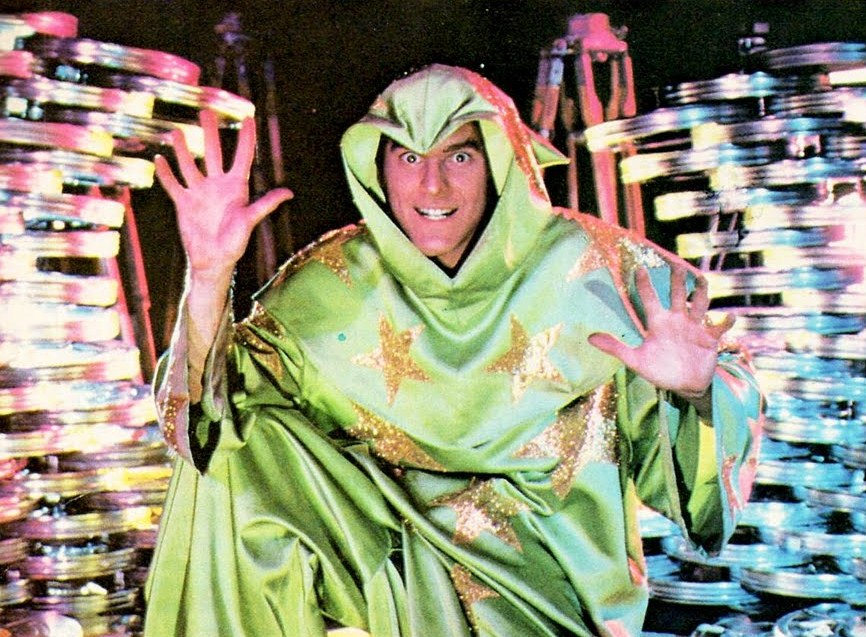
Abstract: "Time" thinks about the Humanities—and the humanization of those perceived or identifying as monsters under capitalistic hegemony as invariably decaying towards fascism—less as pure fiction and more as something to cultivate using Gothic poetics in relation to space and time as relayed through fiction and reality during an ongoing relationship: dialectical and historical materialism (e.g., Mike Jittlov [below] critiquing the Hollywood system using special effects to tell a larger Marxist narrative: The Wizard of Speed and Time, 1988).
About my book: My name is Persephone van der Waard and I am currently writing and illustrating a non-profit book series on sex positivity and the Gothic. Made in collaboration with other sex workers, the project is a four-volume set called Sex Positivity versus Sex Coercion, or Gothic Communism: Liberating Sex Workers under Capitalism through Iconoclastic Art. As of 2/14/2024, my thesis volume and manifesto volume are available online (the other volumes shall release over the remainder of 2024). To access my live volumes, simply go to my website's 1-page promo and pick up your own copies for free. While you're there, you can also learn about the yet-unreleased volumes, project history and logo design/promo posters!
Prep, part zero: "Time Is a Circle"; or, Expressing
Reality through Gothic Poetry in Relation to Historical Materialism
It
has been said that astronomy is a humbling and character-building experience.
There is perhaps no better demonstration of the folly of human conceits than
this distant image of our tiny world. To me, it underscores our responsibility
to deal more kindly with one another, and to preserve and cherish the pale blue
dot.
—Carl Sagan, Pale
Blue Dot: A Vision of the Human Future in Space (1994)
Cuties,
In my usual backwards style, "Time" was
written last but placed at the beginning of the prep section, and constitutes
its final stage before we dive into the monster modules. It reflects on my
dealing with fascism at home insofar as Imperialism makes home alien wherever
it manifests, and like a boomerang always comes home to roost within historical
materialism. We exist to challenge that as Dio put it: "Like a rainbow in
the dark!"
Godspeed,
Your Commie Mommy,
—Persephone

1 probe, 1990)
This prep considers time as something to express
through experience and expertise. Time is defined by space (distance and
closeness) and material conditions. It becomes a circle, meaning historical materialism
is a cycle insofar as people are shaped and maintained by socio-material
conditions and vice versa. This becomes something to express insofar as we are not
constant, but change over time in ways that shape how we see the world; i.e.,
as something to creatively respond to. This isn't just the physical
manifestations thereof, but also the order in which they are received and
explored; e.g., my holistic backwards approach, but also concentrism—of citing
things within things. "You can't do that!" a writer from my hometown once
told me, regarding a flashback I wrote inside a flashback (this person perhaps being unfamiliar with framed [concentric] narratives; e.g., Mary Shelley's Frankenstein). I beg to differ. We
can do whatever is required to break Capitalist Realism provided the
proletarian (sex-positive) function is constant.
Monsters, then, become something to express the human
condition with insofar as all of these things are in flux. I wanted to express
all of this through my personal experiences having built gradually upon my entire
body of work—my initial radicalization and further pushing towards the Left by
virtue of myself: a) as a closeted trans woman who fell in love with a
non-binary person, a BDSM predator and narcissist, and a borderline
Marxist-Leninist; and b) a steady progression towards my current position as an
an-Com ludo-Gothicist by virtue of my work being shaped further by falling in
love again, this time with a Indigenous GNC an-Com. Our views are shaped by
those we meet and fall in love with in sequence and upon reflection, who we see
as human by virtue of common ground and interests amid differences—a pedagogy
of the oppressed relaid in Gothic poetics as recursive, concentric,
anisotropic, and ergodic (endlessly tiered and self-contained, determined by
flow and non-trivial effort); it's about tearing down harmful boundaries and
installing healthy ones through different points of view like teaching, medicine and the medieval, but also selective absorption, a
confusion of the senses
and magical assembly
to add to our Song of Infinity
(all specialized poetic devices the medieval prep section will explore further).
In our hands, ludo-Gothic BDSM is a potent means of establishing and
negotiating boundaries—to perform and play with power (and trauma) where it
exists, in the shadow zone.
Friends are made through communicating boundaries and
being open with those we connect with while living in situations that require
us to use code to portray our human condition but also oppression and
rebellion. In short, we identify as monsters who love and see each other as
human in spite of those who, one way or another, side with the colonizer group;
e.g., overt statements like "Stay in your lane!" or shows of
solidarity with the oppressor class when the oppressed class is speaking out
against systemic issues.
This is often difficult to express and yields ease of
access through abstraction—metaphors. If someone says "black lives
matter" and someone says "white lives matter" in response, you
have an argument that can be reconfigured into a poetic form; e.g., cats; i.e.,
"black cats matter" vs "white cats matter" when the
underlying dialectical-material reality is black is functionally alien/oppressed
(them) within capital and white is functionally human/privileged (us) by
virtue of being the colonizer position during the dialectic of the alien as
something to invoke through the Gothic mode. Issues of class intersect with
culture, which require us seeing these things in ways that simplify it without
reducing it to one or the other but both engaging back and forth. It becomes
something of a dance, whose normal perception of "cat" desperately
needs to be confused (echoing Monty Python's absurdist 1969 skit, "Confuse-A-Cat,"
as able to take itself seriously enough, in the proper hands, to reverse the usual
flow of power as directed away from the state for once).
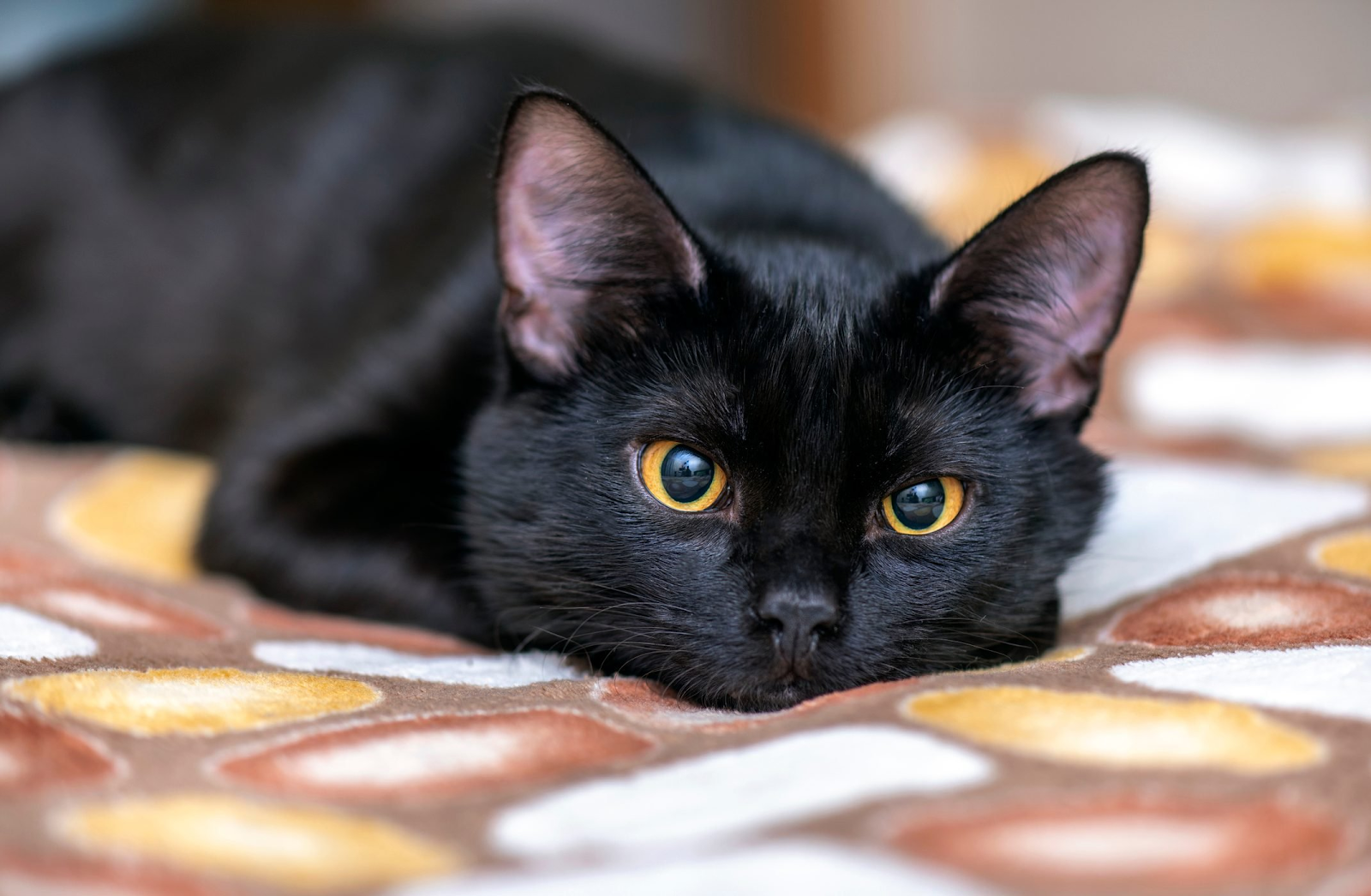
In terms of cats or lives or anything else, these all
constitute arguments through different devices that try to raise awareness
about not just the raw mechanics of oppression, but cognitive dissonance as a
matter of experience. They reduce to oppressed vs oppressor
regardless if you use the underlying signified or its myriad signifiers, of
which cats are but one example. Us versus them. Beware those who fight against
liberation by telling you to stay in your lane directly or ipso facto,
by virtue of action speaking for them as dogmatic. Negotiation, then, is as
much reminding people where power lies and how to use it mid-argument.
So let's begin…
This section pertains to a fictional person in crisis, dubbed Mercutio;
to compensate, I have it written in the first person to supply a narrative affect,
and injected elements of myself into the experience. It's essentially a thought
experiment: how far would you go to protect the ones you love from
fascism?
—Perse
Call me Mercutio. My experiences and expertise mirror
Persephone's; through theirs, I speak fictitiously about a crisis that—while
imagined by Persephone through me in this exact case—remains entirely real insofar
as it could very well come to pass (and in some places already has, is, and
will again). Like all imaginings, it springs from bits of truth and lies; i.e.,
speaking to the horror of the Gothic when it comes alive through us:
ceasing to be a "pure fiction" but a living nightmare that applies to
us as victims, including those we love insofar as historical materialism
affects all parties involved—"a nightmare that weighs on the brains of the
living."
History repeats itself, and I suddenly have to face
the reality that my best friend is an enemy of the state I can offer to hide in
the lion's den but must talk seriously to my aunt—let's call her
"Sabine"—about hiding them or I will be sending my best friend to
their death. It feels real in ways that I become a part of as queer myself. We
realize we are strangers in a strange land not welcome to us. And I realize
that we're the Jews of this given pattern; i.e., enemies of the state. We
suddenly become aware of walls having eyes and ears. The home becomes alien,
hostile. Discussing it at all becomes a paradox: a risk and a lifesaver thus
requiring encryption (code) that can "pass." There's only so much
that we can hide.
But also, we must be open before fascism happens to
prevent the worst from coming to pass. But if it does, we must go into hiding
and exist as hunted animals are that, as human, hunt each other in ways other
animals do not. We lose the desire to relax and have sex, thus let our guard
down; we become cagey and flighty, ready to bolt at all times. Our ability to
want sex vanishes and we seek sanctuary and safe space (the problem for Jews
[and other enemies of the state] not being money or the ability to eat, but a
question of asylum as being denied to them; i.e., forcing them to survive out
in the open).
The problem with this is everything becomes a threat.
I ask Sabine for help knowing they're my aunt, but trauma breaks us into soft
or hard divisions of ourselves depending on the severity. I'm not plural, but I
still fawn when faced with potential threats; i.e., things that, through
psychosexual responses, become confused between safety and danger. In short, I
lose the ability to distinguish reflexively between the two at a glance. So
while men primarily abused me in my youth (my formative years), in my adult
years I was abused by women I approached who made me feel safe to be myself
around. This didn't ruin the experience of having relationships, but did color
future experiences with hauntings of said abuse in ways that add to this fight-or-flight
reflex. Specifically, I fawn (as Persephone and their partner Bay both do), and
going to Sabine—a woman, but also the strongest person in the room—I
consciously know she is my aunt and a woman, therefore safe based on my
childhood experiences (mostly—she also invited my parental abuse, but I
digress); I also see her as "power," therefore a threat—i.e., female
power, so I reflexively default to fawning as I would before my own female abusers
when speaking to Sabine about anything because it is a conditioned survival
mechanism I can never turn off. Instead, I have to actively fight it; i.e.,
when I go to my aunt to confirm that one day I may have to call on them to help
give my best friend and their husband asylum and I don't want to be sending
them to their doom.
And talking to my aunt's habit to see history as an
endless cycle that cannot change, which applies to smaller issues and bigger
ones that, while they don't directly affect her, do affect me as an
enemy of the state whose friends are also enemies of the state. I see possible
futures intimated through fiction as based on reality being something that
comes to pass on both registers back and forth. I want Sabine to realize that
we're not just hiding to survive but also to try and change things, to fight
back (e.g., Sense8, which both Persephone and I love, and all our
friends do). Sabine reflexively asks for help with money (i.e., can the people
I shelter "pay their way") and we discuss the logistics of
concealment—that they would have to not go outside, except Sabine is kind of
backward about it: leading off with more of a fawning/non-confrontational
approach as I would, except I'm trying to be direct—and I tell them,
"[my friend] works remotely and makes more money than you do. Even if they
didn't, they're Commies and know how to cook cheap to survive. And I'm not
telling my best friend we'll give them asylum but not their husband." I
hate having to even face and discuss these possible futures, but they are far
more likely than the suggestions of fantasy that fiction often supplies through
escapist Capitalism; i.e., as a ghost of the counterfeit for the middle class
to abject.
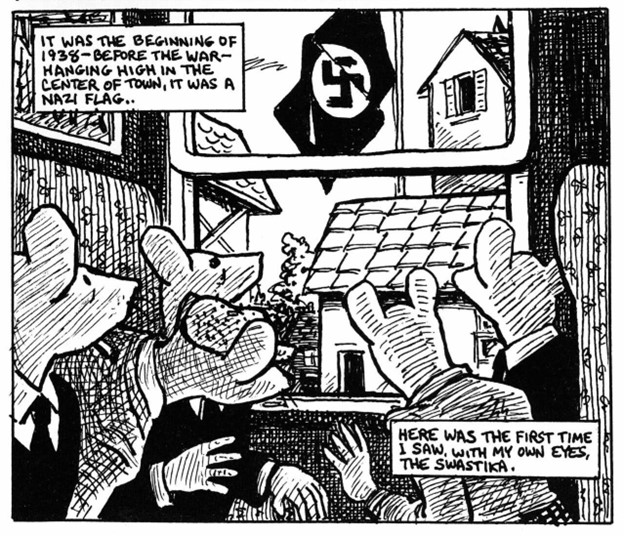 (artist: Art Spiegelman)
But as a Gothicist, the patterns have suddenly become disturbingly
clear in between fiction and history as, for me, coming to pass in reality out
of fiction I have spent all my life studying: I'm the prey and have been born
into the world that will eat me. The castle walls host fascist regalia and the
state-in-decay is baying for my blood and that of my friends; and in the lion's
den, I want to escape, but also use my unique position (my sheltered place
inside the Imperial Core) to help my friends—all while not wanting to harm Sabine
but also knowing my aunt will be fine because they will simply play the
chameleon and cozy up to powerful men as someone to seduce and rely on as they
have all their life; they are au fait in that respect. This can happen
and they can still help me and my friends; they said as much and I have to
trust them, insofar as they ultimately challenged the abusive men in my life.
But still, all of these feelings and histories are at work within me from
moment to living moment.
It's traumatic to face and difficult to wrap my head
around. Hope for the best, plan for the worst—the idea being to help
"black cats abroad" by setting a good precedent through global broadcast:
that it isn't ok to hurt them anywhere. My aunt responds with, "Do they
have money? They'll be expected to sign a lease, the Palestinians are doomed,
the world is going to end," etc. But I don't want to be told the world is
going to end; I want to survive and fight back, but also make a better world
for the future starting with how we treat each other now. Meanwhile, Sabine
just wants security and normality and to spend time with her bigoted friend, Uncle
Fred's wife Joan, and to play and laugh and enjoy that which is owed. But I
want to know that Sabine, when faced with issues that affect me, won't just
default to "they can't change/history is a cycle that cannot change, so
just accept that and put up with it." I hear things from my aunt, who
feels like Joan is all that they have, thus makes allowances for them that
extend to their stepson, to us being Communists and Sabine not wanting to hear
about our problems despite that being the extent to which it will affect them.
That being the first thing that they say troubles me. I am not my aunt's ex-girlfriend,
Lobelia, because I talk about politics differently than they would: as a means of
survival while also helping my friends survive; i.e., as enemies of the state
by virtue of how we identify—literally who we are. Through the power of my
work, I help friends come out, feel more confident, and break various curses by
freeing sleeping beauties from harmful bondage.
The mind, as a consequence of material reality—whether
bent, scrambled or shivered—becomes something to accurately describe in Gothic
poetics: the torment of divisions, phasing. Parts of, sides to, a switching and
shifting of gears. For example, families doesn't understand that plural people—e.g.,
Persephone's friend Mavis—aren't a person with multiple sides, but a system
with multiple persons whose feelings and tastes are separate, but aware of each
other. It describes reality through past models that remain not only accurate,
but helpful towards healing by changing what is thought possible under the
status quo. Someone like Mavis, then, would be seen as impossible by Cartesian
thinkers, but exists anyways in spite of that as something that we can
encourage others-in-hiding to emerge: as a new order of existence that helps
Communism develop through the dialectic of the alien; i.e., as something to
play with in ways that lead to praxial synthesis, to hugs.
No one wants to have these talks. But I want to be
ready and prepared for what's going to happen by virtue of history repeating
itself. Fascism isn't just going to come back in my lifetime, it's already
here. I feel afraid, seeing Joan as an enemy by virtue of past behaviors
(gambling) and being two-faced, but also misgendering me on religious
principle. They're the status quo, and come to visit to spend time with Sabine.
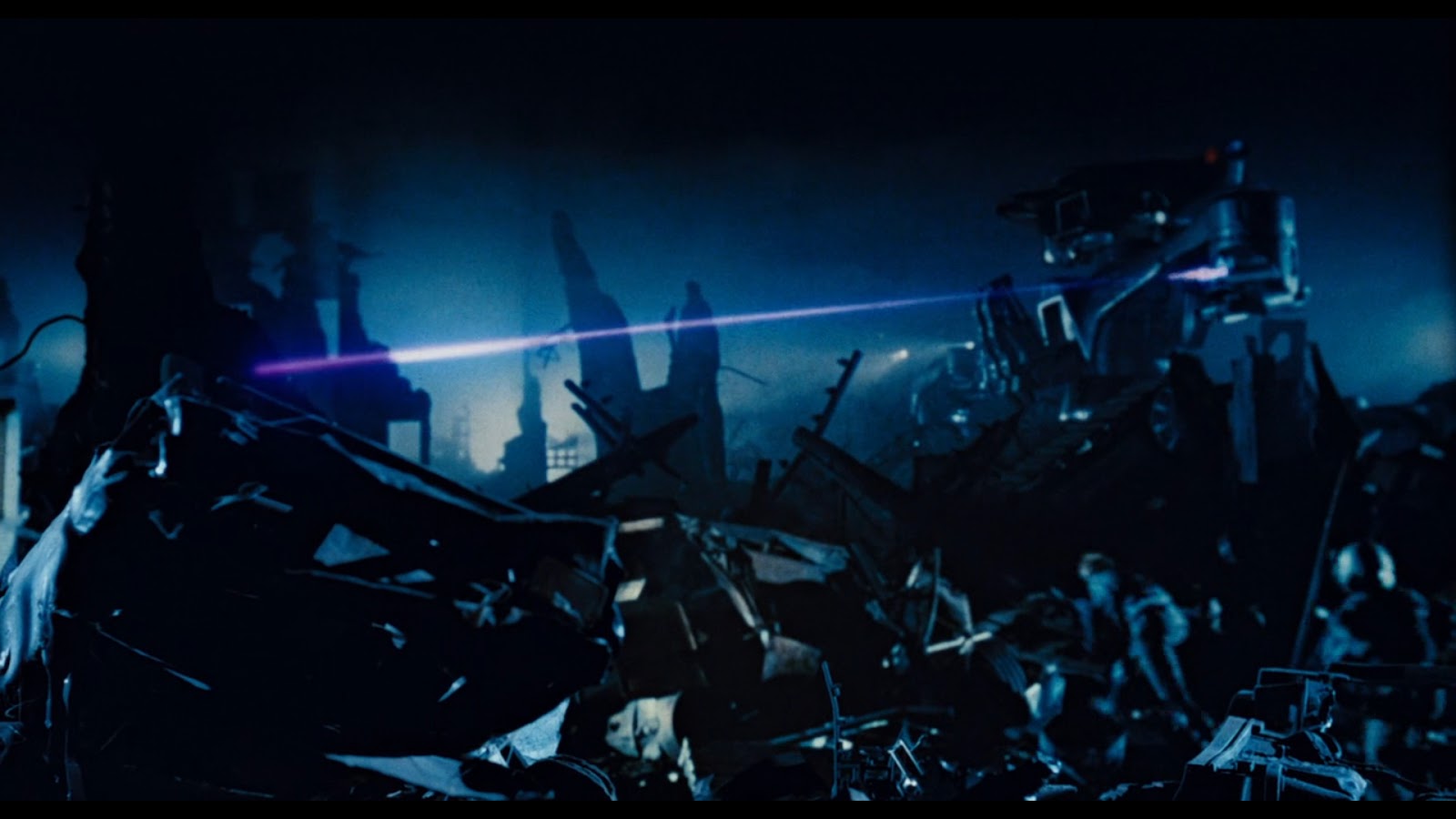
Joan brings their ferret with them. I hear noises and voices above and think of
hunters, of HKs, of automated patrol machines. I feel trapped in a constant
state of fear, of panic, of fight or flight, of terror. These feelings are ultimately
less severe than they could be by virtue of fascism not yet having ascended to
formal power. But terror lives and spreads in the imagination and my
imagination is both powerful, educated, and scarred by trauma. I feel like a
cautious, at times scared, animal because I belong to a group of people that is
starting to be more aggressively hunted as such. They will never stop, but will
chase us to the ends of the Earth.
The feelings of terror aren't totally disempowering
but help me survive while preserving who I want to b while identifying with and
helping those I love as collectively identifying with nature as hunted. I don't
want to go upstairs and suddenly remember past friends being too scared to go
into the kitchen; i.e., too afraid of environments where they felt unsafe due
to the people inside. How the tables turn. This isn't hysteria from the oracle,
nor awfulizing. It's simply the truth.
BDSM or otherwise, people work through preference and experimentation to
issue public statements that are, to some degree, coded. Like Mercutio's
feelings, intermingled with mine, there is often a half-real, invented quality
as well, protecting all parties involved. —Perse
This concludes "Time"; onto "Teaching"! After that, check out my website for the uncensored samples!

